REVIEW 4 major objections 4 minor 1 cited by
Protein language models complete repeats by combining induction heads that copy the aligned residue from the other repeat copy with neurons encoding amino-acid similarity; the approximate-repeat circuit contains and generalizes the exact-repeat circuit.
Reviewed by Pith at T0; open to challenge. T0 means a machine referee read the full paper against a public rubric. the ladder, T0–T4 →
T0 review · deepseek-v4-flash
2026-08-02 20:26 UTC pith:MCECDGOT
load-bearing objection First mechanistic map of repeat completion in PLMs, with a solid induction-head core and an under-supported BLOSUM62 layer. the 4 major comments →
Induction Meets Biology: Mechanisms of Repeat Detection in Protein Language Models
The pith
A machine-rendered reading of the paper's core claim, the machinery that carries it, and where it could break.
The authors reverse-engineered how two protein models (ESM-3 and ESM-C) do this. They used attribution patching: corrupt the second copy of the repeat, see which model components' behavior changes, and thereby find the small set of attention heads and MLP neurons that drive the prediction. Three kinds of attention heads appear: heads that attend to fixed positional offsets, 'induction' heads that attend from the masked position to the aligned position in the other copy (the same pattern-matching-and-copying mechanism found in text language models), and heads biased toward particular amino acids. Among MLP neurons, the important ones fall into categories: neurons selective for a single amino acid, neurons selective for groups of biochemically similar amino acids (matching the BLOSUM62 substitution matrix used by classical alignment tools), and neurons that activate throughout repeated regions.
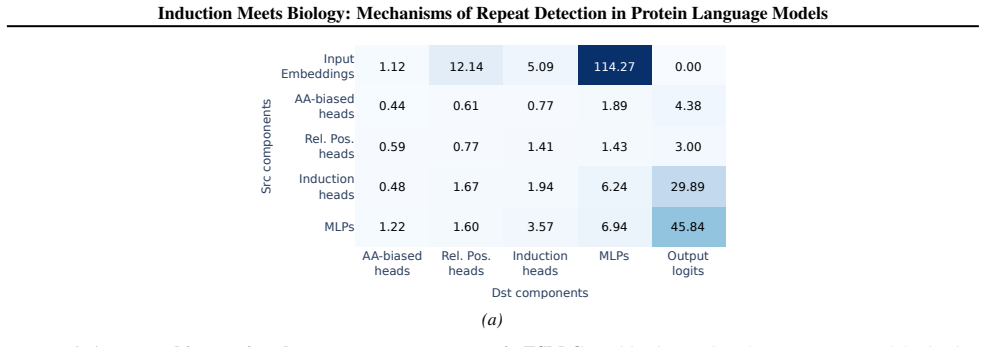
The proposed mechanism is three-stage. Early layers use position heads and biochemical neurons to build representations; middle layers use induction heads to copy the aligned residue, while repeat-region neurons play an inhibitory role; final layers shape the output distribution. The approximate-repeat circuit contains the exact-repeat circuit and works for both, so the authors call it the broader mechanism. ESM-3 additional
Core claim
The central claim: PLMs detect approximate repeats via a two-stage circuit — "PLMs first build feature representations using both general positional attention heads and biologically specialized components, such as neurons that encode amino-acid similarity. Then, induction heads attend to aligned tokens across repeated segments, promoting the correct answer" (Abstract). The approximate-repeat circuit functionally subsumes the exact-repeat circuit (Sec. 3.2, Fig. 3), and this integration of LLM-style induction with BLOSUM62-aligned biochemical neurons is what the paper rises or falls on. If correct, repeat completion in ESM-3/ESM-C is a modular computation over identifiable, interpretable components.
Load-bearing premise
Load-bearing premise: the approximate-repeat task, together with the success filter, isolates 'repeat detection' as a single mechanism. The task masks only positions that are identical to their aligned counterpart and adjacent to a substitution site (Sec. 2, Table 3); indel-containing repeats are excluded because accuracy collapses to 42.9–48.1% (App. C.1); and every circuit and neuron analysis is restricted to sequences where the model already scores 100% (synthetic/identical) or >80% (approximate) (App. G.1). If the model succeeds on this slice via positional copy without genuinely assessing biochemical similarity — or uses different machinery on substituted sites, indels, or hard examples — then the two-stage mechanism is a mechanism for easy masked-copy completion, not for "how PLMs detect both exact and approximate repeats" as claimed.
Editorial analysis
A structured set of objections, weighed in public.
Referee Report
Summary. This paper reverse-engineers repeat detection in two protein language models, ESM-3 and ESM-C. Using attribution patching with integrated gradients (AP-IG), the authors discover sparse circuits for synthetic, natural-identical, and natural-approximate repeat tasks, reporting that 14–17% of components suffice for 85% faithfulness in ESM-3 and about 25% in ESM-C. Structural and functional comparisons lead them to claim that the approximate-repeat circuit subsumes the exact-repeat circuits. Individual component analysis clusters attention heads into relative-position, induction, and amino-acid-biased heads, and identifies MLP neurons selective for amino-acid identity, BLOSUM62 substitution groups, biochemical classes, and repeat regions. Interaction and logit-lens analyses suggest a three-stage mechanism: early layers build aligned representations with position heads and biochemical-similarity neurons, middle-layer induction heads copy the aligned token, and late MLPs refine the prediction. The paper concludes that PLMs combine generic LM-style induction mechanisms with protein-specific biological knowledge.
Significance. If the central claim holds, this is a strong mechanistic interpretability contribution: it extends circuit analysis from text LMs to protein LMs, documents the same core mechanism in two independently trained models, and identifies interpretable individual neurons without sparse autoencoders. The paper also ships code/data and reports faithfulness in a quantitative framework, which is a methodological strength. The convergence with known induction-head findings in LLMs is a useful external anchor. The main significance risk is that the task definition and counterfactual choice may not isolate 'approximate repeat detection requiring biochemical similarity'; several concrete controls are needed before the claimed biological specialization is established.
major comments (4)
- [§2, Table 3; App. C.1, G.1] The approximate-repeat task masks only positions that are identical to their aligned counterpart and adjacent to a substitution; indel repeats are excluded (App. C.1). Since substitution-only repeats are gap-free, the aligned source token is at a constant sequence offset from the masked token. A fixed-offset, exact-copy mechanism therefore suffices for every eligible position, and biochemical similarity is not needed to predict the masked residue. The Section 5 claim that Stage (I) uses 'biochemical similarity neurons' to align tokens across repeats is not uniquely supported, especially because circuit analysis is restricted to sequences with >80% accuracy (App. G.1), which may select for offset-copy successes. Please add a control that masks substituted positions (or otherwise requires similarity-based alignment), and/or a fixed-offset exact-copy baseline.
- [§3.1 vs. §4.2; App. F] AP-IG counterfactuals are constructed by replacing every residue in the non-masked repeat with its BLOSUM62-best substitution (§3.1). The importance ranking therefore selects components sensitive to BLOSUM62-defined residue changes. The same selected components are then labeled using concepts derived from BLOSUM62 cliques (§4.2, App. I.2). This pipeline risks a selection circularity: any residue-sensitive neuron is likely to be important under a residue-substitution perturbation, and the BLOSUM62 concept vocabulary may match some of them by chance. The biological-specialization conclusion would be much stronger if the neuron-concept analysis were repeated on circuits discovered under a non-BLOSUM counterfactual (e.g., 100% Mask or Permutation in App. F) and shown to still enrich for BLOSUM62 groups.
- [§3.2, Fig. 3; §3.1, Fig. 2] The claim that the approximate-repeat circuit 'functionally subsumes' the exact-repeat circuits is confounded by circuit size: approximate circuits use ~17% of components vs ~14% for identical/synthetic circuits (Fig. 2). A larger circuit trivially has higher recall, and after normalization can report >1.0 cross-task faithfulness (Fig. 3c). No random or size-matched circuit baseline is provided. Please report cross-task faithfulness for size-matched random circuits, or use a metric that controls for circuit cardinality, before concluding functional subsumption.
- [§4.2, Fig. 9; §5] The causal role of the 'biochemical similarity' neuron group is not established. Figure 9 reports attribution importances and Fig. 7 reports aggregated EAP-IG interactions; both are correlational summaries. The paper never ablates the BLOSUM62/IMGT/secondary-structure neuron group (or AA-biased heads) and compares approximate vs exact repeat faithfulness. Without such a group ablation, the central claim that PLMs use biological specialization for approximate repeats is not directly tested. Please add group-level ablation experiments, e.g., counterfactually ablating the top BLOSUM62-matched neurons while keeping other circuit components intact, on both identical and approximate tasks.
minor comments (4)
- [App. G.3] There is a duplicated sentence beginning 'For each circuit, we fix...' in the neuron-level analysis section; please remove the repetition.
- [Table 7] In the Induction Score definition, the Copying term uses j* but the arg-max definition appears only in the Pattern Matching term; clarify the notation and the order of definitions.
- [App. F.2] The text says 'we proceed with multiple counterfactuals for circuit discovery and compare the resulting circuits,' but the main pipeline uses only 100% BLOSUM; please reconcile this sentence with the actual primary choice, or point readers to F.3 for the comparison.
- [Fig. 6] Panel (B) is dense; the caption could state more explicitly that 'Biological (Other)' excludes amino-acid identity, BLOSUM62, and repeat concepts, since the color legend alone is ambiguous.
Circularity Check
BLOSUM62 is used both to build circuit-discovery counterfactuals and to label the resulting neurons, partially embedding the biological-similarity conclusion; the core induction-head mechanism remains independently measured.
specific steps
-
other
[Section 3.1 (Circuit Discovery and Evaluation) and Section 4.2 (Quantitative analysis) / Appendix I.2]
"we construct each counterfactual ŝi by replacing every amino acid in the non-masked repeat occurrence with its highest-matching BLOSUM62 substitution (Henikoff & Henikoff, 1992) ... as well as groupings derived from the BLOSUM62 substitution matrix by identifying amino-acid groups that are more likely to substitute for one another."
BLOSUM62 is used twice in the same pipeline: first as the intervention that defines which neurons are 'important' for the approximate-repeat circuit (AP-IG counterfactuals), and second as one of the concept families used to label those neurons (BLOSUM62 cliques). A neuron that responds to the BLOSUM62 substitution pattern will be selected as important and then matched to a BLOSUM62-clique concept, so the finding that 'many important neurons ... are associated with BLOSUM62 groups' is partly guaranteed by the shared input. The paper's conclusion that PLM similarity 'aligns with' BLOSUM62 is therefore not fully independent of the experimental construction. Although Appendix F.3 shows that other counterfactuals recover overlapping circuits, the primary neuron analysis is run on the BLOSUM-sel
full rationale
The central claim—that PLMs detect approximate repeats through a two-stage circuit of relative-position/biological feature-building followed by induction-head copying—is not circular as a whole. The induction heads and relative-position heads are measured directly from attention maps and logit-lens contributions, and the induction-head finding converges with external LLM literature (Olsson et al., 2022). Circuit faithfulness is evaluated on separate subsets, and the approximate-repeat circuit's functional generalization to exact and synthetic repeats is an empirical cross-task result, not a fitted prediction. The paper's self-citations (Hanna et al., 2024; Nikankin et al., 2025a) provide methodology and faithfulness thresholds but are not the load-bearing evidence for the biological conclusion. The main circularity concern is local: BLOSUM62 is used both to construct the counterfactuals that rank neurons as important and to define the BLOSUM62-based concepts used to label those same neurons. This double use partially explains the finding of BLOSUM62-associated neurons and weakens the 'internal similarity aligns with BLOSUM62' claim. However, the induction-head mechanism and the general circuit structure do not reduce to this construction, and the paper itself acknowledges the inductive bias of manually defined concepts in the Limitations. I therefore assign 4 rather than a higher score: one substantive partial circularity, with the central mechanism retaining independent empirical content.
Axiom & Free-Parameter Ledger
free parameters (5)
- Circuit sufficiency threshold =
85% faithfulness
- Attention-head cluster number k =
k=3 for both models
- Neuron retention percentage =
3% (ESM-3), 7% (ESM-C) per layer
- Concept-match AUROC thresholds =
0.75 (most concepts); 0.99 (special/aligned-token concepts)
- Mask eligibility rule =
positions identical to aligned counterpart, adjacent to a substitution; substitution rate ≤ 50%
axioms (6)
- domain assumption AP-IG attribution scores approximate the true causal importance of each component
- domain assumption Faithfulness (Eq. 1) is a valid measure of mechanism sufficiency
- domain assumption RADAR on SEG-masked sequences correctly identifies the ground-truth repeats
- standard math BLOSUM62 is the correct similarity model both for counterfactuals and for neuron concepts
- standard math IMGT physicochemical and Chou-Fasman secondary-structure groupings are meaningful biological categories
- domain assumption The TransformerLens fork computes ESM-3/ESM-C forward passes, patching, and ablations correctly
read the original abstract
Protein sequences are abundant in repeating segments, both as exact copies and as approximate segments with mutations. These repeats are important for protein structure and function, motivating decades of algorithmic work on repeat identification. Recent work has shown that protein language models (PLMs) identify repeats, by examining their behavior in masked-token prediction. To elucidate their internal mechanisms, we investigate how PLMs detect both exact and approximate repeats. We find that the mechanism for approximate repeats functionally subsumes that of exact repeats. We then characterize this mechanism, revealing two main stages: PLMs first build feature representations using both general positional attention heads and biologically specialized components, such as neurons that encode amino-acid similarity. Then, induction heads attend to aligned tokens across repeated segments, promoting the correct answer. Our results reveal how PLMs solve this biological task by combining language-based pattern matching with specialized biological knowledge, thereby establishing a basis for studying more complex evolutionary processes in PLMs.
Figures




Forward citations
Cited by 1 Pith paper
-
Design-CP: Context Parallelism for Design of Protein Nanoparticles
Context-parallel inference for RFdiffusion 3 enables end-to-end all-atom design of large symmetric protein nanoparticles on multi-GPU hardware without retraining.
Reference graph
Works this paper leans on
-
[3]
URL https://doi.org/10.1016/j.tig. 2010.06.003. Reusch, A. and Belinkov, Y . Reverse-engineering the retrieval process in genir models. InProceedings of the 48th International ACM SIGIR Conference on Re- search and Development in Information Retrieval, SIGIR ’25, pp. 668–677, New York, NY , USA, 2025. Associa- tion for Computing Machinery. ISBN 9798400715...
arXiv 2010
-
[5]
ijcnlp-long.153/
URL https://aclanthology.org/2025. ijcnlp-long.153/. Elhage, N., Nanda, N., Olsson, C., Henighan, T., Joseph, N., Mann, B., Askell, A., Bai, Y ., Chen, A., Conerly, T., DasSarma, N., Drain, D., Ganguli, D., Hatfield-Dodds, Z., Hernandez, D., Jones, A., Kernion, J., Lovitt, L., Ndousse, K., Amodei, D., Brown, T., Clark, J., Kaplan, J., McCandlish, S., and ...
2025
-
[7]
Association for Computational Linguistics. ISBN 979-8-89176-190-2. doi: 10.18653/v1/2025.naacl-short
-
[13]
doi: 10.1093/bioinformatics/ btae690
ISSN 1367-4811. doi: 10.1093/bioinformatics/ btae690. URL https://doi.org/10.1093/ bioinformatics/btae690. Mueller, A., Geiger, A., Wiegreffe, S., Arad, D., Arcuschin, I., Belfki, A., Chan, Y . S., Fiotto-Kaufman, J. F., Haklay, T., Hanna, M., et al. MIB: A mechanistic interpretability benchmark. InForty-second International Conference on Machine Learning...
Pith/arXiv arXiv 2025
-
[18]
URL https://openreview.net/forum? id=YWtLZvLmud7. Wang, K. R., Variengien, A., Conmy, A., Shlegeris, B., and Steinhardt, J. Interpretability in the wild: a circuit for indi- rect object identification in GPT-2 small. InThe Eleventh International Conference on Learning Representations,
-
[41]
naacl-short.41/
URL https://aclanthology.org/2025. naacl-short.41/. Hirsh, L., Piovesan, D., Paladin, L., and Tosatto, S. C. E. Identification of repetitive units in protein structures with ReUPred.Amino Acids, 48(6):1391– 1400, Jun 2016. ISSN 1438-2199. doi: 10.1007/ s00726-016-2187-2. URL https://doi.org/10. 1007/s00726-016-2187-2. Hrabe, T. and Godzik, A. ConSole: usi...
2025
-
[446]
URL https://aclanthology.org/2021. emnlp-main.446/. Gujral, O., Bafna, M., Alm, E., and Berger, B. Sparse autoencoders uncover biologically interpretable features in protein language model representations. Proceedings of the National Academy of Sciences, 122(34):e2506316122, 2025. doi: 10.1073/pnas. 2506316122. URL https://www.pnas.org/doi/ abs/10.1073/pn...
doi:10.1073/pnas 2021
-
[660]
URL https://aclanthology.org/2023. acl-long.660/. Barbero, F., Arroyo, A., Gu, X., Perivolaropoulos, C., Veliˇckovi´c, P., Pascanu, R., and Bronstein, M. M. Why do LLMs attend to the first token? InSecond Con- ference on Language Modeling, 2025. URL https: //openreview.net/forum?id=tu4dFUsW5z. Biegert, A. and S ¨oding, J. De novo identifica- tion of highl...
arXiv 2023
-
[1987]
for k∈[2,10] , separately for ESM-3 and ESM-C. As shown in Figure 23, the inertia curves for both models exhibit an elbow at k= 3 , indicating that increasing the number of clusters beyond three yields only minor improvements in within-cluster compactness. The Silhouette analysis yields different behaviors across models. For ESM-3 (Figure 23, top row), th...
1977
-
[2005]
ISBN 9780716743392. Newman, A. M. and Cooper, J. B. XSTREAM: A prac- tical algorithm for identification and architecture mod- eling of tandem repeats in protein sequences.BMC Bioinformatics, 8(1):382, Oct 2007. ISSN 1471-2105. doi: 10.1186/1471-2105-8-382. URL https://doi. org/10.1186/1471-2105-8-382. Nikankin, Y ., Arad, D., Gandelsman, Y ., and Belinkov...
-
[2010]
ISSN 0168-9525. doi: 10.1016/j.tig.2010.06
-
[2020]
com/posts/AcKRB8wDpdaN6v6ru/ interpreting-gpt-the-logit-lens
URL https://www.lesswrong. com/posts/AcKRB8wDpdaN6v6ru/ interpreting-gpt-the-logit-lens. Olsson, C., Elhage, N., Nanda, N., Joseph, N., DasSarma, N., Henighan, T., Mann, B., Askell, A., Bai, Y ., Chen, A., Conerly, T., Drain, D., Ganguli, D., Hatfield-Dodds, Z., Hernandez, D., Johnston, S., Jones, A., Kernion, J., Lovitt, L., Ndousse, K., Amodei, D., Brow...
Pith/arXiv arXiv 2022
-
[2021]
URL https://transformer-circuits. pub/2021/framework/index.html. ESM Team. ESM Cambrian: Revealing the mys- teries of proteins with unsupervised learning, 2024. URL https://evolutionaryscale.ai/blog/ esm-cambrian. Feucht, S., Todd, E., Wallace, B., and Bau, D. The dual- route model of induction. InSecond Conference on Lan- guage Modeling, 2025. URL https:...
Pith/arXiv arXiv 2021
-
[2022]
URL https://api.semanticscholar. org/CorpusID:254096064. Ismail, A. A., Oikarinen, T., Wang, A., Adebayo, J., Stan- ton, S. D., Bravo, H. C., Cho, K., and Frey, N. C. Con- cept bottleneck language models for protein design. In The Thirteenth International Conference on Learning Representations, 2025. URL https://openreview. net/forum?id=Yt9CFhOOFe. Jorda,...
Pith/arXiv arXiv 2025
-
[2023]
URL https://openreview.net/forum? id=NpsVSN6o4ul. Wootton, J. C. Non-globular domains in protein sequences: Automated segmentation using com- plexity measures.Computers & Chemistry, 18 (3):269–285, 1994. ISSN 0097-8485. doi: https://doi.org/10.1016/0097-8485(94)85023-2. URL https://www.sciencedirect.com/ science/article/pii/0097848594850232. Zhang, J., ZH...
arXiv 1994
-
[2024]
Liu, X., Lei, H., Liu, Y ., Liu, Y ., and Hu, W
URL https://openreview.net/forum? id=R5unwb9KPc. Liu, X., Lei, H., Liu, Y ., Liu, Y ., and Hu, W. ProtSAE: Disentangling and interpreting protein language models via semantically-guided sparse autoencoders, 2026. URL https://arxiv.org/abs/2509.05309. Lloyd, S. Least squares quantization in PCM.IEEE Trans- actions on Information Theory, 28(2):129–137, 1982...
arXiv 2026
-
[2025]
URL https://openreview.net/forum? id=zdOGBRQEbz. Andrade, M. A., Perez-Iratxeta, C., and Ponting, C. P. Protein repeats: Structures, functions, and evolution. Journal of Structural Biology, 134(2):117–131, 2001. ISSN 1047-8477. doi: https://doi.org/10.1006/jsbi.2001
-
[2026]
Biological (Other)
URL https://openreview.net/forum? id=X0QxVexIJX. 13 Induction Meets Biology: Mechanisms of Repeat Detection in Protein Language Models A Protein repeats: Evolutionary background Sequence repeats play a significant role in protein evolution. As a result of unequal recombination, a DNA-copying error that occurs when two similar chromosomes align incorrectly...
2001
-
[2105]
URL https: //doi.org/10.1186/1471-2105-15-119
doi: 10.1186/1471-2105-15-119. URL https: //doi.org/10.1186/1471-2105-15-119. Hu, B., Xia, J.-X., Zheng, J., Tan, C., Huang, Y ., Xu, Y ., and Li, S. Z. Protein language models and structure prediction: Connection and progression.ArXiv, abs/2211.16742,
-
[3136]
Mozaffari, S., Arr ´ıas, P
URL https://www.sciencedirect.com/ science/article/pii/S0022283699931364. Mozaffari, S., Arr ´ıas, P. N., Clementel, D., Piovesan, D., Ferrari, C., Tosatto, S. C. E., and Monzon, A. M. STRPsearch: fast detection of structured tandem re- peat proteins.Bioinformatics, 40(12):btae690, 11
-
[4392]
URL https://www.sciencedirect.com/ science/article/pii/S1047847701943928. Arthur, D. and Vassilvitskii, S. k-means++: the advantages of careful seeding. InProceedings of the Eighteenth Annual ACM-SIAM Symposium on Discrete Algorithms, SODA ’07, pp. 1027–1035, USA, 2007. Society for Indus- trial and Applied Mathematics. ISBN 9780898716245. Banerjee, N., Ch...
arXiv 2007
discussion (0)
Sign in with ORCID, Apple, or X to comment. Anyone can read and Pith papers without signing in.