REVIEW 3 major objections 7 minor 64 references
This paper claims that a non-Abelian SU(2) quantum link model in 2+1 dimensions confines static quarks for all couplings, with a coupling-dependent Lüscher term and rough strings.
Reviewed by Pith at T0; open to challenge. T0 means a machine referee read the full paper against a public rubric. the ladder, T0–T4 →
T0 review · deepseek-v4-flash
2026-08-02 20:24 UTC pith:JUA3NZG6
load-bearing objection Solid MPS study of a SU(2) quantum link model with a genuine strong-coupling benchmark, but the load-bearing Hamiltonian mapping is asserted without proof and every numerical result inherits that uncertainty. the 3 major comments →
Scaling and Luescher Term in a non-Abelian (2+1)d SU(2) Quantum Link Model
The pith
A machine-rendered reading of the paper's core claim, the machinery that carries it, and where it could break.
Core claim
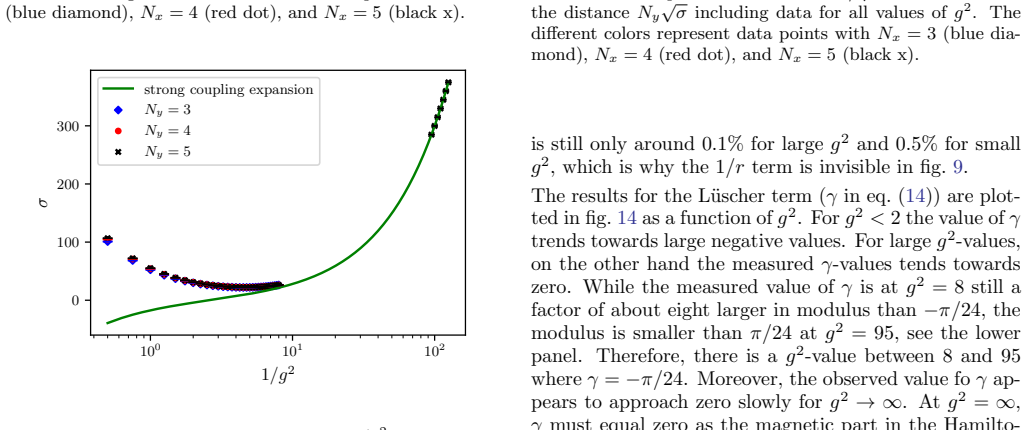
The central claim is that the static quark-antiquark potential in this SU(2) quantum link model is described by V(r) = σr + γ/r + μ with a positive string tension σ for all g² in [0.5, 125], and a Lüscher coefficient γ(g²) that is negative, tends to zero as g² → ∞, and becomes large and negative at small coupling — in qualitative agreement with the model's strong-coupling expansion, which predicts γ = -8π/(3g²) at leading nontrivial order. Although γ crosses the universal Lorentz-invariant value -π/24 somewhere between g² = 8 and 95, it does not settle there, because the lattice spacing derived from the string tension increases again for small g², indicating that no continuum limit exists. T
What carries the argument
The argument runs on the ring-exchange Hamiltonian: a 26-parameter effective Hamiltonian obtained from the {5} representation of the SO(5) embedding of SU(2) quantum link models, reduced to an even-site basis on the hexagonal lattice. The magnetic term of the Kogut-Susskind Hamiltonian is claimed to be recovered from this ring-exchange form at a specific set of parameters (W=0, certain T values), though the reconstruction is not shown. The strong-coupling expansion then maps the leading correction to an open XX spin chain at half filling, whose known ground-state energy yields the analytic estimates σ(g²) = 3g² - 64/(πg²) and γ(g²) = -8π/(3g²) used to interpret the DMRG data.
Load-bearing premise
The entire numerical study rests on the unproven assertion that the 26-parameter ring-exchange Hamiltonian exactly reproduces the magnetic Hamiltonian of the SU(2) quantum link model in the {5} representation; the reconstruction is stated in the text but 'omitted here for brevity'.
What would settle it
An explicit check of the mapping: compute the matrix elements of the original magnetic plaquette operator and the ring-exchange Hamiltonian on the same small set of gauge-invariant configurations (e.g., a single plaquette or a small cluster) in the {5} rishon basis. If they disagree, all results are for a different model. Alternatively, a measurement of γ at intermediate coupling with larger N_x that fails to show the predicted g² dependence or the logarithmic width growth would contradict the paper's central claims.
If this is right
- The model confines static charges for all couplings studied, so it provides a well-defined confining testbed for quantum link models.
- The Lüscher coefficient is coupling-dependent, so the effective string description of this lattice Hamiltonian is not universal; matching strong-coupling expansion supports the interpretation.
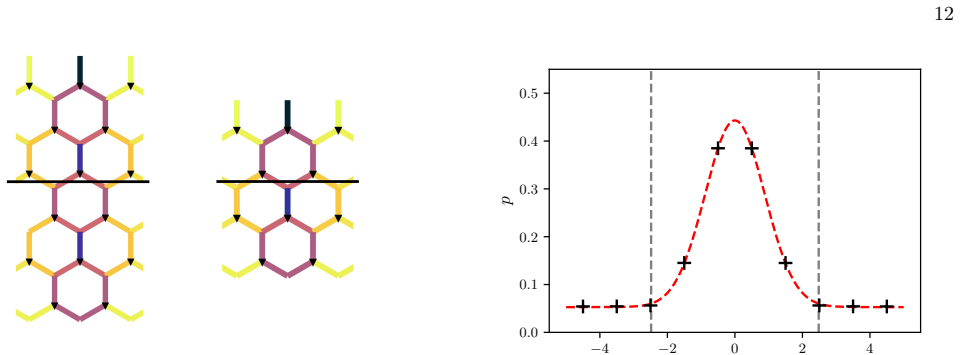
- The logarithmic growth of string width at all couplings indicates rough strings with no roughening transition in this lattice geometry.
- The string tension can be used to set a scale, but the lattice spacing does not vanish as g²→0; the QLM lacks a conventional continuum limit.
- The Hamiltonian formalism with tensor networks can extract subleading potential terms, though current volumes limit competitiveness with Monte Carlo.
Where Pith is reading between the lines
- If the 26-parameter ring-exchange Hamiltonian is not exactly equivalent to the original magnetic Hamiltonian, the physical conclusions apply only to the ring-exchange model; verifying this mapping by an explicit reconstruction on small lattices is a direct test.
- The absence of a roughening transition may be tied to the hexagonal geometry and the orientation of the string; other geometries (e.g., square lattices or different string paths) might still exhibit a roughening transition, as suggested by the authors' own outlook.
- The g²-dependent Lüscher coefficient, if confirmed, implies that effective string theory for strongly coupled lattice Hamiltonian models must retain non-universal corrections; this could guide analogous studies in other QLMs or truncated gauge theories.
- A concrete extension: compute γ(g²) at intermediate coupling with wider lattices (larger N_x) and finer coupling steps to determine whether the 'fish bone' hysteresis is algorithmic and whether γ approaches a universal curve in the infinite-volume limit.
Editorial analysis
A structured set of objections, weighed in public.
Referee Report
Summary. The paper studies the (2+1)-dimensional SU(2) quantum link model in the 5-dimensional representation of SO(5) on a hexagonal lattice using MPS/DMRG. It constructs a 26-parameter ring-exchange Hamiltonian claimed to be equivalent to the magnetic part of the SU(2) QLM, enforces Gauss's law via a penalty term, computes the static quark potential, and extracts the string tension sigma, the Lüscher coefficient gamma, and the transverse string width as functions of the bare coupling g^2. The central claims are: confinement (positive sigma) for all g^2 in [0.5,8] and [95,125]; approximate universality of the potential in units of sqrt(sigma); a g^2-dependent Lüscher coefficient in qualitative agreement with the paper's strong-coupling expansion, predicting sigma=3g^2-64/(pi g^2) and gamma=-8 pi/(3 g^2); and logarithmic string-width scaling for all g^2, interpreted as evidence for a rough string with no roughening transition.
Significance. If the Hamiltonian mapping and the numerical systematics hold up, this is a valuable first tensor-network study of a non-Abelian SU(2) QLM in the {5} representation. The paper provides parameter-free strong-coupling predictions for sigma and gamma, which are compared directly with the numerics, and the observation of a g^2-dependent Lüscher coefficient away from the Lorentz-covariant value -pi/24 is an interesting, potentially falsifiable result. The string-width analysis also extends the rough-string picture to a non-Abelian QLM. However, the significance is conditional: the central numerical results all inherit the unproven equivalence between the ring-exchange model and the QLM, and the Gauss-law penalty as implemented is an approximation rather than an exact projection.
major comments (3)
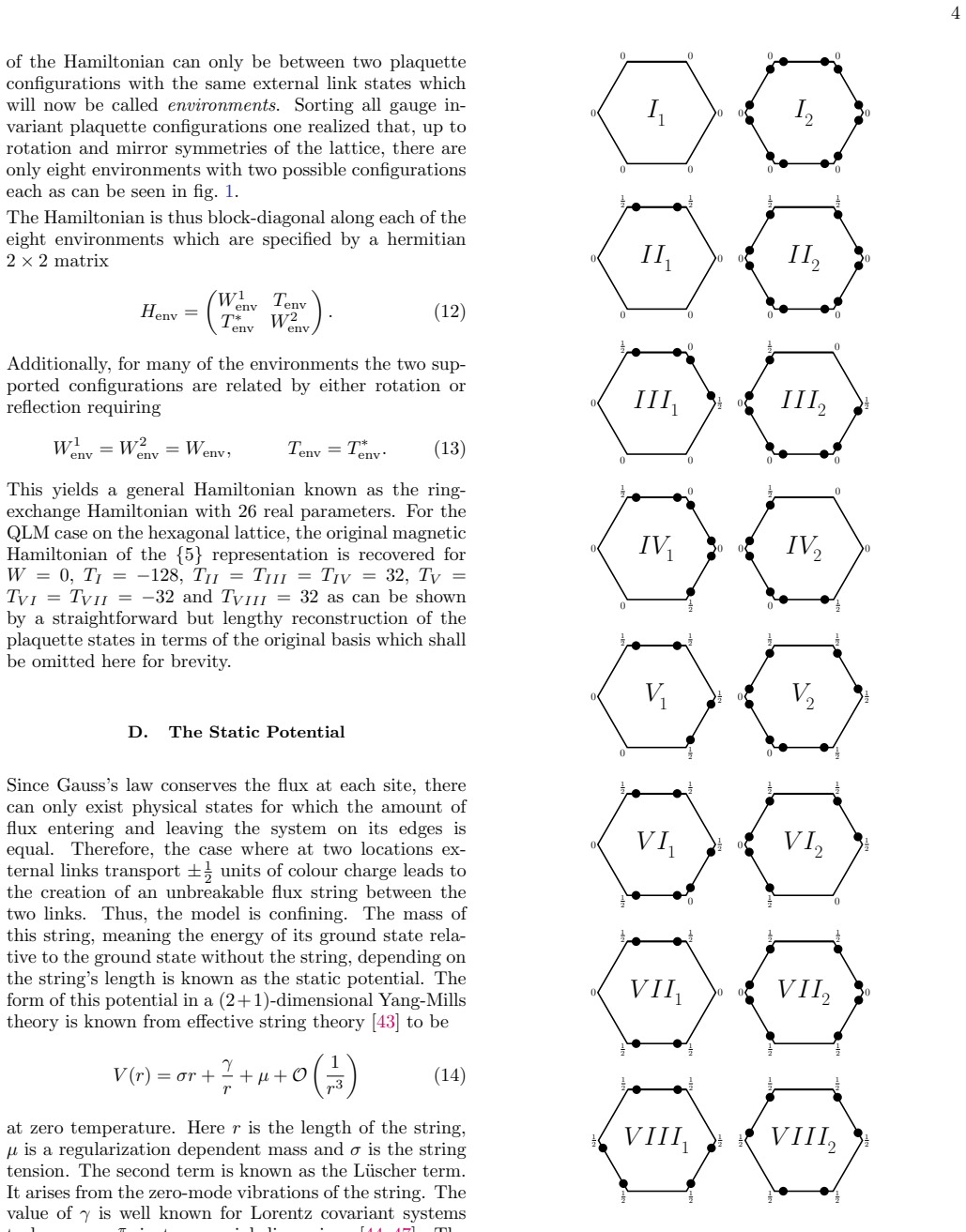
- [§III and §VI] The identification of the 26-parameter ring-exchange Hamiltonian (W=0, T_I=-128, T_II=T_III=T_IV=32, T_V=T_VI=T_VII=-32, T_VIII=32) with the SU(2) QLM magnetic Hamiltonian in the {5} representation is the load-bearing premise of the paper. The text says the reconstruction is 'straightforward but lengthy ... omitted here for brevity,' but this is not a stylistic detail: every numerical result (static potential, sigma, gamma, string width) is computed for the ring-exchange model, not directly for the QLM. The DMRG-vs-ED validation in §III only checks convergence to the ground state of the same ring-exchange Hamiltonian. Please provide the full reconstruction, or at least an independent verification, e.g., exact diagonalization of the original {5}-representation QLM on small clusters and direct comparison of matrix elements or low-energy spectra with the ring-exchange model. Without this, t
- [§IV.B, Fig. 14] The conclusion states that the theory is simulated 'with exact non-Abelian SU(2) local gauge symmetry,' but §III describes Gauss's law as being enforced by a penalty term: an additional mass kappa is added to unphysical configurations and 'kappa must then be tuned such that the expectation value of the prohibited configurations vanishes.' At finite kappa the gauge symmetry is explicitly broken, and the paper gives no evidence that kappa is large enough or that the cited observables are extrapolated to kappa -> infinity. This is particularly relevant for the string tension and Lüscher term, which are extracted from low-energy states. Please either implement the gauge-invariant constraint exactly (e.g., by restricting the MPS to the physical subspace) or provide a systematic kappa-dependence study showing convergence of all reported quantities.
- The claim of a 'clear signal' for a g^2-dependent Lüscher coefficient with no roughening transition is not supported at small g^2 by the data shown. The paper itself states that for small g^2 finite-size effects 'quickly become larger than 100%,' that N_x=5 'is not sufficient to be conclusive,' and that the N_x-dependence is non-monotonic. In addition, the 'fish bone' hysteresis in the N_x=5 curve shows algorithmic contamination of gamma in the range 4<g^2<7. The potential fits also exclude small N_y with different range cuts for each N_x (N_y>=6,10,8 for N_x=5,4,3 respectively), and the quoted error bars come only from the chi^2 Hessian. These issues together imply that the gamma(g^2) curve, especially for g^2<~2, carries unquantified systematic uncertainties. Please restrict the conclusive claims to the parameter region where finite-size control is demonstrated, or supply larger-N_x re
minor comments (7)
- [§VI] Typo: 'non-Ablian' should be 'non-Abelian.'
- [General] The lattice is called both 'hexagonal' and 'honeycomb'; please use one consistent name and define the geometry clearly.
- [Eq. (25)] The notation langle 1 - |0><0| rangle_i is ambiguous; define it as the expectation value of the projector onto flux-carrying states on link i.
- [Fig. 13] The axis label 'Vluescher' contains a typo; it should be 'V_Luescher' or similar.
- [§IV.B] The sentence listing the N_y cuts for each N_x is confusingly ordered (N_x=4 has a larger cut than N_x=3). Please explain the parity/geometry rationale explicitly.
- [§II.E] After the rescaling in Eq. (15), the expansion parameter is g^{-4}; this should be stated explicitly to avoid confusion with the original 1/g^2 magnetic coupling.
- [Ref. [54]] The title of Ref. [54] appears truncated ('The -model with boundaries'); please correct it.
Circularity Check
No circular reduction of predictions to fitted inputs; the central comparison is against an independent strong-coupling expansion. The unproven ring-exchange-to-QLM mapping is a derivation gap, not circularity.
full rationale
The central physical results are not obtained by fitting a parameter and then renaming it a prediction. The static potential V(r) is fit to V(r)=σr+γ/r+μ (Eq. 14), but the reported Lüscher coefficient γ(g²) is then compared with the analytically derived strong-coupling prediction γ(g²)=−8π/(3g²) (Eq. 22), which is computed from a parameter-free XX-chain calculation with no constants fitted to the potential data. Likewise, the string tension is compared with the strong-coupling prediction σ(g²)=3g²−64/(πg²) (Eq. 22) and the numeric agreement at large g² is quoted as a check, not as the source of the prediction. The string-width analysis fits ω²=A ln(N_y−b) and interprets logarithmic growth as roughness; this is a model fit to the data, but the paper does not claim to have predicted the width from an independent first-principles input, so there is no reduction-by-construction. The one notable gap is in Sec. II.C: the 26-parameter ring-exchange Hamiltonian is asserted to reproduce the {5}-representation SU(2) QLM 'as can be shown by a straightforward but lengthy reconstruction of the plaquette states in terms of the original basis which shall be omitted here for brevity.' This is an unverified, load-bearing premise, and the reported DMRG-vs-ED validation only checks convergence to the same ring-exchange Hamiltonian, not the mapping to the QLM. However, this is a correctness/derivation risk rather than a circularity: the analytic expansion and the numerics share the same ring-exchange Hamiltonian, and neither quantity is defined in terms of the other. Self-citations [11,13,14,18] are methodological background and are not load-bearing for the paper's QLM conclusions. Accordingly, I find no step that reduces to its own input; the score of 1 reflects the minor unproven mapping caveat rather than actual circularity.
Axiom & Free-Parameter Ledger
free parameters (4)
- σ (string tension) =
varies with g², e.g., ~300 at g²=100; see Fig. 10
- γ (Lüscher coefficient) =
varies with g²; from ~-60 at g²=1 to ~-0.08 at g²=100 (Fig. 14)
- A, b (string width log-fit parameters) =
not tabulated; fits shown in Fig. 17
- κ (Gauss-law penalty) =
not quoted; tuned so unphysical states vanish
axioms (5)
- ad hoc to paper The 26-parameter ring-exchange Hamiltonian with W=0 and the listed T values reproduces the SU(2) QLM magnetic Hamiltonian in the {5} representation.
- domain assumption Gauss's law can be enforced by a sufficiently large penalty term κ, and the low-energy spectrum converges to the physical Hilbert space.
- domain assumption The effective string form V(r)=σr+γ/r+μ describes the static potential for the distances probed.
- domain assumption The strong-coupling expansion to first order in 1/g^4 with the XX-chain solution is valid for the QLM at large g².
- domain assumption DMRG with bond dimension up to 2000 and truncation error 10^-9 converges to the ground state for the systems studied.
read the original abstract
We investigate a non-Abelian SU$(2)$ quantum link model in $2+1$ dimensions on a hexagonal lattice using tensor network methods. We determine the static quark potential for a wide range of bare coupling values and find that the theory is confining. We also probe the existence of a L\"uscher term and find a clear signal with a $g^2$ dependent coefficient, in qualitative agreement with a strong coupling expansion. Correspondingly, the width of the strings scales logarithmically with the string length again for all $g^2$-values, providing evidence for a rough string, with no indication for a roughening transition.
Figures






Reference graph
Works this paper leans on
-
[1]
Quantum Computing for High- Energy Physics: State of the Art and Challenges,
Alberto Di Meglioet al., “Quantum Computing for High- Energy Physics: State of the Art and Challenges,” PRX Quantum5, 037001 (2024), arXiv:2307.03236 [quant-ph]
Pith/arXiv arXiv 2024
-
[2]
FINITELY CORRELATED STATES ON QUANTUM SPIN CHAINS,
M. Fannes, B. Nachtergaele, and R. F. Werner, “FINITELY CORRELATED STATES ON QUANTUM SPIN CHAINS,” Commun. Math. Phys.144, 443–490 (1992)
1992
-
[3]
An area law for one-dimensional quan- tum systems,
M. B. Hastings, “An area law for one-dimensional quan- tum systems,” J. Stat. Mech.0708, P08024 (2007), arXiv:0705.2024 [quant-ph]
Pith/arXiv arXiv 2007
-
[4]
Thermodynamic Limit of Density Matrix Renormalization for the spin- 1 heisenberg chain,
Stellan Ostlund and Stefan Rommer, “Thermodynamic Limit of Density Matrix Renormalization for the spin- 1 heisenberg chain,” Phys. Rev. Lett.75, 3537–3540 (1995), arXiv:cond-mat/9503107
Pith/arXiv arXiv 1995
-
[5]
(30) including all points withN y ≥6 (see text) in the fit
The solid line represent fits to the data with logarithmic functional form eq. (30) including all points withN y ≥6 (see text) in the fit. 13 hand, the width is expected to be constant as the length is increased. Clearly, our results forω 2 are not well de- scribed by a constant, which is why we attempt a fit of the form ω2(Ny) =Aln(N y −b) (30) to the da...
-
[6]
Time-Dependent Variational Principle for Quantum Lattices,
Jutho Haegeman, J. Ignacio Cirac, Tobias J. Os- borne, Iztok Pizorn, Henri Verschelde, and Frank Verstraete, “Time-Dependent Variational Principle for Quantum Lattices,” Phys. Rev. Lett.107, 070601 (2011), arXiv:1103.0936 [cond-mat.str-el]
Pith/arXiv arXiv 2011
-
[7]
Unifying time evolution and optimization with matrix product states,
Jutho Haegeman, Christian Lubich, Ivan Oseledets, Bart Vandereycken, and Frank Verstraete, “Unifying time evolution and optimization with matrix product states,” Phys. Rev. B94, 165116 (2016), arXiv:1408.5056 [quant- ph]
Pith/arXiv arXiv 2016
-
[8]
The density-matrix renormalization group in the age of matrix product states,
Ulrich Schollwoeck, “The density-matrix renormalization group in the age of matrix product states,” Annals Phys. 326, 96–192 (2011), arXiv:1008.3477 [cond-mat.str-el]
Pith/arXiv arXiv 2011
-
[9]
Formulation of lattice gauge theories for quantum simulations,
Erez Zohar and Michele Burrello, “Formulation of lattice gauge theories for quantum simulations,” Phys. Rev. D 91, 054506 (2015), arXiv:1409.3085 [quant-ph]
Pith/arXiv arXiv 2015
-
[10]
Gauge-invariant rotor Hamil- tonian from dual variables of 3DU(1) gauge theory,
Judah F. Unmuth-Yockey, “Gauge-invariant rotor Hamil- tonian from dual variables of 3DU(1) gauge theory,” Phys. Rev. D99, 074502 (2019), arXiv:1811.05884 [hep- lat]
Pith/arXiv arXiv 2019
-
[11]
Jan F. Haase, Luca Dellantonio, Alessio Celi, Danny Paulson, Angus Kan, Karl Jansen, and Christine A. Muschik, “A resource efficient approach for quantum and classical simulations of gauge theories in parti- cle physics,” Quantum5, 393 (2021), arXiv:2006.14160 [quant-ph]
Pith/arXiv arXiv 2021
-
[12]
Digitising SU(2) gauge fields and the freezing transition,
Tobias Hartung, Timo Jakobs, Karl Jansen, Johann Ost- meyer, and Carsten Urbach, “Digitising SU(2) gauge fields and the freezing transition,” Eur. Phys. J. C82, 237 (2022), arXiv:2201.09625 [hep-lat]
Pith/arXiv arXiv 2022
-
[13]
Loop-string-hadron formulation of an SU(3) gauge theory with dynamical quarks,
Saurabh V. Kadam, Indrakshi Raychowdhury, and Jesse R. Stryker, “Loop-string-hadron formulation of an SU(3) gauge theory with dynamical quarks,” Phys. Rev. D107, 094513 (2023), arXiv:2212.04490 [hep-lat]
Pith/arXiv arXiv 2023
-
[14]
Canonical momenta in digitized Su(2) lattice gauge theory: definition and free theory,
Timo Jakobs, Marco Garofalo, Tobias Hartung, Karl Jansen, Johann Ostmeyer, Dominik Rolfes, Simone Romiti, and Carsten Urbach, “Canonical momenta in digitized Su(2) lattice gauge theory: definition and free theory,” Eur. Phys. J. C83, 669 (2023), arXiv:2304.02322 [hep-lat]
Pith/arXiv arXiv 2023
-
[15]
Timo Jakobs, Marco Garofalo, Tobias Hartung, Karl Jansen, Johann Ostmeyer, Simone Romiti, and Carsten Urbach, “Dynamics in Hamiltonian Lattice Gauge The- ory: Approaching the Continuum Limit with Partition- ings of SU(2),” (2025), arXiv:2503.03397 [hep-lat]
Pith/arXiv arXiv 2025
-
[16]
New basis for Hamil- tonian SU(2) simulations,
Irian D’Andrea, Christian W. Bauer, Dorota M. Grabowska, and Marat Freytsis, “New basis for Hamil- tonian SU(2) simulations,” Phys. Rev. D109, 074501 (2024), arXiv:2307.11829 [hep-ph]
Pith/arXiv arXiv 2024
-
[17]
Saurabh V. Kadam, Aahiri Naskar, Indrakshi Raychowd- hury, and Jesse R. Stryker, “Loop-string-hadron ap- proach to SU(3) lattice Yang-Mills theory: Hilbert space of a trivalent vertex,” Phys. Rev. D111, 074516 (2025), arXiv:2407.19181 [hep-lat]
Pith/arXiv arXiv 2025
-
[18]
Efficient Finite-Resource Formulation of Non- Abelian Lattice Gauge Theories beyond One Dimen- sion,
Pierpaolo Fontana, Marc Miranda Riaza, and Alessio Celi, “Efficient Finite-Resource Formulation of Non- Abelian Lattice Gauge Theories beyond One Dimen- sion,” Phys. Rev. X15, 031065 (2025), arXiv:2409.04441 [quant-ph]
arXiv 2025
-
[19]
Timo Jakobs, Marco Garofalo, Tobias Hartung, Karl Jansen, Paul Ludwig, Johann Ostmeyer, Simone Romiti, and Carsten Urbach, “A Comprehensive Stress Test of 15 Truncated Hilbert Space Bases against Green’s function Monte Carlo in U(1) Lattice Gauge Theory,” (2025), arXiv:2510.27611 [hep-lat]
arXiv 2025
-
[20]
Hamiltonian For- mulation of Wilson’s Lattice Gauge Theories,
John B. Kogut and Leonard Susskind, “Hamiltonian For- mulation of Wilson’s Lattice Gauge Theories,” Phys. Rev. D11, 395–408 (1975)
1975
-
[21]
Finite Matrix Models With Continuous Local Gauge Invariance,
D. Horn, “Finite Matrix Models With Continuous Local Gauge Invariance,” Phys. Lett. B100, 149–151 (1981)
1981
-
[22]
Lattice Gauge Mag- nets: Local Isospin From Spin,
Peter Orland and Daniel Rohrlich, “Lattice Gauge Mag- nets: Local Isospin From Spin,” Nucl. Phys. B338, 647– 672 (1990)
1990
-
[23]
Quantum link models: A Discrete approach to gauge theories,
S. Chandrasekharan and U. J. Wiese, “Quantum link models: A Discrete approach to gauge theories,” Nucl. Phys. B492, 455–474 (1997), arXiv:hep-lat/9609042
Pith/arXiv arXiv 1997
-
[24]
R. Brower, S. Chandrasekharan, and U. J. Wiese, “QCD as a quantum link model,” Phys. Rev. D60, 094502 (1999), arXiv:hep-th/9704106
Pith/arXiv arXiv 1999
-
[25]
D-theory: Field theory via dimensional reduction of discrete vari- ables,
B. B. Beard, R. C. Brower, S. Chandrasekharan, D. Chen, A. Tsapalis, and U. J. Wiese, “D-theory: Field theory via dimensional reduction of discrete vari- ables,” Nucl. Phys. B Proc. Suppl.63, 775–789 (1998), arXiv:hep-lat/9709120
Pith/arXiv arXiv 1998
-
[26]
Uwe-Jens Wiese, “From quantum link models to D- theory: a resource efficient framework for the quantum simulation and computation of gauge theories,” Phil. Trans. A. Math. Phys. Eng. Sci.380, 20210068 (2021), arXiv:2107.09335 [hep-lat]
Pith/arXiv arXiv 2021
-
[27]
Real-time Dynamics in U(1) Lattice Gauge Theories with Tensor Networks,
T. Pichler, M. Dalmonte, E. Rico, P. Zoller, and S. Mon- tangero, “Real-time Dynamics in U(1) Lattice Gauge Theories with Tensor Networks,” Phys. Rev. X6, 011023 (2016), arXiv:1505.04440 [cond-mat.quant-gas]
Pith/arXiv arXiv 2016
-
[28]
Lattice quantum electrodynamics in (3+1)-dimensions at finite density with tensor networks,
Giuseppe Magnifico, Timo Felser, Pietro Silvi, and Si- mone Montangero, “Lattice quantum electrodynamics in (3+1)-dimensions at finite density with tensor networks,” Nature Commun.12, 3600 (2021), arXiv:2011.10658 [hep-lat]
Pith/arXiv arXiv 2021
-
[29]
Hidden Or- der and Symmetry Protected Topological States in Quan- tum Link Ladders,
L. Cardarelli, S. Greschner, and L. Santos, “Hidden Or- der and Symmetry Protected Topological States in Quan- tum Link Ladders,” Phys. Rev. Lett.119, 180402 (2017), arXiv:1707.03225 [cond-mat.quant-gas]
Pith/arXiv arXiv 2017
-
[30]
Dynamical quantum phase transitions inU(1) quan- tum link models,
Yi-Ping Huang, Debasish Banerjee, and Markus Heyl, “Dynamical quantum phase transitions inU(1) quan- tum link models,” Phys. Rev. Lett.122, 250401 (2019), arXiv:1808.07874 [cond-mat.str-el]
Pith/arXiv arXiv 2019
-
[31]
Two-dimensional quantum-link lat- tice Quantum Electrodynamics at finite density,
Timo Felser, Pietro Silvi, Mario Collura, and Si- mone Montangero, “Two-dimensional quantum-link lat- tice Quantum Electrodynamics at finite density,” Phys. Rev. X10, 041040 (2020), arXiv:1911.09693 [quant-ph]
Pith/arXiv arXiv 2020
-
[32]
Ground-state phase diagram of quantum link electrodynamics in (2+1)-d,
Tomohiro Hashizume, Jad C. Halimeh, Philipp Hauke, and Debasish Banerjee, “Ground-state phase diagram of quantum link electrodynamics in (2+1)-d,” SciPost Phys. 13, 017 (2022), arXiv:2112.00756 [cond-mat.str-el]
Pith/arXiv arXiv 2022
-
[33]
Achiev- ing the quantum field theory limit in far-from- equilibrium quantum link models,
Jad C. Halimeh, Maarten Van Damme, Torsten V. Zache, Debasish Banerjee, and Philipp Hauke, “Achiev- ing the quantum field theory limit in far-from- equilibrium quantum link models,” Quantum6, 878 (2022), arXiv:2112.04501 [cond-mat.quant-gas]
Pith/arXiv arXiv 2022
-
[34]
The (2 + 1)-d U(1) quantum link model masquerading as deconfined criticality,
D. Banerjee, F. J. Jiang, P. Widmer, and U. J. Wiese, “The (2 + 1)-d U(1) quantum link model masquerading as deconfined criticality,” J. Stat. Mech.1312, P12010 (2013), arXiv:1303.6858 [cond-mat.str-el]
Pith/arXiv arXiv 2013
-
[35]
Meron-Cluster Algorithms for Quan- tum Link Models,
Joao C. Pinto Barros, Thea Budde, and Marina Krstic Marinkovic, “Meron-Cluster Algorithms for Quan- tum Link Models,” PoSLA TTICE2023, 024 (2024), arXiv:2402.01039 [hep-lat]
Pith/arXiv arXiv 2024
-
[36]
Spin-SU(1) Quantum Link Models with Dynamical Matter on a Quantum Simula- tor,
Jesse Osborne, Bing Yang, Ian P. McCulloch, Philipp Hauke, and Jad C. Halimeh, “Spin-SU(1) Quantum Link Models with Dynamical Matter on a Quantum Simula- tor,” (2023), arXiv:2305.06368 [cond-mat.quant-gas]
Pith/arXiv arXiv 2023
-
[37]
Quantum simulation of a lattice Schwinger model in a chain of trapped ions,
Philipp Hauke, David Marcos, Marcello Dalmonte, and Peter Zoller, “Quantum simulation of a lattice Schwinger model in a chain of trapped ions,” Phys. Rev. X3, 041018 (2013), arXiv:1306.2162 [cond-mat.quant-gas]
Pith/arXiv arXiv 2013
-
[38]
Analog quantum simulation of (1+1)-dimensional lat- tice QED with trapped ions,
Dayou Yang, Gouri Shankar Giri, Michael Johanning, Christof Wunderlich, Peter Zoller, and Philipp Hauke, “Analog quantum simulation of (1+1)-dimensional lat- tice QED with trapped ions,” Phys. Rev. A94, 052321 (2016), arXiv:1604.03124 [quant-ph]
Pith/arXiv arXiv 2016
-
[39]
D. Banerjee, F. J. Jiang, T. Z. Olesen, P. Orland, and U. J. Wiese, “From theSU(2) quantum link model on the honeycomb lattice to the quantum dimer model on the kagom´ e lattice: Phase transition and fraction- alized flux strings,” Phys. Rev. B97, 205108 (2018), arXiv:1712.08300 [cond-mat.str-el]
Pith/arXiv arXiv 2018
-
[40]
Non-AbelianSU(2) Lat- tice Gauge Theories in Superconducting Circuits,
A. Mezzacapo, E. Rico, C. Sab ´ ın, I. L. Egusquiza, L. Lamata, and E. Solano, “Non-AbelianSU(2) Lat- tice Gauge Theories in Superconducting Circuits,” Phys. Rev. Lett.115, 240502 (2015), arXiv:1505.04720 [quant- ph]
Pith/arXiv arXiv 2015
-
[41]
Roughening and dynamics of an electric flux string in a (2+1)D lattice gauge theory,
Francesco Di Marcantonio, Sunny Pradhan, Sofia Val- lecorsa, Mari Carmen Ba˜ nuls, and Enrique Rico Ortega, “Roughening and dynamics of an electric flux string in a (2+1)D lattice gauge theory,” (2025), arXiv:2505.23853 [hep-lat]
Pith/arXiv arXiv 2025
-
[42]
Tensor-Network Study of the Roughening Transition in a (2+1)D Z2 Lattice Gauge Theory with Matter,
Wen-Tao Xu, Michael Knap, and Frank Pollmann, “Tensor-Network Study of the Roughening Transition in a (2+1)D Z2 Lattice Gauge Theory with Matter,” Phys. Rev. Lett.135, 036503 (2025)
2025
-
[43]
U(1) lattice gauge theory and string roughening on a triangular Rydberg array,
Lisa Bombieri, Torsten V. Zache, Hannes Pichler, and Daniel Gonz´ alez-Cuadra, “U(1) lattice gauge theory and string roughening on a triangular Rydberg array,” (2026), arXiv:2602.06123 [quant-ph]
arXiv 2026
-
[44]
Quark confinement and the bosonic string,
Martin L¨ uscher and Peter Weisz, “Quark confinement and the bosonic string,” JHEP07, 049 (2002), arXiv:hep- lat/0207003
arXiv 2002
-
[45]
The String and Its Tension in SU(3) Lattice Gauge Theory: Towards Definitive Results,
P. de Forcrand, G. Schierholz, H. Schneider, and M. Te- per, “The String and Its Tension in SU(3) Lattice Gauge Theory: Towards Definitive Results,” Phys. Lett. B160, 137–143 (1985)
1985
-
[46]
Observation of a String in Three-dimensional SU(2) Lattice Gauge Theory,
Jan Ambjorn, P. Olesen, and C. Peterson, “Observation of a String in Three-dimensional SU(2) Lattice Gauge Theory,” Phys. Lett. B142, 410 (1984)
1984
-
[47]
Continuum limit of string formation in 3-d SU(2) LGT,
N. D. Hari Dass and Pushan Majumdar, “Continuum limit of string formation in 3-d SU(2) LGT,” Phys. Lett. B658, 273–278 (2008), arXiv:hep-lat/0702019
Pith/arXiv arXiv 2008
-
[48]
Static quark poten- tial and effective string corrections in the (2+1)-d SU(2) Yang-Mills theory,
M. Caselle, M. Pepe, and A. Rago, “Static quark poten- tial and effective string corrections in the (2+1)-d SU(2) Yang-Mills theory,” JHEP10, 005 (2004), arXiv:hep- lat/0406008
arXiv 2004
-
[49]
Symmetry Breaking Aspects of the Rough- ening Transition in Gauge Theories,
M. L¨ uscher, “Symmetry Breaking Aspects of the Rough- ening Transition in Gauge Theories,” Nucl. Phys. B180, 317–329 (1981)
1981
-
[50]
The Width of the Confining String in Yang-Mills Theory,
F. Gliozzi, M. Pepe, and U. J. Wiese, “The Width of the Confining String in Yang-Mills Theory,” Phys. Rev. Lett.104, 232001 (2010), arXiv:1002.4888 [hep-lat]
Pith/arXiv arXiv 2010
-
[51]
Roughening of Wilson’s Surface,
C. Itzykson, Michael E. Peskin, and Jean-Bernard Zu- ber, “Roughening of Wilson’s Surface,” Phys. Lett. B95, 259–264 (1980). 16
1980
-
[52]
On the Roughening Transition in Nonabelian Lattice Gauge Theories,
Gernot M¨ unster and Peter Weisz, “On the Roughening Transition in Nonabelian Lattice Gauge Theories,” Nucl. Phys. B180, 330–340 (1981)
1981
-
[53]
The Fluctuating String of Lattice Gauge Theory: The Heavy Quark Potential, the Restoration of Rotational Symmetry and Roughen- ing,
J. B. Kogut, D. K. Sinclair, R. B. Pearson, John L. Richardson, and J. Shigemitsu, “The Fluctuating String of Lattice Gauge Theory: The Heavy Quark Potential, the Restoration of Rotational Symmetry and Roughen- ing,” Phys. Rev. D23, 2945 (1981)
1981
-
[54]
About the Pauli exclusion principle,
Pascual Jordan and Eugene P. Wigner, “About the Pauli exclusion principle,” Z. Phys.47, 631–651 (1928)
1928
-
[55]
The -model with boundaries: Part i. diagonalization of the finite chain,
Ulrich Bilstein and Birgit Wehefritz, “The -model with boundaries: Part i. diagonalization of the finite chain,” Journal of Physics A: Mathematical and General32, 191–233 (1999)
1999
-
[56]
The ITensor Software Library for Tensor Network Calculations,
Matthew Fishman, Steven R. White, and E. Miles Stoudenmire, “The ITensor Software Library for Tensor Network Calculations,” SciPost Phys. Codeb.2022, 4 (2022), arXiv:2007.14822 [cs.MS]
Pith/arXiv arXiv 2022
-
[57]
Julia: A Fresh Approach to Nu- merical Computing,
Jeff Bezanson, Alan Edelman, Stefan Karpinski, and Viral B. Shah, “Julia: A Fresh Approach to Nu- merical Computing,” SIAM Rev.59, 65–98 (2017), arXiv:1411.1607 [cs.MS]
Pith/arXiv arXiv 2017
-
[58]
An Introduction to Lattice Gauge The- ory and Spin Systems,
John B. Kogut, “An Introduction to Lattice Gauge The- ory and Spin Systems,” Rev. Mod. Phys.51, 659 (1979)
1979
-
[59]
Mass gap and finite size effects in finite temperature SU(2) lattice gauge the- ory,
J. Engels and V. K. Mitrjushkin, “Mass gap and finite size effects in finite temperature SU(2) lattice gauge the- ory,” Phys. Lett. B282, 415–422 (1992)
1992
-
[60]
R. Sommer, “A New way to set the energy scale in lattice gauge theories and its applications to the static force and αs in SU(2) Yang-Mills theory,” Nucl. Phys. B411, 839– 854 (1994), arXiv:hep-lat/9310022
Pith/arXiv arXiv 1994
-
[61]
Intrinsic width of the flux tube in 2+1 dimensional Yang-Mills theories,
Lorenzo Verzichelli, Michele Caselle, Elia Cellini, Alessandro Nada, and Dario Panfalone, “Intrinsic width of the flux tube in 2+1 dimensional Yang-Mills theories,” PoSLA TTICE2024, 403 (2025), arXiv:2501.01740 [hep-lat]
Pith/arXiv arXiv 2025
-
[62]
Observing long color flux tubes in SU(2) lattice gauge theory,
G. S. Bali, K. Schilling, and C. Schlichter, “Observing long color flux tubes in SU(2) lattice gauge theory,” Phys. Rev. D51, 5165–5198 (1995), arXiv:hep-lat/9409005
Pith/arXiv arXiv 1995
-
[63]
From Decay to Com- plete Breaking: Pulling the Strings in SU(2) Yang- Mills Theory,
M. Pepe and U. J. Wiese, “From Decay to Com- plete Breaking: Pulling the Strings in SU(2) Yang- Mills Theory,” Phys. Rev. Lett.102, 191601 (2009), arXiv:0901.2510 [hep-lat]
Pith/arXiv arXiv 2009
-
[64]
Lorenzo Barca, Stefan Schaefer, Francesco Knechtli, Juan Andr´ es Urrea-Ni˜ no, Sofie Martins, and Michael Peardon, “Exponential error reduction for glueball cal- culations using a two-level algorithm in pure gauge the- ory,” Phys. Rev. D110, 054515 (2024), arXiv:2406.12656 [hep-lat]
Pith/arXiv arXiv 2024
discussion (0)
Sign in with ORCID, Apple, or X to comment. Anyone can read and Pith papers without signing in.