REVIEW 4 major objections 4 minor 20 references
You Don't Need All That Attention: Surgical Memorization Mitigation in Text-to-Image Diffusion Models
T0 review · 4 major / 4 minor · reviewed 2026-08-02 · deepseek-v4-flash
Pith's one-line read The paper claims that text-to-image diffusion models can be kept from reproducing memorized training images by detecting, per prompt, the cross-attention token spikes that act as memorization triggers and attenuating only those positions, w
desk verdict Genuinely new inference-time method, but the evaluation is compromised by test-set hyperparameter tuning and the 'by far most robust' claim is contradicted by their own Table 1. read the letter →
The pith
A machine-rendered reading of the paper's core claim, the machinery that carries it, and where it could break.
The reading
What carries the argument
The central object is a modified classifier-free guidance update: ϵ̂ = ϵ_∅ + s(ϵ⁺(S(p), α) − ϵ_∅) − r(ϵ⁻ − ϵ_∅). The repulsion term subtracts the memorized prompt's standard prediction; the attraction term adds a prediction in which cross-attention logits for the detected spike set S(p) are scaled down by α before softmax. Spike detection runs on the fly: M_i = max_q AttnScore_{q,i}, then Z_i = (M_i − μ)/σ over tokens, with S(p) = {i : Z_i > τ}. Three U-Net passes (unconditional, memorized, spike-attenuated) are batched into one forward pass per denoising step.
What would settle it
On a held-out set of memorized prompts, run CA attenuation with the published hyperparameters and check whether mitigation failures concentrate on prompts where S(p) is empty or where attention maps show no outlier tokens; if a substantial fraction of memorized prompts produce no detected spikes yet still regenerate the training image, the spike-detection premise is falsified. Alternatively, apply the method to non-memorized prompts at scale; if CLIP or FID degrades beyond noise on diverse prompt sets, the 'surgical' claim weakens.
Extended reading notes
Core claim
Memorized prompts give away their trigger tokens through statistical outliers in cross-attention mass. The authors show that the end-of-text token is only one spike among many—and for template memorization it is often not a spike at all—so a fixed rule like 'attenuate the EOT token' fails. Their detector scores each token by the maximum attention it receives from any spatial query, Z-scores those maxima across tokens, and flags positions above a threshold. Attenuating the logits of exactly those positions, then using the resulting noise prediction as the positive target in a contrastive guidance formula (with a negative weight on the original prompt's prediction), yields lower similarity-to-
Load-bearing premise
The method assumes that memorization-critical tokens always manifest as statistical outliers in the per-token max-aggregated cross-attention distribution under the memorized prompt, and that the Z-score threshold tuned on the evaluation set transfers to unseen prompts.
Editorial extensions
If this is right
- Inference-time mitigation can be applied to already-deployed models without retraining or fine-tuning, and without knowing in advance which prompts are memorized.
- Dynamic per-prompt spike detection removes the need for hard-coded token heuristics, extending mitigation to template memorization where end-of-text attenuation is counterproductive.
- Combining repulsion with an attenuated positive target improves the memorization–quality trade-off over attenuation alone, preventing fidelity collapse.
- The method transfers across U-Net and transformer-based diffusion backbones, suggesting the mechanism is general.
Reading between the lines
- The spike-detection principle could be applied as a training-time regularizer: penalizing the formation of per-token attention outliers during training might reduce memorization at the source, not just at inference.
- Because the method is harmless on non-memorized prompts, it could serve as an always-on safety filter in production image-generation pipelines, closing the gap left by methods that require a pre-identified forget set.
- GUARD's positive target need not be attention-based; any noise prediction that stays prompt-aligned but distinct from the memorized example (e.g., a paraphrase) could instantiate the framework, so the results invite a search over better positive targets.
Editorial analysis
A structured set of objections, weighed in public.
Referee Report
Summary. The paper proposes GUARD, an inference-time memorization-mitigation framework for text-to-image diffusion models that modifies the standard CFG prediction by adding a repulsive term away from the memorized-prompt conditional noise and an attractive term toward a 'positive target'. The positive target is instantiated as cross-attention attenuation at per-prompt detected 'spike' tokens: a statistical detector flags token positions whose max-over-queries attention mass is an outlier (Z_i > τ), and the corresponding cross-attention logits are scaled down. The resulting method, CA-in-GUARD, is evaluated against prior inference-time methods (RTA, Wen et al., Ren et al., Han et al.) on SD v1.4 verbatim and template memorization and SD v2.0 template memorization, using SSCD, CLIP, and FID, with additional experiments on SD v3.0, DINO retrieval, full-spectrum prompts, and non-memorized prompts. The main claim is that CA-in-GUARD is 'by far the most robust' and state-of-the-art across architectures and memorization types.
Significance. The problem is timely and important, and the proposed framework is a reasonable and potentially useful contribution: it is inference-only, per-prompt, and surgical, combining a repulsion term with an attention-attenuated positive target. The paper includes useful empirical analyses of cross-attention patterns for verbatim vs template memorization, and the authors provide a substantial set of ablations (block selection, head selection, timesteps, samplers, CFG scale) and additional evaluations (DINO, full-spectrum, non-memorized prompts, SD v3.0). The code is promised. If the headline claims were established with a clean evaluation protocol, the work would be a solid contribution to the inference-time memorization-mitigation literature. However, as presented, the central claim of state-of-the-art robustness across settings is not supported by the paper's own tables, and the evaluation protocol has a circularity problem: hyperparameters are selected on the same prompt set used for reporting the headline results. These issues affect the validity of the main conclusions, though they are fixable with a revised protocol and more measured claims.
major comments (4)
- [§6, §A.2, Table 2] The evaluation protocol selects the hyperparameters τ, α, r (and, implicitly, the baseline hyperparameters) by grid search on the same memorized prompts used to report the headline numbers. Section 6 says configurations are chosen to yield the best SSCD, CLIP, or FID within a 15% CLIP cap, and Appendix A.2 confirms that tuning is performed per architecture-memorization setting. No validation split is described. This makes Table 1, Table 5, and Figures 3–4 in-sample selections rather than predictions. The central claim that the method generalizes per-prompt to unseen prompts cannot be established from this protocol. Please report results with hyperparameters fixed on a disjoint validation set, or show that the reported conclusions are insensitive to the specific choices of τ, α, and r (e.g., a sensitivity plot with a single setting held across all prompts).
- [§7, Table 1] The abstract and §7 state that CA-in-GUARD is 'by far the most robust' and 'dominates across settings,' but Table 1 under the best-SSCD selection shows that for SD v1.4 template memorization, Han et al. obtains SSCD 0.479±0.033 while CA-in-GUARD obtains 0.517±0.038, with essentially tied CLIP (0.188 vs 0.186) and FID (210.8 vs 211.0). This is one of the three core settings, and the proposed method is worse on the primary memorization metric. The text later acknowledges that Han et al. is the strongest prior method in this setting, but it never reconciles that with the 'dominates across settings' conclusion. Please either weaken the claim to 'competitive or state-of-the-art on most settings' or provide additional evidence, such as a statistically valid multi-setting comparison or a test with hyperparameters fixed before seeing the evaluation prompts.
- [§5.2, Eq. (7), Table 2] The spike-detection mechanism's generality is not established. The detector defines S(p) = {i : Z_i > τ} with Z_i computed from max-over-queries attention mass, but the threshold τ varies enormously across settings in Table 2: [0.01,0.05] for SD v1.4 verbatim, [0.5,3.0] for SD v1.4 template, and [1.5,3.0] for SD v2.0 template. Because τ is tuned on the same evaluation set, the claim that this is an automatic, statistical, per-prompt outlier detector is weakened: it may simply be a flexible knob fitted to each evaluation distribution. Please provide evidence that the detector identifies meaningful token positions (e.g., comparison with oracle annotations or analysis of detected position stability across prompts) and that τ can be set on a training/validation split without losing the reported mitigation gains.
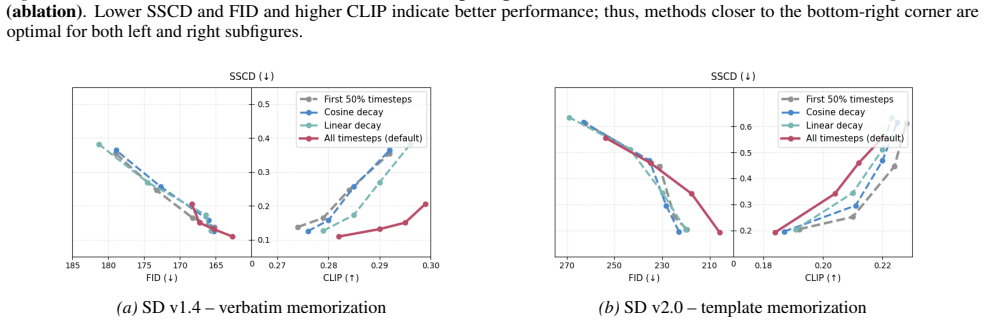
- [§7, Figure 4, Table 5] The trade-off analysis is also affected by the in-sample selection. For example, in Table 5(b) ('best CLIP'), the best-SSCD column for SD v1.4 verbatim shows CA attenuation at 0.206 with CLIP 0.299, identical to CA-in-GUARD, and the latter's SSCD is no better than CA attenuation in several rows. The paper's conclusion that GUARD consistently improves or maintains performance across every metric and setting relies on comparing in-sample best configurations; a validation-based comparison could change which method wins on which metric. The qualitative conclusion about trade-offs would be more compelling with Pareto frontiers computed from configurations selected on a validation split, not on the evaluation set.
minor comments (4)
- [Abstract and §8] The phrase 'by far the most robust' and 'state-of-the-art across architectures and memorization types' is stronger than the evidence in Tables 1 and 5 supports. Even after fixing the evaluation protocol, the paper should temper the language to match the actual magnitude of the improvements.
- [§5.3 and §A.2] The computation of S(p) is described at a high level in the main text ('aggregating over specific blocks/heads as specified later') and in the appendix, but the exact pooling over layers, heads, and timesteps is not fully specified in one place. Please define precisely how Mi is computed across the selected down/mid blocks and heads, since the detector is central to the method.
- [§6, memorized prompt selection] The SSCD > 0.7 filtering is reasonable for focusing on hard cases, but it changes the benchmark relative to prior work. The paper notes this for Han et al., but it would help to also report the performance of all methods on the unfiltered 500-prompt set in the main table (currently in Table 7 in the appendix) so readers can judge the effect of the filtering.
- [Table 1 and Table 5] The 95% confidence intervals are reported for SSCD and CLIP but not for FID, and FID is computed on the generated set without confidence intervals. Since some key comparisons are close (e.g., SD v1.4 template CLIP/FID), please state explicitly that FID differences within a few units are not statistically meaningful, or provide a measure of uncertainty.
Circularity Check
SOTA claim rests on grid search over the evaluation prompts themselves, and Table 1 contradicts the dominance claim.
-
fitted input called prediction
[§6 Experimental Protocol – Hyperparameter selection; §A.2 Implementation Details – Hyperparameter Tuning; Table 1 caption]
"Among runs within this acceptable range, we report the best results for each method in terms of SSCD, CLIP, and FID. ... We tune hyperparameters separately for each architecture-memorization setting and each mitigation method. ... We perform grid search over method-specific hyperparameter ranges for each setting."
The reported 'prediction' of memorization mitigation is the best SSCD found by grid search over tau, alpha, r on the same evaluation prompts (72/143/96 per setting) whose SSCD against the training image is the target metric. No validation split is held out; 'best SSCD' is the minimum over configurations evaluated on the test set, so Table 1 and Figures 3-4 report in-sample optima rather than out-of-sample predictions. The headline 'by far the most robust' is therefore partly a statement about fitted configurations, and the comparison is statistically forced in favor of methods with more tunable hyperparameters.
full rationale
The central derivation is not circular: GUARD (Eq. 5) is a genuine modification of classifier-free guidance, and the CA spike detector S(p) = {i : Z_i > tau} with attenuation l' = l * alpha is a mechanistic intervention that does not define the target SSCD metric into the method. I found no load-bearing self-citation: the authors' prior unlearning papers are cited only as background algorithms, and no uniqueness theorem or ansatz is imported from them. The circularity is in the evaluation. Section 6 and Appendix A.2 state that hyperparameters tau, alpha, r are tuned by grid search per setting, and that among runs within a 15% CLIP cap the paper reports the best SSCD/CLIP/FID for each method. Because this grid search is performed on the same memorized prompts used to compute the evaluation metric, the reported 'best SSCD' is an in-sample optimum, not a prediction on unseen prompts. This is a partial fit of the reported result to the evaluation target. Separately, even under this fitting protocol the paper's own Table 1 undercuts the dominance claim: on SD v1.4 template memorization at best-SSCD selection, Han et al. reach SSCD 0.479±0.033 while CA-in-GUARD reaches 0.517±0.038, with CLIP/FID essentially tied; the paper acknowledges Han is the strongest prior method there but never reconciles this with 'dominates across settings.' That contradiction is a correctness/overclaim problem, not an additional circularity. Overall score 6: one central empirical 'prediction' is partially fitted to its own evaluation target, while the method itself is not circular.
Assumptions & free parameters
free parameters (3)
- τ (spike detection threshold) =
0.01–0.05 (verbatim), 0.5–3.0 (template) per Table 2
- α (cross-attention logit scaling factor) =
0.05–0.7 depending on setting (Table 2)
- r (repulsion strength in GUARD) =
0.1–6.0 depending on setting (Table 2)
assumptions (4)
- domain assumption Memorization is causally driven by abnormally high cross-attention on specific trigger tokens (e.g., EOT and other spikes).
- domain assumption The noise prediction from the spike-attenuated pass, ϵ+, is a valid positive target that steers toward a distinct but prompt-aligned image.
- standard math Outlier detection via Z-scores on max-over-queries attention mass is a reliable statistical signal.
- domain assumption A linear combination of three noise predictions (Eq. 5) remains a valid guidance procedure.
Cite this review
Pith. "Pith review of You Don't Need All That Attention: Surgical Memorization Mitigation in Text-to-Image Diffusion Models." pith.science (2026). https://pith.science/paper/PHGSBO2A
@misc{pith2026260300133,
  author       = {Pith},
  title        = {Pith review of: You Don't Need All That Attention: Surgical Memorization Mitigation in Text-to-Image Diffusion Models},
  year         = {2026},
  howpublished = {\url{https://pith.science/paper/PHGSBO2A}},
  note         = {Machine review of arXiv:2603.00133}
}
read the original abstract
Generative models have been shown to "memorize" certain training data, leading to verbatim or near-verbatim generating images, which may cause privacy concerns or copyright infringement. We introduce Guidance Using Attractive-Repulsive Dynamics (GUARD), a novel framework for memorization mitigation in text-to-image diffusion models. GUARD adjusts the image denoising process to guide the generation away from an original training image and towards one that is distinct from training data while remaining aligned with the prompt, guarding against reproducing training data, without hurting image generation quality. We propose a concrete instantiation of this framework, where the positive target that we steer towards is given by a novel method for (cross) attention attenuation based on (i) a novel statistical mechanism that automatically identifies the prompt positions where cross attention must be attenuated and (ii) attenuating cross-attention in these per-prompt locations. The resulting GUARD offers a surgical, dynamic per-prompt inference-time approach that, we find, is by far the most robust method in terms of consistently producing state-of-the-art results for memorization mitigation across two architectures and for both verbatim and template memorization, while also improving upon or yielding comparable results in terms of image quality.
Figures


Figures from the paper (12 more)




Reference graph
Works this paper leans on
-
[1]
Data unlearning in diffusion models.arXiv preprint arXiv:2503.01034,
Alberti, S., Hasanaliyev, K., Shah, M., and Ermon, S. Data unlearning in diffusion models.arXiv preprint arXiv:2503.01034,
-
[2]
Robustness of CA Attenuation on Non-Memorized Prompts An important practical question is how memorization miti- gation affects prompts that are not memorized by the model
Code.The code for reproducing the results is available at: https://github.com/kairanzhao/GUARD A.3. Robustness of CA Attenuation on Non-Memorized Prompts An important practical question is how memorization miti- gation affects prompts that are not memorized by the model. While prior work typically assumes that memorized ex- amples are identified beforehan...
2022
-
[3]
URL https://arxiv.org/abs/ 2501.18052. Deeb, A. and Roger, F. Do unlearning methods remove in- formation from language model weights?arXiv preprint arXiv:2410.08827,
-
[8]
Park, Y .-H., Yun, S., Kim, J.-H., Kim, J., Jang, G., Jeong, Y ., Jo, J., and Lee, G. Direct unlearning optimization for robust and safe text-to-image models.arXiv preprint arXiv:2407.21035,
-
[9]
URL https://arxiv.org/abs/2411.02068. Schuhmann, C., Beaumont, R., Vencu, R., Gordon, C., Wightman, R., Cherti, M., Coombes, T., Katta, A., Mullis, C., Wortsman, M., et al. Laion-5b: An open large-scale dataset for training next generation image-text models. Advances in neural information processing systems, 35: 25278–25294,
-
[10]
URL https://arxiv. org/abs/2311.15268. Siddiqui, S. A., Weller, A., Krueger, D., Dziugaite, G. K., Mozer, M. C., and Triantafillou, E. From dormant to deleted: Tamper-resistant unlearning through weight- space regularization.arXiv preprint arXiv:2505.22310,
-
[11]
Diffusion art or digital forgery? investigat- ing data replication in diffusion models
Somepalli, G., Singla, V ., Goldblum, M., Geiping, J., and Goldstein, T. Diffusion art or digital forgery? investigat- ing data replication in diffusion models. InProceedings of the IEEE/CVF conference on computer vision and pat- tern recognition, pp. 6048–6058, 2023a. Somepalli, G., Singla, V ., Goldblum, M., Geiping, J., and Goldstein, T. Understanding ...
-
[12]
Zhang, Y ., Fan, C., Zhang, Y ., Yao, Y ., Jia, J., Liu, J., Zhang, G., Liu, G., Kompella, R. R., Liu, X., et al. Unlearn- canvas: Stylized image dataset for enhanced machine unlearning evaluation in diffusion models.arXiv preprint arXiv:2402.11846,
Show all 20 references
-
[13]
Appendix Contents A.1 Limitations
11 Surgical Memorization Mitigation in Text-to-Image Diffusion Models A. Appendix Contents A.1 Limitations . . . . . . . . . . . . . . . . . 12 A.2 Implementation Details . . . . . . . . . . . 12 A.3 Robustness of CA Attenuation on Non- Memorized Prompts . . . . . . . . . . . ...
2025
-
[15]
positive targets
Table 3.Comparison of no mitigation and CA attenuation on non- memorized prompts for Stable Diffusion v1.4 and v2.0. Results are reported as mean values with 95% confidence intervals. SD v1.4 SD v2.0Method SSCD CLIP FID SSCD CLIP FID No mitigation0.071±0.0060.299±0.010141.9470...
2024
-
[16]
no mitiga- tion
Overall, CA- in-GUARD remains robust and performs well across these settings. Sampler.We compare DDIM, Euler A, and DPM++ sam- plers. CA-in-GUARD consistently reduces memorization across these samplers, indicating that its effectiveness is not tied to a particular sampling alg...
2024
-
[17]
Specifically, we construct SSCD-CLIP and SSCD-FID Pareto frontiers for each model version and memorization type setting
In addition to our protocol-driven evaluation, we also report results using the traditional Pareto-front analysis commonly adopted in prior work (Wen et al., 2024; Ren et al., 2024; Han et al., 2025). Specifically, we construct SSCD-CLIP and SSCD-FID Pareto frontiers for each ...
2024
-
[18]
The advantage is particularly notable for the SSCD-CLIP trade-off, where both CA at- tenuation and CA-in-GUARD consistently dominate other methods
Across all experimental settings, our methods achieve the best or comparable SSCD-CLIP and SSCD-FID trade-offs relative to existing baselines. The advantage is particularly notable for the SSCD-CLIP trade-off, where both CA at- tenuation and CA-in-GUARD consistently dominate o...
2025
-
[19]
Lower scores indicate weaker similarity to the training set and therefore less memorization
Specifically, we report DINO@1 and DINO@5, corresponding to the retrieval similarity to the nearest and top-5 nearest training examples, respectively. Lower scores indicate weaker similarity to the training set and therefore less memorization. As shown in Table 6, the conclusi...
2023
-
[20]
Lower values indicate less similarity to the training set and therefore less memorization. Method SD v1.4 – template memorization SD v2.0 – template memorization SSCD (↓) DINO@1 (↓) DINO@5 (↓) SSCD (↓) DINO@1 (↓) DINO@5 (↓) No mitigation 0.776±0.017 0.924±0.006 0.906±0.013 0.7...
2024
-
[2017]
S., and Smith, V
Hu, S., Fu, Y ., Wu, Z. S., and Smith, V . Unlearning or obfus- cating? jogging the memory of unlearned llms via benign relearning.arXiv preprint arXiv:2406.13356,
-
[2021]
Adjusting initial noise to mitigate memorization in text-to-image dif- fusion models.arXiv preprint arXiv:2510.08625,
Han, H., Kim, S., Joo, H., Hong, S., and Lee, J. Adjusting initial noise to mitigate memorization in text-to-image dif- fusion models.arXiv preprint arXiv:2510.08625,
-
[2023]
An adversarial perspective on machine 10 Surgical Memorization Mitigation in Text-to-Image Diffusion Models unlearning for ai safety.arXiv preprint arXiv:2409.18025,
Łucki, J., Wei, B., Huang, Y ., Henderson, P., Tramèr, F., and Rando, J. An adversarial perspective on machine 10 Surgical Memorization Mitigation in Text-to-Image Diffusion Models unlearning for ai safety.arXiv preprint arXiv:2409.18025,
-
[2024]
Gandikota, R., Materzynska, J., Fiotto-Kaufman, J., and Bau, D
URL https://arxiv.org/abs/ 2310.12508. Gandikota, R., Materzynska, J., Fiotto-Kaufman, J., and Bau, D. Erasing concepts from diffusion models. In Proceedings of the IEEE/CVF International Conference on Computer Vision, pp. 2426–2436,
-
[2025]
Cywi´nski, B
URL https://arxiv.org/ abs/2409.11219. Cywi´nski, B. and Deja, K. Saeuron: Interpretable con- cept unlearning in diffusion models with sparse autoen- coders,
Reviewed August 2, 2026 · model on record in the stance chip above.
Discussion (0). Sign in to comment.