REVIEW 4 major objections 4 minor 14 references
This paper claims that collaboration failures in unstructured multi-agent LLM systems can be detected and corrected in real time from the causal structure of agent interactions alone, without access to agent internals or task semantics.
Reviewed by Pith at T0; open to challenge. T0 means a machine referee read the full paper against a public rubric. the ladder, T0–T4 →
A dynamic interaction graph can expose and partially heal structural failures in emergent multi-agent LLM collaboration, with mixed empirical support.
T0 review reviewed 2026-08-02 challenge →
load-bearing objection A genuinely useful graph-based monitoring framework for emergent multi-agent LLM collaboration, but the 'protocol-agnostic' claim is untested because the evaluation forces agents to emit the exact labels DIG is built from. the 4 major comments →
DIG to Heal: Scaling General-purpose Agent Collaboration via Explainable Dynamic Decision Paths
The pith
A machine-rendered reading of the paper's core claim, the machinery that carries it, and where it could break.
The reading
Core claim
DIG makes emergent collaboration observable by turning every agent activation and message delivery into nodes and edges of a labeled bipartite directed acyclic graph, with each edge labeled by how the recipient handled it. The paper's claim is that cooperation patterns, and the failures they produce, live in this graph: a topological characterization maps specific graph shapes—unreachable work, empty recipient sets, reroute loops, cross-lineage merges, overlapping consumption—to distinct error types, and any observable system-level diagnosis function reduces to inference over the DIG (Theorem 1). Therefore monitoring and healing need not look inside agents or understand the task; they operat
What carries the argument
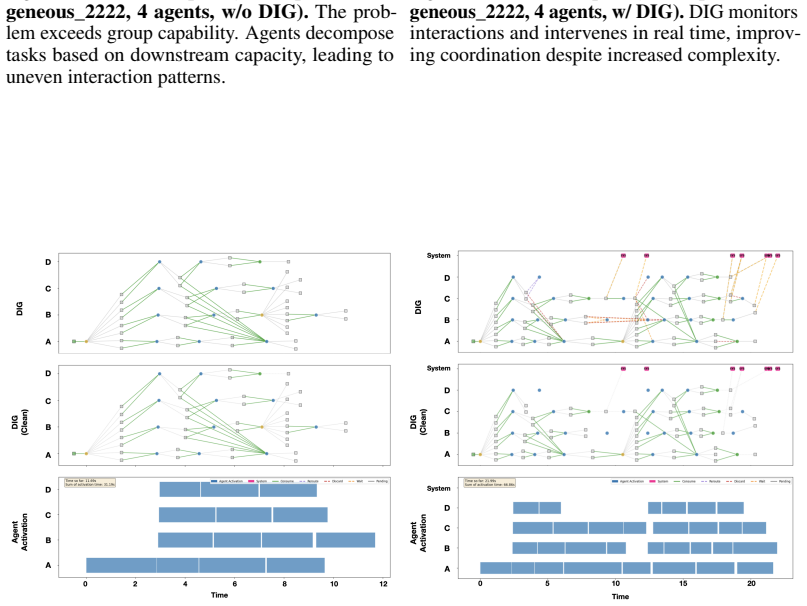
The Dynamic Interaction Graph and its canonical edge rewrite operators form the central mechanism. Agent activation nodes and event nodes make up a bipartite DAG; each incoming edge receives one of four fates—CONSUME, DELAY (wait), REROUTE, or DISCARD—and these fates act as local graph rewrites that update the DIG. The failure taxonomy and healing logic read these labels and the reachability structure: for example, an event whose recipient set is empty becomes an orphaned event, repeated REROUTEs become excessive rerouting, and a SUBMIT issued while reachable work remains is early termination. The graph carries the argument because all diagnosis is a function of its topology and edge labels.
Load-bearing premise
The construction assumes that every agent interaction can be reliably labeled with an action primitive (CONSUME, WAIT, REROUTE, DISCARD, SUBMIT) and that event payloads and recipient sets are observable; in the experiments this is guaranteed by forcing agents to output structured input_actions, so without that guarantee the DIG cannot be built from truly unconstrained natural-language conversations.
What would settle it
Run the same two tasks with agents whose messages are free-form natural language and no structured output protocol, then attempt to reconstruct DIG from the messages alone; if the edge-label mapping is unrecoverable or ambiguous, the protocol-agnostic claim is falsified. Alternatively, a task where unseen structural errors produce DIG topologies identical to successful ones would falsify the topological characterization.
If this is right
- If the graph-level characterization holds, real-time failure detection in multi-agent LLM systems can run without semantic judgment or access to agent reasoning, detecting deadlocks, premature submission, orphaned work, and redundant effort purely from trace structure.
- Healing can be automated at the interaction level: injecting guidance, rerouting events, or creating system events when a pattern is detected, without retraining or modifying agents.
- The approach scales to dense collaborations: in the paper's 20-agent case study, the DIG-enabled system produced a valid answer within 70 seconds where the unmonitored system failed to finish in 120 seconds, with 16 structural failures detected and corrected.
- The framework is intended as a compatibility layer: topology-level signals can feed into semantic or behavioral error detectors rather than replacing them, so existing failure-attribution methods can be augmented.
- Because DIG treats interaction structure as the object of analysis, it offers a protocol-agnostic ground for comparing different agent designs and for studying how cooperation emerges.
Where Pith is reading between the lines
- Editorial inference: If DIG is applied to agents that communicate in unrestricted natural language, the edge-labeling assumption becomes the bottleneck; the paper's evaluation forces agents to emit structured input_actions, so extending to free-text messages requires an additional parser whose reliability is not established. The absence of such a parser is the main openness gap.
- Editorial inference: The graph-rewrite view suggests a testable prediction: error frequency should be predictable from local topology statistics—reroute counts, orphaned-event counts, lineage-merger counts—before task completion, enabling classifiers trained on DIG features rather than agent outputs.
- Editorial inference: The failure taxonomy may generalize beyond LLM agents to any asynchronous message-passing system with comparable primitives, such as human crowdsourced workflows; if the same topology-to-failure mapping appears there, DIG would support a general theory of collaboration failure rather than one specific to LLM agents.
- Editorial inference: The trade-off observed—more detected failures and longer runtime with healing—suggests that naive structure-driven intervention can overcorrect; a cost-sensitive policy that learns which patterns warrant intervention versus mere logging would be a natural extension the paper does not develop.
Editorial analysis
A structured set of objections, weighed in public.
Referee Report
Summary. The paper introduces the Dynamic Interaction Graph (DIG), a time-evolving bipartite causal graph meant to represent asynchronous interactions among general-purpose LLM agents that collaborate without predefined roles or control flow. DIG labels each interaction edge with one of four primitives (CONSUME/WAIT/REROUTE/DISCARD) and defines local graph rewrite operators. The authors claim a topological characterization of collaboration-induced failures, a theorem that all observable system-level reasoning reduces to inference over DIG, and a structure-driven healing mechanism. They evaluate on two synthetic tasks (Count Frequency and Research Job) with homogeneous and heterogeneous agent teams, reporting error reductions, detection counts, and runtime, plus a 20-agent case study.
Significance. If the central claims held, DIG would offer a general, protocol-agnostic layer for monitoring and correcting emergent multi-agent LLM collaboration without access to agent internals or task semantics. The paper's conceptual framework is original and the evaluation setting is verifiable; the inclusion of per-run statistics in Appendix E and the 20-agent case study are strengths. However, the load-bearing assumption that edge labels are observable from natural-language interactions is not tested, and the empirical support for the headline error-reduction claim is statistically weak in most settings. The theoretical result is a tautology. The paper is therefore a promising but not yet established contribution.
major comments (4)
- [§4.2, Appendix B] The entire DIG construction, rewrite dynamics, and failure taxonomy depend on the per-edge action labels φ_v ∈ {CONSUME, DELAY, REROUTE, DISCARD}. In the evaluation, these labels are not inferred from natural language: Appendix B forces every agent to emit structured `input_actions` with an action and `reroute_to` recipients. This is a communication protocol, not a protocol-agnostic trace. The paper claims to be 'protocol-agnostic' (Fig. 1, §4), but no evidence is provided that arbitrary natural-language messages can be mapped reliably to these four primitives. A single message can simultaneously answer, forward, and request, so the labeling step is underdetermined. This is a load-bearing gap: without an automatic labeling mechanism, DIG cannot be built in the claimed general setting. Please either specify and evaluate such a mechanism, or substantially soften the protocol-agnostic claim
- [§4.3, Appendix A] Theorem 1 is effectively a restatement of its own assumption. The proof defines I(Ψ(T)) = Φ(T) by choosing a representative trace, which is well-defined only because Eq. (10) already assumes Φ is invariant over traces with isomorphic DIGs. The theorem therefore does not establish any substantive reduction; it merely rephrases the invariance condition. Since the paper presents this as a formal foundation for 'topological inference reduction,' it should be reframed as a definitional observation or removed. It does not, by itself, justify that failures detected from DIG structure correspond to actual task errors; final task error is measured externally via Eq. (9).
- [§7, Table 3] The text states that 'DIG consistently reduces final error in all settings,' but the significance tests in Table 3 show p<0.05 for task error only in three CF settings (4-agent homo 8000, 4-agent hetero 2222, 6-agent homo 12000). In the remaining five settings—including both Research Job rows—the task-error p-values are 0.061, 0.096, 0.124, 0.271, and 0.867, none significant at conventional levels. The claim of consistent improvement is therefore not statistically supported. Additionally, the MAS+LLM Judge baseline is only shown qualitatively in Fig. 5; no quantitative comparison of error, detection, or runtime is reported, so the statement that DIG 'avoids expensive semantic judging and provides more targeted intervention' is unsupported.
- [§5, §7] Detection and healing depend on several unspecified thresholds: 'reasonable time window' (MC, OE, DL) and 'reasonable number of times' (ER). No values are given in the main text or appendices, and no sensitivity analysis is reported. These free parameters can substantially affect how many failures are detected and healed, and therefore the reported error reductions are not fully reproducible. Please specify the thresholds and, ideally, show that the main results are robust to their variation.
minor comments (4)
- [§4.2] Terminology is inconsistent: the mapping φ_v is defined as {CONSUME, DELAY, REROUTE, DISCARD}, but the operators are called Wait (W) and the taxonomy uses 'WAIT'. Please unify the term (e.g., use 'WAIT' throughout).
- [Abstract and §8] The phrase 'for the first time' is used twice and is difficult to verify. I recommend softening to 'a framework that enables' or similar, unless a systematic comparison with all prior interaction-modeling approaches is provided.
- [§6] The paper claims to introduce 'the first dataset of execution traces' but no data repository or artifact URL is provided (only a project webpage). If the traces are part of the contribution, please include a link or appendix with the raw data.
- [Appendix G] The trace figures (Figs. 7–13) are very small and difficult to read in the PDF. Higher-resolution versions or vector graphics would help the reader verify the qualitative claims about interaction patterns.
Circularity Check
Theorem 1 is a definitional tautology (I is defined as Φ of a representative trace), so the formal 'reduction' restates its own invariance premise; the empirical evaluations provide independent grounding, and no load-bearing self-citation chain is present.
specific steps
-
self definitional
[Sec. 4.3, Theorem 1; Appendix A.1, Eqs. (10)-(12)]
"For any system-level functional Φ : T→ F that depends only on observable interactions, equivalently, is invariant over traces with isomorphic DIGs, there exists a graph functional I:{G(t)} t∈Z → F such that, for every trace T ∈T, Φ(T) = I(Ψ(T)). ... Define I on the range of Ψ by selecting any trace T ∈T such that Ψ(T) ={G(t)} t∈Z and setting I({G(t)} t∈Z) ≜ Φ(T)."
The theorem's conclusion is contained in its assumption. Invariance under DIG isomorphism is exactly the statement that Φ factors through Ψ; the proof then defines I to be Φ evaluated on a representative trace. No use is made of DIG topology, edge labels, causality, or any derived property. Eq. (12) is true by the definition in Eq. (11), so the claimed 'topological inference reduction' is a vacuous reformulation rather than an derived result.
full rationale
The only clear circularity is Theorem 1, which is a tautology: the proof constructs I by picking a representative trace and setting I(Ψ(T)) = Φ(T), so under the stated invariance assumption the result is immediate by definition. This does not independently establish that DIG topology enables failure inference; it merely renames the invariance assumption. The rest of the paper has substantial independent content: final task error is measured externally via coverage/over in Eq. (9), and the MAS+DIG vs MAS-Only comparisons are empirical, not forced by the construction. The largest validity gap, not a circular derivation, is that the edge labels CONSUME/WAIT/REROUTE/DISCARD are supplied by the agents themselves under the structured protocol in Appendix B, so the protocol-agnostic claim is untested for natural-language interaction. The paper's self-citations are not load-bearing. Overall, the formal centerpiece is definitional, but the empirical failure-detection and healing results are externally grounded, warranting a moderate circularity score rather than a high one.
Axiom & Free-Parameter Ledger
free parameters (2)
- detection time-window threshold
- excessive-rerouting count threshold
axioms (4)
- domain assumption Agents' observable outputs include reliable structured action labels (input_actions) mapping each event to CONSUME/WAIT/REROUTE/DISCARD.
- domain assumption The system-level functional Φ depends only on observable interactions and is invariant under DIG isomorphism.
- domain assumption Event payloads and delivery policies are fully observable and well-formed.
- domain assumption LLM agents follow the prompt instructions and output machine-readable actions accurately.
Cite this review
Pith. "Pith review of DIG to Heal: Scaling General-purpose Agent Collaboration via Explainable Dynamic Decision Paths." pith.science (2026). https://pith.science/paper/4RVNVVGG
@misc{pith2026260300309,
  author       = {Pith},
  title        = {Pith review of: DIG to Heal: Scaling General-purpose Agent Collaboration via Explainable Dynamic Decision Paths},
  year         = {2026},
  howpublished = {\url{https://pith.science/paper/4RVNVVGG}},
  note         = {Machine review of arXiv:2603.00309}
}
read the original abstract
The increasingly popular agentic AI paradigm promises to harness the power of multiple, general-purpose large language model (LLM) agents to collaboratively complete complex tasks. While many agentic AI systems reduce complexity through predefined workflows or fixed agent roles, the ideal is to support truly autonomous agents capable of emergent collaboration across many interacting agents. Yet in practice, such unstructured interactions often lead to redundant work and cascading failures that are difficult to interpret or correct. In this work, we study multi-agent systems composed of general-purpose LLM agents that solve problems through emergent collaboration, without relying on predefined roles, control flows, or communication constraints. We introduce the Dynamic Interaction Graph (DIG), which captures emergent collaboration as a time-evolving causal network of agent activations and interactions. DIG makes emergent collaboration observable and explainable for the first time, enabling real-time identification, explanation, and correction of collaboration-induced error patterns directly from agents' collaboration paths. Thus, DIG fills a critical gap in understanding how general LLM agents solve problems together in truly agentic multi-agent systems. The project webpage can be found at: https://happyeureka.github.io/dig.
Figures


Reference graph
Works this paper leans on
-
[1]
wait” instead. If you don’t want it, use “discard
= Φ(T2).(10) DefineIon the range ofΨby selecting any traceT ∈Tsuch thatΨ(T) ={G(t)} t∈Z and setting I {G(t)}t∈Z ≜Φ(T).(11) This definition is well-defined: if another trace T ′ ∈T satisfies Ψ(T ′) ={G(t)} t∈Z, then Ψ(T ′) ∼= Ψ(T) , so Eq.(10) gives Φ(T ′) = Φ(T) . Hence Eq. (11) does not depend on the chosen representative trace. Finally, for any traceT ∈...
2008
-
[9]
Chengcan Wu, Zhixin Zhang, Mingqian Xu, Zeming Wei, and Meng Sun. Monitoring llm-based multi-agent systems against corruptions via node evaluation.arXiv preprint arXiv:2510.19420,
-
[10]
Autogen: Enabling next-gen llm applications via multi-agent conversation framework
Qingyun Wu, Gagan Bansal, Jieyu Zhang, Yiran Wu, Shaokun Zhang, Erkang Zhu, Beibin Li, Li Jiang, Xiaoyun Zhang, and Chi Wang. Autogen: Enabling next-gen llm applications via multi-agent conversation framework. arXiv preprint arXiv:2308.08155,
-
[12]
URL https: //arxiv.org/abs/2502.05453. Chengyue Yu, Siyuan Lu, Chenyi Zhuang, Dong Wang, Qintong Wu, Zongyue Li, Runsheng Gan, Chunfeng Wang, Siqi Hou, Gaochi Huang, Wenlong Yan, Lifeng Hong, Aohui Xue, Yanfeng Wang, Jinjie Gu, David Tsai, and Tao Lin. Aworld: Orchestrating the training recipe for agentic ai,
-
[13]
URL https://arxiv. org/abs/2508.20404. Guibin Zhang, Junhao Wang, Junjie Chen, Wangchunshu Zhou, Kun Wang, and Shuicheng Yan. Agentracer: Who is inducing failure in the llm agentic systems?arXiv preprint arXiv:2509.03312, 2025a. Shaokun Zhang, Ming Yin, Jieyu Zhang, Jiale Liu, Zhiguang Han, Jingyang Zhang, Beibin Li, Chi Wang, Huazheng Wang, Yiran Chen, e...
-
[2002]
Towards a science of scaling agent systems.arXiv preprint arXiv:2512.08296,
Yubin Kim, Ken Gu, Chanwoo Park, Chunjong Park, Samuel Schmidgall, A Ali Heydari, Yao Yan, Zhihan Zhang, Yuchen Zhuang, Yun Liu, et al. Towards a science of scaling agent systems.arXiv preprint arXiv:2512.08296,
-
[2008]
Why do multi-agent llm systems fail?arXiv preprint arXiv:2503.13657,
Mert Cemri, Melissa Z Pan, Shuyi Yang, Lakshya A Agrawal, Bhavya Chopra, Rishabh Tiwari, Kurt Keutzer, Aditya Parameswaran, Dan Klein, Kannan Ramchandran, et al. Why do multi-agent llm systems fail?arXiv preprint arXiv:2503.13657,
-
[2013]
When agents go astray: Course- correcting swe agents with prms.arXiv preprint arXiv:2509.02360,
Shubham Gandhi, Jason Tsay, Jatin Ganhotra, Kiran Kate, and Yara Rizk. When agents go astray: Course- correcting swe agents with prms.arXiv preprint arXiv:2509.02360,
-
[2014]
Agent ai: Surveying the horizons of multimodal interaction
Zane Durante, Qiuyuan Huang, Naoki Wake, Ran Gong, Jae Sung Park, Bidipta Sarkar, Rohan Taori, Yusuke Noda, Demetri Terzopoulos, Yejin Choi, et al. Agent ai: Surveying the horizons of multimodal interaction. arXiv preprint arXiv:2401.03568,
-
[2016]
Qian Wang, Tianyu Wang, Zhenheng Tang, Qinbin Li, Nuo Chen, Jingsheng Liang, and Bingsheng He
URLhttps://arxiv.org/abs/1506.05254. Qian Wang, Tianyu Wang, Zhenheng Tang, Qinbin Li, Nuo Chen, Jingsheng Liang, and Bingsheng He. Megaagent: A large-scale autonomous llm-based multi-agent system without predefined sops. InFindings of the Association for Computational Linguistics: ACL 2025, pages 4998–5036,
Pith/arXiv arXiv 2025
-
[2023]
Beyond self-talk: A communication-centric survey of llm-based multi-agent systems
Bingyu Yan, Zhibo Zhou, Litian Zhang, Lian Zhang, Ziyi Zhou, Dezhuang Miao, Zhoujun Li, Chaozhuo Li, and Xiaoming Zhang. Beyond self-talk: A communication-centric survey of llm-based multi-agent systems. arXiv preprint arXiv:2502.14321,
-
[2024]
Fulin Lin, Shaowen Chen, Ruishan Fang, Hongwei Wang, and Tao Lin. Stop wasting your tokens: Towards efficient runtime multi-agent systems.arXiv preprint arXiv:2510.26585,
-
[2025]
Fanqi Kong, Ruijie Zhang, Huaxiao Yin, Guibin Zhang, Xiaofei Zhang, Ziang Chen, Zhaowei Zhang, Xiaoyuan Zhang, Song-Chun Zhu, and Xue Feng. Aegis: Automated error generation and attribution for multi-agent systems.arXiv preprint arXiv:2509.14295,
-
[2026]
URL https://openreview.net/forum?id= LGsed0QQVq
ISSN 2835-8856. URL https://openreview.net/forum?id= LGsed0QQVq. Survey Certification. Weize Chen, Yusheng Su, Jingwei Zuo, Cheng Yang, Chenfei Yuan, Chen Qian, Chi-Min Chan, Yujia Qin, Yaxi Lu, Ruobing Xie, et al. Agentverse: Facilitating multi-agent collaboration and exploring emergent behaviors in agents.arXiv preprint arXiv:2308.10848, 2(4):5,
This paper was first reviewed by deepseek-v4-flash on August 2, 2026.
discussion (0)
Sign in with ORCID, Apple, or X to comment. Anyone can read and Pith papers without signing in.