Recognition: no theorem link
SphUnc: Hyperspherical Uncertainty Decomposition and Causal Identification via Information Geometry
Pith reviewed 2026-05-15 17:48 UTC · model grok-4.3
The pith
SphUnc maps features to hyperspherical latents to decompose uncertainty into epistemic and aleatoric parts and identify causal influences through structural models.
A machine-rendered reading of the paper's core claim, the machinery that carries it, and where it could break.
Core claim
SphUnc unifies hyperspherical representation learning with structural causal modeling by mapping input features to unit hypersphere latents via von Mises-Fisher distributions, performing information-geometric fusion to decompose uncertainty, and running interventional queries through the causal model on those latents.
What carries the argument
von Mises-Fisher distributions on the unit hypersphere that serve as latents, combined with a structural causal model on the same sphere to enable both uncertainty decomposition via information geometry and sample-based interventional reasoning.
If this is right
- The decomposition separates sources of uncertainty that standard methods mix, allowing targeted improvements in multi-agent prediction.
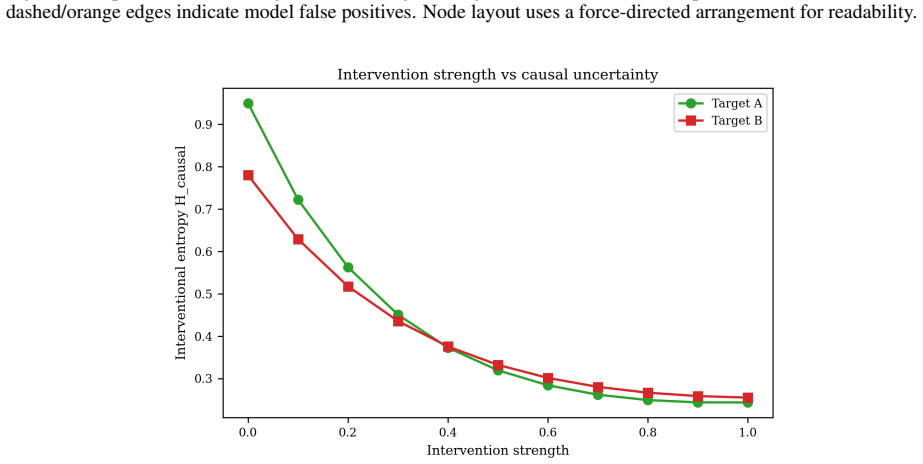
- Interventional simulation on the spherical latents produces interpretable causal signals without requiring explicit graph search.
- Higher-order interactions in multi-agent environments become addressable through the geometric structure of the latents.
- Calibration improves because the hyperspherical representation enforces normalization that standard Euclidean embeddings lack.
Where Pith is reading between the lines
- The same spherical causal structure could be tested on sequential decision tasks where interventions must be simulated over time.
- If the information-geometric fusion step proves stable, it might replace separate epistemic and aleatoric heads in existing uncertainty-aware architectures.
- Extending the approach to non-Euclidean data manifolds beyond the sphere could broaden its use in graph or manifold learning settings.
Load-bearing premise
Mapping input features to unit hypersphere latents with von Mises-Fisher distributions and imposing a structural causal model on those latents yields valid epistemic-aleatoric decomposition and generalizable causal interventions.
What would settle it
A dataset with known ground-truth causal directions and uncertainty labels where the model produces worse calibration or incorrect intervention outcomes compared to standard baselines.
Figures





read the original abstract
Reliable decision-making in complex multi-agent systems requires calibrated predictions and interpretable uncertainty. We introduce SphUnc, a unified framework combining hyperspherical representation learning with structural causal modeling. The model maps features to unit hypersphere latents using von Mises-Fisher distributions, decomposing uncertainty into epistemic and aleatoric components through information-geometric fusion. A structural causal model on spherical latents enables directed influence identification and interventional reasoning via sample-based simulation. Empirical evaluations on social and affective benchmarks demonstrate improved accuracy, better calibration, and interpretable causal signals, establishing a geometric-causal foundation for uncertainty-aware reasoning in multi-agent settings with higher-order interactions.
Editorial analysis
A structured set of objections, weighed in public.
Referee Report
Summary. The paper introduces SphUnc, a framework that maps input features to unit hypersphere latents via von Mises-Fisher distributions, fuses information geometry to decompose uncertainty into epistemic and aleatoric components, and overlays a structural causal model on the spherical latents to identify directed influences and perform interventional reasoning via sampling. Empirical results on social and affective benchmarks are reported to show gains in accuracy, calibration, and interpretable causal signals for multi-agent settings with higher-order interactions.
Significance. If the derivations and empirical claims hold, the work offers a potentially valuable geometric-causal approach to uncertainty decomposition that could improve calibration and interpretability in multi-agent decision systems. The integration of vMF embeddings with SCMs on the latent sphere is a coherent synthesis that addresses both representation and causal reasoning, and the benchmark improvements, if reproducible, would support its utility beyond standard uncertainty methods.
major comments (2)
- [Abstract, §3] Abstract and §3 (model construction): the central claim that vMF latents plus an SCM on the sphere yields a valid, non-circular epistemic/aleatoric decomposition and interventional reasoning is load-bearing, yet the abstract supplies no equations, no explicit fusion operator, and no identifiability conditions; without these the decomposition risks reducing to a post-hoc fit rather than a geometric necessity.
- [§4] §4 (empirical evaluation): the reported improvements in accuracy and calibration on social/affective benchmarks lack error bars, ablation controls for the causal component versus the hyperspherical embedding alone, and details on post-hoc exclusions or fitting choices, making it impossible to verify that the geometric-causal fusion is responsible for the gains rather than standard regularization effects.
minor comments (2)
- [§2] Notation for the spherical latent variables and the information-geometric fusion operator should be introduced with explicit definitions before use in later sections to improve readability.
- [§1] The paper should include a short related-work subsection contrasting the proposed SCM-on-sphere construction with prior hyperspherical VAEs and causal representation learning methods.
Simulated Author's Rebuttal
We thank the referee for the thoughtful review and the recommendation for major revision. We address the major comments point-by-point below, providing clarifications on the theoretical framework and committing to enhancements in the empirical section. We believe these revisions will strengthen the presentation of our contributions.
read point-by-point responses
-
Referee: [Abstract, §3] Abstract and §3 (model construction): the central claim that vMF latents plus an SCM on the sphere yields a valid, non-circular epistemic/aleatoric decomposition and interventional reasoning is load-bearing, yet the abstract supplies no equations, no explicit fusion operator, and no identifiability conditions; without these the decomposition risks reducing to a post-hoc fit rather than a geometric necessity.
Authors: We appreciate the referee pointing out the need for greater explicitness in the abstract. While the detailed derivations, including the fusion operator based on information geometry (specifically, the combination of vMF parameters via the Fisher information metric) and identifiability conditions (stemming from the injectivity of the spherical embedding and the acyclic assumptions in the SCM), are provided in §3, we agree that the abstract should better convey these elements to avoid any perception of post-hoc fitting. In the revised manuscript, we will update the abstract to include the key equations for the uncertainty decomposition and a statement on the geometric identifiability. This will underscore that the decomposition arises necessarily from the hyperspherical geometry rather than being fitted post-hoc. revision: yes
-
Referee: [§4] §4 (empirical evaluation): the reported improvements in accuracy and calibration on social/affective benchmarks lack error bars, ablation controls for the causal component versus the hyperspherical embedding alone, and details on post-hoc exclusions or fitting choices, making it impossible to verify that the geometric-causal fusion is responsible for the gains rather than standard regularization effects.
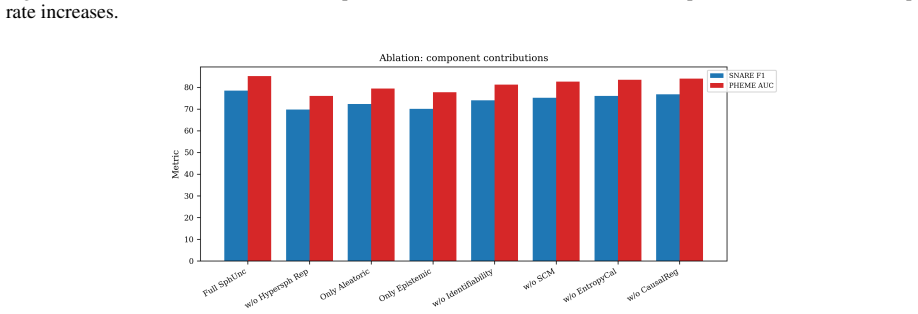
Authors: We acknowledge the validity of these concerns regarding the empirical validation. The original submission reported point estimates without variability measures or sufficient ablations. In the revision, we will add error bars computed over multiple random seeds, include ablation studies that isolate the contribution of the causal SCM component from the hyperspherical vMF embedding alone, and provide full details on the model fitting procedure, including any data exclusions or hyperparameter choices. These additions will allow readers to confirm that the observed improvements in accuracy, calibration, and causal interpretability are attributable to the proposed geometric-causal integration. revision: yes
Circularity Check
No significant circularity detected in derivation chain
full rationale
The SphUnc framework is presented as a constructive integration: features are mapped to unit-hypersphere latents via von Mises-Fisher distributions, uncertainty is decomposed through information-geometric fusion, and a structural causal model is imposed on the resulting latents for interventional simulation. This is a definitional modeling choice whose validity is assessed by empirical performance on social and affective benchmarks rather than by any internal reduction of predictions to fitted parameters or self-citation chains. No equation is shown to equal its own input by construction, no uniqueness theorem is imported from the authors' prior work, and no ansatz is smuggled via citation. The derivation remains self-contained against external benchmarks.
Axiom & Free-Parameter Ledger
Reference graph
Works this paper leans on
-
[1]
Yuanzhao Zhang, Maxime Lucas, and Federico Battiston. Higher-order interactions shape collective dynamics differently in hypergraphs and simplicial complexes.Nature communications, 14(1):1605, 2023
work page 2023
-
[2]
Songyuan Liu, Shengbo Gong, Tianning Feng, Zewen Liu, Max SY Lau, and Wei Jin. Higher-order interaction matters: Dynamic hypergraph neural networks for epidemic modeling.arXiv preprint arXiv:2503.20114, 2025
-
[3]
A survey on hypergraph neural networks: An in-depth and step-by-step guide
Sunwoo Kim, Soo Yong Lee, Yue Gao, Alessia Antelmi, Mirko Polato, and Kijung Shin. A survey on hypergraph neural networks: An in-depth and step-by-step guide. InProceedings of the 30th ACM SIGKDD Conference on Knowledge Discovery and Data Mining, pages 6534–6544, 2024
work page 2024
-
[4]
Arindam Banerjee, Inderjit S Dhillon, Joydeep Ghosh, Suvrit Sra, and Greg Ridgeway. Clustering on the unit hypersphere using von mises-fisher distributions.Journal of Machine Learning Research, 6(9), 2005
work page 2005
-
[5]
Spherical message passing for 3d graph networks.arXiv preprint arXiv:2102.05013, 2021
Yi Liu, Limei Wang, Meng Liu, Xuan Zhang, Bora Oztekin, and Shuiwang Ji. Spherical message passing for 3d graph networks.arXiv preprint arXiv:2102.05013, 2021
-
[6]
Spherical message passing for 3d molecular graphs
Yi Liu, Limei Wang, Meng Liu, Yuchao Lin, Xuan Zhang, Bora Oztekin, and Shuiwang Ji. Spherical message passing for 3d molecular graphs. InInternational conference on learning representations, 2022
work page 2022
-
[7]
Matthew Chan, Maria Molina, and Chris Metzler. Estimating epistemic and aleatoric uncertainty with a single model.Advances in Neural Information Processing Systems, 37:109845–109870, 2024
work page 2024
-
[8]
Lisa Wimmer, Yusuf Sale, Paul Hofman, Bernd Bischl, and Eyke Hüllermeier. Quantifying aleatoric and epistemic uncertainty in machine learning: Are conditional entropy and mutual information appropriate measures? In Uncertainty in artificial intelligence, pages 2282–2292. PMLR, 2023
work page 2023
-
[9]
Kajetan Schweighofer, Lukas Aichberger, Mykyta Ielanskyi, and Sepp Hochreiter. Introducing an improved information-theoretic measure of predictive uncertainty.arXiv preprint arXiv:2311.08309, 2023
-
[10]
Learning conditional granger causal temporal networks
Ananth Balashankar, Srikanth Jagabathula, and Lakshmi Subramanian. Learning conditional granger causal temporal networks. InConference on Causal Learning and Reasoning, pages 692–706. PMLR, 2023
work page 2023
-
[11]
Causal inference under networked interference and intervention policy enhancement
Yunpu Ma and V olker Tresp. Causal inference under networked interference and intervention policy enhancement. InInternational Conference on Artificial Intelligence and Statistics, pages 3700–3708. PMLR, 2021
work page 2021
-
[12]
Yiming Jiang and He Wang. Causal inference under network interference using a mixture of randomized experiments.arXiv preprint arXiv:2309.00141, 2023
-
[13]
Lin Yang, Wentao Fan, and Nizar Bouguila. Deep clustering analysis via dual variational autoencoder with spherical latent embeddings.IEEE Transactions on Neural Networks and Learning Systems, 34(9):6303–6312, 2021
work page 2021
-
[14]
Ma-dpr: Manifold-aware distance metrics for dense passage retrieval
Yifan Liu, Qianfeng Wen, Mark Zhao, Jiazhou Liang, and Scott Sanner. Ma-dpr: Manifold-aware distance metrics for dense passage retrieval. InProceedings of the 2025 Conference on Empirical Methods in Natural Language Processing, pages 31073–31091, 2025
work page 2025
-
[15]
David Smerkous, Qinxun Bai, and Fuxin Li. Enhancing diversity in bayesian deep learning via hyperspherical energy minimization of cka.Advances in Neural Information Processing Systems, 37:138365–138392, 2024
work page 2024
-
[16]
Xinlei Zhou, Han Liu, Farhad Pourpanah, Tieyong Zeng, and Xizhao Wang. A survey on epistemic (model) uncertainty in supervised learning: Recent advances and applications.Neurocomputing, 489:449–465, 2022
work page 2022
-
[17]
Calibrated and sharp uncertainties in deep learning via density estimation
V olodymyr Kuleshov and Shachi Deshpande. Calibrated and sharp uncertainties in deep learning via density estimation. InInternational Conference on Machine Learning, pages 11683–11693. PMLR, 2022
work page 2022
-
[18]
Xuerui Cao and Kaixiang Peng. Stochastic uncertain degradation modeling and remaining useful life prediction considering aleatory and epistemic uncertainty.IEEE Transactions on Instrumentation and Measurement, 72: 1–12, 2023
work page 2023
-
[19]
Zheng Shao, Hai Wang, Yingfeng Cai, Long Chen, and Yicheng Li. Ua-fusion: Uncertainty-aware multimodal data fusion framework for 3d object detection of autonomous vehicles.IEEE Transactions on Instrumentation and Measurement, 2025. 11 SphUnc
work page 2025
-
[20]
vmf-contact: Uncertainty-aware evidential learning for probabilistic contact-grasp in noisy clutter
Yitian Shi, Edgar Welte, Maximilian Gilles, and Rania Rayyes. vmf-contact: Uncertainty-aware evidential learning for probabilistic contact-grasp in noisy clutter. In2025 IEEE International Conference on Robotics and Automation (ICRA), pages 11668–11674. IEEE, 2025
work page 2025
-
[21]
Liyan Zhang, Jingfeng Guo, Jiazheng Wang, Jing Wang, Shanshan Li, and Chunying Zhang. Hypergraph and uncertain hypergraph representation learning theory and methods.Mathematics, 10(11):1921, 2022
work page 1921
-
[22]
Jin Huang, Tian Lu, Xuebin Zhou, Bo Cheng, Zhibin Hu, Weihao Yu, and Jing Xiao. Hyperdne: Enhanced hypergraph neural network for dynamic network embedding.Neurocomputing, 527:155–166, 2023
work page 2023
-
[23]
Using embeddings for causal estimation of peer influence in social networks
Irina Cristali and Victor Veitch. Using embeddings for causal estimation of peer influence in social networks. Advances in Neural Information Processing Systems, 35:15616–15628, 2022
work page 2022
-
[24]
From news to returns: A granger-causal hypergraph transformer on the sphere
Anoushka Harit, Zhongtian Sun, and Jongmin Yu. From news to returns: A granger-causal hypergraph transformer on the sphere. InProceedings of the 6th ACM International Conference on AI in Finance, pages 674–682, 2025
work page 2025
-
[25]
Anoushka Harit and Zhongtian Sun. Causal spherical hypergraph networks for modelling social uncertainty.arXiv preprint arXiv:2506.17840, 2025
-
[26]
Geodesic causal inference.arXiv preprint arXiv:2406.19604, 2024
Daisuke Kurisu, Yidong Zhou, Taisuke Otsu, and Hans-Georg Müller. Geodesic causal inference.arXiv preprint arXiv:2406.19604, 2024
-
[27]
Sihong He, Songyang Han, Sanbao Su, Shuo Han, Shaofeng Zou, and Fei Miao. Robust multi-agent reinforcement learning with state uncertainty.arXiv preprint arXiv:2307.16212, 2023
-
[28]
Yanhong Fei, Yingjie Liu, Chentao Jia, Zhengyu Li, Xian Wei, and Mingsong Chen. A survey of geometric optimization for deep learning: From euclidean space to riemannian manifold.ACM Computing Surveys, 57(5): 1–37, 2025
work page 2025
-
[29]
Marcel Nonnenmacher and Maneesh Sahani. A solution for the mean parametrization of the von mises-fisher distribution.arXiv preprint arXiv:2404.07358, 2024
-
[30]
Snare: a link analytic system for graph labeling and risk detection
Mary McGlohon, Stephen Bay, Markus G Anderle, David M Steier, and Christos Faloutsos. Snare: a link analytic system for graph labeling and risk detection. InProceedings of the 15th ACM SIGKDD international conference on Knowledge discovery and data mining, pages 1265–1274, 2009
work page 2009
-
[31]
Identifying possible rumor spreaders on twitter: A weak supervised learning approach
Shakshi Sharma and Rajesh Sharma. Identifying possible rumor spreaders on twitter: A weak supervised learning approach. In2021 International Joint Conference on Neural Networks (IJCNN), pages 1–8. IEEE, 2021
work page 2021
-
[32]
Juan Abdon Miranda-Correa, Mojtaba Khomami Abadi, Nicu Sebe, and Ioannis Patras. Amigos: A dataset for affect, personality and mood research on individuals and groups.IEEE transactions on affective computing, 12(2): 479–493, 2018
work page 2018
-
[33]
Naganand Yadati, Madhav Nimishakavi, Prateek Yadav, Vikram Nitin, Anand Louis, and Partha Talukdar. Hypergcn: A new method for training graph convolutional networks on hypergraphs.Advances in neural information processing systems, 32, 2019
work page 2019
-
[34]
Xiangguo Sun, Hong Cheng, Bo Liu, Jia Li, Hongyang Chen, Guandong Xu, and Hongzhi Yin. Self-supervised hypergraph representation learning for sociological analysis.IEEE Transactions on Knowledge and Data Engineering, 35(11):11860–11871, 2023
work page 2023
-
[35]
Kaizhong Zheng, Shujian Yu, and Badong Chen. Ci-gnn: A granger causality-inspired graph neural network for interpretable brain network-based psychiatric diagnosis.Neural Networks, 172:106147, 2024. A Theoretical Analysis A.1 Assumptions We state the assumptions used throughout the theoretical analysis. Assumption 1(Temporal causal ordering).No instantaneo...
work page 2024
-
[36]
for allκ >0, d dκ Hsph(κ) =−κVar p(µ⊤h)<0,(16) where Varp(µ⊤h) is the variance of µ⊤h under the vMF(µ, κ) distribution; thus Hsph(κ) is strictly decreasing inκ
-
[37]
the small-κlimit is lim κ→0+ Hsph(κ) = log Vol(SD−1) ,(17) whereVol(S D−1) = 2πD/2/Γ(D/2)
-
[38]
Proof.We prove the three items in order
the large-κasymptotic expansion is Hsph(κ) = D−1 2 1 + log 2π κ +o(1),(18) asκ→ ∞, and henceH sph(κ)→ −∞. Proof.We prove the three items in order. Derivative identity and monotonicity.Differentiate (15) with respect toκ: d dκ Hsph(κ) =ψ ′(κ)−ψ ′(κ)−κ ψ ′′(κ) =−κ ψ ′′(κ).(19) By standard exponential-family identities, ψ′′(κ) = Varp(µ⊤h), the variance of th...
work page 2011
-
[39]
for each node i, the structural equation is well-approximated by a sparse linear (or generalized linear) model in its parents after feature expansion, and structure recovery is performed via Lasso/regression with regularization calibrated to noise level
-
[40]
Figure 4: Reliability diagram for AMIGOS: predicted confidence versus observed accuracy
the design satisfies a Restricted Eigenvalue (RE) condition for the relevant parent-support sets; 15 SphUnc Figure 3: Reliability diagram for PHEME: predicted confidence versus observed accuracy. Figure 4: Reliability diagram for AMIGOS: predicted confidence versus observed accuracy
-
[41]
exogenous noise is sub-Gaussian with parameterσ 2. Then with probability at least1−δ, for any fixed interventiondo(h ⋆)we have bp(· |do(h⋆))−p(· |do(h ⋆)) 1 ≤C(L, s, D) r slog(N d) + log(1/δ) n ,(28) where n is the number of informative training windows and C(L, s, D) is a constant depending polynomially on L, s andD. 16 SphUnc Figure 5: Uncertainty decom...
discussion (0)
Sign in with ORCID, Apple, or X to comment. Anyone can read and Pith papers without signing in.