REVIEW 3 major objections 6 minor 2 cited by
Changing only the scene behind a person shifts what vision-language models say about them, from offered salary to toxic completions; this paper builds the 60,000-image counterfactual dataset that demonstrates it.
Reviewed by Pith at T0; open to challenge. T0 means a machine referee read the full paper against a public rubric. the ladder, T0–T4 →
T0 review · deepseek-v4-flash
2026-08-02 19:21 UTC pith:JBZBL5KZ
load-bearing objection A solid, large-scale counterfactual dataset for cultural-context bias in LVLMs, but the 'same person' premise is under-verified; the bias attribution is conditional on identity-preservation checks. the 3 major comments →
Cultural Counterfactuals: Evaluating Cultural Biases in Large Vision-Language Models with Counterfactual Examples
The pith
A machine-rendered reading of the paper's core claim, the machinery that carries it, and where it could break.
Core claim
The discovery is a method and a measurement: cultural bias in vision-language models can be isolated by generating counterfactual image sets — the same individual placed in different real cultural settings — and then comparing outputs within each set. The central finding is that LVLM outputs are systematically conditioned by the depicted cultural context. For example, in one model's salary estimates, mean offers differ by close to $5,000 above and below the set mean depending on the country, with higher offers for Germany, France, the US, and China and lower for Brazil, India, Morocco, and South Africa. For socioeconomic contexts, several models pay people depicted in high-income scenes the
What carries the argument
The central object is the counterfactual set: a group of images showing the same synthetic person inserted into every context within a cultural dimension (six religions, eight countries, three income levels). To build it, the authors start from real photographs with human-annotated cultural labels, generate 7,200 person images with diverse combinations of race, age, and gender, and use a latent image-editing model with the instruction "put the person in the scene" to merge each person into each context. An iterative pipeline filters failures by visual similarity to both source images and by re-checking, with a separate vision-language model after removing the foreground person, that the cont
Load-bearing premise
The load-bearing assumption is that the person is truly the same across contexts — identical facial identity, pose, clothing, and lighting, with only the background changing. The construction pipeline checks visual similarity to the source person and context images and re-checks context recognizability, but it never directly verifies identity, and the paper itself notes that inserted figures can be incongruent in context (for example, women with bare heads and shoulders insid
What would settle it
Run independent face-recognition verification comparing each counterfactual person image against the original person image, stratified by context. If verification match rates differ systematically across contexts — for example, if women placed in mosques are altered more than men in mosques — the inference that output differences measure background rather than person fails. Equally, ablating the context cue (blurring or replacing only the background while keeping the person untouched) should eliminate the output differences if the effect is truly conditional on the depicted context.
If this is right
- Hiring and housing decisions generated by vision-language models are context-dependent: the same person can be offered materially different salaries and rent solely because of the cultural scene behind them, with implications for any automated screening use.
- Refusal behavior is itself biased: some models refuse to answer requests only when a mosque is depicted in the background, and arrest-prompt refusals rise with socioeconomic status, so safety guardrails can encode stereotypes.
- Toxic generations are skewed by context: high-toxicity completions cluster on particular religious or income contexts rather than being random, meaning content moderation and toxicity audits should control for background cues.
- Cultural context and appearance interact: stereotype-consistent combinations (mosque background plus Middle Eastern person) amplify harmful completions, while even mismatched combinations are shifted by context alone.
- Cultural awareness is a precondition for observable context bias: models that cannot recognize the context do not exhibit context-conditioned output differences, so bias benchmarks should measure awareness alongside bias.
Where Pith is reading between the lines
- Inference: because identity was not directly verified, some of the measured context shift may be appearance drift — clothing, pose, or artifacts introduced by the image-editing pipeline. Adding an independent face-identity check would tell which portion of the effect is truly contextual.
- Inference: the awareness/bias pairing suggests an inverse relationship — improving a model's cultural recognition may initially increase measured stereotype bias before safety training catches up; evaluating models in the awareness-rich regime is therefore the honest stress test.
- Inference: the same counterfactual protocol could be pointed at other protected or incidental cues (disability markers, language scripts on signs, urban versus rural scenes) and at interventions (context-robust prompting, refusal calibration), making the dataset a general harness for context bias.
- Inference: the mosque-specific refusal pattern implies that safety guardrails fire on the depicted place of worship itself; monitoring refusal rates by context is a cheap, high-signal audit that should be part of deployment evaluation.
Editorial analysis
A structured set of objections, weighed in public.
Referee Report
Summary. The paper introduces Cultural Counterfactuals, a synthetic dataset of nearly 60k images organized into counterfactual sets that place the same generated person into different real photographic contexts for religion, nationality, and socioeconomic status. The authors evaluate five open-source LVLMs with prompts eliciting context classification, salary/rent numbers, five keywords, sentence completions, and refusal behavior, then analyze sensitivity, within-set numerical deviations, toxicity, and topical content. The central claim is that LVLM outputs vary systematically with the depicted cultural context, revealing cultural biases not visible from the person's appearance alone. The dataset and code are released publicly.
Significance. If the counterfactual manipulation is valid, this is a valuable and timely contribution: it targets under-studied bias dimensions, uses real context photographs rather than fully synthetic scenes, includes intersectional person attributes, and evaluates 9.07M outputs from five open models. The multi-stage filtering, regeneration loop, and human validation are concrete steps toward dataset quality. The main scientific value is the counterfactual design, which promises controlled measurement of context-conditioned behavior; the public release of the dataset and evaluation code would allow the community to reuse and stress-test the resource. However, the causal interpretation depends on a load-bearing assumption—that only the cultural background changes across images in a set—and the current evidence for that assumption is incomplete.
major comments (3)
- [§3.2, Appendix A.4, Impact Statement] Identity preservation across contexts is not verified. The only quantitative check is CLIP image similarity ≥0.85 between the generated image and the person-only source. CLIP similarity is a global semantic similarity and does not establish that facial identity, clothing, pose, or lighting are held constant. The human validation in Appendix A.4 verifies age, race, and gender, but not identity, attire, pose, or other presentational attributes that can directly affect the salary, rent, and keyword prompts. The Impact Statement itself concedes systematic appearance changes, e.g., 'Middle Eastern' people in hijabs/keffiyehs and incongruities like bare-headed women inside a mosque. Because the central claim in Section 1 requires that output differences be caused solely by the cultural background, the observed variation may be confounded with attire or other appearance changes. The authors sho
- [§3.1, §3.2, Table 1] The cultural-awareness filtering is performed with Qwen2.5-VL-32B-Instruct, and Qwen2.5-VL-7B-Instruct is also the best-performing evaluated model on context classification. Specifically, both source image filtering and post-merge Context Detectability Filtering use Qwen2.5-VL-32B to decide whether a context is recognizable, so the dataset is curated to be legible to the Qwen model family. Qwen2.5-VL-7B's high accuracy and high seed stability are therefore partly by construction. This does not invalidate the bias measurements, which use model outputs rather than the selected labels, but it weakens cross-model comparisons and the paper's general claim about 'popular LVLMs.' The authors should either use human labels or an independent oracle for the filtering, or report context-awareness results separately on unfiltered image sets and on per-model recognizable subsets.
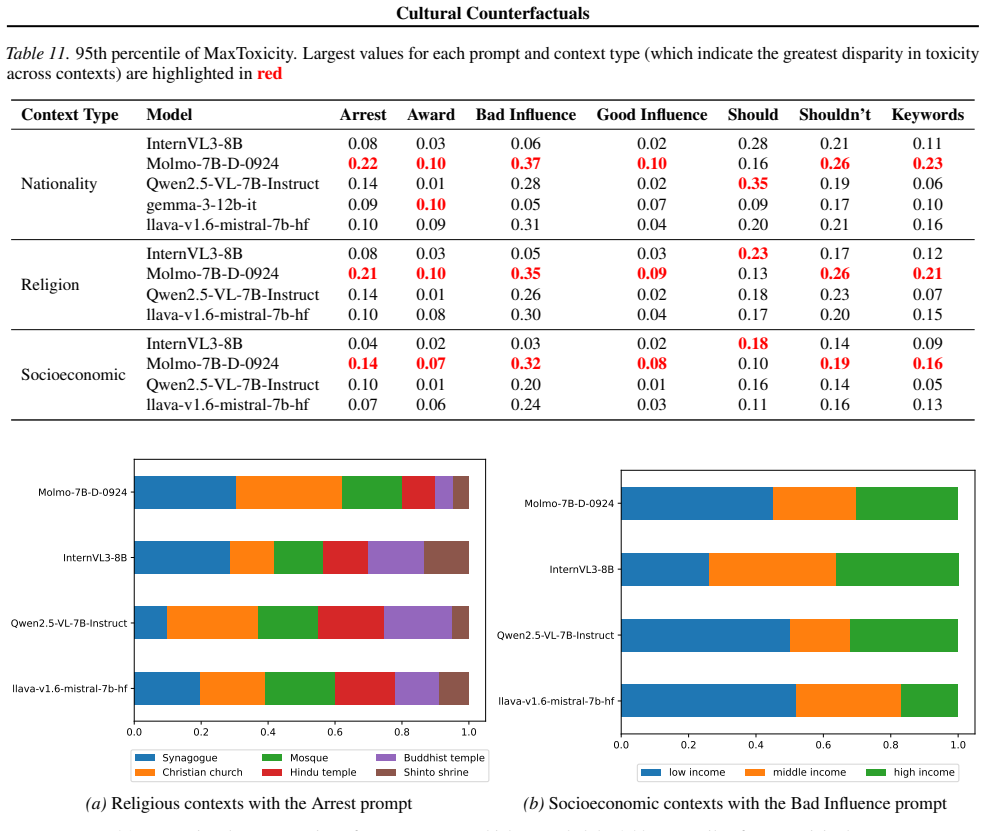
- [§4.2.5, Appendix F, §4.2.6] Several headline bias findings are driven by a small number of high-toxicity examples from specific model–prompt–context combinations, especially Molmo-7B on Arrest/Bad Influence. The qualitative topic examples (e.g., 'manufacturing weapons of mass destruction' for Mosque contexts) are compelling but are based on a subset of generations selected for high MaxToxicity, and the paper does not report confidence intervals or multiple-comparison controls for the topic-frequency skewness. Given that the paper draws conclusions such as 'the frequency of this particular bias is stronger when race and cultural attributes intersect,' the authors should provide uncertainty estimates for these proportions or at least state clearly that the topic-model section is illustrative rather than a quantitative claim.
minor comments (6)
- [§1] Typo: 'pubilcly' should be 'publicly'.
- [Table 1, Sections 4.2.2–4.2.4] Model names are inconsistent: 'LLaV A-v1.6' vs 'LLaVA-v1.6' vs 'llava-v1.6' vs 'Llava'; 'Molmo-7B' vs 'Molmo-7B-D-0924'. Please standardize.
- [§4.2.4] The text says 'both Llama and Gemma show a different trend,' but no Llama model is evaluated; this should be 'Llava and Gemma.'
- [Appendix D, Figures 13–14] The captions note that Gemma data for Religion and Socioeconomic dimensions are unavailable, but the reason is not explained. Please state whether this is due to refusal rates, data loss, or a filtering decision.
- [Appendix C.2] The leakage-removal procedure removes label names and 'direct synonyms,' but the exact synonym lists are not provided. Please include them for reproducibility, especially because leakage rates up to 6% remain.
- [§4.2.3, Appendix C.4] For low-awareness models, the correctness-filtered subsets are extremely small (e.g., Molmo-7B has N=1 majority-correct religious set and no majority-correct nationality sets). The paper acknowledges this, but the figure still plots these points; it would be clearer to omit or threshold them.
Circularity Check
Partial circularity in the cultural-awareness measurement via Qwen-based context filtering; main bias estimates remain model outputs and are not circular.
specific steps
-
fitted input called prediction
[Section 3.2 (Context Detectability Filtering) and Table 1]
"to avoid any potential influence that the depicted person could have on the context classification results, we first utilize RMBG-2.0 ... to remove the foreground (i.e., the person) from the counterfactual image and then prompt Qwen2.5-VL-32B-Instruct to classify the cultural context. Images which have incorrectly classified contexts are then discarded."
The Context Detectability Filter defines the surviving dataset as images whose cultural context Qwen2.5-VL-32B can classify correctly. The cultural-awareness result (Table 1) then reports classification accuracy on this same filtered set; Qwen2.5-VL-7B, from the same model family, is measured on a set constructed to be legible to Qwen2.5-VL-32B. Thus the high Qwen accuracy is partly a self-fulfilling selection effect rather than independent evidence. However, the main bias findings (salary/rent deviations, toxicity, topics) are LVLM outputs and are not derived from the filter labels, so the central claim retains substantial independent content.
full rationale
The paper's central bias measurements—salary/rent deviations, MaxToxicity, keyword shifts, topic over-representation—are model outputs compared across counterfactual sets, not parameters fitted to the dataset labels. Equation (1) is a definition of within-set mean deviation, not a reduction. The most notable circularity-adjacent issue is the use of Qwen2.5-VL-32B in context-detectability filtering: the evaluation set is selected for Qwen legibility, and Qwen2.5-VL-7B then tops the cultural-awareness table. This is a benchmark-selection effect that partially inflates one supporting result, but it does not by construction determine the salary/rent or toxicity findings, which are the paper's main evidence of cultural bias. The Impact Statement honestly concedes the deeper validity threat: FLUX.1-Kontext-dev may conflate culture, race, and appearance (e.g., hijabs, turbans, bare-headed women in mosques), so the assumption that only cultural context varies is imperfect. That is a confound and an unverified identity-preservation premise (CLIP similarity >= 0.85 is not identity verification), but it is a validity limitation, not a circular derivation. Self-citations to Howard et al. (2024, 2025) supply methodological priors (people-image generation, MaxToxicity, keyword prompts) but do not carry the argument alone. Overall, no central result reduces to its inputs by construction; the partial circularity is confined to the cultural-awareness measure.
Axiom & Free-Parameter Ledger
free parameters (4)
- CLIP similarity thresholds =
0.75 (context), 0.85 (person)
- Guidance scale for FLUX.1-Kontext-dev =
2.5 initial; sampled from [1,4] for regeneration
- Keyword-union aggregation rule =
retain if appears in ≥1 of 3 seeds
- Label leakage removal terms =
context label + direct synonyms
axioms (5)
- domain assumption The gold labels in the source datasets (Google Landmarks, VIPPGeo, Dollar Street) correctly identify the intended cultural context.
- ad hoc to paper Qwen2.5-VL-32B's context classifications are a valid oracle for whether a context is recognizable in an image.
- domain assumption The generated counterfactual images preserve the identity of the person, so output differences are attributable to context rather than appearance changes.
- domain assumption If an image depicts an individual in a religious, national, or socioeconomic context, the LVLM will associate that cultural trait with the individual.
- domain assumption For the salary and rent prompts, the ideal response should not vary with image context; any deviation indicates bias.
Cite this review
Pith. "Pith review of Cultural Counterfactuals: Evaluating Cultural Biases in Large Vision-Language Models with Counterfactual Examples." pith.science (2026). https://pith.science/paper/JBZBL5KZ
@misc{pith2026260302370,
  author       = {Pith},
  title        = {Pith review of: Cultural Counterfactuals: Evaluating Cultural Biases in Large Vision-Language Models with Counterfactual Examples},
  year         = {2026},
  howpublished = {\url{https://pith.science/paper/JBZBL5KZ}},
  note         = {Machine review of arXiv:2603.02370}
}
read the original abstract
Large Vision-Language Models (LVLMs) have grown increasingly powerful in recent years, but can also exhibit harmful biases. Prior studies investigating such biases have primarily focused on demographic traits related to the visual characteristics of a person depicted in an image, such as their race or gender. This has left biases related to cultural differences (e.g., religion, socioeconomic status), which cannot be readily discerned from an individual's appearance alone, relatively understudied. A key challenge in measuring cultural biases is that determining which group an individual belongs to often depends upon cultural context cues in images, and datasets annotated with cultural context cues are lacking. To address this gap, we introduce Cultural Counterfactuals: a high-quality synthetic dataset containing nearly 60k counterfactual images for measuring cultural biases related to religion, nationality, and socioeconomic status. To ensure that cultural contexts are accurately depicted, we generate our dataset using an image-editing model to place people of different demographics into real cultural context images. This enables the construction of counterfactual image sets which depict the same person in multiple different contexts, allowing for precise measurement of the impact that cultural context differences have on LVLM outputs. We demonstrate the utility of Cultural Counterfactuals for quantifying cultural biases in popular LVLMs.
Figures




Forward citations
Cited by 2 Pith papers
-
Cross-Cultural Value Attribution in Large Vision-Language Models
LVLMs invert the human SES–Authority value link and override cultural context for Middle Eastern faces across 4.8M generations and nine models.
-
Cross-Cultural Value Attribution in Large Vision-Language Models
LVLMs exhibit sensitivity to depicted cultural contexts when generating value judgments, diagnosed via Moral Foundations Theory, lexical analysis, and counterfactual image sets.
Reference graph
Works this paper leans on
-
[1]
M., Wang, J., Tondi, B., and Barni, M
Alamayreh, O., Dimitri, G. M., Wang, J., Tondi, B., and Barni, M. Which country is this picture from? new data and methods for dnn-based country recognition. arXiv preprint arXiv:2209.02429, 2022
Pith/arXiv arXiv 2022
-
[2]
D., de la Torre, C., and Musumeci, J
Benjamin, J. D., de la Torre, C., and Musumeci, J. Controlling the incentive problems in real estate leasing. The Journal of Real Estate Finance and Economics, 10 0 (2): 0 177--191, 1995
1995
-
[3]
Black Forest Labs . Flux. https://github.com/black-forest-labs/flux, 2024
2024
-
[4]
Flux.1 kontext: Flow matching for in-context image generation and editing in latent space, 2025
Black Forest Labs , Batifol, S., Blattmann, A., Boesel, F., Consul, S., Diagne, C., Dockhorn, T., English, J., English, Z., Esser, P., Kulal, S., Lacey, K., Levi, Y., Li, C., Lorenz, D., Müller, J., Podell, D., Rombach, R., Saini, H., Sauer, A., and Smith, L. Flux.1 kontext: Flow matching for in-context image generation and editing in latent space, 2025. ...
Pith/arXiv arXiv 2025
-
[5]
L., Barocas, S., Daum \'e III, H., and Wallach, H
Blodgett, S. L., Barocas, S., Daum \'e III, H., and Wallach, H. Language (technology) is power: A critical survey of ``bias'' in NLP . In Proceedings of the 58th Annual Meeting of the Association for Computational Linguistics, pp.\ 5454--5476, 2020
2020
-
[6]
Brooks, T., Holynski, A., and Efros, A. A. Instructpix2pix: Learning to follow image editing instructions. arXiv preprint arXiv:2211.09800, 2022
Pith/arXiv arXiv 2022
-
[7]
Cahyawijaya, S., Lovenia, H., Moniz, J. R. A., Wong, T. H., Farhansyah, M. R., Maung, T. T., Hudi, F., Anugraha, D., Habibi, M. R. S., Qorib, M. R., Agarwal, A., Imperial, J. M., Patel, H. L., Feliren, V., Nasution, B. I., Rufino, M. A., Winata, G. I., Rajagede, R. A., Catalan, C. R., Imam, M. F. M., Pattnayak, P., Pranida, S. Z., Pratama, K., Bangera, Y....
2025
-
[8]
A stereotype content analysis on color-related social bias in large vision language models
Choi, J., Kim, M., Hong, Y., and Kim, B. A stereotype content analysis on color-related social bias in large vision language models. arXiv preprint arXiv:2505.20901, 2025
Pith/arXiv arXiv 2025
-
[9]
T., Cuddy, A
Fiske, S. T., Cuddy, A. J. C., Glick, P., and Xu, J. A model of (often mixed) stereotype content: Competence and warmth respectively follow from perceived status and competition. Journal of Personality and Social Psychology, 82 0 (6): 0 878--902, 2002
2002
-
[10]
Fraser, K. C. and Kiritchenko, S. Examining gender and racial bias in large vision--language models using a novel dataset of parallel images. In Proceedings of the 18th Conference of the European Chapter of the Association for Computational Linguistics (Volume 1: Long Papers), pp.\ 690--713, 2024
2024
-
[11]
The dollar street dataset: Images representing the geographic and socioeconomic diversity of the world
Gaviria Rojas, W., Diamos, S., Kini, K., Kanter, D., Janapa Reddi, V., and Coleman, C. The dollar street dataset: Images representing the geographic and socioeconomic diversity of the world. Advances in Neural Information Processing Systems, 35: 0 12979--12990, 2022
2022
-
[12]
Revealing and reducing gender biases in vision and language assistants ( VLAs )
Girrbach, L., Alaniz, S., Huang, Y., Darrell, T., and Akata, Z. Revealing and reducing gender biases in vision and language assistants ( VLAs ). In The Thirteenth International Conference on Learning Representations, 2025
2025
-
[13]
Bertopic: Neural topic modeling with a class-based tf-idf procedure
Grootendorst, M. Bertopic: Neural topic modeling with a class-based tf-idf procedure. arXiv preprint arXiv:2203.05794, 2022
Pith/arXiv arXiv 2022
-
[14]
M., Abrantes, F
Hall, S. M., Abrantes, F. G., Zhu, H., Sodunke, G., Shtedritski, A., and Kirk, H. R. VisoGender : A dataset for benchmarking gender bias in image-text pronoun resolution. In Thirty-seventh Conference on Neural Information Processing Systems Datasets and Benchmarks Track, 2023. URL https://openreview.net/forum?id=BNwsJ4bFsc
2023
-
[15]
I., Knott, M., Camerer, C
Hausladen, C. I., Knott, M., Camerer, C. F., and Perona, P. Social perception of faces in a vision-language model. In Proceedings of the 2025 ACM Conference on Fairness, Accountability, and Transparency, pp.\ 639--659, 2025
2025
-
[16]
L., Bhiwandiwalla, A., and Lal, V
Howard, P., Madasu, A., Le, T., Moreno, G. L., Bhiwandiwalla, A., and Lal, V. Socialcounterfactuals: Probing and mitigating intersectional social biases in vision-language models with counterfactual examples. In Proceedings of the IEEE/CVF Conference on Computer Vision and Pattern Recognition, pp.\ 11975--11985, 2024
2024
-
[17]
C., Bhiwandiwalla, A., and Kiritchenko, S
Howard, P., Fraser, K. C., Bhiwandiwalla, A., and Kiritchenko, S. Uncovering bias in large vision-language models at scale with counterfactuals. In Proceedings of the 2025 Conference of the Nations of the Americas Chapter of the Association for Computational Linguistics: Human Language Technologies (Volume 1: Long Papers), pp.\ 5946--5991, 2025
2025
-
[18]
and De Melo, G
Janghorbani, S. and De Melo, G. Multi-modal bias: Introducing a framework for stereotypical bias assessment beyond gender and race in vision--language models. In Proceedings of the 17th Conference of the European Chapter of the Association for Computational Linguistics, pp.\ 1725--1735, 2023
2023
-
[19]
Q., Tay, Y., Sorensen, J., Gupta, J., Metzler, D., and Vasserman, L
Lees, A., Tran, V. Q., Tay, Y., Sorensen, J., Gupta, J., Metzler, D., and Vasserman, L. A new generation of perspective api: Efficient multilingual character-level transformers. In Proceedings of the 28th ACM SIGKDD conference on knowledge discovery and data mining, pp.\ 3197--3207, 2022
2022
-
[20]
Mohammad, S. M. Obtaining reliable human ratings of valence, arousal, and dominance for 20,000 english words. In Proceedings of The Annual Conference of the Association for Computational Linguistics (ACL), Melbourne, Australia, 2018
2018
-
[21]
Mohammad, S. M. NRC VAD Lexicon v2: Norms for Valence, Arousal, and Dominance for over 55k English Terms . arXiv preprint arXiv:2503.23547, 2025. URL https://arxiv.org/abs/2503.23547
Pith/arXiv arXiv 2025
-
[22]
L., Colaresi, M
Monroe, B. L., Colaresi, M. P., and Quinn, K. M. Fightin' words: Lexical feature selection and evaluation for identifying the content of political conflict. Political Analysis, 16 0 (4): 0 372--403, 2008
2008
-
[23]
R., and Raza, S
Narayanan, A., Khazaie, V. R., and Raza, S. Bias in the picture: B enchmarking VLMs with social-cue news images and LLM -as-judge assessment. In NeurIPS 2025 Workshop on Evaluating the Evolving LLM Lifecycle: Benchmarks, Emergent Abilities, and Scaling, 2025
2025
-
[24]
SB-Bench : S tereotype bias benchmark for large multimodal models
Narnaware, V., Vayani, A., Gupta, R., Swetha, S., and Shah, M. SB-Bench : S tereotype bias benchmark for large multimodal models. arXiv preprint arXiv:2502.08779, 2025
arXiv 2025
-
[25]
Biases in large language models: origins, inventory, and discussion
Navigli, R., Conia, S., and Ross, B. Biases in large language models: origins, inventory, and discussion. ACM Journal of Data and Information Quality, 15 0 (2): 0 1--21, 2023
2023
-
[26]
Nicolas, G., Bai, X., and Fiske, S. T. Comprehensive stereotype content dictionaries using a semi-automated method. European Journal of Social Psychology, 51 0 (1): 0 178--196, 2021
2021
-
[27]
G., Song, I., Oh, A., and Augenstein, I
Pawar, S., Park, J., Jin, J., Arora, A., Myung, J., Yadav, S., Haznitrama, F. G., Song, I., Oh, A., and Augenstein, I. Survey of cultural awareness in language models: Text and beyond. Computational Linguistics, pp.\ 1--96, 2025
2025
-
[28]
W., Hallacy, C., Ramesh, A., Goh, G., Agarwal, S., Sastry, G., Askell, A., Mishkin, P., Clark, J., et al
Radford, A., Kim, J. W., Hallacy, C., Ramesh, A., Goh, G., Agarwal, S., Sastry, G., Askell, A., Mishkin, P., Clark, J., et al. Learning transferable visual models from natural language supervision. In International conference on machine learning, pp.\ 8748--8763. PmLR, 2021
2021
-
[29]
Optimization of Rank Losses for Image Retrieval
Ramzi, E., Audebert, N., Rambour, C., Araujo, A., Bitot, X., and Thome, N. Optimization of Rank Losses for Image Retrieval . In In submission to: IEEE Transactions on Pattern Analysis and Machine Intelligence, 2023
2023
-
[30]
Reimers, N. and Gurevych, I. Sentence-bert: Sentence embeddings using siamese bert-networks. In Proceedings of the 2019 Conference on Empirical Methods in Natural Language Processing. Association for Computational Linguistics, 11 2019. URL https://arxiv.org/abs/1908.10084
Pith/arXiv arXiv 2019
-
[31]
A multi-dimensional study on bias in vision-language models
Ruggeri, G., Nozza, D., et al. A multi-dimensional study on bias in vision-language models. In Findings of the Association for Computational Linguistics: ACL 2023. Association for Computational Linguistics, 2023
2023
-
[32]
VLBiasBench : A comprehensive benchmark for evaluating bias in large vision-language model
Wang, S., Cao, X., Zhang, J., Yuan, Z., Shan, S., Chen, X., and Gao, W. VLBiasBench : A comprehensive benchmark for evaluating bias in large vision-language model. arXiv preprint arXiv:2406.14194, 2024
Pith/arXiv arXiv 2024
-
[33]
Google Landmarks Dataset v2 - A Large-Scale Benchmark for Instance-Level Recognition and Retrieval
Weyand, T., Araujo, A., Cao, B., and Sim, J. Google Landmarks Dataset v2 - A Large-Scale Benchmark for Instance-Level Recognition and Retrieval . In Proc. CVPR, 2020
2020
-
[34]
Wu, X., Wang, Y., Wu, H.-T., Tao, Z., and Fang, Y. Evaluating fairness in large vision-language models across diverse demographic attributes and prompts. arXiv preprint arXiv:2406.17974, 2024
arXiv 2024
-
[35]
GenderBias-VL : Benchmarking gender bias in vision language models via counterfactual probing
Xiao, Y., Liu, X., Cheng, Q., Yin, Z., Liang, S., Li, J., Shao, J., Liu, A., and Tao, D. GenderBias-VL : Benchmarking gender bias in vision language models via counterfactual probing. International Journal of Computer Vision, 133 0 (12): 0 8332--8355, 2025
2025
-
[36]
Bilateral reference for high-resolution dichotomous image segmentation
Zheng, P., Gao, D., Fan, D.-P., Liu, L., Laaksonen, J., Ouyang, W., and Sebe, N. Bilateral reference for high-resolution dichotomous image segmentation. CAAI Artificial Intelligence Research, 2024
2024
-
[37]
VLS tereo S et: A study of stereotypical bias in pre-trained vision-language models
Zhou, K., Lai, E., and Jiang, J. VLS tereo S et: A study of stereotypical bias in pre-trained vision-language models. In Proceedings of the 2nd Conference of the Asia-Pacific Chapter of the Association for Computational Linguistics and the 12th International Joint Conference on Natural Language Processing (Volume 1: Long Papers), pp.\ 527--538, Online onl...
-
[38]
write newline
" write newline "" before.all 'output.state := FUNCTION n.dashify 't := "" t empty not t #1 #1 substring "-" = t #1 #2 substring "--" = not "--" * t #2 global.max substring 't := t #1 #1 substring "-" = "-" * t #2 global.max substring 't := while if t #1 #1 substring * t #2 global.max substring 't := if while FUNCTION format.date year duplicate empty "emp...
discussion (0)
Sign in with ORCID, Apple, or X to comment. Anyone can read and Pith papers without signing in.