REVIEW 3 major objections 5 minor 24 references
Machine-learned interatomic potential for titanium carbide MXenes: Application to ion irradiation simulations
T0 review · 3 major / 5 minor · reviewed 2026-08-02 · deepseek-v4-flash
Pith's one-line read This paper develops a machine-learned interatomic potential for titanium carbide MXenes that is fast and accurate enough for molecular dynamics, and uses it to produce the first quantitative ion-irradiation statistics—sputtering yields, ref
desk verdict First ML potential for bare Ti MXenes, solid and useful, but the non-spin-polarized DFT reference leaves a real, unbounded caveat in the near-equilibrium regime. read the letter →
The pith
A machine-rendered reading of the paper's core claim, the machinery that carries it, and where it could break.
The reading
What carries the argument
The central object is the tabulated Gaussian approximation potential (tabGAP), a low-dimensional machine-learned interatomic potential that combines a two-body distance descriptor, a three-body permutation-invariant descriptor, and a scalar embedded-atom-method density descriptor, with predictions tabulated on 1D and 3D spline grids for computational efficiency. It is supplemented by a Ziegler–Biersack–Littmark screened-Coulomb repulsive pair potential fitted to all-electron DFT data, which handles close-range collisions during ion irradiation. The tabGAP formalism carries the argument by delivering near-DFT accuracy at a computational cost only 20–40% slower than an analytical Tersoff poten
What would settle it
Measure the equilibrium in-plane lattice constant of a bare single-layer Ti2C MXene using spin-polarized DFT or a high-level method such as quantum Monte Carlo: the paper's potential gives 3.03 Å, while spin-polarized DFT gives 3.08 Å. If a reliable reference confirms 3.08 Å (or shows the potential's relaxed geometry is off by more than ~0.03 Å), the non-spin reference is inadequate and the potential's near-equilibrium description—and all irradiation simulations starting from its relaxed sheets—would be biased.
Extended reading notes
Core claim
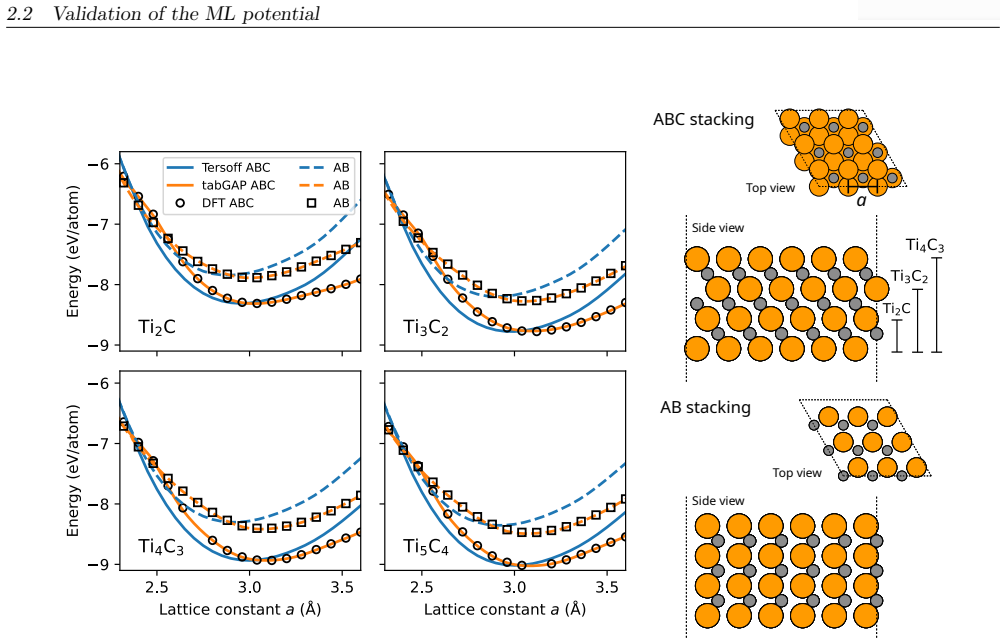
The central claim is that a tabulated Gaussian approximation potential (tabGAP) trained on 1,522 DFT-generated structures containing 24,150 atoms—covering strained/sheared MXenes, defective and disordered sheets, non-MXene Ti–C phases, and iterative-learning structures—reproduces the DFT energy surface for Ti_{n+1}C_n MXenes with root-mean-square errors of 4.5 meV/atom and 0.19 eV/Å in forces on MXene structures. Validation against DFT shows accurate lattice constants (within ~0.01 Å), vacancy formation energies (within ~0.2 eV), shear stacking-fault profiles, phonon dispersions, and quasi-static atom-drag curves. Using this potential, the paper reports that for He irradiation of Ti2C and Ti
Load-bearing premise
The entire reference dataset for training (except isolated atoms) was computed with non-spin-polarized density functional theory, yet near equilibrium spin-polarized Ti2C is lower in energy by 33 meV/atom and has a ~0.05 Å larger lattice constant; if non-spin DFT is not an adequate reference for near-equilibrium MXene energetics, the potential's accuracy fails in precisely the regime used to relax the sheets before irradiation.
Editorial extensions
If this is right
- Provides the first molecular-dynamics-based quantitative guidelines for ion-beam defect engineering of Ti_{n+1}C_n MXenes, including sputtering yields, ion reflection, implantation probabilities, and damage extent as functions of impact energy.
- Confirms experimentally observed preferential sputtering of Ti under heavy-ion and high-energy light-ion irradiation, and predicts a low-energy light-ion regime where C sputtering is enhanced due to more efficient energy transfer to the lighter C atoms.
- Shows that single-layer Ti2C and Ti3C2 sheets remain intact and self-heal after heavy Ti impacts at energies up to 100 keV, consistent with experimental stability observations and suggesting that irradiation-induced defect engineering is a viable route for MXenes.
- Demonstrates a repeatable training strategy—mixing manually constructed, ab initio molecular dynamics, and iterative-learning structures—that the author argues can be transferred to develop ML potentials for other MXene compositions and surface terminations.
- Quantifies low but non-negligible He implantation probabilities (0.0001–0.0005 for 15–40 eV He on Ti2C), relevant for understanding ion-beam doping of MXenes.
Reading between the lines
- Because all training data except isolated-atom references were generated without spin polarization, the potential's near-equilibrium description of bare MXenes may be biased: spin-polarized DFT lowers Ti2C energy by 33 meV/atom and shifts the lattice constant from 3.03 Å to 3.08 Å, so if spin polarization is physically important for bare sheets, the potential's relaxed geometry—and any irradiation
- The use of purely repulsive He–Ti and He–C pair potentials likely underestimates low-energy He implantation probabilities; adding an attractive interaction (as the paper acknowledges) would raise the chance of He sticking to the sheet, which is directly testable by comparing to low-energy ion-scattering experiments.
- The iterative 'learn from its mistakes' loop that eliminated unphysical dense carbon clusters in high-temperature MD suggests a general, inexpensive way to detect extrapolation failures in ML potentials for 2D materials: run high-temperature or damage simulations and scrutinize any energetically over-stable but structurally anomalous configurations, then retrain.
- The reported double-peak in C sputtering yield for He on Ti3C2, attributed to correlated two-atom sputtering events, implies that standard single-sputtering models might poorly describe light-ion damage in multilayer MXenes; this could be probed by analyzing impact-parameter-resolved sputtering events in the simulations.
Editorial analysis
A structured set of objections, weighed in public.
Referee Report
Summary. The paper develops a tabulated Gaussian approximation potential (tabGAP) for bare Ti_{n+1}C_n MXenes, trained on a diverse set of DFT structures including MXenes, non-MXene Ti–C phases, defects, and iteratively sampled disordered/recrystallized configurations. The potential is validated against DFT for lattice constants, monovacancy formation energies, shear stacking-fault profiles, phonon dispersions, and quasi-static atom drag. The authors then apply the potential to large-scale MD irradiation simulations of Ti2C and Ti3C2 sheets, reporting He and Ti ion reflection, implantation, pass-through, sputtering yields, and coordination defects as functions of impact energy from ~15 eV to 100 keV, and conclude with guidelines for defect engineering by ion irradiation. The main claims are that the ML potential is accurate and robust across a wide range of bond environments and that the irradiation statistics provide first-of-their-kind MD-based quantitative guidance.
Significance. If the claims hold, the paper addresses a genuine gap: despite the technological importance of MXenes, there are very few ML interatomic potentials for them, and no dedicated MD potential for Ti_{n+1}C_n irradiation studies. The approach is physically sensible, the training database is reasonably diverse, and the validation shows good agreement with DFT for several properties (lattice constants, vacancy energies, shear profiles, phonons, drag). The use of tabGAP is a strength: it is fast, transferable, and the repulsive ZBL-corrected short-range part is appropriate for collision cascades. The irradiation study is extensive — about one million individual impact simulations — and the qualitative finding of preferential Ti sputtering and the resilience/healing of the sheets is consistent with available experiments. The authors are also transparent about the non-spin-polarized DFT reference and the isolated-atom correction in Figure 5. However, the central applied claim — quantitative defect-engineering guidelines — depends on the adequacy of a constrained nonmagnetic reference, which is not quantitatively bounded. The reproducibility claim is also weakened by the missing open-reposito
major comments (3)
- [§4.1, Supplemental S2, Table 1, Figure 5] The training reference is non-spin-polarized PBE except for isolated-atom energies. The manuscript itself reports that spin-polarized Ti2C is 33 meV/atom lower in energy and has a lattice constant of 3.08 Å instead of 3.03 Å. Since the tabGAP descriptors (two-body, three-body, EAM density) contain no spin/magnetization degrees of freedom, the potential cannot represent the magnetic state. Consequently, Table 1 and Figures 2–5 validate agreement against a constrained nonmagnetic PES, not necessarily the physical PBE ground state. The irradiation simulations are initialized at the tabGAP/non-spin lattice constant, so if the magnetic state is the relevant ground state, every trajectory carries ~1.6% in-plane strain. Sputtering thresholds, reflection/implantation probabilities, and damage counts are sensitive to such strain near thresholds. The authors disclose the limitation and correct iso
- [§4.2, Ref. [47]] The text states 'All input parameters and training data are available in an open repository [47]', but reference [47] is 'Link to be added later.' This is load-bearing for a paper whose central product is a trained ML potential: without the exact training database, descriptor parameters, and regression settings, the potential cannot be reproduced or independently retrained. The repository link or a permanent DOI must be provided; this is a necessary condition for the reproducibility of the method.
- [§2.1 vs §2.2, Figure 1] Most validation quantities are drawn from categories that are explicitly part of the training database: strained/sheared MXenes, vacancies, AIMD thermal frames, and defect configurations. The parity plots in Figure 1 show training errors, not holdout test errors. Thus the agreement in Table 1 and Figures 3–5 is largely interpolative and does not by itself demonstrate robustness outside the training distribution. The genuinely out-of-sample part is the irradiation application, but no DFT check is provided for the conditions used there (e.g., threshold displacement energies, recoil damage, or implanted configurations). Please report a holdout test RMSE and benchmark at least one irradiation-relevant quantity against DFT (for example, the displacement threshold energy along a low-index direction, or the energy of a Frenkel pair) to substantiate the extrapolation claim.
minor comments (5)
- [§2.3] Typo: 'with with both light and heavier ions' — delete the second 'with'.
- [§2.3, last paragraph] The sentence 'for Ti3C2 sheets they are much higher (Figure 5(b))' should refer to Figure 6(b), not Figure 5(b). Figure 5 shows atom drag, not irradiation probabilities.
- [Figure 2 caption] The caption says the Tersoff data are shifted in energy to match DFT minima. This is fine for comparing the shape of E(a), but it means the absolute Tersoff energy scale is not directly compared; the text should state this more explicitly to avoid misleading absolute-energy comparisons.
- [§2.2, speed benchmark] The speed is quoted as '70–135 katom-steps/s' on 'a single CPU node' with a specific AMD processor. Please specify whether this is one core or multiple cores, and clarify the units (kilo atom-steps per second) so that the comparison with Tersoff is reproducible.
- [Figure 5] The labels 'spin' in the figure are ambiguous. It would be clearer to label the curves as 'DFT no spin-pol.', 'DFT spin-pol. isolated atom', and 'spin-corrected DFT'.
Circularity Check
No circular derivation: the ML potential is fitted to DFT energies/forces and irradiation outcomes are produced post-training; disclosed limitations affect validity, not circularity.
full rationale
The derivation chain is not circular. The tabGAP potential is trained on DFT total energies and forces (Methods 4.2), and the claimed results — lattice constants, vacancy formation energies, shear profiles, phonons, drag curves, and irradiation statistics — are computed from the trained potential and compared against DFT reference calculations or known external data; none of these quantities is itself a fitting target. The static-drag isolated-atom limit agrees with the spin-corrected reference because the paper states it trained that value in ('The tabGAP is trained with the correct spin-polarized energy of the isolated atom'), so this is disclosed consistency, not a prediction from the model. Self-citations to the tabGAP method [29,30] and its earlier applications [34,35] are ordinary method reuse rather than a load-bearing self-citation chain; there is no imported uniqueness theorem and no ansatz presented as externally forced. Several non-circular limitations are present and should be weighed separately. Methods 4.1 and Supplement S2 disclose that spin-polarized Ti2C is 33 meV/atom lower in energy with a 3.08 Å lattice constant, while all training data except isolated atoms are computed without spin polarization; the tabGAP descriptors contain no spin degrees of freedom, so the potential cannot represent magnetic MXene states. This is a correctness/transferability risk for the irradiation guidelines, not a circularity. Validation quantities such as lattice constants, shear profiles, vacancies, and phonons overlap with structures included in the training database, which weakens independent confirmation but is not circular because the fitted targets were energies/forces rather than the derived properties. The missing open-data link ([47] 'Link to be added later') is a reproducibility gap, not a circularity. Overall, no circular step can be exhibited from the paper's equations or construction, so the score is 0.
Assumptions & free parameters
free parameters (3)
- tabGAP regression coefficients α_s and energy prefactors δ_d
- ZBL repulsive screening parameters ζ_i, η_i
- tabGAP cutoff radii =
5.0 Å (2-body/EAM), 4.0 Å (3-body)
assumptions (5)
- domain assumption DFT-PBE reference energies and forces define the true MXene energy landscape.
- domain assumption Non-spin-polarized DFT (except isolated atoms) adequately represents the configurational energies needed for irradiation.
- domain assumption TabGAP descriptors (2-body distance, 3-body invariant, EAM density) can faithfully represent Ti-C interactions.
- domain assumption Purely repulsive ZBL/Ref. [55] potentials describe He-Ti and He-C interactions during irradiation.
- domain assumption 2 ps NVE simulations with a border thermostat and classical nuclei capture sputtering, reflection, implantation, and defect statistics.
Cite this review
Pith. "Pith review of Machine-learned interatomic potential for titanium carbide MXenes: Application to ion irradiation simulations." pith.science (2026). https://pith.science/paper/5JPMIX7Y
@misc{pith2026260304152,
  author       = {Pith},
  title        = {Pith review of: Machine-learned interatomic potential for titanium carbide MXenes: Application to ion irradiation simulations},
  year         = {2026},
  howpublished = {\url{https://pith.science/paper/5JPMIX7Y}},
  note         = {Machine review of arXiv:2603.04152}
}
abstract
A computationally efficient and accurate machine-learned (ML) interatomic potential is developed for bare Ti$_{n+1}$C$_n$ MXenes. With a diverse set of structures computed with density functional theory, the trained ML potential demonstrates good accuracy and robustness to a wide range of bond distances and environments, making it a useful tool for molecular dynamics simulations of MXenes subjected to mechanical load or irradiation. The ML potential is applied to simulations of light and heavy ion irradiation, gathering insight into the statistics and probabilities of sputtering, reflection, defect creation, and implantation into bare Ti$_{n+1}$C$_n$ MXene sheets. The results provide guidelines for defect engineering of MXenes through ion irradiation and implantation. Additionally, the ML potential development provides a landmark recipe for enabling machine-learning-driven atomistic simulations of other MXenes.
Figures


Figures from the paper (5 more)


Reference graph
Works this paper leans on
-
[47]
Link to be added later
-
[35]
J. Zhao, J. Byggm¨ astar, H. He, K. Nordlund, F. Djurabekova, M. Hua,npj Comput Mater 2023,9, 1 1
2023
-
[36]
A. Jain, S. P. Ong, G. Hautier, W. Chen, W. D. Richards, S. Dacek, S. Cholia, D. Gunter, D. Skinner, G. Ceder, K. A. Persson,APL Mater.2013,1, 1 011002
2013
-
[37]
Kretschmer, S
S. Kretschmer, S. Ghaderzadeh, S. Facsko, A. V. Krasheninnikov,J. Phys. Chem. Lett. 2022,13, 2 514
2022
-
[38]
Y. Zuo, C. Chen, X. Li, Z. Deng, Y. Chen, J. Behler, G. Cs´ anyi, A. V. Shapeev, A. P. Thompson, M. A. Wood, S. P. Ong,arXiv:1906.08888 [cond-mat, physics:physics]2019
arXiv 1906
-
[39]
Kresse, J
G. Kresse, J. Hafner,Phys. Rev. B1993,47, 1 558
-
[40]
Kresse, J
G. Kresse, J. Hafner,Phys. Rev. B1994,49, 20 14251
-
[41]
Kresse, J
G. Kresse, J. Furthm¨ uller,Computational Materials Science1996,6, 1 15
Show all 24 references
-
[42]
Kresse, J
G. Kresse, J. Furthm¨ uller,Phys. Rev. B1996,54, 16 11169
-
[43]
J. P. Perdew, K. Burke, M. Ernzerhof,Phys. Rev. Lett.1996,77, 18 3865
1996
-
[44]
P. E. Bl¨ ochl,Phys. Rev. B1994,50, 24 17953
-
[45]
Kresse, D
G. Kresse, D. Joubert,Physical Review B1999,59, 3 1758
-
[46]
A. P. Bart´ ok, G. Cs´ anyi,International Journal of Quantum Chemistry2015,115, 16 1051
-
[48]
Glielmo, C
A. Glielmo, C. Zeni, A. De Vita,Physical Review B2018,97, 18
-
[49]
Vandermause, S
J. Vandermause, S. B. Torrisi, S. Batzner, Y. Xie, L. Sun, A. M. Kolpak, B. Kozinsky,npj Computational Materials2020,6, 1 1
-
[50]
J. F. Ziegler, J. P. Biersack, U. Littmarck, InTreatise on Heavy-Ion Science, 93–129. Perg- amon, New York, ISBN 978-1-4615-8105-5 978-1-4615-8103-1,1985
1985
-
[51]
Nordlund, N
K. Nordlund, N. Runeberg, D. Sundholm,Nuclear Instruments and Methods in Physics Research Section B: Beam Interactions with Materials and Atoms1997,132, 1 45
-
[52]
Beck,Molecular Physics1968,14, 4 311
D. Beck,Molecular Physics1968,14, 4 311
-
[53]
Morishita, R
K. Morishita, R. Sugano, B. D. Wirth, T. Diaz de la Rubia,Nuclear Instruments and Meth- ods in Physics Research Section B: Beam Interactions with Materials and Atoms2003,202 76
-
[54]
Juslin, B
N. Juslin, B. D. Wirth,Journal of Nuclear Materials2013,432, 1 61
-
[55]
Nordlund, S
K. Nordlund, S. Lehtola, G. Hobler,Phys. Rev. A2025,111, 3 032818
-
[56]
A. P. Thompson, H. M. Aktulga, R. Berger, D. S. Bolintineanu, W. M. Brown, P. S. Crozier, P. J. in ’t Veld, A. Kohlmeyer, S. G. Moore, T. D. Nguyen, R. Shan, M. J. Stevens, J. Tranchida, C. Trott, S. J. Plimpton,Computer Physics Communications2022,271 108171
-
[57]
A. Togo,J. Phys. Soc. Jpn.2023,92, 1 012001
2023
-
[58]
A. Togo, L. Chaput, T. Tadano, I. Tanaka,J. Phys.: Condens. Matter2023,35, 35 353001. 15 Supplemental document of: Machine-learned Interatomic Potential for Tin+1Cn MXenes: Application to Ion Irradia- tion Simulations Jesper Byggm¨ astar Department of Physics, P.O. Box 43, FI-...
Reviewed August 2, 2026 · model on record in the stance chip above.
Discussion (0). Continue with ORCID to comment.