REVIEW 4 major objections 6 minor 1 cited by
MOO: A Multi-view Oriented Observations Dataset for Viewpoint Analysis in Cattle Re-Identification
T0 review · 4 major / 6 minor · reviewed 2026-08-02 · deepseek-v4-flash
Pith's one-line read A controlled multi-view synthetic cattle dataset yields a precise viewpoint analysis: re-identification models generalize significantly better from elevations above 30°, and pre-training on it improves real-world matching across datasets.
desk verdict The MOO dataset is a genuinely useful new resource for animal ReID, but the headline 30° elevation-threshold result is coarse and the paper contradicts itself about what the threshold means. read the letter →
The pith
A machine-rendered reading of the paper's core claim, the machinery that carries it, and where it could break.
The reading
What carries the argument
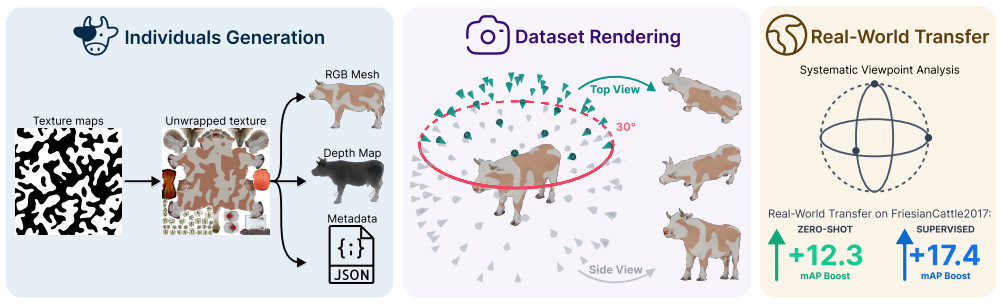
The MOO dataset itself is the load-bearing instrument: 1,000 identities generated from one commercial cow mesh with procedurally varied coat patterns, rendered from 16 azimuths × 8 elevations (with jitter), each image accompanied by exact azimuth/elevation labels, camera calibration, and depth maps. This controlled grid lets the authors partition by elevation and azimuth and measure generalization curves; the 30° threshold emerges from comparing single-view experts across eight elevation bins.
What would settle it
On a real dataset with ground-truth camera elevation for each image of known individuals, train the same ViT baseline at each elevation bin and compare the asymmetric generalization curve; if the 30° crossover is absent or reversed, or if MOO pre-training fails to beat the ImageNet baseline on any real dataset under matched protocols, the central claim is refuted.
Extended reading notes
Core claim
The central discovery is a quantified asymmetry in viewpoint sensitivity: for patterned cattle, elevation above roughly 30° yields representations that transfer across azimuth and to unseen elevations, while side-view training degrades sharply. The authors establish this with a benchmark where all variables except viewpoint are controlled—same 3D mesh, procedurally generated coat patterns, background-free renders, uniform angular sampling—so the measured mAP drops are attributable to geometry. The corollary, that a top-view-only pre-training beats an all-view pre-training on a real top-down dataset, indicates that geometric priors are most useful when matched to deployment elevation.
Load-bearing premise
The appearance variability of real Holstein-Friesian cattle is assumed to be sufficiently matched by procedural textures on a single cow mesh, so that viewpoint effects measured on synthetic renders transfer to real-world imagery.
Editorial extensions
If this is right
- Camera-placement guidance: for aerial-ground cattle re-identification, placing cameras at elevations above roughly 30° will yield features that transfer across views better than ground-level side views.
- Pre-training on MOO, particularly with top views only, improves real-world zero-shot and supervised cattle re-identification across four independent datasets.
- The fine-grained angular annotations enable strategic selection of training views to match the deployment scenario, a capability existing datasets lack.
- The observation that all-view training cannot match view-specific experts points to a fundamental architectural limitation in cross-view generalization, motivating future models that condition on viewpoint.
Reading between the lines
- The 30° threshold may reflect a generic geometric property of quadruped self-occlusion and could extend to other patterned animals; this is testable by generating analogous synthetic datasets for different species.
- A practical extension is to use MOO's angular labels to train a viewpoint-conditioned or elevation-predicting model, which might close the gap to the view-specific expert upper bound.
- The transfer success of background-free synthetic renders suggests that occlusion and clutter, not viewpoint geometry, are the next domain gap to attack; adding synthetic occlusions and backgrounds could further improve real-world transfer.
Editorial analysis
A structured set of objections, weighed in public.
Referee Report
Summary. The paper introduces MOO, a synthetic multi-view cattle re-identification dataset containing 1,000 procedurally textured 3D cow identities rendered from 128 viewpoints (16 azimuths × 8 elevations), yielding 128,000 RGB images with foreground masks, depth maps, and precise elevation/azimuth annotations. Using a ViT-based ReID baseline, the authors report (i) a viewpoint analysis claiming that training on elevations above 30° generalizes better to unseen elevations than training on lower elevations, (ii) an azimuth analysis showing lateral views outperform sagittal views, (iii) a benchmark under Top→Side, Side→Top, and Top-Side→Top-Side protocols, and (iv) transfer experiments on four real-world cattle datasets in zero-shot and supervised settings, claiming consistent gains from MOO pre-training. The dataset itself is a useful contribution, but the central empirical claims—especially the 30° critical threshold and the consistency of transfer gains—are insufficiently supported and, in places, internally contradictory.
Significance. If the claims were solid, MOO would be a valuable resource: it is the first cattle ReID dataset with dense, precise viewpoint annotations and controlled identity variation, and it enables systematic study of how elevation and azimuth affect matching performance. The synthetic-to-real transfer experiments address a practically important question. However, the headline finding—a 'critical elevation threshold' at 30°—is not established by the evidence presented. The 30° value is predetermined by the evaluation split in §3.3 rather than discovered, no statistical analysis supports the existence of a threshold (vs. a gradual trend), and the conclusion in §6 contradicts the abstract and §4.2 on the direction of the effect. The transfer claims are also overstated: zero-shot and supervised gains are not consistent across datasets (FC17 degrades). The dataset and evaluation protocols remain useful, but the paper's analytical conclusions need substantial revision and additional evidence before the central claims can be accepted.
major comments (4)
- [§3.3 and §4.2] The 30° 'critical elevation threshold' is not independently discovered. Section 3.3 defines the side/top split at 30° as part of the evaluation protocol ('images captured below 30° are classified as side views, while images above 30° are classified as top views'), and §4.2 then claims to 'identify' 30° as critical. With only eight elevation levels (−20°, −5°, 10°, 25°, 40°, 55°, 70°, 85°), any threshold between 25° and 40° would be reported as 30°. No breakpoint analysis, model comparison (e.g., threshold vs. monotone trend), or significance test is provided. The paper should either (a) present a rigorous threshold-estimation procedure with confidence intervals, or (b) reframe the claim as a descriptive observation about the evaluated elevations, not a discovered critical angle.
- [§6 vs. Abstract/§4.2] There is a direct internal contradiction about the direction of the effect. The abstract and §4.2 state that 'above 30° models generalize significantly better to unseen views' and that 'elevations superior to 30° enable robust ReID.' Section 6 concludes the opposite: 'a critical elevation threshold of 30° above which models struggle with cross-view matching.' This ambiguity makes the headline result unfalsifiable as stated. The authors must correct one of these statements and ensure the conclusion matches the reported results.
- [Table 4 and §5.2] The claim of 'consistent performance gains' from MOO pre-training is contradicted by the FC17 results. Zero-shot: ImageNet21K baseline mAP is 45.8, while ImageNet→MOO (All) is 40.1—a 5.7-point drop. Supervised: baseline mAP is 90.0, while ImageNet→MOO (All) is 83.9—a 6.1-point drop. The text acknowledges FC17 as an exception but still concludes 'consistent gains' in the abstract and §5.2. This overstatement should be removed and the analysis should quantify the conditions under which MOO pre-training helps versus hurts (e.g., elevation distribution, background, occlusion).
- [§4.1 and all experimental tables] No error bars, standard deviations, or multiple seeds are reported for any experimental result. Because training stochasticity can easily produce mAP differences of several points, the claimed differences (e.g., 39.4 vs. 41.6 mAP in Table 3, or the 52.5% upper bound) may not be significant. At minimum, report mean±std over at least three seeds for the main experiments, and perform a significance test for the threshold comparison in §4.2.
minor comments (6)
- [§3.1] The elevation range is stated as '−20° to 90°' in the introduction but the grid is described as 'θ∈[−20°,85°]' in §3.1 and Figure 2 shows 85° as the top. Please harmonize the stated range.
- [§3.3] The classification boundary says 'below 30°' and 'above 30°'—what happens exactly at 30°? Since 30° is not a sampled elevation, this is only a minor imprecision, but the protocol should define strict vs. non-strict inequality.
- [Figure 2] The figure is hard to read in monochrome; consider adding value labels or a color map with sufficient contrast. Also specify whether the matrix is symmetric and what 'same-view setup' means for query and gallery.
- [§4.2] The phrase 'elevations superior to 30°' is awkward; use 'greater than 30°' or 'elevations above 30°'.
- [Table 1] The marker conventions (filled vs. open circles) are not defined in the caption. Please add a legend.
- [References] Reference [31] is cited as 'CzechLynx' with a 2026 publication venue; if this is a preprint or accepted paper, please update the citation details.
Circularity Check
The 30° 'critical elevation threshold' is not independently estimated: §3.3 predefines 30° as the side/top split and §4.2 reports that same bin boundary as a discovered threshold.
-
self definitional
[§3.3 (Evaluation Protocols) and §4.2 (Elevation Impact)]
""To simulate realistic monitoring scenarios, images captured below 30◦ are classified as side views, while images above 30◦ are classified as top views." (§3.3) ... "elevations superior to 30◦ enable robust ReID." (§4.2)"
The 30° boundary is first fixed as the side/top split in the evaluation protocol (§3.3). Section 4.2 then reports this same value as an empirical discovery ('elevations superior to 30◦ enable robust ReID'), but no breakpoint analysis, model comparison, or statistical fit is performed: with only the 8 pre-set elevations (−20°, −5°, 10°, 25°, 40°, 55°, 70°, 85°), any threshold between 25° and 40° yields the same discretized result. The numeric threshold is therefore a restatement of the chosen protocol binning, not an independently predicted quantity. The qualitative asymmetry (top views transfer better than side views) remains empirical, so the circularity is partial.
full rationale
This is primarily a dataset paper, and most of its empirical evaluation is externally grounded: the MOO benchmark and the transfer experiments on four real-world cattle datasets compare MOO pretraining against an ImageNet baseline, so those results are not circular. The one load-bearing circular step is the 30° 'critical elevation threshold' advertised in the abstract and contributions. Section 3.3 predefines 30° as the boundary between side and top views, and Section 4.2 presents elevations above 30° as the discovered threshold without any independent breakpoint estimation; the numerical value is fixed by the protocol, not by the data. I also flag an internal contradiction: the Conclusion says the threshold is 'above which models struggle with cross-view matching,' while the Abstract and §4.2 say it is 'above which models generalize significantly better' — this makes the headline claim ambiguous and is a correctness risk, though not a separate circularity. Because the central threshold claim partly reduces to the protocol definition, while the asymmetry finding and transfer results retain independent empirical content, a score of 6 is appropriate.
Assumptions & free parameters
free parameters (1)
- Elevation threshold (side/top split) =
30°
assumptions (3)
- domain assumption A single commercial 3D cow mesh plus a procedural texture generator produces enough identity and pose variability to stand in for real cattle.
- domain assumption Rendering with foreground masks removes background bias without removing factors that matter for viewpoint generalization.
- domain assumption Azimuth/elevation jitter of ±10° and ±5° models continuous viewpoint variation sufficiently.
Cite this review
Pith. "Pith review of MOO: A Multi-view Oriented Observations Dataset for Viewpoint Analysis in Cattle Re-Identification." pith.science (2026). https://pith.science/paper/Q3OK5RGY
@misc{pith2026260304314,
  author       = {Pith},
  title        = {Pith review of: MOO: A Multi-view Oriented Observations Dataset for Viewpoint Analysis in Cattle Re-Identification},
  year         = {2026},
  howpublished = {\url{https://pith.science/paper/Q3OK5RGY}},
  note         = {Machine review of arXiv:2603.04314}
}
abstract
Animal re-identification (ReID) faces critical challenges due to viewpoint variations, particularly in Aerial-Ground (AG-ReID) settings where models must match individuals across drastic elevation changes. However, existing datasets lack the precise angular annotations required to systematically analyze these geometric variations. To address this, we introduce the Multi-view Oriented Observation (MOO) dataset, a large-scale synthetic AG-ReID dataset of $1,000$ cattle individuals captured from $128$ uniformly sampled viewpoints ($128,000$ annotated images). Using this controlled dataset, we quantify the influence of elevation and identify a critical elevation threshold, above which models generalize significantly better to unseen views. Finally, we validate the transferability to real-world applications in both zero-shot and supervised settings, demonstrating performance gains across four real-world cattle datasets and confirming that synthetic geometric priors effectively bridge the domain gap. Collectively, this dataset and analysis lay the foundation for future model development in cross-view animal ReID. MOO is publicly available at https://github.com/TurtleSmoke/MOO.
Figures


Forward citations
Cited by 1 Pith paper
-
WildBox: A Dataset and Benchmark for Aerial Monocular 3D Detection of African Savanna Wildlife
WildBox provides over 237k 3D wildlife annotations from drone video and benchmarks reveal zero-shot 3D detection at 0 AP but fine-tuned performance of 8.68 AP-BEV and 13.17 AP3D, with depth estimation causing most errors.
Reference graph
Works this paper leans on
-
[1]
SeaTurtleID2022: A long-span dataset for reli- able sea turtle re-identification
Luk´aˇs Adam, V ojtˇech ˇCerm´ak, Kostas Papafitsoros, and Lukas Picek. SeaTurtleID2022: A long-span dataset for reli- able sea turtle re-identification. InWACV, pages 7131–7141,
-
[2]
Aleksandr Algasov, Ekaterina Nepovinnykh, Fedor Zolotarev, Tuomas Eerola, Heikki K ¨alvi¨ainen, Pavel Zem ˇc´ık, and Charles V . Stewart. Unsupervised pelage pattern unwrap- ping for animal re-identification, 2025. 2
2025
-
[3]
Automatic individual holstein friesian cattle iden- tification via selective local coat pattern matching in RGB-D imagery
William Andrew, Sion Hannuna, Neill Campbell, and Tilo Burghardt. Automatic individual holstein friesian cattle iden- tification via selective local coat pattern matching in RGB-D imagery. InICIP, pages 484–488, 2016. 4
2016
-
[4]
Vi- sual Localisation and Individual Identification of Holstein Friesian Cattle via Deep Learning
William Andrew, Colin Greatwood, and Tilo Burghardt. Vi- sual Localisation and Individual Identification of Holstein Friesian Cattle via Deep Learning. InICCVW, pages 2850– 2859, 2017. 4
2017
-
[5]
Dowsey, and Tilo Burghardt
William Andrew, Jing Gao, Siobhan Mullan, Neill Campbell, Andrew W. Dowsey, and Tilo Burghardt. Visual identification of individual Holstein-Friesian cattle via deep metric learning. COMPAG, 185:106133, 2021. 2, 3
2021
-
[6]
Spots-10: Animal pattern benchmark dataset for machine learning algorithms, 2024
John Atanbori. Spots-10: Animal pattern benchmark dataset for machine learning algorithms, 2024. 2, 3
2024
-
[7]
Multi-views Embedding for Cattle Re-identification
Luca Bergamini, Angelo Porrello, Andrea Capobianco Don- dona, Ercole Del Negro, Mauro Mattioli, Nicola D’alterio, and Simone Calderara. Multi-views Embedding for Cattle Re-identification. InSITIS, pages 184–191, 2018. 2, 3
2018
-
[8]
Zebrapose: Zebra detection and pose estimation using only synthetic data
Elia Bonetto and Aamir Ahmad. Zebrapose: Zebra detection and pose estimation using only synthetic data. InWACV, pages 6611–6620, 2026. 2
2026
Show all 41 references
-
[9]
Holstein Cattle Face Re-Identification Unifying Global and Part Fea- ture Deep Network with Attention Mechanism.ANIMALS, 12(8):1047, 2022
Xiaolang Chen, Tianlong Yang, Kaizhan Mai, Caixing Liu, Juntao Xiong, Yingjie Kuang, and Yuefang Gao. Holstein Cattle Face Re-Identification Unifying Global and Part Fea- ture Deep Network with Attention Mechanism.ANIMALS, 12(8):1047, 2022. 2
2022
-
[10]
Dunshea, and Sigfredo Fuentes
Hai Ho Dac, Claudia Gonzalez Viejo, Nir Lipovetzky, Eden Tongson, Frank R. Dunshea, and Sigfredo Fuentes. Live- stock Identification Using Deep Learning for Traceability. SENSORS, 22(21):8256, 2022. 2
2022
-
[11]
Automated Identification of Individuals in Wildlife Population Using Siamese Neural Networks
Nkosikhona Dlamini and Terence L van Zyl. Automated Identification of Individuals in Wildlife Population Using Siamese Neural Networks. InISCMI, pages 224–228, 2020. 2, 3
2020
-
[12]
An image is worth 16x16 words: Transformers for image recognition at scale
Alexey Dosovitskiy, Lucas Beyer, Alexander Kolesnikov, Dirk Weissenborn, Xiaohua Zhai, Thomas Unterthiner, Mostafa Dehghani, Matthias Minderer, Georg Heigold, Syl- vain Gelly, Jakob Uszkoreit, and Neil Houlsby. An image is worth 16x16 words: Transformers for image recognition ...
2021
-
[13]
Cow texture generator
Corentin Dumery. Cow texture generator. https : / / github . com / CorentinDumery / cow - tex - generator, 2021. Accessed: 2026. 2
2021
-
[14]
Dowsey, and Neill W
Jing Gao, Tilo Burghardt, William Andrew, Andrew W. Dowsey, and Neill W. Campbell. Towards self-supervision for video identification of individual holstein-friesian cattle: The cows2021 dataset, 2021. 2, 3, 4
2021
-
[15]
A tiger cannot change its stripes: using a three-dimensional model to match images of living tigers and tiger skins.BIO LETT, 5(3):383– 386, 2009
Lex Hiby, Phil Lovell, Narendra Patil, N Samba Kumar, Ar- jun M Gopalaswamy, and K Ullas Karanth. A tiger cannot change its stripes: using a three-dimensional model to match images of living tigers and tiger skins.BIO LETT, 5(3):383– 386, 2009. 2
2009
-
[16]
Prior-aware synthetic data to the rescue: Animal pose estimation with very limited real data
Le Jiang, Shuangjun Liu, Xiangyu Bai, and Sarah Ostadab- bas. Prior-aware synthetic data to the rescue: Animal pose estimation with very limited real data. InBMVC, 2022. 2
2022
-
[17]
Cattle identification based on multiple feature decision layer fusion.SCI REP, 14(1):26631, 2024
Dongxu Li, Baoshan Li, Qi Li, Yueming Wang, Mei Yang, and Mingshuo Han. Cattle identification based on multiple feature decision layer fusion.SCI REP, 14(1):26631, 2024. 2
2024
-
[18]
ATRW: A Benchmark for Amur Tiger Re-identification in the Wild
Shuyuan Li, Jianguo Li, Hanlin Tang, Rui Qian, and Weiyao Lin. ATRW: A Benchmark for Amur Tiger Re-identification in the Wild. InACM MM, pages 2590–2598, 2020. 2, 3
2020
-
[19]
Individual dairy cow identification based on lightweight convolutional neural network.PLOS ONE, 16 (11):e0260510, 2021
Shijun Li, Lili Fu, Yu Sun, Ye Mu, Lin Chen, Ji Li, and He Gong. Individual dairy cow identification based on lightweight convolutional neural network.PLOS ONE, 16 (11):e0260510, 2021. 2, 3
2021
-
[20]
Bag of tricks and a strong baseline for deep person re-identification
Hao Luo, Youzhi Gu, Xingyu Liao, Shenqi Lai, and Wei Jiang. Bag of tricks and a strong baseline for deep person re-identification. InCVPRW, pages 0–0, 2019. 3
2019
-
[21]
Learning Landmark Guided Embeddings for Animal Re-identification
Olga Moskvyak, Frederic Maire, Feras Dayoub, and Mahsa Baktashmotlagh. Learning Landmark Guided Embeddings for Animal Re-identification. InWACVW, pages 12–19, 2020. 2
2020
-
[22]
Hager, and Alan L
Jiteng Mu, Weichao Qiu, Gregory D. Hager, and Alan L. Yuille. Learning From Synthetic Animals. InCVPR, pages 12386–12395, 2020. 2
2020
-
[23]
SealID: Saimaa Ringed Seal Re-Identification Dataset.SENSORS, 22(19):7602, 2022
Ekaterina Nepovinnykh, Tuomas Eerola, Vincent Biard, Piia Mutka, Marja Niemi, Mervi Kunnasranta, and Heikki K¨alvi¨ainen. SealID: Saimaa Ringed Seal Re-Identification Dataset.SENSORS, 22(19):7602, 2022. 2, 3
2022
-
[24]
Ekaterina Nepovinnykh, Ilia Chelak, Tuomas Eerola, Veikka Immonen, Heikki K¨alvi¨ainen, Maksim Kholiavchenko, and Charles V . Stewart. Species-Agnostic Patterned Animal Re- identification by Aggregating Deep Local Features.IJCV, 132(9):4003–4018, 2024. 2
2024
-
[25]
Stewart, and Heikki K¨alvi¨ainen
Ekaterina Nepovinnykh, Veikka Immonen, Tuomas Eerola, Charles V . Stewart, and Heikki K¨alvi¨ainen. Re-identification of patterned animals by multi-image feature aggregation and geometric similarity.IETCV, 19(1):e12337, 2025. 2
2025
-
[26]
Rubenstein
Jason Parham, Jonathan Crall, Charles Stewart, Tanya Berger- Wolf, and Daniel I. Rubenstein. Animal population censusing at scale with citizen science and photographic identification. InAAAI Spring Symposium - Technical Report, pages 37–44,
-
[27]
Learning Part Segmentation From Synthetic Animals
Jiawei Peng, Ju He, Prakhar Kaushik, Zihao Xiao, Jiteng Mu, and Alan Yuille. Learning Part Segmentation From Synthetic Animals. InWACVW, pages 90–101, 2024. 2 5
2024
-
[28]
Dynamic Multi-Behaviour, Orientation-Invariant Re-Identification of Holstein-Friesian Cattle.SENSORS, 25 (10):2971, 2025
Maarten Perneel, Ines Adriaens, Jan Verwaeren, and Ben Aernouts. Dynamic Multi-Behaviour, Orientation-Invariant Re-Identification of Holstein-Friesian Cattle.SENSORS, 25 (10):2971, 2025. 3
2025
-
[29]
A Hybrid Rolling Skew Histogram-Neural Net- work Approach to Dairy Cow Identification System
Cho Nilar Phyo, Thi Thi Zin, Hiromitsu Hama, and Ikuo Kobayashi. A Hybrid Rolling Skew Histogram-Neural Net- work Approach to Dairy Cow Identification System. In IVCNZ, pages 1–5, 2018. 2
2018
-
[30]
Animal identi- fication with independent foreground and background model- ing
Lukas Picek, Lukas Neumann, and Jiri Matas. Animal identi- fication with independent foreground and background model- ing. InDAGM, pages 241–257, 2024. 2
2024
-
[31]
CzechLynx: A dataset for indi- vidual identification and pose estimation of the eurasian lynx
Lukas Picek, Jakub Straka, Miroslav Jirik, Elisa Belotti, Mar- tin Duˇla, Josefa Krausov´a, Michal Bojda, V ojtech Cermak, Ludˇek Bufka, Rostislav Dvoˇr´ak, Luboslav Hrd´y, V´aclav Ko- courek, Ji ˇr´ı Labuda, Lud ˇek Toman, Vlado Trul ´ık, Martin V´aˇna, and Miroslav Kutal. Cz...
2026
-
[32]
Imagenet-21k pretraining for the masses
Tal Ridnik, Emanuel Ben-Baruch, Asaf Noy, and Lihi Zelnik- Manor. Imagenet-21k pretraining for the masses. InNIPSDB,
-
[33]
Cowley, and David Paul
Ali Shojaeipour, Greg Falzon, Paul Kwan, Nooshin Hadavi, Frances C. Cowley, and David Paul. Automated Muzzle Detection and Biometric Identification via Few-Shot Deep Transfer Learning of Mixed Breed Cattle.AGRONOMY, 11 (11):2365, 2021. 2, 3
2021
-
[34]
Dissecting Person Re- Identification From the Viewpoint of Viewpoint
Xiaoxiao Sun and Liang Zheng. Dissecting Person Re- Identification From the Viewpoint of Viewpoint. InCVPR, pages 608–617, 2019. 1, 2
2019
-
[35]
Elimi- nating Background-bias for Robust Person Re-identification
Maoqing Tian, Shuai Yi, Hongsheng Li, Shihua Li, Xuesen Zhang, Jianping Shi, Junjie Yan, and Xiaogang Wang. Elimi- nating Background-bias for Robust Person Re-identification. InCVPR, pages 5794–5803, 2018. 2
2018
-
[36]
Cow 3D model
TurboSquid. Cow 3D model. https : / / www . turbosquid . com / 3d - models / cow - 3d - model / 1126261, 2017. Accessed: 2026. 2
2017
-
[37]
Cow identification in free-stall barns based on an improved Mask R-CNN and an SVM.COMPAG, 194:106738, 2022
Jianxing Xiao, Gang Liu, Kejian Wang, and Yongsheng Si. Cow identification in free-stall barns based on an improved Mask R-CNN and an SVM.COMPAG, 194:106738, 2022. 2, 3
2022
-
[38]
Dowsey, and Neill W
Phoenix Yu, Tilo Burghardt, Andrew W. Dowsey, and Neill W. Campbell. Holstein-friesian re-identification using multiple cameras and self-supervision on a working farm.COMPAG, 237:110568, 2025. 2, 3
2025
-
[39]
Addressing the elephant in the room: Robust animal re-identification with unsupervised part-based feature alignment, 2024
Yingxue Yu, Vidit Vidit, Andrey Davydov, Martin Engilberge, and Pascal Fua. Addressing the elephant in the room: Robust animal re-identification with unsupervised part-based feature alignment, 2024. 2
2024
-
[40]
Jianmin Zhao, Qiusheng Lian, and Neal N. Xiong. Multi- Center Agent Loss for Visual Identification of Chinese Sim- mental in the Wild.ANIMALS, 12(4):459, 2022. 2
2022
-
[41]
Compact loss for visual identification of cattle in the wild.COMPAG, 195:106784,
Jian-Min Zhao and Qiu-Sheng Lian. Compact loss for visual identification of cattle in the wild.COMPAG, 195:106784,
Reviewed August 2, 2026 · model on record in the stance chip above.
Discussion (0). Sign in to comment.