REVIEW 5 minor 64 references
A compact RFQ cooler-buncher tames ISOL beam energy spread, enabling 100-MHz laser spectroscopy of short-lived rubidium isotopes.
Reviewed by Pith at T0; open to challenge. T0 means a machine referee read the full paper against a public rubric. the ladder, T0–T4 →
T0 review · deepseek-v4-flash
2026-08-02 18:54 UTC pith:MC4ZX6N4
load-bearing objection First online CRIS at BRIF is real and the Rb constants match literature, but the headline energy-spread suppression number is an unverified scaling estimate, so the paper needs revision rather than rejection.
Commissioning and Full Realization of the PLASEN System at BRIF
The pith
A machine-rendered reading of the paper's core claim, the machinery that carries it, and where it could break.
Core claim
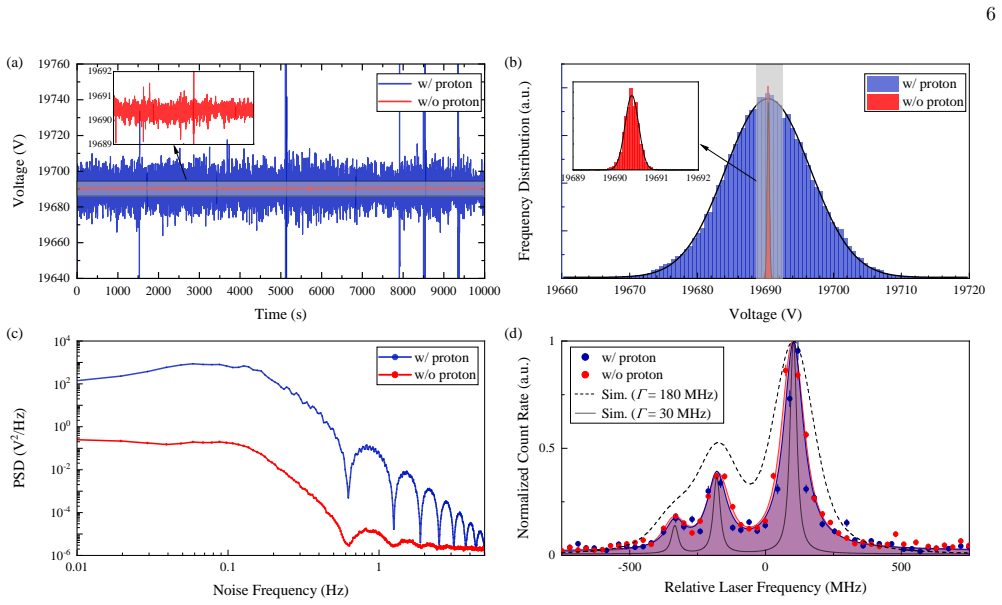
The PLASEN system achieves high-resolution (about 100 MHz) and high-sensitivity (1:200 efficiency) collinear resonance ionization spectroscopy of unstable nuclei at BRIF, because the RFQ-cb effectively cools and bunches the continuous beam despite its large energy spread. Under proton irradiation, the 20-kV platform voltage fluctuates with a FWHM spread of about 14.69 V, implying a total beam energy spread of at least 22 eV, which would cause about 121 MHz Doppler broadening. Yet the measured 87Rb linewidths with and without protons are essentially the same (86 vs 100 MHz), showing that the RFQ-cb removes that broadening. High-quality hyperfine spectra of 92Rb (zero spin) and 95Rb (spin 5/2)
What carries the argument
The compact radio-frequency quadrupole cooler-buncher (RFQ-cb), a linear Paul trap floated at 30 kV that cools ions in helium buffer gas and releases them as bunches via a fast-switched extraction cap, reduces both emittance and energy spread of the beam. The collinear resonance ionization spectroscopy (CRIS) setup then overlaps the bunched, neutralized atoms with pulsed lasers for stepwise resonant ionization and ion detection.
Load-bearing premise
The estimate of the beam's 22 eV energy spread assumes that the unmeasured 10-kV acceleration stage fluctuates proportionally to the measured 20-kV stage; if that scaling fails, the Doppler broadening the RFQ-cb is credited with removing would change.
What would settle it
Monitor the 10-kV HV platform voltage directly during proton irradiation (or measure the hyperfine spectrum with the RFQ-cb switched off and the continuous beam sent straight to the spectroscopy line) to see whether the 22 eV spread and the corresponding 121 MHz broadening actually exist; if the continuous-beam linewidth is not dramatically larger, the central claim of energy-spread suppression would be weakened.
If this is right
- If the system performs as claimed, it can measure nuclear spins, electromagnetic moments, and charge radii of neutron-rich Rb isotopes and other fission-fragment species, including isotopes near the predicted r-process path.
- The demonstrated sensitivity (1:200, overall 1:666 from mass separation) enables laser spectroscopy of isotopes with production yields as low as ~100 pps within reasonable measurement times.
- Resonance ionization can selectively address long-lived isomeric states via isomer shifts, providing purified isomeric beams for decay spectroscopy; a dedicated decay station has already been installed downstream.
- The RFQ-cb could form radioactive molecules in-trap, extending the platform to molecular spectroscopy of species like RaF or RaOH for fundamental-symmetry tests such as parity non-conservation and electric dipole moments.
- The system's beam-quality improvement at BRIF suggests similar RFQ-cb installations could unlock high-resolution collinear spectroscopy at other ISOL facilities with large energy spreads.
Where Pith is reading between the lines
- The 22 eV energy-spread estimate assumes the unmeasured 10-kV platform fluctuates proportionally to the measured 20-kV platform; a direct measurement of the 10-kV stage would either confirm or revise the Doppler-broadening budget.
- The comparison of linewidths with and without proton irradiation includes differences in space charge and laser power, so the specific contribution of the RFQ-cb to linewidth improvement is not isolated; a test with the RFQ-cb bypassed would cleanly separate its effect.
- The unexplained asymmetric line profiles correlate with helium buffer gas density, hinting at an in-trap energy-loss or collision mechanism that, once understood, could further improve resolution or serve as a diagnostic of beam dynamics.
- If in-trap molecular formation works online, the system could measure radioactive molecules with the same high resolution, potentially extending the reach of precision spectroscopy to octupole-deformed nuclei such as 225Ra.
Editorial analysis
A structured set of objections, weighed in public.
Referee Report
Summary. The paper reports the online commissioning of the PLASEN system at the BRIF ISOL facility. The system combines a radio-frequency quadrupole cooler-buncher (RFQ-cb) with a collinear resonance ionization spectroscopy (CRIS) setup. Using stable and radioactive Rb ion beams, the authors demonstrate that the RFQ-cb produces bunched beams with good quality, enabling hyperfine-structure spectra of 92Rb and 95Rb with roughly 100 MHz linewidth and about 1:200 detection efficiency. The extracted hyperfine constants and isotope shifts agree with literature values. The paper further presents a semi-quantitative estimate of the BRIF beam energy spread and argues that the RFQ-cb suppresses this spread, based on a linewidth comparison with and without proton-beam irradiation.
Significance. If the performance claims hold, PLASEN represents a significant new capability for collinear laser spectroscopy at a Chinese ISOL facility, opening access to neutron-rich medium-mass nuclei. The strengths of the paper are concrete: first online CRIS measurements of 92,95Rb, literature-agreeing hyperfine constants, high efficiency (1:200), and a detailed instrument description. The energy-spread suppression claim is less quantitatively secure, but the overall demonstration of a working high-resolution, high-sensitivity system is credible and valuable for the community.
minor comments (5)
- [Section III A] The 22.04 eV total energy spread is described as a lower limit, but it rests on the unverified assumption that the unmonitored 10-kV IS-HV platform fluctuates proportionally to the measured 20-kV platform. If the 10-kV stage is actually more stable, the total spread could be as low as the measured 14.69 V; if less stable, higher. Please rephrase this as a model-dependent estimate and clearly distinguish the directly measured lower limit on the 20-kV stage from the assumed 10-kV contribution.
- [Section III B / Fig. 2(d)] The comparison of linewidths with and without proton irradiation is not a clean measurement of RFQ-cb energy-spread suppression because the beam intensity and laser power differed between the two conditions, as the authors acknowledge. This caveat should be stated more prominently in the abstract and conclusions; the quantitative 121 MHz broadening removed by the RFQ-cb should be labeled as an estimate, not a measured result.
- [Figure 2 caption] The caption contains garbled text: 'Sim. (/s71/s32= 180 MHz)' and 'Sim. (/s71 = 30 MHz)' are likely meant to be 'Sim. (Γ = 180 MHz)' and 'Sim. (Γ = 30 MHz)'. Please correct.
- [Throughout] There are several typographical errors: 'tranditional' (Introduction), 'efficiency' and 'sufficient' (various places), and 'containg' (Section IV). These should be corrected.
- [Reference [28]] Reference [28] gives the DOI as '10.1103/hm9t (2026)', which appears to be a placeholder. Please provide the complete DOI or bibliographic information.
Circularity Check
No significant circularity: the RFQ-cb claim rests on direct measurements and a forward Doppler-broadening estimate, not on fitted inputs.
full rationale
The paper's central claims are supported by direct measurements: 20-kV platform voltage monitoring, 87Rb linewidths with and without proton irradiation, and HFS spectra of 92,95Rb. The 22.04-eV beam energy spread is estimated from the measured 20-kV platform plus an explicit, but unverified, proportional-scaling assumption for the 10-kV platform; it is not extracted from the spectral linewidths. Eq. (1) is a standard Doppler-broadening formula cited to the authors' prior work, but it is used as a forward calculation, not fitted to the data. The simulated 180-MHz spectrum in Fig. 2(d) is a comparison benchmark, and the actual narrower measured linewidth is the evidence that the RFQ-cb suppresses the large input spread. Extracted hyperfine constants and isotope shifts are compared with external literature [46] and the 1:200 efficiency is a measured count ratio. There is no quantity called a 'prediction' that is constructed from the same data used to test it. The unverified 10-kV scaling assumption is a correctness risk that could change the numerical 121-MHz estimate, but the measured 20-kV contribution alone (about 15 eV) already implies substantial Doppler broadening, so the qualitative conclusion is not forced by the assumption. Self-citations are descriptive (RFQ-cb hardware, DAQ, offline performance) and are not load-bearing in the derivation chain. Overall, no circular step is exhibited.
Axiom & Free-Parameter Ledger
axioms (4)
- domain assumption The voltage fluctuation of the 10-kV ion-source platform scales proportionally with the applied voltage of the 20-kV main platform.
- domain assumption The built-in moving-average filter of the multimeter suppresses high-frequency voltage noise above about 0.32 Hz, so the measured spread is a lower limit to the true energy spread.
- standard math Doppler broadening follows Γ_D = e ν0 δE / sqrt(2 E m c^2) from Ref. [37].
- domain assumption The HFS line asymmetry can be accounted for by an asymmetric pseudo-Voigt profile without biasing the extracted A, B, and isotope shifts.
read the original abstract
A PLASEN (Precision LAser Spectroscopy for Exotic Nuclei) system, consisting of a compact radio-frequency quadrupole cooler-buncher (RFQ-cb) and a collinear resonance ionization spectroscopy setup, has now been fully commissioned with radioactive ion beams at the Beijing Radioactive Ion-beam Facility (BRIF). Using both stable and radioactive Rb ion beams from BRIF, we demonstrated that the large beam energy spread observed at BRIF has been successfully handled by employing the RFQ-cb, enabling the delivery of high-quality bunched radioactive ion beams for collinear resonance ionization spectroscopy experiments. Under these conditions, we performed laser spectroscopy of exotic nuclei, achieving high resolution (about 100 MHz spectral linewidth) and high sensitivity (up to 1:200 efficiency). This fully operational PLASEN system will serve as a state-of-the-art experimental platform at BRIF for research in multiple fields such as nuclear, atomic and molecular physics.
Figures


Reference graph
Works this paper leans on
-
[1]
Y. Ye, X. Yang, H. Sakurai, and B. Hu, Nature Reviews Physics 7, 21 (2025)
2025
-
[2]
Otsuka, A
T. Otsuka, A. Gade, O. Sorlin, T. Suzuki, and Y. Utsuno, Rev. Mod. Phys. 92, 015002 (2020)
2020
-
[3]
Sorlin and M.-G
O. Sorlin and M.-G. Porquet, Progress in Particle and Nuclear Physics 61, 602 (2008)
2008
-
[4]
Thibault, R
C. Thibault, R. Klapisch, C. Rigaud, A. M. Poskanzer, R. Prieels, L. Lessard, and W. Reisdorf, Phys. Rev. C 12, 644 (1975)
1975
-
[5]
E. K. Warburton, J. A. Becker, and B. A. Brown, Phys. Rev. C 41, 1147 (1990)
1990
-
[6]
B. A. Brown, Physics 3, 104 (2010)
2010
-
[7]
T. J. Gray, J. M. Allmond, Z. Xu, et al., Phys. Rev. Lett. 130, 242501 (2023)
2023
-
[8]
Rocchini, P
M. Rocchini, P. E. Garrett, M. Zielińska, et al. , Phys. Rev. Lett. 130, 122502 (2023)
2023
-
[9]
Heyde and J
K. Heyde and J. L. Wood, Rev. Mod. Phys. 83, 1467 (2011)
2011
-
[10]
X. F. Yang, C. Wraith, L. Xie, et al. , Phys. Rev. Lett. 116, 182502 (2016)
2016
-
[11]
Nowacki, A
F. Nowacki, A. Poves, E. Caurier, and B. Bounthong, Phys. Rev. Lett. 117, 272501 (2016)
2016
-
[12]
P. G. Hansen and B. Jonson, Europhysics Letters 4, 409 (1987)
1987
-
[13]
Tanihata, H
I. Tanihata, H. Hamagaki, O. Hashimoto, et al. , Phys. Rev. Lett. 55, 2676 (1985)
1985
-
[14]
A. S. Jensen, K. Riisager, D. V. Fedorov, and E. Garrido, Rev. Mod. Phys. 76, 215 (2004)
2004
-
[15]
Riisager, Physica Scripta 2013, 014001 (2013)
K. Riisager, Physica Scripta 2013, 014001 (2013)
2013
-
[16]
von Oertzen, M
W. von Oertzen, M. Freer, and Y. Kanada-En’yo, Physics Reports 432, 43 (2006)
2006
-
[17]
Liu and Y.-L
Y. Liu and Y.-L. Ye, Nuclear Science and Techniques 29, 184 (2018)
2018
-
[18]
Y. Liu, Y. L. Ye, J. L. Lou, et al. , Phys. Rev. Lett. 124, 192501 (2020)
2020
-
[19]
X. Yang, S. Wang, S. Wilkins, and R. G. Ruiz, Progress in Particle and Nuclear Physics 129, 104005 (2023)
2023
-
[20]
Hergert, Frontiers in Physics 8, 379 (2020)
H. Hergert, Frontiers in Physics 8, 379 (2020)
2020
-
[21]
Ekström, C
A. Ekström, C. Forssén, G. Hagen, G. R. Jansen, W. Jiang, and T. Papenbrock, Frontiers in Physics 11, 1129094 (2023)
2023
-
[22]
Seliverstov, T
M. Seliverstov, T. Cocolios, W. Dexters, et al. , Physics Letters B 719, 362 (2013)
2013
-
[23]
B. A. Marsh, T. Day Goodacre, S. Sels, et al. , Nature Physics 14, 1163 (2018)
2018
-
[24]
Neugart, J
R. Neugart, J. Billowes, M. L. Bissell, et al. , Journal of Physics G: Nuclear and Particle Physics 44, 064002 (2017)
2017
-
[25]
Minamisono, P
K. Minamisono, P. Mantica, A. Klose, et al. , Nucl. In- strum. Meth. Phys. Res. A 709, 85 (2013)
2013
-
[26]
Imgram, D
P. Imgram, D. Atanasov, M. Athanasakis-Kaklamanakis, et al., Review of Scientific Instruments 96, 093302 (2025). 10
2025
-
[27]
Vernon, R
A. Vernon, R. de Groote, J. Billowes, et al. , Nucl. In- strum. Meth. Phys. Res. B 463, 384 (2020)
2020
-
[28]
A. J. Brinson, B. J. Rickey, J. M. Allmond, et al. , Phys. Rev. Res. , 10.1103/hm9t (2026)
-
[29]
Mueller, I
P. Mueller, I. A. Sulai, A. C. C. Villari, et al. , Phys. Rev. Lett. 99, 252501 (2007)
2007
-
[30]
X. Yang, T. Furukawa, T. Wakui, et al. , Phys. Rev. A 90, 052516 (2014)
2014
-
[31]
Lagaki, H
V. Lagaki, H. Heylen, I. Belosevic, et al. , Nucl. Instrum. Meth. Phys. Res. A 1014, 165663 (2021)
2021
-
[32]
W. Nan, B. Guo, J. Chen, et al. , Progress in Particle and Nuclear Physics 145, 104188 (2025)
2025
-
[33]
X. Zhou, J. Yang, and the HIAF project team, AAPPS Bulletin 32, 35 (2022)
2022
-
[34]
Bai, X.-F
S.-W. Bai, X.-F. Yang, S.-J. Wang, et al., Nuclear Science and Techniques 33, 9 (2022)
2022
-
[35]
S. Wang, X. Yang, S. Bai, et al. , Nucl. Instrum. Meth. Phys. Res. A 1032, 166622 (2022)
2022
-
[36]
Zhang, H
P. Zhang, H. Hu, X. Yang, et al. , Nucl. Instrum. Meth. Phys. Res. B 541, 37 (2023)
2023
- [37]
-
[38]
Hu, Y.-F
H.-R. Hu, Y.-F. Guo, X.-F. Yang, et al. , Science Bulletin 70, 2721 (2025)
2025
-
[39]
Liu, X.-F
Y.-C. Liu, X.-F. Yang, S.-W. Bai, et al. , Nuclear Science and Techniques 34, 38 (2023)
2023
-
[40]
Z. Yan, X. Yang, H. Hu, et al. , In preparation (2026)
2026
-
[41]
S. W. Smith, The Scientist and Engineer’s Guide to Dig- ital Signal Processing, 2nd ed. (California Technical Pub- lishing, San Diego, USA, 1999)
1999
-
[42]
Dockery, K
A. Dockery, K. Minamisono, A. Ortiz Cortes, and B. Rickey, Spectrochimica Acta Part B: Atomic Spec- troscopy 233, 107280 (2025)
2025
-
[43]
R. P. de Groote, M. Verlinde, V. Sonnenschein, K. T. Flanagan, I. Moore, and G. Neyens, Phys. Rev. A 95, 032502 (2017)
2017
-
[44]
Koszorús, X
A. Koszorús, X. F. Yang, J. Billowes, et al. , Phys. Rev. C 100, 034304 (2019)
2019
-
[45]
W. Gins, B. van den Borne, R. de Groote, and G. Neyens, Computer Physics Communications 297, 109053 (2024)
2024
-
[46]
Thibault, F
C. Thibault, F. Touchard, S. Büttgenbach, et al. , Physi- cal Review C 23, 2720 (1981)
1981
-
[47]
T. J. Procter, J. A. Behr, J. Billowes, et al. , The Euro- pean Physical Journal A 51, 23 (2015)
2015
-
[48]
K. M. Lynch, J. Billowes, M. L. Bissell, et al. , Phys. Rev. X 4, 011055 (2014)
2014
-
[49]
G. J. Farooq-Smith, T. E. Cocolios, J. Billowes, et al. , Phys. Rev. C 94, 054305 (2016)
2016
-
[50]
Lynch, T
K. Lynch, T. Cocolios, N. Althubiti, G. Farooq-Smith, W. Gins, and A. Smith, Nucl. Instrum. Meth. Phys. Res. A 844, 14 (2017)
2017
-
[51]
M. S. Safronova, D. Budker, D. DeMille, et al., Rev. Mod. Phys. 90, 025008 (2018)
2018
-
[52]
C. S. Wood, S. C. Bennett, D. Cho, et al. , Science 275, 1759 (1997)
1997
-
[53]
B. M. Roberts, V. A. Dzuba, and V. V. Flambaum, Phys. Rev. A 88, 012510 (2013)
2013
-
[54]
T. E. Chupp, P. Fierlinger, M. J. Ramsey-Musolf, and J. T. Singh, Rev. Mod. Phys. 91, 015001 (2019)
2019
-
[55]
W. B. Cairncross and J. Ye, Nature Reviews Physics 1, 510 (2019)
2019
-
[56]
Arrowsmith-Kron, M
G. Arrowsmith-Kron, M. Athanasakis-Kaklamanakis, M. Au, et al. , Reports on Progress in Physics 87, 084301 (2024)
2024
-
[57]
Garcia Ruiz, R
R. Garcia Ruiz, R. Berger, J. Billowes, et al., Nature 581, 396 (2020)
2020
-
[58]
S. M. Udrescu, A. J. Brinson, R. F. G. Ruiz, et al. , Phys. Rev. Lett. 127, 033001 (2021)
2021
-
[59]
Athanasakis-Kaklamanakis, S
M. Athanasakis-Kaklamanakis, S. G. Wilkins, P. Lassègues, et al. , Phys. Rev. A 110, L010802 (2024)
2024
-
[60]
Athanasakis-Kaklamanakis, S
M. Athanasakis-Kaklamanakis, S. G. Wilkins, L. V. Skripnikov, et al. , Nature Communications 16, 2139 (2025)
2025
-
[61]
S. G. Wilkins, H. A. Perrett, S. M. Udrescu, et al. , Phys. Rev. Res. 8, L012012 (2026)
2026
-
[62]
S. G. Wilkins, S. M. Udrescu, M. Athanasakis- Kaklamanakis, et al. , Science 390, 386 (2025)
2025
-
[63]
Athanasakis-Kaklamanakis, M
M. Athanasakis-Kaklamanakis, M. Au, A. Kyuberis, et al. , Nature 648, 562–568 (2025)
2025
-
[64]
W. C. Mei, S. J. Chen, X. F. Yang, et al. , In preparation (2026)
2026
discussion (0)
Sign in with ORCID, Apple, or X to comment. Anyone can read and Pith papers without signing in.