REVIEW 3 major objections 4 minor 5 cited by
The superconducting state of a d-wave altermagnet metal is a pair of p-wave condensates that condense at different temperatures, with sub-leading fluctuations selecting either nematic or chiral phases.
Reviewed by Pith at T0; open to challenge. T0 means a machine referee read the full paper against a public rubric. the ladder, T0–T4 →
T0 review · deepseek-v4-flash
2026-08-02 18:49 UTC pith:XJFNY6WP
load-bearing objection Solid symmetry-based analysis of multicomponent p-wave SC in d-wave altermagnets; the main soft spot is the acknowledged A–B decoupling and the unproven generic claim. the 3 major comments →
Superconducting States and Intertwined Orders in Metallic Altermagnets
The pith
A machine-rendered reading of the paper's core claim, the machinery that carries it, and where it could break.
Core claim
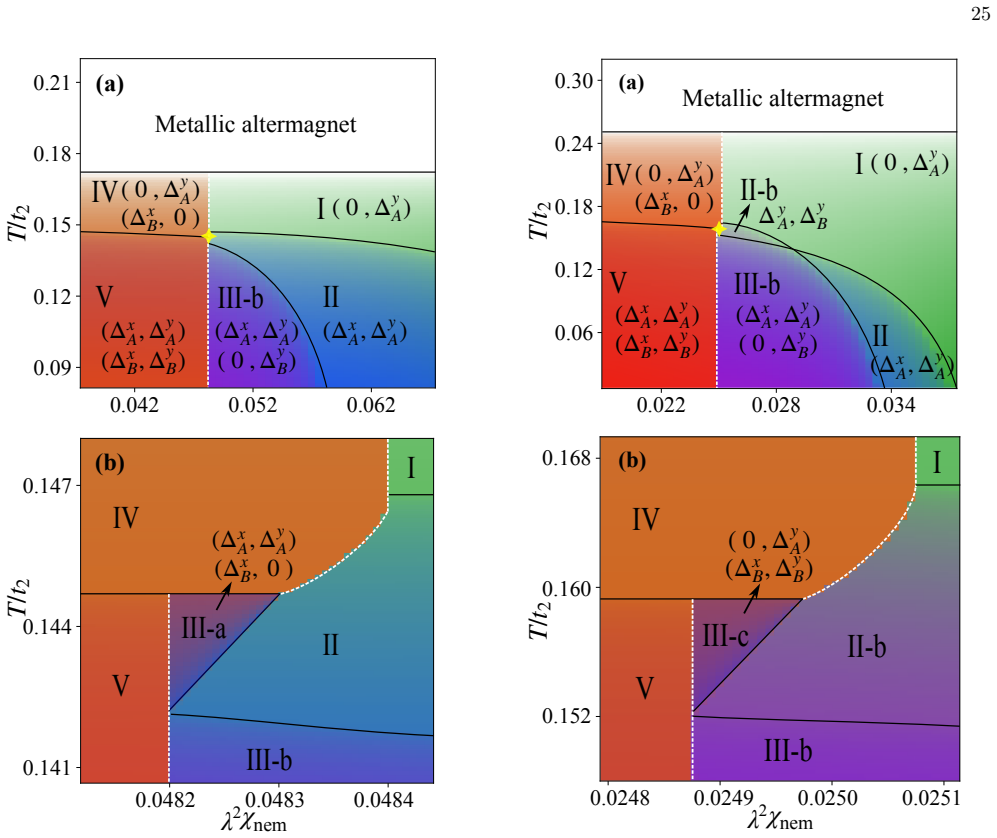
The central claim is that the superconducting ground-state manifold of a C4T-symmetric d-wave altermagnet metal is captured by two sets of equal-spin two-component p-wave gaps, (Δx_A, Δy_B) and (Δy_A, Δx_B), which are degenerate under the C4T operation but condense at different temperatures because the p_x and p_y components are inequivalent on each elliptical Fermi surface. Within mean-field theory, the relative phases inside each pair lock to ±π/2, giving approximately p±iϵp pairing on each band. Fluctuation-induced couplings then lift the degeneracy between phases: integrating out nematic fluctuations generates positive biquadratic inter-band couplings that drive C4T-breaking superconduct
What carries the argument
The central objects are the four complex superconducting order parameters Δx_A, Δy_A, Δx_B, Δy_B (A and B are the two spin- and sublattice-polarized Fermi surfaces related by C4T), organized into a Landau free energy with gauge-invariant quadratic, quartic, and biquadratic terms. The argument is carried by the superconducting susceptibilities χ_SC(Q): equal-spin p-wave channels diverge at Q=0, while singlet channels only develop a finite-momentum peak, identifying p-wave as the leading instability. The key mechanism is the integration over Gaussian fluctuations of two sub-leading normal-state fields—the nematic field φ and the spin current-loop field φ_l—which generate inter-band couplings i
Load-bearing premise
The load-bearing premise is that the two spin/band sectors are decoupled (no spin-orbit coupling), so the relative phase between the two p-wave pairs is free; the paper also assumes the system is deep enough in the altermagnet phase that singlet and finite-momentum pairing can be ignored.
What would settle it
A single superconducting transition in the specific heat of a clean d-wave altermagnet metal would contradict the predicted two-step condensation. Alternatively, if the low-temperature superconducting state shows no spontaneous time-reversal breaking (e.g., no zero-field muon relaxation signal) even when spin current-loop fluctuations are expected, the chiral-selection claim would be falsified.
If this is right
- A metallic altermagnet with attractive p-wave interaction will exhibit two successive superconducting transitions upon warming, with one gap pair vanishing before the other.
- Sufficiently strong nematic fluctuations stabilize superconducting phases in which the gap amplitudes on the two bands are unequal, spontaneously breaking the C4T symmetry of the normal state.
- Spin current-loop fluctuations lift the degeneracy between p+ip and p−ip states, selecting a pair of chiral ground states and reducing the number of time-reversed states from four to two.
- The multi-component order parameters imply composite (vestigial) order—nematic and time-reversal-breaking orders—that can persist above Tc, and possibly charge-4e superconductivity; the paper flags these as directions for future work.
Where Pith is reading between the lines
- If spin-orbit coupling or inter-band hybridization is present, the two sectors become coupled and the relative phase locks; the phase diagram would then lose the decoupled two-U(1) structure, so the paper's predictions are most directly testable in centrosymmetric altermagnets without SOC.
- The C4T amplitude relation |Δx_A|=|Δy_B| and |Δy_A|=|Δx_B| offers a direct experimental signature: phase-insensitive tunneling or specific-heat probes should see the same gap magnitude on the two bands yet different critical temperatures, which is unusual and identifiable.
- The mechanism is not obviously restricted to the Lieb lattice: any d-wave altermagnet with spin-split Fermi surfaces and sub-leading nematic/loop fluctuations may realize the same dichotomy; a minimal test would be to compute the same Landau coefficients in a different altermagnet model.
- A concrete way to check the chiral selection is zero-field muon spin rotation: the low-temperature phase selected by spin current-loop fluctuations spontaneously breaks time-reversal symmetry, so a nonzero muon precession signal would appear; conversely, absence of such signal would favor the nematic scenario.
Editorial analysis
A structured set of objections, weighed in public.
Referee Report
Summary. The paper studies a minimal d-wave altermagnetic metal on a Lieb lattice, focusing on equal-spin p-wave pairing. Within mean-field theory, the superconducting state is described by two sets of two-component order parameters, (Δx_A, Δy_B) and (Δy_A, Δx_B), which condense at two different temperatures because the C4T symmetry of the altermagnet enforces degeneracies between components on opposite spin-polarized bands while leaving the two sets non-degenerate. The paper then constructs a Landau free energy for the four order-parameter components and shows that, because the bare model has no inter-band hybridization h_ab or inter-band pair-hopping, the A and B sectors are decoupled at quadratic order. Nematic fluctuations generate positive inter-band biquadratic couplings that stabilize C4T-breaking ('nematic') superconducting phases, while spin current-loop fluctuations generate negative couplings that favor coexistence and select a pair of chiral states. The central scenario is supported by explicit microscopic derivations of the superconducting susceptibilities (App. C), mean-field gap equations (App. D), Landau coefficients (App. E), the leading-order T_c-splitting scaling (App. F), and the fluctuation-generated couplings (Apps. G–H).
Significance. If the central claims hold, the paper provides a systematic microscopic framework for multi-component p-wave superconductivity in altermagnets, going beyond leading-instability analyses by mapping out the free-energy minima and showing how sub-leading particle-hole fluctuations can qualitatively reshape the superconducting phase diagram. The explicit derivations are a strength: the susceptibility calculations, the mean-field gap equations, the Landau coefficients, and the analytic T_c-splitting expression in Eq. (F11) are all stated in a form that can be checked and reproduced. The paper also makes concrete, falsifiable predictions within the model, such as the sign of the fluctuation-induced inter-band couplings and the selection of chiral states. The main weakness is the reliance on a bare model with strictly decoupled spin/band sectors and on freely adjustable fluctuation susceptibilities; as the authors themselves flag, this is an artifact of the simplified Hamiltonian. This limits the generality of the claims as stated in the Introduction.
major comments (3)
- [§IV A, App. D2, Eq. (E10)] The entire two-U(1), two-T_c scenario rests on the absence of inter-sector quadratic couplings. With h_ab = 0, Eq. (E10) gives r11 = r22 = r12 = 0 and the A and B sectors decouple. The paper explicitly calls this an 'artifact' in Sec. IV A and later concedes that pair-hopping terms not included in the model can lock the relative phase. Despite this, the Introduction claims that the 'essential results' are expected to hold for systems with an altermagnetic metallic state. This is a load-bearing gap: a symmetry-allowed inter-band pair-hopping term or SOC would generate quadratic inter-band couplings that can merge the two T_c's and alter the chiral selection. I request either a quantitative robustness check—e.g., add a small h_ab or pair-hopping term and show that the two-T_c splitting and the chiral ground state survive—or a clear restriction of the central claims to the h_ab = 0 model. A
- [§IV B–C, Eqs. (4.7), (H30), (I4)] The qualitative phase diagrams in Figs. 3 and 5 are controlled by the signs and magnitudes of the fluctuation-generated couplings. While the couplings λ_i and γ_i are microscopically derived in Apps. G and H, the susceptibilities χ_nem and χ_lp are treated as free parameters and scanned over. In particular, the sign of the nematic-induced inter-band coupling v_AB is proportional to λ1λ2, and the paper states only that it is positive 'for the parameter sets considered here.' Similarly, the chiral selection via w_AB relies on γ3^2 and on the sign of χ_lp. The paper should state plainly that χ_nem and χ_lp are phenomenological input, not computed outputs, and should either provide a microscopic estimate of these susceptibilities in the Lieb lattice model or frame the results as a mechanism rather than a material-specific prediction. Without this clarification, the fluctuation-induced select
- [§II, Fig. 2, Eqs. (C20)–(C21)] The conclusion that equal-spin p-wave pairing is the leading instability is derived under the explicit assumption that the system is deep in the altermagnetic phase and that spin-singlet and finite-momentum pairing can be ignored. This is reasonable as a model setup, but the paper does not provide a quantitative criterion for 'deep enough.' The singlet susceptibility in Fig. 2(a) has a finite peak rather than a divergence, so a sufficiently strong attractive interaction in the singlet channel could still dominate. The Introduction's broad statement about metallic altermagnets should therefore be tempered, and the parameter regime in which the p-wave scenario applies should be stated more sharply.
minor comments (4)
- [Abstract / Sec. V] The title and abstract promise 'intertwined orders,' but the paper analyzes fluctuation-induced couplings to superconductivity and only qualitatively discusses vestigial orders in the final section. The vestigial phases are not computed. The wording could be adjusted to avoid overstating the scope.
- [Eq. (H13)] The text introducing γ3,4 states 'g3 = sink x sink x, g4 = sink x sink y.' The first expression is presumably sin^2 k_x; please correct the typo.
- [Sec. IV B after Eq. (4.1)] The sentence 'this structure implies four independent global U(1) symmetries' is misleading because the w_xy terms already lock the relative phases within each sector. It might be clearer to say the free energy appears to have four U(1) factors before the phase-locking terms are considered.
- [App. I, symmetry classification] The classification of phases by broken U(1) symmetries should more prominently note the two-dimensional BKT caveat, which is mentioned only parenthetically. This is relevant for the interpretation of 'phase diagrams' in 2D.
Circularity Check
No significant circularity: the superconducting and fluctuation-induced results are computed from a stated microscopic model, not reduced to fitted inputs.
full rationale
The paper's central derivation chain is self-contained and does not reduce to its inputs. The two-component p-wave order parameters are symmetry-classified, and the two transition temperatures are obtained from explicitly evaluated superconducting susceptibilities (Appendix F), not imposed by hand. The decoupling of the A and B sectors is an openly stated model assumption, h_ab = 0 (Appendix D2), which the paper itself flags as a limitation: 'We attribute this artifact to the simplified form of our microscopic Hamiltonian and to the absence of inter-band interactions in our model.' The fluctuation-generated inter-band couplings are derived microscopically in Appendices G and H; their signs follow from the structure of the couplings and from the microscopic coefficients, and the phase diagrams are parameter sweeps over χ_nem and χ_lp rather than fits to data. The possible effect of inter-band pair hopping or spin-orbit coupling is explicitly acknowledged in the Discussion, which is a caveat on the model, not an instance of circular reasoning. Self-citations to the Lieb-lattice model (Ref. [55]) and to subleading instabilities (Refs. [109,110]) provide independent published inputs with stated assumptions and do not themselves constitute the claimed prediction. No equation is found to equal its own input by construction, and no fitted parameter is renamed as a prediction.
Axiom & Free-Parameter Ledger
free parameters (7)
- effective AM spin splitting ϕ =
0.05 (main text); −0.25 (App. I)
- pairing interaction V2 =
2.25 (with t2=0.75, μ=−2.1); 3.75 for the alternative set
- chemical potential μ =
−2.1; −2.8; −1.9; −2.0 in different figures
- nearest-neighbor repulsion V1 =
1.0
- nematic susceptibility χ_nem =
swept as phase-diagram axis
- spin current-loop susceptibility χ_lp =
swept as phase-diagram axis; set to 1/6 in Figs. 15–16
- pairing anisotropy Vd =
0 (main text); ±0.25 (App. I)
axioms (5)
- domain assumption Deep in the AM phase, the low-energy theory is the two-band model with spin–band locking and no inter-sector hybridization h_ab(k) = 0 (no spin-orbit coupling).
- domain assumption Equal-spin intra-band p-wave pairing is the leading superconducting instability; spin-singlet and finite-momentum channels are negligible in the deep-AM regime.
- domain assumption C4T symmetry of the tetragonal AM enforces the pure α-phase with n̄ = 0 (no β-phase mixing).
- domain assumption Nematic and spin current-loop fluctuations are Gaussian with static susceptibilities χ_nem, χ_lp and no static order (⟨φ⟩ = ⟨φl⟩ = 0), and these channels are subleading to the altermagnetic instability.
- standard math Standard many-body machinery: BCS mean-field decoupling, Bogoliubov–de Gennes, Gor'kov/GL expansion, Matsubara summation.
read the original abstract
Altermagnets are a newly identified class of magnets with nodal spin-split band structures, providing a fertile platform for studying unconventional superconductivity and intertwined orders. Here we investigate multicomponent superconductivity and fluctuation-induced intertwined orders in an interacting $d$-wave metallic altermagnet that is invariant under a combination of a fourfold rotation $C_4$ and time-reversal symmetry $T$. Within mean-field theory, the superconducting ground-state manifold is described in terms of two equal-spin two-component $p$-wave gap functions $(\Delta_A^x,\Delta_B^y)$ and $(\Delta_A^y,\Delta_B^x)$, where $A$ and $B$ refer to the two spin-polarized Fermi surfaces related by $C_4T$ symmetry. Because these two sets of gap functions condense at different temperatures, a rich phase diagram with multiple superconducting phase transitions emerges. Distinct fluctuations of sub-leading normal-state instabilities that compete with altermagnetism lift the degeneracy of the multicomponent pairing state in different ways. While nematic fluctuations enhance competition between distinct superconducting components and stabilize nematic superconducting phases, spin current-loop fluctuations promote coexistence and select a pair of chiral states. Our results uncover the pairing structure and elucidate how intertwined sub-leading fluctuations shape superconducting order in altermagnetic metals, suggesting a route toward realizing nematic and topological superconductivity.
Figures




Forward citations
Cited by 5 Pith papers
-
Nodal Topological Superconductivity Driven by Crystalline Antiunitary Symmetry in Altermagnets
Crystalline antiunitary symmetry in altermagnets selects pairing that produces robust nodal topological superconducting phases with Majorana flat bands and chiral edge states.
-
Finite temperature pair density wave superconductivity in $d$-wave altermagnets
D-wave altermagnets host a robust finite-temperature pair-density-wave superconducting phase driven by momentum-dependent spin splitting.
-
Unconventional superconductivity in $A$V$_2X_2$O family of surface altermagnets
Theoretical analysis of AV2X2O oxychalcogenides predicts dominant equal-spin triplet superconductivity arising from altermagnetic order that forbids conventional singlet pairing.
-
Direction-selective triplet pairing and spin-edge locking in altermagnetic metals
Altermagnetic spin splitting selects direction-selective triplet pairing in 2D d-wave metals and generates spin-locked Majorana edge states in both spin-conserving and Rashba-mixed regimes.
-
Pressure-Induced Superconducting-like Transition in the $\it d$-wave Altermagnet Candidate CsV$_2$Se$_2$O
Pressure suppresses the density-wave feature in the d-wave altermagnet candidate CsV2Se2O and induces a reproducible, field-suppressible resistive downturn below 3 K suggestive of superconductivity.
Reference graph
Works this paper leans on
-
[1]
Mixed-spin pairing Let us defineL=l α +l β +l γ. For mixed-spin pair- ing with evenL, the superconducting susceptibility at momentumQis χQ N(E F ) = Z dθ 2π |γk|2χ12.(C14) For oddLit takes the form χQ N(E F ) = Z dθ 2π |γk|2 × ¯n2 ¯n2 + (δcosl αθ)2 χ11 + (δcosl αθ)2 ¯n2 + (δcosl αθ)2 χ12 . (C15) In theαphase (¯n= 0), even and odd values ofLyield identical...
-
[2]
χ11 + (δcosl αθ)2 ¯n2 + (δcosl αθ)2 χ11 + ¯n2 ¯n2 + (δcosl αθ)2 χ12 # . (C19) In theαphase (¯n= 0), the susceptibility is χQ N(E F ) = Z dθ 2π |γk|2 ×
Equal-spin pairing For equal-spin pairing, only the spin-triplet channel is allowed, implying thatl γ must be odd. The supercon- ducting susceptibility at momentumQis given by χ(Q) N(E F ) = Z dθ 2π |γk|2 " χ11 + (δcosl αθ)2 ¯n2 + (δcosl αθ)2 χ11 + ¯n2 ¯n2 + (δcosl αθ)2 χ12 # . (C19) In theαphase (¯n= 0), the susceptibility is χQ N(E F ) = Z dθ 2π |γk|2 ×...
-
[3]
As a warm-up, we first analyze a spinless model that captures an individual equal-spin sector; in the next subsection we incorporate couplings between the two spin Fermi surfaces
Spinless model In the absence of spin–orbit coupling and fluctuation effects, equal-spin pairing in the spin-up and spin-down sectors are decoupled. As a warm-up, we first analyze a spinless model that captures an individual equal-spin sector; in the next subsection we incorporate couplings between the two spin Fermi surfaces. For the spinless case, the n...
-
[4]
Spinful model For an altermagnetic system with two spin sectors, the Bogoliubov–de Gennes Hamiltonian in the Nambu basis Ψk = (ckA, ckB, c† −kA, c† −kB)T is HBdG(k) = ξA k hab(k) ∆ A(k) 0 h∗ ab(k)ξ B k 0 ∆ B(k) ∆∗ A(k) 0−ξ A k −h∗ ab(−k) 0 ∆ ∗ B(k)−h ab(−k)−ξ B k . (D14) The superconducting gaps are taken in thep-wave basis as ∆A(k) =−∆ x A si...
-
[5]
(D17) in the order parameters ∆x A,∆ y A,∆ x B,∆ y B
Microscopic derivation of the Landau coefficients Near the superconducting transition, we expand the free energy in Eq. (D17) in the order parameters ∆x A,∆ y A,∆ x B,∆ y B. The quadratic contribution is obtained from the standard loop expansion, F (2) = 1 2 kBT X k,n Tr Gp(iωn,k) ˆ∆(k)Gh(iωn,k) ˆ∆†(k) +N L |∆x A|2 2V2b + |∆y A|2 2V2a + |∆x B|2 2V2a + |∆y...
-
[6]
It is convenient to use the generic parametrization of spin- split Fermi surfaces in terms of spin-tripletα-phase and β-phase order parameters introduced in Eq
Evaluation of the Landau coefficients in the continuum limit To gain analytic insight, we take the continuum limit of the model by expanding around small momenta. It is convenient to use the generic parametrization of spin- split Fermi surfaces in terms of spin-tripletα-phase and β-phase order parameters introduced in Eq. (B1) . We then rewrite the disper...
-
[7]
− 1 (iωn −ξ A k )2(iωn +ξ A k ) + 1 (iωn +ξ A k )2(iωn −ξ A k ) # . (G14) Performing the Matsubara summation yields λ1,2 = V1 4NL X k g2 x,y(k) ×
Evaluation of the Landau coefficients in the lattice model The free-energy of the tetragonal model used in the main text can be obtained in a straightforward way from Eq. (D17) by settingh ab(k) = 0. The free-energy be- comes: FSC =r1(|∆x A|2 +|∆ y B|2) +r 2(|∆y A|2 +|∆ x B|2) +u 1(|∆x A|4 +|∆ y B|4) +u 2(|∆y A|4 +|∆ x B|4) +v xy(|∆x A|2|∆y A|2 +|∆ x B|2|...
-
[8]
The interaction is Hint =V 1 X ⟨i,j⟩ n1,i,σn2,j,σ′ =V 1 X ⟨i,δ⟩ c† 1,i,σc1,i,σc† 2,i+δ,σ′c2,i+δ,σ′
Derivation of the microscopic coupling We now consider spin current-loop fluctuations aris- ing from a nearest-neighbor density–density repulsion be- tween opposite sublattices. The interaction is Hint =V 1 X ⟨i,j⟩ n1,i,σn2,j,σ′ =V 1 X ⟨i,δ⟩ c† 1,i,σc1,i,σc† 2,i+δ,σ′c2,i+δ,σ′. (H1) Following Ref. [112], we define the inter-sublattice op- erators: Oa i,δ =...
-
[9]
Renormalized free-energy To derive the Landau coefficients generated by the cou- pling between spin current-loop fluctuations and super- conductivity, we begin by considering the regime near the superconducting transition temperature, where only the components ∆ x A and ∆y B remain finite. The relevant part of the free energy, including the coupling to th...
-
[10]
+v AB(|∆x A|2|∆x B|2 +|∆ y A|2|∆y B|2) +v xy AB|∆x A|2|∆y B|2 +v yx AB|∆y A|2|∆x B|2 +w AB(∆x∗ A ∆x B∆y A∆y∗ B + c.c.)
T otal F ree energy Using the results of the previous Appendices, the bare, nematic, and spin current-loop contributions combine into the total superconducting free energy F=r 1(|∆x A|2 +|∆ y B|2) +r 2(|∆y A|2 +|∆ x B|2) +u 1(|∆x A|4 +|∆ y B|4) +u 2(|∆y A|4 +|∆ x B|4) +v xy(|∆x A|2|∆y A|2 +|∆ x B|2|∆y B|2) +w xy (∆x A∆y∗ A )2 + (∆x B∆y∗ B )2 + c.c. +v AB(...
-
[11]
Phase diagrams at different chemical potentials We now illustrate how these symmetry-distinct phases are realized in concrete phase diagrams for finite pairing interaction anisotropyV d at different chemical potentials, first in the presence of nematic fluctuations and subse- quently including spin current-loop fluctuations. We begin by considering the ef...
-
[12]
We now turn to the case in which nematic and spin current-loop fluctuations coexist
Coexistence of nematic and spin current-loop fluctuations In the presence of only nematic fluctuations, the sys- tem can exhibit a sequence of three-step transitions upon increasing temperature: from a state with three nonzero superconducting components, to a two-component state, then to a one-component state, and finally to the normal phase. We now turn ...
-
[13]
E. Berg, E. Fradkin, S. A. Kivelson, and J. M. Tran- quada, Striped superconductors: how spin, charge and superconducting orders intertwine in the cuprates, New Journal of Physics11, 115004 (2009)
2009
-
[14]
Fradkin and S
E. Fradkin and S. A. Kivelson, Ineluctable complexity, Nature Physics8, 864 (2012)
2012
-
[15]
Fradkin, S
E. Fradkin, S. A. Kivelson, and J. M. Tranquada, Col- loquium: Theory of intertwined orders in high tempera- ture superconductors, Rev. Mod. Phys.87, 457 (2015)
2015
-
[16]
E. Fradkin, Intertwined orders and the physics of high temperature superconductors, Particles8, 10.3390/par- ticles8030070 (2025)
-
[17]
R. M. Fernandes, P. P. Orth, and J. Schmalian, Inter- twined vestigial order in quantum materials: Nematic- ity and beyond, Annual Review of Condensed Matter Physics10, 133 (2019)
2019
-
[18]
Vojta, Lattice symmetry breaking in cuprate super- conductors: stripes, nematics, and superconductivity, Advances in Physics58, 699 (2009)
M. Vojta, Lattice symmetry breaking in cuprate super- conductors: stripes, nematics, and superconductivity, Advances in Physics58, 699 (2009)
2009
-
[19]
D. F. Agterberg and H. Tsunetsugu, Dislocations and vortices in pair-density-wave superconductors, Nature Physics4, 639 (2008)
2008
-
[20]
E. Berg, E. Fradkin, S. A. Kivelson, and J. M. Tran- quada, Striped superconductors: how spin, charge and superconducting orders intertwine in the high tem- perature sueprconductors, New Journal of Physics11, 115004 (2009)
2009
-
[21]
Radzihovsky and A
L. Radzihovsky and A. Vishwanath, Quantum liquid crystals in an imbalanced fermi gas: Fluctuations and fractional vortices in larkin-ovchinnikov states, Phys. Rev. Lett.103, 010404 (2009)
2009
-
[22]
Radzihovsky, Fluctuations and phase transitions in larkin-ovchinnikov liquid-crystal states of a population- imbalanced resonant fermi gas, Phys
L. Radzihovsky, Fluctuations and phase transitions in larkin-ovchinnikov liquid-crystal states of a population- imbalanced resonant fermi gas, Phys. Rev. A84, 023611 (2011)
2011
-
[23]
R. M. Fernandes, A. V. Chubukov, J. Knolle, I. Eremin, and J. Schmalian, Preemptive nematic order, pseudo- gap, and orbital order in the iron pnictides, Phys. Rev. B85, 024534 (2012)
2012
-
[24]
Y. Wang, D. F. Agterberg, and A. Chubukov, Coexis- tence of charge-density-wave and pair-density-wave or- ders in underdoped cuprates, Phys. Rev. Lett.114, 197001 (2015)
2015
-
[25]
R.-G. Cai, L. Li, Y.-Q. Wang, and J. Zaanen, Inter- twined order and holography: The case of parity break- ing pair density waves, Phys. Rev. Lett.119, 181601 (2017)
2017
-
[26]
L. Nie, A. V. Maharaj, E. Fradkin, and S. A. Kivelson, Vestigial nematicity from spin and/or charge order in the cuprates, Phys. Rev. B96, 085142 (2017)
2017
-
[27]
Chatterjee, S
S. Chatterjee, S. Sachdev, and M. S. Scheurer, Inter- twining topological order and broken symmetry in a the- ory of fluctuating spin-density waves, Phys. Rev. Lett. 119, 227002 (2017)
2017
-
[28]
D. F. Agterberg, J. S. Davis, S. D. Edkins, E. Frad- kin, D. J. Van Harlingen, S. A. Kivelson, P. A. Lee, L. Radzihovsky, J. M. Tranquada, and Y. Wang, The Physics of Pair-Density Waves: Cuprate Superconduc- tors and Beyond, Annu. Rev. Condens. Matter Phys. 11, 231 (2020)
2020
-
[29]
S.-K. Jian, Y. Huang, and H. Yao, Charge-4esuper- conductivity from nematic superconductors in two and three dimensions, Phys. Rev. Lett.127, 227001 (2021)
2021
-
[30]
R. M. Fernandes and L. Fu, Charge-4esuperconduc- tivity from multicomponent nematic pairing: Applica- tion to twisted bilayer graphene, Phys. Rev. Lett.127, 047001 (2021)
2021
-
[31]
Y.-B. Liu, J. Zhou, and F. Yang, Nematic superconduc- tivity and its critical vestigial phases in the quasicrystal, Phys. Rev. Lett.133, 136002 (2024)
2024
-
[32]
Y.-B. Liu, J. Zhou, C. Wu, and F. Yang, Charge-4e superconductivity and chiral metal in 45-twisted bilayer cuprates and related bilayers, Nat. Commun.14, 7926 (2023)
2023
-
[33]
Hecker, R
M. Hecker, R. Willa, J. Schmalian, and R. M. Fernan- des, Cascade of vestigial orders in two-component super- 29 conductors: Nematic, ferromagnetic,s-wave charge-4e, andd-wave charge-4estates, Phys. Rev. B107, 224503 (2023)
2023
-
[34]
P. P. Poduval and M. S. Scheurer, Vestigial singlet pair- ing in a fluctuating magnetic triplet superconductor and its implications for graphene superlattices, Nature Com- munications15, 1713 (2024)
2024
-
[35]
V. Gali, M. Hecker, and R. M. Fernandes, Critical ne- matic phase with pseudogaplike behavior in twisted bi- layers, Phys. Rev. Lett.133, 236501 (2024)
2024
- [36]
-
[37]
Y. Verghis, D. Sedov, J. Weßling, P. P. Poduval, and M. S. Scheurer, Vestigial pairing from fluctuat- ing magnetism and triplet superconductivity (2025), arXiv:2510.02474 [cond-mat.supr-con]
arXiv 2025
-
[38]
E. Berg, E. Fradkin, and S. A. Kivelson, Charge-4e su- perconductivity from pair-density-wave order in certain high-temperature superconductors, Nature Physics5, 830 (2009)
2009
-
[39]
R. M. Fernandes, A. I. Coldea, H. Ding, I. R. Fisher, P. Hirschfeld, and G. Kotliar, Iron pnictides and chalco- genides: a new paradigm for superconductivity, Nature 601, 35 (2022)
2022
-
[40]
C. Fang, H. Yao, W.-F. Tsai, J. Hu, and S. A. Kivelson, Theory of electron nematic order in lafeaso, Phys. Rev. B77, 224509 (2008)
2008
-
[41]
C. Xu, M. M¨ uller, and S. Sachdev, Ising and spin orders in the iron-based superconductors, Phys. Rev. B78, 020501 (2008)
2008
-
[42]
ˇSmejkal, R
L. ˇSmejkal, R. Gonz´ alez-Hern´ andez, T. Jungwirth, and J. Sinova, Crystal time-reversal symmetry breaking and spontaneous hall effect in collinear antiferromagnets, Science Advances6, eaaz8809 (2020)
2020
-
[43]
ˇSmejkal, J
L. ˇSmejkal, J. Sinova, and T. Jungwirth, Beyond con- ventional ferromagnetism and antiferromagnetism: A phase with nonrelativistic spin and crystal rotation sym- metry, Phys. Rev. X12, 031042 (2022)
2022
-
[44]
ˇSmejkal, J
L. ˇSmejkal, J. Sinova, and T. Jungwirth, Emerging re- search landscape of altermagnetism, Phys. Rev. X12, 040501 (2022)
2022
-
[45]
Jungwirth, J
T. Jungwirth, J. Sinova, R. M. Fernandes, Q. Liu, H. Watanabe, S. Murakami, S. Nakatsuji, and L. ˇSmejkal, Symmetry, microscopy and spectroscopy signatures of altermagnetism, Nature649, 837 (2026)
2026
-
[46]
T. Jungwirth, R. M. Fernandes, E. Fradkin, A. H. Mac- Donald, J. Sinova, and L. ˇSmejkal, Altermagnetism: An unconventional spin-ordered phase of matter, Newton 1, 10.1016/j.newton.2025.100162 (2025), publisher: El- sevier
arXiv 2025
-
[47]
Z. Feng, X. Zhou, L. ˇSmejkal, L. Wu, Z. Zhu, H. Guo, R. Gonz´ alez-Hern´ andez, X. Wang, H. Yan, P. Qin, X. Zhang, H. Wu, H. Chen, Z. Meng, L. Liu, Z. Xia, J. Sinova, T. Jungwirth, and Z. Liu, An Anomalous Hall Effect in altermagnetic ruthenium dioxide, Nat. Elec- tron.5, 735 (2022)
2022
-
[48]
R. D. Gonzalez Betancourt, J. Zub´ aˇ c, R. Gonzalez- Hernandez, K. Geishendorf, Z. ˇSob´ aˇ n, G. Springholz, K. Olejn ´ ık, L.ˇSmejkal, J. Sinova, T. Jungwirth, S. T. B. Goennenwein, A. Thomas, H. Reichlov´ a, J.ˇZelezn´ y, and D. Kriegner, Spontaneous anomalous Hall effect arising from an unconventional compensated magnetic phase in a semiconductor, Ph...
2023
-
[49]
X. Zhou, W. Feng, R.-W. Zhang, L. ˇSmejkal, J. Sinova, Y. Mokrousov, and Y. Yao, Crystal thermal transport in altermagnetic RuO 2, Phys. Rev. Lett.132, 056701 (2024)
2024
-
[50]
Fedchenko, J
O. Fedchenko, J. Min´ ar, A. Akashdeep, S. D’Souza, D. Vasilyev, O. Tkach, L. Odenbreit, Q. L. Nguyen, D. Kutnyakhov, N. Wind, L. Wenthaus, M. Scholz, K. Rossnagel, M. Hoesch, M. Aeschlimann, B. Stadtm¨ uller, M. Kl¨ aui, G. Sch¨ onhense, T. Jungwirth, A. B. Hellenes, G. Jakob, L. ˇSmejkal, J. Sinova, and H.-J. Elmers, Observation of time-reversal symmetr...
2024
-
[51]
S. Lee, S. Lee, S. Jung, J. Jung, D. Kim, Y. Lee, B. Seok, J. Kim, B. G. Park, L.ˇSmejkal, C.-J. Kang, and C. Kim, Broken Kramers’ degeneracy in altermagnetic MnTe, Phys. Rev. Lett.132, 036702 (2024)
2024
-
[52]
Osumi, S
T. Osumi, S. Souma, T. Aoyama, K. Yamauchi, A. Honma, K. Nakayama, T. Takahashi, K. Ohgushi, and T. Sato, Observation of a giant band splitting in altermagnetic MnTe, Phys. Rev. B109, 115102 (2024)
2024
-
[53]
K. P. Kluczyk, K. Gas, M. J. Grzybowski, P. Skupi´ nski, M. A. Borysiewicz, T. Fas, J. Suffczy´ nski, J. Z. Do- magala, K. Grasza, A. Mycielski, M. Baj, K. H. Ahn, V´ yborn´ y, M. Sawicki, and M. Gryglas-Borysiewicz, Co- existence of anomalous Hall effect and weak magneti- zation in a nominally collinear antiferromagnet MnTe, Phys. Rev. B110, 155201 (2023)
2023
-
[54]
Reimers, L
S. Reimers, L. Odenbreit, L. ˇSmejkal, V. N. Stro- cov, P. Constantinou, A. B. Hellenes, R. J. Ubiergo, W. H. Campos, V. K. Bharadwaj, A. Chakraborty, T. Denneulin, W. Shi, R. E. Dunin-Borkowski, S. Das, M. Kl¨ aui, J. Sinova, and M. Jourdan, Direct observa- tion of altermagnetic band splitting in CrSb thin films, Nat. Commun.15, 2116 (2024)
2024
-
[55]
J. Ding, Z. Jiang, X. Chen, Z. Tao, Z. Liu, T. Li, J. Liu, J. Sun, J. Cheng, J. Liu, Y. Yang, R. Zhang, L. Deng, W. Jing, Y. Huang, Y. Shi, M. Ye, S. Qiao, Y. Wang, Y. Guo, D. Feng, and D. Shen, Large Band Splitting ing-Wave Altermagnet CrSb, Physical Review Letters 133, 206401 (2024)
2024
-
[56]
G. Yang, Z. Li, S. Yang, J. Li, H. Zheng, W. Zhu, Z. Pan, Y. Xu, S. Cao, W. Zhao, A. Jana, J. Zhang, M. Ye, Y. Song, L.-H. Hu, L. Yang, J. Fujii, I. Vobornik, M. Shi, H. Yuan, Y. Zhang, Y. Xu, and Y. Liu, Three- dimensional mapping of the altermagnetic spin splitting in crsb, Nature Communications16, 1442 (2025)
2025
-
[57]
W. Lu, S. Feng, Y. Wang, D. Chen, Z. Lin, X. Liang, S. Liu, W. Feng, K. Yamagami, J. Liu, C. Felser, Q. Wu, and J. Ma, Signature of Topological Surface Bands in Altermagnetic Weyl Semimetal CrSb, Nano Letters25, 7343 (2025)
2025
-
[58]
Z. Lin, D. Chen, W. Lu, X. Liang, S. Feng, K. Ya- magami, J. Osiecki, M. Leandersson, B. Thiagarajan, J. Liu, C. Felser, and J. Ma, Observation of giant spin splitting and d-wave spin texture in room temperature altermagnet RuO2, arXiv:2402.04995 (2024)
Pith/arXiv arXiv 2024
-
[59]
Krempask´ y, L
J. Krempask´ y, L. ˇSmejkal, S. W. D’Souza, M. Ha- jlaoui, G. Springholz, K. Uhl ´ ıˇ rov´ a, F. Alarab, P. C. Constantinou, V. Strocov, D. Usanov, W. R. Pudelko, R. Gonz´ alez-Hern´ andez, A. Birk Hellenes, Z. Jansa, H. Reichlov´ a, Z. ˇSob´ aˇ n, R. D. Gonzalez Betancourt, P. Wadley, J. Sinova, D. Kriegner, J. Min´ ar, J. H. Dil, and T. Jungwirth, Alter...
2024
-
[60]
O. J. Amin, A. Dal Din, E. Golias, Y. Niu, A. Za- kharov, S. C. Fromage, C. J. B. Fields, S. L. Heywood, R. B. Cousins, F. Maccherozzi, J. Krempask´ y, J. H. Dil, D. Kriegner, B. Kiraly, R. P. Campion, A. W. Rush- forth, K. W. Edmonds, S. S. Dhesi, L. ˇSmejkal, T. Jung- wirth, and P. Wadley, Nanoscale imaging and control of altermagnetism in MnTe, Nature6...
2024
-
[61]
R. Babu Regmi, H. Bhandari, B. Thapa, Y. Hao, N. Sharma, J. McKenzie, X. Chen, A. Nayak, M. El Gazzah, B. G´ abor M´ arkus, L. Forr´ o, X. Liu, H. Cao, J. Mitchell, I. I. Mazin, and N. J. Ghimire, Altermagnetism in the layered intercalated transi- tion metal dichalcogenide CoNb 4Se8, arXiv:2408.08835 (2024)
arXiv 2024
-
[62]
Jiang, M
B. Jiang, M. Hu, J. Bai, Z. Song, C. Mu, G. Qu, W. Li, W. Zhu, H. Pi, Z. Wei, Y.-J. Sun, Y. Huang, X. Zheng, Y. Peng, L. He, S. Li, J. Luo, Z. Li, G. Chen, H. Li, H. Weng, and T. Qian, A metallic room-temperature d-wave altermagnet, Nature Physics21, 754 (2025)
2025
-
[63]
Zhang, X
F. Zhang, X. Cheng, Z. Yin, C. Liu, L. Deng, Y. Qiao, Z. Shi, S. Zhang, J. Lin, Z. Liu, M. Ye, Y. Huang, X. Meng, C. Zhang, T. Okuda, K. Shimada, S. Cui, Y. Zhao, G.-H. Cao, S. Qiao, J. Liu, and C. Chen, Crystal-symmetry-paired spin–valley locking in a lay- ered room-temperature metallic altermagnet candidate, Nature Physics21, 760 (2025)
2025
-
[64]
C.-C. Wei, X. Li, S. Hatt, X. Huai, J. Liu, B. Singh, K.- M. Kim, R. M. Fernandes, P. Cardon, L. Zhao, T. T. Tran, B. A. Frandsen, K. S. Burch, F. Liu, and H. Ji, la2o3mn2se2: A correlated insulating layered d-wave al- termagnet, Phys. Rev. Mater.9, 024402 (2025)
2025
-
[65]
C. Li, M. Hu, Z. Li, Y. Wang, W. Chen, B. Thia- garajan, M. Leandersson, C. Polley, T. Kim, H. Liu, C. Fulga, M. G. Vergniory, O. Janson, O. Tjernberg, and J. van den Brink, Topological Weyl altermagnetism in CrSb, Communications Physics8, 311 (2025)
2025
-
[66]
Brekke, A
B. Brekke, A. Brataas, and A. Sudbø, Two-dimensional altermagnets: Superconductivity in a minimal micro- scopic model, Physical Review B108, 224421 (2023)
2023
-
[67]
D. S. Antonenko, R. M. Fernandes, and J. W. F. Vender- bos, Mirror chern bands and weyl nodal loops in alter- magnets, Phys. Rev. Lett.134, 096703 (2025)
2025
-
[68]
M. Roig, A. Kreisel, Y. Yu, B. M. Andersen, and D. F. Agterberg, Minimal models for altermagnetism, Phys. Rev. B110, 144412 (2024)
2024
-
[69]
Y. Fang, J. Cano, and S. A. A. Ghorashi, Quantum Ge- ometry Induced Nonlinear Transport in Altermagnets, Physical Review Letters133, 106701 (2024)
2024
-
[70]
Ferrari and R
F. Ferrari and R. Valent ´ ı, Altermagnetism on the Shastry-Sutherland lattice, Physical Review B110, 205140 (2024)
2024
-
[71]
P. Das, V. Leeb, J. Knolle, and M. Knap, Realizing al- termagnetism in Fermi-Hubbard models with ultracold atoms, Phys. Rev. Lett.132, 263402 (2024)
2024
-
[72]
D¨ urrnagel, H
M. D¨ urrnagel, H. Hohmann, A. Maity, J. Seufert, M. Klett, L. Klebl, and R. Thomale, Altermagnetic phase transition in a Lieb metal, Phys. Rev. Lett.135, 036502 (2025)
2025
-
[73]
Kaushal and M
N. Kaushal and M. Franz, Altermagnetism in modi- fied Lieb lattice Hubbard model, Phys. Rev. Lett.135, 156502 (2025)
2025
-
[74]
Takahashi, C
K. Takahashi, C. R. W. Steward, M. Ogata, R. M. Fer- nandes, and J. Schmalian, Elasto-hall conductivity and the anomalous hall effect in altermagnets, Phys. Rev. B 111, 184408 (2025)
2025
-
[75]
J. Li, J. Liu, X. Yang, and H.-K. Tang, Enhancement of d-wave pairing in strongly correlated altermagnet (2025), arXiv:2505.12342 [cond-mat.str-el]
Pith/arXiv arXiv 2025
-
[76]
P.-H. Chang, I. I. Mazin, and K. D. Belashchenko, Inverse lieb materials: Altermagnetism and more, arXiv:2508.04839 (2025)
Pith/arXiv arXiv 2025
-
[77]
P. Ghosh and R. Thomale, Zoology of altermagnetic- type non-collinear magnets on the maple leaf lattice (2026), arXiv:2601.16807 [cond-mat.str-el]
arXiv 2026
-
[78]
C. Wu, K. Sun, E. Fradkin, and S.-C. Zhang, Fermi liquid instabilities in the spin channel, Phys. Rev. B75, 115103 (2007)
2007
-
[79]
Soto-Garrido and E
R. Soto-Garrido and E. Fradkin, Pair-density-wave superconducting states and electronic liquid-crystal phases, Phys. Rev. B89, 165126 (2014)
2014
-
[80]
S. H. Lee, H. C. Choi, and B.-J. Yang, Odd-parity spin- triplet superconductivity in centrosymmetric antiferro- magnetic metals, Phys. Rev. Lett.126, 067001 (2021)
2021
discussion (0)
Sign in with ORCID, Apple, or X to comment. Anyone can read and Pith papers without signing in.