REVIEW 3 major objections 4 minor 1 cited by
Prompt-attention norms, scored at global positions, identify the tokens whose recomputation best restores cross-chunk information flow in long-context QA.
Reviewed by Pith at T0; open to challenge. T0 means a machine referee read the full paper against a public rubric. the ladder, T0–T4 →
Selecting tokens for KV recomputation by prompt-attention norms, computed under inference-consistent global RoPE positions, beats CacheBlend and EPIC on long-context QA in LLMs and VLMs.
T0 review reviewed 2026-08-02 challenge →
load-bearing objection A useful attention-norm selection rule for KV recomputation with a broad empirical pattern, but the paper never explains how it computes global-position attention from chunk-local caches, so the central ablation is not reproducible as written. the 3 major comments →
InfoFlow KV: Information-Flow-Aware KV Recomputation for Long Context
The pith
A machine-rendered reading of the paper's core claim, the machinery that carries it, and where it could break.
The reading
Core claim
The paper's central claim is that prompt-conditioned attention norms—the total attention mass each context token receives from the prompt tokens—are a reliable importance score for selecting KV-recomputation targets, but only when those norms are computed under a global positional layout that matches inference-time decoding. The authors formalize this by reconstructing global RoPE positions for retrieved chunks and scoring each context token as the column sum of the prompt-to-context attention matrix. They show that chunk-local or mismatched position geometries yield inferior and unstable rankings, while global geometry consistently performs best across four QA benchmarks and three LLM famil
What carries the argument
The load-bearing object is the per-token importance score s_j = sum_i A_ij, the column sum of the prompt-to-context attention matrix at a mid-to-late transformer layer (layers 22–25). This scalar ranks every context token; the top-k tokens are then recomputed under the full global causal mask. The score becomes inference-consistent by reconstructing the global RoPE position of every chunk token (Eq. 5) so the selection geometry matches the geometry of actual decoding. The chunk-reordering stage is a secondary mechanism that moves entire chunks closer to the prompt and then re-runs selection under the updated layout.
Load-bearing premise
The method assumes cached keys, which are positionally encoded at chunk-local coordinates during prefilling, can be moved to the global coordinates used for scoring; the paper does not state how this positional switch is performed, even though the entire advantage of global geometry depends on it.
What would settle it
Compute the top-k selections twice: once with cached keys explicitly re-rotated to global RoPE positions as Eq. 5 prescribes, and once with the same keys left at chunk-local positions. If downstream accuracy is indistinguishable between the two, the 'inference-consistent RoPE geometry' is not the driver of the reported gains; if the selected token sets differ, the paper must state which variant produced the results in Table 1.
If this is right
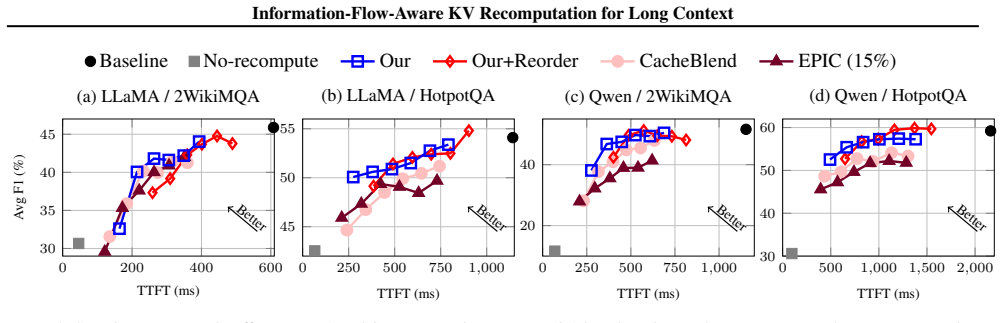
- At a 15% recomputation budget, attention-norm selection closes most of the accuracy gap between chunk-local prefilling and full-context inference on multi-hop QA tasks (e.g., Qwen 2WikiMQA: 0.5089 vs 0.5161 baseline, 0.3948 no-recompute), and sometimes exceeds the baseline.
- In sequence-parallel settings, the method communicates only the recomputed tokens rather than the full KV cache, yielding a 2.57x lower time-to-first-token than ring attention at 16K context and a 3.49x speedup over single-GPU prefill at 32K.
- The selection criterion transfers to vision-language models, beating prior recomputation methods consistently on chart, OCR, and visual-question benchmarks under equal recomputation budgets.
- Because the method does not modify the pretrained model and works from cached states, it layers onto existing chunked-prefilling pipelines and supports parallel per-chunk prefilling across GPUs.
- Global RoPE geometry is required for reliable selection: chunk-local or mismatched position layouts degrade accuracy, so systems adopting this approach must handle positional reassignment carefully.
Where Pith is reading between the lines
- The attention-norm signal is effectively a causal-influence ranking of context tokens on the prompt's decoding, so the same idea could plausibly drive other context-management decisions—KV eviction during streaming, chunk retention in memory, or retrieval reranking.
- The paper leaves unspecified how cached keys, originally RoPE-rotated at chunk-local positions, are switched to global positions before scoring. If the switch is a cheap re-rotation of keys, the method is nearly free; if it requires recomputing keys, the prefilling savings erode. An explicit implementation would settle this trade-off.
- The reordering result suggests a broader design principle for multi-document RAG: prompt-proximity in position space can matter more than the original retrieval order, so chunk layouts should be treated as an optimization variable rather than a fixed input.
- For prompts that attend sparsely to the retrieved context, the column-sum score may become flat and selection nearly random; a direct test would be to run the method on retrieval sets with deliberately low relevance and check whether gains shrink.
Editorial analysis
A structured set of objections, weighed in public.
Referee Report
Summary. The paper proposes InfoFlow KV, a method for selective KV recomputation in long-context RAG. It selects recomputation targets by ranking context tokens according to the attention mass they receive from prompt tokens, computed under a global RoPE positional reconstruction of retrieved chunks, and optionally reorders chunks to place more informative segments closer to the prompt. The method is evaluated on Qwen, LLaMA, and ChatGLM on four LongBench QA datasets, on Qwen3-VL on several VLM benchmarks, and in a sequence-parallel latency study.
Significance. If the reported effects hold, this is a valuable result: a content-based, query-conditioned selection criterion that outperforms both discrepancy-based (CacheBlend) and positional-heuristic (EPIC) baselines across multiple model families and modalities, with a plausible information-flow interpretation. The paper provides a broad empirical evaluation, a RoPE-geometry ablation, and a latency analysis. However, the current manuscript omits a key implementation detail—the re-positioning of cached keys under global RoPE—that is required for the method's central mechanism and for reproducing Table 1. The efficiency claims also do not clearly account for the cost of the selection forward pass.
major comments (3)
- [§4.2, Eqs. (5)–(8), Table 1] The GLOBAL RoPE geometry requires the prompt-to-context attention matrix A to be computed with context keys at global positions g(t). However, §4.1 states that KV states are cached with chunk-local RoPE positions. The paper does not specify how these cached keys are transformed to global positions before computing A (e.g., by RoPE re-rotation or by recomputation). If keys remain at local positions, the actual geometry is a hybrid with uncontrolled relative angles, and the claimed advantage of GLOBAL over HL–HP/HL–TP/TL–TP cannot be verified. Please state the re-positioning operation explicitly and include its cost.
- [§7, Table 5, Fig. 2] The selection step requires a forward pass that computes attention from M prompt tokens to all N context tokens (at the selected layers) to obtain A. The paper does not state whether this selection-pass cost is included in the reported TTFT and latency curves. If excluded, the comparison to ring attention (which performs full-context attention) is not under 'comparable latency.' If included, the method's overhead in the 'prepared context' setting is not solely recomputation. Please specify the cost model precisely.
- [Appendix B, §4.2] The layer selection for attention norms is described as 'layers 22–25,' while Eq. (7) defines a single-layer score. The manuscript does not explain whether the score uses one layer, averages over layers, or sums. Without this detail, the reported results are not reproducible. Please clarify the exact computation and correct the typo 'a 22-25 layer.'
minor comments (4)
- [Table 2 caption] 'HotpotQA' is misspelled; should be 'HotpotQA.'
- [§1 contribution list] 'attention-norm–basedcriterion' is missing a space; should read 'attention-norm–based criterion.'
- [§4.3] The chunk reordering algorithm is described only qualitatively. Please provide the concrete scoring/ordering rule (or refer to an appendix) so that 'Our + Reorder' can be reproduced.
- [Table 3, Qwen fixed-chunk rows] Our + Reorder substantially underperforms Our on several Qwen fixed-chunk settings (e.g., 2WikiMQA 0.4773 vs 0.5089; MuSiQue 0.2872 vs 0.3384). The text says reordering 'maintains comparable performance,' which is misleading for these cases; please qualify the claim.
Circularity Check
No significant circularity: the selection signal is a direct attention computation judged on independent QA benchmarks; no target metric is fitted into the derivation.
full rationale
Walked the claimed derivation chain. The importance score s_j = sum_i A_ij (Eq. 7) is a deterministic attention-mass computation from the prompt-to-context attention matrix, and Eq. 8 simply takes its top-k; no benchmark label, downstream F1, or target metric is used to define or fit the score. The central claim is therefore not equivalent to its inputs by construction. The GLOBAL RoPE geometry ablation (Table 1) and the RoPE-similarity statistics (Table 2, §5.2) are after-the-fact characterizations of the selected tokens, not components of the selection rule, so the observed correlation with positional reachability is explanatory rather than a self-fulfilling derivation. There are no load-bearing self-citations, no imported uniqueness theorem, and no ansatz smuggled in by citation; CacheBlend and EPIC are external baselines and are compared, not invoked as justification. Two caveats are noted but neither is circularity: (1) Appendix B's layer selection (layers 22-25) is a hyperparameter choice made from a layer-wise analysis on Qwen, which is a tuning/reproducibility concern rather than a fitted input called a prediction; (2) §4.2 never specifies how cached keys RoPE-rotated at chunk-local positions (§4.1, Eq. 3) are converted to the global positions used in Eq. 7's attention matrix — an omitted implementation step that impacts reproducibility and could affect the GLOBAL-geometry claim, but not a circular reduction of the derivation to its inputs. Verdict: no significant circularity (score 0).
Axiom & Free-Parameter Ledger
free parameters (4)
- Attention-norm extraction layer range =
layers 22–25 (Qwen numbering)
- Recompute budget top-k (LLM tables) =
not reported; 'comparable' to EPIC (15%)
- Chunk size =
2048 tokens
- Reorder geometry pair (stage-1/stage-2) =
HL–TP then GLOBAL
axioms (6)
- domain assumption Prompt-to-context attention mass is a faithful proxy for a token's influence on downstream generation (information flow).
- domain assumption Cached chunk-local KV states can be re-positioned to a global RoPE geometry for computing selection attention norms, without full recomputation.
- standard math RoPE rotations compose so that re-rotating a key between positional assignments is well-defined.
- domain assumption Reordering independently retrieved chunks preserves answer coherence and relevance.
- ad hoc to paper The layer range 22–25 tuned on Qwen transfers to LLaMA, ChatGLM, and Qwen3-VL.
- domain assumption Ring attention and single-GPU full-prefill are numerically interchangeable for the F1 comparisons in Table 6.
Cite this review
Pith. "Pith review of InfoFlow KV: Information-Flow-Aware KV Recomputation for Long Context." pith.science (2026). https://pith.science/paper/PYDPIWDF
@misc{pith2026260305353,
  author       = {Pith},
  title        = {Pith review of: InfoFlow KV: Information-Flow-Aware KV Recomputation for Long Context},
  year         = {2026},
  howpublished = {\url{https://pith.science/paper/PYDPIWDF}},
  note         = {Machine review of arXiv:2603.05353}
}
read the original abstract
Retrieval-augmented generation (RAG) for long-context question answering is bottlenecked by inference-time prefilling over large retrieved contexts. A common strategy is to precompute key-value (KV) caches for individual documents and selectively recompute a small subset of tokens to restore global causal dependencies, but existing methods rely on heuristics or representation discrepancies without modeling whether selected tokens can effectively influence generation. We cast selective KV recomputation as an information flow problem and show that a simple attention-norm signal from the query reliably identifies tokens that are both semantically relevant and structurally positioned to propagate information, when computed under an inference-consistent RoPE geometry. We therefore reconstruct global positional assignments for retrieved chunks and introduce an information-flow-guided chunk reordering strategy. Experiments on Large Language Model and Vision-Language Model benchmarks demonstrate consistent gains over prior methods under comparable latency.
Figures



Forward citations
Cited by 1 Pith paper
-
Compute Globally, Materialize Locally: The Memory Contract of Sparse Event-KV
Source-omitted event KV rows can carry compact upstream state (semantic materialization); deliberate answer-free carriers raise recovery from 6% to 51% on Qwen3-8B, while passive natural mentions do not.
Reference graph
Works this paper leans on
-
[1]
Bai, S., Cai, Y ., Chen, R., Chen, K., Chen, X., Cheng, Z., Deng, L., Ding, W., Gao, C., Ge, C., Ge, W., Guo, Z., Huang, Q., Huang, J., Huang, F., Hui, B., Jiang, S., Li, Z., Li, M., Li, M., Li, K., Lin, Z., Lin, J., Liu, X., Liu, J., Liu, C., Liu, Y ., Liu, D., Liu, S., Lu, D., Luo, R., Lv, C., Men, R., Meng, L., Ren, X., Ren, X., Song, S., Sun, Y ., Tan...
-
[4]
The llama 3 herd of models.arXiv preprint arXiv:2407.21783,
Grattafiori, A., Dubey, A., Jauhri, A., Pandey, A., Kadian, A., Al-Dahle, A., Letman, A., Mathur, A., Schelten, A., Vaughan, A., et al. The llama 3 herd of models.arXiv preprint arXiv:2407.21783,
-
[6]
Liu, H., Zaharia, M., and Abbeel, P. Ring attention with blockwise transformers for near-infinite context.arXiv preprint arXiv:2310.01889,
-
[7]
doi: 10.1007/ s11432-024-4235-6
ISSN 1869-1919. doi: 10.1007/ s11432-024-4235-6. URL http://dx.doi.org/ 10.1007/s11432-024-4235-6. Masry, A., Do, X. L., Tan, J. Q., Joty, S., and Hoque, E. Chartqa: A benchmark for question answering about charts with visual and logical reasoning. InFindings of the association for computational linguistics: ACL 2022, pp. 2263–2279,
-
[9]
N., Hutchins, D., and Szegedy, C
Wu, Y ., Rabe, M. N., Hutchins, D., and Szegedy, C. Mem- orizing transformers.arXiv preprint arXiv:2203.08913,
-
[11]
Yang, Z., Qi, P., Zhang, S., Bengio, Y ., Cohen, W., Salakhut- dinov, R., and Manning, C. D. Hotpotqa: A dataset for diverse, explainable multi-hop question answering. In Proceedings of the 2018 conference on empirical methods in natural language processing, pp. 2369–2380,
2018
-
[2020]
International Committee on Compu- tational Linguistics. URL https://www.aclweb. org/anthology/2020.coling-main.580. Hu, J., Huang, W., Wang, W., Wang, H., Hu, T., Zhang, Q., Feng, H., Chen, X., Shan, Y ., and Xie, T. Epic: Efficient position-independent caching for serving large language models.arXiv preprint arXiv:2410.15332,
Pith/arXiv arXiv 2020
-
[2022]
Shoeybi, M., Patwary, M., Puri, R., LeGresley, P., Casper, J., and Catanzaro, B. Megatron-lm: Training multi- billion parameter language models using model paral- lelism.arXiv preprint arXiv:1909.08053,
Pith/arXiv arXiv 1909
-
[2023]
Qwen3 technical report.arXiv preprint arXiv:2505.09388,
Yang, A., Li, A., Yang, B., Zhang, B., Hui, B., Zheng, B., Yu, B., Gao, C., Huang, C., Lv, C., et al. Qwen3 technical report.arXiv preprint arXiv:2505.09388,
-
[2024]
GLM, T., Zeng, A., Xu, B., Wang, B., Zhang, C., Yin, D., Zhang, D., Rojas, D., Feng, G., Zhao, H., et al. Chatglm: A family of large language models from glm-130b to glm-4 all tools.arXiv preprint arXiv:2406.12793,
-
[2025]
Cai, Z., Zhang, Y ., Gao, B., Liu, Y ., Li, Y ., Liu, T., Lu, K., Xiong, W., Dong, Y ., Hu, J., et al. Pyramidkv: Dynamic kv cache compression based on pyramidal information funneling.arXiv preprint arXiv:2406.02069,
This paper was first reviewed by deepseek-v4-flash on August 2, 2026.
discussion (0)
Sign in with ORCID, Apple, or X to comment. Anyone can read and Pith papers without signing in.