Bias In, Bias Out? Finding Unbiased Subnetworks in Vanilla Models
Pith reviewed 2026-05-15 16:09 UTC · model grok-4.3
The pith
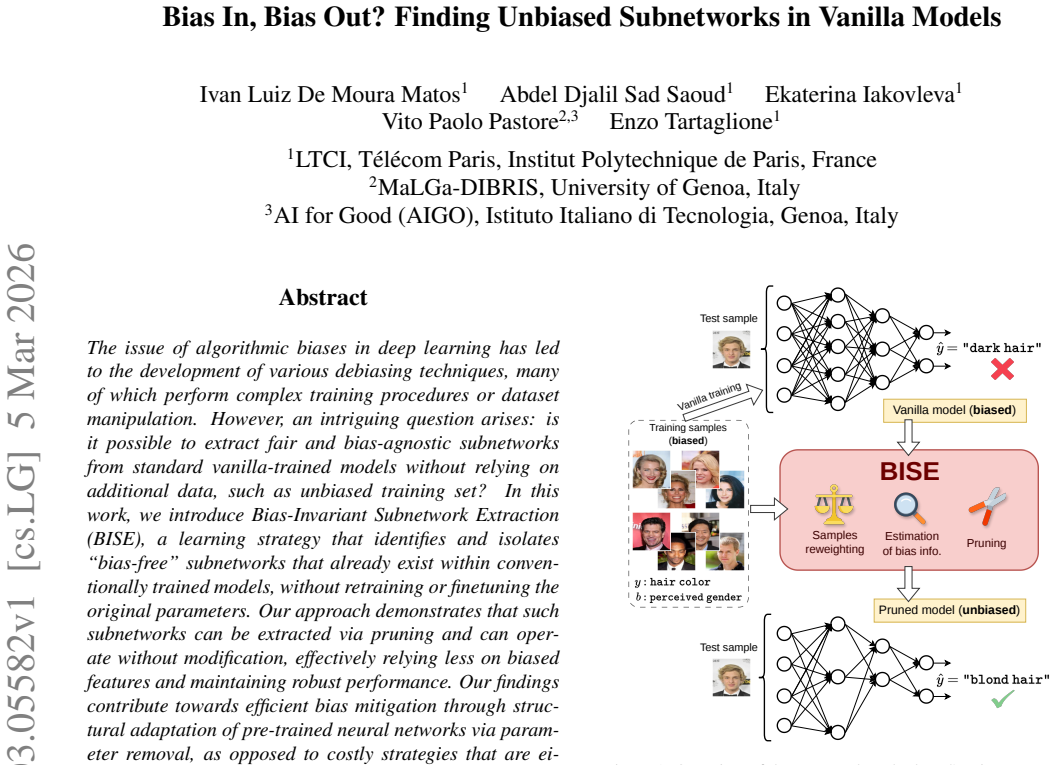
Standard neural networks trained on biased data already contain unbiased subnetworks that can be isolated by pruning without retraining.
A machine-rendered reading of the paper's core claim, the machinery that carries it, and where it could break.
Core claim
Bias-Invariant Subnetwork Extraction (BISE) locates and isolates bias-free subnetworks that already exist inside conventionally trained models. These subnetworks are obtained through pruning and run without any parameter changes, relying less on biased features while preserving robust accuracy on standard benchmarks.
What carries the argument
Bias-Invariant Subnetwork Extraction (BISE): a pruning procedure that selects and retains only the parameters forming bias-free subnetworks within a vanilla-trained model.
If this is right
- Extracted subnetworks rely less on biased features while keeping task performance.
- Bias mitigation occurs through parameter removal rather than retraining or data changes.
- The approach works on pre-trained models without additional unbiased training sets.
- Resulting models are more computationally efficient than methods that retrain all parameters.
Where Pith is reading between the lines
- Bias encoding may be localized to specific parameter subsets rather than distributed uniformly.
- The same pruning idea could be tested on other model properties such as robustness to distribution shift.
- Post-training fairness adjustments become feasible for already deployed networks.
- Training dynamics might be re-examined to see how biases concentrate during optimization.
Load-bearing premise
Bias-free subnetworks already exist inside models trained on biased data and can be reliably found by pruning without any unbiased examples or retraining.
What would settle it
Finding that every pruned subnetwork extracted by BISE still shows the same bias levels as the full original model on the tested benchmarks would falsify the claim.
Figures


read the original abstract
The issue of algorithmic biases in deep learning has led to the development of various debiasing techniques, many of which perform complex training procedures or dataset manipulation. However, an intriguing question arises: is it possible to extract fair and bias-agnostic subnetworks from standard vanilla-trained models without relying on additional data, such as unbiased training set? In this work, we introduce Bias-Invariant Subnetwork Extraction (BISE), a learning strategy that identifies and isolates "bias-free" subnetworks that already exist within conventionally trained models, without retraining or finetuning the original parameters. Our approach demonstrates that such subnetworks can be extracted via pruning and can operate without modification, effectively relying less on biased features and maintaining robust performance. Our findings contribute towards efficient bias mitigation through structural adaptation of pre-trained neural networks via parameter removal, as opposed to costly strategies that are either data-centric or involve (re)training all model parameters. Extensive experiments on common benchmarks show the advantages of our approach in terms of the performance and computational efficiency of the resulting debiased model.
Editorial analysis
A structured set of objections, weighed in public.
Referee Report
Summary. The paper introduces Bias-Invariant Subnetwork Extraction (BISE), a pruning-based method to identify and isolate bias-free subnetworks that purportedly already exist inside conventionally trained (vanilla) models. These subnetworks are claimed to be extractable without any additional unbiased data, without retraining or fine-tuning, and to maintain competitive performance while relying less on biased features. Experiments on standard benchmarks are said to demonstrate advantages in both accuracy and computational efficiency relative to data-centric or full-retraining debiasing approaches.
Significance. If the central claim holds—that bias-free subnetworks can be reliably isolated from vanilla models using only the original biased training data—the result would be practically significant. It would offer a low-cost structural debiasing route that avoids both dataset curation and parameter updates, which is attractive for large pre-trained networks. The work also supplies a concrete test of the “lottery ticket” style hypothesis in the fairness setting.
major comments (2)
- [§3] §3 (BISE algorithm): the mask-selection objective is not shown to be free of an external bias signal. The description states that pruning uses only the original training loss, yet the selection must still quantify “reliance on biased features.” Without an explicit equation or pseudocode step that defines this quantification (e.g., a gradient-based attribution term or a fairness regularizer), it is impossible to verify that the procedure avoids the very information it claims to forgo.
- [§4.2] §4.2 (experimental protocol): the reported fairness metrics (e.g., demographic parity or equalized odds) are evaluated on the same distribution used for pruning. This leaves open whether the extracted subnetwork generalizes to a shifted test distribution whose bias statistics differ from the training set—an essential check for the “bias-agnostic” claim.
minor comments (2)
- [§3] Notation for the binary mask m is introduced without a clear statement of its cardinality or how the pruning ratio is chosen; a short paragraph or table entry would clarify reproducibility.
- [Figure 2] Figure 2 caption does not indicate whether error bars are standard deviation across seeds or across datasets; this affects interpretation of the performance gap.
Simulated Author's Rebuttal
We thank the referee for the constructive feedback on our manuscript. We address each major comment below and outline revisions to improve clarity and strengthen the experimental validation of the bias-agnostic claims.
read point-by-point responses
-
Referee: [§3] §3 (BISE algorithm): the mask-selection objective is not shown to be free of an external bias signal. The description states that pruning uses only the original training loss, yet the selection must still quantify “reliance on biased features.” Without an explicit equation or pseudocode step that defines this quantification (e.g., a gradient-based attribution term or a fairness regularizer), it is impossible to verify that the procedure avoids the very information it claims to forgo.
Authors: We appreciate this observation. The BISE mask-selection procedure optimizes solely the standard cross-entropy loss on the original (biased) training data, without any fairness regularizer, gradient attribution to sensitive attributes, or external bias signal. Subnetworks are identified via iterative magnitude-based pruning of parameters that contribute least to loss minimization, consistent with lottery-ticket hypotheses. To eliminate ambiguity, we will add an explicit mathematical formulation of the mask objective (Equation X) and pseudocode in §3, confirming that no bias-related term enters the selection process. Fairness metrics are computed only after extraction for evaluation purposes. revision: yes
-
Referee: [§4.2] §4.2 (experimental protocol): the reported fairness metrics (e.g., demographic parity or equalized odds) are evaluated on the same distribution used for pruning. This leaves open whether the extracted subnetwork generalizes to a shifted test distribution whose bias statistics differ from the training set—an essential check for the “bias-agnostic” claim.
Authors: We agree that demonstrating robustness to distribution shifts in bias statistics is necessary to fully support the bias-agnostic claim. Our current protocol follows standard benchmark splits, but we will augment §4.2 with additional experiments on synthetically shifted test sets (e.g., by varying the strength of spurious correlations between protected attributes and labels while keeping the training distribution fixed). Updated tables and figures will report accuracy and fairness metrics under these conditions. revision: yes
Circularity Check
No circularity: empirical pruning strategy with no self-referential derivations
full rationale
The paper introduces BISE as a pruning-based method to isolate existing bias-free subnetworks from vanilla-trained models without retraining or extra unbiased data. No equations, parameter fits presented as predictions, or self-citation chains appear in the abstract or description. The central claim rests on experimental results on benchmarks rather than any derivation that reduces by construction to its inputs. The selection criterion is described at a high level as identifying subnetworks that rely less on biased features, but without shown mathematical reduction or load-bearing self-citation, the approach remains self-contained and non-circular.
Axiom & Free-Parameter Ledger
Reference graph
Works this paper leans on
-
[1]
The EU artificial intelligence act, 2024
EU Artificial Intelligence Act. The EU artificial intelligence act, 2024. 2
work page 2024
-
[2]
Does data repair lead to fair models? curating con- textually fair data to reduce model bias
Sharat Agarwal, Sumanyu Muku, Saket Anand, and Chetan Arora. Does data repair lead to fair models? curating con- textually fair data to reduce model bias. InWACV, 2022. 2
work page 2022
-
[3]
Systematic generalisation with group in- variant predictions
Faruk Ahmed, Yoshua Bengio, Harm Van Seijen, and Aaron Courville. Systematic generalisation with group in- variant predictions. InICLR, 2021. 7
work page 2021
-
[4]
Jaan Aru, Aqeel Labash, Oriol Corcoll, and Raul Vicente. Mind the gap: Challenges of deep learning approaches to theory of mind.Artificial Intelligence Review, 2023. 1
work page 2023
-
[5]
Learning de-biased represen- tations with biased representations
Hyojin Bahng, Sanghyuk Chun, Sangdoo Yun, Jaegul Choo, and Seong Joon Oh. Learning de-biased represen- tations with biased representations. InICML, 2020. 2, 3, 5, 6, 13, 14, 15
work page 2020
-
[6]
Un- biased supervised contrastive learning
Carlo Alberto Barbano, Benoit Dufumier, Enzo Tartaglione, Marco Grangetto, and Pietro Gori. Un- biased supervised contrastive learning. InICLR, 2023. 2, 16
work page 2023
-
[7]
Unsupervised learning of unbiased visual repre- sentations.IEEE TAI, 2025
Carlo Alberto Barbano, Enzo Tartaglione, and Marco Grangetto. Unsupervised learning of unbiased visual repre- sentations.IEEE TAI, 2025. 3
work page 2025
-
[8]
Abhipsa Basu, Saswat Subhajyoti Mallick, and R. Venkatesh Babu. Mitigating biases in blackbox feature extractors for image classification tasks. In NeurIPS, 2024. 2
work page 2024
-
[9]
Estimating or Propagating Gradients Through Stochastic Neurons for Conditional Computation
Yoshua Bengio, Nicholas L ´eonard, and Aaron Courville. Estimating or propagating gradients through stochastic neurons for conditional computation.arXiv preprint arXiv:1308.3432, 2013. 4
work page internal anchor Pith review Pith/arXiv arXiv 2013
-
[10]
Cody Blakeney, Nathaniel Huish, Yan Yan, and Ziliang Zong. Simon says: Evaluating and mitigating bias in pruned neural networks with knowledge distillation.arXiv preprint arXiv:2106.07849, 2021. 2
-
[11]
Nuanced metrics for measur- ing unintended bias with real data for text classification
Daniel Borkan, Lucas Dixon, Jeffrey Sorensen, Nithum Thain, and Lucy Vasserman. Nuanced metrics for measur- ing unintended bias with real data for text classification. In Companion proceedings of the 2019 world wide web con- ference, 2019. 5, 15
work page 2019
-
[12]
Simplify: A python library for optimizing pruned neural networks
Andrea Bragagnolo and Carlo Alberto Barbano. Simplify: A python library for optimizing pruned neural networks. SoftwareX, 2022. 16
work page 2022
-
[13]
Language models are few-shot learners
Tom Brown, Benjamin Mann, Nick Ryder, Melanie Sub- biah, Jared D Kaplan, Prafulla Dhariwal, Arvind Neelakan- tan, Pranav Shyam, Girish Sastry, Amanda Askell, Sand- hini Agarwal, Ariel Herbert-V oss, Gretchen Krueger, Tom Henighan, Rewon Child, Aditya Ramesh, Daniel Ziegler, Jeffrey Wu, Clemens Winter, Chris Hesse, Mark Chen, Eric Sigler, Mateusz Litwin, S...
work page 2020
-
[14]
Rubi: Reducing unimodal biases for visual question answering
Remi Cadene, Corentin Dancette, Matthieu Cord, and Devi Parikh. Rubi: Reducing unimodal biases for visual question answering. InNeurIPS, 2019. 3, 6
work page 2019
-
[15]
Fairness without demographics through knowledge distillation
Junyi Chai, Taeuk Jang, and Xiaoqian Wang. Fairness without demographics through knowledge distillation. In NeurIPS, 2022. 2
work page 2022
-
[16]
Knowledge distillation with the reused teacher classifier
Defang Chen, Jian-Ping Mei, Hailin Zhang, Can Wang, Yan Feng, and Chun Chen. Knowledge distillation with the reused teacher classifier. InCVPR, 2022. 7
work page 2022
-
[17]
Hongrong Cheng, Miao Zhang, and Javen Qinfeng Shi. A survey on deep neural network pruning: Taxonomy, com- parison, analysis, and recommendations.IEEE TPAMI,
-
[18]
Christopher Clark, Mark Yatskar, and Luke Zettlemoyer. Don’t take the easy way out: Ensemble based methods for avoiding known dataset biases.EMNLP-IJCNLP, 2019. 6
work page 2019
-
[19]
Environment inference for invariant learning
Elliot Creager, J ¨orn-Henrik Jacobsen, and Richard Zemel. Environment inference for invariant learning. InICML,
-
[20]
Brian d’Alessandro, Cathy O’Neil, and Tom LaGatta. Conscientious classification: A data scientist’s guide to discrimination-aware classification.Big data, 2017. 2
work page 2017
-
[21]
Fairdistillation: Mit- igating stereotyping in language models.ECML-PKDD,
Pieter Delobelle and Bettina Berendt. Fairdistillation: Mit- igating stereotyping in language models.ECML-PKDD,
-
[22]
Bert: Pre-training of deep bidirectional trans- formers for language understanding
Jacob Devlin, Ming-Wei Chang, Kenton Lee, and Kristina Toutanova. Bert: Pre-training of deep bidirectional trans- formers for language understanding. InProceedings of the 2019 conference of the North American chapter of the as- sociation for computational linguistics: human language technologies, volume 1 (long and short papers), 2019. 1, 5, 16
work page 2019
-
[23]
A winning hand: Com- pressing deep networks can improve out-of-distribution ro- bustness
James Diffenderfer, Brian Bartoldson, Shreya Chaganti, Jize Zhang, and Bhavya Kailkhura. A winning hand: Com- pressing deep networks can improve out-of-distribution ro- bustness. InNeurIPS, 2021. 3
work page 2021
-
[24]
The lottery ticket hypothesis: Finding sparse, trainable neural networks
Jonathan Frankle and Michael Carbin. The lottery ticket hypothesis: Finding sparse, trainable neural networks. In ICLR, 2019. 3
work page 2019
-
[25]
Shortcut learning in deep neural net- works.Nature Machine Intelligence, 2020
Robert Geirhos, J ¨orn-Henrik Jacobsen, Claudio Michaelis, Richard Zemel, Wieland Brendel, Matthias Bethge, and Fe- lix A Wichmann. Shortcut learning in deep neural net- works.Nature Machine Intelligence, 2020. 1, 2, 4
work page 2020
-
[26]
Debias- ing pre-trained language models via efficient fine-tuning
Michael Gira, Ruisu Zhang, and Kangwook Lee. Debias- ing pre-trained language models via efficient fine-tuning. In Proceedings of the second workshop on language technol- ogy for equality, diversity and inclusion, 2022. 2
work page 2022
-
[27]
Morphnet: Fast & simple resource-constrained structure learning of deep networks
Ariel Gordon, Elad Eban, Ofir Nachum, Bo Chen, Hao Wu, Tien-Ju Yang, and Edward Choi. Morphnet: Fast & simple resource-constrained structure learning of deep networks. InCVPR, 2018. 3
work page 2018
-
[28]
Deep residual learning for image recognition
Kaiming He, Xiangyu Zhang, Shaoqing Ren, and Jian Sun. Deep residual learning for image recognition. InCVPR,
-
[29]
Structured pruning for deep convolutional neural networks: A survey.IEEE TPAMI,
Yang He and Lingao Xiao. Structured pruning for deep convolutional neural networks: A survey.IEEE TPAMI,
-
[30]
Benchmarking neural network robustness to common corruptions and per- turbations
Dan Hendrycks and Thomas Dietterich. Benchmarking neural network robustness to common corruptions and per- turbations. InICLR, 2019. 5, 13, 15
work page 2019
-
[31]
Unbiased classifica- tion through bias-contrastive and bias-balanced learning
Youngkyu Hong and Eunho Yang. Unbiased classifica- tion through bias-contrastive and bias-balanced learning. In NeurIPS, 2021. 2, 6, 7, 13, 18, 20
work page 2021
-
[32]
What do compressed deep neural networks forget?arXiv preprint arXiv:1911.05248,
Sara Hooker, Aaron Courville, Gregory Clark, Yann Dauphin, and Andrea Frome. What do compressed deep neural networks forget?arXiv preprint arXiv:1911.05248,
-
[33]
Charac- terising bias in compressed models.arXiv preprint arXiv:2010.03058,
Sara Hooker, Nyalleng Moorosi, Gregory Clark, Samy Bengio, and Emily Denton. Characterising bias in com- pressed models.arXiv preprint arXiv:2010.03058, 2020. 3
-
[34]
Selecmix: Debiased learning by contradicting-pair sam- pling
Inwoo Hwang, Sangjun Lee, Yunhyeok Kwak, Seong Joon Oh, Damien Teney, Jin-Hwa Kim, and Byoung-Tak Zhang. Selecmix: Debiased learning by contradicting-pair sam- pling. InNeurIPS, 2022. 2
work page 2022
-
[35]
Simple data balancing achieves com- petitive worst-group-accuracy
Badr Youbi Idrissi, Martin Arjovsky, Mohammad Pezeshki, and David Lopez-Paz. Simple data balancing achieves com- petitive worst-group-accuracy. InProceedings of the First Conference on Causal Learning and Reasoning. PMLR,
-
[36]
Bias in pruned vision models: In-depth analysis and counter- measures
Eugenia Iofinova, Alexandra Peste, and Dan Alistarh. Bias in pruned vision models: In-depth analysis and counter- measures. InCVPR, 2023. 3
work page 2023
-
[37]
On feature learning in the presence of spu- rious correlations
Pavel Izmailov, Polina Kirichenko, Nate Gruver, and An- drew G Wilson. On feature learning in the presence of spu- rious correlations. InNeurIPS, 2022. 2, 5, 7, 15, 16
work page 2022
-
[38]
On the effect of pruning on adversarial robustness
Artur Jord ˜ao and H´elio Pedrini. On the effect of pruning on adversarial robustness. InICCV Workshops, 2021. 3
work page 2021
-
[39]
Going be- yond classification accuracy metrics in model compression
Vinu Joseph, Shoaib Ahmed Siddiqui, Aditya Bhaskara, Ganesh Gopalakrishnan, Saurav Muralidharan, Michael Garland, Sheraz Ahmed, and Andreas Dengel. Going be- yond classification accuracy metrics in model compression. arXiv preprint arXiv:2012.01604, 2020. 3
-
[40]
Learning not to learn: Training deep neu- ral networks with biased data
Byungju Kim, Hyunwoo Kim, Kyungsu Kim, Sungjin Kim, and Junmo Kim. Learning not to learn: Training deep neu- ral networks with biased data. InCVPR, 2019. 2, 3, 7
work page 2019
-
[41]
Learning debiased classifier with biased committee
Nayeong Kim, Sehyun Hwang, Sungsoo Ahn, Jaesik Park, and Suha Kwak. Learning debiased classifier with biased committee. InNeurIPS, 2022. 2, 3, 7, 8
work page 2022
-
[42]
Improving robustness to multiple spuri- ous correlations by multi-objective optimization
Nayeong Kim, Juwon Kang, Sungsoo Ahn, Jungseul Ok, and Suha Kwak. Improving robustness to multiple spuri- ous correlations by multi-objective optimization. InICML,
-
[43]
Diederik P. Kingma and Jimmy Ba. Adam: A method for stochastic optimization. InICLR, 2015. 16
work page 2015
-
[44]
Wilds: A benchmark of in-the-wild distribution shifts
Pang Wei Koh, Shiori Sagawa, Henrik Marklund, Sang Michael Xie, Marvin Zhang, Akshay Balsubramani, Weihua Hu, Michihiro Yasunaga, Richard Lanas Phillips, Irena Gao, Tony Lee, Etienne David, Ian Stavness, Wei Guo, Berton Earnshaw, Imran Haque, Sara M Beery, Jure Leskovec, Anshul Kundaje, Emma Pierson, Sergey Levine, Chelsea Finn, and Percy Liang. Wilds: A ...
work page 2021
-
[45]
Achieving fairness through channel pruning for dermatological disease diagnosis
Qingpeng Kong, Ching-Hao Chiu, Dewen Zeng, Yu-Jen Chen, Tsung-Yi Ho, Jingtong Hu, and Yiyu Shi. Achieving fairness through channel pruning for dermatological disease diagnosis. InInternational Conference on Medical Image Computing and Computer-Assisted Intervention, 2024. 3
work page 2024
-
[46]
Nima Kordzadeh and Maryam Ghasemaghaei. Algorithmic bias: review, synthesis, and future research directions.Eu- ropean Journal of Information Systems, 2022. 1
work page 2022
-
[47]
A contrastive learning approach to mitigate bias in speech models.arXiv preprint arXiv:2406.14686,
Alkis Koudounas, Flavio Giobergia, Eliana Pastor, and Elena Baralis. A contrastive learning approach to mitigate bias in speech models.arXiv preprint arXiv:2406.14686,
-
[48]
Learning multiple layers of features from tiny images
Alex Krizhevsky. Learning multiple layers of features from tiny images. Master’s thesis, Department of Computer Sci- ence, University of Toronto, 2009. 5, 15
work page 2009
-
[49]
Gradient-based learning applied to document recognition.Proceedings of the IEEE, 1998
Yann LeCun, L ´eon Bottou, Yoshua Bengio, and Patrick Haffner. Gradient-based learning applied to document recognition.Proceedings of the IEEE, 1998. 5, 14
work page 1998
-
[50]
Debiased distillation by trans- planting the last layer.arXiv preprint arXiv:2302.11187,
Jiwoon Lee and Jaeho Lee. Debiased distillation by trans- planting the last layer.arXiv preprint arXiv:2302.11187,
-
[51]
Learning debiased representation via dis- entangled feature augmentation
Jungsoo Lee, Eungyeup Kim, Juyoung Lee, Jihyeon Lee, and Jaegul Choo. Learning debiased representation via dis- entangled feature augmentation. InNeurIPS, 2021. 2, 6, 20
work page 2021
-
[52]
Repair: Removing represen- tation bias by dataset resampling
Yi Li and Nuno Vasconcelos. Repair: Removing represen- tation bias by dataset resampling. InCVPR, 2019. 2
work page 2019
-
[53]
Discover and mitigate unknown biases with debiasing alternate net- works
Zhiheng Li, Anthony Hoogs, and Chenliang Xu. Discover and mitigate unknown biases with debiasing alternate net- works. InECCV, 2022. 2, 5, 6, 7, 8, 14, 15, 16
work page 2022
-
[54]
Achieving adversarial ro- bustness via sparsity.Machine Learning, 2022
Ningyi Liao, Shufan Wang, Liyao Xiang, Nanyang Ye, Shuo Shao, and Pengzhi Chu. Achieving adversarial ro- bustness via sparsity.Machine Learning, 2022. 3
work page 2022
-
[55]
Lucas Liebenwein, Cenk Baykal, Brandon Carter, David Gifford, and Daniela Rus. Lost in pruning: The effects of pruning neural networks beyond test accuracy.Proceedings of Machine Learning and Systems, 2021. 3
work page 2021
-
[56]
Biasadv: Bias-adversarial augmentation for model debiasing
Jongin Lim, Youngdong Kim, Byungjai Kim, Chanho Ahn, Jinwoo Shin, Eunho Yang, and Seungju Han. Biasadv: Bias-adversarial augmentation for model debiasing. In CVPR, 2023. 2
work page 2023
-
[57]
Evan Z. Liu, Behzad Haghgoo, Annie S. Chen, Aditi Raghunathan, Pang Wei Koh, Shiori Sagawa, Percy Liang, and Chelsea Finn. Just train twice: Improving group robust- ness without training group information. InICML, 2021. 2, 7, 8
work page 2021
-
[58]
Deep learning face attributes in the wild
Ziwei Liu, Ping Luo, Xiaogang Wang, and Xiaoou Tang. Deep learning face attributes in the wild. InICCV, 2015. 5, 13, 14, 15
work page 2015
-
[59]
Decoupled weight decay regularization
Ilya Loshchilov and Frank Hutter. Decoupled weight decay regularization. InICLR, 2019. 16
work page 2019
-
[60]
Martin Q Ma, Yao-Hung Hubert Tsai, Paul Pu Liang, Han Zhao, Kun Zhang, Ruslan Salakhutdinov, and Louis- Philippe Morency. Conditional contrastive learning for im- proving fairness in self-supervised learning.arXiv preprint arXiv:2106.02866, 2021. 2 10
-
[61]
An image enhancing pattern- based sparsity for real-time inference on mobile devices
Xiaolong Ma, Wei Niu, Tianyun Zhang, Sijia Liu, Sheng Lin, Hongjia Li, Xiang Chen, Jian Tang, Kaisheng Ma, Bin Ren, and Yanzhi Wang. An image enhancing pattern- based sparsity for real-time inference on mobile devices. In ECCV, 2020. 3
work page 2020
-
[62]
De- biasing deep chest x-ray classifiers using intra-and post- processing methods
Ricards Marcinkevics, Ece Ozkan, and Julia E V ogt. De- biasing deep chest x-ray classifiers using intra-and post- processing methods. InMachine Learning for Healthcare Conference. PMLR, 2022. 2
work page 2022
-
[63]
A survey on bias and fairness in machine learning.ACM computing surveys (CSUR), 2021
Ninareh Mehrabi, Fred Morstatter, Nripsuta Saxena, Kristina Lerman, and Aram Galstyan. A survey on bias and fairness in machine learning.ACM computing surveys (CSUR), 2021. 2
work page 2021
-
[64]
Debiasing masks: A new framework for shortcut mitigation in NLU.EMNLP, 2022
Johannes Mario Meissner, Saku Sugawara, and Akiko Aizawa. Debiasing masks: A new framework for shortcut mitigation in NLU.EMNLP, 2022. 2, 3
work page 2022
-
[65]
Gender arti- facts in visual datasets
Nicole Meister, Dora Zhao, Angelina Wang, Vikram V Ra- maswamy, Ruth Fong, and Olga Russakovsky. Gender arti- facts in visual datasets. InICCV, 2023. 1
work page 2023
-
[66]
Fanxu Meng, Hao Cheng, Ke Li, Huixiang Luo, Xiaowei Guo, Guangming Lu, and Xing Sun. Pruning filter in filter. InNeurIPS, 2020. 3
work page 2020
-
[67]
A fair loss function for network pruning.NeurIPS TSRML Workshop, 2022
Robbie Meyer and Alexander Wong. A fair loss function for network pruning.NeurIPS TSRML Workshop, 2022. 3
work page 2022
-
[68]
Mining bias-target alignment from voronoi cells
R ´emi Nahon, Van-Tam Nguyen, and Enzo Tartaglione. Mining bias-target alignment from voronoi cells. InICCV,
-
[69]
Debiasing surgeon: fan- tastic weights and how to find them
R ´emi Nahon, Ivan Luiz De Moura Matos, Van-Tam Nguyen, and Enzo Tartaglione. Debiasing surgeon: fan- tastic weights and how to find them. InECCV, 2024. 2, 3, 7, 8, 14, 16, 17
work page 2024
-
[70]
Learning from failure: De-biasing classifier from biased classifier
Junhyun Nam, Hyuntak Cha, Sungsoo Ahn, Jaeho Lee, and Jinwoo Shin. Learning from failure: De-biasing classifier from biased classifier. InNeurIPS, 2020. 2, 3, 4, 5, 6, 7, 8, 15, 16, 18
work page 2020
-
[71]
Leonardo Olivi, Edoardo Santero Mormile, and Enzo Tartaglione. Efficient adaptation of deep neural networks for semantic segmentation in space applications.Scientific Reports, 2025. 17
work page 2025
-
[72]
Prune responsibly.arXiv preprint arXiv:2009.09936, 2020
Michela Paganini. Prune responsibly.arXiv preprint arXiv:2009.09936, 2020. 3
-
[73]
Training debiased subnetworks with con- trastive weight pruning
Geon Yeong Park, Sangmin Lee, Sang Wan Lee, and Jong Chul Ye. Training debiased subnetworks with con- trastive weight pruning. InCVPR, 2023. 2
work page 2023
-
[74]
Self-supervised debi- asing using low rank regularization
Geon Yeong Park, Chanyong Jung, Sangmin Lee, Jong Chul Ye, and Sang Wan Lee. Self-supervised debi- asing using low rank regularization. InCVPR, 2024. 6, 13
work page 2024
-
[75]
Ot ´avio Parraga, Martin D. More, Christian M. Oliveira, Nathan S. Gavenski, Lucas S. Kupssinsk ¨u, Adilson Medronha, Luis V . Moura, Gabriel S. Sim ˜oes, and Ro- drigo C. Barros. Debiasing methods for fairer neural mod- els in vision and language research: A survey.ACM com- puting surveys (CSUR), 2022. 2
work page 2022
-
[76]
Learning deep representations with probabilistic knowledge transfer
Nikolaos Passalis and Anastasios Tefas. Learning deep representations with probabilistic knowledge transfer. In ECCV, 2018. 2
work page 2018
-
[77]
Looking at model debiasing through the lens of anomaly detection
Vito Paolo Pastore, Massimiliano Ciranni, Davide Marinelli, Francesca Odone, and Vittorio Murino. Looking at model debiasing through the lens of anomaly detection. InWACV, 2025. 2
work page 2025
-
[78]
Pytorch: An imperative style, high-performance deep learning library
Adam Paszke, Sam Gross, Francisco Massa, Adam Lerer, James Bradbury, Gregory Chanan, Trevor Killeen, Zeming Lin, Natalia Gimelshein, Luca Antiga, Alban Desmaison, Andreas Kopf, Edward Yang, Zachary DeVito, Martin Rai- son, Alykhan Tejani, Sasank Chilamkurthy, Benoit Steiner, Lu Fang, Junjie Bai, and Soumith Chintala. Pytorch: An imperative style, high-per...
work page 2019
-
[79]
Learning unbiased representations via mu- tual information backpropagation
Ruggero Ragonesi, Riccardo V olpi, Jacopo Cavazza, and Vittorio Murino. Learning unbiased representations via mu- tual information backpropagation. InCVPR, 2021. 2
work page 2021
-
[80]
A comparative study on the impact of model compression techniques on fairness in language models
Krithika Ramesh, Arnav Chavan, Shrey Pandit, and Sunayana Sitaram. A comparative study on the impact of model compression techniques on fairness in language models. InProceedings of the 61st Annual Meeting of the Association for Computational Linguistics (Volume 1: Long Papers), 2023. 3
work page 2023
discussion (0)
Sign in with ORCID, Apple, or X to comment. Anyone can read and Pith papers without signing in.