Recognition: no theorem link
Higher-order hadronic vacuum polarization contribution to the muon g-2 from lattice QCD
Pith reviewed 2026-05-15 15:28 UTC · model grok-4.3
The pith
Lattice QCD yields first sub-percent result for next-to-leading order hadronic vacuum polarization in muon g-2.
A machine-rendered reading of the paper's core claim, the machinery that carries it, and where it could break.
Core claim
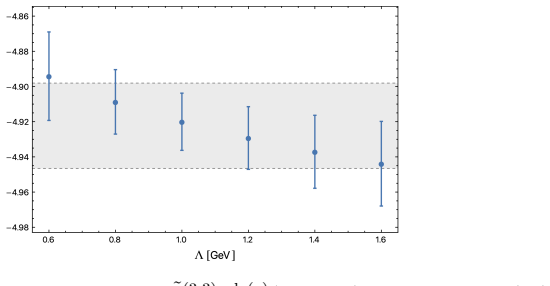
Using N_f=2+1 O(a)-improved Wilson fermions on CLS ensembles at six lattice spacings, the authors compute the NLO hadronic vacuum polarization contribution via the time-momentum representation of the kernel applied to the spatially summed vector correlator. After finite-volume and isospin-breaking corrections they obtain the continuum-extrapolated value a_μ^{hvp,nlo}=-101.57(26)_{stat}(54)_{syst}×10^{-11}.
What carries the argument
Time-momentum representation of the space-like kernel combined with the spatially summed vector current correlator.
If this is right
- The NLO HVP term is now available from lattice QCD with sub-percent precision.
- The lattice value lies 1.4 sigma below the 2025 White Paper central estimate.
- It exhibits 4.6 sigma tension with data-driven determinations that exclude the recent CMD-3 measurement.
- The method shows that higher-order HVP contributions can be computed on the lattice with controlled systematics.
Where Pith is reading between the lines
- Adopting this lattice value would lower the total hadronic contribution in the muon g-2 theory prediction relative to the White Paper.
- The observed tension may indicate systematic differences between lattice and dispersion-relation approaches that future work should resolve.
- The same framework can be extended to compute even higher-order terms such as NNLO directly on the lattice.
- This result supplies an independent cross-check that can be combined with leading-order HVP lattice data in global fits.
Load-bearing premise
Finite-volume corrections and isospin-breaking effects are controlled at the level required for sub-percent accuracy, and the six lattice spacings suffice for a reliable continuum extrapolation without large higher-order discretization effects.
What would settle it
An independent lattice calculation on finer spacings or with a different fermion discretization that yields a central value outside the interval -101.57 ± 0.80 × 10^{-11} would falsify the quoted result.
Figures


read the original abstract
We present the first lattice QCD calculation of the next-to-leading order hadronic vacuum polarization contribution to the muon anomalous magnetic moment with sub-percent precision. We employ the time-momentum representation for the space-like kernel, which is combined with the spatially summed vector correlator computed on CLS ensembles with $N_{\mathrm{f}}=2+1$ flavors of $\mathrm{O}(a)$-improved Wilson fermions, covering six lattice spacings between $0.039$ and $0.097\,$fm and a range of pion masses including the physical value. After accounting for finite-size corrections and isospin-breaking effects, we obtain as our final, continuum-extrapolated result $a_\mu^{\mathrm{hvp,\,nlo}}=-101.57(26)_{\mathrm{stat}}(54)_{\mathrm{syst}}\times10^{-11}$. It lies below the estimate provided by the 2025 White Paper of the Muon $(g-2)$ Theory Initiative by $1.4\sigma$ but is two times more precise. It also exhibits a strong tension of $4.6\sigma$ with data-driven evaluations based on hadronic cross section measurements excluding the recent result by CMD-3.
Editorial analysis
A structured set of objections, weighed in public.
Referee Report
Summary. The manuscript reports the first lattice QCD calculation of the next-to-leading order hadronic vacuum polarization (NLO HVP) contribution to the muon anomalous magnetic moment using the time-momentum representation. It employs the spatially summed vector correlator on CLS N_f=2+1 ensembles with O(a)-improved Wilson fermions, covering six lattice spacings (0.039–0.097 fm) and a range of pion masses down to the physical point. After finite-size corrections and isospin-breaking effects, the continuum-extrapolated result is a_μ^{hvp,nlo} = -101.57(26)_stat(54)_syst × 10^{-11}, which lies 1.4σ below the 2025 White Paper estimate and shows 4.6σ tension with certain data-driven evaluations.
Significance. If the result and its error budget hold, this would be a significant contribution as the first sub-percent precision lattice determination of the NLO HVP term, providing an independent cross-check on data-driven methods for the muon g-2. The calculation uses multiple lattice spacings including physical pion masses and accounts for key corrections, strengthening its potential impact on resolving tensions in the g-2 community.
major comments (2)
- [Continuum extrapolation] Continuum extrapolation (details in the results and extrapolation sections): The functional form of the global continuum fit is not specified, and with the coarsest spacing a≈0.097 fm included, it is unclear whether O(a^4) or a^2 log(a) terms in the NLO kernel integral have been tested. The skeptic concern is valid here because the kernel weights long-distance modes where such higher-order discretization effects can be numerically enhanced; an under-estimate would shift the central value by an amount comparable to the 54×10^{-11} systematic, directly affecting the claimed 1.4σ tension.
- [Finite-volume and isospin-breaking corrections] Finite-volume and isospin-breaking corrections (methods and results sections): The weakest assumption is that these corrections are controlled at the sub-percent level needed for the quoted precision. Explicit demonstration is required that the finite-volume corrections (applied to the time-momentum representation) and isospin-breaking effects do not introduce biases larger than the assigned systematic when the NLO kernel emphasizes long-distance contributions.
minor comments (2)
- [Abstract] The abstract would benefit from a brief statement of the continuum extrapolation ansatz and the breakdown of the 54×10^{-11} systematic into individual sources.
- [Results] Notation for the final result should consistently use the same subscript style for stat and syst errors throughout the text and tables.
Simulated Author's Rebuttal
We thank the referee for the careful reading of our manuscript and the positive assessment of its potential significance. We address each major comment below with clarifications from the existing analysis and indicate the revisions we will make.
read point-by-point responses
-
Referee: [Continuum extrapolation] Continuum extrapolation (details in the results and extrapolation sections): The functional form of the global continuum fit is not specified, and with the coarsest spacing a≈0.097 fm included, it is unclear whether O(a^4) or a^2 log(a) terms in the NLO kernel integral have been tested. The skeptic concern is valid here because the kernel weights long-distance modes where such higher-order discretization effects can be numerically enhanced; an under-estimate would shift the central value by an amount comparable to the 54×10^{-11} systematic, directly affecting the claimed 1.4σ tension.
Authors: The global fit form is described in the extrapolation section as a combined fit in a and m_π that includes the leading O(a²) discretization term appropriate to the O(a)-improved action and the TMR kernel. We acknowledge that explicit tests of O(a⁴) and a²log(a) terms were not presented in the original submission. We will revise the manuscript to state the functional form explicitly in a dedicated paragraph and add a table of fit variations that includes these higher-order terms. The additional fits show shifts well below the quoted systematic uncertainty, but we agree that documenting this robustness is necessary. revision: yes
-
Referee: [Finite-volume and isospin-breaking corrections] Finite-volume and isospin-breaking corrections (methods and results sections): The weakest assumption is that these corrections are controlled at the sub-percent level needed for the quoted precision. Explicit demonstration is required that the finite-volume corrections (applied to the time-momentum representation) and isospin-breaking effects do not introduce biases larger than the assigned systematic when the NLO kernel emphasizes long-distance contributions.
Authors: We agree that the long-distance weighting of the NLO kernel makes explicit control of these corrections essential. The manuscript applies finite-volume corrections via the TMR-adapted analytical expressions and includes isospin-breaking effects through reweighting on the CLS ensembles. To meet the referee's request for explicit demonstration, we will expand the methods and results sections with additional figures showing the size of the corrections as a function of time separation and their contribution to the final error budget, confirming that residual biases remain below the assigned 54×10^{-11} systematic. revision: yes
Circularity Check
No circularity: direct lattice computation and extrapolation
full rationale
The derivation consists of computing the spatially summed vector correlator on CLS Nf=2+1 ensembles at six lattice spacings, applying finite-volume and isospin-breaking corrections, and performing a continuum extrapolation of the time-momentum integral for the NLO kernel. None of these steps defines the output quantity in terms of itself, renames a fitted parameter as a prediction, or relies on a self-citation chain whose only justification is prior work by the same authors. The result is obtained from external ensembles and standard lattice techniques without incorporating the target a_μ value into any fit or ansatz. This is the normal, non-circular case for a first-principles lattice calculation.
Axiom & Free-Parameter Ledger
free parameters (2)
- continuum extrapolation fit coefficients
- finite-volume correction parameters
axioms (2)
- domain assumption O(a)-improved Wilson fermions with Nf=2+1 flavors reproduce continuum QCD after extrapolation
- domain assumption The time-momentum representation accurately converts the Euclidean correlator to the required space-like kernel
Forward citations
Cited by 3 Pith papers
-
Lattice determination of the higher-order hadronic vacuum polarization contribution to the muon $g-2$
Lattice QCD gives a_μ^{hvp,nlo} = (-101.57 ± 0.60) × 10^{-11} at 0.6% precision, 1.4σ below the 2025 White Paper estimate and in 4.6σ tension with pre-CMD-3 data-driven results.
-
Muon $g$$-$2: correlation-induced uncertainties in precision data combinations
A general framework quantifies correlation-induced uncertainties in precision data combinations and applies it to e+e- to hadrons cross sections for muon g-2 HVP determinations.
-
DREAMuS: Dark matter REsearch with Advanced Muon Source
DREAMuS proposes a muon-beam fixed-target setup at HIAF to probe GeV-scale muon-philic dark matter with sensitivity to couplings around 10^{-4} using background-suppressed signatures from a light flavor-violating mediator.
Reference graph
Works this paper leans on
-
[1]
F. Jegerlehner and A. Nyffeler,The Muong−2,Phys. Rept.477(2009) 1 [0902.3360]
work page internal anchor Pith review Pith/arXiv arXiv 2009
-
[2]
Jegerlehner,The Anomalous Magnetic Moment of the Muon, vol
F. Jegerlehner,The Anomalous Magnetic Moment of the Muon, vol. 274, Springer, Cham (2017), 10.1007/978-3-319-63577-4
-
[3]
Lepton anomalous magnetic moments: Theory
H. Wittig,Lepton anomalous magnetic moments: Theory,2512.18382. [4]Muon g-2collaboration,Measurement of the Positive Muon Anomalous Magnetic Moment to 0.46 ppm,Phys. Rev. Lett.126(2021) 141801 [2104.03281]. [5]Muon g-2collaboration,Measurement of the Positive Muon Anomalous Magnetic Moment to 0.20 ppm,Phys. Rev. Lett.131(2023) 161802 [2308.06230]. [6]Muon...
work page internal anchor Pith review Pith/arXiv arXiv 2021
-
[4]
The anomalous magnetic moment of the muon in the Standard Model: an update
R. Aliberti et al.,The anomalous magnetic moment of the muon in the Standard Model: an update,Phys. Rept.1143(2025) 1 [2505.21476]. [8]RBC, UKQCDcollaboration,Calculation of the hadronic vacuum polarization contribution to the muon anomalous magnetic moment,Phys. Rev. Lett.121(2018) 022003 [1801.07224]. [9]ETMcollaboration,Electromagnetic and strong isosp...
work page internal anchor Pith review Pith/arXiv arXiv 2025
-
[5]
S. Bors´ anyi et al.,Leading hadronic contribution to the muon magnetic moment from lattice QCD,Nature593(2021) 51 [2002.12347]
-
[6]
C. Lehner and A.S. Meyer,Consistency of hadronic vacuum polarization between lattice QCD and the R-ratio,Phys. Rev. D101(2020) 074515 [2003.04177]. [12]χQCDcollaboration,Muong−2with overlap valence fermions,Phys. Rev. D107 (2023) 034513 [2204.01280]
- [7]
-
[8]
M. C` e et al.,Window observable for the hadronic vacuum polarization contribution to the muong−2from lattice QCD,Phys. Rev. D106(2022) 114502 [2206.06582]. [15]ETMcollaboration,Lattice calculation of the short and intermediate time-distance hadronic vacuum polarization contributions to the muon magnetic moment using twisted-mass fermions,Phys. Rev. D107(...
-
[9]
S. Kuberski, M. C` e, G. von Hippel, H.B. Meyer, K. Ottnad, A. Risch et al., Hadronic vacuum polarization in the muong−2: the short-distance contribution from lattice QCD,JHEP03(2024) 172 [2401.11895]. 39
-
[10]
Hybrid calculation of hadronic vacuum polarization in muon g-2 to 0.48\%
A. Boccaletti et al.,High precision calculation of the hadronic vacuum polarisation contribution to the muon anomaly,2407.10913
work page internal anchor Pith review Pith/arXiv arXiv
-
[11]
S. Spiegel and C. Lehner,High-precision continuum limit study of the HVP short-distance window,Phys. Rev. D111(2025) 114517 [2410.17053]. [20]RBC, UKQCDcollaboration,The long-distance window of the hadronic vacuum polarization for the muong−2,Phys. Rev. Lett.134(2025) 201901 [2410.20590]
-
[12]
D. Djukanovic, G. von Hippel, S. Kuberski, H.B. Meyer, N. Miller, K. Ottnad et al., The hadronic vacuum polarization contribution to the muong−2at long distances, JHEP04(2025) 098 [2411.07969]. [22]ETMcollaboration,Strange and charm quark contributions to the muon anomalous magnetic moment in lattice QCD with twisted-mass fermions,Phys. Rev. D111 (2025) 0...
-
[13]
A. Keshavarzi, D. Nomura and T. Teubner,g−2of charged leptons,α(M 2 Z), and the hyperfine splitting of muonium,Phys. Rev. D101(2020) 014029 [1911.00367]
-
[14]
L. Di Luzio, A. Keshavarzi, A. Masiero and P. Paradisi,Model-Independent Tests of the Hadronic Vacuum Polarization Contribution to the Muong−2,Phys. Rev. Lett. 134(2025) 011902 [2408.01123]
-
[15]
Higher-order hadronic-vacuum-polarization contribution to the muon g-2 from lattice QCD
B. Chakraborty, C.T.H. Davies, J. Koponen, G.P. Lepage and R.S. Van de Water, Higher-Order Hadronic-Vacuum-Polarization Contribution to the Muon G-2 from Lattice QCD,Phys. Rev. D98(2018) 094503 [1806.08190]
work page internal anchor Pith review Pith/arXiv arXiv 2018
- [16]
-
[17]
A. Conigli, D. Djukanovic, G. von Hippel, S. Kuberski, H.B. Meyer, K. Miura et al., Precision lattice calculation of the hadronic contribution to the running of the electroweak gauge couplings,2511.01623
-
[18]
A.V. Nesterenko,Timelike and spacelike kernel functions for the hadronic vacuum polarization contribution to the muon anomalous magnetic moment,J. Phys. G49 (2022) 055001 [2112.05009]
-
[19]
E. Balzani, S. Laporta and M. Passera,Hadronic vacuum polarization contributions to the muong−2in the space-like region,Phys. Lett. B834(2022) 137462 [2112.05704]
-
[20]
Vector Correlators in Lattice QCD: methods and applications
D. Bernecker and H.B. Meyer,Vector Correlators in Lattice QCD: Methods and applications,Eur. Phys. J. A47(2011) 148 [1107.4388]. 40
work page internal anchor Pith review Pith/arXiv arXiv 2011
-
[21]
E. Balzani, S. Laporta and M. Passera,Time-kernel for lattice determinations of NLO hadronic vacuum polarization contributions to the muong−2,Phys. Lett. B 858(2024) 139040 [2406.17940]. [34]CMD-3collaboration,Measurement of thee +e− →π +π− cross section from threshold to 1.2 GeV with the CMD-3 detector,Phys. Rev. D109(2024) 112002 [2302.08834]. [35]CMD-3...
-
[22]
T. Harris and H.B. Meyer,Non-singlet vector current in lattice QCD: O(a)-improvement from large volumes,2510.06869. [37]ALPHAcollaboration,The renormalisedO(a)improved vector current in three-flavour lattice QCD with Wilson quarks,Eur. Phys. J. C81(2021) 254 [2010.09539]
-
[23]
The hadronic vacuum polarization contribution to the muon $g-2$ from lattice QCD
M. Della Morte, A. Francis, V. G¨ ulpers, G. Herdo´ ıza, G. von Hippel, H. Horch et al.,The hadronic vacuum polarization contribution to the muong−2from lattice QCD,JHEP10(2017) 020 [1705.01775]
work page internal anchor Pith review Pith/arXiv arXiv 2017
-
[24]
Time-kernels for the higher-order hvp in the muon g−2
A. Beltran and H. Wittig, “Time-kernels for the higher-order hvp in the muon g−2.” Manuscript in preparation, 2026. [40]ALPHAcollaboration,Hadronic physics from a Wilson fermion mixed-action approach: Setup and scale setting,2510.20450
-
[25]
Strassberger et al.,Scale setting for CLS 2+1 simulations,PoSLATTICE2021 (2022) 135 [2112.06696]
B. Strassberger et al.,Scale setting for CLS 2+1 simulations,PoSLATTICE2021 (2022) 135 [2112.06696]. [42]RQCDcollaboration,Scale setting and the light baryon spectrum in N f = 2 + 1 QCD with Wilson fermions,JHEP05(2023) 035 [2211.03744]
-
[26]
Simulation of QCD with N_f=2+1 flavors of non-perturbatively improved Wilson fermions
M. Bruno et al.,Simulation of QCD with N f =2+1 flavors of non-perturbatively improved Wilson fermions,JHEP02(2015) 043 [1411.3982]. [44]RQCDcollaboration,Lattice simulations withN f = 2 + 1improved Wilson fermions at a fixed strange quark mass,Phys. Rev. D94(2016) 074501 [1606.09039]
work page internal anchor Pith review Pith/arXiv arXiv 2015
-
[27]
Improvement of N_f=3 lattice QCD with Wilson fermions and tree-level improved gauge action
J. Bulava and S. Schaefer,Improvement ofN f = 3 lattice QCD with Wilson fermions and tree-level improved gauge action,Nucl. Phys. B874(2013) 188 [1304.7093]
work page internal anchor Pith review Pith/arXiv arXiv 2013
-
[28]
M.A. Clark and A.D. Kennedy,Accelerating dynamical fermion computations using the rational hybrid Monte Carlo (RHMC) algorithm with multiple pseudofermion fields,Phys. Rev. Lett.98(2007) 051601 [hep-lat/0608015]
work page internal anchor Pith review Pith/arXiv arXiv 2007
-
[29]
Kuberski,Low-mode deflation for twisted-mass and RHMC reweighting in lattice QCD,Comput
S. Kuberski,Low-mode deflation for twisted-mass and RHMC reweighting in lattice QCD,Comput. Phys. Commun.300(2024) 109173 [2306.02385]
-
[30]
Properties and uses of the Wilson flow in lattice QCD
M. L¨ uscher,Properties and uses of the Wilson flow in lattice QCD,JHEP08(2010) 071 [1006.4518]. 41 [49]Particle Data Groupcollaboration,Review of particle physics,Phys. Rev. D 110(2024) 030001
work page internal anchor Pith review Pith/arXiv arXiv 2010
- [31]
- [32]
-
[33]
Husung,Lattice artifacts of local fermion bilinears up to O(a 2),Eur
N. Husung,Lattice artifacts of local fermion bilinears up to O(a 2),Eur. Phys. J. C 85(2025) 427 [2409.00776]
-
[34]
H. Akaike,Information Theory and an Extension of the Maximum Likelihood Principle, inSelected Papers of Hirotugu Akaike, (New York), Springer Science+Business Media (1998)
work page 1998
-
[35]
W.I. Jay and E.T. Neil,Bayesian model averaging for analysis of lattice field theory results,Phys. Rev. D103(2021) 114502 [2008.01069]
-
[36]
E.T. Neil and J.W. Sitison,Improved information criteria for Bayesian model averaging in lattice field theory,Phys. Rev. D109(2024) 014510 [2208.14983]
-
[37]
M. Bruno and R. Sommer,On fits to correlated and auto-correlated data,Comput. Phys. Commun.285(2023) 108643 [2209.14188]
-
[38]
Automatic differentiation for error analysis of Monte Carlo data
A. Ramos,Automatic differentiation for error analysis of Monte Carlo data, Comput. Phys. Commun.238(2019) 19 [1809.01289]. [58]ALPHAcollaboration,Monte Carlo errors with less errors,Comput. Phys. Commun.156(2004) 143 [hep-lat/0306017]
work page internal anchor Pith review Pith/arXiv arXiv 2019
-
[39]
K.G. Chetyrkin and A. Maier,Massless correlators of vector, scalar and tensor currents in position space at ordersα 3 s andα 4 s: Explicit analytical results,Nucl. Phys. B844(2011) 266 [1010.1145]
work page internal anchor Pith review Pith/arXiv arXiv 2011
-
[40]
Low-energy couplings of QCD from current correlators near the chiral limit
L. Giusti, P. Hernandez, M. Laine, P. Weisz and H. Wittig,Low-energy couplings of QCD from current correlators near the chiral limit,JHEP04(2004) 013 [hep-lat/0402002]
work page internal anchor Pith review Pith/arXiv arXiv 2004
-
[41]
Improving meson two-point functions in lattice QCD
T.A. DeGrand and S. Schaefer,Improving meson two point functions in lattice QCD,Comput. Phys. Commun.159(2004) 185 [hep-lat/0401011]
work page internal anchor Pith review Pith/arXiv arXiv 2004
-
[42]
A. G´ erardin, M. C` e, G. von Hippel, B. H¨ orz, H.B. Meyer, D. Mohler et al.,The leading hadronic contribution to(g−2) µ from lattice QCD withN f = 2 + 1flavours of O(a) improved Wilson quarks,Phys. Rev. D100(2019) 014510 [1904.03120]
-
[43]
C. Andersen, J. Bulava, B. H¨ orz and C. Morningstar,TheI= 1pion-pion scattering amplitude and timelike pion form factor fromN f = 2 + 1lattice QCD, Nucl. Phys. B939(2019) 145 [1808.05007]
work page internal anchor Pith review Pith/arXiv arXiv 2019
- [44]
- [45]
-
[46]
Slope and curvature of the hadron vacuum polarization at vanishing virtuality from lattice QCD
S. Borsanyi, Z. Fodor, T. Kawanai, S. Krieg, L. Lellouch, R. Malak et al.,Slope and curvature of the hadronic vacuum polarization at vanishing virtuality from lattice QCD,Phys. Rev. D96(2017) 074507 [1612.02364]
work page internal anchor Pith review Pith/arXiv arXiv 2017
-
[47]
M.T. Hansen and A. Patella,Finite-volume effects in(g−2) HVP,LO µ ,Phys. Rev. Lett.123(2019) 172001 [1904.10010]
-
[48]
M.T. Hansen and A. Patella,Finite-volume and thermal effects in the leading-HVP contribution to muonic (g−2),JHEP10(2020) 029 [2004.03935]
-
[49]
Lattice QCD and the Timelike Pion Form Factor
H.B. Meyer,Lattice QCD and the Timelike Pion Form Factor,Phys. Rev. Lett.107 (2011) 072002 [1105.1892]
work page internal anchor Pith review Pith/arXiv arXiv 2011
-
[50]
C. Aubin, T. Blum, C. Tu, M. Golterman, C. Jung and S. Peris,Light quark vacuum polarization at the physical point and contribution to the muong−2,Phys. Rev. D101(2020) 014503 [1905.09307]. [71]RM123collaboration,Leading isospin breaking effects on the lattice,Phys. Rev. D 87(2013) 114505 [1303.4896]
-
[51]
A. Risch and H. Wittig,Leading isospin breaking effects in the hadronic vacuum polarisation with open boundaries,PoSLATTICE2019(2019) 296 [1911.04230]
-
[52]
A. Risch and H. Wittig,Leading isospin breaking effects in the HVP contribution to aµ and to the running ofα,PoSLATTICE2021(2022) 106 [2112.00878]
-
[53]
H.B. Meyer,Lorentz-covariant coordinate-space representation of the leading hadronic contribution to the anomalous magnetic moment of the muon,Eur. Phys. J. C77(2017) 616 [1706.01139]
work page internal anchor Pith review Pith/arXiv arXiv 2017
- [54]
-
[55]
J. Parrino, V. Biloshytskyi, E.-H. Chao, H.B. Meyer and V. Pascalutsa,Computing the UV-finite electromagnetic corrections to the hadronic vacuum polarization in the muon (g−2) from lattice QCD,JHEP07(2025) 201 [2501.03192]
- [56]
-
[57]
V. Biloshytskyi, E.-H. Chao, A. G´ erardin, J.R. Green, F. Hagelstein, H.B. Meyer et al.,Forward light-by-light scattering and electromagnetic correction to hadronic vacuum polarization,JHEP03(2023) 194 [2209.02149]
-
[58]
V. Biloshytskyi, D. Erb, H.B. Meyer, J. Parrino and V. Pascalutsa,Field-theoretic versus data-driven evaluations of electromagnetic corrections to hadronic vacuum polarization in(g−2) µ,2509.08115. 43
work page internal anchor Pith review Pith/arXiv arXiv
-
[59]
A correlation study of heavy quark effects on hvp observables at the precision frontier
A. Beltran, P. Masjuan and A. Rivera, “A correlation study of heavy quark effects on hvp observables at the precision frontier.” Manuscript in preparation, 2026
work page 2026
-
[60]
Charm Quark Mass with Calibrated Uncertainty
J. Erler, P. Masjuan and H. Spiesberger,Charm Quark Mass with Calibrated Uncertainty,Eur. Phys. J. C77(2017) 99 [1610.08531]
work page internal anchor Pith review Pith/arXiv arXiv 2017
- [61]
-
[62]
Improved predictions for g-2 of the muon and \alpha_{\rm QED}(M_Z^2)
K. Hagiwara, A.D. Martin, D. Nomura and T. Teubner,Improved predictions for g−2of the muon andα QED(M 2 Z),Phys. Lett. B649(2007) 173 [hep-ph/0611102]
work page internal anchor Pith review Pith/arXiv arXiv 2007
-
[63]
(g-2)_mu and alpha(M_Z^2) re-evaluated using new precise data
K. Hagiwara, R. Liao, A.D. Martin, D. Nomura and T. Teubner, (g−2) µ andα(M 2 Z) re-evaluated using new precise data,J. Phys. G38(2011) 085003 [1105.3149]
work page internal anchor Pith review Pith/arXiv arXiv 2011
-
[64]
A. Kurz, T. Liu, P. Marquard and M. Steinhauser,Hadronic contribution to the muon anomalous magnetic moment to next-to-next-to-leading order,Phys. Lett. B 734(2014) 144 [1403.6400]
work page internal anchor Pith review Pith/arXiv arXiv 2014
-
[65]
The muon $g-2$ and $\alpha(M_Z^2)$: a new data-based analysis
A. Keshavarzi, D. Nomura and T. Teubner,Muong−2andα(M 2 Z): a new data-based analysis,Phys. Rev. D97(2018) 114025 [1802.02995]. 44
work page internal anchor Pith review Pith/arXiv arXiv 2018
discussion (0)
Sign in with ORCID, Apple, or X to comment. Anyone can read and Pith papers without signing in.