Weighted Chernoff information and optimal loss exponent in context-sensitive hypothesis testing
Pith reviewed 2026-05-15 13:52 UTC · model grok-4.3
The pith
For factorizing context weights the optimal weighted loss in binary hypothesis testing decays as exp(-n times the weighted Chernoff information).
A machine-rendered reading of the paper's core claim, the machinery that carries it, and where it could break.
Core claim
The central claim is that the minimal weighted total loss L_n^* satisfies L_n^* = exp{-n D_C^w(P, Q) + o(n)} for large n, where D_C^w is obtained by maximizing over α the log of the integral of the weighted measure φ p^α q^{1-α}. This holds precisely when the weight factors as a product of per-observation terms.
What carries the argument
The weighted Chernoff information D_C^w, defined as the supremum over α of the log-normalizer of the tilted weighted distributions φ p^α q^{1-α} inside the likelihood-ratio exponential family.
If this is right
- The exponent governs the decay of the minimal weighted sum of type-I and type-II errors.
- Closed-form expressions exist for the weighted Chernoff information in Gaussian, Poisson, and exponential families.
- The characterization extends directly to hypothesis testing among any finite number of alternatives under the same weight factorization.
- Concentration bounds are available for the tilted weighted log-likelihood ratio statistic.
Where Pith is reading between the lines
- If the context weight does not factorize, the exponent may require a more complex multi-letter expression.
- The same embedding technique could yield exponents for sequential testing procedures that accumulate weighted evidence.
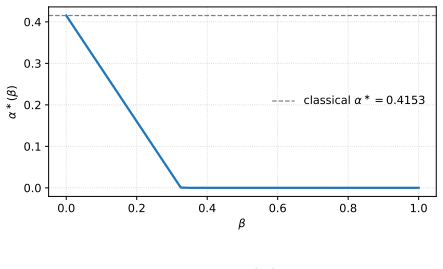
- Computation of the weighted Chernoff information reduces to a one-dimensional convex optimization over the tilting parameter α.
Load-bearing premise
The multiplicative context weight must factorize into a product over individual observations.
What would settle it
A direct computation of the optimal weighted loss for a small n with non-factorizing weights that shows the rate differs from the single-letter weighted Chernoff information by a term larger than o(n).
Figures


read the original abstract
We study binary hypothesis testing for i.i.d. observations under a multiplicative context weight. For the optimal weighted total loss, defined as the sum of weighted type-I and type-II losses, we prove the logarithmic asymptotic $$ L_n^* = \exp\{-n D_C^{\mathrm{w}}(\mathbb{P}, \mathbb{Q}) + o(n)\}, \quad n \to \infty, $$ where $D_C^{\mathrm{w}}$ is the weighted Chernoff information. The single-letter form of the exponent relies on a structural assumption that the weight factorises across observations, $\varphi(x_1^n) = \prod_{i=1}^n \varphi(x_i)$; this restriction is essential for the single-letter representation and should be distinguished from the weaker qualitative description "multiplicative context weight". The proof embeds the weighted geometric mixtures $\varphi p^\alpha q^{1-\alpha}$ into a likelihood-ratio exponential family and identifies the rate through its log-normaliser. We also derive concentration bounds for the tilted weighted log-likelihood, obtain closed forms for Gaussian, Poisson, and exponential models, and extend the exponent characterisation to finitely many hypotheses.
Editorial analysis
A structured set of objections, weighed in public.
Referee Report
Summary. The manuscript proves that for binary hypothesis testing of i.i.d. observations under a multiplicative context weight that factorizes as φ(x_1^n) = ∏ φ(x_i), the optimal weighted total loss satisfies the logarithmic asymptotic L_n^* = exp{-n D_C^w(P, Q) + o(n)} as n → ∞, where D_C^w is the weighted Chernoff information. The proof embeds the weighted geometric mixtures φ p^α q^{1-α} into a likelihood-ratio exponential family and identifies the rate via its log-normalizer; standard large-deviation arguments then yield the exact exponent. Closed-form expressions are derived for Gaussian, Poisson, and exponential families, and the characterization is extended to finitely many hypotheses.
Significance. If the central derivation holds, the work supplies a single-letter rate for the error exponent in a weighted, context-sensitive hypothesis testing setting. The exponential-family embedding is a standard and clean technique that directly generalizes the classical Chernoff information while preserving explicit computability for common parametric families. The explicit statement that the factorization assumption is both necessary and sufficient for the single-letter form is a strength, as is the absence of additional regularity conditions beyond those already required for the unweighted case.
major comments (2)
- [§3] §3 (main theorem): the embedding of the weighted family into the likelihood-ratio exponential family is described at a high level; a line-by-line verification that the optimizing α yields precisely the log-normalizer D_C^w (without implicit dependence on the weight) would confirm that the rate function is obtained directly from P and Q.
- [§4] §4 (closed forms): for the Gaussian case the explicit expression for D_C^w should be stated alongside the classical Chernoff information so that the precise effect of the factor φ can be read off; the current presentation leaves this comparison implicit.
minor comments (2)
- [Abstract] Abstract: the symbol L_n^* is used before it is defined; a parenthetical gloss such as “the minimal weighted total loss” would improve immediate readability.
- [Introduction] Notation section: the distinction between the qualitative phrase “multiplicative context weight” and the structural factorization assumption should be repeated once more in the introduction for readers who skip the abstract.
Simulated Author's Rebuttal
We thank the referee for the careful reading and constructive suggestions. We address each major comment below and will incorporate the requested clarifications in the revised manuscript.
read point-by-point responses
-
Referee: [§3] §3 (main theorem): the embedding of the weighted family into the likelihood-ratio exponential family is described at a high level; a line-by-line verification that the optimizing α yields precisely the log-normalizer D_C^w (without implicit dependence on the weight) would confirm that the rate function is obtained directly from P and Q.
Authors: We agree that a more explicit verification would improve clarity. In the revised §3 we will insert a step-by-step derivation showing that the saddle-point α* that maximizes the weighted log-normalizer is independent of φ except through the factorization assumption, and that the resulting rate equals D_C^w(P,Q) obtained directly from the pair of distributions. revision: yes
-
Referee: [§4] §4 (closed forms): for the Gaussian case the explicit expression for D_C^w should be stated alongside the classical Chernoff information so that the precise effect of the factor φ can be read off; the current presentation leaves this comparison implicit.
Authors: We accept the suggestion. The revised §4 will display the closed-form expression for D_C^w in the Gaussian case immediately next to the classical Chernoff information, with a short remark isolating the multiplicative factor contributed by φ. revision: yes
Circularity Check
No significant circularity; derivation is self-contained
full rationale
The paper derives the single-letter asymptotic for the weighted loss exponent by embedding the factorized weighted geometric mixtures φ p^α q^{1-α} into a likelihood-ratio exponential family and identifying the rate via its log-normalizer, followed by standard large-deviation arguments. This reduction relies only on the explicit factorization assumption (stated as necessary) and classical exponential-family properties; no parameter fitting, self-referential definitions, or load-bearing self-citations appear in the chain. Closed forms for specific families follow directly from the same normalizer without additional circular steps.
Axiom & Free-Parameter Ledger
axioms (2)
- domain assumption The context weight factorises as a product over individual observations
- standard math Standard large-deviation properties hold for the tilted weighted log-likelihood
Lean theorems connected to this paper
-
IndisputableMonolith/Cost/FunctionalEquation.leanwashburn_uniqueness_aczel (J uniqueness) unclear?
unclearRelation between the paper passage and the cited Recognition theorem.
Theorem 3.1: L_n^* = exp{-n D_C^w(P,Q) + o(n)} via the log-normalizer F(α) = ln Z_{pq}(α) of the tilted family (pq)_α(x) = φ(x) p^α q^{1-α} / Z(α)
-
IndisputableMonolith/Foundation/ArithmeticFromLogic.leanLogicNat recovery and embed_strictMono unclear?
unclearRelation between the paper passage and the cited Recognition theorem.
Definition 2.4 and §3.2: weighted Chernoff as max_α -ln ρ_α^w; exponential-family representation with sufficient statistic t(x) = ln(p/q)
What do these tags mean?
- matches
- The paper's claim is directly supported by a theorem in the formal canon.
- supports
- The theorem supports part of the paper's argument, but the paper may add assumptions or extra steps.
- extends
- The paper goes beyond the formal theorem; the theorem is a base layer rather than the whole result.
- uses
- The paper appears to rely on the theorem as machinery.
- contradicts
- The paper's claim conflicts with a theorem or certificate in the canon.
- unclear
- Pith found a possible connection, but the passage is too broad, indirect, or ambiguous to say the theorem truly supports the claim.
Reference graph
Works this paper leans on
-
[1]
Azuma K., Weighted sums of certain dependent random variables, Tôhoku Mathematical Journal19(1967), no. 3, 357–367
work page 1967
-
[2]
Cambridge University Press, 1989, vol
McDiarmid C., On the method of bounded differences, inSurveys in Combinatorics. Cambridge University Press, 1989, vol. 141, pp. 148– 188
work page 1989
-
[3]
H. Chernoff. A measure of asymptotic efficiency for tests of a hypoth- esis based on the sum of observations.The Annals of Mathematical Statistics, 23(4):493–507, 1952. doi:10.1214/aoms/1177729330
-
[4]
JungJ., GaoC., SharpinequalitiesbetweentotalvariationandHellinger distances for Gaussian mixtures, 2026, arXiv: 2602.03202v1
work page internal anchor Pith review arXiv 2026
-
[5]
Kelbert M., Suhov Y., Context-sensitive hypothesis-testing and expo- nential families,Statistics59(2025), no. 4, 845–878
work page 2025
-
[6]
Kelbert M., Suhov Y., On basic context-dependent concepts of Infor- mation Theory and Statistics,Theory Probab. Appl.70(2026), no. 4, 563-583
work page 2026
-
[7]
F. Nielsen. Revisiting Chernoff information with likelihood ratio expo- nential families.Entropy, 24(10):1400, 2022. doi:10.3390/e24101400
-
[8]
Nielsen F., Okamura K., Onf-divergences between Cauchy distribu- tions,IEEE Transactions on Information Theory69(2023), no. 5, 3150–3170
work page 2023
-
[9]
F. Nielsen. Hypothesis testing, information divergence and compu- tational geometry. In F. Nielsen and F. Barbaresco (eds.),Geomet- ric Science of Information, GSI 2013, Lecture Notes in Computer Science, vol. 8085, pp. 241–248. Springer, Berlin, Heidelberg, 2013. doi:10.1007/978-3-642-40020-9_25
-
[10]
Asymptotically optimal tests for mu ltinomial distributions
W. Hoeffding. Asymptotically optimal tests for multinomial distri- butions.The Annals of Mathematical Statistics, 36(2):369–401, 1965. doi:10.1214/aoms/1177700150
-
[11]
E. Yu. Kalimulina. Application of multi-valued logic models in traffic aggregation problems in mobile networks. InProceedings of the 2021 IEEE 15th International Conference on Application of Information and 36 Communication Technologies (AICT),Baku, Azerbaijan, 13–15October
work page 2021
-
[12]
A. A. Esin and E. Yu. Kalimulina. Markov-modulated queueing network for mobile traffic aggregation with threshold-controlled buffers.Math- ematical Modelling and Numerical Simulation with Applications, 6(1), Article 4, 2026. doi:10.53391/2791-8564.1019
-
[13]
S.-I. Amari and H. Nagaoka.Methods of Information Geometry. Trans- lations of Mathematical Monographs, vol. 191. American Mathematical Society, Providence, RI, 2000. doi:10.1090/mmono/191
-
[14]
N. N. Chentsov.Statistical Decision Rules and Optimal Inference. Translations of Mathematical Monographs, vol. 53. American Mathe- matical Society, Providence, RI, 1982. Translated from the Russian edition, Nauka, Moscow, 1972
work page 1982
-
[15]
S.-I. Amari.Information Geometry and Its Applications. Ap- plied Mathematical Sciences, vol. 194. Springer Japan, Tokyo, 2016. doi:10.1007/978-4-431-55978-8
-
[16]
F. Nielsen. An information-geometric characterization of Chernoff information.IEEE Signal Processing Letters, 20(3):269–272, 2013. doi:10.1109/LSP.2013.2243726
-
[17]
Y. Ren, J. Zhang, Y. Xia, R. Wang, F. Xie, J. Guan, H. Zhang, and S. Zhou. Regression-based conditional independence test with adaptive kernels.Artificial Intelligence, 347:104391, 2025. doi:10.1016/j.artint.2025.104391
-
[18]
E. Yu. Kalimulina.Weighted Chernoff information — numerical illus- tration. Software, companion to the present paper, version 1.0.0, 2026. doi:10.5281/zenodo.19736237. 37
discussion (0)
Sign in with ORCID, Apple, or X to comment. Anyone can read and Pith papers without signing in.