Parity-dependent Casimir forces and Hall currents for a confined Dirac field
Pith reviewed 2026-05-21 11:38 UTC · model grok-4.3
The pith
Boundary conditions making a Dirac field even or odd under midplane reflection produce Casimir forces of opposite sign.
A machine-rendered reading of the paper's core claim, the machinery that carries it, and where it could break.
Core claim
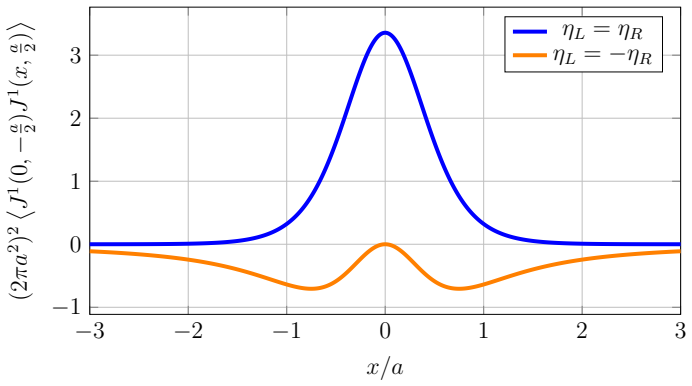
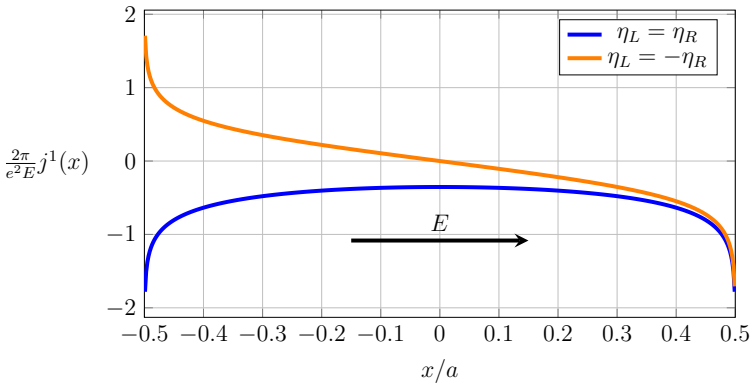
The even (symmetric) boundary conditions on the walls for the confined massless Dirac field yield an attractive Casimir force, whereas the odd (antisymmetric) ones yield a repulsive force, in agreement with the general theorem linking parity to the sign of the fermionic Casimir effect. The parity also governs the correlation of currents on the walls and the profile of the induced Hall-like current in the bulk when an external electric field is applied in 2+1 dimensions.
What carries the argument
The parity of the Dirac field configuration under reflection about the midplane between the walls, realized through specific boundary conditions.
If this is right
- The sign of the Casimir force is determined by the parity of the boundary conditions under midplane reflection.
- Current correlations between the walls are sensitive to whether the configuration is even or odd.
- An external electric field induces a transverse bulk current in 2+1 dimensions whose spatial profile inherits the parity of the confining setup.
Where Pith is reading between the lines
- The parity dependence could extend to other fermionic systems or higher dimensions where similar boundary conditions are realizable.
- The Hall current profile result points to possible links with transport phenomena in confined quantum systems beyond the vacuum case.
- Physical analogs such as effective Dirac models in materials might allow testing the repulsive force prediction.
Load-bearing premise
The chosen boundary conditions correspond precisely to the even or odd parity of the system under reflection about the midplane.
What would settle it
An explicit calculation of the Casimir energy for the odd boundary condition case showing a positive value (repulsive force) would confirm the claim, while a negative value would contradict the application of the parity theorem.
Figures
read the original abstract
We study a massless Dirac field subjected to two alternative boundary conditions on two parallel thin walls, in d + 1 dimensions. The two configurations correspond to the system being even or odd under reflection about the midplane between the two walls, and lead to qualitatively different behaviors. The even (symmetric) configuration produces an attractive Casimir force, whereas the odd (antisymmetric) one yields repulsion, in agreement with a general theorem linking parity to the sign of the fermionic Casimir effect. We complement this result by studying two phenomena associated with the vacuum fluctuations responsible for the Casimir interaction, both of which are also sensitive to parity: the correlation between currents concentrated on the walls, and the induced bulk current under the influence of an external electric field. For the latter we show that, in 2 + 1 dimensions, an induced transverse (Hall-like) current arises, whose spatial profile inherits the symmetry of the confining potential.
Editorial analysis
A structured set of objections, weighed in public.
Referee Report
Summary. The paper studies a massless Dirac field in d+1 dimensions confined between two parallel thin walls under two alternative boundary conditions. These are asserted to realize even (symmetric) and odd (antisymmetric) parity under reflection about the midplane. The even case produces an attractive Casimir force and the odd case a repulsive one, consistent with a general theorem on parity and the sign of the fermionic Casimir effect. The work further examines parity-sensitive vacuum phenomena: correlations between currents on the walls and, in 2+1 dimensions, an induced transverse Hall-like current whose profile inherits the symmetry of the confining potential.
Significance. If the boundary conditions are shown to enforce definite parity for the Dirac spinor, the results furnish a concrete realization of the parity-Casimir theorem and illustrate how parity controls both the force sign and associated current observables. The explicit treatment of the induced Hall current in 2+1 dimensions adds a falsifiable prediction that could be tested in condensed-matter analogs. The derivation from boundary conditions and appeal to an external general theorem avoids ad-hoc parameters.
major comments (1)
- [Setup of boundary conditions and parity discussion] The central claim that the two chosen boundary conditions realize even versus odd parity (thereby licensing the general theorem) requires explicit verification that the parity operator—typically involving a combination of gamma matrices—commutes with or is enforced by the symmetric/antisymmetric conditions on the full spinor. Without this check, the mapping to the theorem and the predicted force signs rests on an unverified assumption. This appears in the setup of the boundary conditions and the subsequent appeal to the theorem.
minor comments (2)
- [Section defining the model] Clarify the precise form of the boundary conditions (e.g., which components of the spinor are set to zero or related) and state the representation of the gamma matrices used, to allow readers to reproduce the parity check.
- [Introduction or results section] The abstract mentions 'in agreement with a general theorem'; provide a brief self-contained statement of that theorem or a precise citation so the connection is transparent without external lookup.
Simulated Author's Rebuttal
We thank the referee for their careful reading of our manuscript and for the constructive comments. We address the single major comment below.
read point-by-point responses
-
Referee: [Setup of boundary conditions and parity discussion] The central claim that the two chosen boundary conditions realize even versus odd parity (thereby licensing the general theorem) requires explicit verification that the parity operator—typically involving a combination of gamma matrices—commutes with or is enforced by the symmetric/antisymmetric conditions on the full spinor. Without this check, the mapping to the theorem and the predicted force signs rests on an unverified assumption. This appears in the setup of the boundary conditions and the subsequent appeal to the theorem.
Authors: We agree that an explicit verification strengthens the presentation. In the revised manuscript we have added a dedicated paragraph immediately following the definition of the two boundary conditions. There we introduce the parity operator P (constructed from the product of the transverse gamma matrix and the reflection operator in the confined direction) and demonstrate by direct substitution that the symmetric boundary conditions are invariant under P while the antisymmetric conditions transform into their negative. This establishes that the mode expansions are even or odd eigenstates of P, thereby licensing the appeal to the general parity-Casimir theorem for the sign of the force. revision: yes
Circularity Check
No significant circularity; derivation is self-contained
full rationale
The paper defines two explicit sets of boundary conditions on the Dirac field that are stated to realize even versus odd parity under midplane reflection. Casimir energies and forces are computed directly from the mode spectra under these conditions, with the sign difference noted to agree with a cited general theorem on parity and fermionic Casimir effects. No equation reduces by construction to a fitted input, no load-bearing premise rests solely on a self-citation chain, and the central results follow from the boundary conditions plus standard quantization without renaming or smuggling ansatze. The derivation chain therefore remains independent of its own outputs.
Axiom & Free-Parameter Ledger
axioms (1)
- domain assumption Boundary conditions for the Dirac field that enforce even or odd parity under midplane reflection.
Lean theorems connected to this paper
-
IndisputableMonolith/Foundation/AlexanderDuality.leanalexander_duality_circle_linking unclear?
unclearRelation between the paper passage and the cited Recognition theorem.
The even (symmetric) configuration produces an attractive Casimir force, whereas the odd (antisymmetric) one yields repulsion, in agreement with a general theorem linking parity to the sign of the fermionic Casimir effect.
What do these tags mean?
- matches
- The paper's claim is directly supported by a theorem in the formal canon.
- supports
- The theorem supports part of the paper's argument, but the paper may add assumptions or extra steps.
- extends
- The paper goes beyond the formal theorem; the theorem is a base layer rather than the whole result.
- uses
- The paper appears to rely on the theorem as machinery.
- contradicts
- The paper's claim conflicts with a theorem or certificate in the canon.
- unclear
- Pith found a possible connection, but the passage is too broad, indirect, or ambiguous to say the theorem truly supports the claim.
Reference graph
Works this paper leans on
-
[1]
M. Bordag, U. Mohideen, and V. M. Mostepanenko,New developments in the Casimir effect, Phys. Rept.353, 1 (2001).https://doi.org/10.1016/S0370-1573(01) 00015-1
- [2]
-
[3]
I. E. Dzyaloshinskii, E. M. Lifshitz, and L. P. Pitaevskii,The general theory of van der Waals forces, Adv. Phys.10, 165 (1961).https://doi.org/10.1080/ 00018736100101281
work page 1961
-
[4]
L. P. Pitaevskii,Thermal Lifshitz force between an atom and a conductor with a small density of carriers, Phys. Rev. Lett.101, 163202 (2008).https://doi.org/ 10.1103/PhysRevLett.101.163202
-
[5]
R. Golestanian,Casimir-Lifshitz interaction between dielectrics of arbitrary geometry: A dielectric contrast perturbation theory, Phys. Rev. A80, 012519 (2009).https: //doi.org/10.1103/PhysRevA.80.012519
-
[6]
P. Rodriguez-Lopez, S. J. Rahi, and T. Emig,Three-body Casimir effects and non- monotonic forces, Phys. Rev. A80, 022519 (2009).https://doi.org/10.1103/ PhysRevA.80.022519
work page 2009
-
[7]
K. A. Milton, E. K. Abalo, P. Parashar, N. Pourtolami, I. Brevik, S. A. Ellingsen, S. Y. Buhmann, and S. Scheel,Casimir-Polder repulsion: Three-body effects, Phys. Rev. A91, 042510 (2015).https://doi.org/10.1103/PhysRevA.91.042510
-
[8]
S. Paladugu, A. Callegari, Y. Tuna, L. Barth, S. Dietrich, A. Gambassi, and G. Volpe, Nonadditivity of critical Casimir forces, Nat. Commun.7, 11403 (2016).https: //doi.org/10.1038/ncomms11403
-
[9]
O. Kenneth and I. Klich,Opposites attract: A theorem about the Casimir force, Phys. Rev. Lett.97, 160401 (2006).https://doi.org/10.1103/PhysRevLett.97.160401
-
[10]
A. Fern´ andez, C. D. Fosco, and G. Hansen,Sign of the Casimir force between two bodies coupled to a Dirac field, Phys. Rev. D112, 025009 (2025).https://doi.org/ 10.1103/PhysRevD.112.025009
- [11]
-
[12]
K. Johnson,The M.I.T. bag model, Acta Phys. Pol. B6, 865 (1975).https:// inspirehep.net/literature/100425
work page 1975
-
[13]
N. Arrizabalaga, L. Le Treust, and N. Raymond,On the MIT bag model in the non-relativistic limit, Commun. Math. Phys.354, 641 (2017).https://doi.org/ 10.1007/s00220-017-2916-8
-
[14]
C. D. Fosco and G. Hansen,Dynamical Casimir effect from fermions in an oscillating bag in1 + 1dimensions, Phys. Rev. D105, 016004 (2022).https://doi.org/10. 1103/PhysRevD.105.016004
work page 2022
-
[15]
C. D. Fosco and G. Hansen,Dynamical Casimir effect for fermions in2 + 1di- mensions, Phys. Rev. D108, 056005 (2023).https://doi.org/10.1103/PhysRevD. 108.056005
-
[16]
P. Sundberg and R. L. Jaffe,The Casimir effect for fermions in one dimension, An- nals Phys.309, 442–458 (2004).https://doi.org/10.1016/j.aop.2003.08.015. 16
-
[17]
A. N. Redlich,Gauge noninvariance and parity violation of three-dimensional fermions, Phys. Rev. Lett.52, 18 (1984).https://doi.org/10.1103/PhysRevLett. 52.18
-
[18]
A. J. Niemi and G. W. Semenoff,Axial anomaly induced fermion fractionization and effective gauge theory actions in odd-dimensional space-times, Phys. Rev. Lett.51, 2077 (1983).https://doi.org/10.1103/PhysRevLett.51.2077. 17
discussion (0)
Sign in with ORCID, Apple, or X to comment. Anyone can read and Pith papers without signing in.