Recognition: no theorem link
Causally Sufficient and Necessary Feature Expansion for Class-Incremental Learning
Pith reviewed 2026-05-15 13:35 UTC · model grok-4.3
The pith
Causal PNS regularization guides feature expansion to avoid collisions in class-incremental learning
A machine-rendered reading of the paper's core claim, the machinery that carries it, and where it could break.
Core claim
By extending PNS to CPNS for CIL, which quantifies causal completeness of intra-task representations and separability of inter-task representations, and using a dual-scope counterfactual generator based on twin networks to minimize PNS risks, feature expansion can be guided to mitigate collisions while preserving old knowledge.
What carries the argument
CPNS regularization via dual-scope counterfactual generator that creates intra-task counterfactuals for causal completeness and inter-task interfering features for separability.
Load-bearing premise
Spurious feature correlations primarily cause the feature collisions observed in expansion-based class-incremental learning.
What would settle it
Compare the feature space overlap between tasks in models trained with and without the proposed CPNS regularization on standard CIL benchmarks like CIFAR or ImageNet subsets; if overlap remains high despite the method, the claim would be weakened.
Figures




read the original abstract
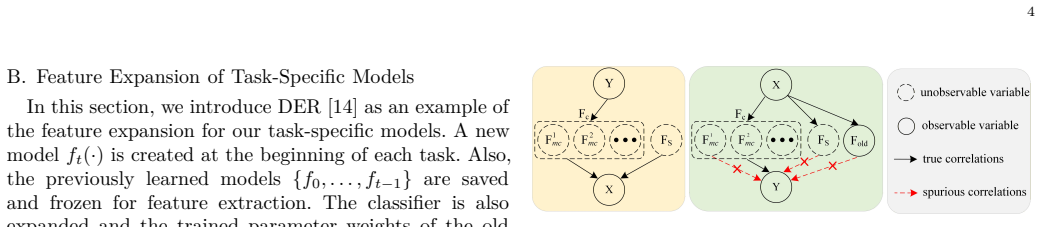
Current expansion-based methods for Class Incremental Learning (CIL) effectively mitigate catastrophic forgetting by freezing old features. However, such task-specific features learned from the new task may collide with the old features. From a causal perspective, spurious feature correlations are the main cause of this collision, manifesting in two scopes: (i) guided by empirical risk minimization (ERM), intra-task spurious correlations cause task-specific features to rely on shortcut features. These non-robust features are vulnerable to interference, inevitably drifting into the feature space of other tasks; (ii) inter-task spurious correlations induce semantic confusion between visually similar classes across tasks. To address this, we propose a Probability of Necessity and Sufficiency (PNS)-based regularization method to guide feature expansion in CIL. Specifically, we first extend the definition of PNS to expansion-based CIL, termed CPNS, which quantifies both the causal completeness of intra-task representations and the separability of inter-task representations. We then introduce a dual-scope counterfactual generator based on twin networks to ensure the measurement of CPNS, which simultaneously generates: (i) intra-task counterfactual features to minimize intra-task PNS risk and ensure causal completeness of task-specific features, and (ii) inter-task interfering features to minimize inter-task PNS risk, ensuring the separability of inter-task representations. Theoretical analyses confirm its reliability. The regularization is a plug-and-play method for expansion-based CIL to mitigate feature collision. Extensive experiments demonstrate the effectiveness of the proposed method.
Editorial analysis
A structured set of objections, weighed in public.
Referee Report
Summary. The manuscript proposes CPNS, an extension of the probability of necessity and sufficiency (PNS) to class-incremental learning (CIL), to guide feature expansion and mitigate collisions caused by spurious correlations. It introduces a dual-scope counterfactual generator using twin networks to produce intra-task counterfactual features and inter-task interfering features, minimizing intra- and inter-task PNS risks. The method is presented as a plug-and-play regularization with theoretical reliability and empirical effectiveness in reducing feature collision in expansion-based CIL.
Significance. If the theoretical analyses hold and the counterfactuals are valid, this could provide a novel causal framework for improving feature separability in CIL, addressing limitations of freezing-based methods. The plug-and-play aspect makes it potentially impactful for practical CIL systems, though its significance depends on demonstrating that the gains stem from the causal mechanism rather than general regularization.
major comments (3)
- [Abstract] Abstract: The central claim that spurious feature correlations are the main cause of feature collision (manifesting as intra-task shortcuts and inter-task semantic confusion) is asserted without derivation or supporting analysis; the manuscript must show why this dominates over other factors such as optimization dynamics or representation capacity.
- [Theoretical Analysis] Theoretical section on CPNS definition: The extension of PNS to CPNS quantifies causal completeness and separability using the same learned feature representations that the regularization acts upon, creating a potential circularity; without explicit identification conditions (known SCM, no unmeasured confounding, positivity) for the high-dimensional ERM feature space, the causal interpretation of the regularization term lacks grounding.
- [Experiments] Experiments section: The abstract states that extensive experiments demonstrate effectiveness, yet no quantitative results, error bars, ablation studies, or specific comparisons to baselines are referenced; this prevents assessment of whether reported gains arise from the claimed CPNS mechanism or from generic regularization effects.
minor comments (2)
- [Method] The dual-scope counterfactual generator description should include pseudocode or explicit equations for how intra-task and inter-task features are generated and how the twin networks are trained.
- [Notation] Notation for CPNS and the risk terms should be introduced with a clear table or definitions list to avoid ambiguity when reading the theoretical claims.
Simulated Author's Rebuttal
We thank the referee for the constructive comments, which help clarify the presentation of our causal framework for class-incremental learning. We address each major comment below and indicate the corresponding revisions.
read point-by-point responses
-
Referee: [Abstract] The central claim that spurious feature correlations are the main cause of feature collision (manifesting as intra-task shortcuts and inter-task semantic confusion) is asserted without derivation or supporting analysis; the manuscript must show why this dominates over other factors such as optimization dynamics or representation capacity.
Authors: We agree that the abstract states the claim concisely. The full manuscript derives this in the introduction and Section 3 by constructing a causal graph for expansion-based CIL under ERM, showing that shortcut features arise from intra-task confounding and inter-task semantic overlap even when representation capacity is sufficient. To strengthen the dominance argument, we will add a short illustrative example and a paragraph contrasting with optimization dynamics (e.g., via a controlled simulation where capacity is fixed but spurious paths remain). revision: partial
-
Referee: [Theoretical Analysis] The extension of PNS to CPNS quantifies causal completeness and separability using the same learned feature representations that the regularization acts upon, creating a potential circularity; without explicit identification conditions (known SCM, no unmeasured confounding, positivity) for the high-dimensional ERM feature space, the causal interpretation of the regularization term lacks grounding.
Authors: We acknowledge the circularity concern. CPNS is computed on interventional distributions produced by the twin-network counterfactual generators, which approximate interventions independently of the final classifier features. We will revise the theoretical section to explicitly list the identification assumptions: (i) positivity in the feature space, (ii) no unmeasured confounding between task data and the learned representations (standard in ERM settings), and (iii) the structural causal model is sufficiently approximated by the dual generators. This grounds the causal claims without altering the method. revision: yes
-
Referee: [Experiments] The abstract states that extensive experiments demonstrate effectiveness, yet no quantitative results, error bars, ablation studies, or specific comparisons to baselines are referenced; this prevents assessment of whether reported gains arise from the claimed CPNS mechanism or from generic regularization effects.
Authors: The abstract summarizes results at a high level for brevity, while Section 5 contains the full quantitative evaluation (accuracy tables with standard deviations over 5 runs, ablation on intra- vs. inter-task generators, and comparisons to recent expansion-based CIL baselines). To improve accessibility, we will expand the abstract with one sentence referencing key gains (e.g., +3.2% average accuracy on CIFAR-100) and direct readers to the corresponding tables and ablation figures. revision: yes
Circularity Check
CPNS definition and twin-network generator form a self-referential loop on the same learned features
specific steps
-
self definitional
[Abstract]
"we first extend the definition of PNS to expansion-based CIL, termed CPNS, which quantifies both the causal completeness of intra-task representations and the separability of inter-task representations. We then introduce a dual-scope counterfactual generator based on twin networks to ensure the measurement of CPNS, which simultaneously generates: (i) intra-task counterfactual features to minimize intra-task PNS risk and ensure causal completeness of task-specific features, and (ii) inter-task interfering features to minimize inter-task PNS risk"
CPNS is explicitly defined as a quantifier of properties (completeness, separability) of the task-specific features; the generator is then introduced solely to produce the counterfactuals needed to measure and minimize CPNS risk on those identical features. The regularization therefore enforces the definitional properties it claims to quantify, reducing the claimed causal guidance to a self-referential adjustment of the input representations.
full rationale
The paper's core derivation extends PNS to CPNS to quantify intra-task completeness and inter-task separability of the very representations produced by ERM-trained expansion, then deploys a dual-scope twin-network generator whose sole purpose is to produce counterfactuals that minimize the CPNS risk on those same representations. Because no independent SCM, positivity conditions, or external identification strategy is supplied, the regularization term reduces to enforcing the definitional properties by construction rather than deriving new causal constraints. This matches the self-definitional pattern and yields partial circularity (score 6) while leaving room for empirical utility.
Axiom & Free-Parameter Ledger
axioms (1)
- domain assumption Spurious feature correlations are the main cause of collision between task-specific features in expansion-based CIL
invented entities (2)
-
CPNS
no independent evidence
-
dual-scope counterfactual generator
no independent evidence
Reference graph
Works this paper leans on
-
[1]
A comprehensive survey of continual learning: Theory, method and application,
L. Wang, X. Zhang, H. Su, and J. Zhu, “A comprehensive survey of continual learning: Theory, method and application,” IEEE Transactions on Pattern Analysis and Machine Intelligence, vol. 46, no. 8, pp. 5362–5383, 2024
work page 2024
-
[2]
Schedule- robust continual learning,
R. Wang, M. Ciccone, M. Pontil, and C. Ciliberto, “Schedule- robust continual learning,” IEEE Transactions on Pattern Anal- ysis and Machine Intelligence, vol. 48, no. 2, pp. 1424–1436, 2026
work page 2026
-
[3]
icarl: Incremental classifier and representation learning,
S.-A. Rebuffi, A. Kolesnikov, G. Sperl, and C. H. Lampert, “icarl: Incremental classifier and representation learning,” in Proceedings of the IEEE conference on Computer Vision and Pattern Recognition, 2017, pp. 2001–2010
work page 2017
-
[4]
Large scale incremental learning,
Y. Wu, Y. Chen, L. Wang, Y. Ye, Z. Liu, Y. Guo, and Y. Fu, “Large scale incremental learning,” in Proceedings of the IEEE conference on Computer Vision and Pattern Recognition, 2019, pp. 374–382
work page 2019
-
[5]
Class-incremental learning: survey and performance evaluation on image classification,
M. Masana, X. Liu, B. Twardowski, M. Menta, A. D. Bagdanov, and J. Van De Weijer, “Class-incremental learning: survey and performance evaluation on image classification,” IEEE Transactions on Pattern Analysis and Machine Intelligence, vol. 45, no. 5, pp. 5513–5533, 2022
work page 2022
-
[6]
Class-incremental learning: A survey,
D.-W. Zhou, Q.-W. Wang, Z.-H. Qi, H.-J. Ye, D.-C. Zhan, and Z. Liu, “Class-incremental learning: A survey,” IEEE Transactions on Pattern Analysis and Machine Intelligence, pp. 9851–9873, 2024
work page 2024
-
[7]
Crnet: A fast continual learning framework with random theory,
D. Li and Z. Zeng, “Crnet: A fast continual learning framework with random theory,” IEEE Transactions on Pattern Analysis and Machine Intelligence, vol. 45, no. 9, pp. 10 731–10 744, 2023. 15
work page 2023
-
[8]
Catastrophic interference in connectionist networks: The sequential learning problem,
M. McCloskey and N. J. Cohen, “Catastrophic interference in connectionist networks: The sequential learning problem,” in Psychology of Learning and Motivation, 1989, vol. 24, pp. 109– 165
work page 1989
-
[9]
Adaptive progressive continual learning,
J. Xu, J. Ma, X. Gao, and Z. Zhu, “Adaptive progressive continual learning,” IEEE Transactions on Pattern Analysis and Machine Intelligence, vol. 44, no. 10, pp. 6715–6728, 2022
work page 2022
-
[10]
S. Grossberg, “Adaptive resonance theory: How a brain learns to consciously attend, learn, and recognize a changing world,” Neural Networks, vol. 37, pp. 1–47, 2013
work page 2013
-
[11]
Dytox: Transformers for continual learning with dynamic token ex- pansion,
A. Douillard, A. Ramé, G. Couairon, and M. Cord, “Dytox: Transformers for continual learning with dynamic token ex- pansion,” in Proceedings of the IEEE conference on Computer Vision and Pattern Recognition, 2022, pp. 9285–9295
work page 2022
-
[12]
Resolving task confusion in dynamic expansion architectures for class incremental learning,
B. Huang, Z. Chen, P. Zhou, J. Chen, and Z. Wu, “Resolving task confusion in dynamic expansion architectures for class incremental learning,” in Proceedings of the AAAI Conference on Artificial Intelligence, vol. 37, no. 1, 2023, pp. 908–916
work page 2023
-
[13]
Foster: Feature boosting and compression for class-incremental learn- ing,
F.-Y. Wang, D.-W. Zhou, H.-J. Ye, and D.-C. Zhan, “Foster: Feature boosting and compression for class-incremental learn- ing,” in European Conference on Computer Vision, 2022, pp. 398–414
work page 2022
-
[14]
Der: Dynamically expandable representation for class incremental learning,
S. Yan, J. Xie, and X. He, “Der: Dynamically expandable representation for class incremental learning,” in Proceedings of the IEEE conference on Computer Vision and Pattern Recognition, 2021, pp. 3014–3023
work page 2021
-
[15]
Multi-granularity regularized re-balancing for class incremental learning,
H. Chen, Y. Wang, and Q. Hu, “Multi-granularity regularized re-balancing for class incremental learning,” IEEE Transactions on Knowledge and Data Engineering, vol. 35, no. 7, pp. 7263– 7277, 2023
work page 2023
-
[16]
Complemen- tary learning subnetworks towards parameter-efficient class- incremental learning,
D. Li, Z. Zeng, W. Dai, and P. N. Suganthan, “Complemen- tary learning subnetworks towards parameter-efficient class- incremental learning,” IEEE Transactions on Knowledge and Data Engineering, vol. 37, no. 6, pp. 3240–3252, 2025
work page 2025
-
[17]
Task-agnostic guided feature expansion for class-incremental learning,
B. Zheng, D.-W. Zhou, H.-J. Ye, and D.-C. Zhan, “Task-agnostic guided feature expansion for class-incremental learning,” in Proceedings of the Computer Vision and Pattern Recognition Conference, 2025, pp. 10 099–10 109
work page 2025
-
[18]
An overview of statistical learning theory,
V. N. Vapnik, “An overview of statistical learning theory,” IEEE Transactions on Neural Networks, vol. 10, no. 5, pp. 988–999, 1999
work page 1999
-
[19]
The caltech-ucsd birds-200-2011 dataset,
C. Wah, S. Branson, P. Welinder, P. Perona, and S. Belongie, “The caltech-ucsd birds-200-2011 dataset,” 2011
work page 2011
-
[20]
Prototypical verbalizer for prompt-based few-shot tuning,
G. Cui, S. Hu, N. Ding, L. Huang, and Z. Liu, “Prototypical verbalizer for prompt-based few-shot tuning,” in Proceedings of the 60th Annual Meeting of the Association for Computational Linguistics (Volume 1: Long Papers), 2022, pp. 7014–7024
work page 2022
-
[21]
Similarity of neural network representations revisited,
S. Kornblith, M. Norouzi, H. Lee, and G. Hinton, “Similarity of neural network representations revisited,” in International Conference on Machine Learning. PMlR, 2019, pp. 3519–3529
work page 2019
-
[22]
Z. Zhang, C.-B. Meng, X.-L. Jiang, C.-Y. Zhao, S. Qiao, and T. Zhang, “Comprehensive quality assessment method for neutron radiographic images based on cnn and visual salience: Z. zhang et al. ” Nuclear Science and Techniques, vol. 36, no. 7, p. 118, 2025
work page 2025
-
[23]
Imagenet: A large-scale hierarchical image database,
J. Deng, W. Dong, R. Socher, L.-J. Li, K. Li, and L. Fei-Fei, “Imagenet: A large-scale hierarchical image database,” in 2009 IEEE conference on computer vision and pattern recognition. Ieee, 2009, pp. 248–255
work page 2009
- [24]
-
[25]
Invariant learning via probability of sufficient and necessary causes,
M. Yang, Z. Fang, Y. Zhang, Y. Du, F. Liu, J.-F. Ton, J. Wang, and J. Wang, “Invariant learning via probability of sufficient and necessary causes,” Advances in Neural Information Processing Systems, vol. 36, pp. 79 832–79 857, 2023
work page 2023
-
[26]
A. A. Rusu, N. C. Rabinowitz, G. Desjardins, H. Soyer, J. Kirkpatrick, K. Kavukcuoglu, R. Pascanu, and R. Hadsell, “Progressive neural networks,” arXiv preprint arXiv:1606.04671, 2016
work page internal anchor Pith review Pith/arXiv arXiv 2016
-
[27]
Progress & compress: A scalable framework for continual learning,
J. Schwarz, W. Czarnecki, J. Luketina, A. Grabska-Barwinska, Y. W. Teh, R. Pascanu, and R. Hadsell, “Progress & compress: A scalable framework for continual learning,” in International Conference on Machine Learning. PMLR, 2018, pp. 4528–4537
work page 2018
-
[28]
Beef: Bi-compatible class-incremental learning via energy-based expansion and fusion,
F.-Y. Wang, D.-W. Zhou, L. Liu, H.-J. Ye, Y. Bian, D.-C. Zhan, and P. Zhao, “Beef: Bi-compatible class-incremental learning via energy-based expansion and fusion,” in International Conference on Learning Representations, 2022
work page 2022
-
[29]
Causal representation learning from multi-modal biomedical observations,
Y. Sun, L. Kong, G. Chen, L. Li, G. Luo, Z. Li, Y. Zhang, Y. Zheng, M. Yang, P. Stojanov et al., “Causal representation learning from multi-modal biomedical observations,” ArXiv, pp. arXiv–2411, 2025
work page 2025
-
[30]
Multi-view causal representation learning with partial observability,
D. Yao, D. Xu, S. Lachapelle, S. Magliacane, P. Taslakian, G. Martius, J. v. Kügelgen, and F. Locatello, “Multi-view causal representation learning with partial observability,” in 12th International Conference on Learning Representations, 2024
work page 2024
-
[31]
Interventional causal representation learning,
K. Ahuja, D. Mahajan, Y. Wang, and Y. Bengio, “Interventional causal representation learning,” in International Conference on Machine Learning. PMLR, 2023, pp. 372–407
work page 2023
-
[32]
Weakly supervised causal representation learning,
J. Brehmer, P. De Haan, P. Lippe, and T. S. Cohen, “Weakly supervised causal representation learning,” Advances in Neural Information Processing Systems, vol. 35, pp. 38 319–38 331, 2022
work page 2022
-
[33]
M. J. Kusner, J. Loftus, C. Russell, and R. Silva, “Counter- factual fairness,” Advances in Neural Information Processing Systems, vol. 30, 2017
work page 2017
-
[34]
Coun- terfactual samples synthesizing and training for robust visual question answering,
L. Chen, Y. Zheng, Y. Niu, H. Zhang, and J. Xiao, “Coun- terfactual samples synthesizing and training for robust visual question answering,” IEEE Transactions on Pattern Analysis and Machine Intelligence, vol. 45, no. 11, pp. 13 218–13 234, 2023
work page 2023
-
[35]
Counterfactual visual explanations,
Y. Goyal, Z. Wu, J. Ernst, D. Batra, D. Parikh, and S. Lee, “Counterfactual visual explanations,” in International Confer- ence on Machine Learning, ser. Proceedings of Machine Learning Research, K. Chaudhuri and R. Salakhutdinov, Eds., vol. 97. PMLR, 09–15 Jun 2019, pp. 2376–2384
work page 2019
-
[36]
Rademacher complexity for adversarially robust generalization,
D. Yin, R. Kannan, and P. Bartlett, “Rademacher complexity for adversarially robust generalization,” in International Con- ference on Machine Learning. PMLR, 2019, pp. 7085–7094
work page 2019
-
[37]
Learning multiple layers of features from tiny images,
A. Krizhevsky, G. Hinton et al., “Learning multiple layers of features from tiny images,” 2009
work page 2009
-
[38]
Birds 525 species- image classification,
“Birds 525 species- image classification,” 2023
work page 2023
-
[39]
Automated flower classifi- cation over a large number of classes,
M.-E. Nilsback and A. Zisserman, “Automated flower classifi- cation over a large number of classes,” in 2008 Sixth Indian Conference on Computer Vision, Graphics & Image Processing. IEEE, 2008, pp. 722–729
work page 2008
-
[40]
Food-101 - mining discriminative components with random forests,
L. Bossard, M. Guillaumin, and L. V. Gool, “Food-101 - mining discriminative components with random forests,” in European Conference on Computer Vision, 2014
work page 2014
-
[41]
Learning a unified classifier incrementally via rebalancing,
S. Hou, X. Pan, C. C. Loy, Z. Wang, and D. Lin, “Learning a unified classifier incrementally via rebalancing,” in Proceedings of the IEEE conference on Computer Vision and Pattern Recognition, 2019, pp. 831–839
work page 2019
-
[42]
Semantic drift compensation for class-incremental learning,
L. Yu, B. Twardowski, X. Liu, L. Herranz, K. Wang, Y. Cheng, S. Jui, and J. v. d. Weijer, “Semantic drift compensation for class-incremental learning,” in Proceedings of the IEEE conference on Computer Vision and Pattern Recognition, 2020, pp. 6982–6991
work page 2020
-
[43]
Beef: Bi-compatible class-incremental learning via energy-based expansion and fusion,
F. L. Wang, D.-W. Zhou, L. Liu, H.-J. Ye, Y. Bian, D. chuan Zhan, and P. Zhao, “Beef: Bi-compatible class-incremental learning via energy-based expansion and fusion,” in Interna- tional Conference on Learning Representations, 2023
work page 2023
-
[44]
A protocol for evaluat- ing model interpretation methods from visual explanations,
H. Behzadi-Khormouji and J. Oramas, “A protocol for evaluat- ing model interpretation methods from visual explanations,” in Proceedings of the IEEE/CVF Winter Conference on Applica- tions of Computer Vision, 2023, pp. 1421–1429
work page 2023
-
[45]
Towards Deep Learning Models Resistant to Adversarial Attacks
A. Madry, A. Makelov, L. Schmidt, D. Tsipras, and A. Vladu, “Towards deep learning models resistant to adversarial attacks,” arXiv preprint arXiv:1706.06083, 2017
work page internal anchor Pith review Pith/arXiv arXiv 2017
-
[46]
Transport-based counterfactual models,
L. De Lara, A. González-Sanz, N. Asher, L. Risser, and J.-M. Loubes, “Transport-based counterfactual models,” Journal of Machine Learning Research, vol. 25, no. 1, Jan. 2024
work page 2024
-
[47]
Diffusion visual counterfactual explanations,
M. Augustin, V. Boreiko, F. Croce, and M. Hein, “Diffusion visual counterfactual explanations,” Advances in Neural Infor- mation Processing Systems, vol. 35, pp. 364–377, 2022
work page 2022
-
[48]
Towards the causal complete cause of multi-modal representation learning,
J. Wang, S. Zhao, W. Qiang, J. Li, C. Zheng, F. Sun, and H. Xiong, “Towards the causal complete cause of multi-modal representation learning,” arXiv preprint arXiv:2407.14058, 2024
-
[49]
Self-supervised learning from a multi-view perspective,
Y.-H. Tsai, Y. Wu, R. Salakhutdinov, and L.-P. Morency, “Self-supervised learning from a multi-view perspective,” in Proceedings of the International Conference on Learning Rep- resentations, 2021. 16
work page 2021
-
[50]
Statistical aspects of wasser- stein distances,
V. M. Panaretos and Y. Zemel, “Statistical aspects of wasser- stein distances,” Annual Review of Statistics and its Applica- tion, vol. 6, no. 1, pp. 405–431, 2019
work page 2019
-
[51]
A tutorial on the cross-entropy method,
P.-T. De Boer, D. P. Kroese, S. Mannor, and R. Y. Rubinstein, “A tutorial on the cross-entropy method,” Annals of Operations Research, vol. 134, no. 1, pp. 19–67, 2005
work page 2005
-
[52]
Approximating the kullback leibler divergence between gaussian mixture models,
J. R. Hershey and P. A. Olsen, “Approximating the kullback leibler divergence between gaussian mixture models,” in 2007 IEEE International Conference on Acoustics, Speech and Signal Processing-ICASSP’07, vol. 4. IEEE, 2007, pp. IV–317
work page 2007
-
[53]
L. Van der Maaten and G. Hinton, “Visualizing data using t- sne. ” Journal of machine learning research, vol. 9, no. 11, 2008
work page 2008
-
[54]
Grad-cam: Visual explanations from deep net- works via gradient-based localization,
R. R. Selvaraju, M. Cogswell, A. Das, R. Vedantam, D. Parikh, and D. Batra, “Grad-cam: Visual explanations from deep net- works via gradient-based localization,” in Proceedings of the IEEE International Conference on Computer Vision, 2017, pp. 618–626. Zhen Zhang is pursuing the Ph.D. degree in the School of Computing and Artificial Intelligence, Southwes...
work page 2017
discussion (0)
Sign in with ORCID, Apple, or X to comment. Anyone can read and Pith papers without signing in.