Recognition: no theorem link
Searching for axions with time resolved pulsar polarimetry
Pith reviewed 2026-05-15 12:54 UTC · model grok-4.3
The pith
Time-resolved Crab pulsar polarization observations bound the axion-photon coupling.
A machine-rendered reading of the paper's core claim, the machinery that carries it, and where it could break.
Core claim
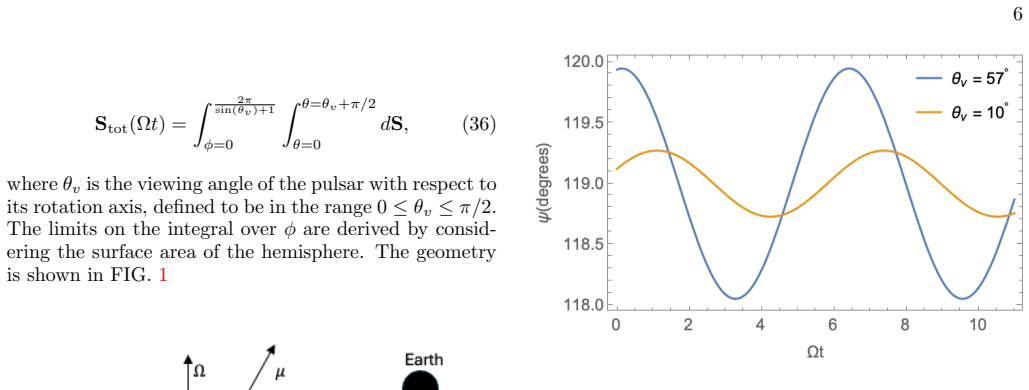
Pulsars possess strong dipole magnetic fields that source axion fields oscillating with the pulsar's rotational period. These axions induce birefringence on the emitted radiation. Using time-resolved observations of the optical polarization of the Crab pulsar, bounds are placed on the axion-photon coupling, demonstrating the potential of time-resolved pulsar birefringence in the search for axions.
What carries the argument
Axion-induced birefringence modulated at the pulsar's rotational frequency.
If this is right
- Tighter bounds follow from higher-precision polarization data on the same pulsar.
- The same analysis applies to other pulsars that have time-resolved polarimetry records.
- Axion masses near the inverse of observed spin periods become accessible.
- The approach provides an independent channel alongside cavity and helioscope searches.
Where Pith is reading between the lines
- Radio-band observations could widen the frequency range probed by the same mechanism.
- Detection would directly confirm axion production in strong astrophysical magnetic fields.
- Next-generation telescopes with microsecond timing could turn this into a competitive dark-matter search.
Load-bearing premise
The axion-induced polarization rotation can be cleanly separated from other time-dependent polarization changes in the Crab pulsar data.
What would settle it
High-sensitivity measurements that detect no periodic polarization variation at the Crab's spin frequency down to levels below the reported bound.
Figures

read the original abstract
Pulsars possess strong dipole magnetic fields that can source axion fields through the axion-photon interaction. Pulsars may therefore be surrounded by axion field configurations oscillating with the pulsar's rotational period. These axions could be detected by observing their effect on the polarization of the pular's emission. In this paper, we use time resolved observations of the optical polarization of the Crab pulsar to place bounds on the axion-photon coupling, demonstrating the potential of time resolved pulsar birefringence in the search for axions.
Editorial analysis
A structured set of objections, weighed in public.
Referee Report
Summary. The manuscript claims that axion fields sourced by a pulsar's dipole magnetic field via the axion-photon interaction oscillate at the rotational period and induce a measurable birefringence (periodic polarization rotation) on the emitted radiation. Using time-resolved optical polarization observations of the Crab pulsar, the authors derive bounds on the axion-photon coupling g_{aγ} and argue that this demonstrates the potential of time-resolved pulsar birefringence as a search technique for axions.
Significance. If the axion-induced birefringence can be cleanly isolated from intrinsic magnetospheric polarization variability, the approach would provide a novel probe for axions with masses set by the pulsar spin frequency, complementary to existing astrophysical and laboratory bounds. The work correctly identifies a potentially falsifiable signature tied to the rotation period, but the significance is limited by the absence of a demonstrated separation between the proposed signal and known geometric effects in the Crab data.
major comments (2)
- [Abstract] Abstract: the central claim that bounds on g_{aγ} follow from the Crab polarimetry data requires that the axion-induced periodic rotation amplitude exceed or be statistically separable from the known time-dependent polarization swings of the rotating-vector model. No quantitative model, amplitude estimate, or fit statistic comparing the two contributions is supplied, so the derived limits cannot be verified from the given information.
- [Data analysis] Data analysis section: the manuscript provides no description of the likelihood function, covariance treatment, or hypothesis test used to decide whether an axion term is required by the data versus a pure geometric model. Without this, it is impossible to assess whether the reported bounds are driven by the observations or by the modeling assumptions.
minor comments (2)
- [Abstract] The abstract refers to 'pular's emission'; correct the typo to 'pulsar's emission'.
- [Introduction] Standardize the axion-photon coupling notation to g_{aγ} (or g_{aγγ}) consistently; avoid mixing symbols.
Simulated Author's Rebuttal
We thank the referee for their thorough review and constructive feedback on our manuscript. We agree that the presentation of the data analysis and the separation of the axion signal from geometric effects require clarification and additional quantitative detail. We have revised the manuscript to address these points directly and provide the requested statistical framework.
read point-by-point responses
-
Referee: [Abstract] Abstract: the central claim that bounds on g_{aγ} follow from the Crab polarimetry data requires that the axion-induced periodic rotation amplitude exceed or be statistically separable from the known time-dependent polarization swings of the rotating-vector model. No quantitative model, amplitude estimate, or fit statistic comparing the two contributions is supplied, so the derived limits cannot be verified from the given information.
Authors: We acknowledge that the original manuscript did not provide an explicit quantitative comparison between the axion-induced birefringence and the rotating-vector model (RVM) swings. In the revised version we have added a dedicated subsection in the analysis that models the observed polarization angle as ψ(t) = ψ_RVM(t) + δψ_a(t), where δψ_a(t) = g_{aγ} B_eff sin(2π t / P + ϕ) with B_eff the effective magnetic field component along the line of sight. We supply an order-of-magnitude estimate showing that the axion term is a small perturbation (δψ_a ≪ 1 rad for the couplings of interest) and demonstrate separability by fitting the RVM parameters first to the dominant geometric swing and then searching for a residual periodic component at the known spin frequency. A new figure compares the χ² of the RVM-only fit versus the RVM-plus-sinusoidal-term fit, together with the 95 % CL upper limit on the axion amplitude extracted from the likelihood profile. These additions allow the reader to verify how the reported bounds are obtained. revision: yes
-
Referee: [Data analysis] Data analysis section: the manuscript provides no description of the likelihood function, covariance treatment, or hypothesis test used to decide whether an axion term is required by the data versus a pure geometric model. Without this, it is impossible to assess whether the reported bounds are driven by the observations or by the modeling assumptions.
Authors: We agree that the statistical methodology was insufficiently specified. The revised manuscript now contains an expanded Data Analysis section that (i) defines the Gaussian likelihood for the measured Stokes Q and U (or equivalently the polarization angle and degree) at each time bin, (ii) specifies the covariance matrix that incorporates both statistical measurement uncertainties and a small systematic floor for residual calibration errors, and (iii) describes the hypothesis test: a likelihood-ratio comparison between the null hypothesis (pure RVM) and the alternative (RVM plus a single-frequency sinusoidal term at the pulsar period). The axion-photon coupling bound is set at the 95 % CL point where -2Δlnℒ = 3.84 for the one additional degree of freedom. We also report the best-fit RVM parameters and the improvement in χ² when the axion term is included, confirming that the limits are data-driven rather than prior-dominated. revision: yes
Circularity Check
No circularity: bound derived from external Crab polarization data
full rationale
The paper claims to derive bounds on the axion-photon coupling by analyzing time-resolved optical polarization data from the Crab pulsar for birefringence induced by axion fields oscillating at the rotation period. No equations or steps in the provided abstract or description reduce the claimed prediction to a fitted parameter by construction, nor do they rely on self-citations for load-bearing uniqueness theorems or ansatze. The central result is presented as a direct comparison against external observational data, making the derivation self-contained against benchmarks outside the paper's own inputs. No self-definitional, fitted-input-renamed-as-prediction, or renaming-known-result patterns are exhibited.
Axiom & Free-Parameter Ledger
axioms (1)
- domain assumption Axions interact with photons in the presence of magnetic fields via the Primakoff effect or equivalent coupling.
Reference graph
Works this paper leans on
-
[1]
CP Conservation in the Presence of Instantons,
R. D. Peccei and H. R. Quinn, “CP Conservation in the Presence of Instantons,”Phys. Rev. Lett.38(1977) 1440–1443
work page 1977
-
[2]
S. Weinberg, “A New Light Boson?,”Phys. Rev. Lett. 40(1978) 223–226
work page 1978
-
[3]
Constraints Imposed by CP Conservation in the Presence of Instantons,
R. D. Peccei and H. R. Quinn, “Constraints Imposed by CP Conservation in the Presence of Instantons,”Phys. Rev. D16(1977) 1791–1797
work page 1977
-
[4]
Problem of StrongPandTInvariance in the Presence of Instantons,
F. Wilczek, “Problem of StrongPandTInvariance in the Presence of Instantons,”Phys. Rev. Lett.40(1978) 279–282
work page 1978
-
[5]
Axial vector vertex in spinor electrodynamics,
S. L. Adler, “Axial vector vertex in spinor electrodynamics,”Phys. Rev.177(1969) 2426–2438
work page 1969
-
[6]
A PCAC puzzle:π 0 →γγin theσmodel,
J. S. Bell and R. Jackiw, “A PCAC puzzle:π 0 →γγin theσmodel,”Nuovo Cim. A60(1969) 47–61
work page 1969
-
[7]
The Strong CP Problem and Axions
R. D. Peccei, “The Strong CP problem and axions,” Lect. Notes Phys.741(2008) 3–17, arXiv:hep-ph/0607268
work page internal anchor Pith review Pith/arXiv arXiv 2008
-
[8]
An Improved Experimental Limit on the Electric Dipole Moment of the Neutron
C. A. Bakeret al., “An Improved experimental limit on the electric dipole moment of the neutron,”Phys. Rev. Lett.97(2006) 131801,arXiv:hep-ex/0602020
work page internal anchor Pith review Pith/arXiv arXiv 2006
-
[9]
Axions and the Strong CP Problem,
J. E. Kim and G. Carosi, “Axions and the Strong CP Problem,”Rev. Mod. Phys.82(2010) 557–602, arXiv:0807.3125 [hep-ph]. [Erratum: Rev.Mod.Phys. 91, 049902 (2019)]
-
[10]
G. Grilli di Cortona, E. Hardy, J. Pardo Vega, and G. Villadoro, “The QCD axion, precisely,”JHEP01 (2016) 034,arXiv:1511.02867 [hep-ph]
work page internal anchor Pith review Pith/arXiv arXiv 2016
-
[11]
Cosmology of the Invisible Axion,
J. Preskill, M. B. Wise, and F. Wilczek, “Cosmology of the Invisible Axion,”Phys. Lett. B120(1983) 127–132
work page 1983
-
[12]
A Cosmological Bound on the Invisible Axion,
L. F. Abbott and P. Sikivie, “A Cosmological Bound on the Invisible Axion,”Phys. Lett. B120(1983) 133–136
work page 1983
-
[13]
M. Dine and W. Fischler, “The Not So Harmless Axion,”Phys. Lett. B120(1983) 137–141
work page 1983
-
[14]
P. Svrcek and E. Witten, “Axions In String Theory,” JHEP06(2006) 051,arXiv:hep-th/0605206
work page internal anchor Pith review Pith/arXiv arXiv 2006
-
[15]
D. J. E. Marsh, “Axion Cosmology,”Phys. Rept.643 (2016) 1–79,arXiv:1510.07633 [astro-ph.CO]
work page internal anchor Pith review Pith/arXiv arXiv 2016
-
[16]
A. Arvanitaki, S. Dimopoulos, S. Dubovsky, N. Kaloper, and J. March-Russell, “String Axiverse,”Phys. Rev. D 81(2010) 123530,arXiv:0905.4720 [hep-th]
work page internal anchor Pith review Pith/arXiv arXiv 2010
-
[17]
W. Hu, R. Barkana, and A. Gruzinov, “Cold and fuzzy dark matter,”Phys. Rev. Lett.85(2000) 1158–1161, arXiv:astro-ph/0003365
work page internal anchor Pith review Pith/arXiv arXiv 2000
-
[18]
Axions as Dark Matter Particles
L. D. Duffy and K. van Bibber, “Axions as Dark Matter Particles,”New J. Phys.11(2009) 105008, arXiv:0904.3346 [hep-ph]
work page internal anchor Pith review Pith/arXiv arXiv 2009
-
[19]
Ultralight scalars as cosmological dark matter
L. Hui, J. P. Ostriker, S. Tremaine, and E. Witten, “Ultralight scalars as cosmological dark matter,”Phys. Rev. D95no. 4, (2017) 043541,arXiv:1610.08297 [astro-ph.CO]
work page internal anchor Pith review Pith/arXiv arXiv 2017
-
[20]
Axion dark matter: What is it and why now?,
F. Chadha-Day, J. Ellis, and D. J. E. Marsh, “Axion dark matter: What is it and why now?,”Sci. Adv.8 no. 8, (2022) abj3618,arXiv:2105.01406 [hep-ph]
-
[21]
Cosmology of axion dark matter,
C. A. J. O’Hare, “Cosmology of axion dark matter,” PoSCOSMICWISPers(2024) 040, arXiv:2403.17697 [hep-ph]
-
[22]
Profumo,An Introduction to Particle Dark Matter
S. Profumo,An Introduction to Particle Dark Matter. World Scientific, 2017
work page 2017
-
[23]
J. E. Moody and F. Wilczek, “NEW MACROSCOPIC FORCES?,”Phys. Rev. D30(1984) 130
work page 1984
-
[24]
cajohare/axionlimits: Axionlimits
C. O’Hare, “cajohare/axionlimits: Axionlimits.” https://cajohare.github.io/AxionLimits/, July, 2020
work page 2020
-
[25]
Optical Polarimetry of the Inner Crab Nebula and Pulsar
P. Moran, A. Shearer, R. Mignani, A. S lowikowska, A. De Luca, C. Gouiff` es, and P. Laurent, “Optical Polarimetry of the Inner Crab Nebula and Pulsar,” Mon. Not. Roy. Astron. Soc.433(2013) 2564, arXiv:1305.6824 [astro-ph.HE]
work page internal anchor Pith review Pith/arXiv arXiv 2013
-
[26]
The Imaging X-Ray Polarimetry Explorer (IXPE): Pre-Launch,
M. C. Weisskopf, P. Soffitta, L. Baldini, B. D. Ramsey, S. L. O’Dell, and R. et al., “The Imaging X-Ray Polarimetry Explorer (IXPE): Pre-Launch,”Journal of Astronomical Telescopes, Instruments, and Systems8 no. 2, (Apr., 2022) 026002,arXiv:2112.01269 [astro-ph.IM]
-
[27]
D. Gonz´ alez-Caniulef, J. Heyl, S. Fabiani, P. Soffitta, E. Costa, N. Bucciantini, D. Kirmizibayrak, and F. Xie, “Crab pulsar: IXPE observations reveal unified polarization properties in the optical and soft X-ray bands,”Astron. Astrophys.693(2025) A152, arXiv:2408.03245 [astro-ph.HE]
-
[28]
Polarized gamma-ray emission from the Crab,
A. J. Dean, D. J. Clark, J. B. Stephen, V. A. McBride, L. Bassani, A. Bazzano, A. J. Bird, A. B. Hill, S. E. Shaw, and P. Ubertini, “Polarized gamma-ray emission from the Crab,”Science321(2008) 1183–1185. [29]POLARBEARCollaboration, S. Adachiet al., “Exploration of the polarization angle variability of the Crab Nebula with POLARBEAR and its application to...
-
[29]
Detecting axionlike dark matter with linearly polarized pulsar light,
T. Liu, G. Smoot, and Y. Zhao, “Detecting axionlike dark matter with linearly polarized pulsar light,”Phys. Rev. D101no. 6, (2020) 063012,arXiv:1901.10981 [astro-ph.CO]. [31]SPT-3GCollaboration, K. R. Fergusonet al., “Searching for axionlike time-dependent cosmic birefringence with data from SPT-3G,”Phys. Rev. D 106no. 4, (2022) 042011,arXiv:2203.16567 [a...
-
[30]
The electromagnetic field of an idealized star in rigid rotation in vacuo,
A. J. Deutsch, “The electromagnetic field of an idealized star in rigid rotation in vacuo,”Annales d’Astrophysique18(Jan., 1955) 1
work page 1955
-
[31]
M. Khelashvili, M. Lisanti, A. Prabhu, and B. R. Safdi, “Axion pulsarscope,”Phys. Rev. D111no. 8, (2025) 083027,arXiv:2402.17820 [hep-ph]
-
[32]
Axion configurations around pulsars
B. Garbrecht and J. I. McDonald, “Axion configurations around pulsars,”JCAP07(2018) 044, arXiv:1804.04224 [astro-ph.CO]
work page internal anchor Pith review Pith/arXiv arXiv 2018
-
[33]
No chiral light bending by clumps of axion-like particles,
D. Blas, A. Caputo, M. M. Ivanov, and L. Sberna, “No chiral light bending by clumps of axion-like particles,” Phys. Dark Univ.27(2020) 100428,arXiv:1910.06128 [hep-ph]
-
[34]
Eikonal method in magnetohydrodynamics,
S. Weinberg, “Eikonal method in magnetohydrodynamics,”Phys. Rev.126(Jun, 1962) 1899–1909.https: //link.aps.org/doi/10.1103/PhysRev.126.1899
-
[35]
45 Years of Rotation of the Crab Pulsar
A. Lyne, C. Jordan, F. Graham-Smith, C. Espinoza, B. Stappers, and P. Weltrvrede, “45 years of rotation of the Crab pulsar,”Mon. Not. Roy. Astron. Soc.446 (2015) 857–864,arXiv:1410.0886 [astro-ph.HE]
work page internal anchor Pith review Pith/arXiv arXiv 2015
-
[36]
Optical polarisation of the Crab pulsar: precision measurements and comparison to the radio emission
A. Slowikowska, G. Kanbach, M. Kramer, and 9 A. Stefanescu, “Optical polarisation of the Crab pulsar: Precision measurements and comparison to the radio emission,”Mon. Not. Roy. Astron. Soc.397(2009) 103, arXiv:0901.4559 [astro-ph.SR]
work page internal anchor Pith review Pith/arXiv arXiv 2009
-
[37]
Magnetic absorption of VHE photons in the magnetosphere of the Crab pulsar
S. V. Bogovalov, I. Contopoulos, A. Prosekin, I. Tronin, and F. A. Aharonian, “Magnetic absorption of VHE photons in the magnetosphere of the Crab pulsar,” Mon. Not. Roy. Astron. Soc.476no. 3, (2018) 4213–4223,arXiv:1902.01191 [astro-ph.HE]
work page internal anchor Pith review Pith/arXiv arXiv 2018
discussion (0)
Sign in with ORCID, Apple, or X to comment. Anyone can read and Pith papers without signing in.