REVIEW 3 major objections 5 minor 81 references
A two-tone flat-band drive can stabilize a discrete time crystal in a clean spin chain, freezing thermalization between global spin flips.
Reviewed by Pith at T0; open to challenge. T0 means a machine referee read the full paper against a public rubric. the ladder, T0–T4 →
T0 review · deepseek-v4-flash
2026-08-02 18:11 UTC pith:VBVANQL4
load-bearing objection The central DTC claim collapses on the printed parameters — the spin-flip is a π/2 pulse, not a π pulse, and the flat-band identity's needed drive symmetry is unmet. the 3 major comments →
Discrete time crystal order in spin chains enabled by Floquet flat bands
The pith
A machine-rendered reading of the paper's core claim, the machinery that carries it, and where it could break.
Core claim
The central claim is that a Floquet drive consisting of a global π-pulse followed by a two-tone flat-band segment makes the full one-period evolution operator exactly a spin flip, U(T)=exp(-iπΣσx/2), for any interaction strength and range. The flat-band segment is engineered so that its own time evolution over the second half-cycle is the identity, producing a fully degenerate quasienergy spectrum and freezing the system's dynamics. Exact time evolution then shows a stable period-doubled magnetization and a pronounced Fourier peak at ω/2, interpreted as a discrete time crystal. Deviations from the ideal protocol produce a prethermal DTC, and an additional static spin-spin interaction restore
What carries the argument
The key object is the two-tone flat-band drive: two noncommuting many-body operators Λ1 and Λ2 are switched with time-periodic square-wave amplitudes λ1,2(t) whose switching points bracket a null point where the Hamiltonian vanishes. The central identity is that, because the amplitudes are odd around the null point, U(T2)=1 for the flat-band segment (via Trotter-Suzuki and Zassenhaus factorization), giving a completely degenerate Floquet quasienergy spectrum. This engineered degeneracy localizes the initial state and suppresses heating, turning the overall one-period propagator into a clean spin-flip pulse.
Load-bearing premise
The whole construction rests on the claim that the two-tone drive cancels its own dynamics over the second half of each period, an identity that requires the drive amplitudes to be odd around the midpoint and that the explicit square wave used in the numerics may not satisfy.
What would settle it
Compute the Floquet operator for the flat-band segment alone (with the spin-flip drive switched off) using the stated default parameters p=3 and ω0=0. If U(T,T1) is not the identity — or if the quasienergy spectrum is not fully degenerate — then the π-pulse form of the full one-period evolution is not exact, and the observed subharmonic response is a prethermal effect rather than a flat-band-stabilized DTC.
If this is right
- If the central claim is correct, a clean spin chain under this drive will show a stable period-doubled magnetization without disorder, integrability, or fine-tuned freezing points.
- The flat-band DTC should persist for arbitrary system size and for interaction ranges from nearest-neighbor to all-to-all, unlike MBL- or DMBL-based DTCs.
- The phase is prethermal: at long times, spin-spin interactions cause a slow drift toward thermal equilibrium, so observed time-crystal order should eventually decay.
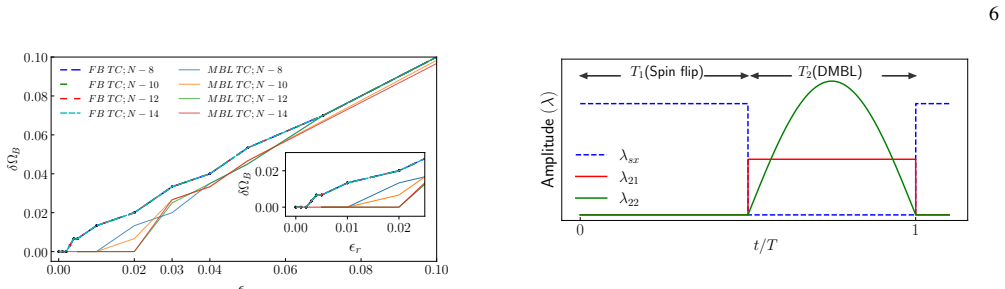
- Spin-rotation errors as small as εr≈0.002 introduce sidebands and beating, making the flat-band DTC less resilient to pulse errors than MBL- or DMBL-based DTCs.
- Adding a static ZZ interaction to the flat-band Hamiltonian suppresses rotation-error sensitivity in two regimes: strong interactions with high-frequency drive, and weak interactions with low-frequency drive.
Where Pith is reading between the lines
- The flat-band identity U(T2)=1 depends on an exact odd-symmetry condition around the null point; the square-wave protocol used in the numerics (p=3, ω0=0) may not satisfy this symmetry over the full interval, so the reported degenerate spectrum and π-pulse form of U(T) deserve a direct numerical check.
- A decisive extension would compare protocols with p=1 (which does satisfy the symmetry) against p=3; if both yield the same ω/2 peak, the mechanism is more forgiving than the proof suggests, and if not, the observed DTC may be a prethermal effect rather than an exact flat-band phase.
- If confirmed, this establishes a general design principle: any pair of noncommuting drives with a null point can freeze many-body dynamics, suggesting the protocol could be adapted to higher spins, bosonic systems, or two-dimensional lattices without disorder.
- The paper's comparison with MBL and DMBL DTCs suggests a cost-geometry trade-off between parameter tunability and error resilience that could guide experimental platform choice, but this comparison is only qualitative in the manuscript.
Editorial analysis
A structured set of objections, weighed in public.
Referee Report
Summary. The paper proposes a two-stage periodic drive for a clean spin-1/2 chain: a global spin-flip pulse during the first half-period, followed by a two-tone 'flat-band' drive during the second half-period. It claims the two-tone drive engineers a fully degenerate Floquet quasi-energy spectrum, freezes the interacting dynamics, and thereby produces a robust period-doubled subharmonic response interpreted as a discrete time crystal (DTC). Numerical magnetization traces, Fourier spectra, comparisons with MBL and DMBL stabilizations, and a modified protocol with an added σzσz interaction are presented for chains of up to N=14 sites.
Significance. If the central claim were correct, the paper would offer a disorder-free, interaction-independent route to DTC order with a broad parameter window. The manuscript contains useful machinery: exact small-system time evolution, Floquet quasi-energy diagonalization, disorder averaging over 960 realizations, and a Magnus expansion for the modified protocol. However, the main 'DTC phase' claim is not supported. In the exact flat-band limit the stroboscopic evolution factorizes into a global pulse and the identity, so the period-doubling is not an emergent many-body phenomenon and has no rigidity. The reported long-time decay in Fig. 5 is also inconsistent with the analytic flat-band identity. The modified protocol in Sec. VI is the most promising part, but it is not analyzed at the level required to establish a prethermal or true DTC phase.
major comments (3)
- [Sec. III; Appendix A, Eqs. (A10)/(A14)] The exact flat-band identity makes the full stroboscopic evolution at εr=0 exactly U(T)=exp(-iπ/2 Σσx), up to the flat-band segment being the identity. This is a product of single-spin rotations, and the interactions J, λ0, system size, and interaction range play no role. Consequently, the period-doubled magnetization in Fig. 3 and the 'insensitivity' in Figs. 4–5 are consequences of the engineered identity plus the pulse, not emergent many-body signatures. The operational DTC criteria in Sec. I include rigidity; by the authors' own Fig. 7, the exact protocol loses its period-doubled response for εr ≳ 0.002, much earlier than MBL or DMBL. Labeling the exact flat-band limit a 'DTC phase' is therefore not justified without a separate demonstration of a finite rigidity window.
- [Sec. IV, Fig. 5] If Eq. (A10) holds at εr=0, then U(T2)=1 for any interaction range, including all-to-all (β=0). Hence the parity-adjusted order parameter should be Z(nT)=1 for all n and all β. The reported gradual decay in the all-to-all case is thus impossible in the model as described. The text attributes this to 'deviation from flat-band arising from spin-spin interactions', but the modified Hamiltonian in Eq. (5) preserves the same two-tone factors and the same odd symmetry. The authors must state whether the simulation included a finite εr, a static interaction not multiplied by λ1(t), or an approximate integrator; otherwise the numerical data and the analytic identity are mutually inconsistent.
- [Secs. IV–V, Figs. 6–7] For the exact flat-band protocol, even with εr>0 the evolution between spin flips remains the identity. The full period evolution is therefore a repeated global rotation U(T)=exp[-i(π/2)(1-εr)Σσx]. The beat patterns in Fig. 6 and the FB-DTC curves in Fig. 7 are single-spin pulse-amplitude errors, not many-body physics; no interaction is needed to produce them. Comparing these curves with MBL and DMBL curves as measures of 'robustness of the DTC phase' conflates an exactly decoupled pulse sequence with interacting many-body phases. The meaningful many-body content in Sec. VI (modified protocol) is more relevant, but the Magnus result Eq. (B15) is essentially a transverse-field Ising model, and the stability windows require more direct evidence—long-time plateaus, finite-size scaling, and explicit dependence on the added interaction—before they can support a DTC-phase claim.
minor comments (5)
- [Sec. II] The sentence 'λ_s=ω/2 ... such that λ_s T=π' is confusing. With T1=T/2, the actual pulse angle is λ_sT1=π/2, which is the correct spin-flip condition. The text should state the convention explicitly (generator coefficient versus Bloch-sphere rotation angle) to avoid the factor-of-two confusion that also appears in the stress-test discussion.
- [Appendix A, Eq. (A3)] The integration limits in Eq. (A3) are garbled: the evolution operator is written with ∫_T^{T1} and ∫_{T1}^0, which have the wrong orientation and dependence on T. This needs correction.
- [Sec. VI A] The sentence defining δΩ1 and δΩ2 is incomplete ('Here, δΩ1=and δΩ2'). Also T′ and T″ are used before their relation to the drive frequencies is fully specified.
- [Fig. 4] The y-axis label in panel (a1) appears corrupted ('□1 0 1'); presumably it should be ⟨σz⟩.
- [Appendix B] The Magnus derivation fixes p=2 for analytical convenience, while the main text and numerical sections use p=3. The relation between the two should be stated explicitly, since the intermediate commutators and the effective Hamiltonian may depend on p.
Circularity Check
At εr=0 the stroboscopic evolution is reduced to the designed spin-flip pulse, so the ω/2 subharmonic response and the J/N/range insensitivity are inputs of the construction, not emergent predictions; additionally the printed defaults give λsT1=π/2, not π.
specific steps
-
self definitional
[Sec. II (spin-flip parameter choice) and Appendix A, Eqs. (A10)-(A11); Sec. III, Fig. 3]
"If the value of λ_s is set to ω/2 (where ω=2π/T), such that λ_s T=π; then the Hamiltonian Ĥ1 in Eq. (1b) simply flips each spin over the course of its duration. ... ˆU(T,T1)=1 (A10). Therefore, the unitary evolution operator becomes: ˆU(T,0)=exp(−i ˆH_SF T1) (A11)."
The flat-band segment is constructed so that U(T,T1)=1, leaving as the stroboscopic evolution only the deliberately chosen spin-flip pulse. The parameter λ_s is set precisely so that H_SF 'simply flips each spin', so the period-doubled magnetization and the ω/2 peak of Fig. 3 are the Fourier spectrum of the input pulse, not a consequence of emergent many-body dynamics. The claimed DTC at εr=0 is therefore equivalent to the definition of the drive.
-
self definitional
[Sec. IV.A (spin-coupling variation) and Sec. VII, with Appendix A]
"The flat-band protocol introduced in Sect. II is designed to achieve perfect localization: the two-tone drive is carefully tuned so that the effective Floquet operator reduces to the identity at integer multiples of the time period, thereby freezing all dynamics (see Appendix A). ... The results reveal that the 2T-DTC phase emerges robustly across the entire range of spin-spin interaction strengths."
The insensitivity to spin-spin interaction strength (and the analogous insensitivity to system size and interaction range) is not a discovered robustness property: Eq. (A10) gives U(T,T1)=1 for any J once the two-tone symmetry is imposed. The protocol is 'carefully tuned' to make the Floquet operator the identity, so statements such as 'suppresses thermalization' and 'insensitive to interaction strength' are restatements of that engineered identity rather than predictions derived from it.
full rationale
The analytic proof of the flat-band identity (Appendix A) is self-contained and, if its symmetry assumption A1 holds, it does establish U(T,T1)=1. The circularity enters at the interpretive step: with U(T,T1)=1, Eq. (A11) says the entire stroboscopic evolution is just the spin-flip term, whose parameters were chosen to produce flipping. Hence the ω/2 subharmonic response and the J/N/range insensitivity at εr=0 are the designed inputs renamed as predictions. No load-bearing self-citation chain is present; refs. [63,64] are not by the authors and the proof is in the paper. The εr-melting study and the modified protocol of Sec. VI contain independent content (Magnus expansion and numerical exploration), which prevents the whole paper from being wholly definitional. A further correctness defect independent of circularity is that the printed defaults T1=T/2 and λ_s=ω/2 give λ_sT1=π/2, so exp(−iH_SF T1) is a π/2 rotation and the claimed ⟨σz(nT)⟩=(−1)^n does not follow from the equations as written.
Axiom & Free-Parameter Ledger
free parameters (5)
- λs (spin-flip amplitude) =
10 (ω/2)
- λ0 (flat-band drive amplitude) =
0.18
- ω1 (second drive amplitude) =
λ0 J / 2 = 0.09
- p (frequency multiplier of λ2) =
3 (default)
- λf (added interaction strength) =
0.7 λ0 (varied)
axioms (4)
- ad hoc to paper The drives satisfy λ1,2(α1T+t')=-λ1,2(α1T-t') (Eq. A1)
- domain assumption First-order Suzuki-Trotter and Zassenhaus expansions are valid at the drive frequencies
- domain assumption The system is closed and exact time evolution is converged
- ad hoc to paper The long-time drift toward thermal equilibrium in Figs. 5-6 reflects a prethermal DTC rather than numerical error
read the original abstract
We propose a novel protocol to realize discrete time-crystal (DTC) order in clean, periodically driven spin-$1/2$ chains. In each drive cycle, a global spin flip is followed by a two-tone flat-band segment. This flat-band segment engineers a fully degenerate Floquet quasienergy spectrum, suppresses thermalization, and stabilizes a robust period-doubled subharmonic response. Using exact time evolution, we identify a pronounced subharmonic peak at half the drive frequency in the Fourier spectrum of the order parameter, thereby providing clear evidence for the emergence of stable DTC. The resulting phase is insensitive to system size, interaction strength, and interaction range; however, it remains sensitive to spin-rotation errors ($\varepsilon_r$), which can destabilize the subharmonic response. Compared with disorder-induced many-body localized (MBL) and disorder-free dynamically many-body localized (DMBL) DTCs, we find that the exact flat-band protocol offers a broader tunability of drive parameters, whereas MBL and DMBL based DTCs are more resistant to $\varepsilon_r$. In particular, the $\varepsilon_r$ sensitivity can be suppressed by incorporating additional spin-spin interactions that have modest deviations from the ideal flat-band protocol. This manifests itself in a robust DTC response over a finite window of spin-coupling strengths and drive frequencies. Our results establish flat-band driving as a versatile and experimentally relevant route to DTC order in disorder-free spin systems and motivate further exploration of nonequilibrium phases.
Figures




Reference graph
Works this paper leans on
-
[1]
B. M. Walter Greiner,Quantum Mechanics(Springer Berlin Heidelberg, 2012)
2012
-
[2]
Strocchi,Symmetry Breaking(Springer Berlin Heidelberg, 2021)
F. Strocchi,Symmetry Breaking(Springer Berlin Heidelberg, 2021)
2021
-
[3]
C. M. Bender and D. W. Hook, Rev. Mod. Phys.96, 045002 (2024)
2024
-
[4]
Ziaeepour, Journal of Physics: Conference Series626, 012074 (2015)
H. Ziaeepour, Journal of Physics: Conference Series626, 012074 (2015)
2015
-
[5]
O. Lombardi and S. Fortin, The role of symmetry in the inter- pretation of quantum mechanics (2016), arXiv:1602.07160
Pith/arXiv arXiv 2016
-
[6]
Mack and V
G. Mack and V. Schomerus, Journal of Geometry and Physics 11, 361 (1993)
1993
-
[7]
Harlow and H
D. Harlow and H. Ooguri, Communications in Mathematical Physics383, 1669 (2021)
2021
-
[8]
C.M.Bender,A.Felski,S.P.Klevansky,andS.Sarkar,Journal of Physics: Conference Series2038, 012004 (2021)
2021
-
[9]
Gripaios, O
B. Gripaios, O. Randal-Williams, and J. Tooby-Smith, Journal of Geometry and Physics201, 105212 (2024)
2024
-
[10]
WILLENBROCK, Symmetries of the standard model, in PhysicsInD>=4Tasi2004(WorldScientific,2004)pp.3–38
S. WILLENBROCK, Symmetries of the standard model, in PhysicsInD>=4Tasi2004(WorldScientific,2004)pp.3–38
2004
-
[11]
Bernabeu, Symmetries in the standard model, inFundamen- tal Physics and Physics Education Research, edited by B
J. Bernabeu, Symmetries in the standard model, inFundamen- tal Physics and Physics Education Research, edited by B. G. Sidharth, J. C. Murillo, M. Michelini, and C. Perea (Springer International Publishing, Cham, 2021) pp. 3–16
2021
-
[12]
XIX, 327
R.Matthew,Mathematicsandparticlephysics,inSymmetryand the Standard Model(Springer New York, NY, 2014) pp. XIX, 327
2014
-
[13]
C.Wu,Thesymmetryprincipleincondensedmatterphysics(i), inA Festschrift in Honor of the C N Yang Centenary(WORLD SCIENTIFIC, 2022) p. 413–473
2022
-
[14]
McGreevy, Annual Review of Condensed Matter Physics14, 57 (2023)
J. McGreevy, Annual Review of Condensed Matter Physics14, 57 (2023)
2023
-
[15]
N. S. Yanofsky and M. Zelcer, Foundations of Science22, 495 (2017)
2017
-
[16]
Brauner, Spontaneous symmetry breaking, inEffective Field Theory for Spontaneously Broken Symmetry(Springer Interna- tional Publishing, Cham, 2024) pp
T. Brauner, Spontaneous symmetry breaking, inEffective Field Theory for Spontaneously Broken Symmetry(Springer Interna- tional Publishing, Cham, 2024) pp. 61–84
2024
-
[17]
L. D. Landau and E. M. Lifshitz,Statistical Physics, 3rd ed. (Butterworth-Heinemann, Oxford, England, 1996)
1996
-
[18]
Goldenfeld,Lectures on Phase Transitions and the Renor- malization Group(Addison-Wesley, 1992)
N. Goldenfeld,Lectures on Phase Transitions and the Renor- malization Group(Addison-Wesley, 1992)
1992
-
[19]
D. J. Thouless, M. Kohmoto, M. P. Nightingale, and M. den Nijs, Phys. Rev. Lett.49, 405 (1982)
1982
-
[20]
M. O. Goerbig, Quantum hall effects (2009), arXiv:0909.1998 [cond-mat.mes-hall]
Pith/arXiv arXiv 2009
-
[21]
Basko, I
D. Basko, I. Aleiner, and B. Altshuler, Annals of Physics321, 1126 (2006)
2006
-
[22]
Nandkishore and D
R. Nandkishore and D. A. Huse, Annual Review of Condensed Matter Physics6, 15–38 (2015)
2015
-
[23]
X7, 021013 (2017)
V.Khemani,S.P.Lim,D.N.Sheng,andD.A.Huse,Phys.Rev. X7, 021013 (2017)
2017
-
[24]
D. A. Abanin, E. Altman, I. Bloch, and M. Serbyn, Reviews of 14 Modern Physics91, 10.1103/revmodphys.91.021001 (2019)
-
[25]
Fazio, Phys
F.Iemini,A.Russomanno,J.Keeling,M.Schirò,M.Dalmonte, and R. Fazio, Phys. Rev. Lett.121, 035301 (2018)
2018
-
[26]
B. Buča, J. Tindall, and D. Jaksch, Nature Communications10, 10.1038/s41467-019-09757-y (2019)
-
[27]
Sacha,Time Crystals, Springer Series on Atomic, Optical, and Plasma Physics, Vol
K. Sacha,Time Crystals, Springer Series on Atomic, Optical, and Plasma Physics, Vol. 114 (Springer International Publish- ing, 2021)
2021
-
[28]
A. Shapere and F. Wilczek, Physical Review Letters109, 10.1103/physrevlett.109.160402 (2012)
-
[29]
Wilczek, Phys
F. Wilczek, Phys. Rev. Lett.109, 160401 (2012)
2012
-
[30]
Bruno, Phys
P. Bruno, Phys. Rev. Lett.111, 070402 (2013)
2013
-
[31]
Nozières, Europhysics Letters103, 57008 (2013)
P. Nozières, Europhysics Letters103, 57008 (2013)
2013
-
[32]
Watanabe and M
H. Watanabe and M. Oshikawa, Phys. Rev. Lett.114, 251603 (2015)
2015
-
[33]
Sacha, Phys
K. Sacha, Phys. Rev. A91, 033617 (2015)
2015
-
[34]
D.V.Else,B.Bauer,andC.Nayak,Phys.Rev.Lett.117,090402 (2016)
2016
-
[35]
Pagano, I.-D
J.Zhang,P.W.Hess,A.Kyprianidis,P.Becker,A.Lee,J.Smith, G. Pagano, I.-D. Potirniche, A. C. Potter, A. Vishwanath, N. Y. Yao, and C. Monroe, Nature543, 217 (2017)
2017
-
[36]
M.Ippoliti,K.Kechedzhi,R.Moessner,S.Sondhi,andV.Khe- mani, PRX Quantum2, 030346 (2021)
2021
-
[37]
Choi, Journal of the Korean Physical Society82, 875 (2023)
J.-y. Choi, Journal of the Korean Physical Society82, 875 (2023)
2023
-
[38]
Russomanno, F
A. Russomanno, F. Iemini, M. Dalmonte, and R. Fazio, Phys. Rev. B95, 214307 (2017)
2017
-
[39]
J. M. Deutsch, Phys. Rev. A43, 2046 (1991)
2046
-
[40]
Srednicki, Phys
M. Srednicki, Phys. Rev. E50, 888 (1994)
1994
-
[41]
Hauschild, F
J. Hauschild, F. Heidrich-Meisner, and F. Pollmann, Phys. Rev. B94, 161109 (2016)
2016
-
[42]
R. Chandra, M. Rahaman, S. Majumder, A. Roy, and S. Sarkar, Integrable floquet time crystals in one dimension (2025), arXiv:2510.04326 [cond-mat.str-el]
Pith/arXiv arXiv 2025
-
[43]
Schäfer, G
R. Schäfer, G. S. Uhrig, and J. Stolze, Physical Review B100, 184301 (2019)
2019
-
[44]
Rahaman, A
M. Rahaman, A. Sakurai, and A. Roy, New Journal of Physics 26, 063035 (2024)
2024
-
[45]
W. C. Yu, J. Tangpanitanon, A. W. Glaetzle, D. Jaksch, and D. G. Angelakis, Phys. Rev. A99, 033618 (2019)
2019
-
[46]
B.Huang,Y.-H.Wu,andW.V.Liu,Phys.Rev.Lett.120,110603 (2018)
2018
-
[47]
S. Anisur, W. V. Liu, and S. Choudhury, Entropy27, 10.3390/e27060609 (2025)
-
[48]
Choudhury, Atoms9, 10.3390/atoms9020025 (2021)
S. Choudhury, Atoms9, 10.3390/atoms9020025 (2021)
-
[49]
C. Lyu, S. Choudhury, C. Lv, Y. Yan, and Q. Zhou, Phys. Rev. Res.2, 033070 (2020)
2020
-
[50]
H.BiswasandS.Choudhury,Discretetimecrystalsinthespin-s central spin model (2025), arXiv:2505.13207 [quant-ph]
Pith/arXiv arXiv 2025
-
[51]
H. Biswas and S. Choudhury, The floquet central spin model: A platform to realize eternal time crystals, entanglement steer- ing, and multiparameter metrology (2025), arXiv:2501.18472 [quant-ph]
Pith/arXiv arXiv 2025
-
[52]
L.Zhang,V.Khemani,andD.A.Huse,Phys.Rev.B94,224202 (2016)
2016
-
[53]
N. Y. Yao, A. C. Potter, I.-D. Potirniche, and A. Vishwanath, Phys. Rev. Lett.118, 030401 (2017)
2017
-
[54]
Randall, C
J. Randall, C. E. Bradley, F. V. van der Gronden, A. Galicia, M. H. Abobeih, M. Markham, D. J. Twitchen, F. Machado, N. Y. Yao, and T. H. Taminiau, Science374, 1474 (2021)
2021
-
[55]
S. Choi, J. Choi, R. Landig, G. Kucsko, H. Zhou, J. Isoya, F. Jelezko, S. Onoda, H. Sumiya, V. Khemani, C. von Keyser- lingk, N. Y. Yao, E. Demler, and M. D. Lukin, Nature543, 221 (2017)
2017
-
[56]
Pizzi, J
A. Pizzi, J. Knolle, and A. Nunnenkamp, Nature Communica- tions12, 2341 (2021)
2021
-
[57]
V. K. Kozin and O. Kyriienko, Physical Review Letters123, 210602 (2019)
2019
-
[58]
Das, Phys
A. Das, Phys. Rev. B82, 172402 (2010)
2010
-
[59]
Haldar, D
A. Haldar, D. Sen, R. Moessner, and A. Das, Phys. Rev. X11, 021008 (2021)
2021
-
[60]
Rahaman, T
M. Rahaman, T. Mori, and A. Roy, Phys. Rev. B109, 104311 (2024)
2024
-
[61]
Ashhab, J
S. Ashhab, J. R. Johansson, A. M. Zagoskin, and F. Nori, Phys. Rev. A75, 063414 (2007)
2007
-
[62]
Morningstar, L
A. Morningstar, L. Colmenarez, V. Khemani, D. J. Luitz, and D. A. Huse, Phys. Rev. B105, 174205 (2022)
2022
-
[63]
Banerjee, S
T. Banerjee, S. Choudhury, and K. Sengupta, New Journal of Physics27, 084506 (2025)
2025
-
[64]
Ghosh, S
K. Ghosh, S. Choudhury, D. Sen, and K. Sengupta, Phys. Rev. B112, 155142 (2025)
2025
-
[65]
U.DivakaranandK.Sengupta,Phys.Rev.B90,184303(2014)
2014
-
[66]
J. Naji, R. Jafari, L. Zhou, and A. Langari, Phys. Rev. B106, 094314 (2022)
2022
-
[67]
J. D. Sau and K. Sengupta, Phys. Rev. B90, 104306 (2014)
2014
-
[68]
N. Lambert, E. Giguère, P. Menczel, B. Li, P. Hopf, G. Suárez, M. Gali, J. Lishman, R. Gadhvi, R. Agarwal, A. Galicia, N. Shammah, P. Nation, J. R. Johansson, S. Ahmed, S. Cross, A. Pitchford, and F. Nori, Qutip 5: The quantum toolbox in python (2024), arXiv:2412.04705 [quant-ph]
Pith/arXiv arXiv 2024
-
[69]
J. H. Shirley, Phys. Rev.138, B979 (1965)
1965
-
[70]
Sambe, Phys
H. Sambe, Phys. Rev. A7, 2203 (1973)
1973
-
[71]
Holthaus, Journalof PhysicsB: Atomic, Molecular andOp- tical Physics49, 013001 (2015)
M. Holthaus, Journalof PhysicsB: Atomic, Molecular andOp- tical Physics49, 013001 (2015)
2015
-
[72]
G. B. Mbeng, A. Russomanno, and G. E. Santoro, SciPost Physics Lecture Notes , 082 (2024)
2024
-
[73]
A. S. Buyskikh, M. Fagotti, J. Schachenmayer, F. Essler, and A. J. Daley, Phys. Rev. A93, 053620 (2016)
2016
-
[74]
V.Khemani,A.Lazarides,R.Moessner,andS.L.Sondhi,Phys. Rev. Lett.116, 250401 (2016)
2016
-
[75]
Preskill, Quantum2, 79 (2018)
J. Preskill, Quantum2, 79 (2018)
2018
-
[76]
Browaeys and T
A. Browaeys and T. Lahaye, Nature Physics16, 132 (2020)
2020
-
[77]
Das and B
N.HatanoandM.Suzuki,Findingexponentialproductformulas ofhigherorders,inQuantumAnnealingandOtherOptimization Methods, edited by A. Das and B. K. Chakrabarti (Springer Berlin Heidelberg, Berlin, Heidelberg, 2005) pp. 37–68
2005
-
[78]
Casas, A
F. Casas, A. Murua, and M. Nadinic, Computer Physics Com- munications183, 2386 (2012)
2012
-
[79]
Dupays and J.-C
L. Dupays and J.-C. Pain, Journal of Physics A: Mathematical and Theoretical56, 255202 (2023)
2023
-
[80]
Kimura, Progress of Theoretical and Experimental Physics 2017, 041A03 (2017)
T. Kimura, Progress of Theoretical and Experimental Physics 2017, 041A03 (2017)
2017
discussion (0)
Sign in with ORCID, Apple, or X to comment. Anyone can read and Pith papers without signing in.