Recognition: 2 theorem links
· Lean TheoremSpin-valley physics in anomalous thermoelectric responses of the spin-orbit coupled α-T₃ system with broken time-reversal symmetry
Pith reviewed 2026-05-15 10:20 UTC · model grok-4.3
The pith
The α-T₃ system with spin-orbit interaction and staggered magnetization reaches nearly complete spin and valley polarizations in its anomalous thermoelectric responses.
A machine-rendered reading of the paper's core claim, the machinery that carries it, and where it could break.
Core claim
The paper establishes that the interplay of spin-orbit interaction, staggered magnetization, and the α parameter enables efficient tuning of spin- and valley-dependent Hall and Nernst signals in the α-T₃ system. Both the spin and valley polarizations, extracted from the resolved Nernst conductivities, attain nearly complete polarization over extended regions of the parameter space. The spin-valley physics of these responses is explained both with and without the magnetization term.
What carries the argument
Spin- and valley-resolved Nernst conductivities calculated from the tight-binding Hamiltonian with added spin-orbit and magnetization terms, connected to the Hall responses by the Mott relation.
If this is right
- The magnetization term introduces highly tunable spin and valley polarizations in the Nernst response.
- Both spin and valley polarizations can reach nearly complete values over broad parameter ranges.
- The peak-dip features in Nernst responses follow directly from the corresponding Hall responses via the Mott relation.
- The system exhibits distinct spin-valley Hall and Nernst physics depending on the presence or absence of magnetization.
Where Pith is reading between the lines
- If the model holds in real materials, temperature-gradient driven devices could separate spins and valleys efficiently.
- Similar polarization effects might appear in other 2D lattices when symmetry is broken in comparable ways.
- Testing the polarization at higher temperatures or with disorder would check how robust the complete polarization regions are.
- The approach may link to studies of topological transitions in related honeycomb lattices.
Load-bearing premise
The specific tight-binding model with spin-orbit and staggered magnetization terms must accurately represent the electronic properties of the real α-T₃ material.
What would settle it
An experiment on a fabricated α-T₃ sample showing spin or valley polarization well below near-complete levels in the predicted parameter regimes would disprove the central claim.
Figures


read the original abstract
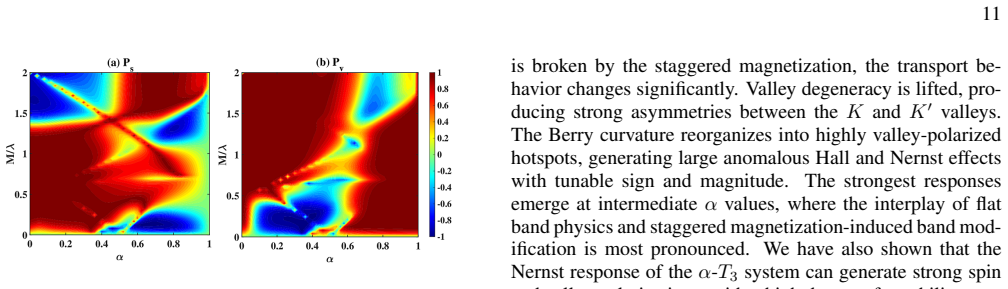
We extract spin-valley physics in the anomalous Hall and Nernst responses of the spin-orbit coupled $\alpha$-$T_3$ system in the presence of a time-reversal symmetry breaking staggered magnetization. We show that the interplay between the SOI, magnetization, and a model parameter $\alpha$ for the $\alpha$-$T_3$ lattice enables efficient tuning of spin- and valley-dependent Hall and Nernst signals. The spin-valley physics of the Hall and Nernst responses in the absence and presence of the magnetization are well explained. The peak-dip features of the Nernst responses are also understood from the corresponding Hall responses through the Mott relation. We find that the magnetization introduces highly tunable spin and valley polarizations, which are calculated from the spin- and valley-resolved Nernst conductivities. It is shown that both the spin and valley polarizations can attain nearly complete polarization over extended regions of the parameter space. Overall, our results highlight the $\alpha$-$T_3$ lattice as a promising platform for spin and valley caloritronic applications.
Editorial analysis
A structured set of objections, weighed in public.
Referee Report
Summary. The manuscript examines the spin-valley physics in the anomalous Hall and Nernst responses of the spin-orbit coupled α-T3 lattice with a staggered magnetization that breaks time-reversal symmetry. Using linear response theory and the Kubo formula, the authors compute spin- and valley-resolved conductivities, apply the Mott relation to interpret Nernst peak-dip features from the Hall responses, and show that both spin and valley polarizations (defined as normalized differences of the resolved Nernst conductivities) reach near-unity values over extended regions of the parameter space spanned by the lattice parameter α and the magnetization amplitude.
Significance. If the calculations hold, the work identifies the α-T3 lattice as a tunable platform for spin-valley caloritronics, with concrete predictions for near-complete polarizations arising from the interplay of spin-orbit coupling, magnetization, and lattice geometry. The direct computation of polarizations from resolved conductivities and the explicit use of the Mott relation to link Hall and Nernst features constitute clear strengths, providing falsifiable, model-based guidance for experiments in related 2D materials.
minor comments (3)
- The introduction should include a brief schematic of the α-T3 lattice to clarify the role of the parameter α and the positions of the A, B, and C sublattices.
- Numerical details such as k-point mesh density and broadening parameter used in the Kubo formula evaluations should be stated explicitly in the methods or results section to support reproducibility.
- Figure captions for the polarization plots should specify the exact threshold (e.g., |P| > 0.95) used to identify 'nearly complete' polarization and the corresponding intervals of α and magnetization.
Simulated Author's Rebuttal
We thank the referee for the positive summary and significance assessment of our work on spin-valley physics in the anomalous thermoelectric responses of the spin-orbit coupled α-T3 system. The recommendation for minor revision is noted, and we appreciate the recognition of the tunable polarizations and the use of the Mott relation as strengths. No specific major comments were raised in the report.
Circularity Check
No significant circularity in derivation chain
full rationale
The central results follow from direct numerical evaluation of spin- and valley-resolved Nernst conductivities via the Kubo formula applied to the given tight-binding Hamiltonian (with SOI and staggered magnetization terms). Polarization is then obtained from the standard normalized difference P = (N+ − N−)/(N+ + N−). The Mott relation is invoked only to interpret peak-dip features in the Nernst signal, not to derive the polarization values themselves. No parameters are fitted to data and then relabeled as predictions, no load-bearing self-citations justify uniqueness or ansatzes, and no known empirical pattern is merely renamed. The derivation chain is therefore self-contained within the model and standard linear-response formulas.
Axiom & Free-Parameter Ledger
free parameters (2)
- α
- staggered magnetization amplitude
axioms (2)
- domain assumption Linear response theory applies to the thermoelectric conductivities
- domain assumption Mott relation connects Nernst and Hall responses
Lean theorems connected to this paper
-
IndisputableMonolith/Cost/FunctionalEquation.leanwashburn_uniqueness_aczel unclear?
unclearRelation between the paper passage and the cited Recognition theorem.
We compute the spin- and valley-resolved anomalous Hall, and anomalous Nernst conductivities... using Eq. (10) for Berry curvature and Eqs. (11)–(12) for the conductivities.
-
IndisputableMonolith/Foundation/AlphaCoordinateFixation.leanJ_uniquely_calibrated_via_higher_derivative unclear?
unclearRelation between the paper passage and the cited Recognition theorem.
The peak-dip features of the Nernst responses are also understood from the corresponding Hall responses through the Mott relation.
What do these tags mean?
- matches
- The paper's claim is directly supported by a theorem in the formal canon.
- supports
- The theorem supports part of the paper's argument, but the paper may add assumptions or extra steps.
- extends
- The paper goes beyond the formal theorem; the theorem is a base layer rather than the whole result.
- uses
- The paper appears to rely on the theorem as machinery.
- contradicts
- The paper's claim conflicts with a theorem or certificate in the canon.
- unclear
- Pith found a possible connection, but the passage is too broad, indirect, or ambiguous to say the theorem truly supports the claim.
Reference graph
Works this paper leans on
-
[1]
Case I: Hall conductivities in the absence of the staggered magnetization (M= 0) In this case, the anomalous Hall response is solely determined by the Berry curvature generated by the SOI. In Fig. 5(a), we show the variation of the Hall conductivity for a given valley summed over the spin index, i.e.,σ η,+ H =σ η,↑ H +σ η,↓ H , along with the VHC, as func...
-
[2]
Case II: Hall Conductivities in the Presence of Magnetization (M̸= 0) Here, we discuss the characteristics of the Hall conductivities in the presence of a staggered magnetizationM̸= 0. As observed earlier, the magnetization modifies the magnitudes and positions of the energy gaps. It also redistributes the Berry curvature around the valleys, thereby signi...
-
[3]
10(b) shows the SNC at individual val- leys and the total SNC, consideringα= 0.3
Case I: Nernst Conductivities in the absence of Magnetization (M= 0) Figure 10(a) depicts the chemical potential dependence of the spin-summed ANC in individual valleys along with the VNC, while Fig. 10(b) shows the SNC at individual val- leys and the total SNC, consideringα= 0.3. The VNC and SNC are explicitly given byα v N =α K,+ N −α K′,+ N and αs N =α...
-
[4]
Nernst Conductivities in the Presence of Magnetization (M̸= 0) The presence of a staggered magnetization leads to a drastic change in the Nernst response of the system as shown in Fig
-
[5]
13,KandK ′ valleys contribute dif- ferently due to breaking of the TRS
As shown in Fig. 13,KandK ′ valleys contribute dif- ferently due to breaking of the TRS. The peak-dip feature of αK,+ N is more prominent than that ofα K′,+ N , thus leading to a nonvanishing total ANC (not shown) in addition to the finite VNC (dashed line). Figure 13(b) shows that SNCs at individ- ual valleys are completely different. In fact the total S...
- [6]
- [7]
-
[8]
D. D. Awschalom and M. E. Flatte, Challenges for semiconduc- tor spintronics, Nat. Phys.3, 153 (2007)
work page 2007
-
[9]
Fert, Nobel Lecture: Origin, development, and future of spintronics, Rev
A. Fert, Nobel Lecture: Origin, development, and future of spintronics, Rev. Mod. Phys.80, 1517 (2008)
work page 2008
-
[10]
D. D. Awschalom and N. Samarth, Spintronics without mag- netism, Physics2, 50 (2009)
work page 2009
-
[11]
A. Aharony, O. Entin-Wohlman, Y . Tokura, and S. Katsumoto, Spin filtering by a periodic spintronic device, Phys. Rev. B78, 125328 (2008)
work page 2008
-
[12]
Z. G. Zhu, Selective spin injection controlled by electrical way in ferromagnet/quantum dot/semiconductor system, Phys. Lett. A372, 695 (2008)
work page 2008
-
[13]
J. E. Hirsch, Spin Hall Effect, Phys. Rev. Lett.83, 1834 (1999)
work page 1999
-
[14]
E. G. Mishchenko, A. V . Shytov, and B. I. Halperin, Spin Cur- rent and Polarization in Impure Two-Dimensional Electron Sys- tems with Spin-Orbit Coupling, Phys. Rev. Lett.93, 226602 (2004)
work page 2004
-
[15]
R. Raimondi, C. Gorini, M. Dzierzawa, and P. Schwab, Current- induced spin polarization and the spin Hall effect: A quasiclas- sical approach, Solid State Commun.144, 524 (2007)
work page 2007
-
[16]
S. D. Ganichev, E. L. Ivchenko, V . V . Bel’kov, S. A. Tarasenko, M. Sollinger, D. Weiss, W. Wegscheider, and W. Prettl, Spin- galvanic effect, Nature417, 153 (2002)
work page 2002
-
[17]
M. J. Stevens, A. L. Smirl, R. D. R. Bhat, A. Najmaie, J. E. Sipe, and H. M. van Driel, Quantum Interference Control of Ballis- tic Pure Spin Currents in Semiconductors, Phys. Rev. Lett.90, 136603 (2003)
work page 2003
- [18]
-
[19]
Z. Ma, R. L. Wu, Y . B. Yu, and M. Wang, V oltage-controllable generator of pure spin current: A three-terminal model, J. Appl. Phys.116, 043706 (2014)
work page 2014
-
[20]
S. Datta and B. Das, Electronic analog of the electro-optic mod- ulator, Appl. Phys. Lett.56, 665 (1990)
work page 1990
-
[21]
S. Gardelis, C. G. Smith, C. H. W. Barnes, E. H. Linfield, and D. A. Ritchie, Spin-valve effects in a semiconductor field-effect transistor: A spintronic device, Phys. Rev. B60, 7764 (1999)
work page 1999
-
[22]
G. Schmidt, D. Ferrand, L. W. Molenkamp, A. T. Filip, and B. J. van Wees, Fundamental obstacle for electrical spin injec- tion from a ferromagnetic metal into a diffusive semiconductor, Phys. Rev. B62, R4790(R) (2000)
work page 2000
-
[23]
C. M. Hu, J. Nitta, A. Jensen, J. B. Hansen, and H. Takayanagi, Spin-polarized transport in a two-dimensional electron gas with interdigital-ferromagnetic contacts, Phys. Rev. B63, 125333 (2001)
work page 2001
-
[24]
N. Tombros, C. Jozsa, M. Popinciuc, H. T. Jonkman, and B. J. V . Wees, Electronic spin transport and spin precession in single graphene layers at room temperature, Nature448, 571 (2007)
work page 2007
- [25]
-
[26]
S. Souma and M. Ogawa, Pure spin current induced by adia- batic quantum pumping in zigzag-edged graphene nanoribbons, Appl. Phys. Lett.104, 183103 (2014)
work page 2014
-
[27]
R. Mohammadkhani, B. Abdollahipour, and M. Alidoust, Strain-controlled spin and charge pumping in graphene devices via spin-orbit coupled barriers, EPL111, 67005 (2015)
work page 2015
-
[28]
G. E. W. Bauer, A. H. MacDonald, and S. Maekawa, Spin Caloritronics, Solid State Commun.150, 459 (2010)
work page 2010
-
[29]
G. E.W. Bauer, E. Saitoh, and B. J. van Wees, Spin caloritronics, Nat. Mater.11, 391 (2012)
work page 2012
- [30]
- [31]
-
[32]
C. M. Jaworski, J. Yang, S. Mack, D. D. Awschalom, J. P. Here- mans, and R. C. Myers, Observation of the spin-Seebeck effect in a ferromagnetic semiconductor, Nat. Mater9, 898 (2010)
work page 2010
-
[33]
A. D. Avery, M. R. Pufall, and B. L. Zink, Observation of the Planar Nernst Effect in Permalloy and Nickel Thin Films with In-Plane Thermal Gradients, Phys. Rev. Lett.109, 196602 (2012)
work page 2012
-
[34]
S. Y . Huang, W. G. Wang, S. F. Lee, J. Kwo, and C. L. Chien, Intrinsic Spin-Dependent Thermal Transport, Phys. Rev. Lett. 107, 216604 (2011)
work page 2011
-
[35]
X. Chen, L. Zhang, and H. Guo, Valley caloritronics and its realization by graphene nanoribbons, Phys. Rev. B92, 155427 (2015)
work page 2015
-
[36]
D. Xiao, W. Yao, and Q. Niu, Valley-Contrasting Physics in Graphene: Magnetic Moment and Topological Transport, Phys. Rev. Lett.99, 236809 (2007)
work page 2007
- [37]
-
[38]
W. Yao, D. Xiao, and Q. Niu, Valley-dependent optoelectronics from inversion symmetry breaking, Phys. Rev. B77, 235406 (2008)
work page 2008
- [39]
-
[40]
K. F. Mak, K. L. McGill, J. Park, and P. L. McEuen, The valley Hall effect in MoS2 transistors, Science344, 1489 (2014)
work page 2014
- [41]
-
[42]
T. Jungwirth, Q. Niu, and A. H. MacDonald, Anomalous Hall Effect in Ferromagnetic Semiconductors, Phys. Rev. Lett.88, 207208 (2002)
work page 2002
-
[43]
N. Nagaosa, J. Sinova, S. Onoda, A. H. MacDonald, and N. P. Ong, Anomalous Hall Effect, Rev. Mod. Phys.82, 1539 (2010)
work page 2010
-
[44]
X-Q. Yu, Z-G. Zhu, G. Su, and A.-P. Jauho, Thermally Driven Pure Spin and Valley Currents via the Anomalous Nernst Effect in Monolayer Group-VI Dichalcogenides, Phys. Rev. Lett.115, 246601 (2015)
work page 2015
-
[45]
Sharma, Tunable topological Nernst effect in two- dimensional transition-metal dichalcogenides, Phys
G. Sharma, Tunable topological Nernst effect in two- dimensional transition-metal dichalcogenides, Phys. Rev. B98, 075416 (2018)
work page 2018
-
[46]
D. L. Bergman and V . Oganesyan, Theory of Dissipationless Nernst Effects, Phys. Rev. Lett.104, 0666011 (2010)
work page 2010
-
[47]
T. Yokoyama and S. Murakami, Transverse magnetic heat trans- port on the surface of a topological insulator, Phys. Rev. B83, 161407 (R) (2011)
work page 2011
-
[48]
D. Xiao, Y . Yao, Z. Fang, and Q. Niu, Berry-Phase Effect in Anomalous Thermoelectric Transport, Phys. Rev. Lett.97, 026603 (2006)
work page 2006
-
[49]
M. T. Dau, C. Vergnaud, A. Marty, C. Beigne, S. Gambarelli, V . Maurel, T. Journot, B. Hyot, T. Guillet, B. Grevin, H. Okuno, and M. Jamet, The valley Nernst effect in WSe2, Nat. Commun. 10, 5796 (2010)
work page 2010
-
[50]
Z. A. Xu, N. P. Ong, Y . Wang, T. Kakeshita, and S. Uchida, V ortex-like excitations and the onset of superconducting phase fluctuation in underdoped La 2−xSrxCuO4, Nature406, 486 (2000)
work page 2000
-
[51]
Y . Wang, Z. A. Xu, T. Kakeshita, S. Uchida, S. Ono, Y . Ando, and N. P. Ong, Onset of the vortexlike Nernst signal above Tc in La 2−xSrxCuO4 and Bi 2Sr2−yLayCuO6, Phys. Rev. B64, 224519 (2001)
work page 2001
- [52]
-
[53]
M. Hirschberger, R. Chisnell, Y . S. Lee, and N. P. Ong, Thermal Hall Effect of Spin Excitations in a Kagome Magnet, Phys. Rev. Lett.115, 106603 (2015)
work page 2015
-
[54]
H. Doki, M. Akazawa, H-Y . Lee, J. H. Han, K. Sugii, M. Shi- mozawa, N. Kawashima, M. Oda, H. Yoshida, and M. Ya- mashita, Spin Thermal Hall Conductivity of a Kagome Anti- ferromagnet, Phys. Rev. Lett.121, 097203 (2018)
work page 2018
-
[55]
X. Zhou, H. Liu, W. Wu, K. Jiang, Y . Shi, Z. Li, Y . Sui, J. Hu, and J. Luo, Anomalous thermal Hall effect and anomalous Nernst effect of CsV3Sb5, Phys. Rev. B105, 205104 (2022)
work page 2022
-
[56]
Illes, Properties of theα-T 3 model, PhD Thesis, University of Guelph (2017)
E. Illes, Properties of theα-T 3 model, PhD Thesis, University of Guelph (2017)
work page 2017
-
[57]
Sutherland, Localization of electronic wave functions due to local topology, Phys
B. Sutherland, Localization of electronic wave functions due to local topology, Phys. Rev. B34, 5208 (1986)
work page 1986
- [58]
-
[59]
C. C. Abilio, P. Butaud, T. Fournier, B. Pannetier, J. Vidal, S. Tedesco, and B. Dalzotto, Magnetic Field Induced Localization in a Two-Dimensional Superconducting Wire Network, Phys. Rev. Lett.83, 5102 (1999)
work page 1999
- [60]
- [61]
-
[62]
T. Biswas and T. K. Ghosh, Magnetotransport properties of the α-T3 model, J. Phys.: Condens. Matter28, 495302 (2016)
work page 2016
-
[63]
E. Illes and E. J. Nicol, Klein tunneling in theα-T 3 model, Phys. Rev. B95, 235432 (2017)
work page 2017
-
[64]
SK. F. Islam and P. Dutta, Valley-polarized magnetoconductiv- ity and particle-hole symmetry breaking in a periodically mod- ulatedα-T 3 lattice, Phys. Rev. B96, 045418 (2017)
work page 2017
-
[65]
T. Biswas and T. K. Ghosh, Dynamics of a quasiparticle in the α-T3 model: role of pseudospin polarization and transverse magnetic field on zitterbewegung, J. Phys.: Condens. Matter 30, 075301 (2018)
work page 2018
-
[66]
A. Balassis, D. Dahal, G. Gumbs, A. Iurov, D. Huang and O. Roslyak, Magnetoplasmons for theα-T 3 model with filled Lan- dau levels, J. Phys.: Condens. Matter32, 485301 (2020)
work page 2020
- [67]
- [68]
-
[69]
E. Illes and E. J. Nicol, Magnetic properties of theα-T 3 model: Magneto-optical conductivity and the Hofstadter but- terfly, Phys. Rev. B94, 125435 (2016)
work page 2016
-
[70]
A. D. Kovacs, G. David, B. Dora, and J. Cserti, Frequency- dependent magneto-optical conductivity in the generalizedα- T3 model, Phys. Rev. B95, 035414 (2017)
work page 2017
-
[71]
Y . R. Chen, Y . Xu, J. Wang, J. F. Liu, and Z. Ma, Enhanced magneto-optical response due to the flat band in nanoribbons made from theα-T 3 lattice, Phys. Rev. B99, 045420 (2019)
work page 2019
-
[72]
L. Chen, J. Zuber, Z. Ma, and C. Zhang, Nonlinear optical re- sponse of theα-T 3 model due to the nontrivial topology of the 13 band dispersion, Phys. Rev. B100, 035440 (2019)
work page 2019
-
[73]
D. O. Oriekhov and V . P. Gusynin, RKKY interaction in a doped pseudospin-1 fermion system at finite temperature, Phys. Rev. B101, 235162 (2020)
work page 2020
-
[74]
O. Roslyak, G. Gumbs, A. Balassis, and H. Elsayed, Effect of magnetic field and chemical potential on the RKKY interaction in theα-T 3 lattice, Phys. Rev. B103, 075418 (2021)
work page 2021
-
[75]
J. Wang, J. F. Liu, and C. S. Ting, Recovered minimal conduc- tivity in theα-T 3 model, Phys. Rev. B101, 205420 (2020)
work page 2020
-
[76]
M. W. Alam, B. Souayeh, and SK. F. Islam, Enhancement of thermoelectric performance of a nanoribbon made ofα-T 3 lat- tice, J. Phys.: Condens. Matter31485303 (2019)
work page 2019
-
[77]
W. Duan, Seebeck and Nernst effects of pseudospin-1 fermions in theα-T 3 model under magnetic fields, Phys. Rev. B108, 155428 (2023)
work page 2023
-
[78]
A. Yan, X. Wang, and Y . X. Li, Nernst and seebeck effects in α-T3 lattice, J. Phys.: Condens. Matter36305705 (2024)
work page 2024
-
[79]
K. W. Lee, P.-H. Fu, and Y . S. Ang, Interplay between Haldane and modified Haldane models inα-T 3 lattice: Band structures, phase diagrams, and edge states, Phys. Rev. B109, 235105 (2024)
work page 2024
-
[80]
F. Wang and Y . Ran, Nearly flat band with Chern numberC= 2 on the dice lattice, Phys. Rev. B84, 241103(R) (2011)
work page 2011
discussion (0)
Sign in with ORCID, Apple, or X to comment. Anyone can read and Pith papers without signing in.