REVIEW 5 major objections 6 minor 1 cited by
Multimodal LLMs miss 3D structure not for lack of geometry in RGB inputs but because standard fine-tuning never switches that geometry on; this paper shows a sparse joint pre-training stage that fixes it, lifting grounding, captioning, and
Reviewed by Pith at T0; open to challenge. T0 means a machine referee read the full paper against a public rubric. the ladder, T0–T4 →
T0 review · deepseek-v4-flash
2026-08-02 18:00 UTC pith:PEMU67Y4
load-bearing objection Solid training recipe with consistent gains, but the headline causal claim that the RGB-only 3D gap is purely a training-paradigm problem outruns the evidence: pre-training data/compute is uncontrolled and scene overlap is never ruled out. the 5 major comments →
GAP-MLLM: Geometry-Aligned Pre-training for Activating 3D Spatial Perception in Multimodal Large Language Models
The pith
A machine-rendered reading of the paper's core claim, the machinery that carries it, and where it could break.
Core claim
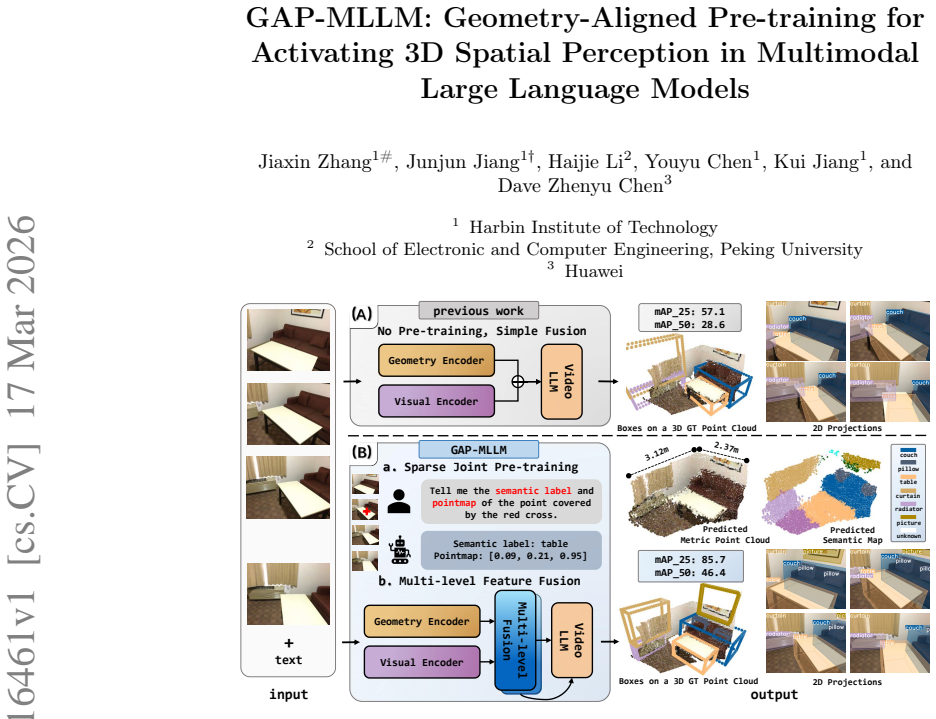
The paper's central claim is that the performance gap in 3D perception between RGB-only MLLMs with implicit geometric priors and methods with explicit 3D input is caused by a geometry-semantics imbalance in the training paradigm, not by insufficient geometric priors. Prior work naively concatenates geometric features and fine-tunes on text-heavy downstream objectives, so geometry stays weakly activated. GAP-MLLM instead runs a sparse joint pre-training objective—predict the metric 3D pointmap coordinate and the semantic label of a red-cross pixel under a unified first-frame metric coordinate system—before task fine-tuning. Results show this activation step consistently raises performance on
What carries the argument
Two devices carry the argument. First, the sparse geometry-semantics joint pre-training task: given a multi-frame image sequence and a red-cross visual prompt, the model must jointly output the semantic label and the metric (x,y,z) pointmap coordinate of that pixel in the first-frame coordinate system, forcing the LLM to hold geometry and semantics in one representation. Second, the multi-level progressive fusion module: at each of 24 layers, a sigmoid-gated MLP computes per-token weights g that blend visual tokens T_V and geometric tokens T_G via T_S = g ⊙ T_V + (1−g) ⊙ T_G; final-layer tokens enter the LLM decoder while selected intermediate layers (5, 11, 17) are injected into early decod
Load-bearing premise
The gated fusion in Eq. (3) blends geometric and visual tokens element-wise, so it only works if the two branches' token grids genuinely correspond pixel-to-pixel after token merging; the paper asserts this via identical architectural design but never verifies that geometric-branch and visual-branch tokens at the same grid position actually describe the same scene point.
What would settle it
Take a set of test frames, extract the geometric token at grid position (i,j) from VGGT and the visual token at (i,j) from Qwen3-VL; reproject the VGGT pointmap coordinates for that token into the image and compute the semantic/visual similarity between the visual token at (i,j) and the visual token at the reprojected location. If similarity is no higher than random pairs, the tokens are not aligned and the fusion mechanism is not what the paper claims. Alternatively, randomly permute the geometric tokens' spatial positions before fusion; if detection/grounding performance barely drops, spatia
If this is right
- A 3B RGB-only model reaches Acc@0.25 of 53.1 on the ScanRefer grounding benchmark, within about 5 points of the best explicit-3D methods and far above prior RGB-only baselines (VG-LLM-4B: 36.4).
- The GAP recipe transfers: applying the same pre-training to VG-LLM improves it on all three tasks, so geometry-aligned pre-training, not a specific fusion architecture, is the driver.
- Sparse supervision suffices—roughly 500K prompted pixels, equivalent to about two 680×480 images—meaning the activation stage is cheap to run.
- Joint semantic-plus-geometry supervision outperforms pointmap-only training, in both downstream detection F1 and metric reconstruction accuracy, indicating semantic labels help stabilize metric structure.
- The model produces metric-consistent pointmaps under the unified first-frame coordinate system, which is what makes the same representation transferable across grounding, captioning, and detection.
Where Pith is reading between the lines
- Testable extension the paper does not run: shuffle the geometric tokens spatially before gated fusion. If accuracy barely drops, the fusion's element-wise alignment is not the real mechanism; if it collapses, alignment is confirmed as load-bearing.
- The paradigm implies a general recipe for any implicit prior—depth, optical flow, surface normals—that a cheap 'predict prior + semantic label' stage should beat naive feature concatenation; worth probing on priors beyond VGGT.
- The authors' stated limitation that sparse supervision yields coarse boundary maps suggests a density-ablation path: scaling pre-training labels from one prompted pixel to a low-resolution full pointmap could reveal whether fine-grained geometry follows, or whether task transfer degrades.
- If the central claim is right, future RGB-only 3D benchmark comparisons should control for the pre-training stage; otherwise architecture wins may be confounded by whether geometry was activated in training.
Editorial analysis
A structured set of objections, weighed in public.
Referee Report
Summary. The paper argues that the gap between RGB-only MLLM-based 3D perception and explicit-3D methods is not due to insufficient geometric priors but to a training-paradigm misalignment: text-dominated fine-tuning fails to activate geometric representations. To address this, the authors propose GAP-MLLM, which adds (1) a sparse geometry–semantics joint pre-training stage that asks the MLLM to predict pointmap coordinates and semantic labels for prompted pixels under a unified first-frame metric coordinate system, and (2) a multi-level gated fusion module that adaptively combines visual and geometric tokens from multiple layers. Experiments on ScanRefer 3D visual grounding, Scan2Cap dense captioning, EmbodiedScan video object detection, and ScanNet metric reconstruction report consistent improvements over RGB-only baselines, with ablations showing contributions from both main components.
Significance. If the central causal claim is correct, the paper offers a practical recipe for activating implicit geometric priors in RGB-only MLLMs with sparse supervision, potentially reducing the reliance on explicit 3D data. The reported gains are consistent and nontrivial across three downstream tasks and two backbone configurations, and the paper ships detailed prompt templates and ablations that support reproducibility of the method itself. However, the strength of the causal claim depends on controls that are not currently provided: the pre-training stage adds data and compute without a non-geometric control, and the pre-training/evaluation scene overlap is not addressed. The metric-reconstruction probe in Table 4 is essentially the pre-training task and therefore does not independently validate downstream transfer. The paper is a solid empirical contribution, but the attribution of the gains to 'geometry alignment' rather than to additional training data or architectural components needs further evidence.
major comments (5)
- [§4.1 and Table 13] The central claim—that gains stem from geometry-aligned pre-training rather than from extra data/compute—is not isolated. The sparse joint pre-training stage uses approximately 500K additional samples, but no control run with the same data budget and a non-geometric objective (e.g., semantic-only pre-training, generic captioning, or depth-prediction without coordinate semantics) is reported. Table 13 isolates the presence/absence of components A and B, but A always includes the geometric objective. Please provide a control with the same extra data and a non-geometric pre-training task; otherwise the gains in Tables 1–3 and 5 could be attributed to additional training data/compute rather than to activation of geometric priors.
- [§4.1 (Pre-training dataset) and Tables 1–3] The paper never states whether the scenes used for sparse joint pre-training (ScanNet and EmbodiedScan) are disjoint from the scenes used for downstream evaluation (ScanRefer and Scan2Cap on ScanNet; EmbodiedScan detection). If pre-training includes evaluation scenes, the headline numbers partially reflect test-set leakage rather than transfer of activated geometric priors. Please include an explicit statement of scene-level disjointness and, ideally, report results trained only on the training-split scenes. This is load-bearing for the transfer claim.
- [Table 1 vs. Supplementary Table 14] The main-paper comparison 'VG-LLM-4B' (36.4/11.8) vs. 'VG-LLM-4B (w/ GAP)' (49.7/23.2) conflates the GAP components with the two-stage grounding change. Supplementary Table 14 shows that two-stage grounding alone improves Acc@0.25 from 37.5 to 45.4 on the VG-LLM baseline. Since all GAP-MLLM numbers in Table 13 use two-stage grounding, the direct comparison in Table 1 attributes the full +13.3 points to GAP. The main paper should either report the two-stage-grounding baseline in Table 1 or clearly add a note pointing to Table 14, so that the reader can see the true contribution of the geometry-aligned pre-training and fusion (about +4–7 points after removing the grounding reformulation).
- [Table 4 and §4.2 (Pointmaps and Semantic labels)] The metric reconstruction probe in Table 4 evaluates essentially the same task used in pre-training (predicting pointmap coordinates from sparse prompts). While this serves as a sanity check that the model learned the pre-training objective, it does not provide independent evidence for the claim that geometry-aligned pre-training improves downstream 3D perception. The downstream tasks (Tables 1–3) are the appropriate tests. The presentation should be adjusted to avoid implying that Table 4 is a transfer result; at most it demonstrates that the pre-training objective was learned.
- [§3.1, Eq. (3)] The gated fusion in Eq. (3) performs element-wise blending of visual and geometric tokens, which requires the two token grids to be spatially aligned after token merging. The paper asserts this alignment by giving the geometric branch an 'identical architectural design' to the visual branch, but provides no direct verification that VGGT features and Qwen3-VL features at corresponding spatial positions correspond to the same image locations. If the two branches use different input resolutions, patch embedding strides, or feature normalization, the alignment may be only approximate. Please provide a quantitative check of spatial correspondence (e.g., mutual-nearest-neighbor agreement on a small set of frames) or an ablation that uses a learned cross-attention instead of element-wise fusion to assess sensitivity to misalignment.
minor comments (6)
- [Abstract / §1] The phrase 'activating structural perception' is used many times without a formal definition. Consider stating what activation means quantitatively (e.g., higher feature norm, lower entropy, or improved pointmap prediction) to make the claim falsifiable.
- [Table 13 and §4.3] All results are reported as single runs without variance or significance tests. Given the moderate differences in some ablations (e.g., Table 8: Gated 50.6 vs. Cross-Attention 49.1), please report at least two runs or a standard-error estimate to support the claim of consistent improvement.
- [Fig. 9] The labels 'Layer ??', 'Layer ??', 'Layer ??' are placeholder-like. Please replace with the actual layer numbers (L1, L2, L3) or describe them in the caption.
- [§4.1 (Implementation Details)] The authors mention that the visual encoder of the MLLM and the geometric encoder are frozen. However, the fusion module includes MLPs that are trained from scratch. It would be useful to state the number of trainable parameters and the computational cost of the pre-training stage to contextualize the comparisons.
- [References] The related-work discussion would benefit from a citation to recent works on cross-modal feature alignment in MLLMs, which the current §2 does not cover in detail. Also, reference [7] appears to be a duplicate of [8] with slightly different titles; please verify.
- [Supplementary Table 14] The caption says 'Introducing Two-Stage Grounding consistently improves performance across multiple 3D perception tasks', but the Scan2Cap gains are small (76.9→77.0 CIDEr). This is not a problem, but the phrasing 'consistently' should be softened to avoid overclaiming.
Circularity Check
Partial circularity in the pointmap 'probe' (Tab. 4); downstream transfer claims are independent.
specific steps
-
fitted input called prediction
[Sec. 3.2 (Sparse Geometry-Semantics Joint Pre-training) and Sec. 4.2 / Tab. 4 (Results on Pointmaps and Semantic labels)]
"we introduce a sparse geometry–semantics joint pre-training objective ... the model predicts both the 3D coordinate (x, y, z) of the prompted pixel and its semantic label c ... Tab. 4 reports aligned and metric evaluations on 10 ScanNet scenes. ... GAP-MLLM performs best under metric evaluation, indicating stronger metric-aware reconstruction."
The metric reconstruction probe outputs pointmaps, which are exactly the supervised output of the pre-training objective. Demonstrating pointmap accuracy after pointmap-supervised pre-training is a measure of the training objective, not an independent prediction of activated geometric priors. The non-circular evidence for the central claim is the downstream transfer to grounding/captioning/detection (Tabs 1-3), which are not the pre-training task. Thus this is a partial, non-central circularity rather than a collapse of the main derivation.
full rationale
The paper's central claim — that geometry-aligned pre-training activates structural perception and transfers to downstream 3D perception — is evaluated on ScanRefer, Scan2Cap, and EmbodiedScan detection, which are not the sparse pointmap+label pre-training objective, so those headline results are not forced by construction. The Tab. 4 pointmap probe does re-test essentially the training objective, so it should be read as a sanity check rather than as an independent prediction; this is the only circular component. The causal attribution is also underdetermined by confounds (extra 500K pre-training samples/compute and unstated train/eval scene overlap), but those are experimental validity risks, not definitional circularity. Self-citations such as [56] for the two-stage grounding formulation are backed by the Tab. 14 ablation and are not load-bearing. Overall, the derivation is substantially independent, with one partial same-task probe slightly inflating the 'activation' evidence.
Axiom & Free-Parameter Ledger
free parameters (1)
- intermediate fusion layers L1, L2, L3 =
5, 11, 17
axioms (3)
- domain assumption VGGT provides sufficiently accurate, pixel-aligned geometric priors from RGB frames
- domain assumption Visual and geometric token grids are spatially aligned after token merging
- ad hoc to paper First-frame metric coordinate system is a consistent supervision space across all tasks
read the original abstract
Multimodal Large Language Models (MLLMs) demonstrate exceptional semantic reasoning but struggle with 3D spatial perception when restricted to pure RGB inputs. Despite leveraging implicit geometric priors from 3D reconstruction models, image-based methods still exhibit a notable performance gap compared to methods using explicit 3D data. We argue that this gap does not arise from insufficient geometric priors, but from a misalignment in the training paradigm: text-dominated fine-tuning fails to activate geometric representations within MLLMs. Existing approaches typically resort to naive feature concatenation and optimize directly for downstream tasks without geometry-specific supervision, leading to suboptimal structural utilization. To address this limitation, we propose GAP-MLLM, a Geometry-Aligned Pre-training paradigm that explicitly activates structural perception before downstream adaptation. Specifically, we introduce a visual-prompted joint task that compels the MLLMs to predict sparse pointmaps alongside semantic labels, thereby enforcing geometric awareness. Furthermore, we design a multi-level progressive fusion module with a token-level gating mechanism, enabling adaptive integration of geometric priors without suppressing semantic reasoning. Extensive experiments demonstrate that GAP-MLLM significantly enhances geometric feature fusion and consistently enhances performance across 3D visual grounding, 3D dense captioning, and 3D video object detection tasks.
Figures


Forward citations
Cited by 1 Pith paper
-
SpatialFusion: Endowing Unified Image Generation with Intrinsic 3D Geometric Awareness
SpatialFusion internalizes 3D geometric awareness into unified image generation models by pairing an MLLM with a spatial transformer that produces depth maps to constrain diffusion generation.
Reference graph
Works this paper leans on
-
[1]
In: European conference on computer vision
Achlioptas, P., Abdelreheem, A., Xia, F., Elhoseiny, M., Guibas, L.: Referit3d: Neural listeners for fine-grained 3d object identification in real-world scenes. In: European conference on computer vision. pp. 422–440. Springer (2020)
2020
-
[2]
arXiv preprint arXiv:2511.21631 (2025)
Bai, S., Cai, Y., Chen, R., Chen, K., Chen, X., Cheng, Z., Deng, L., Ding, W., Gao, C., Ge, C., Ge, W., Guo, Z., Huang, Q., Huang, J., Huang, F., Hui, B., Jiang, S., Li, Z., Li, M., Li, M., Li, K., Lin, Z., Lin, J., Liu, X., Liu, J., Liu, C., Liu, Y., Liu, D., Liu, S., Lu, D., Luo, R., Lv, C., Men, R., Meng, L., Ren, X., Ren, X., Song, S., Sun, Y., Tang, ...
Pith/arXiv arXiv 2025
-
[3]
Bai, S., Chen, K., Liu, X., Wang, J., Ge, W., Song, S., Dang, K., Wang, P., Wang, S., Tang, J., et al.: Qwen2. 5-vl technical report. arXiv preprint arXiv:2502.13923 (2025)
Pith/arXiv arXiv 2025
-
[4]
arXiv preprint arXiv:2509.25413 (2025)
Cai, Z., Yeh, C.F., Xu, H., Liu, Z., Meyer, G., Lei, X., Zhao, C., Li, S.W., Chandra, V., Shi, Y.: Depthlm: Metric depth from vision language models. arXiv preprint arXiv:2509.25413 (2025)
arXiv 2025
-
[5]
arXiv preprint arXiv:2410.01647 (2024)
Cao, Y., Jv, Y., Xu, D.: 3dgs-det: Empower 3d gaussian splatting with bound- ary guidance and box-focused sampling for 3d object detection. arXiv preprint arXiv:2410.01647 (2024)
arXiv 2024
-
[6]
arXiv preprint arXiv:2603.00912 (2026)
Cao,Y.,Wu,F.,Chen,D.Z.,Zhong,Y.,Hong,L.,Xu,D.:Vggt-det:Miningvggtin- ternal priors for sensor-geometry-free multi-view indoor 3d object detection. arXiv preprint arXiv:2603.00912 (2026)
arXiv 2026
-
[7]
Advances in Neu- ral Information Processing Systems36, 71862–71873 (2023)
Cao, Y., Yihan, Z., Xu, H., Xu, D.: Coda: Collaborative novel box discovery and cross-modal alignment for open-vocabulary 3d object detection. Advances in Neu- ral Information Processing Systems36, 71862–71873 (2023)
2023
-
[8]
IEEE Transactions on Pattern Analysis and Machine Intelligence (2025) 16 J
Cao, Y., Zeng, Y., Xu, H., Xu, D.: Collaborative novel object discovery and box-guided cross-modal alignment for open-vocabulary 3d object detection. IEEE Transactions on Pattern Analysis and Machine Intelligence (2025) 16 J. Zhang et al
2025
-
[9]
In: ECCV (2020)
Chen, D.Z., Chang, A.X., Nießner, M.: Scanrefer: 3d object localization in RGB-D scans using natural language. In: ECCV (2020)
2020
-
[10]
Chen, D.Z., Wu, Q., Nießner, M., Chang, A.X.: D 3 net: A unified speaker-listener architecturefor3ddensecaptioningandvisualgrounding.In:EuropeanConference on Computer Vision. pp. 487–505. Springer (2022)
2022
-
[11]
In: Proceedings of the IEEE/CVF conference on computer vision and pattern recognition
Chen, S., Chen, X., Zhang, C., Li, M., Yu, G., Fei, H., Zhu, H., Fan, J., Chen, T.: Ll3da: Visual interactive instruction tuning for omni-3d understanding reasoning and planning. In: Proceedings of the IEEE/CVF conference on computer vision and pattern recognition. pp. 26428–26438 (2024)
2024
-
[12]
arXiv preprint arXiv:2405.10370 (2024)
Chen, Y., Yang, S., Huang, H., Wang, T., Xu, R., Lyu, R., Lin, D., Pang, J.: Grounded 3d-llm with referent tokens. arXiv preprint arXiv:2405.10370 (2024)
Pith/arXiv arXiv 2024
-
[13]
arXiv preprint arXiv:2510.13800 (2025)
Chen, Y., Qi, Z., Zhang, W., Jin, X., Zhang, L., Liu, P.: Reasoning in space via grounding in the world. arXiv preprint arXiv:2510.13800 (2025)
arXiv 2025
-
[14]
In: Proceedings of the IEEE/CVF conference on com- puter vision and pattern recognition
Chen, Z., Gholami, A., Nießner, M., Chang, A.X.: Scan2cap: Context-aware dense captioning in rgb-d scans. In: Proceedings of the IEEE/CVF conference on com- puter vision and pattern recognition. pp. 3193–3203 (2021)
2021
-
[15]
In: Proceedings of the IEEE/CVF international conference on computer vision
Chen, Z., Hu, R., Chen, X., Nießner, M., Chang, A.X.: Unit3d: A unified trans- former for 3d dense captioning and visual grounding. In: Proceedings of the IEEE/CVF international conference on computer vision. pp. 18109–18119 (2023)
2023
-
[16]
In: Proceedings of the IEEE conference on computer vision and pattern recognition
Dai,A.,Chang,A.X.,Savva,M.,Halber,M.,Funkhouser,T.,Nießner,M.:Scannet: Richly-annotated 3d reconstructions of indoor scenes. In: Proceedings of the IEEE conference on computer vision and pattern recognition. pp. 5828–5839 (2017)
2017
-
[17]
arXiv preprint arXiv:2310.19516 (2023)
Dwedari, M.M., Niessner, M., Chen, D.Z.: Generating context-aware natural an- swers for questions in 3d scenes. arXiv preprint arXiv:2310.19516 (2023)
Pith/arXiv arXiv 2023
-
[18]
arXiv preprint arXiv:2505.20279 (2025)
Fan, Z., Zhang, J., Li, R., Zhang, J., Chen, R., Hu, H., Wang, K., Qu, H., Wang, D., Yan, Z., et al.: Vlm-3r: Vision-language models augmented with instruction-aligned 3d reconstruction. arXiv preprint arXiv:2505.20279 (2025)
Pith/arXiv arXiv 2025
-
[19]
arXiv preprint arXiv:2503.21776 (2025)
Feng, K., Gong, K., Li, B., Guo, Z., Wang, Y., Peng, T., Wu, J., Zhang, X., Wang, B., Yue, X.: Video-r1: Reinforcing video reasoning in mllms. arXiv preprint arXiv:2503.21776 (2025)
Pith/arXiv arXiv 2025
-
[20]
arXiv preprint arXiv:2601.11442 (2026)
Gao, X., Zhang, Z., Chen, D.Z., Xu, S., Quan, L., Pérez-Pellitero, E., Jang, Y.: Map2thought: Explicit 3d spatial reasoning via metric cognitive maps. arXiv preprint arXiv:2601.11442 (2026)
arXiv 2026
-
[21]
Cambridge university press (2003)
Hartley, R., Zisserman, A.: Multiple view geometry in computer vision. Cambridge university press (2003)
2003
-
[22]
Advances in Neural Information Processing Systems36, 20482–20494 (2023)
Hong, Y., Zhen, H., Chen, P., Zheng, S., Du, Y., Chen, Z., Gan, C.: 3d-llm: In- jecting the 3d world into large language models. Advances in Neural Information Processing Systems36, 20482–20494 (2023)
2023
-
[23]
Advances in Neural Information Processing Systems 37, 113991–114017 (2024)
Huang, H., Chen, Y., Wang, Z., Huang, R., Xu, R., Wang, T., Liu, L., Cheng, X., Zhao, Y., Pang, J., et al.: Chat-scene: Bridging 3d scene and large language models with object identifiers. Advances in Neural Information Processing Systems 37, 113991–114017 (2024)
2024
-
[24]
arXiv preprint arXiv:2311.12871 (2023)
Huang, J., Yong, S., Ma, X., Linghu, X., Li, P., Wang, Y., Li, Q., Zhu, S.C., Jia, B., Huang, S.: An embodied generalist agent in 3d world. arXiv preprint arXiv:2311.12871 (2023)
Pith/arXiv arXiv 2023
-
[25]
arXiv preprint arXiv:2410.21276 (2024)
Hurst, A., Lerer, A., Goucher, A.P., Perelman, A., Ramesh, A., Clark, A., Os- trow, A., Welihinda, A., Hayes, A., Radford, A., et al.: Gpt-4o system card. arXiv preprint arXiv:2410.21276 (2024)
Pith/arXiv arXiv 2024
-
[26]
arXiv preprint arXiv:2509.13414 (2025) GAP-MLLM 17
Keetha, N., Müller, N., Schönberger, J., Porzi, L., Zhang, Y., Fischer, T., Knapitsch, A., Zauss, D., Weber, E., Antunes, N., et al.: Mapanything: Univer- sal feed-forward metric 3d reconstruction. arXiv preprint arXiv:2509.13414 (2025) GAP-MLLM 17
Pith/arXiv arXiv 2025
-
[27]
arXiv preprint arXiv:2406.09246 (2024)
Kim, M.J., Pertsch, K., Karamcheti, S., Xiao, T., Balakrishna, A., Nair, S., Rafailov, R., Foster, E., Lam, G., Sanketi, P., et al.: Openvla: An open-source vision-language-action model. arXiv preprint arXiv:2406.09246 (2024)
Pith/arXiv arXiv 2024
-
[28]
arXiv preprint arXiv:2512.14364 (2025)
Koch, S., Wald, J., Matsuki, H., Hermosilla, P., Ropinski, T., Tombari, F.: Unified semantic transformer for 3d scene understanding. arXiv preprint arXiv:2512.14364 (2025)
Pith/arXiv arXiv 2025
-
[29]
arXiv preprint arXiv:2408.03326 (2024)
Li, B., Zhang, Y., Guo, D., Zhang, R., Li, F., Zhang, H., Zhang, K., Zhang, P., Li, Y., Liu, Z., et al.: Llava-onevision: Easy visual task transfer. arXiv preprint arXiv:2408.03326 (2024)
Pith/arXiv arXiv 2024
-
[30]
arXiv preprint arXiv:2510.22706 (2025)
Li, H., Zou, Z., Liu, F., Zhang, X., Hong, F., Cao, Y., Lan, Y., Zhang, M., Yu, G., Zhang, D., et al.: Iggt: Instance-grounded geometry transformer for semantic 3d reconstruction. arXiv preprint arXiv:2510.22706 (2025)
arXiv 2025
-
[31]
In: International conference on machine learning
Li, J., Li, D., Savarese, S., Hoi, S.: Blip-2: Bootstrapping language-image pre- training with frozen image encoders and large language models. In: International conference on machine learning. pp. 19730–19742. PMLR (2023)
2023
-
[32]
arXiv preprint arXiv:2511.10647 (2025)
Lin, H., Chen, S., Liew, J., Chen, D.Y., Li, Z., Shi, G., Feng, J., Kang, B.: Depth anything 3: Recovering the visual space from any views. arXiv preprint arXiv:2511.10647 (2025)
Pith/arXiv arXiv 2025
-
[33]
arXiv preprint arXiv:2405.10255 (2024)
Ma, X., Smart, B., Bhalgat, Y., Chen, S., Li, X., Ding, J., Gu, J., Chen, D.Z., Peng, S., Bian, J.W., et al.: When llms step into the 3d world: A survey and meta-analysis of 3d tasks via multi-modal large language models. arXiv preprint arXiv:2405.10255 (2024)
arXiv 2024
-
[34]
In: Ad- vances in Neural Information Processing Systems (2025)
Mao, Y., Zhong, J., Fang, C., Zheng, J., Tang, R., Zhu, H., Tan, P., Zhou, Z.: Spatiallm: Training large language models for structured indoor modeling. In: Ad- vances in Neural Information Processing Systems (2025)
2025
-
[35]
Ad- vances in Neural Information Processing Systems37, 23464–23487 (2024)
Meng, L., Yang, J., Tian, R., Dai, X., Wu, Z., Gao, J., Jiang, Y.G.: Deepstack: Deeply stacking visual tokens is surprisingly simple and effective for lmms. Ad- vances in Neural Information Processing Systems37, 23464–23487 (2024)
2024
-
[36]
In: Proceedings of the IEEE/CVF conference on computer vision and pattern recognition
Qi, C.R., Chen, X., Litany, O., Guibas, L.J.: Imvotenet: Boosting 3d object detec- tion in point clouds with image votes. In: Proceedings of the IEEE/CVF conference on computer vision and pattern recognition. pp. 4404–4413 (2020)
2020
-
[37]
In: proceedings of the IEEE/CVF International Conference on Computer Vision
Qi, C.R., Litany, O., He, K., Guibas, L.J.: Deep hough voting for 3d object detec- tion in point clouds. In: proceedings of the IEEE/CVF International Conference on Computer Vision. pp. 9277–9286 (2019)
2019
-
[38]
arXiv preprint arXiv:2501.01428 (2025)
Qi, Z., Zhang, Z., Fang, Y., Wang, J., Zhao, H.: Gpt4scene: Understand 3d scenes from videos with vision-language models. arXiv preprint arXiv:2501.01428 (2025)
Pith/arXiv arXiv 2025
-
[39]
arXiv preprint arXiv:2501.15830 (2025)
Qu, D., Song, H., Chen, Q., Yao, Y., Ye, X., Ding, Y., Wang, Z., Gu, J., Zhao, B., Wang, D., et al.: Spatialvla: Exploring spatial representations for visual-language- action model. arXiv preprint arXiv:2501.15830 (2025)
Pith/arXiv arXiv 2025
-
[40]
In: International conference on machine learning
Radford, A., Kim, J.W., Hallacy, C., Ramesh, A., Goh, G., Agarwal, S., Sastry, G., Askell, A., Mishkin, P., Clark, J., et al.: Learning transferable visual models from natural language supervision. In: International conference on machine learning. pp. 8748–8763. PmLR (2021)
2021
-
[41]
In: Proceedings of the IEEE conference on computer vision and pattern recognition
Schonberger, J.L., Frahm, J.M.: Structure-from-motion revisited. In: Proceedings of the IEEE conference on computer vision and pattern recognition. pp. 4104–4113 (2016)
2016
-
[42]
arXiv preprint arXiv:2509.02560 (2025) 18 J
Shen, Y., Zhang, Z., Qu, Y., Zheng, X., Ji, J., Zhang, S., Cao, L.: Fastvggt: Training-free acceleration of visual geometry transformer. arXiv preprint arXiv:2509.02560 (2025) 18 J. Zhang et al
Pith/arXiv arXiv 2025
-
[43]
arXiv preprint arXiv:2505.23044 (2025)
Sheng, Y., Deng, J., Zhang, X., Zhang, Y., Hua, B., Zhang, Y., Ji, J.: Spatialsplat: Efficient semantic 3d from sparse unposed images. arXiv preprint arXiv:2505.23044 (2025)
arXiv 2025
-
[44]
arXiv preprint arXiv:2403.05530 (2024)
Team, G., Georgiev, P., Lei, V.I., Burnell, R., Bai, L., Gulati, A., Tanzer, G., Vin- cent,D.,Pan,Z.,Wang,S.,etal.:Gemini1.5:Unlockingmultimodalunderstanding across millions of tokens of context. arXiv preprint arXiv:2403.05530 (2024)
Pith/arXiv arXiv 2024
-
[45]
arXiv preprint arXiv:2511.18416 (2025)
Wang, H., Zhou, H., Liu, H., Yan, L.: 4d-vggt: A general foundation model with spatiotemporal awareness for dynamic scene geometry estimation. arXiv preprint arXiv:2511.18416 (2025)
arXiv 2025
-
[46]
In: Proceedings of the Computer Vision and Pattern Recognition Conference
Wang, J., Chen, M., Karaev, N., Vedaldi, A., Rupprecht, C., Novotny, D.: Vggt: Visual geometry grounded transformer. In: Proceedings of the Computer Vision and Pattern Recognition Conference. pp. 5294–5306 (2025)
2025
-
[47]
In: Proceedings of the Computer Vision and Pattern Recognition Conference
Wang, Q., Zhang, Y., Holynski, A., Efros, A.A., Kanazawa, A.: Continuous 3d perception model with persistent state. In: Proceedings of the Computer Vision and Pattern Recognition Conference. pp. 10510–10522 (2025)
2025
-
[48]
In: Proceedings of the IEEE/CVF Conference on Computer Vision and Pattern Recognition
Wang, S., Leroy, V., Cabon, Y., Chidlovskii, B., Revaud, J.: Dust3r: Geometric 3d vision made easy. In: Proceedings of the IEEE/CVF Conference on Computer Vision and Pattern Recognition. pp. 20697–20709 (2024)
2024
-
[49]
In: Proceedings of the IEEE/CVF Conference on Computer Vision and Pattern Recognition
Wang, T., Mao, X., Zhu, C., Xu, R., Lyu, R., Li, P., Chen, X., Zhang, W., Chen, K., Xue, T., et al.: Embodiedscan: A holistic multi-modal 3d perception suite towards embodied ai. In: Proceedings of the IEEE/CVF Conference on Computer Vision and Pattern Recognition. pp. 19757–19767 (2024)
2024
-
[50]
arXiv preprint arXiv:2507.13347 (2025)
Wang, Y., Zhou, J., Zhu, H., Chang, W., Zhou, Y., Li, Z., Chen, J., Pang, J., Shen, C., He, T.:π 3: Permutation-equivariant visual geometry learning. arXiv preprint arXiv:2507.13347 (2025)
Pith/arXiv arXiv 2025
-
[51]
arXiv preprint arXiv:2505.23747 (2025)
Wu, D., Liu, F., Hung, Y.H., Duan, Y.: Spatial-mllm: Boosting mllm capabilities in visual-based spatial intelligence. arXiv preprint arXiv:2505.23747 (2025)
Pith/arXiv arXiv 2025
-
[52]
arXiv preprint arXiv:2508.11952 (2025)
Xu, Y., Zhang, J., Huang, Z., Chen, Y., Zhou, Y., Chen, Z., Yuan, Y.J., Xia, P., Huang, G., Cai, X., et al.: Uniugg: Unified 3d understanding and generation via geometric-semantic encoding. arXiv preprint arXiv:2508.11952 (2025)
arXiv 2025
-
[53]
In: Pro- ceedings of the Computer Vision and Pattern Recognition Conference
Yang, J., Yang, S., Gupta, A.W., Han, R., Fei-Fei, L., Xie, S.: Thinking in space: How multimodal large language models see, remember, and recall spaces. In: Pro- ceedings of the Computer Vision and Pattern Recognition Conference. pp. 10632– 10643 (2025)
2025
-
[54]
arXiv preprint arXiv:2511.05491 (2025)
Yang, R., Zhu, Z., Li, Y., Huang, J., Yan, S., Zhou, S., Liu, Z., Li, X., Li, S., Wang, W., et al.: Visual spatial tuning. arXiv preprint arXiv:2511.05491 (2025)
arXiv 2025
-
[55]
arXiv preprint arXiv:2601.02281 (2026)
Yuan, S., Yang, Y., Yang, X., Zhang, X., Zhao, Z., Zhang, L., Zhang, Z.: In- finitevggt: Visual geometry grounded transformer for endless streams. arXiv preprint arXiv:2601.02281 (2026)
arXiv 2026
-
[56]
arXiv preprint arXiv:2503.22976 (2025)
Zhang, J., Chen, Y., Zhou, Y., Xu, Y., Huang, Z., Mei, J., Chen, J., Yuan, Y.J., Cai, X., Huang, G., et al.: From flatland to space: Teaching vision-language models to perceive and reason in 3d. arXiv preprint arXiv:2503.22976 (2025)
arXiv 2025
-
[57]
arXiv preprint arXiv:2505.24625 (2025)
Zheng, D., Huang, S., Li, Y., Wang, L.: Learning from videos for 3d world: En- hancing mllms with 3d vision geometry priors. arXiv preprint arXiv:2505.24625 (2025)
arXiv 2025
-
[58]
In: Proceedings of the Computer Vision and Pattern Recognition Conference
Zheng, D., Huang, S., Wang, L.: Video-3d llm: Learning position-aware video rep- resentation for 3d scene understanding. In: Proceedings of the Computer Vision and Pattern Recognition Conference. pp. 8995–9006 (2025)
2025
-
[59]
arXiv preprint arXiv:2510.25760 (2025) GAP-MLLM 19
Zheng, X., Dongfang, Z., Jiang, L., Zheng, B., Guo, Y., Zhang, Z., Albanese, G., Yang, R., Ma, M., Zhang, Z., et al.: Multimodal spatial reasoning in the large model era: A survey and benchmarks. arXiv preprint arXiv:2510.25760 (2025) GAP-MLLM 19
arXiv 2025
-
[60]
arXiv preprint arXiv:2409.18125 (2024)
Zhu, C., Wang, T., Zhang, W., Pang, J., Liu, X.: Llava-3d: A simple yet effective pathway to empowering lmms with 3d-awareness. arXiv preprint arXiv:2409.18125 (2024)
Pith/arXiv arXiv 2024
-
[61]
label"and the point’s 3D coordinate in
Zitkovich, B., Yu, T., Xu, S., Xu, P., Xiao, T., Xia, F., Wu, J., Wohlhart, P., Welker, S., Wahid, A., et al.: Rt-2: Vision-language-action models transfer web knowledge to robotic control. In: Conference on Robot Learning. pp. 2165–2183. PMLR (2023) 20 J. Zhang et al. GAP-MLLM: Geometry-Aligned Pre-training for Activating 3D Spatial Perception in Multimo...
2023
discussion (0)
Sign in with ORCID, Apple, or X to comment. Anyone can read and Pith papers without signing in.