Recognition: 1 theorem link
· Lean TheoremFace2Scene: Using Facial Degradation as an Oracle for Diffusion-Based Scene Restoration
Pith reviewed 2026-05-15 09:39 UTC · model grok-4.3
The pith
Facial degradation extracted from restored faces can condition diffusion models to restore entire degraded scenes including body and background.
A machine-rendered reading of the paper's core claim, the machinery that carries it, and where it could break.
Core claim
Given a degraded image and one or more identity references, apply a Ref-FR model to reconstruct high-quality facial details. From the restored-degraded face pair, extract a face-derived degradation code that captures degradation attributes such as noise, blur, and compression, which is then transformed into multi-scale degradation-aware tokens. These tokens condition a diffusion model to restore the full scene in a single step, including the body and background.
What carries the argument
Face-derived degradation code extracted from the restored-degraded face pair and transformed into multi-scale degradation-aware tokens that condition the diffusion model for full-scene restoration.
Load-bearing premise
The degradation attributes captured from the face are representative of the degradation present across the entire scene including body and background.
What would settle it
A set of test images in which the face receives one type of degradation while the background and body receive a clearly different type, such as added blur only to the face, would show whether the method applies the wrong restoration to non-facial regions.
Figures


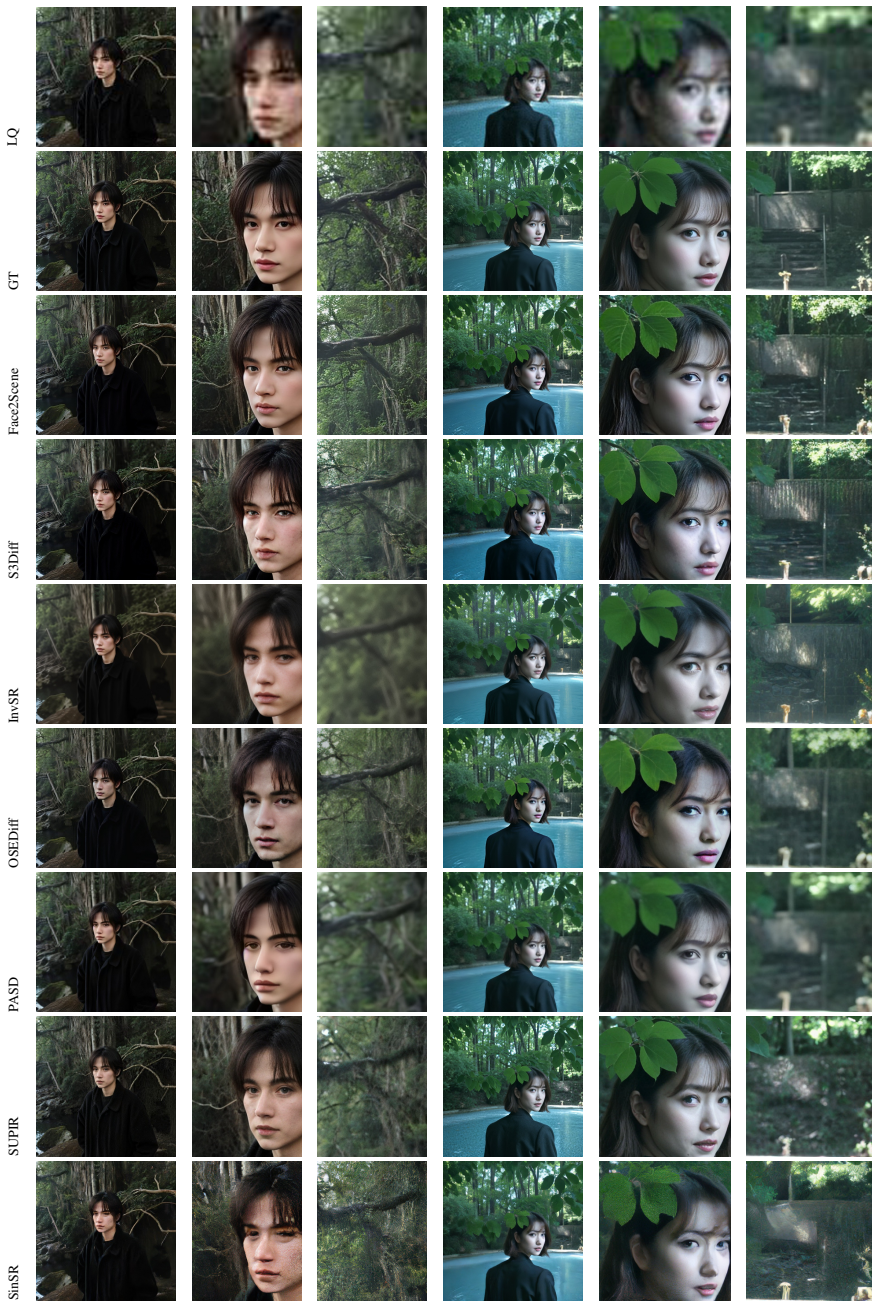


read the original abstract
Recent advances in image restoration have enabled high-fidelity recovery of faces from degraded inputs using reference-based face restoration models (Ref-FR). However, such methods focus solely on facial regions, neglecting degradation across the full scene, including body and background, which limits practical usability. Meanwhile, full-scene restorers often ignore degradation cues entirely, leading to underdetermined predictions and visual artifacts. In this work, we propose Face2Scene, a two-stage restoration framework that leverages the face as a perceptual oracle to estimate degradation and guide the restoration of the entire image. Given a degraded image and one or more identity references, we first apply a Ref-FR model to reconstruct high-quality facial details. From the restored-degraded face pair, we extract a face-derived degradation code that captures degradation attributes (e.g., noise, blur, compression), which is then transformed into multi-scale degradation-aware tokens. These tokens condition a diffusion model to restore the full scene in a single step, including the body and background. Extensive experiments demonstrate the superior effectiveness of the proposed method compared to state-of-the-art methods.
Editorial analysis
A structured set of objections, weighed in public.
Referee Report
Summary. The paper introduces Face2Scene, a two-stage framework for full-scene image restoration. Given a degraded input and identity references, a Ref-FR model first restores the face; a degradation code is then extracted from the restored-degraded face pair, converted to multi-scale tokens, and used to condition a diffusion model that restores the entire image (including body and background) in one step. The central claim is that this face-derived oracle yields superior restoration quality over existing methods, supported by extensive experiments.
Significance. If the face-to-scene degradation transfer holds, the approach offers a practical way to supply degradation cues to otherwise underdetermined scene restorers, potentially improving usability in real-world settings where faces are salient. The integration of Ref-FR outputs with diffusion conditioning is a coherent extension of prior work and could influence hybrid restoration pipelines.
major comments (1)
- [Method overview] The method overview (abstract and method description): the claim that a single face-derived degradation code suffices to condition restoration of the full scene rests on the untested assumption that degradation attributes (noise, blur, compression) extracted from the face are representative of spatially variant degradations elsewhere. No ablation or analysis is shown to quantify failure modes under localized motion blur or texture-dependent artifacts, which directly undermines the superiority claim.
minor comments (1)
- [Abstract] The abstract states 'extensive experiments' without naming datasets, metrics, or baselines; adding these details in the abstract or a dedicated table would improve readability.
Simulated Author's Rebuttal
We thank the referee for their detailed review and constructive comments on our paper. We address the major comment point by point below. We agree that additional analysis on spatially variant degradations would enhance the manuscript and will incorporate it in the revision.
read point-by-point responses
-
Referee: [Method overview] The method overview (abstract and method description): the claim that a single face-derived degradation code suffices to condition restoration of the full scene rests on the untested assumption that degradation attributes (noise, blur, compression) extracted from the face are representative of spatially variant degradations elsewhere. No ablation or analysis is shown to quantify failure modes under localized motion blur or texture-dependent artifacts, which directly undermines the superiority claim.
Authors: We appreciate the referee pointing out this potential limitation. Our experiments across multiple datasets with various real-world degradations demonstrate that the face-derived degradation code effectively guides the diffusion model to restore the full scene with superior quality compared to baselines. This suggests that the degradation attributes are sufficiently representative in practice for the types of degradations considered. Nevertheless, we recognize the importance of evaluating under localized degradations. In the revised version, we will include an ablation study using synthetically generated localized motion blur and texture-specific artifacts to quantify the failure modes and discuss the conditions under which the assumption holds. revision: yes
Circularity Check
No significant circularity; derivation builds on external Ref-FR and diffusion components
full rationale
The paper's core pipeline applies an existing reference-based face restoration (Ref-FR) model to a degraded input, extracts a degradation code from the resulting restored-degraded face pair, converts that code into multi-scale tokens, and uses the tokens to condition a diffusion model for full-scene restoration. None of these steps reduce by construction to the target output or rely on a self-citation chain whose validity is presupposed by the present work. The extraction of the degradation code is presented as a direct computation from the face pair rather than a fitted parameter renamed as a prediction, and no uniqueness theorem or ansatz is imported from prior work by the same authors to force the architecture. The method therefore remains self-contained against external benchmarks and does not exhibit any of the enumerated circularity patterns.
Axiom & Free-Parameter Ledger
axioms (1)
- domain assumption Reference-based face restoration models can accurately recover high-quality facial details from degraded inputs given identity references.
Lean theorems connected to this paper
-
IndisputableMonolith/Cost/FunctionalEquation.leanwashburn_uniqueness_aczel unclear?
unclearRelation between the paper passage and the cited Recognition theorem.
From the restored–degraded face pair, we extract a face-derived degradation code that captures degradation attributes (e.g., noise, blur, compression), which is then transformed into multi-scale degradation-aware tokens.
What do these tags mean?
- matches
- The paper's claim is directly supported by a theorem in the formal canon.
- supports
- The theorem supports part of the paper's argument, but the paper may add assumptions or extra steps.
- extends
- The paper goes beyond the formal theorem; the theorem is a base layer rather than the whole result.
- uses
- The paper appears to rely on the theorem as machinery.
- contradicts
- The paper's claim conflicts with a theorem or certificate in the canon.
- unclear
- Pith found a possible connection, but the passage is too broad, indirect, or ambiguous to say the theorem truly supports the claim.
Reference graph
Works this paper leans on
-
[1]
Stephen Batifol, Andreas Blattmann, Frederic Boesel, Sak- sham Consul, Cyril Diagne, Tim Dockhorn, Jack English, Zion English, Patrick Esser, Sumith Kulal, et al. Flux. 1 kontext: Flow matching for in-context image generation and editing in latent space.arXiv e-prints, pages arXiv–2506,
-
[2]
Deedsr: Towards real-world im- age super-resolution via degradation-aware stable diffusion
Chunyang Bi, Xin Luo, Sheng Shen, Mengxi Zhang, Huan- jing Yue, and Jingyu Yang. Deedsr: Towards real-world im- age super-resolution via degradation-aware stable diffusion. arXiv preprint arXiv:2404.00661, 2024. 2, 3
-
[3]
The perception-distortion tradeoff
Yochai Blau and Tomer Michaeli. The perception-distortion tradeoff. InProceedings of the IEEE conference on computer vision and pattern recognition, pages 6228–6237, 2018. 7
work page 2018
-
[4]
Emerg- ing properties in self-supervised vision transformers
Mathilde Caron, Hugo Touvron, Ishan Misra, Herv ´e J´egou, Julien Mairal, Piotr Bojanowski, and Armand Joulin. Emerg- ing properties in self-supervised vision transformers. InPro- ceedings of the IEEE/CVF international conference on com- puter vision, pages 9650–9660, 2021. 5
work page 2021
-
[5]
Conceptual 12m: Pushing web-scale image-text pre- training to recognize long-tail visual concepts
Soravit Changpinyo, Piyush Sharma, Nan Ding, and Radu Soricut. Conceptual 12m: Pushing web-scale image-text pre- training to recognize long-tail visual concepts. InProceed- ings of the IEEE/CVF conference on computer vision and pattern recognition, pages 3558–3568, 2021. 5
work page 2021
-
[6]
Personalized restoration via dual-pivot tuning.IEEE Transactions on Image Processing, 2025
Pradyumna Chari, Sizhuo Ma, Daniil Ostashev, Achuta Kadambi, Gurunandan Krishnan, Jian Wang, and Kfir Aber- man. Personalized restoration via dual-pivot tuning.IEEE Transactions on Image Processing, 2025. 1, 2
work page 2025
-
[7]
Chaofeng Chen, Jiadi Mo, Jingwen Hou, Haoning Wu, Liang Liao, Wenxiu Sun, Qiong Yan, and Weisi Lin. Topiq: A top-down approach from semantics to distortions for image quality assessment.IEEE Transactions on Image Processing, 33:2404–2418, 2024. 6
work page 2024
-
[8]
A simple framework for contrastive learning of visual representations
Ting Chen, Simon Kornblith, Mohammad Norouzi, and Ge- offrey Hinton. A simple framework for contrastive learning of visual representations. InInternational conference on ma- chine learning, pages 1597–1607. PmLR, 2020. 4
work page 2020
-
[9]
Image super- resolution with text prompt diffusion.arXiv preprint arXiv:2311.14282, 2023
Zheng Chen, Yulun Zhang, Jinjin Gu, Xin Yuan, Linghe Kong, Guihai Chen, and Xiaokang Yang. Image super- resolution with text prompt diffusion.arXiv preprint arXiv:2311.14282, 2023. 3, 4
-
[10]
Copy or not? reference-based face image restoration with fine details
Min Jin Chong, Dejia Xu, Yi Zhang, Zhangyang Wang, David Forsyth, Gurunandan Krishnan, Yicheng Wu, and Jian Wang. Copy or not? reference-based face image restoration with fine details. In2025 IEEE/CVF Winter Conference on Applications of Computer Vision (WACV), pages 9660–9669. IEEE, 2025. 3
work page 2025
-
[11]
Arcface: Additive angular margin loss for deep face recognition
Jiankang Deng, Jia Guo, Niannan Xue, and Stefanos Zafeiriou. Arcface: Additive angular margin loss for deep face recognition. InProceedings of the IEEE/CVF con- ference on computer vision and pattern recognition, pages 4690–4699, 2019. 2, 5, 7
work page 2019
-
[12]
Keyan Ding, Kede Ma, Shiqi Wang, and Eero P Simoncelli. Image quality assessment: Unifying structure and texture similarity.IEEE transactions on pattern analysis and ma- chine intelligence, 44(5):2567–2581, 2020. 6
work page 2020
-
[13]
Restoration by generation with constrained priors
Zheng Ding, Xuaner Zhang, Zhuowen Tu, and Zhihao Xia. Restoration by generation with constrained priors. InPro- ceedings of the IEEE/CVF Conference on Computer Vision and Pattern Recognition, pages 2567–2577, 2024. 2
work page 2024
-
[14]
Scaling recti- fied flow transformers for high-resolution image synthesis
Patrick Esser, Sumith Kulal, Andreas Blattmann, Rahim Entezari, Jonas M ¨uller, Harry Saini, Yam Levi, Dominik Lorenz, Axel Sauer, Frederic Boesel, et al. Scaling recti- fied flow transformers for high-resolution image synthesis. InForty-first international conference on machine learning,
-
[15]
Human body restoration with one-step diffusion model and a new benchmark
Jue Gong, Jingkai Wang, Zheng Chen, Xing Liu, Hong Gu, Yulun Zhang, and Xiaokang Yang. Human body restoration with one-step diffusion model and a new benchmark. InIn- ternational Conference on Machine Learning, 2025. 2, 3
work page 2025
-
[16]
Haodiff: Human-aware one-step diffusion via dual-prompt guidance
Jue Gong, Tingyu Yang, Jingkai Wang, Zheng Chen, Xing Liu, Hong Gu, Yulun Zhang, and Xiaokang Yang. Haodiff: Human-aware one-step diffusion via dual-prompt guidance. arXiv preprint arXiv:2505.19742, 2025. 2, 3
-
[17]
Momentum contrast for unsupervised visual rep- resentation learning
Kaiming He, Haoqi Fan, Yuxin Wu, Saining Xie, and Ross Girshick. Momentum contrast for unsupervised visual rep- resentation learning. InConference on computer vision and pattern recognition, 2020. 4
work page 2020
-
[18]
Martin Heusel, Hubert Ramsauer, Thomas Unterthiner, Bernhard Nessler, and Sepp Hochreiter. Gans trained by a two time-scale update rule converge to a local nash equilib- rium.Advances in neural information processing systems, 30, 2017. 6
work page 2017
-
[19]
Classifier-Free Diffusion Guidance
Jonathan Ho and Tim Salimans. Classifier-free diffusion guidance.arXiv preprint arXiv:2207.12598, 2022. 4
work page internal anchor Pith review Pith/arXiv arXiv 2022
-
[20]
Jonathan Ho, Ajay Jain, and Pieter Abbeel. Denoising dif- fusion probabilistic models.Advances in neural information processing systems, 33:6840–6851, 2020. 1
work page 2020
-
[21]
Ref-ldm: A latent diffusion model for reference-based face image restoration
Chi-Wei Hsiao, Yu-Lun Liu, Cheng-Kun Yang, Sheng-Po Kuo, Kevin Jou, and Chia-Ping Chen. Ref-ldm: A latent diffusion model for reference-based face image restoration. Advances in Neural Information Processing Systems, 37: 74840–74867, 2024. 1, 3, 4
work page 2024
-
[22]
Batch normalization: Accelerating deep network training by reducing internal co- variate shift
Sergey Ioffe and Christian Szegedy. Batch normalization: Accelerating deep network training by reducing internal co- variate shift. InInternational conference on machine learn- ing, 2015. 4
work page 2015
-
[23]
Liming Jiang, Qing Yan, Yumin Jia, Zichuan Liu, Hao Kang, and Xin Lu. InfiniteYou: Flexible photo recrafting while pre- serving your identity.International conference on computer vision (ICCV), 2025. 5, 2
work page 2025
-
[24]
Musiq: Multi-scale image quality transformer
Junjie Ke, Qifei Wang, Yilin Wang, Peyman Milanfar, and Feng Yang. Musiq: Multi-scale image quality transformer. InProceedings of the IEEE/CVF international conference on computer vision, pages 5148–5157, 2021. 6, 2
work page 2021
-
[25]
Dual prompting image restoration with diffusion transformers
Dehong Kong, Fan Li, Zhixin Wang, Jiaqi Xu, Renjing Pei, Wenbo Li, and WenQi Ren. Dual prompting image restoration with diffusion transformers. InProceedings of the Computer Vision and Pattern Recognition Conference, pages 12809–12819, 2025. 2, 3
work page 2025
-
[26]
Ensembling off-the-shelf models for gan training
Nupur Kumari, Richard Zhang, Eli Shechtman, and Jun-Yan Zhu. Ensembling off-the-shelf models for gan training. In Proceedings of the IEEE/CVF conference on computer vi- sion and pattern recognition, pages 10651–10662, 2022. 5
work page 2022
-
[27]
From face to natural image: Learning real degradation for blind image super-resolution
Xiaoming Li, Chaofeng Chen, Xianhui Lin, Wangmeng Zuo, and Lei Zhang. From face to natural image: Learning real degradation for blind image super-resolution. InEuropean Conference on Computer Vision, pages 376–392. Springer,
-
[28]
Xiaoming Li, Shiguang Zhang, Shangchen Zhou, Lei Zhang, and Wangmeng Zuo. Learning dual memory dictionaries for blind face restoration.IEEE Transactions on Pattern Anal- ysis and Machine Intelligence, 45(5):5904–5917, 2022. 2, 5
work page 2022
-
[29]
Esther YH Lin, Zhecheng Wang, Rebecca Lin, Daniel Miau, Florian Kainz, Jiawen Chen, Xuaner Zhang, David B Lin- dell, and Kiriakos N Kutulakos. Learning lens blur fields. IEEE Transactions on Pattern Analysis and Machine Intelli- gence, 2025. 8
work page 2025
-
[30]
Diff- bir: Toward blind image restoration with generative diffusion prior
Xinqi Lin, Jingwen He, Ziyan Chen, Zhaoyang Lyu, Bo Dai, Fanghua Yu, Yu Qiao, Wanli Ouyang, and Chao Dong. Diff- bir: Toward blind image restoration with generative diffusion prior. InEuropean conference on computer vision, pages 430–448. Springer, 2024. 8, 6, 9
work page 2024
-
[31]
Faceme: Robust blind face restoration with personal identification
Siyu Liu, Zheng-Peng Duan, Jia OuYang, Jiayi Fu, Hyunhee Park, Zikun Liu, Chun-Le Guo, and Chongyi Li. Faceme: Robust blind face restoration with personal identification. InProceedings of the AAAI Conference on Artificial Intel- ligence, pages 5567–5575, 2025. 1, 2, 3, 6, 7, 4
work page 2025
-
[32]
Yunan Liu, Shanshan Zhang, Jie Xu, Jian Yang, and Yu- Wing Tai. An accurate and lightweight method for human body image super-resolution.IEEE Transactions on Image Processing, 30:2888–2897, 2021. 3
work page 2021
-
[33]
Yingqi Liu, Jingwen He, Yihao Liu, Xinqi Lin, Fanghua Yu, Jinfan Hu, Yu Qiao, and Chao Dong. Adaptbir: Adaptive blind image restoration with latent diffusion prior for higher fidelity.Pattern Recognition, 155:110659, 2024. 2, 3
work page 2024
-
[34]
Metric learning based interactive modulation for real-world super-resolution
Chong Mou, Yanze Wu, Xintao Wang, Chao Dong, Jian Zhang, and Ying Shan. Metric learning based interactive modulation for real-world super-resolution. InEuropean conference on computer vision, pages 723–740. Springer,
-
[35]
Tip: Text-driven image processing with semantic and restoration instructions.CoRR, 2023
Chenyang Qi, Zhengzhong Tu, Keren Ye, Mauricio Delbra- cio, Peyman Milanfar, Qifeng Chen, and Hossein Talebi. Tip: Text-driven image processing with semantic and restoration instructions.CoRR, 2023. 3, 4
work page 2023
-
[36]
You only look once: Unified, real-time object de- tection
Joseph Redmon, Santosh Divvala, Ross Girshick, and Ali Farhadi. You only look once: Unified, real-time object de- tection. InProceedings of the IEEE conference on computer vision and pattern recognition, pages 779–788, 2016. 2
work page 2016
-
[37]
High-resolution image synthesis with latent diffusion models
Robin Rombach, Andreas Blattmann, Dominik Lorenz, Patrick Esser, and Bj ¨orn Ommer. High-resolution image synthesis with latent diffusion models. InProceedings of the IEEE/CVF conference on computer vision and pattern recognition, pages 10684–10695, 2022. 1
work page 2022
-
[38]
Adversarial diffusion distillation
Axel Sauer, Dominik Lorenz, Andreas Blattmann, and Robin Rombach. Adversarial diffusion distillation. InEuropean Conference on Computer Vision, pages 87–103. Springer,
-
[39]
Keda Tao, Jinjin Gu, Yulun Zhang, Xiucheng Wang, and Nan Cheng. Overcoming false illusions in real-world face restoration with multi-modal guided diffusion model.arXiv preprint arXiv:2410.04161, 2024. 2
-
[40]
Overcoming false illusions in real-world face restoration with multi-modal guided diffusion model
Keda TAO, Jinjin Gu, Yulun Zhang, Xiucheng Wang, and Nan Cheng. Overcoming false illusions in real-world face restoration with multi-modal guided diffusion model. InThe Thirteenth International Conference on Learning Represen- tations, 2025. 1
work page 2025
-
[41]
Pfstorer: Personalized face restoration and super-resolution
Tuomas Varanka, Tapani Toivonen, Soumya Tripathy, Guoy- ing Zhao, and Erman Acar. Pfstorer: Personalized face restoration and super-resolution. InProceedings of the IEEE/CVF Conference on Computer Vision and Pattern Recognition, pages 2372–2381, 2024. 2
work page 2024
-
[42]
Ex- ploring clip for assessing the look and feel of images
Jianyi Wang, Kelvin CK Chan, and Chen Change Loy. Ex- ploring clip for assessing the look and feel of images. InPro- ceedings of the AAAI conference on artificial intelligence, pages 2555–2563, 2023. 6, 2
work page 2023
-
[43]
Osdface: One-step diffusion model for face restoration
Jingkai Wang, Jue Gong, Lin Zhang, Zheng Chen, Xing Liu, Hong Gu, Yutong Liu, Yulun Zhang, and Xiaokang Yang. Osdface: One-step diffusion model for face restoration. In Proceedings of the Computer Vision and Pattern Recognition Conference, pages 12626–12636, 2025. 10
work page 2025
-
[44]
Honestface: To- wards honest face restoration with one-step diffusion model
Jingkai Wang, Wu Miao, Jue Gong, Zheng Chen, Xing Liu, Hong Gu, Yutong Liu, and Yulun Zhang. Honestface: To- wards honest face restoration with one-step diffusion model. arXiv preprint arXiv:2505.18469, 2025. 3
-
[45]
Unsuper- vised degradation representation learning for blind super- resolution
Longguang Wang, Yingqian Wang, Xiaoyu Dong, Qingyu Xu, Jungang Yang, Wei An, and Yulan Guo. Unsuper- vised degradation representation learning for blind super- resolution. InProceedings of the IEEE/CVF conference on computer vision and pattern recognition, pages 10581– 10590, 2021. 2
work page 2021
-
[46]
Prior based pyramid resid- ual clique network for human body image super-resolution
Simiao Wang, Yu Sang, Yunan Liu, Chunpeng Wang, Mingyu Lu, and Jinguang Sun. Prior based pyramid resid- ual clique network for human body image super-resolution. Pattern Recognition, 150:110352, 2024. 3
work page 2024
-
[47]
Esrgan: En- hanced super-resolution generative adversarial networks
Xintao Wang, Ke Yu, Shixiang Wu, Jinjin Gu, Yihao Liu, Chao Dong, Yu Qiao, and Chen Change Loy. Esrgan: En- hanced super-resolution generative adversarial networks. In Proceedings of the European conference on computer vision (ECCV) workshops, pages 0–0, 2018. 1
work page 2018
-
[48]
Real-esrgan: Training real-world blind super-resolution with pure synthetic data
Xintao Wang, Liangbin Xie, Chao Dong, and Ying Shan. Real-esrgan: Training real-world blind super-resolution with pure synthetic data. InProceedings of the IEEE/CVF inter- national conference on computer vision, pages 1905–1914,
work page 1905
-
[49]
Sinsr: diffusion-based image super- resolution in a single step
Yufei Wang, Wenhan Yang, Xinyuan Chen, Yaohui Wang, Lanqing Guo, Lap-Pui Chau, Ziwei Liu, Yu Qiao, Alex C Kot, and Bihan Wen. Sinsr: diffusion-based image super- resolution in a single step. InProceedings of the IEEE/CVF conference on computer vision and pattern recognition, pages 25796–25805, 2024. 2, 3, 6, 9
work page 2024
-
[50]
Zhou Wang, Alan C Bovik, Hamid R Sheikh, and Eero P Si- moncelli. Image quality assessment: from error visibility to structural similarity.IEEE transactions on image processing, 13(4):600–612, 2004. 6
work page 2004
-
[51]
Zhouxia Wang, Jiawei Zhang, Tianshui Chen, Wenping Wang, and Ping Luo. Restoreformer++: Towards real- world blind face restoration from undegraded key-value pairs.IEEE Transactions on Pattern Analysis and Machine Intelligence, 45(12):15462–15476, 2023. 10
work page 2023
-
[52]
Rongyuan Wu, Lingchen Sun, Zhiyuan Ma, and Lei Zhang. One-step effective diffusion network for real-world image super-resolution.Advances in Neural Information Process- ing Systems, 37:92529–92553, 2024. 1, 3, 8, 6, 9
work page 2024
-
[53]
Maniqa: Multi-dimension attention network for no-reference image quality assessment
Sidi Yang, Tianhe Wu, Shuwei Shi, Shanshan Lao, Yuan Gong, Mingdeng Cao, Jiahao Wang, and Yujiu Yang. Maniqa: Multi-dimension attention network for no-reference image quality assessment. InProceedings of the IEEE/CVF conference on computer vision and pattern recognition, pages 1191–1200, 2022. 6, 2
work page 2022
-
[54]
Pixel-aware stable diffusion for realistic image super-resolution and personalized stylization
Tao Yang, Rongyuan Wu, Peiran Ren, Xuansong Xie, and Lei Zhang. Pixel-aware stable diffusion for realistic image super-resolution and personalized stylization. InEuropean conference on computer vision, pages 74–91. Springer, 2024. 1, 8, 6, 9
work page 2024
-
[55]
Zhicun Yin, Junjie Chen, Ming Liu, Zhixin Wang, Fan Li, Renjing Pei, Xiaoming Li, Rynson WH Lau, and Wang- meng Zuo. Refstar: Blind facial image restoration with ref- erence selection, transfer, and reconstruction.arXiv preprint arXiv:2507.10470, 2025. 3
-
[56]
Jiacheng Ying, Mushui Liu, Zhe Wu, Runming Zhang, Zhu Yu, Siming Fu, Si-Yuan Cao, Chao Wu, Yunlong Yu, and Hui-Liang Shen. Restorerid: Towards tuning- free face restoration with id preservation.arXiv preprint arXiv:2411.14125, 2024. 2, 3, 4
-
[57]
Fanghua Yu, Jinjin Gu, Zheyuan Li, Jinfan Hu, Xiangtao Kong, Xintao Wang, Jingwen He, Yu Qiao, and Chao Dong. Scaling up to excellence: Practicing model scaling for photo- realistic image restoration in the wild. InProceedings of the IEEE/CVF conference on computer vision and pattern recognition, pages 25669–25680, 2024. 1, 2, 8, 6, 9
work page 2024
-
[58]
Zongsheng Yue, Jianyi Wang, and Chen Change Loy. Effi- cient diffusion model for image restoration by residual shift- ing.IEEE Transactions on Pattern Analysis and Machine Intelligence, 2024. 8, 6, 9
work page 2024
-
[59]
Arbitrary-steps image super-resolution via diffusion inver- sion
Zongsheng Yue, Kang Liao, and Chen Change Loy. Arbitrary-steps image super-resolution via diffusion inver- sion. InProceedings of the Computer Vision and Pattern Recognition Conference, pages 23153–23163, 2025. 1, 8, 6, 9
work page 2025
-
[60]
Aiping Zhang, Zongsheng Yue, Renjing Pei, Wenqi Ren, and Xiaochun Cao. Degradation-guided one-step im- age super-resolution with diffusion priors.arXiv preprint arXiv:2409.17058, 2024. 2, 3, 4, 5, 7, 8, 6, 9
-
[61]
Instantrestore: Single-step personalized face restoration with shared-image attention
Howard Zhang, Yuval Alaluf, Sizhuo Ma, Achuta Kadambi, Jian Wang, and Kfir Aberman. Instantrestore: Single-step personalized face restoration with shared-image attention. InProceedings of the Special Interest Group on Computer Graphics and Interactive Techniques Conference Conference Papers, pages 1–10, 2025. 1, 3, 4
work page 2025
-
[62]
Adding conditional control to text-to-image diffusion models
Lvmin Zhang, Anyi Rao, and Maneesh Agrawala. Adding conditional control to text-to-image diffusion models. In Proceedings of the IEEE/CVF international conference on computer vision, pages 3836–3847, 2023. 3
work page 2023
-
[63]
The unreasonable effectiveness of deep features as a perceptual metric
Richard Zhang, Phillip Isola, Alexei A Efros, Eli Shecht- man, and Oliver Wang. The unreasonable effectiveness of deep features as a perceptual metric. InProceedings of the IEEE conference on computer vision and pattern recogni- tion, pages 586–595, 2018. 6
work page 2018
-
[64]
Blind image quality assessment via vision- language correspondence: A multitask learning perspective
Weixia Zhang, Guangtao Zhai, Ying Wei, Xiaokang Yang, and Kede Ma. Blind image quality assessment via vision- language correspondence: A multitask learning perspective. InProceedings of the IEEE/CVF conference on computer vi- sion and pattern recognition, pages 14071–14081, 2023. 6
work page 2023
-
[65]
Recognize anything: A strong image tagging model
Youcai Zhang, Xinyu Huang, Jinyu Ma, Zhaoyang Li, Zhaochuan Luo, Yanchun Xie, Yuzhuo Qin, Tong Luo, Yaqian Li, Shilong Liu, et al. Recognize anything: A strong image tagging model. InProceedings of the IEEE/CVF Con- ference on Computer Vision and Pattern Recognition, pages 1724–1732, 2024. 2
work page 2024
-
[66]
Yiming Zhang, Zhe Wang, Xinjie Li, Yunchen Yuan, Cheng- song Zhang, Xiao Sun, Zhihang Zhong, and Jian Wang. Diff- body: Human body restoration by imagining with generative diffusion prior.arXiv preprint arXiv:2404.03642, 2024. 3
-
[67]
Reference-guided identity preserving face restora- tion.arXiv preprint arXiv:2505.21905, 2025
Mo Zhou, Keren Ye, Viraj Shah, Kangfu Mei, Mauricio Delbracio, Peyman Milanfar, Vishal M Patel, and Hossein Talebi. Reference-guided identity preserving face restora- tion.arXiv preprint arXiv:2505.21905, 2025. 3
-
[68]
Shangchen Zhou, Kelvin Chan, Chongyi Li, and Chen Change Loy. Towards robust blind face restora- tion with codebook lookup transformer.Advances in Neural Information Processing Systems, 35:30599–30611, 2022. 10 LQ GT Face2Scene S3Diff InvSR OSEDiff PASD SUPIR SinSR Figure 11.Visual comparison on InScene Synthetic dataset across seven methods. LQ GT Face2S...
work page 2022
discussion (0)
Sign in with ORCID, Apple, or X to comment. Anyone can read and Pith papers without signing in.