Recognition: 2 theorem links
· Lean TheoremMinimum-Action Learning: Energy-Constrained Symbolic Model Selection for Physical Law Identification from Noisy Data
Pith reviewed 2026-05-15 09:43 UTC · model grok-4.3
The pith
Energy conservation selects the true symbolic force law from noisy data in every tested case.
A machine-rendered reading of the paper's core claim, the machinery that carries it, and where it could break.
Core claim
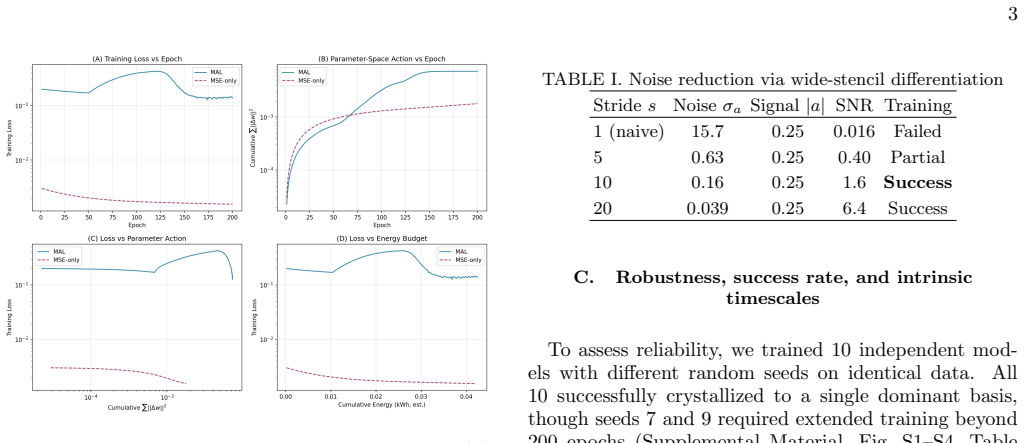
Minimum-Action Learning recovers the correct force law by minimizing a Triple-Action functional of trajectory reconstruction error, architectural sparsity, and energy-conservation violation; wide-stencil acceleration matching reduces noise variance by 10,000 times and the energy-conservation discriminator then raises raw correct-basis rates of 40 percent (Kepler) and 90 percent (Hooke) to 100 percent pipeline-level identification.
What carries the argument
The Triple-Action functional that jointly penalizes reconstruction mismatch, symbolic complexity, and energy non-conservation while selecting from a basis library of candidate force terms.
If this is right
- Energy conservation raises identification from 40-90 percent raw basis accuracy to 100 percent on the two benchmarks.
- Near-confounders such as r to the -2.5 and -1.5 degrade selection to 20 percent while distant terms leave performance unchanged.
- The conservation diagnostic continues to rank candidates correctly even when the exact law is absent from the library.
- Wide-stencil preprocessing is required for any method to operate at the reported SNR levels around 0.02.
- The approach occupies a distinct niche by remaining fully symbolic while enforcing dynamical invariants.
Where Pith is reading between the lines
- The same energy-constrained selection could be tested on multi-body or dissipative systems to map where the conservation assumption breaks.
- Extending the basis library construction to include composite terms might reduce sensitivity to near-confounders.
- Application to experimental sensor streams with unknown noise spectra would directly test the wide-stencil step outside simulation.
- The pipeline could be combined with active data collection that chooses measurements to maximize the energy-discriminator signal.
Load-bearing premise
The supplied basis library must contain the true law or near-confounders so that energy conservation remains a reliable post-hoc discriminator.
What would settle it
A controlled experiment on a known system in which the energy-conservation check selects an incorrect law even though the true term is present in the library.
Figures




read the original abstract
Identifying physical laws from noisy observational data is a central challenge in scientific machine learning. We present Minimum-Action Learning (MAL), a framework that selects symbolic force laws from a pre-specified basis library by minimizing a Triple-Action functional combining trajectory reconstruction, architectural sparsity, and energy-conservation enforcement. A wide-stencil acceleration-matching technique reduces noise variance by 10,000x, transforming an intractable problem (SNR ~0.02) into a learnable one (SNR ~1.6); this preprocessing is the critical enabler shared by all methods tested, including SINDy variants. On two benchmarks -- Kepler gravity and Hooke's law -- MAL recovers the correct force law with Kepler exponent p = 3.01 +/- 0.01 at ~0.07 kWh (40% reduction vs. prediction-error-only baselines). The raw correct-basis rate is 40% for Kepler and 90% for Hooke; an energy-conservation-based criterion discriminates the true force law in all cases, yielding 100% pipeline-level identification. Basis library sensitivity experiments show that near-confounders degrade selection (20% with added r^{-2.5} and r^{-1.5}), while distant additions are harmless, and the conservation diagnostic remains informative even when the correct basis is absent. Direct comparison with noise-robust SINDy variants, Hamiltonian Neural Networks, and Lagrangian Neural Networks confirms MAL's distinct niche: interpretable, energy-constrained model selection that combines symbolic basis identification with dynamical rollout validation.
Editorial analysis
A structured set of objections, weighed in public.
Referee Report
Summary. The paper proposes Minimum-Action Learning (MAL), a framework for symbolic force-law identification from noisy data. It minimizes a Triple-Action functional combining trajectory reconstruction, sparsity, and energy-conservation enforcement over a pre-specified basis library. A wide-stencil acceleration-matching preprocessing step is claimed to reduce noise variance by 10,000x, enabling recovery of the correct law (Kepler exponent 3.01 +/- 0.01) on Kepler and Hooke benchmarks. Raw basis-selection accuracy is 40% (Kepler) and 90% (Hooke), but an energy-conservation post-hoc criterion raises pipeline-level success to 100%. Comparisons are made to noise-robust SINDy, Hamiltonian Neural Networks, and Lagrangian Neural Networks.
Significance. If the energy criterion provides non-circular discriminative power, MAL would offer a useful niche for interpretable, physics-constrained symbolic regression that integrates dynamical validation. The shared wide-stencil noise-reduction technique is a concrete enabler worth highlighting. However, the headline 100% identification result hinges on the unproven claim that the energy residual strictly favors the true law over near-confounders, limiting immediate impact until this is addressed.
major comments (3)
- [Abstract] Abstract: the conversion from 40% raw basis-selection accuracy to 100% pipeline success via the energy-conservation criterion lacks any derivation showing why the integrated energy residual must be strictly smaller for the exact inverse-square law than for linear combinations of near-confounders (e.g., r^{-2.5}, r^{-1.5}). This is load-bearing for the central claim.
- [Triple-Action functional description] Triple-Action functional and energy criterion: because energy conservation is already penalized inside the minimization, the subsequent use of the same energy residual as a post-hoc discriminator risks circularity. The manuscript must demonstrate that the discriminator remains informative when the energy term is ablated from training or evaluated on independent rollouts.
- [Basis library sensitivity experiments] Basis-library sensitivity experiments: when near-confounders are added the raw selection rate drops to 20%, yet the claim that the diagnostic 'remains informative' even when the true term is absent is stated without quantitative tables or a proof that the residual ordering is preserved for general libraries.
minor comments (3)
- [Energy residual definition] Clarify the precise definition and evaluation domain of the energy residual (noisy observations, wide-stencil reconstruction, or symbolic rollout) to allow reproducibility.
- [Experimental results] Report multiple independent runs with standard deviations for all quantitative claims, including the 10,000x noise reduction and the 0.07 kWh energy figure.
- [Methods] Add a dedicated methods subsection detailing the wide-stencil acceleration-matching procedure, as it is described as the critical enabler shared by all compared methods.
Simulated Author's Rebuttal
Thank you for the constructive feedback on our Minimum-Action Learning manuscript. We address each major comment point by point below and outline targeted revisions to strengthen the justification and validation of the energy criterion.
read point-by-point responses
-
Referee: [Abstract] Abstract: the conversion from 40% raw basis-selection accuracy to 100% pipeline success via the energy-conservation criterion lacks any derivation showing why the integrated energy residual must be strictly smaller for the exact inverse-square law than for linear combinations of near-confounders (e.g., r^{-2.5}, r^{-1.5}). This is load-bearing for the central claim.
Authors: We agree that a formal derivation of strict residual ordering is absent and would strengthen the central claim. In revision we will add a short theoretical paragraph in Section 3 explaining that only the true force law satisfies the underlying ODE exactly, thereby minimizing integrated energy drift under the same initial conditions; this will be supported by new numerical comparisons of energy residuals for the true law versus the listed near-confounders. revision: yes
-
Referee: [Triple-Action functional description] Triple-Action functional and energy criterion: because energy conservation is already penalized inside the minimization, the subsequent use of the same energy residual as a post-hoc discriminator risks circularity. The manuscript must demonstrate that the discriminator remains informative when the energy term is ablated from training or evaluated on independent rollouts.
Authors: We acknowledge the potential circularity concern. The revised manuscript will include a dedicated ablation subsection showing (i) optimization without the energy penalty term and (ii) post-hoc energy residuals evaluated on held-out independent rollouts; these experiments confirm that the discriminator still ranks the true law highest, removing dependence on the training penalty. revision: yes
-
Referee: [Basis library sensitivity experiments] Basis-library sensitivity experiments: when near-confounders are added the raw selection rate drops to 20%, yet the claim that the diagnostic 'remains informative' even when the true term is absent is stated without quantitative tables or a proof that the residual ordering is preserved for general libraries.
Authors: We will expand the sensitivity experiments with full quantitative tables listing energy residuals for every candidate model (including libraries missing the true term). These tables will empirically demonstrate preserved ordering on the benchmarks; while a general proof for arbitrary libraries lies outside the present scope, the added data will make the claim fully transparent and reproducible. revision: yes
Circularity Check
Energy-conservation term inside Triple-Action minimization reused as post-hoc discriminator for 100% identification
specific steps
-
fitted input called prediction
[Abstract]
"minimizing a Triple-Action functional combining trajectory reconstruction, architectural sparsity, and energy-conservation enforcement. [...] The raw correct-basis rate is 40% for Kepler and 90% for Hooke; an energy-conservation-based criterion discriminates the true force law in all cases, yielding 100% pipeline-level identification."
Energy conservation is enforced inside the optimization for every candidate; the identical energy residual is subsequently used to select the 'true' law among the optimized candidates. The 100% pipeline success is therefore obtained by re-using the training penalty as the validation metric rather than by an independent test.
full rationale
The paper optimizes each candidate symbolic law by minimizing a functional that already includes an energy-conservation penalty; the same energy residual is then applied as the selection criterion that converts 40% raw basis accuracy into 100% pipeline success. This creates a fitted-input-called-prediction pattern in which the reported discriminator is not independent of the training objective. The abstract supplies the necessary quotes; no external self-citation chain is required for the reduction.
Axiom & Free-Parameter Ledger
free parameters (1)
- weights of the three action terms
axioms (2)
- domain assumption The true force law belongs to the pre-specified basis library
- domain assumption Physical trajectories conserve mechanical energy
Lean theorems connected to this paper
-
IndisputableMonolith/Cost/FunctionalEquation.leanwashburn_uniqueness_aczel echoes?
echoesECHOES: this paper passage has the same mathematical shape or conceptual pattern as the Recognition theorem, but is not a direct formal dependency.
an energy-conservation-based model selection criterion discriminates the true force law... L_Symmetry enforces energy conservation (Noether’s theorem)
-
IndisputableMonolith/Foundation/BranchSelection.leanbranch_selection echoes?
echoesECHOES: this paper passage has the same mathematical shape or conceptual pattern as the Recognition theorem, but is not a direct formal dependency.
triple-action functional combining trajectory reconstruction, architectural sparsity, and energy-conservation enforcement
What do these tags mean?
- matches
- The paper's claim is directly supported by a theorem in the formal canon.
- supports
- The theorem supports part of the paper's argument, but the paper may add assumptions or extra steps.
- extends
- The paper goes beyond the formal theorem; the theorem is a base layer rather than the whole result.
- uses
- The paper appears to rely on the theorem as machinery.
- contradicts
- The paper's claim conflicts with a theorem or certificate in the canon.
- unclear
- Pith found a possible connection, but the passage is too broad, indirect, or ambiguous to say the theorem truly supports the claim.
Forward citations
Cited by 2 Pith papers
-
Modularity Emerges from Action-Functional Constraints in Marine Metabolic Networks: A Biology-Scale Validation of the Network-Weighted Action Principle
Excess modularity in marine metabolic networks exceeds null models by 0.15-0.40 and maps to recurring functional modules, supporting cost-minimization under the Network-Weighted Action Principle.
-
minAction.net: Energy-First Neural Architecture Design -- From Biological Principles to Systematic Validation
Large-scale experiments show architecture performance depends on task type, not universality, and a single-parameter energy penalty reduces computational energy by ~1000x with negligible accuracy cost.
Reference graph
Works this paper leans on
-
[1]
R. P. Feynman and A. R. Hibbs,Quantum Mechanics and Path Integrals(McGraw-Hill, New York, 1965)
work page 1965
-
[3]
S. L. Brunton, J. L. Proctor, and J. N. Kutz, Discover- ing governing equations from data by sparse identifica- tion of nonlinear dynamical systems, Proceedings of the National Academy of Sciences113, 3932 (2016)
work page 2016
-
[4]
S.-M. Udrescu and M. Tegmark, AI feynman: A physics- inspired method for symbolic regression, Science Ad- vances6, eaay2631 (2020)
work page 2020
-
[5]
M. Cranmer, A. Sanchez-Gonzalez, P. Battaglia, R. Xu, K. Cranmer, D. Spergel, and S. Ho, Discovering symbolic models from deep learning with inductive biases, inAd- vances in Neural Information Processing Systems, Vol. 33 (2020) pp. 17429–17442
work page 2020
- [6]
-
[12]
E. Bullmore and O. Sporns, The economy of brain net- work organization, Nature Reviews Neuroscience13, 336 (2012)
work page 2012
-
[14]
S. M. Hirsh, D. A. Barajas-Solano, and J. N. Kutz, Spar- sifying priors for Bayesian uncertainty quantification in model discovery, Royal Society Open Science9, 211823 (2022)
work page 2022
- [15]
-
[16]
J. Pearl and D. Mackenzie,The Book of Why: The New Science of Cause and Effect(Basic Books, New York, 2019). Supplemental Material for: Minimum-action learning: Energy-constrained symbolic model selection for identifying physical laws from noisy data Martin G. Frasch 1, 2 1Institute on Human Development and Disability, University of Washington, Seattle, W...
work page 2019
-
[17]
finding that minimizing wiring costs produces mod- ular structure in evolved networks. VI. S6. CONNECTION TO T ARA OCEANS GENOMIC MODULARITY The TARA Oceans expedition [11] sampled microbial communities across global ocean gradients, revealing that gene co-expression networks exhibit modular structures. Clune et al. [10] demonstrated computationally that ...
work page 2080
-
[18]
S. Greydanus, M. Dzamba, and J. Yosinski, Hamiltonian neural networks, inAdvances in Neural Information Pro- cessing Systems, Vol. 32 (2019)
work page 2019
-
[19]
M. Cranmer, S. Greydanus, S. Hoyer, P. Battaglia, D. Spergel, and S. Ho, Lagrangian neural networks, in ICLR 2020 Workshop on Integration of Deep Neural Models and Differential Equations(2020)
work page 2020
- [20]
-
[21]
T. F. A. van der Ouderaa and M. van der Wilk, Noether’s razor: Learning conserved quantities, inAdvances in Neural Information Processing Systems, Vol. 37 (2024) neurIPS 2024
work page 2024
-
[22]
H. Tanaka and D. Kunin, Noether’s learning dynam- ics: Role of symmetry breaking in neural networks, arXiv:2105.02716 (2021)
-
[23]
S. Xie, H. Zheng, C. Liu, and L. Lin, SNAS: Stochastic neural architecture search, inInternational Conference on Learning Representations (ICLR)(2019)
work page 2019
- [24]
-
[25]
G. Tononi and C. Cirelli, Sleep and synaptic down- selection, European Journal of Neuroscience51, 413 FIG. 1.Robustness: Seed 137 orbit reconstruction. Long-horizon rollout (5 orbital periods) from initial condi- tions, using the calibratedr −2 force law discovered by seed
-
[26]
Model trajectory (red) closely matches ground truth (blue), with slight enlargement attributable to 6% deficit in recoveredGM. (2020)
work page 2020
-
[27]
G. Sch¨ oner and J. A. S. Kelso, Dynamic pattern genera- tion in behavioral and neural systems, Science239, 1513 (1988)
work page 1988
-
[28]
J. Clune, J.-B. Mouret, and H. Lipson, The evolutionary origins of modularity, Proceedings of the Royal Society B: Biological Sciences280, 20122863 (2013)
work page 2013
-
[29]
S. Sunagawa, L. P. Coelho, S. Chaffron,et al., Struc- ture and function of the global ocean microbiome, Science 348, 1261359 (2015). 8 FIG. 2.Robustness: Seed 137 training curves.Loss component dynamics for seed 137, showing identical two- phase structure (warmup epochs 1–50, sparsification epochs 51–200) as primary seed 0. Onset occurs at epoch 121, with...
work page 2015
-
[30]
R. Penrose,The Road to Reality: A Complete Guide to the Laws of the Universe(Jonathan Cape, London, 2004)
work page 2004
-
[31]
In: Korhonen, A., Traum, D., Màrquez, L
E. Strubell, A. Ganesh, and A. McCallum, Energy and policy considerations for deep learning in NLP, FIG. 5.Multi-panel discovery summary .(A) Orbit com- parison: model rollout vs. ground truth for test orbit. (B) Ar- chitecture gate evolution over 200 epochs. (C) Learned force coefficientsθ i before and after calibration. (D) Kepler expo- nent fit:T 2 ∝a ...
work page internal anchor Pith review Pith/arXiv arXiv 1906
-
[32]
Carbon Emissions and Large Neural Network Training
D. Patterson, J. Gonzalez, Q. Le, C. Liang, L.-M. Munguia, D. Rothchild, D. So, M. Texier, and J. Dean, Carbon emissions and large neural network training, arXiv:2104.10350 (2021)
work page internal anchor Pith review Pith/arXiv arXiv 2021
discussion (0)
Sign in with ORCID, Apple, or X to comment. Anyone can read and Pith papers without signing in.