REVIEW 5 minor 2 cited by
Unfolded soft-drop jet-mass spectra of boosted W bosons yield m_W = 80.83 ± 0.55 GeV, the tightest all-jets result at a hadron collider.
Reviewed by Pith at T0; open to challenge. T0 means a machine referee read the full paper against a public rubric. the ladder, T0–T4 →
T0 review · grok-4.5
2026-07-13 21:45 UTC pith:CGDTQ7HB
load-bearing objection Solid first unfolded double-differential soft-drop mass spectrum for boosted hadronic W+jets, plus a clean 0.55 GeV all-jets m_W extraction that is new and carefully done.
Measurement of the jet mass in hadronic decays of boosted W bosons at 13 TeV and extraction of the W boson mass
The pith
A machine-rendered reading of the paper's core claim, the machinery that carries it, and where it could break.
Core claim
After soft-drop grooming and ParticleNet-MD tagging, the unfolded double-differential W+jets cross section as a function of jet p_T and soft-drop mass yields a W-boson mass of 80.83 ± 0.55 GeV—the smallest uncertainty yet achieved from an all-jets final state at a hadron collider.
What carries the argument
Soft-drop jet mass (with z_cut = 0.1, β = 0) combined with a mass-decorrelated ParticleNet tagger and a two-dimensional Bernstein transfer function that extrapolates the QCD multijet background from the tagger-fail to the tagger-pass region.
Load-bearing premise
The residual transfer function that moves the QCD background from the control region into the signal region can be captured by low-order Bernstein polynomials whose free coefficients absorb all residual mass dependence.
What would settle it
If an independent data-driven background estimate that does not rely on the Bernstein residual function produces a statistically inconsistent shift of the unfolded mass peak, the quoted m_W value would be falsified.
If this is right
- The double-differential unfolded spectra become a direct benchmark for parton-shower and hadronization models of color-disconnected W → qq′ systems.
- The same soft-drop + ParticleNet pipeline can be applied to boosted Z and Higgs bosons, enabling parallel mass extractions and calibration of jet-mass scale.
- At the HL-LHC the identical method is projected to become competitive with leptonic m_W determinations once the statistical sample grows by an order of magnitude.
- The measured jet-mass peak supplies a data-driven constraint that can be used to calibrate the jet-mass scale in top-quark and new-physics analyses that rely on boosted W tagging.
Where Pith is reading between the lines
- Because the W is color-disconnected from the rest of the event, residual discrepancies between data and simulation in the peak region isolate pure non-perturbative hadronization effects more cleanly than in top-quark jets.
- The same residual-transfer-function technique can be ported to other groomed observables (N-subjettiness, energy-correlation ratios) to test whether the Bernstein description remains adequate.
- A future joint fit of the soft-drop mass peak with a leptonic m_W measurement could quantify the residual jet-energy-scale bias that currently dominates the all-jets uncertainty.
Editorial analysis
A structured set of objections, weighed in public.
Referee Report
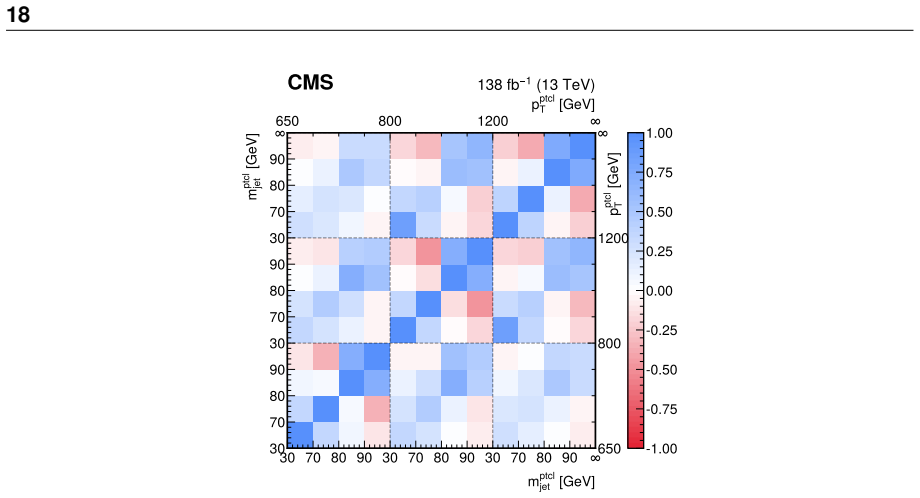
Summary. The paper reports the first unfolded double-differential measurement of the W+jets cross section as a function of large-radius jet p_T and soft-drop mass m_SD for boosted hadronic W decays (p_T > 650 GeV) in 138 fb^{-1} of 13 TeV CMS data. Soft-drop grooming and mass-decorrelated ParticleNet (primary) and N_2 (cross-check) taggers isolate the two-prong signal from QCD multijet background; the residual background is constrained in situ via a transfer function from the tagger-fail region. Detector effects are unfolded simultaneously with background subtraction in a regularized maximum-likelihood fit. From the particle-level peak region (70 < m_SD < 90 GeV, N_2 < 0.2) a linear template fit yields m_W = 80.83 ± 0.55 GeV (on-shell scheme), stated to be the most precise all-jets result at a hadron collider.
Significance. The work supplies the first particle-level double-differential spectra of groomed jet mass in a color-singlet boosted W sample, a valuable calibration input for jet-substructure modeling and for future HL-LHC all-jets m_W prospects. The extraction itself, while not competitive with leptonic determinations, is carefully documented: response matrix, acceptance, purity, closure tests with independent Pythia/Herwig samples, and a full systematic breakdown (Table 4) are provided. The claim of smallest all-jets uncertainty is factually supported by comparison with earlier SPS/Tevatron results. The analysis is therefore a solid first step that both tests non-perturbative QCD and opens a path for precision measurements in the all-jets channel.
minor comments (5)
- [Section 9] Section 9 and Fig. 9: the text states that only the two peak bins 70 < m_SD < 90 GeV are used for the template fit, yet the figure shows the full spectrum with overlaid m_W templates; a short clarifying sentence would prevent misreading.
- [Table 4] Table 4: the impact of the hadronization-model uncertainty on m_W is quoted as only 0.02 GeV while the same source contributes ~12–15 % to the signal-strength modifiers (Table 3). A one-sentence explanation of why the peak-position fit is so insensitive would help the reader.
- [Figure 7] Figure 7 caption and body text: the particle-level selection N_2 < 0.2 is applied for the displayed spectra, but the abstract and introduction emphasize the ParticleNet-based result; a brief note that the N_2 cut is used only for the mass extraction would improve consistency.
- [Section 6] Section 6, Eq. (8): the orders of the Bernstein polynomials are stated to range from 1–2 (p_T) and 2–6 (ρ_SD) “depending on the data-taking period”; listing the chosen orders per era (or referring to a supplementary table) would aid reproducibility.
- A few typographical inconsistencies appear (e.g., “mW” vs. “m_W”, occasional missing spaces before units). A final copy-edit pass is recommended.
Circularity Check
No circularity: unfolded spectra and m_W template fit are independent of the fitted background transfer function and of self-cited calibrations.
full rationale
The paper is a standard experimental measurement. Detector-level m_SD spectra in pass/fail regions are fitted with free Bernstein coefficients a_ij of the residual transfer function r (Eq. 8) solely to subtract QCD multijet background; the resulting background-subtracted yields are then unfolded via a regularized maximum-likelihood fit whose parameters of interest are the particle-level signal-strength modifiers µ_j (Eq. 10). The W-mass extraction (Sec. 9) is a subsequent linear template fit of those unfolded, normalized peak-region (70 < m_SD < 90 GeV) cross sections to independent PYTHIA samples generated at five discrete m_W values; closure tests recover the input mass within uncertainties. Jet-energy and tagging calibrations cite prior CMS work that rests on independent control samples (dijet, γ+jets, Z+jets) and do not enter the mass templates. No equation equates an extracted quantity to a fitted input by construction, no uniqueness theorem is imported from the authors, and no ansatz is smuggled via self-citation. The derivation chain is therefore self-contained against external benchmarks.
Axiom & Free-Parameter Ledger
free parameters (3)
- Bernstein residual coefficients a_ij
- Signal-strength modifiers μ_j
- W-tagging efficiency nuisance θ
axioms (4)
- domain assumption Soft-drop grooming with z_cut = 0.1, eta_sd = 0 removes soft wide-angle radiation without biasing the two-prong W mass peak.
- domain assumption The mass-decorrelated ParticleNet-DDT (or N2-DDT) tagger at 5 % QCD efficiency preserves a sufficiently pure two-prong sample that residual mass dependence can be absorbed into the Bernstein residual.
- domain assumption LO PYTHIA templates with varied m_W, after NLO QCD+EW reweighting of the overall rate, adequately describe the peak shape for a linear template fit.
- domain assumption Detector response matrix obtained from GEANT4 simulation plus residual data-driven corrections is invertible under Tikhonov regularization without large bias.
read the original abstract
The jet mass of W bosons decaying to a quark-antiquark pair is measured in W+jets events from proton-proton collisions at a center-of-mass energy of 13 TeV. The data used were collected by the CMS experiment at the CERN LHC and correspond to an integrated luminosity of 138 fb$^{-1}$. Hadronic decays of W bosons with high momenta produce strongly collimated decay products due to the large Lorentz boost, and are reconstructed as single large-radius jets. These jets have a characteristic substructure that is exploited to distinguish them from the large background of quark- and gluon-initiated jets. The jet mass is computed using the soft-drop algorithm, which suppresses soft wide-angle radiation that leads to a broadening of the jet mass distribution. For the first time, unfolded measurements are presented of the double-differential W+jets cross section as a function of the jet transverse momentum and soft-drop mass. From these distributions, the W boson mass is obtained, with a value of 80.83 $\pm$ 0.55 GeV, achieving the smallest uncertainty available today from an all-jets final state at a hadron collider.
Figures



Forward citations
Cited by 2 Pith papers
-
High-$p_{\rm T}$ physics and jet production
Conference summary of high-pT jet production measurements testing pQCD, PDFs and the strong coupling at hadron colliders.
-
Standard Model W, Z (+jet) at CMS and ATLAS
A review summarizing precision measurements of Standard Model W and Z boson production and decays from ATLAS and CMS collaborations.
Reference graph
Works this paper leans on
-
[1]
Electroweak measurements in electron-positron collisions at W-boson-pair energies at LEP
ALEPH, DELPHI, L3, OPAL, SLD, LEP Electroweak Working Group, SLD Electroweak Group, SLD Heavy Flavour Group, “Electroweak measurements in electron-positron collisions at W-boson-pair energies at LEP”,Phys. Rept.532(2013) 119, doi:10.1016/j.physrep.2013.07.004,arXiv:1302.3415
-
[2]
Measurement of the W boson mass with the D0 detector
D0 Collaboration, “Measurement of the W boson mass with the D0 detector”,Phys. Rev. Lett.108(2012) 151804,doi:10.1103/PhysRevLett.108.151804, arXiv:1203.0293
-
[3]
High-precision measurement of the W boson mass with the CDF II detector
CDF Collaboration, “High-precision measurement of the W boson mass with the CDF II detector”,Science376(2022) 170,doi:10.1126/science.abk1781
-
[4]
Measurement of the W-boson mass in pp collisions at√s=7 TeV with the ATLAS detector
ATLAS Collaboration, “Measurement of the W-boson mass in pp collisions at√s=7 TeV with the ATLAS detector”,Eur. Phys. J. C78(2018) 110, doi:10.1140/epjc/s10052-017-5475-4,arXiv:1701.07240. [Erratum: doi:10.1140/epjc/s10052-018-6354-3]
-
[5]
Measurement of the W boson mass
LHCb Collaboration, “Measurement of the W boson mass”,JHEP01(2022) 036, doi:10.1007/JHEP01(2022)036,arXiv:2109.01113
-
[6]
ATLAS Collaboration, “Measurement of the W-boson mass and width with the ATLAS detector using proton-proton collisions at √s=7 TeV”,Eur. Phys. J. C84(2024) 1309, doi:10.1140/epjc/s10052-024-13190-x,arXiv:2403.15085
-
[7]
High-precision measurement of the W boson mass with the CMS experiment at the LHC
CMS Collaboration, “High-precision measurement of the W boson mass with the CMS experiment at the LHC”, 2024.arXiv:2412.13872. Submitted toNature
Pith/arXiv arXiv 2024
-
[8]
Particle Data Group, “Review of particle physics”,Phys. Rev. D110(2024) 030001, doi:10.1103/PhysRevD.110.030001. References 23
-
[9]
Looking inside jets: an introduction to jet substructure and boosted-object phenomenology
S. Marzani, G. Soyez, and M. Spannowsky, “Looking inside jets: an introduction to jet substructure and boosted-object phenomenology”, volume 958. Springer, 2019. ISBN 978-3-030-15708-1.doi:10.1007/978-3-030-15709-8
-
[10]
A. J. Larkoski, I. Moult, and B. Nachman, “Jet substructure at the Large Hadron Collider: A review of recent advances in theory and machine learning”,Phys. Rept.841(2020) 1, doi:10.1016/j.physrep.2019.11.001,arXiv:1709.04464
-
[11]
Jet substructure at the Large Hadron Collider
R. Kogler et al., “Jet substructure at the Large Hadron Collider”,Rev. Mod. Phys.91 (2019) 045003,doi:10.1103/RevModPhys.91.045003,arXiv:1803.06991
-
[12]
R. Kogler, “Advances in jet substructure at the LHC: Algorithms, measurements and searches for new physical phenomena”. Springer Cham, 2021. ISBN 978-3-030-72858-8. doi:10.1007/978-3-030-72858-8
-
[13]
Search for decays of the W ± and Z bosons into quark-anti-quark pairs
UA2 Collaboration, “Search for decays of the W ± and Z bosons into quark-anti-quark pairs”,Phys. Lett. B186(1987) 452,doi:10.1016/0370-2693(87)90325-X
-
[14]
Observation of Hadronic W Decays in t-tbar Events with the Collider Detector at Fermilab
CDF Collaboration, “Observation of hadronic W decays int ¯tevents with the Collider Detector at Fermilab”,Phys. Rev. Lett.80(1998) 5720, doi:10.1103/PhysRevLett.80.5720,arXiv:hep-ex/9711004
work page internal anchor Pith review Pith/arXiv arXiv doi:10.1103/physrevlett.80.5720 1998
-
[15]
Prospects for a measurement of the $W$ boson mass in the all-jets final state at hadron colliders
M. Freytsis et al., “Prospects for a measurement of the W boson mass in the all-jets final state at hadron colliders”,JHEP02(2019) 003,doi:10.1007/JHEP02(2019)003, arXiv:1807.07454
work page internal anchor Pith review Pith/arXiv arXiv doi:10.1007/jhep02(2019)003 2019
-
[16]
Towards an understanding of jet substructure
M. Dasgupta, A. Fregoso, S. Marzani, and G. P . Salam, “Towards an understanding of jet substructure”,JHEP09(2013) 029,doi:10.1007/JHEP09(2013)029, arXiv:1307.0007
-
[17]
Jet substructure as a new Higgs search channel at the LHC
J. M. Butterworth, A. R. Davison, M. Rubin, and G. P . Salam, “Jet substructure as a new Higgs search channel at the LHC”,Phys. Rev. Lett.100(2008) 242001, doi:10.1103/PhysRevLett.100.242001,arXiv:0802.2470
-
[18]
A. J. Larkoski, S. Marzani, G. Soyez, and J. Thaler, “Soft drop”,JHEP05(2014) 146, doi:10.1007/JHEP05(2014)146,arXiv:1402.2657
-
[19]
The CMS experiment at the CERN LHC
CMS Collaboration, “The CMS experiment at the CERN LHC”,JINST3(2008) S08004, doi:10.1088/1748-0221/3/08/S08004
-
[20]
ATLAS Collaboration, “Jet mass and substructure of inclusive jets in √s=7 TeV pp collisions with the ATLAS experiment”,JHEP05(2012) 128, doi:10.1007/JHEP05(2012)128,arXiv:1203.4606
work page internal anchor Pith review Pith/arXiv arXiv doi:10.1007/jhep05(2012)128 2012
-
[21]
ATLAS Collaboration, “Measurement of the soft-drop jet mass in pp collisions at√s=13 TeV with the ATLAS detector”,Phys. Rev. Lett.121(2018) 092001, doi:10.1103/PhysRevLett.121.092001,arXiv:1711.08341
work page internal anchor Pith review Pith/arXiv arXiv doi:10.1103/physrevlett.121.092001 2018
-
[22]
CMS Collaboration, “Measurements of the differential jet cross section as a function of the jet mass in dijet events from proton-proton collisions at √s=13 TeV”,JHEP11 (2018) 113,doi:10.1007/JHEP11(2018)113,arXiv:1807.05974
-
[23]
Measurement of the jet mass in highly boosted t t-bar events from pp collisions at sqrt(s) = 8 TeV
CMS Collaboration, “Measurement of the jet mass in highly boosted t t events from pp collisions at √s=8 TeV”,Eur. Phys. J. C77(2017) 467, doi:10.1140/epjc/s10052-017-5030-3,arXiv:1703.06330. 24
work page internal anchor Pith review Pith/arXiv arXiv doi:10.1140/epjc/s10052-017-5030-3 2017
-
[24]
CMS Collaboration, “Measurement of the jet mass distribution and top quark mass in hadronic decays of boosted top quarks in pp collisions at √s=13 TeV”,Phys. Rev. Lett. 124(2020) 202001,doi:10.1103/PhysRevLett.124.202001,arXiv:1911.03800
work page internal anchor Pith review Pith/arXiv arXiv doi:10.1103/physrevlett.124.202001 2020
-
[25]
CMS Collaboration, “Measurement of the differential t t production cross section as a function of the jet mass and extraction of the top quark mass in hadronic decays of boosted top quarks”,Eur. Phys. J. C83(2023) 560, doi:10.1140/epjc/s10052-023-11587-8,arXiv:2211.01456
work page internal anchor Pith review Pith/arXiv arXiv doi:10.1140/epjc/s10052-023-11587-8 2023
-
[26]
ATLAS Collaboration, “Measurement of the jet mass in high transverse momentum Z(→b b)γproduction at √s=13 TeV using the ATLAS detector”,Phys. Lett. B812 (2021) 135991,doi:10.1016/j.physletb.2020.135991,arXiv:1907.07093
-
[27]
Development of the CMS detector for the CERN LHC Run 3
CMS Collaboration, “Development of the CMS detector for the CERN LHC Run 3”, JINST19(2024) P05064,doi:10.1088/1748-0221/19/05/P05064, arXiv:2309.05466
-
[28]
Description and performance of track and primary-vertex reconstruction with the CMS tracker
CMS Collaboration, “Description and performance of track and primary-vertex reconstruction with the CMS tracker”,JINST9(2014) P10009, doi:10.1088/1748-0221/9/10/P10009,arXiv:1405.6569
-
[29]
The CMS Phase-1 Pixel Detector Upgrade
CMS Tracker Group, “The CMS Phase-1 pixel detector upgrade”,JINST16(2021) P02027,doi:10.1088/1748-0221/16/02/P02027,arXiv:2012.14304
work page internal anchor Pith review Pith/arXiv arXiv doi:10.1088/1748-0221/16/02/p02027 2021
-
[30]
Track impact parameter resolution for the full pseudo rapidity coverage in the 2017 dataset with the CMS Phase-1 pixel detector
CMS Collaboration, “Track impact parameter resolution for the full pseudo rapidity coverage in the 2017 dataset with the CMS Phase-1 pixel detector”, CMS Detector Performance Note CMS-DP-2020-049, 2020
2017
-
[31]
2017 tracking performance plots
CMS Collaboration, “2017 tracking performance plots”, CMS Detector Performance Note CMS-DP-2017-015, 2017
2017
-
[32]
Performance of the CMS Level-1 trigger in proton-proton collisions at √s=13 TeV
CMS Collaboration, “Performance of the CMS Level-1 trigger in proton-proton collisions at √s=13 TeV”,JINST15(2020) P10017,doi:10.1088/1748-0221/15/10/P10017, arXiv:2006.10165
-
[33]
CMS Collaboration, “The CMS trigger system”,JINST12(2017) P01020, doi:10.1088/1748-0221/12/01/P01020,arXiv:1609.02366
-
[34]
Performance of the CMS high-level trigger during LHC Run 2
CMS Collaboration, “Performance of the CMS high-level trigger during LHC Run 2”, JINST19(2024) P11021,doi:10.1088/1748-0221/19/11/P11021, arXiv:2410.17038
-
[35]
Particle-flow reconstruction and global event description with the CMS detector
CMS Collaboration, “Particle-flow reconstruction and global event description with the CMS detector”,JINST12(2017) P10003,doi:10.1088/1748-0221/12/10/P10003, arXiv:1706.04965
-
[36]
Technical proposal for the Phase-II upgrade of the Compact Muon Solenoid
CMS Collaboration, “Technical proposal for the Phase-II upgrade of the Compact Muon Solenoid”, CMS Technical Proposal CERN-LHCC-2015-010, CMS-TDR-15-02, 2015
2015
-
[37]
Electron and photon reconstruction and identification with the CMS experiment at the CERN LHC
CMS Collaboration, “Electron and photon reconstruction and identification with the CMS experiment at the CERN LHC”,JINST16(2021) P05014, doi:10.1088/1748-0221/16/05/P05014,arXiv:2012.06888
-
[38]
Pileup mitigation at CMS in 13 TeV data
CMS Collaboration, “Pileup mitigation at CMS in 13 TeV data”,JINST15(2020) P09018, doi:10.1088/1748-0221/15/09/P09018,arXiv:2003.00503. References 25
-
[39]
Pileup per particle identification
D. Bertolini, P . Harris, M. Low, and N. Tran, “Pileup per particle identification”,JHEP10 (2014) 059,doi:10.1007/JHEP10(2014)059,arXiv:1407.6013
-
[40]
The anti-kT jet clustering algorithm
M. Cacciari, G. P . Salam, and G. Soyez, “The anti-kT jet clustering algorithm”,JHEP04 (2008) 063,doi:10.1088/1126-6708/2008/04/063,arXiv:0802.1189
-
[41]
M. Cacciari, G. P . Salam, and G. Soyez, “FASTJETuser manual”,Eur. Phys. J. C72(2012) 1896,doi:10.1140/epjc/s10052-012-1896-2,arXiv:1111.6097
-
[42]
Jet energy scale and resolution in the CMS experiment in pp collisions at 8 TeV
CMS Collaboration, “Jet energy scale and resolution in the CMS experiment in pp collisions at 8 TeV”,JINST12(2017) P02014, doi:10.1088/1748-0221/12/02/P02014,arXiv:1607.03663
-
[43]
J. Alwall et al., “The automated computation of tree-level and next-to-leading order differential cross sections, and their matching to parton shower simulations”,JHEP07 (2014) 079,doi:10.1007/JHEP07(2014)079,arXiv:1405.0301
-
[44]
A comprehensive guide to the physics and usage ofPYTHIA8.3
C. Bierlich et al., “A comprehensive guide to the physics and usage ofPYTHIA8.3”, SciPost Phys. Codeb.2022(2022) 8,doi:10.21468/SciPostPhysCodeb.8, arXiv:2203.11601
-
[45]
Extraction and validation of a new set of CMSPYTHIA8 tunes from underlying-event measurements
CMS Collaboration, “Extraction and validation of a new set of CMSPYTHIA8 tunes from underlying-event measurements”,Eur. Phys. J. C80(2020) 4, doi:10.1140/epjc/s10052-019-7499-4,arXiv:1903.12179
-
[46]
Parton fragmentation and string dynamics
B. Andersson, G. Gustafson, G. Ingelman, and T. Sj ¨ostrand, “Parton fragmentation and string dynamics”,Phys. Rept.97(1983) 31,doi:10.1016/0370-1573(83)90080-7
-
[47]
T. Sj ¨ostrand, “The merging of jets”,Phys. Lett. B142(1984) 420, doi:10.1016/0370-2693(84)91354-6
-
[48]
J. Alwall et al., “Comparative study of various algorithms for the merging of parton showers and matrix elements in hadronic collisions”,Eur. Phys. J. C53(2008) 473, doi:10.1140/epjc/s10052-007-0490-5,arXiv:0706.2569
-
[49]
HERWIG7.0/HERWIG++ 3.0 release note
J. Bellm et al., “HERWIG7.0/HERWIG++ 3.0 release note”,Eur. Phys. J. C76(2016) 196, doi:10.1140/epjc/s10052-016-4018-8,arXiv:1512.01178
-
[50]
Development and validation of HERWIG 7 tunes from CMS underlying-event measurements
CMS Collaboration, “Development and validation ofHERWIG7 tunes from CMS underlying-event measurements”,Eur. Phys. J. C81(2021) 312, doi:10.1140/epjc/s10052-021-08949-5,arXiv:2011.03422
work page internal anchor Pith review Pith/arXiv arXiv doi:10.1140/epjc/s10052-021-08949-5 2021
-
[51]
Merging meets matching inMC@NLO
R. Frederix and S. Frixione, “Merging meets matching inMC@NLO”,JHEP12(2012) 061, doi:10.1007/JHEP12(2012)061,arXiv:1209.6215
-
[52]
A new method for combining NLO QCD with shower Monte Carlo algorithms
P . Nason, “A new method for combining NLO QCD with shower Monte Carlo algorithms”,JHEP11(2004) 040,doi:10.1088/1126-6708/2004/11/040, arXiv:hep-ph/0409146
-
[53]
Matching NLO QCD computations with parton shower simulations: thePOWHEGmethod
S. Frixione, P . Nason, and C. Oleari, “Matching NLO QCD computations with parton shower simulations: thePOWHEGmethod”,JHEP11(2007) 070, doi:10.1088/1126-6708/2007/11/070,arXiv:0709.2092
-
[54]
A general framework for implementing NLO calculations in shower Monte Carlo programs: thePOWHEG BOX
S. Alioli, P . Nason, C. Oleari, and E. Re, “A general framework for implementing NLO calculations in shower Monte Carlo programs: thePOWHEG BOX”,JHEP06(2010) 043, doi:10.1007/JHEP06(2010)043,arXiv:1002.2581. 26
-
[55]
A positive-weight next-to-leading-order Monte Carlo for heavy flavour hadroproduction
S. Frixione, G. Ridolfi, and P . Nason, “A positive-weight next-to-leading-order Monte Carlo for heavy flavour hadroproduction”,JHEP09(2007) 126, doi:10.1088/1126-6708/2007/09/126,arXiv:0707.3088
-
[56]
Parton distributions from high-precision collider data
NNPDF Collaboration, “Parton distributions from high-precision collider data”,Eur. Phys. J. C77(2017) 663,doi:10.1140/epjc/s10052-017-5199-5, arXiv:1706.00428
-
[57]
GEANT4 Collaboration, “GEANT4—a simulation toolkit”,Nucl. Instrum. Meth. A506 (2003) 250,doi:10.1016/S0168-9002(03)01368-8
-
[58]
CMS Collaboration, “Search for boosted Higgs boson decay to a charm quark-antiquark pair in proton-proton collisions at √s=13 TeV”,Phys. Rev. Lett.131(2023) 041801, doi:10.1103/PhysRevLett.131.041801,arXiv:2211.14181
work page internal anchor Pith review Pith/arXiv arXiv doi:10.1103/physrevlett.131.041801 2023
-
[59]
Precise predictions for V+jets dark matter backgrounds
J. M. Lindert et al., “Precise predictions for V+jets dark matter backgrounds”,Eur. Phys. J. C77(2017) 829,doi:10.1140/epjc/s10052-017-5389-1,arXiv:1705.04664
-
[60]
CMS Collaboration, “Measurement of normalized differential t t cross sections in the dilepton channel from pp collisions at √s=13 TeV”,JHEP04(2018) 060, doi:10.1007/JHEP04(2018)060,arXiv:1708.07638
-
[61]
CMS Collaboration, “Measurement of differential cross sections for top quark pair production using the lepton+jets final state in proton-proton collisions at 13 TeV”,Phys. Rev. D95(2017) 092001,doi:10.1103/PhysRevD.95.092001,arXiv:1610.04191
-
[62]
Better jet clustering algorithms
Y. L. Dokshitzer, G. D. Leder, S. Moretti, and B. R. Webber, “Better jet clustering algorithms”,JHEP08(1997) 001,doi:10.1088/1126-6708/1997/08/001, arXiv:hep-ph/9707323
-
[63]
CMS Collaboration, “Identification of heavy, energetic, hadronically decaying particles using machine-learning techniques”,JINST15(2020) P06005, doi:10.1088/1748-0221/15/06/P06005,arXiv:2004.08262
-
[64]
New angles on energy correlation functions
I. Moult, L. Necib, and J. Thaler, “New angles on energy correlation functions”,JHEP12 (2016) 153,doi:10.1007/JHEP12(2016)153,arXiv:1609.07483
-
[65]
Energy correlation functions for jet substructure
A. J. Larkoski, G. P . Salam, and J. Thaler, “Energy correlation functions for jet substructure”,JHEP06(2013) 108,doi:10.1007/JHEP06(2013)108, arXiv:1305.0007
-
[66]
Jet tagging via particle clouds
H. Qu and L. Gouskos, “Jet tagging via particle clouds”,Phys. Rev. D101(2020) 056019, doi:10.1103/PhysRevD.101.056019,arXiv:1902.08570
-
[67]
Dynamic graph CNN for learning on point clouds
Y. Wang et al., “Dynamic graph CNN for learning on point clouds”,ACM T rans. Graph. 38(2019) 12,doi:10.1145/3326362,arXiv:1801.07829
-
[68]
Identification of highly Lorentz-boosted heavy particles using graph neural networks and new mass decorrelation techniques
CMS Collaboration, “Identification of highly Lorentz-boosted heavy particles using graph neural networks and new mass decorrelation techniques”, CMS Detector Performance Note CMS-DP-2020-002, 2020
2020
-
[69]
Thinking outside the ROCs: Designing decorrelated taggers (DDT) for jet substructure
J. Dolen et al., “Thinking outside the ROCs: Designing decorrelated taggers (DDT) for jet substructure”,JHEP05(2016) 156,doi:10.1007/JHEP05(2016)156, arXiv:1603.00027. References 27
-
[70]
CMS Collaboration, “Search for low mass vector resonances decaying into quark-antiquark pairs in proton-proton collisions at √s=13 TeV”,Phys. Rev. D100 (2019) 112007,doi:10.1103/PhysRevD.100.112007,arXiv:1909.04114
work page internal anchor Pith review Pith/arXiv arXiv doi:10.1103/physrevd.100.112007 2019
-
[71]
CMS Collaboration, “Performance of the CMS muon detector and muon reconstruction with proton-proton collisions at √s=13 TeV”,JINST13(2018) P06015, doi:10.1088/1748-0221/13/06/P06015,arXiv:1804.04528
-
[72]
The CMS statistical analysis and combination tool:COMBINE
CMS Collaboration, “The CMS statistical analysis and combination tool:COMBINE”, Comput. Softw. Big Sci.8(2024) 19,doi:10.1007/s41781-024-00121-4, arXiv:2404.06614
-
[73]
Precision luminosity measurement in proton-proton collisions at√s=13 TeV in 2015 and 2016 at CMS
CMS Collaboration, “Precision luminosity measurement in proton-proton collisions at√s=13 TeV in 2015 and 2016 at CMS”,Eur. Phys. J. C81(2021) 800, doi:10.1140/epjc/s10052-021-09538-2,arXiv:2104.01927
-
[74]
CMS luminosity measurement for the 2017 data-taking period at√s=13 TeV
CMS Collaboration, “CMS luminosity measurement for the 2017 data-taking period at√s=13 TeV”, CMS Physics Analysis Summary CMS-PAS-LUM-17-004, 2018
2017
-
[75]
CMS luminosity measurement for the 2018 data-taking period at√s=13 TeV
CMS Collaboration, “CMS luminosity measurement for the 2018 data-taking period at√s=13 TeV”, CMS Physics Analysis Summary CMS-PAS-LUM-18-002, 2019
2018
-
[76]
Measurement of the inelastic proton-proton cross section at√s=13 TeV
CMS Collaboration, “Measurement of the inelastic proton-proton cross section at√s=13 TeV”,JHEP07(2018) 161,doi:10.1007/JHEP07(2018)161, arXiv:1802.02613
-
[77]
Giant QCD K-factors beyond NLO
M. Rubin, G. P . Salam, and S. Sapeta, “Giant QCD K-factors beyond NLO”,JHEP09 (2010) 084,doi:10.1007/JHEP09(2010)084,arXiv:1006.2144
-
[78]
TUNFOLD, an algorithm for correcting migration effects in high energy physics
S. Schmitt, “TUNFOLD, an algorithm for correcting migration effects in high energy physics”,JINST7(2012) T10003,doi:10.1088/1748-0221/7/10/T10003, arXiv:1205.6201
-
[79]
Solution of incorrectly formulated problems and the regularization method
A. N. Tikhonov, “Solution of incorrectly formulated problems and the regularization method”,Soviet Math. Dokl.4(1963) 1035
1963
-
[80]
HEPData record for this analysis, 2026.doi:10.17182/hepdata.169182
discussion (0)
Sign in with ORCID, Apple, or X to comment. Anyone can read and Pith papers without signing in.