Recognition: no theorem link
Pricing Innovation Under Latency Constraints: A Mean-Field Analysis of Coded Payload Delivery
Pith reviewed 2026-05-15 06:41 UTC · model grok-4.3
The pith
Under fixed base-lane rates and aggregate constraints, modest RLNC fast-lane capacity produces measurable utility gains that vary with base-lane propagation regime.
A machine-rendered reading of the paper's core claim, the machinery that carries it, and where it could break.
Core claim
Under a fixed base-lane price-rate pair and an aggregate rate constraint, the fast-lane pricing bound shows that even modest additional RLNC rate generates measurable utility gains whose magnitude depends on the base-lane propagation regime.
What carries the argument
The mean-field mapping from decoding-time distributions under stochastic arrivals to deadline-meeting probabilities and the resulting willingness-to-pay bounds for base and RLNC lanes.
If this is right
- Service providers can set distinct price-rate pairs for base and fast lanes while respecting a total-rate cap and still increase total participant surplus.
- RLNC fast-lane value is highest when base-lane symbol arrivals are slowest, so operators can allocate small RLNC fractions where propagation variance is large.
- The same bounds extend without change to reward schedules that pay at several successive deadlines rather than a single one.
- The model supplies concrete numerical guidance for pricing in blockchain message dissemination and other latency-sensitive competition settings.
Where Pith is reading between the lines
- The bounds could be used to design dynamic lane-allocation rules that adjust RLNC fraction in real time as measured base-lane statistics change.
- Testing whether the derived price-rate curves remain stable when participant counts are only moderate rather than asymptotically large would clarify the practical range of the mean-field approximation.
- The framework naturally suggests comparing RLNC fast-lane gains against alternative fast-lane mechanisms such as prioritized queuing or repetition coding under the same aggregate-rate constraint.
Load-bearing premise
The mean-field limit accurately represents system behavior for large participant counts and the chosen stochastic arrival models match real deadline-driven traffic patterns.
What would settle it
A direct measurement of utility gains versus added RLNC rate in a large-scale testbed with fixed base-lane pricing that deviates substantially from the derived bound for the observed base-lane propagation statistics.
Figures




read the original abstract
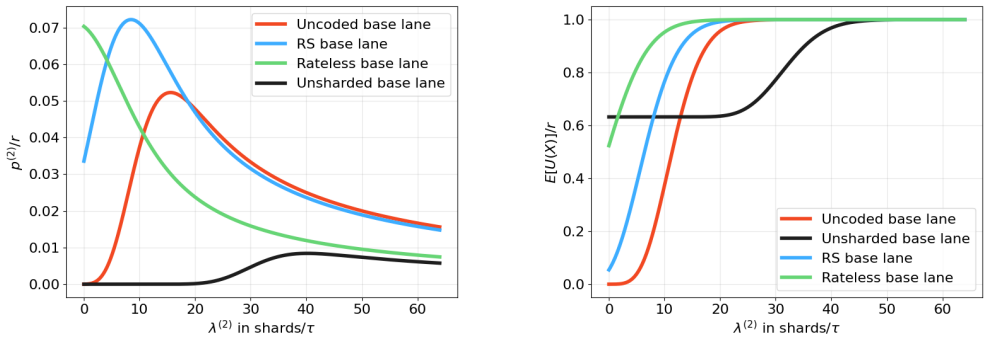
We study pricing mechanisms for low-latency payload delivery in settings where participant rewards depend on the time required to reconstruct a payload. In such environments, the decoding time distribution determines deadline-meeting probabilities and therefore bounds a participant's willingness to pay for additional delivery rate. Using a mean-field formulation, we derive price-rate bounds from simple stochastic arrival models and instantiate them for (i) unsharded transmission and (ii) sharded delivery under three regimes: uncoded sharding, fixed-rate erasure coding, and rateless coding. These bounds yield a comparative characterization of how symbol usefulness translates into economic value under deadline-driven utilities. We further analyze a two-lane service consisting of a base lane and a Random Linear Network Coding (RLNC) fast lane. In this turbo decoding setting, a receiver combines shards arriving via both lanes to minimize time to decode. Under a fixed base-lane price-rate pair and an aggregate rate constraint, we derive a fast-lane pricing bound and show how even modest additional RLNC rate can generate measurable utility gains, depending on the base-lane propagation regime. The framework extends naturally to stepwise reward schedules with multiple deadlines, and we illustrate its applicability on representative scenarios motivated by blockchain message dissemination and latency-sensitive competition.
Editorial analysis
A structured set of objections, weighed in public.
Referee Report
Summary. The manuscript develops a mean-field analysis of pricing for low-latency payload delivery in which rewards depend on decoding-time distributions. It derives price-rate bounds from stochastic arrival models for unsharded transmission and for sharded delivery under uncoded, fixed-rate erasure, and rateless (RLNC) regimes. The core contribution is a two-lane (base + RLNC fast-lane) model under a fixed base-lane price-rate pair and an aggregate rate constraint; the authors obtain a fast-lane pricing bound and show that modest additional RLNC rate can produce measurable utility gains whose magnitude depends on the base-lane propagation regime. The framework is illustrated on stepwise reward schedules and on blockchain-dissemination scenarios.
Significance. If the mean-field derivations are valid, the work supplies a tractable economic lens on the value of coding innovations under hard deadlines, directly linking symbol usefulness to willingness-to-pay. The explicit fast-lane bound and the comparative characterization across coding regimes are potentially useful for mechanism design in latency-sensitive systems. The extension to multi-deadline reward schedules is a natural and welcome generalization.
major comments (2)
- [Mean-field Analysis] Mean-field Analysis section: the central claim that the large-N limit yields reliable willingness-to-pay bounds rests on convergence of individual decoding-time tails to the mean-field prediction. No quantitative error bounds or finite-N simulations are provided to assess how quickly the approximation holds for the moderate participant counts typical of blockchain dissemination; tail deviations would directly alter the derived utility-gain figures.
- [Two-lane service analysis] Two-lane service analysis: under the aggregate rate constraint the individual decoding probabilities are no longer independent; the manuscript does not derive or bound the resulting correlation effect on the fast-lane pricing expression, which is load-bearing for the claim that modest RLNC increments generate measurable gains.
minor comments (2)
- [Abstract] The abstract states that bounds are 'derived' but supplies no equation numbers or key expressions; adding one or two representative formulas would improve readability.
- [Model formulation] Notation for the stochastic arrival parameters is introduced without an explicit table of symbols; a compact notation summary would aid cross-referencing between the unsharded and sharded cases.
Simulated Author's Rebuttal
We thank the referee for the constructive comments. We address each major point below, indicating planned revisions where appropriate.
read point-by-point responses
-
Referee: Mean-field Analysis section: the central claim that the large-N limit yields reliable willingness-to-pay bounds rests on convergence of individual decoding-time tails to the mean-field prediction. No quantitative error bounds or finite-N simulations are provided to assess how quickly the approximation holds for the moderate participant counts typical of blockchain dissemination; tail deviations would directly alter the derived utility-gain figures.
Authors: We agree that the manuscript provides no quantitative error bounds or finite-N simulations. The derivations invoke standard mean-field convergence for large populations, but we acknowledge that tail accuracy for moderate N (e.g., blockchain settings) is a genuine limitation. In revision we will add an explicit discussion of the approximation's scope, reference relevant concentration results for decoding processes, and note the absence of small-N validation without introducing new simulations. revision: partial
-
Referee: Two-lane service analysis: under the aggregate rate constraint the individual decoding probabilities are no longer independent; the manuscript does not derive or bound the resulting correlation effect on the fast-lane pricing expression, which is load-bearing for the claim that modest RLNC increments generate measurable gains.
Authors: The dependence induced by the aggregate rate constraint is correctly identified. Nevertheless, the fast-lane pricing bound is obtained from the mean-field expected utility; by the law of large numbers the empirical decoding fraction converges to the mean-field value, so the first-order price-rate relation remains asymptotically valid. Correlations affect only higher-order fluctuations outside the scope of the bound. We will revise the section to state this asymptotic justification explicitly. revision: partial
Circularity Check
No circularity: bounds derived from independent stochastic models
full rationale
The paper derives price-rate bounds via mean-field analysis applied to explicit stochastic arrival models for decoding times. No step reduces a prediction to a fitted parameter by construction, invokes a self-citation as the sole justification for a uniqueness claim, or renames an input as an output. The mean-field limit and two-lane pricing bounds are obtained from the stated arrival processes and aggregate constraints without circular reduction. This is the common case of a self-contained derivation.
Axiom & Free-Parameter Ledger
free parameters (1)
- stochastic arrival rate parameters
axioms (1)
- domain assumption Mean-field approximation is valid for large-scale participant systems
Reference graph
Works this paper leans on
-
[1]
A. Wahrst ¨atter. On Attestations, Block Propagation, and Timing Games. Ethereum Research post. [Online]. Available: https://ethresear.ch/t/ on-attestations-block-propagation-and-timing-games/20272
-
[2]
Deep Diving Attestations: A Quantitative Analysis
——. Deep Diving Attestations: A Quantitative Analysis. Ethereum Research post. [Online]. Available: https://ethresear.ch/t/ deep-diving-attestations-a-quantitative-analysis/20020
-
[3]
Time moves faster when there is nothing you anticipate: The role of time in mev rewards,
B. ¨Oz, B. Kraner, N. Vallarano, B. S. Kruger, F. Matthes, and C. J. Tessone, “Time moves faster when there is nothing you anticipate: The role of time in mev rewards,”arXiv preprint arXiv:2307.05814, 2023
-
[4]
Time is money: Strategic timing games in proof-of-stake protocols,
C. Schwarz-Schilling, F. Saleh, T. Thiery, D. Pan, N. K. Shah, and B. Monnot, “Time is money: Strategic timing games in proof-of-stake protocols,” inAdvances in Financial Technologies (AFT), 2023
work page 2023
-
[5]
EIP-4844: Shard Blob Transactions,
V . Buterin, D. Feist, D. Loerakker, G. Kadianakis, M. Garnett, M. Taiwo, and A. Dietrichs, “EIP-4844: Shard Blob Transactions,” https://eips.ethereum.org/EIPS/eip-4844, 2022, ethereum Improvement Proposal – Proto-Danksharding. [Online]. Available: https://eips. ethereum.org/EIPS/eip-4844
work page 2022
-
[6]
P. Soltani and F. Ashtiani, “Delay analysis of eip-4844,”arXiv preprint arXiv:2409.11043, 2024
-
[7]
D. Loerakker, P. Lambda, G. Ballet, D. Feist, and V . Buterin, “Eip-7594: Peerdas,” https://eips.ethereum.org/EIPS/eip-7594, 2024, ethereum Im- provement Proposal
work page 2024
-
[8]
P. Daian, S. Goldfeder, T. Kell, Y . Li, X. Zhao, I. Bentov, L. Breidenbach, and A. Juels, “Flash boys 2.0: Frontrunning, transaction reordering, and consensus instability in decentralized exchanges,”arXiv preprint arXiv:1904.05234, 2019
work page internal anchor Pith review Pith/arXiv arXiv 1904
-
[9]
The Block Auction Infrastructure Race,
Flashbots Collective, “The Block Auction Infrastructure Race,” 2025, flashbots Collective post
work page 2025
-
[10]
Time to bribe: Measuring block construction market,
A. Wahrst ¨atter, L. Zhou, K. Qin, D. Svetinovic, and A. Gervais, “Time to bribe: Measuring block construction market,”arXiv preprint arXiv:2305.16468, 2023
-
[11]
Decentralization of ethereum’s builder market,
S. Yang, K. Nayak, and F. Zhang, “Decentralization of ethereum’s builder market,”arXiv preprint arXiv:2405.01329, 2024
-
[12]
Structural advantages for integrated builders in mev-boost,
M. Pai and M. Resnick, “Structural advantages for integrated builders in mev-boost,”arXiv preprint arXiv:2311.09083, 2023
-
[13]
A random linear network coding approach to multicast,
T. Ho, M. M ´edard, R. Koetter, D. R. Karger, M. Effros, J. Shi, and B. Leong, “A random linear network coding approach to multicast,” IEEE Transactions on information theory, vol. 52, no. 10, pp. 4413– 4430, 2006
work page 2006
-
[14]
An algebraic approach to network coding,
R. Koetter and M. M ´edard, “An algebraic approach to network coding,” IEEE/ACM transactions on networking, vol. 11, no. 5, pp. 782–795, 2003
work page 2003
-
[15]
L. Kleinrock,Queueing Systems. V olume 1: Theory. John Wiley & Sons, 1975
work page 1975
-
[16]
D. P. Bertsekas and R. G. Gallager,Data Networks, 2nd ed. Prentice Hall, 1992
work page 1992
-
[17]
A. Shokrollahi, “Raptor codes,”IEEE transactions on information theory, vol. 52, no. 6, pp. 2551–2567, 2006
work page 2006
-
[18]
Polynomial codes over certain finite fields,
I. S. Reed and G. Solomon, “Polynomial codes over certain finite fields,” Journal of the society for industrial and applied mathematics, vol. 8, no. 2, pp. 300–304, 1960
work page 1960
-
[19]
Q. Kniep, J. Sliwinski, and R. Wattenhofer, “Solana alpenglow consen- sus,” 2025
work page 2025
-
[20]
M. M ´edard, V . A. Vasudevan, M. V . Pedersen, and K. R. Duffy,Network Coding for Engineers. John Wiley & Sons, 2025
work page 2025
-
[21]
Babel storage: Uncoordinated content delivery from multiple coded storage systems,
J. Neu and M. Medard, “Babel storage: Uncoordinated content delivery from multiple coded storage systems,” in2019 IEEE Global Communi- cations Conference (GLOBECOM). IEEE, 2019, pp. 1–6
work page 2019
-
[22]
Multi-code distributed storage,
C. Hellge and M. Medard, “Multi-code distributed storage,” in2016 IEEE 9th International Conference on Cloud Computing (CLOUD). IEEE, 2016, pp. 839–842
work page 2016
-
[23]
(2024, Jan.) Illuminating ethereum’s order flow landscape
Flashbots. (2024, Jan.) Illuminating ethereum’s order flow landscape. Reports an example in which a single transaction attracted 18 competing searcher bids. [Online]. Available: https://writings.flashbots. net/illuminate-the-order-flow
work page 2024
-
[24]
(2021, Dec.) Why building the most profitable block is important
——. (2021, Dec.) Why building the most profitable block is important. States that the median miner merges a maximum of 3 bundles per block. [Online]. Available: https://writings.flashbots.net/ on-the-most-profitable-block
work page 2021
discussion (0)
Sign in with ORCID, Apple, or X to comment. Anyone can read and Pith papers without signing in.