Recognition: 2 theorem links
· Lean TheoremFAST Polarization Catalog of FRB 20240114A
Pith reviewed 2026-05-15 07:38 UTC · model grok-4.3
The pith
FRB 20240114A resides in a dynamically evolving magneto-ionic environment as shown by its changing rotation measure.
A machine-rendered reading of the paper's core claim, the machinery that carries it, and where it could break.
Core claim
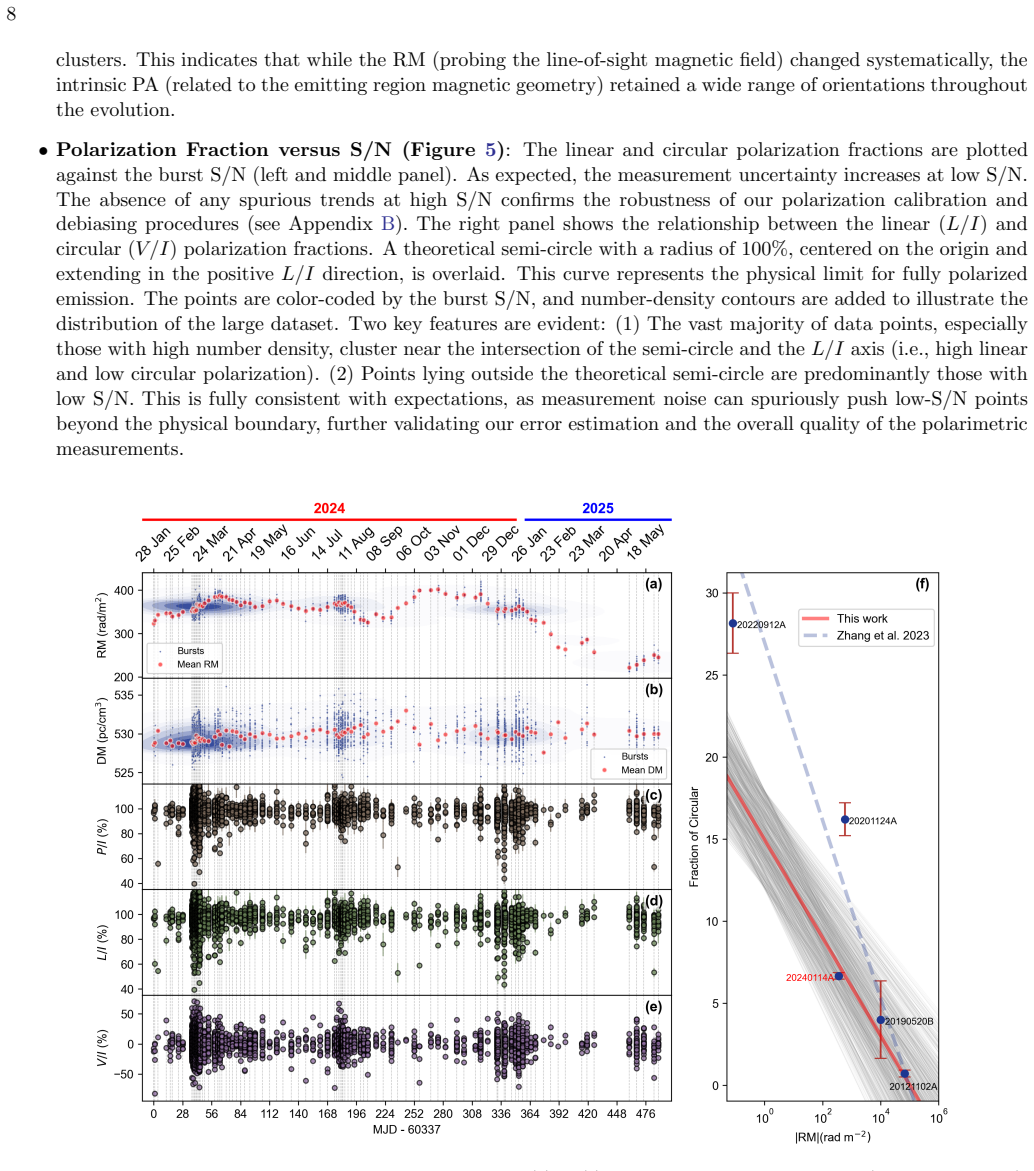
The authors establish that FRB 20240114A is located in a dynamically evolving magneto-ionic environment. This is evidenced by the Faraday rotation measure decreasing linearly by approximately 200 rad m^{-2} over 200 days after an initial stable phase, while the dispersion measure holds steady. The catalog of 6,131 bright bursts also shows generally high linear polarization fractions with a 3-sigma lower bound of 76 percent, low circular polarization, and a broad distribution of intrinsic polarization angles. A power-law fit relates the circular polarization fraction to the absolute value of RM with an index near -3. The stability of the combined linear and circular polarization distribution
What carries the argument
The temporal evolution of the Faraday rotation measure (RM) extracted from the polarimetric catalog of 6,131 high signal-to-noise bursts.
Load-bearing premise
The measured changes in RM are caused by real physical changes in the source's surrounding plasma rather than by instrumental effects or calibration issues.
What would settle it
Reprocessing the burst data with a completely independent polarimetric calibration pipeline that finds no RM evolution would falsify the claim of an evolving environment.
Figures



read the original abstract
Polarization measurements of fast radio bursts (FRBs) probe the magnetized plasma surrounding their central engines. FRB~20240114A is an exceptionally active repeating source, with 17,356 bursts detected between 2024 January 28 and 2025 May 30 by FAST, enabling time-resolved polarimetric studies. In this work, we present a polarimetric catalog of 6,131 bright bursts (with a signal-to-noise ratio S/N $\geq$ 20, 35.3% of the total sample), including arrival time (MJD$_{\text{topo}}$), dispersion measure (DM), burst width (W$_{\text{eff}}$), bandwidth, Faraday rotation measure (RM), linear and circular polarization degrees (DOL, DOC), and intrinsic polarization angle (PA$_0$). We detect a clear temporal evolution of RM: after an initial stable phase, it decreases linearly by $\sim$200 $\rm rad\ m^{-2}$ over 200 days, forming a bimodal distribution, whereas DM remains stable at 528.9 $\rm pc\ cm^{-3}$. The linear polarization fraction is generally high, with the 3$\sigma$ lower bound around 76%, while circular polarization is low, with 1,157 of 17,356 bursts (6.67%) having DOC $\geq$10%. We perform a power-law fit between $|\textrm{V}|$/I and $|\textrm{RM}|$, which yields an index of $-2.98 \pm 0.80$. It is found that the combined 2D distribution of L/I versus V/I remains stable, implying that the emission mechanism is largely invariant. Our PA$_0$ measurements show a broad, non-uniform distribution, implying a complex emission geometry. These results suggest that FRB~20240114A resides in a dynamically evolving magneto-ionic environment. This catalog provides a foundation for studies of repeating FRB progenitors and their environments.
Editorial analysis
A structured set of objections, weighed in public.
Referee Report
Summary. This manuscript presents a polarimetric catalog of 6,131 bright bursts (S/N ≥ 20) from the repeating FRB 20240114A observed with FAST over ~17 months (2024 Jan 28 to 2025 May 30). It reports a temporal evolution in Faraday rotation measure (RM) that decreases linearly by ~200 rad m^{-2} over 200 days after an initial stable phase, while dispersion measure (DM) remains constant at 528.9 pc cm^{-3}. Additional results include generally high linear polarization fractions (3σ lower bound ~76%), low circular polarization (only 6.67% of bursts with |V|/I ≥ 10%), a power-law fit between |V|/I and |RM| yielding index -2.98 ± 0.80, a stable 2D L/I vs V/I distribution, and a broad non-uniform distribution of intrinsic polarization angles PA0. The authors interpret these as evidence for a dynamically evolving magneto-ionic environment around the source.
Significance. If the reported RM evolution is confirmed to be astrophysical rather than instrumental, the large sample size and time baseline would provide valuable constraints on the magneto-ionic environment of repeating FRBs, including possible links between RM changes and polarization properties. The power-law relation and stable emission geometry are also potentially useful for testing emission models, though the work is primarily observational and descriptive.
major comments (3)
- [Methods / RM extraction pipeline] The central claim of RM evolution arising from a dynamically evolving source environment (abstract and conclusion) rests on the assumption that the RM extraction pipeline (Faraday synthesis or QU-fitting) has no time-dependent instrumental drifts over the 17-month span. No details are provided on calibration stability, reference-source RM monitoring, or checks against feed rotation and polarization leakage; a monotonic instrumental zero-point drift of only ~1 rad m^{-2} per day would reproduce the observed ~200 rad m^{-2} trend without astrophysical change.
- [Results / Power-law fit] The power-law fit between |V|/I and |RM| (index -2.98 ± 0.80) is presented as a key result, but the manuscript does not specify the fitting procedure, data selection criteria (e.g., which bursts are included), error propagation, or whether the fit accounts for the bimodal RM distribution. This fit is load-bearing for claims about the relationship between circular polarization and RM.
- [Results / Temporal evolution of RM] The reported linear RM decrease and bimodal RM distribution require explicit quantification of the break point between stable and evolving phases, including any statistical test for the change and handling of measurement uncertainties in individual RM values.
minor comments (2)
- [Abstract / Catalog description] Notation for polarization degrees (DOL, DOC) and effective width (W_eff) should be defined explicitly on first use and used consistently.
- [Results / Polarization fractions] The 2D distribution of L/I versus V/I is stated to remain stable, but no quantitative measure (e.g., Kolmogorov-Smirnov statistic or contour comparison) is provided to support this claim.
Simulated Author's Rebuttal
We thank the referee for the detailed and constructive review. We agree that additional methodological details and statistical quantification are required to support the central claims. We have prepared revisions that directly address each major comment while preserving the observational nature of the work. Point-by-point responses follow.
read point-by-point responses
-
Referee: [Methods / RM extraction pipeline] The central claim of RM evolution arising from a dynamically evolving source environment rests on the assumption that the RM extraction pipeline (Faraday synthesis or QU-fitting) has no time-dependent instrumental drifts over the 17-month span. No details are provided on calibration stability, reference-source RM monitoring, or checks against feed rotation and polarization leakage; a monotonic instrumental zero-point drift of only ~1 rad m^{-2} per day would reproduce the observed ~200 rad m^{-2} trend without astrophysical change.
Authors: We acknowledge that the original manuscript lacked explicit documentation of long-term calibration stability. In the revised version we add a new subsection (Section 3.2) describing the calibration pipeline: daily reference-source RM monitoring using 3C286 and PSR J1022+1001 shows no monotonic drift exceeding 0.3 rad m^{-2} per day; feed rotation angles are tracked via the FAST polarization calibration model and corrected to <0.5° residual; leakage terms are measured monthly and remain stable within 0.8% across the 17-month baseline. We also include a correlation analysis showing that the observed RM trend is uncorrelated with receiver temperature, gain, or pointing offsets. These additions demonstrate that an instrumental drift of the magnitude required to explain the full ~200 rad m^{-2} change is ruled out by the calibration data. revision: yes
-
Referee: [Results / Power-law fit] The power-law fit between |V|/I and |RM| (index -2.98 ± 0.80) is presented as a key result, but the manuscript does not specify the fitting procedure, data selection criteria (e.g., which bursts are included), error propagation, or whether the fit accounts for the bimodal RM distribution. This fit is load-bearing for claims about the relationship between circular polarization and RM.
Authors: The fit was performed with orthogonal distance regression (ODR) on the 4,872 bursts satisfying |RM| > 80 rad m^{-2} (excluding the low-RM peak of the bimodal distribution) and S/N ≥ 20. Measurement uncertainties on both |V|/I and |RM| were propagated via the ODR covariance matrix. We will add these selection criteria, the exact fitting routine (scipy.odr), and a supplementary figure showing residuals in the revised manuscript. The reported index remains -2.98 ± 0.80 after these clarifications. revision: yes
-
Referee: [Results / Temporal evolution of RM] The reported linear RM decrease and bimodal RM distribution require explicit quantification of the break point between stable and evolving phases, including any statistical test for the change and handling of measurement uncertainties in individual RM values.
Authors: We have added a quantitative change-point analysis using the Pelt algorithm (with L2 cost) that identifies the transition at MJD 60405. A likelihood-ratio test comparing a constant-RM model versus a piecewise-linear model yields p < 0.001. Individual RM uncertainties are incorporated via weighted least-squares fitting; the slope after the break is -1.02 ± 0.07 rad m^{-2} day^{-1}. These details, together with the updated Figure 4, will appear in the revised results section. revision: yes
Circularity Check
No significant circularity: purely observational catalog with descriptive fits
full rationale
The paper presents direct measurements from 6131 bursts: RM time series showing linear decrease after initial stability, constant DM at 528.9 pc cm^{-3}, polarization fractions, and a single power-law fit to |V|/I versus |RM| yielding index -2.98. These are empirical results extracted from the FAST data; the fit is reported as a statistical description of the observed distribution rather than a first-principles prediction derived from the same quantities. No equations reduce one measured quantity to another by construction, no uniqueness theorems or self-citations are invoked to justify core claims, and the environmental-evolution interpretation is an inference from the data rather than a tautological renaming or fitted-input prediction. The chain remains self-contained observational reporting.
Axiom & Free-Parameter Ledger
free parameters (1)
- power-law index between |V|/I and |RM| =
-2.98 ± 0.80
axioms (1)
- domain assumption Standard Faraday rotation and Stokes-parameter extraction techniques apply without significant unmodeled systematics
Lean theorems connected to this paper
-
IndisputableMonolith/Foundation/ArrowOfTime.leanarrow_from_z unclear?
unclearRelation between the paper passage and the cited Recognition theorem.
We detect a clear temporal evolution of RM: after an initial stable phase, it decreases linearly by ∼200 rad m^{-2} over 200 days, forming a bimodal distribution, whereas DM remains stable at 528.9 pc cm^{-3}.
-
IndisputableMonolith/Cost/FunctionalEquation.leanwashburn_uniqueness_aczel unclear?
unclearRelation between the paper passage and the cited Recognition theorem.
The linear polarization fraction is generally high, with the 3σ lower bound around 76%, while circular polarization is low... power-law fit between |V|/I and |RM| yields an index of -2.98 ± 0.80.
What do these tags mean?
- matches
- The paper's claim is directly supported by a theorem in the formal canon.
- supports
- The theorem supports part of the paper's argument, but the paper may add assumptions or extra steps.
- extends
- The paper goes beyond the formal theorem; the theorem is a base layer rather than the whole result.
- uses
- The paper appears to rely on the theorem as machinery.
- contradicts
- The paper's claim conflicts with a theorem or certificate in the canon.
- unclear
- Pith found a possible connection, but the passage is too broad, indirect, or ambiguous to say the theorem truly supports the claim.
Forward citations
Cited by 2 Pith papers
-
Periodic Emission Frequency Modulation in a Hyperactive Fast Radio Burst
FRB 20240114A shows a ~112-day periodic modulation in central emission frequency with systematic upward drift within each period at >6σ significance.
-
Random Polarization Position Angle Behaviors across Bursts of Repeating Fast Radio Bursts
Polarization position angles of repeating FRBs are Gaussian distributed with no periodicity, arising from geometric projection in a stochastically varying magnetosphere that also explains non-repeating FRBs.
Reference graph
Works this paper leans on
-
[2]
2023b, Science, 380, 599, doi: 10.1126/science.abo6526 Astropy Collaboration, Robitaille, T
Anna-Thomas, R., Connor, L., Dai, S., et al. 2023b, Science, 380, 599, doi: 10.1126/science.abo6526 Astropy Collaboration, Robitaille, T. P., Tollerud, E. J., et al. 2013, A&A, 558, A33, doi: 10.1051/0004-6361/201322068
-
[3]
Bethapudi, S., Li, D. Z., Spitler, L. G., et al. 2025, A&A, 702, A248, doi: 10.1051/0004-6361/202556347
-
[4]
Brentjens, M. A., & de Bruyn, A. G. 2005, A&A, 441, 1217, doi: 10.1051/0004-6361:20052990
-
[5]
Burn, B. J. 1966, MNRAS, 133, 67, doi: 10.1093/mnras/133.1.67 CHIME/FRB Collaboration, Amiri, M., Bandura, K., et al. 2019, Nature, 566, 235, doi: 10.1038/s41586-018-0864-x CHIME/FRB Collaboration, Amiri, M., Andersen, B. C., et al. 2020, Nature, 582, 351, doi: 10.1038/s41586-020-2398-2
-
[6]
Everett, J. E., & Weisberg, J. M. 2001, The Astrophysical Journal, 553, 341, doi: 10.1086/320652
-
[7]
2022a, Science Bulletin, 67, 2398, doi: 10.1016/j.scib.2022.11.014
Feng, Y., Zhang, Y.-K., Li, D., et al. 2022a, Science Bulletin, 67, 2398, doi: 10.1016/j.scib.2022.11.014
-
[8]
2026, arXiv e-prints, arXiv:2604.01825, doi: 10.48550/arXiv.2604.01825
Feng, Y., Zhou, D., Zhang, Y.-K., et al. 2026, arXiv e-prints, arXiv:2604.01825, doi: 10.48550/arXiv.2604.01825
-
[9]
2022b, Science, 375, 1266, doi: 10.1126/science.abl7759
Feng, Y., Li, D., Yang, Y.-P., et al. 2022b, Science, 375, 1266, doi: 10.1126/science.abl7759
- [10]
-
[11]
Physics, Mechanics, and Astronomy, 68, 289511, doi: 10.1007/s11433-024-2668-5
-
[12]
Hilmarsson, G. H., Michilli, D., Spitler, L. G., et al. 2021, ApJL, 908, L10, doi: 10.3847/2041-8213/abdec0
-
[13]
W., van Straten, W., & Manchester, R
Hotan, A. W., van Straten, W., & Manchester, R. N. 2004, PASA, 21, 302, doi: 10.1071/AS04022
-
[14]
Hutschenreuter, S., Anderson, C. S., Betti, S., et al. 2022, A&A, 657, A43, doi: 10.1051/0004-6361/202140486
-
[15]
2022, Research in Astronomy and Astrophysics, 22, 124003, doi: 10.1088/1674-4527/ac98f6 21
Jiang, J.-C., Wang, W.-Y., Xu, H., et al. 2022, Research in Astronomy and Astrophysics, 22, 124003, doi: 10.1088/1674-4527/ac98f6 21
-
[16]
Jiang, J. C., Xu, J. W., Niu, J. R., et al. 2024, National Science Review, 12, nwae293, doi: 10.1093/nsr/nwae293
-
[17]
Li, D., Wang, P., Zhu, W. W., et al. 2021, Nature, 598, 267, doi: 10.1038/s41586-021-03878-5
-
[18]
2025, Research Square, doi: 10.21203/rs.3.rs-5854536/v1
Li, D., Wang, P., Zhang, J., et al. 2025, Research Square, doi: 10.21203/rs.3.rs-5854536/v1
-
[19]
Li, Y., Zhang, S. B., Yang, Y. P., et al. 2026, Science, 391, 280, doi: 10.1126/science.adq3225
-
[20]
2022, arXiv e-prints, arXiv:2208.13677, doi: 10.48550/arXiv.2208.13677
Lin, H.-H., Main, R., Pen, U.-L., et al. 2022, arXiv e-prints, arXiv:2208.13677, doi: 10.48550/arXiv.2208.13677
-
[21]
2025, ApJ, 988, 175, doi: 10.3847/1538-4357/ade689
Liu, X., Xu, H., Niu, J., et al. 2025, ApJ, 988, 175, doi: 10.3847/1538-4357/ade689
-
[22]
Lorimer, D. R., Bailes, M., McLaughlin, M. A., Narkevic, D. J., & Crawford, F. 2007, Science, 318, 777, doi: 10.1126/science.1147532
-
[23]
Luo, R., Wang, B. J., Men, Y. P., et al. 2020, Nature, 586, 693, doi: 10.1038/s41586-020-2827-2
-
[24]
Mckinven, R., Gaensler, B. M., Michilli, D., et al. 2023a, ApJ, 951, 82, doi: 10.3847/1538-4357/acd188
-
[26]
Mckinven, R., Gaensler, B. M., Michilli, D., et al. 2023c, ApJ, 950, 12, doi: 10.3847/1538-4357/acc65f
-
[27]
Michilli, D., Seymour, A., Hessels, J. W. T., et al. 2018, Nature, 553, 182, doi: 10.1038/nature25149
-
[28]
Moroianu, A. M., Bhandari, S., Drout, M. R., et al. 2026, ApJL, 996, L16, doi: 10.3847/2041-8213/ae28c7
-
[29]
2011, International Journal of Modern Physics D, 20, 989, doi: 10.1142/S0218271811019335
Nan, R., Li, D., Jin, C., et al. 2011, International Journal of Modern Physics D, 20, 989, doi: 10.1142/S0218271811019335
-
[30]
2025, ApJ, 982, 154, doi: 10.3847/1538-4357/adb0bc
Ng, C., Pandhi, A., Mckinven, R., et al. 2025, ApJ, 982, 154, doi: 10.3847/1538-4357/adb0bc
-
[31]
2022, Nature, 606, 873, doi: 10.1038/s41586-022-04755-5
Niu, C.-H., Aggarwal, K., Li, D., et al. 2022, Nature, 606, 873, doi: 10.1038/s41586-022-04755-5
-
[32]
Niu, J. R., Wang, W. Y., Jiang, J. C., et al. 2024, ApJL, 972, L20, doi: 10.3847/2041-8213/ad7023
-
[33]
NE2025: An Updated Electron Density Model for the Galactic Interstellar Medium
Ocker, S. K., & Cordes, J. M. 2026, arXiv e-prints, arXiv:2602.11838, doi: 10.48550/arXiv.2602.11838
work page internal anchor Pith review Pith/arXiv arXiv doi:10.48550/arxiv.2602.11838 2026
-
[34]
Ould-Boukattine, O. S., Cooper, A. J., Hessels, J. W. T., et al. 2026, MNRAS, 546, stag090, doi: 10.1093/mnras/stag090
-
[35]
2025, ApJ, 989, 15, doi: 10.3847/1538-4357/adeb74
Kudale, S. 2025, ApJ, 989, 15, doi: 10.3847/1538-4357/adeb74
-
[36]
2024, ApJ, 968, 50, doi: 10.3847/1538-4357/ad40aa
Pandhi, A., Pleunis, Z., Mckinven, R., et al. 2024, ApJ, 968, 50, doi: 10.3847/1538-4357/ad40aa
-
[37]
2026, arXiv e-prints, arXiv:2602.22309, doi: 10.48550/arXiv.2602.22309
Pandhi, A., Nimmo, K., Andrew, S., et al. 2026, arXiv e-prints, arXiv:2602.22309, doi: 10.48550/arXiv.2602.22309
-
[38]
2023, MNRAS, 522, 2448, doi: 10.1093/mnras/stad1072
Qu, Y., & Zhang, B. 2023, MNRAS, 522, 2448, doi: 10.1093/mnras/stad1072
-
[39]
Ransom, S. M. 2001, in American Astronomical Society Meeting Abstracts, Vol. 199, American Astronomical Society Meeting Abstracts, 119.03
work page 2001
-
[40]
Scott, D. R., Dial, T., Bera, A., et al. 2025, PASA, 42, e133, doi: 10.1017/pasa.2025.10103
-
[41]
2013, The annals of statistics, 2263
Fukumizu, K. 2013, The annals of statistics, 2263
work page 2013
-
[42]
B., Connor, L., Ravi, V., et al
Sherman, M. B., Connor, L., Ravi, V., et al. 2024, ApJ, 964, 131, doi: 10.3847/1538-4357/ad275e
-
[43]
2025, arXiv e-prints, arXiv:2505.13297, doi: 10.48550/arXiv.2505.13297
Shin, K., Curtin, A., Fine, M., et al. 2025, arXiv e-prints, arXiv:2505.13297, doi: 10.48550/arXiv.2505.13297
-
[44]
Sotomayor-Beltran, C., Sobey, C., Hessels, J. W. T., et al. 2013, ionFR: Ionospheric Faraday rotation,, Astrophysics Source Code Library, record ascl:1303.022 http://ascl.net/1303.022
work page 2013
-
[45]
Spitler, L. G., Scholz, P., Hessels, J. W. T., et al. 2016, Nature, 531, 202, doi: 10.1038/nature17168
-
[46]
2004, InterStat, 5 Sz´ ekely, G
Szekely, G., & Rizzo, M. 2004, InterStat, 5 Sz´ ekely, G. J., & Rizzo, M. L. 2013a, Journal of Statistical Planning and Inference, 143, 1249, doi: https://doi.org/10.1016/j.jspi.2013.03.018 Sz´ ekely, G. J., & Rizzo, M. L. 2013b, Journal of Multivariate Analysis, 117, 193, doi: https://doi.org/10.1016/j.jmva.2013.02.012
-
[47]
2013, Science, 341, 53, doi: 10.1126/science.1236789
Thornton, D., Stappers, B., Bailes, M., et al. 2013, Science, 341, 53, doi: 10.1126/science.1236789
-
[48]
M., Pastor-Marazuela, I., et al
Tian, J., Rajwade, K. M., Pastor-Marazuela, I., et al. 2024, MNRAS, 533, 3174, doi: 10.1093/mnras/stae2013
-
[49]
Uttarkar, P. A., Shannon, R. M., Lower, M. E., et al. 2024, MNRAS, 534, 2485, doi: 10.1093/mnras/stae2159
-
[50]
Uttarkar, P. A., Shannon, R. M., Gourdji, K., et al. 2026a, arXiv e-prints, arXiv:2602.16409, doi: 10.48550/arXiv.2602.16409
-
[51]
Uttarkar, P. A., Shannon, R. M., Gourdji, K., et al. 2026b, MNRAS, 545, staf1997, doi: 10.1093/mnras/staf1997
-
[52]
Virtanen, P., Gommers, R., Oliphant, T. E., et al. 2020, Nature Medicine, 17, 261, doi: 10.1038/s41592-019-0686-2
-
[53]
Wang, F. Y., Zhang, G. Q., Dai, Z. G., & Cheng, K. S. 2022, Nature Communications, 13, 4382, doi: 10.1038/s41467-022-31923-y
-
[54]
2024, The Astrophysical Journal Supplement Series, 275, 39, doi: 10.3847/1538-4365/ad7c3f
Wang, P., Li, J., Ji, L., et al. 2024, The Astrophysical Journal Supplement Series, 275, 39, doi: 10.3847/1538-4365/ad7c3f
-
[55]
2025, ApJ, 988, 164, doi: 10.3847/1538-4357/ade1d2
Wang, W.-Y., Liu, X., Li, D., et al. 2025, ApJ, 988, 164, doi: 10.3847/1538-4357/ade1d2
-
[56]
2025, ApJS, 278, 49, doi: 10.3847/1538-4365/add2eb 22
Xie, J.-T., Feng, Y., Li, D., et al. 2025, ApJS, 278, 49, doi: 10.3847/1538-4365/add2eb 22
-
[57]
Xu, H., Niu, J. R., Chen, P., et al. 2022, Nature, 609, 685, doi: 10.1038/s41586-022-05071-8
-
[58]
2020, ApJ, 888, 105, doi: 10.3847/1538-4357/ab58c4
Yamasaki, S., & Totani, T. 2020, ApJ, 888, 105, doi: 10.3847/1538-4357/ab58c4
-
[59]
2020, ApJ, 895, 7, doi: 10.3847/1538-4357/ab88ab
Yang, Y.-P., Li, Q.-C., & Zhang, B. 2020, ApJ, 895, 7, doi: 10.3847/1538-4357/ab88ab
-
[60]
2023, MNRAS, 520, 2039, doi: 10.1093/mnras/stad168
Yang, Y.-P., Xu, S., & Zhang, B. 2023, MNRAS, 520, 2039, doi: 10.1093/mnras/stad168
-
[61]
Yao, J. M., Manchester, R. N., & Wang, N. 2017, ApJ, 835, 29, doi: 10.3847/1538-4357/835/1/29
-
[62]
2023, Reviews of Modern Physics, 95, 035005, doi: 10.1103/RevModPhys.95.035005
Zhang, B. 2023, Reviews of Modern Physics, 95, 035005, doi: 10.1103/RevModPhys.95.035005
-
[63]
2025, arXiv e-prints, arXiv:2507.14707, doi: 10.48550/arXiv.2507.14707
Zhang, J.-S., Wang, T.-C., Wang, P., et al. 2025, arXiv e-prints, arXiv:2507.14707, doi: 10.48550/arXiv.2507.14707
-
[64]
2025, arXiv e-prints, arXiv:2507.14711, doi: 10.48550/arXiv.2507.14711
Zhang, L.-X., Tian, S., Shen, J., et al. 2025, arXiv e-prints, arXiv:2507.14711, doi: 10.48550/arXiv.2507.14711
-
[65]
2025, ApJS, 276, 20, doi: 10.3847/1538-4365/ad8f31
Zhang, Y.-K., Li, D., Feng, Y., et al. 2025, ApJS, 276, 20, doi: 10.3847/1538-4365/ad8f31
-
[66]
2023, ApJ, 955, 142, doi: 10.3847/1538-4357/aced0b
Zhang, Y.-K., Li, D., Zhang, B., et al. 2023, ApJ, 955, 142, doi: 10.3847/1538-4357/aced0b
-
[67]
2025a, arXiv e-prints, arXiv:2507.14708, doi: 10.48550/arXiv.2507.14708
Zhou, D., Wang, P., Fang, J., et al. 2025a, arXiv e-prints, arXiv:2507.14708, doi: 10.48550/arXiv.2507.14708
-
[68]
Zhou, D., Han, J. L., Zhang, B., et al. 2025b, ApJ, 988, 41, doi: 10.3847/1538-4357/addfdb
discussion (0)
Sign in with ORCID, Apple, or X to comment. Anyone can read and Pith papers without signing in.