REVIEW 4 major objections 6 minor 81 references
A test-time memory bank and pairwise comparisons convert a reasoning VLM's coarse, collapsed quality scores into denser predictions that track human opinion more closely.
Reviewed by Pith at T0; open to challenge. T0 means a machine referee read the full paper against a public rubric. the ladder, T0–T4 →
T0 review · deepseek-v4-flash
2026-08-02 17:43 UTC pith:ZSPCYN6Z
load-bearing objection ME-IQA is a practical, training-free test-time wrapper for VLM NR-IQA that consistently densifies and improves scores, but the paper doesn't yet prove the Thurstone comparator is the reason — a missing neighbor-mean ablation leaves the fusion mechanism unvalidated. the 4 major comments →
ME-IQA: Memory-Enhanced Image Quality Assessment via Re-Ranking
The pith
A machine-rendered reading of the paper's core claim, the machinery that carries it, and where it could break.
Core claim
On the paper's own terms, the central discovery is that reasoning-induced VLMs can be turned from coarse absolute scorers into reliable rankers at test time. The framework retrieves a neighborhood of semantically and perceptually aligned exemplars—anchored by ground-truth-scored images and augmented by previously processed hard cases—then reframes the VLM as a probabilistic comparator. Each pairwise preference is converted into a pseudo-observation of the latent quality score via the inverse normal CDF, and these pseudo-observations are fused with the mapped initial score by a ridge-style closed-form update. The result is a denser, more distortion-sensitive score that better matches human MO
What carries the argument
The hybrid memory bank: a static Anchor Memory of ground-truth-scored images, stratified over the quality range, plus a growing Contrast Memory of recently processed cases. Retrieval is driven by the VLM's own reasoning summaries embedded with a text encoder. The re-ranking core is Thurstone's Case V with a weak quadratic prior; the closed-form fusion s*_i = (Σ_j (s*_j + Φ^{-1}(y_ij)) + λ s_i)/(K+λ) treats each stored neighbor score plus the inverse-normal-transformed preference probability as a pseudo-observation of the query's latent score. The reflection gate (|s*_i - s_i| > ε) rewrites the stored description and consolidates the case into memory.
Load-bearing premise
The load-bearing assumption is that the VLM's pairwise preference probability is a calibrated probability on the same latent scale as the stored memory scores, with unit normal spread; the paper never checks this calibration, and if it fails in a way that tracks the baseline score, the fusion simply shifts predictions toward memory values.
What would settle it
Take a fixed set of image pairs with known human MOS differences, ask the VLM for pairwise preference probabilities, and plot the inverse normal CDF of those probabilities against the true MOS differences. If the relation is not approximately a unit-slope line through the origin, the pseudo-observations used in the fusion are not latent quality differences, and a controlled experiment adding a known miscalibration bias should make ME-IQA's reported gains shrink or vanish.
If this is right
- ME-IQA can be dropped onto any existing reasoning-induced VLM with only black-box access and no retraining, so its gains should transfer to new models as they appear.
- Because the refinement primarily repairs ordinal structure—the rank-correlation gains match or exceed the linear-correlation gains—the method is best understood as improving rank sensitivity rather than rescaling the global score axis.
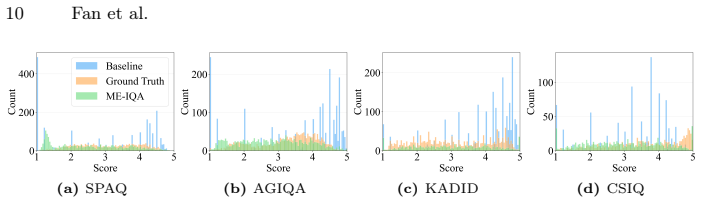
- The distributional analysis shows that the predicted histogram moves toward the human MOS histogram, with lower Jensen-Shannon divergence and a higher effective number of bins, which matters for applications that consume score distributions rather than single numbers.
- At a fixed compute budget of 32 comparisons, ME-IQA beats 64-sample majority/mean voting and an anchor-based comparator on nearly all benchmarks, so test-time re-ranking is a cheaper scaling axis than repeated sampling.
- Gains are largest on synthetic fine-grained datasets (KADID, PIPAL, CSIQ), indicating that the mechanism sharpens exactly the regime where discrete collapse is most visible.
Where Pith is reading between the lines
- Editorial inference: the closed-form update hinges on treating the inverse normal CDF of the pairwise preference probability as a calibrated latent-scale difference with unit spread. The paper does not validate that calibration against human pairwise judgments; if the comparator is miscalibrated and the bias correlates with the baseline score, the fusion may just average neighbor scores and produc
- Editorial inference: because Anchor Memory is built from the same KONIQ-10K set on which the VLMs are fine-tuned, the gains could in part reflect retrieval of near-duplicates or near-training images. A test on datasets with disjoint anchor and test distributions would separate genuine perceptual refinement from memorization-assisted interpolation.
- Editorial inference: the online Contrast Memory grows during testing, so the method's effectiveness depends on stream order; the paper's five-permutation robustness check is reassuring, but a deliberate adversarial ordering, such as worst-quality queries first, would bound the worst case.
- Editorial inference: a natural extension is to calibrate the comparator by learning a per-model mapping from pairwise probability to latent difference using a small human-labeled set, then applying ME-IQA with that calibrated link; this would directly test whether the assumed probit form is the right one.
Editorial analysis
A structured set of objections, weighed in public.
Referee Report
Summary. ME-IQA is a test-time memory-enhanced re-ranking framework for reasoning-induced VLMs in no-reference IQA. For each query, it builds a hybrid memory bank (anchor memory with ground-truth scores, contrast memory grown online from refined predictions), retrieves semantically and perceptually aligned neighbors using reasoning-derived embeddings as retrieval keys, prompts the VLM as a probabilistic comparator to obtain pairwise preference probabilities, and fuses this ordinal evidence with the initial score under a Thurstone Case V objective with a weak quadratic prior (Eq. 8). A gated reflection step then updates the memory. The paper reports consistent PLCC/SRCC improvements over five VLM backbones across seven IQA benchmarks, denser score histograms closer to human MOS, and comparisons with test-time scaling alternatives. Ablations cover neighborhood size, memory components, retrieval keys, the prior weight λ, and resolution.
Significance. If the reported gains are real, ME-IQA provides a practical, training-free wrapper that mitigates a known failure mode (discrete collapse) in reasoning-induced VLMs using only black-box access. The empirical scope is broad: five backbones, seven datasets, and ablations over the main design choices, with an explicit order-robustness test. However, the paper's central mechanistic claim—that pairwise VLM comparisons fused under Thurstone Case V drive the improvement—is not adequately isolated, and the hyperparameter selection protocol and implementation ambiguity weaken the evidence. The contributions are potentially useful, but the current manuscript does not yet convincingly rule out the simpler explanation that test-time retrieval plus averaging of stored scores is responsible for the gains.
major comments (4)
- [§4.3, Table 7] No ablation isolates the fusion mechanism. With K=32 and λ=0.01, Eq. (8) gives s_i^* ≈ (1/K) Σ_j [s_j^* + Φ^{-1}(y_ij)] (the prior term carries weight ~3e-4). If y_ij is uninformative or miscalibrated, this collapses to kNN regression on stored scores; since AM stores GT MOS and CM stores refined scores, retrieval alone could produce the gains. Table 7 shows that changing retrieval from Random to Reasoning-as-Embeddings raises PLCC by +0.023, while Random retrieval itself gives only +0.005 over K=0—consistent with retrieval quality dominating. Please add a neighbor-mean baseline: same retrieval, output the mean of retrieved s_j^* without pairwise prompting or the Φ^{-1} term. Without this baseline, the central claim that the VLM-as-comparator and Thurstone fusion add signal is unsupported.
- [§4.3, Table 9] The default λ=0.01 is selected by sweeping λ on KADID-10K, which is itself one of the reported test sets in Tables 1-3. The KADID numbers in the main tables are therefore partially tuned. Please select λ on a held-out validation set such as a KONIQ subset, or report the λ sweep on all seven benchmarks to show the choice is stable. At minimum, disclose that KADID was used for hyperparameter selection.
- [§3.2, Eqs. (5)-(8)] The paper never states which objective produced the experimental numbers: the BCE objective of Eq. (5) or the closed-form probit-linearized approximation of Eq. (8). These are not equivalent; Eq. (8) is a ridge-style estimator with a Gaussian pseudo-likelihood, not the Thurstone BCE minimizer. The phrase 'This approximation can be used as a fast inference' is ambiguous. Specify for each table which was run, and if both were used, report any performance difference.
- [§3.2, Eq. (6)] Equation (6) treats the VLM's soft preference y_ij as a calibrated probability on the same latent scale as stored scores, with σ=1. This is never validated against human pairwise judgments or the model's own output scale. If Φ^{-1}(y_ij) is biased in a way correlated with s_j^*, Eq. (8) mainly averages neighbor scores and the apparent gains would not reflect genuine perceptual refinement. Please provide calibration diagnostics (e.g., reliability plots of y_ij against human preference, or comparison of Φ^{-1}(y_ij) with observed score gaps) and show that the comparator term changes predictions beyond the neighbor mean.
minor comments (6)
- [Tables 1-3] Point estimates are reported without error bars or significance tests. The table entries are likely single runs; given the small differences in some comparisons (e.g., Table 7 Random vs K=0), please report bootstrap confidence intervals or paired tests across at least a few random orderings.
- [§3.2 / §4.1] The reflection gate ϵ=0.75 appears without justification. Is it tuned, and on which set? If also selected on KADID, that should be disclosed.
- [Table 2] The EvoQuality SRCC section has a typo: the Compare2Score@32 row shows '14.30' in the PIPAL column instead of a correlation value. Also the header 'SP AQ' has a stray space.
- [Table 8] The second block labels the method 'RE-IQA' but the paper uses 'ME-IQA'; fix the typo.
- [§4.1 / Fig. 4] The histogram binning for JS/entropy is described only as 'shared bins per dataset'; please state how many bins and how boundaries are chosen.
- [§4.2, Table 1] The non-reasoning baselines are presumably evaluated under a standard per-image protocol, while ME-IQA uses an online streaming protocol with memory access to prior test queries. This is a protocol difference; please state it and consider reporting baselines under the same online setting where feasible.
Circularity Check
Densification claim is by construction of Eq. (8); PLCC/SRCC gains are not definitionally circular.
specific steps
-
self definitional
[Section 3.2, Eq. (8); Section 4.2, Table 3]
"s∗ i = P j∈N µij +λs i K+λ . (8) ... the entropy of the prediction histogram increases, and so does its entropy-derived effective number of bins (higher is better), jointly indicating broader support and closer alignment to MOS."
Eq. (8) defines the refined score as a real-valued weighted average of K pseudo-observations μ_ij = s_j^* + Φ^{-1}(y_ij). Even with a constant/uninformative comparator (y_ij = 0.5), the output is a continuous average of stored scores, so the output histogram is mathematically guaranteed to have many more distinct values than the baseline's few discrete levels. The entropy/effective-bins gains in Table 3 therefore follow from the estimator's construction, not from the perceptual informativeness of the pairwise probabilities. The paper attributes the distributional gains to 'the VLM-as-comparator that supplies informative pairwise preferences,' but the densification would occur even if the pairwise comparisons carried no quality information. Thus the discrete-collapse-mitigation prediction r
full rationale
The derivation from Eq. (5) to Eq. (8) is a genuine model-based fusion: it combines the initial score with neighbor-based pseudo-observations, and the reported PLCC/SRCC improvements are checked against external benchmarks, so those core claims have independent content. The self-citations (e.g., EvoQuality) are used as baselines and evaluation protocol, not as load-bearing justification for the method. The one circular element is the discrete-collapse/densification result: because Eq. (8) averages real-valued pseudo-observations, the output is guaranteed to spread across many histogram bins, making Table 3's entropy/effective-bins improvements a property of the estimator's definition rather than empirical validation of the comparator. This does not invalidate the ordinal accuracy claims but makes the 'mitigates discrete collapse' evidence partially tautological. The missing ablation of a pure neighbor-mean baseline is a correctness/attribution concern, not itself a circularity.
Axiom & Free-Parameter Ledger
free parameters (6)
- λ (Thurstone fusion prior weight) =
0.01
- ε (reflection gate) =
0.75
- K, K_A, K_C (retrieval budget and split) =
K=32, K_A=16, K_C=16
- B and k_A (anchor memory binning) =
B=5, k_A=3 per bin
- β1..β5 (five-parameter logistic mapping) =
not reported numerically
- C (contrast memory max size / pruning) =
not specified
axioms (6)
- domain assumption Thurstone Case V with σ=1 links latent quality differences to pairwise preference probabilities (Eq 4).
- domain assumption VLM token probability for 'A' is a calibrated pairwise preference probability.
- domain assumption Five-parameter logistic mapping (Eq 3) aligns VLM raw scores to [1,5] MOS scale.
- domain assumption Reasoning summaries / raw reasoning traces are suitable retrieval keys for perceptual quality.
- domain assumption Online streaming protocol (no peeking) is the appropriate evaluation setting; memory updates do not invalidate comparison to independent baselines.
- standard math Probit linearization s_i* ≈ s_j* + Φ^{-1}(y_ij) is a faithful approximation of the BCE objective (Eq 6).
read the original abstract
Reasoning-induced vision-language models (VLMs) advance image quality assessment (IQA) with textual reasoning, yet their scalar scores often lack sensitivity and collapse to a few values, so-called discrete collapse. We introduce ME-IQA, a plug-and-play, test-time memory-enhanced re-ranking framework. It (i) builds a memory bank and retrieves semantically and perceptually aligned neighbors using reasoning summaries, (ii) reframes the VLM as a probabilistic comparator to obtain pairwise preference probabilities and fuse this ordinal evidence with the initial score under Thurstone's Case V model, and (iii) performs gated reflection and consolidates memory to improve future decisions. This yields denser, distortion-sensitive predictions and mitigates discrete collapse. Experiments across multiple IQA benchmarks show consistent gains over strong reasoning-induced VLM baselines, existing non-reasoning IQA methods, and test-time scaling alternatives.
Figures


Reference graph
Works this paper leans on
-
[1]
arXiv preprint arXiv:2502.13923 (2025)
Bai, S., Chen, K., Liu, X., Wang, J., Ge, W., Song, S., Dang, K., Wang, P., Wang, S., Tang, J., et al.: Qwen2.5-VL technical report. arXiv preprint arXiv:2502.13923 (2025)
Pith/arXiv arXiv 2025
-
[2]
IEEE Transactions on Image Processing27(1), 206–219 (2017)
Bosse,S.,Maniry,D.,Müller,K.R.,Wiegand,T.,Samek,W.:Deepneuralnetworks for no-reference and full-reference image quality assessment. IEEE Transactions on Image Processing27(1), 206–219 (2017)
2017
-
[3]
In: Advances in Neural Information Processing Systems
Brown, T., Mann, B., Ryder, N., Subbiah, M., Kaplan, J.D., Dhariwal, P., Nee- lakantan, A., Shyam, P., Sastry, G., Askell, A., Agarwal, S., Herbert-Voss, A., Krueger, G., Henighan, T., Child, R., Ramesh, A., Ziegler, D., Wu, J., Winter, C., Hesse, C., Chen, M., Sigler, E., Litwin, M., Gray, S., Chess, B., Clark, J., Berner, C., McCandlish, S., Radford, A....
1901
-
[4]
In: International Conference on Machine Learning
Burges, C., Shaked, T., Renshaw, E., Lazier, A., Deeds, M., Hamilton, N., Hullen- der, G.: Learning to rank using gradient descent. In: International Conference on Machine Learning. pp. 89–96 (2005)
2005
-
[5]
In: IEEE International Conference on Image Processing
Chen, P., Li, L., Huang, Y., Tan, F., Chen, W.: Qoe evaluation for live broadcasting video. In: IEEE International Conference on Image Processing. pp. 454–458 (2019)
2019
-
[6]
arXiv preprint arXiv:2504.19413 (2025)
Chhikara, P., Khant, D., Aryan, S., Singh, T., Yadav, D.: Mem0: Building production-ready ai agents with scalable long-term memory. arXiv preprint arXiv:2504.19413 (2025)
Pith/arXiv arXiv 2025
-
[7]
IEEE Transactions on Image Processing20(1), 64–75 (2010)
Ciancio, A., Targino da Costa, A.L.N.T., da Silva, E.A.B., Said, A., Samadani, R., Obrador, P.: No-reference blur assessment of digital pictures based on multifeature classifiers. IEEE Transactions on Image Processing20(1), 64–75 (2010)
2010
-
[8]
In: Conference of the North American Chapter of the Association for Computational Linguistics: Human Lan- guage Technologies
Devlin, J., Chang, M.W., Lee, K., Toutanova, K.: Bert: Pre-training of deep bidi- rectional transformers for language understanding. In: Conference of the North American Chapter of the Association for Computational Linguistics: Human Lan- guage Technologies. pp. 4171–4186 (2019)
2019
-
[9]
In: IEEE/CVF Conference on Computer Vision and Pattern Recognition
Fang, Y., Zhu, H., Zeng, Y., Ma, K., Wang, Z.: Perceptual quality assessment of smartphone photography. In: IEEE/CVF Conference on Computer Vision and Pattern Recognition. pp. 3677–3686 (2020)
2020
-
[10]
IEEE Transactions on Neural Networks and Learning Systems26(10), 2275–2290 (2015)
Gao, F., Tao, D., Gao, X., Li, X.: Learning to rank for blind image quality as- sessment. IEEE Transactions on Neural Networks and Learning Systems26(10), 2275–2290 (2015)
2015
-
[11]
http://live
Ghadiyaram, D., Bovik, A.C.: Live in the wild image quality challenge database. http://live. ece. utexas. edu/research/ChallengeDB/index. html (2015) 16 Fan et al
2015
-
[12]
IEEE Transactions on Image Processing25(1), 372–387 (2015)
Ghadiyaram, D., Bovik, A.C.: Massive online crowdsourced study of subjective and objective picture quality. IEEE Transactions on Image Processing25(1), 372–387 (2015)
2015
-
[13]
In: European Confer- ence on Computer Vision
Gu, J., Cai, H., Chen, H., Ye, X., Ren, J.S., Dong, C.: PIPAL: A large-scale image quality assessment dataset for perceptual image restoration. In: European Confer- ence on Computer Vision. pp. 633–651 (2020)
2020
-
[14]
In: International Conference on Machine Learning
Guu, K., Lee, K., Tung, Z., Pasupat, P., Chang, M.: Retrieval augmented language model pre-training. In: International Conference on Machine Learning. pp. 3929– 3938 (2020)
2020
-
[15]
Harper & Row (1964)
Helson, H.: Adaptation-level Theory: An Experimental and Systematic Approach to Behavior. Harper & Row (1964)
1964
-
[16]
IEEE Transactions on Image Processing29, 4041–4056 (2020)
Hosu, V., Lin, H., Sziranyi, T., Saupe, D.: KonIQ-10k: An ecologically valid database for deep learning of blind image quality assessment. IEEE Transactions on Image Processing29, 4041–4056 (2020)
2020
-
[17]
arXiv preprint arXiv:2507.05257 (2025)
Hu, Y., Wang, Y., McAuley, J.: Evaluating memory in llm agents via incremental multi-turn interactions. arXiv preprint arXiv:2507.05257 (2025)
Pith/arXiv arXiv 2025
-
[18]
In: IEEE/CVF Conference on Computer Vision and Pattern Recognition
Hu, Z., Iscen, A., Sun, C., Wang, Z., Chang, K.W., Sun, Y., Schmid, C., Ross, D.A., Fathi, A.: Reveal: Retrieval-augmented visual-language pre-training with multi- source multimodal knowledge memory. In: IEEE/CVF Conference on Computer Vision and Pattern Recognition. pp. 23369–23379 (2023)
2023
-
[19]
Kang, L., Ye, P., Li, Y., Doermann, D.: Convolutional neural networks for no- referenceimagequalityassessment.In:IEEE/CVFConferenceonComputerVision and Pattern Recognition. pp. 1733–1740 (2014)
2014
-
[20]
Ke, J., Wang, Q., Wang, Y., Milanfar, P., Yang, F.: MUSIQ: Multi-scale image qualityTransformer.In:IEEE/CVFInternationalConferenceonComputerVision. pp. 5148–5157 (2021)
2021
-
[21]
Journal of Electronic Imaging19(1), 1–21 (2010)
Larson, E.C., Chandler, D.M.: Most apparent distortion: Full-reference image qual- ity assessment and the role of strategy. Journal of Electronic Imaging19(1), 1–21 (2010)
2010
-
[22]
Advances in Neural Information Processing Systems 33, 9459–9474 (2020)
Lewis, P., Perez, E., Piktus, A., Petroni, F., Karpukhin, V., Goyal, N., Küttler, H., Lewis, M., Yih, W.t., Rocktäschel, T., et al.: Retrieval-augmented generation for knowledge-intensive nlp tasks. Advances in Neural Information Processing Systems 33, 9459–9474 (2020)
2020
-
[23]
IEEE Transactions on Neural Networks22(5), 793–799 (2011)
Li, C., Bovik, A.C., Wu, X.: Blind image quality assessment using a general re- gression neural network. IEEE Transactions on Neural Networks22(5), 793–799 (2011)
2011
-
[24]
IEEE Transactions on Circuits and Systems for Video Technology34(8), 6833–6846 (2023)
Li, C., Zhang, Z., Wu, H., Sun, W., Min, X., Liu, X., Zhai, G., Lin, W.: AGIQA-3K: An open database for AI-generated image quality assessment. IEEE Transactions on Circuits and Systems for Video Technology34(8), 6833–6846 (2023)
2023
-
[25]
arXiv preprint arXiv:2503.22679 (2025)
Li, W., Zhang, X., Zhao, S., Zhang, Y., Li, J., Zhang, L., Zhang, J.: Q-Insight: Understanding image quality via visual reinforcement learning. arXiv preprint arXiv:2503.22679 (2025)
Pith/arXiv arXiv 2025
-
[26]
In: IEEE International Conference on Quality of Multimedia Experience
Lin, H., Hosu, V., Saupe, D.: KADID-10K: A large-scale artificially distorted IQA database. In: IEEE International Conference on Quality of Multimedia Experience. pp. 1–3 (2019)
2019
-
[27]
IEEE Transactions on Circuits and Systems for Video Technology 20(4), 529–539 (2009)
Liu, H., Klomp, N., Heynderickx, I.: A no-reference metric for perceived ringing ar- tifacts in images. IEEE Transactions on Circuits and Systems for Video Technology 20(4), 529–539 (2009)
2009
-
[28]
IEEE Transactions on Image Processing26(8), 3951–3964 (2017) ME-IQA 17
Ma, K., Liu, W., Liu, T., Wang, Z., Tao, D.: dipIQ: Blind image quality assess- ment by learning-to-rank discriminable image pairs. IEEE Transactions on Image Processing26(8), 3951–3964 (2017) ME-IQA 17
2017
-
[29]
IEEE Transactions on Image Processing27(3), 1202–1213 (2017)
Ma, K., Liu, W., Zhang, K., Duanmu, Z., Wang, Z., Zuo, W.: End-to-end blind image quality assessment using deep neural networks. IEEE Transactions on Image Processing27(3), 1202–1213 (2017)
2017
-
[30]
In: Annual Meeting of the Association for Computational Linguistics
Maharana, A., Lee, D.H., Tulyakov, S., Bansal, M., Barbieri, F., Fang, Y.: Evalu- ating very long-term conversational memory of llm agents. In: Annual Meeting of the Association for Computational Linguistics. pp. 13851–13870 (2024)
2024
-
[31]
IEEE Transactions on Image Processing21(12), 4695–4708 (2012)
Mittal, A., Moorthy, A.K., Bovik, A.C.: No-reference image quality assessment in the spatial domain. IEEE Transactions on Image Processing21(12), 4695–4708 (2012)
2012
-
[32]
completely blind
Mittal, A., Soundararajan, R., Bovik, A.C.: Making a “completely blind” image quality analyzer. IEEE Signal Processing Letters20(3), 209–212 (2012)
2012
-
[33]
Entropy23(4), 464 (2021)
Nielsen, F.: On a variational definition for the jensen-shannon symmetrization of distances based on the information radius. Entropy23(4), 464 (2021)
2021
-
[34]
arXiv preprint arXiv:2509.25140 (2025)
Ouyang, S., Yan, J., Hsu, I., Chen, Y., Jiang, K., Wang, Z., Han, R., Le, L.T., Daruki, S., Tang, X., et al.: Reasoningbank: Scaling agent self-evolving with rea- soning memory. arXiv preprint arXiv:2509.25140 (2025)
Pith/arXiv arXiv 2025
-
[35]
arXiv preprint arXiv:2310.08560 (2023)
Packer, C., Wooders, S., Lin, K., Fang, V., Patil, S.G., Stoica, I., Gonzalez, J.E.: MemGPT: Towards LLMs as operating systems. arXiv preprint arXiv:2310.08560 (2023)
Pith/arXiv arXiv 2023
-
[36]
Signal Processing: Image Com- munication30, 57–77 (2015)
Ponomarenko, N., Jin, L., Ieremeiev, O., Lukin, V., Egiazarian, K., Astola, J., Vozel, B., Chehdi, K., Carli, M., Battisti, F., Kuo, C.C.J.: Image database TID2013: Peculiarities, results and perspectives. Signal Processing: Image Com- munication30, 57–77 (2015)
2015
-
[37]
arXiv preprint arXiv:2402.03300 (2024)
Shao, Z., Wang, P., Zhu, Q., Xu, R., Song, J., Bi, X., Zhang, H., Zhang, M., Li, Y., Wu, Y., Guo, D.: DeepSeekMath: Pushing the limits of mathematical reasoning in open language models. arXiv preprint arXiv:2402.03300 (2024)
Pith/arXiv arXiv 2024
-
[38]
IEEE Transactions on Image Processing 15(11), 3440–3451 (2006)
Sheikh, H.R., Sabir, M.F., Bovik, A.C.: A statistical evaluation of recent full refer- ence image quality assessment algorithms. IEEE Transactions on Image Processing 15(11), 3440–3451 (2006)
2006
-
[39]
Cognitive psychology 53(1), 1–26 (2006)
Stewart, N., Chater, N., Brown, G.D.: Decision by sampling. Cognitive psychology 53(1), 1–26 (2006)
2006
-
[40]
In: Interna- tional Conference on Learning Representations
SU, H., Sun, R., Yoon, J., Yin, P., Yu, T., Arik, S.O.: Learn-by-interact: A data- centric framework for self-adaptive agents in realistic environments. In: Interna- tional Conference on Learning Representations. pp. 1–13 (2025)
2025
-
[41]
IEEE Transactions on Image Processing27(8), 3998–4011 (2018)
Talebi, H., Milanfar, P.: NIMA: Neural image assessment. IEEE Transactions on Image Processing27(8), 3998–4011 (2018)
2018
-
[42]
In: International Conference on Learning Representations
Tang, X., Hu, T., Ye, M., Shao, Y., Yin, X., Ouyang, S., Zhou, W., Lu, P., Zhang, Z., Zhao, Y., Cohan, A., Gerstein, M.: Chemagent: Self-updating memories in large language models improves chemical reasoning. In: International Conference on Learning Representations. pp. 1–15 (2025)
2025
-
[43]
Psychological Review34, 273– 286 (1927)
Thurstone, L.L.: A law of comparative judgment. Psychological Review34, 273– 286 (1927)
1927
-
[44]
In: Proceedings of the AAAI Conference on Artificial Intelligence
Wang, J., Chan, K.C., Loy, C.C.: Exploring clip for assessing the look and feel of images. In: Proceedings of the AAAI Conference on Artificial Intelligence. pp. 2555–2563 (2023)
2023
-
[45]
arXiv preprint arXiv:2307.09279 (2023)
Wang, X., Xiong, J., Gao, H., Lin, W.: Regression-free blind image quality assess- ment with content-distortion consistency. arXiv preprint arXiv:2307.09279 (2023)
Pith/arXiv arXiv 2023
-
[46]
In: International Conference on Machine Learning
Wang, Y., Krotov, D., Hu, Y., Gao, Y., Zhou, W., McAuley, J., Gutfreund, D., Feris, R., He, Z.: M+: Extending memoryLLM with scalable long-term memory. In: International Conference on Machine Learning. pp. 1–12 (2025) 18 Fan et al
2025
-
[47]
IEEE Transactions on Pattern Analysis and Machine Intelli- gence44(9), 4577–4590 (2021)
Wang, Z., Ma, K.: Active fine-tuning from gMAD examples improves blind image quality assessment. IEEE Transactions on Pattern Analysis and Machine Intelli- gence44(9), 4577–4590 (2021)
2021
-
[48]
In: IEEE/CVF Conference on Computer Vision and Pattern Recognition
Wang, Z., Wang, H., Chen, T., Wang, Z., Ma, K.: Troubleshooting blind image quality models in the wild. In: IEEE/CVF Conference on Computer Vision and Pattern Recognition. pp. 16256–16265 (2021)
2021
-
[49]
Morgan & Claypool Publishers (2006)
Wang, Z., Bovik, A.C.: Modern Image Quality Assessment. Morgan & Claypool Publishers (2006)
2006
-
[50]
IEEE Signal Processing Magazine28(6), 29–40 (2011)
Wang, Z., Bovik, A.C.: Reduced-and no-reference image quality assessment. IEEE Signal Processing Magazine28(6), 29–40 (2011)
2011
-
[51]
In: IEEE International Conference on Image Processing
Wang, Z., Bovik, A.C., Evan, B.L.: Blind measurement of blocking artifacts in im- ages. In: IEEE International Conference on Image Processing. pp. 981–984 (2000)
2000
-
[52]
IEEE Transactions on Image Process- ing13(4), 600–612 (2004)
Wang, Z., Bovik, A.C., Sheikh, H.R., Simoncelli, E.P.: Image quality assessment: From error visibility to structural similarity. IEEE Transactions on Image Process- ing13(4), 600–612 (2004)
2004
-
[53]
In: Advances in Neural Information Processing Systems
Wang, Z., Simoncelli, E.P.: Local phase coherence and the perception of blur. In: Advances in Neural Information Processing Systems. pp. 1435–1442 (2003)
2003
-
[54]
arXiv preprint arXiv:2504.06821 (2025)
Wang, Z.Z., Gandhi, A., Neubig, G., Fried, D.: Inducing programmatic skills for agentic tasks. arXiv preprint arXiv:2504.06821 (2025)
Pith/arXiv arXiv 2025
-
[55]
In: International Conference on Learning Representations
Wen, W., Zhi, T., Fan, K., Li, Y., Peng, X., Zhang, Y., Liao, Y., Li, J., Zhang, L.: Self-evolving Vision-Language Models for image quality assessment via voting and ranking. In: International Conference on Learning Representations. pp. 1–14 (2026)
2026
-
[56]
In: Advances in Neural Informa- tion Processing Systems
Wu, C., Tam, Z.R., Lin, C., Chen, Y., Lee, H.: Streambench: Towards benchmark- ing continuous improvement of language agents. In: Advances in Neural Informa- tion Processing Systems. pp. 107039–107063 (2024)
2024
-
[57]
In: International Conference on Learning Representations
Wu, D., Wang, H., Yu, W., Zhang, Y., Chang, K.W., Yu, D.: LongMemEval: Benchmarking chat assistants on long-term interactive memory. In: International Conference on Learning Representations. pp. 1–16 (2025)
2025
-
[58]
In: International Conference on Machine Learning
Wu, H., Zhang, Z., Zhang, W., Chen, C., Liao, L., Li, C., Gao, Y., Wang, A., Zhang, E., Sun, W., Yan, Q., Min, X., Zhai, G., Lin, W.: Q-Align: Teaching LMMs for visual scoring via discrete text-defined levels. In: International Conference on Machine Learning. pp. 54015–54029 (2024)
2024
-
[59]
IEEE Transactions on Circuits and Systems for Video Technology26(3), 425–440 (2015)
Wu, Q., Li, H., Meng, F., Ngan, K.N., Luo, B., Huang, C., Zeng, B.: Blind image quality assessment based on multichannel feature fusion and label transfer. IEEE Transactions on Circuits and Systems for Video Technology26(3), 425–440 (2015)
2015
-
[60]
IEEE Transactions on Circuits and Systems for Video Technology28(9), 2078–2089 (2017)
Wu, Q., Li, H., Ngan, K.N., Ma, K.: Blind image quality assessment using local consistency aware retriever and uncertainty aware evaluator. IEEE Transactions on Circuits and Systems for Video Technology28(9), 2078–2089 (2017)
2078
-
[61]
In: European Confer- ence on Computer Vision
Wu, T., Ma, K., Liang, J., Yang, Y., Zhang, L.: A comprehensive study of multi- modal large language models for image quality assessment. In: European Confer- ence on Computer Vision. pp. 143–160 (2024)
2024
-
[62]
arXiv preprint arXiv:2505.14460 (2025)
Wu,T.,Zou,J.,Liang,J.,Zhang,L.,Ma,K.:VisualQuality-R1:Reasoning-induced image quality assessment via reinforcement learning to rank. arXiv preprint arXiv:2505.14460 (2025)
arXiv 2025
-
[63]
arXiv preprint arXiv:2502.12110 (2025)
Xu, W., Mei, K., Gao, H., Tan, J., Liang, Z., Zhang, Y.: A-mem: Agentic memory for llm agents. arXiv preprint arXiv:2502.12110 (2025)
Pith/arXiv arXiv 2025
-
[64]
In: IEEE/CVF Conference on Computer Vision and Pattern Recognition
Xue, W., Zhang, L., Mou, X.: Learning without human scores for blind image quality assessment. In: IEEE/CVF Conference on Computer Vision and Pattern Recognition. pp. 995–1002 (2013) ME-IQA 19
2013
-
[65]
In: IEEE/CVF Conference on Computer Vision and Pattern Recognition Workshops
Yang,S.,Wu,T.,Shi,S.,Lao,S.,Gong,Y.,Cao,M.,Wang,J.,Yang,Y.:MANIQA: Multi-dimension attention network for no-reference image quality assessment. In: IEEE/CVF Conference on Computer Vision and Pattern Recognition Workshops. pp. 1191–1200 (2022)
2022
-
[66]
In: International Conference on Machine Learning (2022)
Yasunaga, M., Aghajanyan, A., Shi, W., James, R., Leskovec, J., Liang, P., Lewis, M., Zettlemoyer, L., Yih, W.t.: Retrieval-augmented multimodal language model- ing. In: International Conference on Machine Learning (2022)
2022
-
[67]
IEEE Transactions on Image Processing21(7), 3129–3138 (2012)
Ye, P., Doermann, D.: No-reference image quality assessment using visual code- books. IEEE Transactions on Image Processing21(7), 3129–3138 (2012)
2012
-
[68]
In: IEEE Conference on Computer Vision and Pattern Recognition
Ye, Q., Xu, H., Ye, J., Yan, M., Hu, A., Liu, H., Qian, Q., Zhang, J., Huang, F.: mPLUG-Owl2: Revolutionizing multi-modal large language model with modality collaboration. In: IEEE Conference on Computer Vision and Pattern Recognition. pp. 13040–13051 (2024)
2024
-
[69]
In: IEEE/CVF Con- ference on Computer Vision and Pattern Recognition
You, Z., Cai, X., Gu, J., Xue, T., Dong, C.: Teaching large language models to regress accurate image quality scores using score distribution. In: IEEE/CVF Con- ference on Computer Vision and Pattern Recognition. pp. 14483–14494 (2025)
2025
-
[70]
In: European Conference on Computer Vision
You,Z.,Li,Z.,Gu,J.,Yin,Z.,Xue,T.,Dong,C.:Depictingbeyondscores:Advanc- ing image quality assessment through multi-modal language models. In: European Conference on Computer Vision. pp. 259–276 (2024)
2024
-
[71]
arXiv preprint arXiv:2408.15240 (2024)
Zhang, L., Hosseini, A., Bansal, H., Kazemi, M., Kumar, A., Agarwal, R.: Generative verifiers: Reward modeling as next-token prediction. arXiv preprint arXiv:2408.15240 (2024)
Pith/arXiv arXiv 2024
-
[72]
IEEE Transactions on Pattern Analysis and Machine Intelligence45(3), 2864–2878 (2022)
Zhang, W., Li, D., Ma, C., Zhai, G., Yang, X., Ma, K.: Continual learning for blind image quality assessment. IEEE Transactions on Pattern Analysis and Machine Intelligence45(3), 2864–2878 (2022)
2022
-
[73]
IEEE Transactions on Image Processing 30, 3474–3486 (2021)
Zhang, W., Ma, K., Zhai, G., Yang, X.: Uncertainty-aware blind image quality assessment in the laboratory and wild. IEEE Transactions on Image Processing 30, 3474–3486 (2021)
2021
-
[74]
In: IEEE/CVF Conference on Computer Vision and Pattern Recognition
Zhang, W., Zhai, G., Wei, Y., Yang, X., Ma, K.: Blind image quality assessment via vision-language correspondence: A multitask learning perspective. In: IEEE/CVF Conference on Computer Vision and Pattern Recognition. pp. 14071–14081 (2023)
2023
-
[75]
In: Conference on Empirical Methods in Natural Language Processing
Zhang, X.F., Beauchamp, N., Wang, L.: Prime: Large language model personaliza- tion with cognitive dual-memory and personalized thought process. In: Conference on Empirical Methods in Natural Language Processing. pp. 33695–33724 (2025)
2025
-
[76]
arXiv preprint arXiv:2506.05176 (2025)
Zhang, Y., Li, M., Long, D., Zhang, X., Lin, H., Yang, B., Xie, P., Yang, A., Liu, D., Lin, J., Huang, F., Zhou, J.: Qwen3 embedding: Advancing text embedding and reranking through foundation models. arXiv preprint arXiv:2506.05176 (2025)
Pith/arXiv arXiv 2025
-
[77]
ACM Transactions on Information Systems43(6), 1–47 (2025)
Zhang, Z., Dai, Q., Bo, X., Ma, C., Li, R., Chen, X., Zhu, J., Dong, Z., Wen, J.R.: A survey on the memory mechanism of large language model-based agents. ACM Transactions on Information Systems43(6), 1–47 (2025)
2025
-
[78]
In: AAAI Conference on Artificial Intelligence
Zhao, A., Huang, D., Xu, Q., Lin, M., Liu, Y., Huang, G.: Expel: LLM agents are experiential learners. In: AAAI Conference on Artificial Intelligence. pp. 19632– 19642 (2024)
2024
-
[79]
In: International Conference on Learning Representations
Zheng, L., Wang, R., Wang, X., An, B.: Synapse: Trajectory-as-exemplar prompt- ing with memory for computer control. In: International Conference on Learning Representations. pp. 1–13 (2024)
2024
-
[80]
In: AAAI Conference on Artificial Intel- ligence
Zhong, W., Guo, L., Gao, Q., Ye, H., Wang, Y.: MemoryBank: Enhancing large language models with long-term memory. In: AAAI Conference on Artificial Intel- ligence. pp. 19724–19731 (2024).https://doi.org/10.1609/AAAI.V38I17.29946 20 Fan et al
discussion (0)
Sign in with ORCID, Apple, or X to comment. Anyone can read and Pith papers without signing in.