REVIEW 4 major objections 4 minor 24 references
This paper proves that in one-dimensional non-Hermitian photonic crystals, the winding number of a dispersion curve equals a transfer-matrix eigenvalue count, and this invariant determines whether edge modes localize on the left or right bo
Reviewed by Pith at T0; open to challenge. T0 means a machine referee read the full paper against a public rubric. the ladder, T0–T4 →
T0 review · deepseek-v4-flash
2026-08-02 17:35 UTC pith:TUXE7BIG
load-bearing objection Transfer-matrix index for continuous non-Hermitian photonic crystals is a genuine contribution, but Example 3 does not verify the path assumption that the key theorems rely on. the 4 major comments →
Spectral topology and edge modes for one-dimensional non-Hermitian photonic crystals
The pith
A machine-rendered reading of the paper's core claim, the machinery that carries it, and where it could break.
Core claim
The central discovery is the equality Ind(D_i_n;1)=W(γ_n;ω_B): the new index, defined from the four transfer-matrix eigenvalues, takes the same value as the winding number of the nth dispersion curve around any point in that component. The paper proves that the index is locally constant on gapped components, that the unbounded principal component has index 0 by homotopy from a Hermitian reference crystal, and that crossing a positively oriented loop changes the index by +1 (negatively oriented, -1). It then constructs the edge mode: for index +1, three transfer-matrix eigenvectors lie inside the unit circle, and a linear combination chosen to match the outgoing boundary condition at z=0 deca
What carries the argument
The transfer matrix M(ω) for one period: it evolves the four-component field across a unit cell, and its eigenvalues λ_j(ω) are the Bloch phase factors e^{ik}, with product 1. The new index Ind(ω)=1/2(#{|λ_j|<1} - #{|λ_j|>1}) is constant on every connected component of the complement of the dispersion curves; Theorem 9 pins the outer component to 0 via a Hermitian limit, Theorem 12 shows the jump across a loop equals its winding number, and Theorem 14 uses the sign of Ind to select the decaying subspace of M(ω) whose linear combination matches the outgoing boundary condition, producing an exponentially decaying edge eigenfunction. The A/F layered stack — anisotropic A layers plus magnetized
Load-bearing premise
The argument needs a continuous path g(t) that avoids the spectrum while deforming back to a Hermitian reference crystal — assumed, not verified, for the Example 3 stack — plus the separate non-intersection of dispersion curves (partially relaxed by Proposition 13); if either fails, the index value, and with it the predicted edge side, can change.
What would settle it
For the three-layer A/F stack of Example 3 (δ=6, φ1=0, φ2=0.8, α=β=0.5, ε0=13+5i), pick a non-branch-point frequency inside one of the closed dispersion loops and compute the four transfer-matrix eigenvalues λ_j(ω). If 1/2(#{|λ_j|<1} - #{|λ_j|>1}) does not equal the winding number of that loop around ω, the central equivalence Theorem 12 fails. Alternatively, solve the semi-infinite problem on I+ at such a frequency; if no exponentially decaying eigenfunction exists despite the index being +1, the bulk-edge statement fails.
If this is right
- For a frequency inside a positively wound dispersion loop that is not a branch point, the semi-infinite crystal on the right supports an exponentially localized edge mode; inside a negatively wound loop, the left crystal does (Theorem 14).
- The winding number of a dispersion curve can be computed from the transfer-matrix eigenvalue count without first mapping the full Bloch band, since Ind(D)=W(γ;ω_B) (Theorem 12).
- Under the rank condition in Proposition 15, the number of edge modes equals the index magnitude: one for |W|=1, two for |W|=2, so the correspondence gives a counting statement, not just existence.
- When different dispersion curves intersect, the conclusion still holds away from the other bands' enclosed regions (Proposition 13 and Remark 5), so the correspondence is stable under band crossings.
- The edge-mode construction carries over to perfect-electric or perfect-magnetic conducting terminations (Remark 4), so the prediction is robust to the choice of boundary condition.
Where Pith is reading between the lines
- A cheap numerical check is to fix a point inside one of the plotted loops of Example 3 and evaluate Ind from the four roots of det(M(ω)-λI); the paper does not report such a direct verification, and this would confirm or refute Theorem 12 for that stack.
- The proof of Theorem 9 needs a spectral-avoiding path g(t) from a Hermitian reference crystal to the target component; for the A/F stack this path is not exhibited, so finding it explicitly or showing that band touchings block it would settle whether the outer index is always 0.
- Because the invariant only uses the relative positions of the four transfer-matrix eigenvalues to the unit circle, it should be computable directly from the coefficients of the quartic characteristic equation, suggesting an algebraic criterion for point-gap membership.
- The same transfer-matrix construction should apply to other continuous 1D non-Hermitian mechanisms (gain/loss, imaginary gauge potentials), since only periodicity and det M=1 are used; testing one such system would show whether the bulk-edge correspondence is a general feature of continuous wave models rather than specific to photonic stacks.
Editorial analysis
A structured set of objections, weighed in public.
Referee Report
Summary. The paper develops a transfer-matrix framework for the non-Hermitian skin effect in one-dimensional continuous photonic crystals. For the Bloch eigenvalue problem with quasi-periodic boundary condition, the transfer matrix M(ω) has four eigenvalue branches λ_j(ω). The authors define Ind(ω)=1/2(#{|λ_j|<1}−#{|λ_j|>1}), prove it is locally constant on each connected component of the complement Γ^c of the dispersion curves, and study its jump across a dispersion curve. Under a homotopy from a reference Hermitian crystal and the existence of a spectral-avoiding path (Theorem 9), the exterior region is assigned index 0; crossing a positively oriented loop changes the index by +1 and a negatively oriented loop by −1, so that Ind(D_i^n)=W(γ_n;ω_B). Theorem 14 then asserts that every non-branch-point frequency in a bounded component with index +1 is an eigenvalue of the semi-infinite problem on I+ with an exponentially decaying eigenfunction, and similarly for index −1 on I−. The paper includes a concrete A/F layered example and explicit transfer-matrix formulas.
Significance. If correct, this is a valuable rigorous bulk-edge correspondence for continuous 1D non-Hermitian photonic crystals, where Toeplitz spectral theory does not apply. The transfer-matrix index is a natural invariant that directly controls the decay of the physical solution and is explicitly computable from the 4×4 monodromy matrix. The paper is well organized, and the local jump argument in Theorem 12 is plausible and internally consistent. The inclusion of explicit transfer matrices for the A and F layers and a concrete three-layer example is a strength. However, the main topological input—the existence of the spectral-avoiding path and the principal-gap assignment for the exterior region—is not verified for the paper's flagship example, and the non-Hermitian band-labeling assumption is asserted rather than proved. These issues make the central claim conditional and require substantial revision.
major comments (4)
- [§3.2, Theorem 9; Example 3] The conclusion Ind(D;1)=0 for the exterior component is not established for the example used throughout the paper. Theorem 9 requires a continuous curve g:[0,1]→C with g(t)∈Γ^c_t and g(1)∈D; this spectral-avoiding path is never constructed or checked for the A/F stack of Example 3. Figure 1 (right) shows only the endpoint loops, and the text gives no information about how the point-gap loops are born during the deformation. If they nucleate through a band touching on the real axis, such a path may be blocked, and Ind(D) need not be 0. Since Theorems 12 and 14 use Ind(D)=0 as the base value, a shift in this value would change every Ind(D_i^n) by a constant and can reverse or remove the predicted side of localization. Please verify the existence of the path for the example, or state the existence of the spectral-avoiding path as an explicit assumption in the main theorems; Assumption 7(ii)
- [§2.3, band-labeling assumption] The paper assumes that the complex eigenfrequencies can be ordered by increasing real part with each ω_n(k) continuous in k and 'no ambiguity'. For non-Hermitian operators, eigenvalue curves can cross, and the real-part ordering can change discontinuously; without a separation condition or a precise continuation argument, the objects γ_n and their winding numbers are not well-defined. This is load-bearing for the definitions of point gaps and for Theorems 11 and 12. The authors should either prove that the stated ordering is well-defined for the class of media considered, or add it as an explicit hypothesis and verify it for Example 3.
- [§3.3, Theorem 12 and Proposition 13] Theorem 12 assumes γ_n∩γ_m=∅ and the existence of a smooth point where ω_n is analytic with a well-defined outward normal. None of these conditions is verified for the dispersion curves in Example 3. The plot in Figure 1 is not enough to exclude intersections or self-tangencies; the jump argument requires a neighborhood where the only relevant curve is γ_n and where ω_n(ξ) is locally injective. Proposition 13 relaxes the non-intersection condition only partially: it still requires the smooth-point and analyticity assumptions and only establishes the index on the punctured domain D_i^n\∪_{m≠n}D_m. Please check these hypotheses for the numerical example or provide a version of the theorem that can be applied directly to it.
- [§3.4, Theorem 14 and sign of the radiation condition] In equation (25), the outgoing condition is c2=Q c1 for z>0 and c2=−Q c1 for z<0. The matrix B defined in (30) is H+QE, which vanishes for the z<0 condition but not for the z>0 condition. The proof of part (i) (I+) therefore appears to use the wrong sign unless the ambient medium is placed on the opposite side than the named interval; for part (ii) the sign should be changed accordingly. This is easily fixed, but as written it is confusing and affects the boundary-value problem that Theorem 14 claims to solve. The authors should also state explicitly why the nonzero α in (28) gives a nontrivial solution Φ; at non-branch points with distinct λ_j this follows from linear independence of the eigenvectors, but the argument should be written out.
minor comments (4)
- [§2.3 and Example 3] The text refers to 'Figure 2 (Right)' for the non-Hermitian band structure of Example 3; this should be Figure 1 (Right). Similarly, Example 3 refers to 'Figure 2 (Left)' for the Hermitian bands; this should be Figure 1 (Left).
- [Throughout] There are several typos: 'eigenfrquency' in §2.1, 'phtononic' in Assumption 7, and the use of 'attain' where 'has' is meant. A careful proofreading pass is needed.
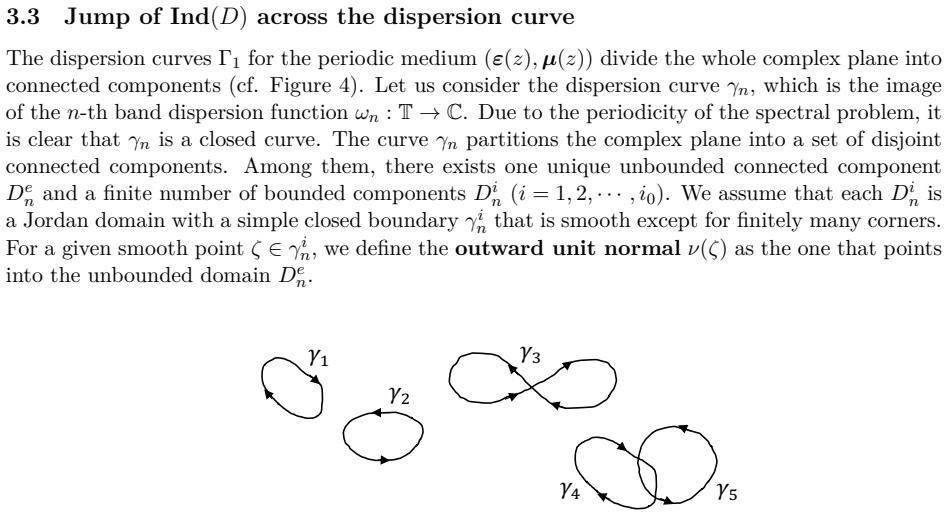
- [§3.3, Theorem 11] Theorem 11 is stated for a general closed curve γ_n, but the proof assumes that each bounded component D_i^n has a simple closed boundary γ_i^n and that W(γ_j^n;ω_B)=0 for j≠i. If γ_n self-intersects or has multiple loops, these points require additional justification; Remark 2 gestures at this but the theorem statement should carry the same qualification.
- [Appendix A] The displayed formula for the discriminant of the quartic is hard to parse and appears to contain a typo: Δ = − Δ1−4Δ2_0/27. Please check and correct this expression.
Circularity Check
No load-bearing circularity: Ind=W is proved, not assumed; the unverified path in Example 3 is a correctness gap, not a circular reduction.
full rationale
The central derivation is self-contained. The relation Ind(D_i^n;1)=W(γ_n;ω_B) in Theorem 12 is not posited as an input: Ind is a pointwise count of transfer-matrix eigenvalues inside/outside the unit circle at a fixed ω, while W is an integral winding number of the dispersion image ω_n(T). The proof derives the equality by local conformal inversion of ω_n near a smooth boundary point and by tracking which eigenvalue branch crosses |λ|=1; Theorem 11 independently relates orientation to W. Theorems 12 and 14 then use this equality as a theorem hypothesis, not as a restatement of a fitted or assumed quantity. There are no fitted constants, no subset of data being 'predicted', and no ansatz imported by citation. The only self-citation is [16] in Remark 1 for the scalar relation tr(M(ω))=2cos(k); that fact is standard and is not load-bearing for the main theorem. A genuine gap is that Example 3 does not exhibit a spectral-avoiding path g(t) required by Theorem 9, nor verify γ_n∩γ_m=∅; but this is a hypothesis-checking/correctness issue, not circularity, because the theorem's conclusion is not assumed in constructing the model, the transfer matrix, or the invariant.
Axiom & Free-Parameter Ledger
axioms (7)
- standard math Floquet-Bloch spectral theory: for Hermitian media the quasi-periodic Maxwell operator has countable real eigenvalues arranged in continuous bands.
- domain assumption For non-Hermitian media, the eigenfrequencies can be ordered by real part and the dispersion curves ω_n(k) are well-defined continuous closed curves without band-label ambiguity.
- domain assumption Assumption 7: the reference Hermitian photonic crystal has a band gap and a point ω0 on the spectrum with exactly two distinct unit-modulus transfer-matrix eigenvalues.
- ad hoc to paper Existence of a continuous curve g(t)∈Γ^c_t connecting the Hermitian reference gap to the target component D (Theorem 9(ii)).
- domain assumption The dispersion curves γ_n and γ_m do not intersect for m≠n, and ω_n is analytic at the chosen boundary point (Theorem 12).
- domain assumption In Theorem 14, ω is not a branch point of the transfer-matrix eigenvalues.
- domain assumption The ambient medium is vacuum and the boundary condition is the outgoing radiation condition (24b)-(25).
read the original abstract
This work investigates edge modes in non-Hermitian photonic crystals with broken spectral reciprocity. In such systems, the spectra of the underlying operators generally form closed loops over the complex plane with nontrivial spectral topology, which gives rise to the so-called skin effect characterized by edge modes localized at interfaces. For discrete lattice models, the skin effect can be understood through the spectral theory of Toeplitz matrices. However, this mathematical framework no longer applies to continuous wave models, where finite-dimensional approximations break down. In this work, we employ a transfer matrix approach to describe wave propagation in one-dimensional periodic media and introduce a new spectral topological invariant based on the eigenvalues of the transfer matrix. The new topological invariant is equivalent to the winding number of the non-Hermitian spectrum and it enables the characterization of edge modes in one-dimensional non-Hermitian photonic crystals. The mathematical theory provides the theoretical foundation for the skin effect in continuous wave models.
Figures



Reference graph
Works this paper leans on
-
[1]
Mathematical foundations of the non-Hermitian skin effect
Habib Ammari et al. “Mathematical foundations of the non-Hermitian skin effect” . In: Archive for Rational Mechanics and Analysis 248.3 (2024), p. 33
2024
-
[2]
Spectra and pseudo-spectra of tridiagonal k-Toeplitz matrices and the topological origin of the non-Hermitian skin effect
Habib Ammari et al. “Spectra and pseudo-spectra of tridiagonal k-Toeplitz matrices and the topological origin of the non-Hermitian skin effect” . In: Journal of Physics A: Mathematical and Theoretical 58.20 (2025), p. 205201
2025
-
[3]
Non-hermitian physics
Yuto Ashida, Zongping Gong, and Masahito Ueda. “Non-hermitian physics” . In: Advances in Physics 69.3 (2020), pp. 249–435
2020
-
[4]
Exceptional topology of non- Hermitian systems
Emil J Bergholtz, Jan Carl Budich, and Flore K Kunst. “Exceptional topology of non- Hermitian systems” . In: Reviews of Modern Physics 93.1 (2021), p. 015005
2021
-
[5]
Non-Hermitian boundary modes and topology
Dan S Borgnia, Alex Jura Kruchkov, and Robert-Jan Slager. “Non-Hermitian boundary modes and topology” . In: Physical review letters 124.5 (2020), p. 056802
2020
-
[6]
Spectral properties of banded Toeplitz matrices
Albrecht Böttcher and Sergei M Grudsky. Spectral properties of banded Toeplitz matrices . SIAM, 2005
2005
-
[7]
Ordinary differential equations with applications
Carmen Chicone. Ordinary differential equations with applications . Springer, 2006
2006
-
[8]
Non-Hermitian topology and exceptional-point geometries
Kun Ding, Chen Fang, and Guancong Ma. “Non-Hermitian topology and exceptional-point geometries” . In: Nature Reviews Physics 4.12 (2022), pp. 745–760
2022
-
[9]
An optimal bound for the spectral variation of two matrices
Ludwig Elsner. “An optimal bound for the spectral variation of two matrices” . In: Linear Algebra and its Applications 71 (1985), pp. 77–80. doi: 10.1016/0024-3795(85)90236-1
-
[10]
Geometry-dependent skin effects in reciprocal photonic crystals
Zhening Fang et al. “Geometry-dependent skin effects in reciprocal photonic crystals” . In: Nanophotonics 11.15 (2022), pp. 3447–3456
2022
-
[11]
Nonreciprocal magnetic photonic crystals
Alex Figotin and I Vitebsky. “Nonreciprocal magnetic photonic crystals” . In: Physical Review E 63.6 (2001), p. 066609
2001
-
[12]
Symmetry and topology in non-Hermitian physics
Kohei Kawabata et al. “Symmetry and topology in non-Hermitian physics” . In: Physical Review X 9.4 (2019), p. 041015
2019
-
[13]
Biorthogonal bulk-boundary correspondence in non-Hermitian systems
Flore K Kunst et al. “Biorthogonal bulk-boundary correspondence in non-Hermitian systems” . In: arXiv preprint arXiv:1805.06492 (2018)
Pith/arXiv arXiv 2018
-
[14]
Edge modes, degeneracies, and topological numbers in non-Hermitian systems
Daniel Leykam et al. “Edge modes, degeneracies, and topological numbers in non-Hermitian systems” . In: Physical review letters 118.4 (2017), p. 040401
2017
-
[15]
Topological phases in the non-Hermitian Su-Schrieffer-Heeger model
Simon Lieu. “Topological phases in the non-Hermitian Su-Schrieffer-Heeger model” . In: Phys- ical Review B 97.4 (2018), p. 045106
2018
-
[16]
Mathematical theory for topological photonic materials in one dimension
Junshan Lin and Hai Zhang. “Mathematical theory for topological photonic materials in one dimension” . In:Journal of Physics A: Mathematical and Theoretical 55.49 (2022), p. 495203
2022
-
[17]
Non-Hermitian topological phenomena: A review
Nobuyuki Okuma and Masatoshi Sato. “Non-Hermitian topological phenomena: A review” . In: Annual Review of Condensed Matter Physics 14.1 (2023), pp. 83–107
2023
-
[18]
Topological origin of non-Hermitian skin effects
Nobuyuki Okuma et al. “Topological origin of non-Hermitian skin effects” . In: Physical review letters 124.8 (2020), p. 086801
2020
-
[19]
Topological band theory for non-Hermitian Hamilto- nians
Huitao Shen, Bo Zhen, and Liang Fu. “Topological band theory for non-Hermitian Hamilto- nians” . In: Physical review letters 120.14 (2018), p. 146402. 20
2018
-
[20]
Non-hermitian chern bands
Shunyu Yao, Fei Song, and Zhong Wang. “Non-hermitian chern bands” . In: Physical review letters 121.13 (2018), p. 136802
2018
-
[21]
Edge states and topological invariants of non-Hermitian systems
Shunyu Yao and Zhong Wang. “Edge states and topological invariants of non-Hermitian systems” . In: Physical review letters 121.8 (2018), p. 086803
2018
-
[22]
Correspondence between winding numbers and skin modes in non-Hermitian systems
Kai Zhang, Zhesen Yang, and Chen Fang. “Correspondence between winding numbers and skin modes in non-Hermitian systems” . In: arXiv preprint arXiv:1910.01131 (2019)
Pith/arXiv arXiv 1910
-
[23]
A review on non-Hermitian skin effect
Xiujuan Zhang et al. “A review on non-Hermitian skin effect” . In: Advances in Physics: X 7.1 (2022), p. 2109431
2022
-
[24]
Nontrivial point-gap topology and non-Hermitian skin effect in photonic crystals
Janet Zhong et al. “Nontrivial point-gap topology and non-Hermitian skin effect in photonic crystals” . In: Physical Review B 104.12 (2021), p. 125416. 21
2021
discussion (0)
Sign in with ORCID, Apple, or X to comment. Anyone can read and Pith papers without signing in.