REVIEW 5 major objections 5 minor 62 references
A single unposed perspective image can be auto-leveled and completed into a gravity-aligned, seamless 360° panorama without camera parameters.
Reviewed by Pith at T0; open to challenge. T0 means a machine referee read the full paper against a public rubric. the ladder, T0–T4 →
T0 review · deepseek-v4-flash
2026-08-04 05:40 UTC pith:5DDWLFFH
load-bearing objection Useful framing and a plausible dataset, but the no-camera-parameters claim is a 3-DoF rotation short of what the problem needs, and the ablations don't support the story. the 5 major comments →
Gimbal360: Canonicalizing Planar Diffusion for Spherical Panorama Completion
The pith
A machine-rendered reading of the paper's core claim, the machinery that carries it, and where it could break.
Core claim
Gimbal360's central claim is that explicitly standardizing geometric and topological priors lets pre-trained planar diffusion models generate seamless 360° panoramas. Projective distortion is removed by predicting a dense correspondence field and then constraining it through a soft-argmin solver to a 3-DoF rigid rotation, mapping the perspective input into a Canonical Viewing Space where the horizon coincides with the equator. Topological continuity is enforced by replacing zero-padding with circular padding in the VAE and adding a Siamese shift-equivariance loss, so the network learns that circularly shifting the input shifts the output identically. The authors report that this yields state
What carries the argument
The Canonical Viewing Space — a gravity-aligned spherical coordinate system where the environmental horizon is the ERP equator — is the representation that makes planar diffusion applicable to spheres. The Differentiable Auto-Leveling module is a dense correspondence predictor followed by a soft-argmin rigid-projection bottleneck; the low-rank Jacobian of the rigid manifold filters chaotic diffusion gradients and prevents non-rigid jelly-like warps. Topologically Equivariant Generation modifies the VAE's padding to circular and trains a Siamese shift-consistency loss, forcing the diffusion transformer to be S^1-equivariant. Horizon360 supplies strictly rectified panoramas and ground-truth fl
Load-bearing premise
The method assumes that an unposed perspective photo can be brought into gravity alignment by a 3-DoF rotation alone, with no camera intrinsics; if the unknown focal length or field of view is not recoverable from the soft-argmin bottleneck, the canonicalization is geometrically incomplete.
What would settle it
Take a perspective image with a known extreme vertical field of view (e.g., 15°) and a known ground-truth panorama; if Gimbal360's output places the horizon at the wrong latitude or visibly stretches the visible content, then the auto-leveling did not recover the intrinsic scale, falsifying the no-camera-parameters claim.
If this is right
- In-the-wild photos with arbitrary pitch, roll, and focal length can be completed into gravity-aligned 360° environments without user-supplied camera extrinsics.
- Seam artifacts are resolved at training time rather than by post-hoc blending, so high-frequency detail survives across the wrap-around boundary.
- The same canonicalization lets a model trained on rectified panoramas generalize to off-level inputs, reducing structural hallucinations like tilted horizons and curved walls.
- The shift-equivariance objective provides a template for making any Euclidean generative backbone respect periodic structure.
- A curated, gravity-aligned panoramic dataset enables the geometric and topological priors to be learned rather than assumed.
Where Pith is reading between the lines
- If auto-leveling truly recovers the 3-DoF rotation, the same module could serve as a lightweight single-image horizon and gravity estimator, independent of the completion task.
- A stress test worth running: feed the model a perspective image whose vertical field of view is far outside the training mixture; the 3-DoF bottleneck cannot absorb focal-length changes, so output geometry may degrade in a measurable way.
- The shift-equivariance idea could transfer to other periodic synthesis tasks, such as 360° video or seamless texture generation, where the seam is currently patched by heuristics.
- Because the dataset is curated to be gravity-aligned, the method's success depends on the quality of that canonicalization; residual tilt in training data would propagate directly into the learned structural prior.
Editorial analysis
A structured set of objections, weighed in public.
Referee Report
Summary. Gimbal360 proposes a framework for completing 360° panoramas from a single unposed perspective image by aligning the input into a gravity-aligned Canonical Viewing Space via a Differentiable Auto-Leveling module, and by enforcing S^1 continuity through Topologically Equivariant Generation. The paper introduces a curated dataset, Horizon360, and reports state-of-the-art FID/KID/FAED/CLIPScore on indoor and outdoor benchmarks against three baselines. The central claims are that auto-leveling works without camera parameters at inference and that the shift-equivariance objective mathematically enforces seamless periodic generation.
Significance. If the results held, the paper would address a real and useful problem: adapting large planar diffusion priors to spherical panorama completion. The decomposition into canonicalization, auto-leveling, and topological equivariance is conceptually appealing, and the dataset is a potentially valuable resource. The paper includes qualitative comparisons and ablations, and the idea of constraining learned correspondence through a rigid solver is a sensible inductive bias. However, the technical formulation is underspecified, the camera-parameter-free claim is not supported by the geometry, and the empirical evidence for the topological equivariance component is internally inconsistent. The lack of equations for the core modules and the narrow comparison set prevent verification of the main contributions.
major comments (5)
- [Sec. 3.3 / Sec. 4] Eq. (1) defines the auto-leveling warp as z_canonical = W(z_ref, R_hat), with R_hat a 3-DoF rotation. However, a perspective image with unknown intrinsics cannot be mapped to an ERP by a rotation alone: the angular extent of the image is determined by the focal length. Section 4 explicitly samples variable vertical FOV and computes fy = 1/tan(θv/2), fx = fy/r, so the training distribution includes inputs whose intrinsic scale the 3-DoF solver cannot represent. The paper provides no equation for W, no intrinsic parameter in the solver, and no experiment that varies FOV while holding other factors fixed. Appendix D.3's admission that telephoto inputs are a failure mode is consistent with this limitation. The central claim of 'without requiring camera parameters at inference' is therefore unsupported for general inputs.
- [Table 1 / Sec. 5.3] The TEG ablation is not consistently favorable. On CVRG-Pano, the full model has FID 63.28 vs. 62.74 for w/o TEG, and KID 0.8236 vs. 0.8194. On Structured3D, the full model has higher KID (0.8106 vs. 0.8012). The text claims that the 'quantitative gap' demonstrates the superiority of native topological constraints, but the table shows the opposite on several metrics. This contradiction needs to be resolved, e.g., with significance testing, more metrics, or a revised interpretation.
- [Appendix C.2] The proof of equivariance is tautological: it posits L_shift -> 0 and then concludes that Rollδ(ϵθ(X,t)) = ϵθ(Rollδ(X),t), which is the definition of the loss being zero. Because L_shift is a soft penalty with a finite weight (λ_shift=0.5), convergence to zero is not guaranteed, and even approximate equality on the training distribution does not imply mathematical forcing. The statements in §3.4 and the abstract that TEG 'ensures' or 'enforces' S^1 continuity should be softened to 'encourages' or 'regularizes.'
- [Sec. 3.3] The Differentiable Auto-Leveling module is not specified to a reproducible level. No equation is given for the dense-correspondence-to-rotation soft-argmin solver, the reprojection error, the rigid spherical camera model, or the differentiable warp W. The cited [23] is a stereo-disparity method, not a rotation estimator; its adaptation to 3-DoF rotation is unclear. Without these formal definitions, the claimed 'structural gradient filter' property and the module's behavior cannot be verified.
- [Sec. 5.2] The comparison set is too narrow to support the state-of-the-art claim. Only HunyuanWorld, WorldGen, and DiT360 are evaluated; none is a dedicated single-image 360-degree outpainting method. The related work lists several directly relevant baselines (PanoDiffusion [49], PanoDecouple [60], CamFreeDiff [54], Matrix3D [30]) that are not included. The authors should either include these baselines or clearly justify their exclusion. As it stands, the SOTA claim is not established against the most relevant prior work.
minor comments (5)
- [Table 1] The header 'T able 1' contains a typo.
- [Appendix A.2] CFG scale of 30.0 is unusually high and likely a typo for 3.0; please verify.
- [Sec. 4 / Appendix B.3] The mixture-distribution parameters are inconsistent: Sec. 4 states P(Θ) = λ·N + (1-λ)·U with λ≈0.7, while Appendix B.3 gives per-parameter percentages (70/30 for pitch, 80/20 for roll, and 50/20 for FOV). Clarify the exact generative process.
- [Sec. 5.2 / Fig. 5] The in-the-wild generalization results are only qualitative. Reporting quantitative rotation/FOV estimation error or a user study would strengthen the robustness claim.
- [Sec. 5.1] The FAED metric is not defined in the text; please provide a definition or citation.
Circularity Check
One definitional tautology in the shift-equivariance proof; the empirical benchmark results and auto-leveling pipeline are not circular.
specific steps
-
self definitional
[Appendix C.2 'Proof of Equivariance' (used by Section 3.4)]
"Assuming successful convergence (Lshift→0), the properties of the L2 norm imply: Rollδ(ϵθ(X, t)) = ϵθ(Rollδ(X), t) almost everywhere."
The asserted equivariance equality is exactly the integrand of the L_shift loss defined in Section 3.4. The 'proof' therefore assumes the conclusion: if the shift-consistency loss reaches zero, the network is shift-equivariant by definition of that loss. This provides no independent derivation that training attains this minimum, no convergence guarantee, and no out-of-distribution bound. The 'mathematically forced' S1 continuity is a restatement of the training objective rather than a derived theorem.
full rationale
The paper's central empirical contribution—state-of-the-art panorama completion measured on held-out Structured3D and CVRG-Pano benchmarks with external metrics (FID, KID, FAED, CLIPScore)—is not circular. The Differentiable Auto-Leveling module is a supervised network trained against a ground-truth flow P_GT extracted from the canonicalized Horizon360 dataset; this is a standard learning setup, not a fitted input renamed as a prediction. The Canonical Viewing Space and Horizon360 canonicalization are design choices validated empirically, not derived from the model. The Appendix C.2 equivariance 'proof' is the one load-bearing step that reduces to its own definition: it states that if the L_shift consistency loss is zero, then the network is shift-equivariant, which is true by construction of that loss. This is a conditional tautology and does not independently establish seamless continuity, but it does not taint the benchmark comparisons. The self-citation [30] in related work is not load-bearing. The telephoto-input limitation in Appendix D.3 is a correctness caveat, not a circularity. Overall circularity is low-to-moderate, centered on the overclaimed 'proof' rather than on the empirical results.
Axiom & Free-Parameter Ledger
free parameters (4)
- lambda_shift =
0.5
- lambda_flow =
0.1
- pose/FOV mixture distribution parameters =
lambda~0.7; pitch 70% N(0,15), 30% U(-45,45); roll 80% N(0,5), 20% U(-45,45); FOV 50% N(60,10), 20% U(45,100)
- CFG scale =
30.0
axioms (5)
- standard math Latent diffusion / DiT training behaves as described by [37] and [16] under LoRA fine-tuning.
- domain assumption A single 3-DoF rigid rotation is a complete model of the perspective-to-ERP mapping for unposed inputs.
- domain assumption A frozen pre-trained VAE can be made topology-preserving by overriding horizontal zero-padding with circular padding without retraining.
- domain assumption Horizon360 canonicalization via vanishing-point/zenith alignment is correct on all 20k panoramas and generalizes to web/AI images.
- ad hoc to paper The Siamese shift-equivariance loss with finite weight is treated as a hard guarantee of S^1 continuity.
read the original abstract
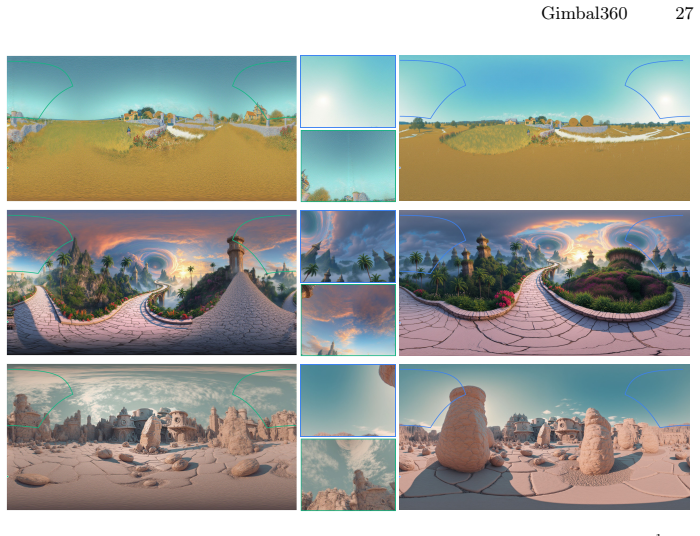
Diffusion models provide powerful priors for 2D image completion, but these priors are learned on bounded planar images and do not transfer directly to $360^\circ$ panoramas. Perspective observations and spherical panoramas differ in both projective geometry and topology: viewpoint-dependent distortion complicates spatial correspondence, while Equirectangular Projection (ERP) panoramas exhibit intrinsic $S^1$ periodicity that standard Euclidean architectures do not preserve. We present Gimbal360, a unified framework that adapts planar diffusion priors to spherical panoramic completion by standardizing these geometric and topological structures. Our Canonical Viewing Space expresses projective distortion as a fixed function of latitude, providing a consistent interface between perspective inputs and spherical panoramas. To map unposed in-the-wild images into this space, Differentiable Projective Canonicalization projects a dense correspondence field onto a 3-DoF rigid projection manifold without requiring camera parameters at inference. We further introduce Topologically Equivariant Generation, which enforces latent shift equivariance to preserve continuity across the periodic ERP boundary. Together, these designs allow diffusion to operate in a representation whose geometry and topology are explicitly aligned with the spherical domain. We also introduce Horizon360, a curated large-scale dataset of gravity-aligned panoramic environments. Extensive experiments show that Gimbal360 achieves state-of-the-art visual fidelity and seam continuity in $360^\circ$ scene completion.
Figures



Reference graph
Works this paper leans on
-
[1]
In: CVPR
Akimoto, N., Matsuo, Y., Aoki, Y.: Diverse plausible 360-degree image outpainting for efficient 3dcg background creation. In: CVPR. pp. 11441–11450 (2022) 4
2022
-
[2]
In: International Conference on Learning Representations (2018) 10
Bińkowski, M., Sutherland, D.J., Arbel, M., Gretton, A.: Demystifying mmd gans. In: International Conference on Learning Representations (2018) 10
2018
-
[3]
arXiv preprint arXiv:2506.21681 (2025) 4
Çapuk, H., Bond, A., Kızıl, M.B., Göçen, E., Erdem, E., Erdem, A.: Tandit: Tangent-plane diffusion transformer for high-quality 360{\deg}panorama gen- eration. arXiv preprint arXiv:2506.21681 (2025) 4
Pith/arXiv arXiv 2025
-
[4]
In: 2017 International Conference on 3D Vision (3DV)
Chang, A., Dai, A., Funkhouser, T., Halber, M., Niebner, M., Savva, M., Song, S., Zeng, A., Zhang, Y.: Matterport3d: Learning from rgb-d data in indoor environ- ments. In: 2017 International Conference on 3D Vision (3DV). pp. 667–676. IEEE Computer Society (2017) 9
2017
-
[5]
In: CVPR
Chang, H., Zhang, H., Jiang, L., Liu, C., Freeman, W.T.: Maskgit: Masked gener- ative image transformer. In: CVPR. pp. 11315–11325 (2022) 3
2022
-
[6]
ACM TOG41(6), 1–16 (2022) 4
Chen, Z., Wang, G., Liu, Z.: Text2light: Zero-shot text-driven hdr panorama gen- eration. ACM TOG41(6), 1–16 (2022) 4
2022
-
[7]
In: ECCV
Coors, B., Condurache, A.P., Geiger, A.: Spherenet: Learning spherical represen- tations for detection and classification in omnidirectional images. In: ECCV. pp. 518–533 (2018) 4
2018
-
[8]
In: ICML (2024) 3
Esser, P., Kulal, S., Blattmann, A., Entezari, R., Müller, J., Saini, H., Levi, Y., Lorenz, D., Sauer, A., Boesel, F., et al.: Scaling rectified flow transformers for high-resolution image synthesis. In: ICML (2024) 3
2024
-
[9]
In: CVPR
Esser, P., Rombach, R., Ommer, B.: Taming transformers for high-resolution image synthesis. In: CVPR. pp. 12873–12883 (2021) 3
2021
-
[10]
arXiv preprint arXiv:2510.11712 (2025) 4, 9, 11
Feng, H., Zhang, D., Li, X., Du, B., Qi, L.: Dit360: High-fidelity panoramic image generation via hybrid training. arXiv preprint arXiv:2510.11712 (2025) 4, 9, 11
arXiv 2025
-
[11]
arXiv preprint arXiv:2311.13141 (2023) 2, 4
Feng,M.,Liu,J.,Cui,M.,Xie,X.:Diffusion360:Seamless360degreepanoramicim- age generation based on diffusion models. arXiv preprint arXiv:2311.13141 (2023) 2, 4
Pith/arXiv arXiv 2023
-
[12]
Communications of the ACM63(11), 139–144 (2020) 3
Goodfellow, I., Pouget-Abadie, J., Mirza, M., Xu, B., Warde-Farley, D., Ozair, S., Courville, A., Bengio, Y.: Generative adversarial networks. Communications of the ACM63(11), 139–144 (2020) 3
2020
-
[13]
Guo,M.H.,Lu,C.Z.,Hou,Q.,Liu,Z.,Cheng,M.M.,Hu,S.M.:Segnext:Rethinking convolutional attention design for semantic segmentation35, 1140–1156 (2022) 7
2022
-
[14]
In: Proceedings of the 2021 conference on empirical methods in natural language processing
Hessel, J., Holtzman, A., Forbes, M., Le Bras, R., Choi, Y.: Clipscore: A reference- free evaluation metric for image captioning. In: Proceedings of the 2021 conference on empirical methods in natural language processing. pp. 7514–7528 (2021) 10
2021
-
[15]
Advances in neural information processing systems30(2017) 10
Heusel,M.,Ramsauer,H.,Unterthiner,T.,Nessler,B.,Hochreiter,S.:Ganstrained by a two time-scale update rule converge to a local nash equilibrium. Advances in neural information processing systems30(2017) 10
2017
-
[16]
Iclr1(2), 3 (2022) 19
Hu, E.J., Shen, Y., Wallis, P., Allen-Zhu, Z., Li, Y., Wang, S., Wang, L., Chen, W., et al.: Lora: Low-rank adaptation of large language models. Iclr1(2), 3 (2022) 19
2022
-
[17]
arXiv preprint arXiv:2506.17206 (2025) 4
Huang, Y., Zhou, Y., Wang, J., Huang, K., Liu, X.: Dreamcube: 3d panorama gen- eration via multi-plane synchronization. arXiv preprint arXiv:2506.17206 (2025) 4
Pith/arXiv arXiv 2025
-
[18]
arXiv preprint (2025) 2, 4, 11, 23
HunyuanWorld, T.: Hunyuanworld 1.0: Generating immersive, explorable, and in- teractive 3d worlds from words or pixels. arXiv preprint (2025) 2, 4, 11, 23
2025
-
[19]
Jaderberg, M., Simonyan, K., Zisserman, A., et al.: Spatial transformer networks 28(2015) 2, 7 16 Lu et al
2015
-
[20]
In: CVPR
Jiang, Z., Xiang, Z., Xu, J., Zhao, M.: Lgt-net: Indoor panoramic room layout estimation with geometry-aware transformer network. In: CVPR. pp. 1654–1663 (2022) 9
2022
-
[21]
In: CVPR
Jin, L., Zhang, J., Hold-Geoffroy, Y., Wang, O., Blackburn-Matzen, K., Sticha, M., Fouhey, D.F.: Perspective fields for single image camera calibration. In: CVPR. pp. 17307–17316 (2023) 10
2023
-
[22]
In: ICLR (2025) 4
Kalischek, N., Oechsle, M., Manhardt, F., Henzler, P., Schindler, K., Tombari, F.: Cubediff: Repurposing diffusion-based image models for panorama generation. In: ICLR (2025) 4
2025
-
[23]
In: ICCV
Kendall, A., Martirosyan, H., Dasgupta, S., Henry, P., Kennedy, R., Bachrach, A., Bry, A.: End-to-end learning of geometry and context for deep stereo regression. In: ICCV. pp. 66–75 (2017) 7
2017
-
[24]
In: ICCV
Kocabas, M., Huang, C.H.P., Tesch, J., Müller, L., Hilliges, O., Black, M.J.: Spec: Seeing people in the wild with an estimated camera. In: ICCV. pp. 11035–11045 (2021) 9
2021
-
[25]
Labs, B.F.: Flux.https://github.com/black-forest-labs/flux(2024) 10, 19
2024
-
[26]
Lee, Y., Kim, K., Kim, H., Sung, M.: Syncdiffusion: Coherent montage via syn- chronized joint diffusions36, 50648–50660 (2023) 2, 4
2023
-
[27]
Li, J., Bansal, M.: Panogen: Text-conditioned panoramic environment generation for vision-and-language navigation36, 21878–21894 (2023) 4
2023
-
[28]
IEEE TIP33, 382–394 (2023) 4
Liao, K., Xu, X., Lin, C., Ren, W., Wei, Y., Zhao, Y.: Cylin-painting: Seamless 360 panoramic image outpainting and beyond. IEEE TIP33, 382–394 (2023) 4
2023
-
[29]
In: ECCV
Liu, A., Li, Z., Chen, Z., Li, N., Xu, Y., Plummer, B.A.: Panofree: Tuning-free holistic multi-view image generation with cross-view self-guidance. In: ECCV. pp. 146–164. Springer (2024) 4
2024
-
[30]
In: CVPR
Lu, Y., Zhang, J., Fang, T., Nahmias, J.D., Tsin, Y., Quan, L., Cao, X., Yao, Y., Li, S.: Matrix3d: Large photogrammetry model all-in-one. In: CVPR. pp. 11250–11263 (2025) 2, 4
2025
-
[31]
In: CVPR
Lugmayr, A., Danelljan, M., Romero, A., Yu, F., Timofte, R., Van Gool, L.: Re- paint: Inpainting using denoising diffusion probabilistic models. In: CVPR. pp. 11461–11471 (2022) 2, 3
2022
-
[32]
In: ECCV
Oh, C., Cho, W., Chae, Y., Park, D., Wang, L., Yoon, K.J.: Bips: Bi-modal indoor panorama synthesis via residual depth-aided adversarial learning. In: ECCV. pp. 352–371. Springer (2022) 4
2022
-
[33]
Signal, Image and Video Processing (2021) 10
Orhan, S., Bastanlar, Y.: Semantic segmentation of outdoor panoramic images. Signal, Image and Video Processing (2021) 10
2021
-
[34]
In: ICCV
Peebles, W., Xie, S.: Scalable diffusion models with transformers. In: ICCV. pp. 4195–4205 (2023) 3
2023
-
[35]
Poly Haven: Poly haven hdris.https://polyhaven.com/hdris, accessed: Decem- ber 2025 9
2025
-
[36]
In: ICML
Radford, A., Kim, J.W., Hallacy, C., Ramesh, A., Goh, G., Agarwal, S., Sastry, G., Askell, A., Mishkin, P., Clark, J., et al.: Learning transferable visual models from natural language supervision. In: ICML. pp. 8748–8763. PmLR (2021) 6
2021
-
[37]
In: CVPR
Rombach, R., Blattmann, A., Lorenz, D., Esser, P., Ommer, B.: High-resolution image synthesis with latent diffusion models. In: CVPR. pp. 10684–10695 (2022) 2, 3, 5
2022
-
[38]
In: CVPR
Sun, C., Hsiao, C.W., Sun, M., Chen, H.T.: Horizonnet: Learning room layout with 1d representation and pano stretch data augmentation. In: CVPR. pp. 1047–1056 (2019) 9
2019
-
[39]
In: CVPR
Sun, C., Sun, M., Chen, H.T.: Hohonet: 360 indoor holistic understanding with latent horizontal features. In: CVPR. pp. 2573–2582 (2021) 9 Gimbal360 17
2021
-
[40]
In: ICML (2025) 4
Sun, X., Ma, S., Li, S., Xu, M., Xia, J., Jiang, L., Deng, X., Wang, J.: Spherical- nested diffusion model for panoramic image outpainting. In: ICML (2025) 4
2025
-
[41]
In: CVPR
Sun, X., Xu, M., Li, S., Ma, S., Deng, X., Jiang, L., Shen, G.: Spherical manifold guided diffusion model for panoramic image generation. In: CVPR. pp. 5824–5834 (2025) 4
2025
-
[42]
arXiv preprint arXiv:2412.03552 (2024) 4
Tan, J., Yang, S., Wu, T., He, J., Guo, Y., Liu, Z., Lin, D.: Imagine360: Immersive 360 video generation from perspective anchor. arXiv preprint arXiv:2412.03552 (2024) 4
Pith/arXiv arXiv 2024
-
[43]
In: ICCV
Tirado-Garín, J., Civera, J.: Anycalib: On-manifold learning for model-agnostic single-view camera calibration. In: ICCV. pp. 8044–8055 (2025) 10
2025
-
[44]
In: ECCV
Veicht, A., Sarlin, P.E., Lindenberger, P., Pollefeys, M.: Geocalib: Learning single- image calibration with geometric optimization. In: ECCV. pp. 1–20. Springer (2024) 10
2024
-
[45]
In: CVPR
Wang, Q., Li, W., Mou, C., Cheng, X., Zhang, J.: 360dvd: Controllable panorama video generation with 360-degree video diffusion model. In: CVPR. pp. 6913–6923 (2024) 4
2024
-
[46]
In: CVPR
Wang, Y., Tao, X., Shen, X., Jia, J.: Wide-context semantic image extrapolation. In: CVPR. pp. 1399–1408 (2019) 3
2019
-
[47]
World Labs: Generating worlds.https://www.worldlabs.ai/blog/generating- worlds, accessed: February 2026 23
2026
-
[48]
In: AAAI
Wu,T.,Li,X.,Qi,Z.,Hu,D.,Wang,X.,Shan,Y.,Li,X.:Spherediffusion:Spherical geometry-aware distortion resilient diffusion model. In: AAAI. vol. 38, pp. 6126– 6134 (2024) 4
2024
-
[49]
In: ICLR (2024) 2, 4
Wu, T., Zheng, C., Cham, T.J.: Panodiffusion: 360-degree panorama outpainting via diffusion. In: ICLR (2024) 2, 4
2024
-
[50]
In: CVPR
Xiao, J., Ehinger, K.A., Oliva, A., Torralba, A.: Recognizing scene viewpoint using panoramic place representation. In: CVPR. pp. 2695–2702. IEEE (2012) 9
2012
-
[51]
Xie, Z.: Worldgen: Generate any 3d scene in seconds.https://github.com/ ZiYang-xie/WorldGen(2025) 11, 23, 24
2025
-
[52]
In: Proceedings of the special interest group on computer graphics and interactive techniques conference conference papers
Yang, S., Tan, J., Zhang, M., Wu, T., Wetzstein, G., Liu, Z., Lin, D.: Layerpano3d: Layered 3d panorama for hyper-immersive scene generation. In: Proceedings of the special interest group on computer graphics and interactive techniques conference conference papers. pp. 1–10 (2025) 9
2025
-
[53]
In: ECCV
Yao, K., Gao, P., Yang, X., Sun, J., Zhang, R., Huang, K.: Outpainting by queries. In: ECCV. pp. 153–169. Springer (2022) 3
2022
-
[54]
In: CVPR
Yuan, X., Tang, S., Li, K., Wang, P.: Camfreediff: camera-free image to panorama generation with diffusion model. In: CVPR. pp. 16408–16417 (2025) 4
2025
-
[55]
In: CVPR
Zhang, C., Wu, Q., Gambardella, C.C., Huang, X., Phung, D., Ouyang, W., Cai, J.: Taming stable diffusion for text to 360 panorama image generation. In: CVPR. pp. 6347–6357 (2024) 4, 10
2024
-
[56]
In: ICCV
Zhang, L., Rao, A., Agrawala, M.: Adding conditional control to text-to-image diffusion models. In: ICCV. pp. 3836–3847 (2023) 3
2023
-
[57]
In: ECCV
Zhang,Y.,Song,S.,Tan,P.,Xiao,J.:Panocontext:Awhole-room3dcontextmodel for panoramic scene understanding. In: ECCV. pp. 668–686. Springer (2014) 9
2014
-
[58]
Zhao, S., Cui, J., Sheng, Y., Dong, Y., Liang, X., Chang, E.I., Xu, Y.: Large scale imagecompletionviaco-modulatedgenerativeadversarialnetworks.arXivpreprint arXiv:2103.10428 (2021) 3
Pith/arXiv arXiv 2021
-
[59]
In: CVPR
Zheng, C., Cham, T.J., Cai, J.: Pluralistic image completion. In: CVPR. pp. 1438– 1447 (2019) 2, 3
2019
-
[60]
In: CVPR
Zheng, D., Zhang, C., Wu, X.M., Li, C., Lv, C., Hu, J.F., Zheng, W.S.: Panorama generation from nfov image done right. In: CVPR. pp. 21610–21619 (2025) 2, 4 18 Lu et al
2025
-
[61]
In: ECCV (2020) 10
Zheng, J., Zhang, J., Li, J., Tang, R., Gao, S., Zhou, Z.: Structured3d: A large photo-realistic dataset for structured 3d modeling. In: ECCV (2020) 10
2020
-
[62]
In: CVPR
Zou, C., Colburn, A., Shan, Q., Hoiem, D.: Layoutnet: Reconstructing the 3d room layout from a single rgb image. In: CVPR. pp. 2051–2059 (2018) 9 Gimbal360 19 A Extended Experimental Setups A.1 Training Details To train Gimbal360 effectively while managing the memory footprint of the mas- sive Flux.1-fill-dev backbone [25], we employ Low-Rank Adaptation (...
2051
discussion (0)
Sign in with ORCID, Apple, or X to comment. Anyone can read and Pith papers without signing in.