REVIEW 5 minor 10 cited by
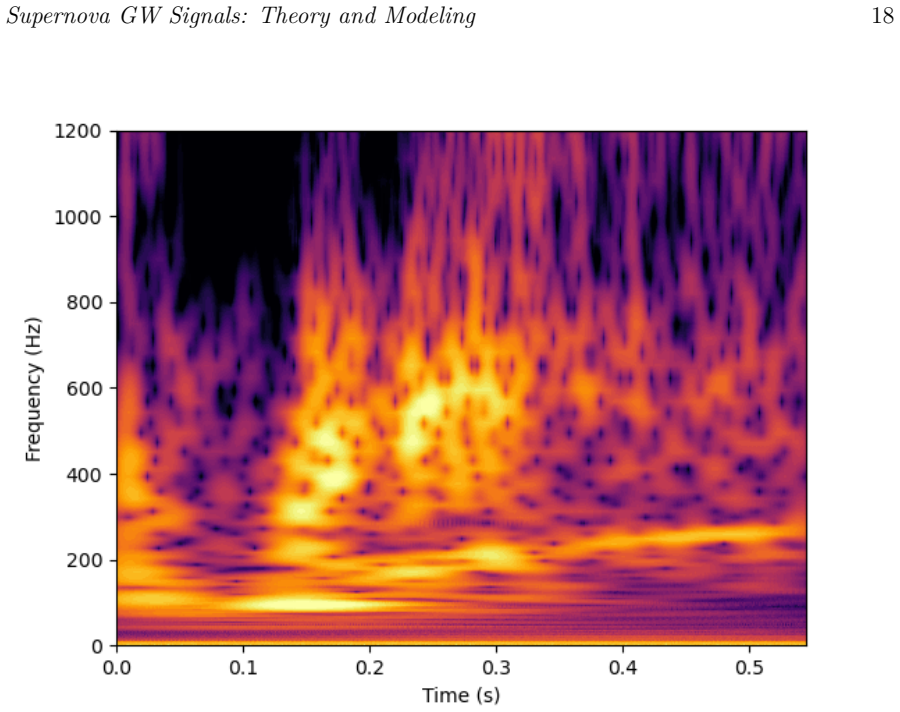
A Galactic core-collapse supernova's gravitational waves would carry a structured, partially universal signal—led by a high-frequency band that rises from ~200 Hz to >1 kHz in the first second after bounce—whose measured trajectory would di
Reviewed by Pith at T0; open to challenge. T0 means a machine referee read the full paper against a public rubric. the ladder, T0–T4 →
T0 review · deepseek-v4-flash
2026-08-02 17:31 UTC pith:IF5GUNZS
load-bearing objection A careful, honest review of supernova GW theory that organizes the field's signal taxonomy and open questions; the key universality caveat is already in the text, so treat the frequency relations as provisional.
Core-Collapse Supernovae and their Gravitational Wave Signals: The Status of Theory and Modeling
The pith
A machine-rendered reading of the paper's core claim, the machinery that carries it, and where it could break.
Core claim
The review's central claim is that modern 3D simulations predict a partially universal gravitational-wave signature from core-collapse supernovae: buoyancy-dominated oscillations of the proto-neutron star surface produce a sharply defined high-frequency emission band, rising from about 200 Hz to over 1 kHz during the first second after bounce. Because the mode frequency tracks the proto-neutron star's mass, radius, and surface temperature, the measured frequency trajectory would, if the underlying relations hold, encode the accretion history, contraction, and ultimately the nuclear equation of state of the newborn neutron star. Together with the rotational-bounce amplitude, the SASI band, an
What carries the argument
The load-bearing object is the buoyancy-dominated oscillation mode of the proto-neutron star surface (an f/g-mode) that sources the high-frequency band. The review points to a local mode-frequency relation f_g ≈ (1/2π)(GM/R²)√(1.1 m_n/⟨E_ν̄e⟩)(1 − GM/Rc²)², plus calibrated 'universal' fits in M/R² and M/R³, as the bridge from waveform to physics. This relation converts a time-frequency track into a readout of the proto-neutron star's mass, radius, and surface temperature; the mode identification is backed by linear perturbation theory (the Cowling-approximation eigenvalue problem for p-, g-, and f-modes).
Load-bearing premise
The load-bearing premise is that the calibrated 'universal' relations connecting mode frequency to proto-neutron-star mass and radius hold across simulation codes, equations of state, and rotation rates; the review itself flags that this universality needs scrutiny, citing deviations for rapid rotation, and unresolved neutrino flavor conversion could also shift the signal structure.
What would settle it
Run the same proto-neutron-star structure with different neutrino-transport treatments or equations of state and check whether the high-frequency trajectory stays within the ~15% error the review quotes for pseudo-Newtonian gravity; a larger scatter would break the universality claim. Observationally, a Galactic event whose measured frequency trajectory cannot be fit by any M/R²-M/R³ relation with a consistent proto-neutron-star evolution would falsify the central inference.
If this is right
- Measuring the high-frequency trajectory could map the proto-neutron star's mass and radius as functions of time after bounce, directly revealing its accretion history and contraction.
- The rotational bounce signal's amplitude scales tightly with the core's T/|W|, so a detection would quantitatively constrain progenitor rotation.
- The SASI band and the neutrino-memory component provide diagnostics for distinguishing successful explosions, black-hole formation, and magnetorotational or phase-transition scenarios.
- Time-dependent parameter inference from the high-frequency band becomes feasible at signal-to-noise ratios around 25, enabling equation-of-state constraints without needing neutrino temperature information.
- If the core g-mode or a phase-transition burst is seen, it would probe nuclear matter above saturation density and possibly a quark-hadron phase transition.
Where Pith is reading between the lines
- If the universality of the mode-frequency relations holds, the same inversion could be applied to longer-duration signals in future third-generation detectors, extending the inference window beyond the first second of current simulations.
- A single Galactic event would test only one trajectory; the community could pre-commit to a blind-analysis protocol comparing predicted and observed frequency tracks, turning a one-off measurement into a stronger test of universality.
- The review's emphasis on uncertainty quantification suggests that cross-code mock-data challenges, where pipelines infer proto-neutron-star properties from simulated waveforms without knowing the input model, are a natural next milestone that could be organized before any real detection.
Editorial analysis
A structured set of objections, weighed in public.
Referee Report
Summary. This review synthesizes the current theoretical and modeling status of gravitational-wave (GW) emission from core-collapse supernovae. It summarizes the explosion mechanism (neutrino-driven, magnetorotational, and phase-transition scenarios) and then surveys predicted GW signal components: the rotational bounce, prompt convection, the high-frequency proto-neutron-star oscillation band, SASI, the core g-mode, phase-transition bursts, and the neutrino/matter memory signal. The paper's central thesis is that the high-frequency ramp, rising from roughly 200 Hz to above 1 kHz after bounce, is the most robust GW feature and that its instantaneous frequency, if measurable, encodes direct information about proto-neutron-star mass, radius, accretion history, and ultimately the nuclear equation of state. The review also calls for community-level preparation through curated model databases, systematic uncertainty quantification, and multi-messenger evidence assessment.
Significance. If this assessment is correct, a Galactic core-collapse supernova would yield a rich GW dataset capable of constraining progenitor rotation, proto-neutron-star structure, the nuclear equation of state, the explosion mechanism, and the nature of hydrodynamic instabilities. The review is valuable as a concise, current status report aimed at the nascent IGWN community; it organizes a large body of simulation work and explicitly identifies open problems. Its main strength is honesty: it states the domain of validity of the quadrupole approximation, quantifies known systematic errors (pseudo-Newtonian gravity of order 15%, monopole-gravity bias), and explicitly flags the unresolved status of collective neutrino flavor conversion. In particular, the potentially load-bearing caveat—whether the calibrated mode-frequency relations are truly universal—is acknowledged in §3.5.1, with deviations for rapid rotation cited. Thus the central inference program is presented with appropriate hedging rather than overclaimed. The paper does not present new derivations or simulations, but as a review this is not a deficiency; its utility lies in synthesis and prioritization of open questions.
minor comments (5)
- [Figure 2 and §3.2 caption] The caption attributes the waveform to a 'relativistic 3D simulation of a non-rotating 20 Msun star [116]', but reference [116] is Yoon (2017), a stellar-evolution paper, not a core-collapse simulation. Please correct this citation to the actual simulation source used for the figure.
- [§2.5] The statement that GW190814 involved a '~2.8 Msun black hole' is inaccurate: the secondary component is about 2.5-2.6 Msun. Moreover, reference [86] is a population-synthesis paper on the mass gap, not the discovery paper for GW190814; please cite Abbott et al. 2020 (ApJ 896, L44) or the appropriate LIGO/Virgo publication.
- [References [169] and [170]] References [169] and [170] are identical (Shibagaki et al. 2020, MNRAS 493, L138). They are cited for related but distinct-sounding claims in §3.7.4; please correct one of the citations to the intended different source or merge them.
- [§3.7.3 and §3.7.4] Minor language issues: §3.7.3 'the EoS to be relatively at lower densities' should presumably read 'relatively soft at lower densities'; §3.7.4 'the absence of presence of a rotational bounce signal' should read 'the absence or presence'.
- [§3.5.1] Equation (8) is introduced as using the mean electron antineutrino energy as a temperature proxy. It would help the reader to state explicitly that the same quantity is also the one most susceptible to changes from collective neutrino flavor conversion, which is flagged later in §2.4 but not connected to Eq. (8) at that point.
Circularity Check
No significant circularity: the review attributes each formula to external original work, performs no new derivation, and explicitly flags the universality of the frequency relations as an open question rather than assuming it.
full rationale
This is a review paper, not a derivation. The central GW inference program rests on Eq. (8) (attributed to Müller et al. 2013 [7]) and on the calibrated M/R² and M/R³ relations from refs [142–144]; these are presented as prior theoretical or semi-empirical results from simulations, not as quantities defined by the target prediction. Eq. (8) is stated to follow from a local approximation for buoyancy-mode frequencies, and the text explicitly calls the alternative relations “semi-empirical” and “calibrated,” which is an honest description of fitting rather than a disguised prediction. Moreover, the review itself supplies the key non-circularity check: it states “To what extent these frequency relations are truly universal requires scrutiny” and cites reported deviations for rapid rotation ([146,100,147]). That is an acknowledged scientific uncertainty about transferability, not a construction-level equivalence. The numerous self-citations (e.g., [7], [34], [64], [142], [144], [145], [146], [147], [158]) are to original simulations and analyses that are externally checkable and not invoked as an unverified uniqueness theorem. No equation in the review is equivalent to its input by definition, no fitted parameter is relabeled as a prediction, and no ansatz is smuggled in via citation. Hence no circular step can be exhibited.
Axiom & Free-Parameter Ledger
free parameters (4)
- Exponent in h ∝ E_turb^1.88 scaling =
1.88 (effective power law, from [8])
- 'Universal' mode-frequency relation calibrations (f ↔ M/R², M/R³) =
Calibration coefficients from refs [142–144]
- SASI period relation constants (Eq. 14) =
19 ms pre-factor with r_sh/100 km and ln(r_sh/R)
- PNS surface-temperature proxy ⟨E_ν̄e⟩ in Eq. 8 =
Angle-averaged electron-antineutrino mean energy from simulations
axioms (5)
- standard math Slow-motion weak-field quadrupole/stress formulas (Eqs. 2–3) give the GW strain of CCSN sources to sufficient accuracy.
- standard math Cowling approximation (no spacetime perturbations) is adequate for proto-neutron-star oscillation mode analysis.
- domain assumption The neutrino-driven mechanism is the baseline explosion mechanism for non- or slowly-rotating massive stars.
- domain assumption Collective neutrino flavor conversion does not qualitatively alter the predicted GW features.
- standard math Bounce-signal frequency scales as f ∝ sqrt(Gρ_c) (fundamental mode scaling).
read the original abstract
The detection of gravitational waves from a core-collapse supernova in the Milky Way or its vicinity represents a unique opportunity to probe the inner workings of these explosions. In this review, I briefly summarize our current understanding of the supernova explosion mechanism and then outline the physical processes that shape the supernova gravitational wave signal. The review highlights how the various components of the signal have the potential to constrain the progenitor rotation, the proto-neutron star structure, the nuclear equation of state, the nature of hydrodynamic instabilities, and the violence of turbulent motions in the supernova core. I also highlight some open questions and uncertainties in the theory of supernova gravitational wave astronomy as well as challenges for further progress. Specifically, there is a need to develop large model databases, systematic uncertainty quantification and methods for evidence assessment to prepare for multi-messenger observations from a Galactic supernova.
Figures


Forward citations
Cited by 10 Pith papers
-
Bidirectional Internal Squeezing for Gravitational-Wave Detectors
Bidirectional internal squeezing using opposing optical parametric amplifiers saturates quantum noise lower bounds from internal dissipation and renders high-frequency signal-referred noise independent of arm and sign...
-
Assessing the Impact of Instrumental Requirements on the Scientific Performance of the Einstein Telescope
Degrading the Einstein Telescope's sensitivity in specific frequency bands hurts different science goals in predictable ways, but the mission remains scientifically strong even in the worst modelled cases.
-
Hot blue progenitors of stellar-mass black holes
Black hole progenitors are predominantly hot and blue at pre-collapse, often Wolf-Rayet stars luminous in ultraviolet, with only a minority as red supergiants, and a direct-collapse rate of about 0.4 per century for a...
-
Thermal Effects on the Moment of Inertia and Gravitational Redshift of PSR J1012+5307: Implications for Hyperonic Matter under SU(3) and SU(6) Symmetries
Thermal cooling of hyperonic neutron stars under SU(3) and SU(6) symmetries produces large drops in radius and moment of inertia plus large rises in gravitational redshift for PSR J1012+5307, while cold hyperonic and ...
-
Parameter Estimation Horizon of Core-Collapse Supernovae with Current and Next-Generation Gravitational-Wave Detectors
Machine learning extracts core rotation and signal properties from CCSN gravitational waves, with next-generation detectors constraining rotation beyond 100 kpc for favorable orientations despite some uncertainties.
-
Understanding supernova gravitational waves with protoneutron star asteroseismology
Linear analysis of protoneutron star oscillations identifies potential universal relations with supernova gravitational wave signals that are independent of model parameters.
-
Hot blue progenitors of stellar-mass black holes
Stellar evolution and atmosphere models predict black hole progenitors are predominantly hot and blue with a direct-collapse rate of ~0.4 per century in a 1 Msun/yr star-forming galaxy.
-
Toward More Realistic Machine-Learning Inference of the Dense-Matter Equation of State from Supernova Gravitational Waves
Real detector noise, multi-progenitor diversity, and 20 ms bounce-time uncertainty leave EOS classification accuracy from CCSN GWs largely intact; larger datasets improve it.
-
Thermal Effects on the Moment of Inertia and Gravitational Redshift of PSR J1012+5307: Implications for Hyperonic Matter under SU(3) and SU(6) Symmetries
Cooling a 1.94-solar-mass hyperonic star from T=30 MeV to 0 MeV under the SU(3) GM1 model shrinks its radius by about 48%, sharply lowers its moment of inertia, and roughly doubles its gravitational redshift.
-
Toward More Realistic Machine-Learning Inference of the Dense-Matter Equation of State from Supernova Gravitational Waves
Using a linear SVM, EOS classification from bounce gravitational waves remains robust to real noise, progenitor diversity, and bounce-time uncertainty in the frequency domain, but collapses in the time domain under ti...
Reference graph
Works this paper leans on
-
[1]
Hirata K, Kajita T, Koshiba M, Nakahata M and Oyama Y 1987 Physical Review Letters 58 1490–1493
1987
-
[2]
Bionta R M, Blewitt G, Bratton C B, Casper D and Ciocio A 1987 Physical Review Letters 58 1494–1496
1987
-
[3]
Alekseev E N, Alekseeva L N, Volchenko V I and Krivosheina I V 1987 Soviet Journal of Experimental and Theoretical Physics Letters 45 589
1987
-
[4]
Press W H and Thorne K S 1972 Ann. Rev. Astron. Astrophys. 10 335
1972
-
[5]
Abbott B P, Abbott R, Abbott T D, Acernese F, Ackley K, Adams C, Adams T, Addesso P, Adhikari R X, Adya V B, Affeldt C, Afrough M, Agarwal B, Agathos M, Agatsuma K, Aggarwal N, Aguiar O D, Aiello L, Ain A, Ajith P, Allen B, Allen G, Allocca A, Altin P A, Amato A, Ananyeva A, Anderson S B, Anderson W G, Angelova S V, Antier S, Appert S, Arai K, Araya M C, ...
2017
-
[6]
Yakunin K N, Marronetti P, Mezzacappa A, Bruenn S W, Lee C, Chertkow M A, Hix W R, Blondin J M, Lentz E J, Bronson Messer O E and Yoshida S 2010 Classical and Quantum Gravity 27 194005–+
2010
-
[7]
Müller B, Janka H T and Marek A 2013 Astrophys. J. 766 43
2013
-
[8]
Radice D, Morozova V, Burrows A, Vartanyan D and Nagakura H 2019 Astrophys. J. 876 L9
2019
-
[9]
Abdikamalov E, Pagliaroli G and Radice D 2022 Gravitational Waves from Core- Collapse Supernovae Handbook of Gravitational Wave Astronomy ed C Bambi S Katsanevas K D K (Springer Nature) p 21
2022
-
[10]
Mezzacappa A and Zanolin M 2025 Reviews of Modern Physics 97 041002
2025
-
[11]
Müller B 2020 Living Reviews in Computational Astrophysics 6 3
2020
-
[12]
Mezzacappa A, Endeve E, Messer O E B and Bruenn S W 2020 Living Reviews in Computational Astrophysics 6 4
2020
-
[13]
Burrows A and Vartanyan D 2021 Nature 589 29–39
2021
-
[14]
Janka H T 2025 Annual Review of Nuclear and Particle Science 75 425–461
2025
-
[15]
Woosley S E, Heger A and Weaver T A 2002 Rev. Mod. Phys. 74 1015–1071
2002
-
[16]
Heger A, Fryer C L, Woosley S E, Langer N and Hartmann D H 2003 Astrophys. J. 591 288–300
2003
-
[17]
Sana H, de Mink S E, de Koter A, Langer N, Evans C J, Gieles M, Gosset E, Izzard R G, Le Bouquin J B and Schneider F R N 2012 Science 337 444
2012
-
[18]
Nomoto K 1984 Astrophys. J. 277 791–805
1984
-
[19]
Jones S, Hirschi R and Nomoto K 2014 Astrophys. J. 797 83
2014
-
[20]
Doherty C L, Gil-Pons P, Siess L and Lattanzio J C 2017 Publ. Astron. Soc. Australia 34 e056
2017
-
[21]
Leung S C and Nomoto K 2019 Publ. Astron. Soc. Australia 36 e006
2019
-
[22]
Woosley S E and Heger A 2015 Astrophys. J. 810 34
2015
-
[23]
Nomoto K 1987 Astrophys. J. 322 206–214
1987
-
[24]
Woosley S E 2017 Astrophys. J. 836 244 REFERENCES 24
2017
-
[25]
Heger A, Müller B and Mandel I Black holes as the end state of stellar evolution: Theory and simulations The Encyclopedia of Cosmology ed Haiman Z (World Scientific Series in Astrophysics) chap 3, pp 61–111 URL https: //www.worldscientific.com/doi/abs/10.1142/9789811282676_0003
-
[26]
Bethe H A 1990 Rev. Mod. Phys. 62 801–866
1990
-
[27]
Langanke K, Martínez–Pinedo G, Sampaio J M, Dean D J, Hix W R, Messer O E, Mezzacappa A, Liebendörfer M, Janka H T and Rampp M 2003 Physical Review Letters 90 241102–+
2003
-
[28]
Astrophys
Jones S, Röpke F K, Pakmor R, Seitenzahl I R, Ohlmann S T and Edelmann P V F 2016 Astron. Astrophys. 593 A72
2016
-
[29]
Kirsebom O S, Jones S, Strömberg D F, Martínez-Pinedo G, Langanke K, Röpke F K, Brown B A, Eronen T, Fynbo H O U, Hukkanen M, Idini A, Jokinen A, Kankainen A, Kostensalo J, Moore I, Möller H, Ohlmann S T, Penttilä H, Riisager K, Rinta-Antila S, Srivastava P C, Suhonen J, Trzaska W H and ńystö J 2019 Phys. Rev. Lett. 123 262701
2019
-
[30]
Mazurek T J 1982 Astrophys. J. 259 L13–L17
1982
-
[31]
Burrows A and Lattimer J M 1985 Astrophys. J. 299 L19–L22
1985
-
[32]
Bruenn S W and Dineva T 1996 Astrophys. J. 458 L71–L74
1996
-
[33]
Glas R, Janka H T, Melson T, Stockinger G and Just O 2019 Astrophys. J. 881 36
2019
-
[34]
Jakobus P, Müller B and Heger A 2025 Mon. Not. R. Astron. Soc. 540 3008–3031
2025
-
[35]
Herant M, Benz W, Hix W R, Fryer C L and Colgate S A 1994 Astrophys. J. 435 339–361
1994
-
[36]
Burrows A, Hayes J and Fryxell B A 1995 Astrophys. J. 450 830–850
1995
-
[37]
Janka H T and Müller E 1995 Astrophys. J. 448 L109–L113
1995
-
[38]
Foglizzo T, Scheck L and Janka H T 2006 Astrophys. J. 652 1436–1450
2006
-
[39]
Blondin J M, Mezzacappa A and DeMarino C 2003 Astrophys. J. 584 971–980
2003
-
[40]
Blondin J M and Mezzacappa A 2007 Nature 445 58–60
2007
-
[41]
Blondin J M and Mezzacappa A 2006 Astrophys. J. 642 401–409
2006
-
[42]
Foglizzo T, Galletti P, Scheck L and Janka H T 2007 Astrophys. J. 654 1006–1021
2007
-
[43]
Müller B, Janka H T and Marek A 2012 Astrophys. J. 756 84
2012
-
[44]
Hanke F, Müller B, Wongwathanarat A, Marek A and Janka H T 2013 Astrophys. J. 770 66
2013
-
[45]
Fernández R, Müller B, Foglizzo T and Janka H T 2014 Mon. Not. R. Astron. Soc. 440 2763–2780
2014
-
[46]
Fernández R 2015 Mon. Not. R. Astron. Soc. 452 2071–2086
2015
-
[47]
Müller B and Varma V 2020 Mon. Not. R. Astron. Soc. 498 L109–L113 REFERENCES 25
2020
-
[48]
Akiyama S, Wheeler J C, Meier D L, Lichtenstadt I Meier D L and Lichtenstadt 2003 Astrophys. J. 584 954–970
2003
-
[49]
Astrophys
Obergaulinger M, Cerdá-Durán P, Müller E and Aloy M A 2009 Astron. Astrophys. 498 241–271
2009
-
[50]
Raynaud R, Guilet J, Janka H T and Gastine T 2020 Science Advances 6 eaay2732
2020
-
[51]
Astrophys
Barrère P, Guilet J, Reboul-Salze A, Raynaud R and Janka H T 2022 Astron. Astrophys. 668 A79
2022
-
[52]
Astrophys
Janka H T 2001 Astron. Astrophys. 368 527–560
2001
-
[53]
Fernández R 2012 Astrophys. J. 749 142
2012
-
[54]
Murphy J W, Dolence J C and Burrows A 2013 Astrophys. J. 771 52
2013
-
[55]
Müller B and Janka H T 2015 Mon. Not. R. Astron. Soc. 448 2141–2174
2015
-
[56]
Mabanta Q A and Murphy J W 2018 Astrophys. J. 856 22
2018
-
[57]
Müller B 2016 Publ. Astron. Soc. Australia 33 e048
2016
-
[58]
Lentz E J, Mezzacappa A, Bronson Messer O E, Hix W R and Bruenn S W 2012 Astrophys. J. 760 94
2012
-
[59]
Melson T, Janka H T, Bollig R, Hanke F, Marek A and Müller B 2015 Astrophys. J. 808 L42
2015
-
[60]
Janka H T, Hanke F, Hüdepohl L, Marek A, Müller B and Obergaulinger M 2012 Progress of Theoretical and Experimental Physics 2012 010000
2012
-
[61]
Suwa Y, Takiwaki T, Kotake K, Fischer T, Liebendörfer M and Sato K 2013 Astrophys. J. 764 99
2013
-
[62]
Yasin H, Schäfer S, Arcones A and Schwenk A 2020 Phys. Rev. Lett. 124 092701
2020
-
[63]
Ghosh S, Wolfe N and Fröhlich C 2022 Astrophys. J. 929 43
2022
-
[64]
Powell J and Müller B 2025 Classical and Quantum Gravity 42 215002
2025
-
[65]
Rusakov A, Burrows A S, Wang T and Vartanyan D 2026 arXiv e-prints arXiv:2602.09025
Pith/arXiv arXiv 2026
-
[66]
Dunham S J, Endeve E, Mezzacappa A, Blondin J M, Buffaloe J and Holley- Bockelmann K 2024 Astrophys. J. 964 38
2024
-
[67]
Tamborra I and Shalgar S 2021 Annual Review of Nuclear and Particle Science 71 165–188
2021
-
[68]
Ehring J, Abbar S, Janka H T, Raffelt G and Tamborra I 2023 Phys. Rev. Lett. 131 061401
2023
-
[69]
Wang T and Burrows A 2025 Astrophys. J. 986 153
2025
-
[70]
Couch S M and Ott C D 2013 Astrophys. J. 778 L7
2013
-
[71]
Couch S M, Chatzopoulos E, Arnett W D and Timmes F X 2015 Astrophys. J. 808 L21
2015
-
[72]
Müller B, Melson T, Heger A and Janka H T 2017 Mon. Not. R. Astron. Soc. 472 491–513 REFERENCES 26
2017
-
[73]
Abdikamalov E and Foglizzo T 2020 Mon. Not. R. Astron. Soc. 493 3496–3512
2020
-
[74]
Müller B, Viallet M, Heger A and Janka H T 2016 Astrophys. J. 833 124
2016
-
[75]
Abdikamalov E, Huete C, Nussupbekov A and Berdibek S 2018 Particles 1 7
2018
-
[76]
Bollig R, Yadav N, Kresse D, Janka H T, Müller B and Heger A 2021 Astrophys. J. 915 28
2021
-
[77]
Lentz E J, Bruenn S W, Hix W R, Mezzacappa A, Messer O E B, Endeve E, Blondin J M, Harris J A, Marronetti P and Yakunin K N 2015 Astrophys. J. 807 L31
2015
-
[78]
Melson T, Janka H T and Marek A 2015 Astrophys. J. 801 L24
2015
-
[79]
Takiwaki T, Kotake K and Suwa Y 2014 Astrophys. J. 786 83
2014
-
[80]
Müller B 2015 Mon. Not. R. Astron. Soc. 453 287–310
2015
discussion (0)
Sign in with ORCID, Apple, or X to comment. Anyone can read and Pith papers without signing in.