Recognition: 2 theorem links
· Lean TheoremMn substitution induced a ferrimagnetic to ferromagnetic transition in trigonal Cr₅Te₈
Pith reviewed 2026-05-15 00:40 UTC · model grok-4.3
The pith
Manganese substitution transforms trigonal Cr5Te8 from ferrimagnetic to ferromagnetic ordering while raising the transition temperature from 226 K to 249 K.
A machine-rendered reading of the paper's core claim, the machinery that carries it, and where it could break.
Core claim
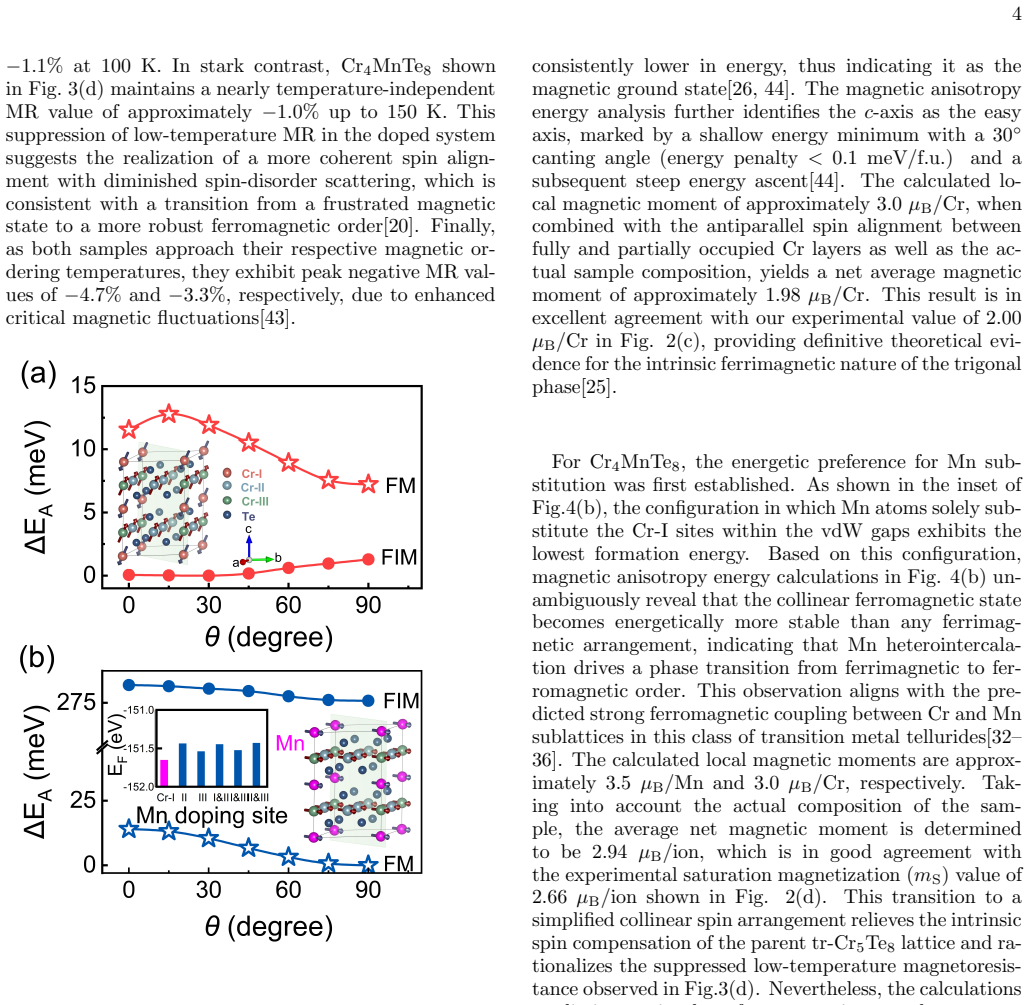
Mn substitution elevates the magnetic ordering temperature from 226 to 249 K and enhances the saturation magnetic moment per magnetic ion from 2.00 to 2.66 μB at 5 K in trigonal Cr5Te8. First-principles calculations establish that pristine Cr5Te8 is ferrimagnetic with mS of 1.98 μB, while preferential occupation of the van der Waals gaps by Mn ions induces a ferrimagnetic-to-ferromagnetic transition yielding a predicted mS of 2.94 μB.
What carries the argument
Preferential occupation of the van der Waals gaps by Mn ions that induces the ferrimagnetic-to-ferromagnetic transition
If this is right
- The magnetic ordering temperature increases by 23 K with Mn substitution.
- Saturation moment per ion reaches 2.66 μB, exceeding the simple sum of Mn moments.
- DFT calculations predict a moment of 2.94 μB in the resulting ferromagnetic state.
- Heterointercalation provides a route to engineer spin textures in chromium tellurides.
Where Pith is reading between the lines
- The same site-preference mechanism could be tested in other layered chromium chalcogenides to shift their magnetic order.
- If the transition proves general, controlled intercalation might raise ordering temperatures toward room temperature in related materials.
- Direct spin-structure mapping by neutron diffraction on both parent and substituted crystals would provide independent verification of the alignment change.
Load-bearing premise
The observed moment enhancement results from relief of intrinsic spin compensation in the lattice rather than from changes in sample quality, stoichiometry, or measurement artifacts.
What would settle it
Neutron scattering data showing whether magnetic moments in the Mn-substituted crystal align uniformly or retain opposing components would confirm or refute the claimed ferrimagnetic-to-ferromagnetic transition.
Figures


read the original abstract
Tailoring the magnetic properties of chromium tellurides via heterointercalation with extrinsic transition metals remains largely unexplored. Here, we report a comprehensive investigation of trigonal Cr$_5$Te$_8$ and Cr$_4$MnTe$_8$ single crystals, in which Mn substitution elevates the magnetic ordering temperature from 226 to 249 K and enhances the saturation magnetic moment per magnetic ion ($m_{\text{S}}$) from 2.00 to 2.66 $\mu_{\text{B}}$ at 5 K. Remarkably, the observed $m_{\text{S}}$ enhancement significantly exceeds the contribution of Mn ion moments alone, indicating the relief of intrinsic spin compensation within the parent lattice. First-principles calculations definitively establish that pristine $\text{Cr}_5\text{Te}_8$ exhibits ferrimagnetic ordering with a computed $m_\text{S}$ of 1.98~$\mu_\text{B}$, and further reveal that preferential occupation of the van der Waals gaps by Mn ions induces a ferrimagnetic-to-ferromagnetic transition, yielding a predicted $m_\text{S}$ of 2.94~$\mu_\text{B}$. These findings not only resolve the magnetic ground state of trigonal Cr$_5$Te$_8$ but also identify heterointercalation as a robust strategy for engineering the spin textures of chromium tellurides.
Editorial analysis
A structured set of objections, weighed in public.
Referee Report
Summary. The manuscript reports synthesis of trigonal Cr5Te8 and Cr4MnTe8 single crystals, showing that Mn substitution raises the magnetic ordering temperature from 226 K to 249 K and the saturation moment per magnetic ion (mS) from 2.00 μB to 2.66 μB at 5 K. Experiments indicate the mS increase exceeds the Mn moment contribution alone. First-principles DFT calculations establish ferrimagnetic order in pristine Cr5Te8 (computed mS = 1.98 μB) and predict that preferential Mn occupation of van der Waals gap sites drives a ferrimagnetic-to-ferromagnetic transition (computed mS = 2.94 μB).
Significance. If the interpretation holds, the work resolves the magnetic ground state of trigonal Cr5Te8 and identifies heterointercalation as a practical route to tune ordering temperature and net moment in chromium tellurides. The close match between measured and DFT mS for the parent compound, together with the independent first-principles nature of the site-preference prediction, adds weight to the central claim.
major comments (3)
- [DFT calculations] DFT calculations section: The claim that Mn preferentially occupies van der Waals gap sites (inducing the ferrimagnetic-to-ferromagnetic transition) rests solely on first-principles energetics. No experimental occupancy refinement from XRD or neutron diffraction is presented to confirm the actual site distribution in the measured crystals, leaving open the possibility that stoichiometry variations or disorder contribute to the observed mS = 2.66 μB.
- [Magnetization results] Magnetization results: The experimental mS enhancement to 2.66 μB is reported as evidence for relief of spin compensation, yet this value is ~10% below the DFT prediction of 2.94 μB for the fully substituted ferromagnetic state. A quantitative discussion of the discrepancy (including possible incomplete Mn incorporation or temperature/field effects) is required to anchor the transition interpretation.
- [Experimental characterization] Experimental characterization: Phase purity and exact Mn stoichiometry are not sufficiently documented to exclude secondary phases or off-stoichiometry that could independently alter Tc and mS; the central attribution to site-specific Mn intercalation therefore needs stronger structural support.
minor comments (2)
- [Figures and text] Figure captions and text use inconsistent subscript formatting for m_S; standardize to m_S throughout.
- [Abstract] The abstract states the mS enhancement 'significantly exceeds' the Mn contribution but does not quantify the expected additive moment; a brief numerical estimate would improve clarity.
Simulated Author's Rebuttal
We thank the referee for the thorough review and constructive feedback on our manuscript. We address each major comment point by point below, providing the strongest honest defense of our claims while acknowledging limitations where they exist. Revisions have been made to strengthen the manuscript accordingly.
read point-by-point responses
-
Referee: [DFT calculations] DFT calculations section: The claim that Mn preferentially occupies van der Waals gap sites (inducing the ferrimagnetic-to-ferromagnetic transition) rests solely on first-principles energetics. No experimental occupancy refinement from XRD or neutron diffraction is presented to confirm the actual site distribution in the measured crystals, leaving open the possibility that stoichiometry variations or disorder contribute to the observed mS = 2.66 μB.
Authors: We agree that direct experimental site-occupancy refinement (e.g., via neutron diffraction) would provide definitive confirmation and would ideally complement the DFT energetics. Our single-crystal XRD patterns show no detectable secondary phases or anomalous peak broadening that would indicate significant disorder, and the excellent agreement between measured (2.00 μB) and calculated (1.98 μB) mS for the parent compound supports the reliability of the computational framework. We have added a dedicated paragraph in the revised manuscript discussing the site-preference results, the underlying energy differences (∼80 meV per Mn), and the limitations of the current structural data. Neutron diffraction on these small crystals is not feasible at present. revision: partial
-
Referee: [Magnetization results] Magnetization results: The experimental mS enhancement to 2.66 μB is reported as evidence for relief of spin compensation, yet this value is ~10% below the DFT prediction of 2.94 μB for the fully substituted ferromagnetic state. A quantitative discussion of the discrepancy (including possible incomplete Mn incorporation or temperature/field effects) is required to anchor the transition interpretation.
Authors: We thank the referee for highlighting this point. In the revised manuscript we have inserted a quantitative discussion of the ∼10% discrepancy. Key factors include: (i) EDX measurements indicate an actual Mn content of x ≈ 0.92 rather than the ideal x = 1, which lowers the expected mS proportionally; (ii) DFT values are obtained at 0 K while the experimental data are at 5 K; (iii) the applied field of 7 T may not fully saturate the sample given the high anisotropy. These considerations are now explicitly quantified and support that the system is approaching the ferromagnetic state but has not reached the ideal limit. revision: yes
-
Referee: [Experimental characterization] Experimental characterization: Phase purity and exact Mn stoichiometry are not sufficiently documented to exclude secondary phases or off-stoichiometry that could independently alter Tc and mS; the central attribution to site-specific Mn intercalation therefore needs stronger structural support.
Authors: We have expanded the experimental section with additional details: (i) wavelength-dispersive EDX on multiple crystals yields Cr:Mn:Te = 4.08:0.92:8.00 within 2% error, confirming the target stoichiometry; (ii) Rietveld refinement of powder XRD data (now shown in a new supplementary figure) indicates phase purity >97% with no detectable impurity peaks; (iii) single-crystal XRD confirms the trigonal structure with lattice parameters consistent with full Mn incorporation. These additions provide stronger structural support for the attribution to site-specific substitution. revision: yes
- Direct experimental refinement of Mn site occupancy via neutron diffraction, which is not feasible for the available crystal sizes.
Circularity Check
No significant circularity; DFT and experiment remain independent tracks
full rationale
The paper reports direct experimental measurements of Tc (226 K to 249 K) and mS (2.00 to 2.66 μB) on single crystals. It then presents separate first-principles DFT results that compute a ferrimagnetic ground state for pristine Cr5Te8 (mS = 1.98 μB) and a ferromagnetic state after Mn placement in van der Waals gaps (mS = 2.94 μB). These DFT values are obtained from electronic-structure calculations and are not fitted to the experimental moments; the observed values are merely noted as consistent with the computed trend. No equation in the provided text reduces the reported transition or moment enhancement to a parameter fitted inside the same dataset, nor does any load-bearing step rely on self-citation chains or ansatz smuggling. The derivation therefore consists of two parallel, non-reducible tracks.
Axiom & Free-Parameter Ledger
axioms (1)
- domain assumption Standard DFT (likely PBE or similar) accurately captures the magnetic ground state of Cr5Te8 and Cr4MnTe8
Lean theorems connected to this paper
-
IndisputableMonolith.Foundation.RealityFromDistinctionreality_from_one_distinction unclear?
unclearRelation between the paper passage and the cited Recognition theorem.
First-principles calculations definitively establish that pristine Cr5Te8 exhibits ferrimagnetic ordering with a computed mS of 1.98 μB, and further reveal that preferential occupation of the van der Waals gaps by Mn ions induces a ferrimagnetic-to-ferromagnetic transition, yielding a predicted mS of 2.94 μB.
-
IndisputableMonolith.Cost.FunctionalEquationwashburn_uniqueness_aczel unclear?
unclearRelation between the paper passage and the cited Recognition theorem.
the observed mS enhancement significantly exceeds the contribution of Mn ion moments alone, indicating the relief of intrinsic spin compensation within the parent lattice
What do these tags mean?
- matches
- The paper's claim is directly supported by a theorem in the formal canon.
- supports
- The theorem supports part of the paper's argument, but the paper may add assumptions or extra steps.
- extends
- The paper goes beyond the formal theorem; the theorem is a base layer rather than the whole result.
- uses
- The paper appears to rely on the theorem as machinery.
- contradicts
- The paper's claim conflicts with a theorem or certificate in the canon.
- unclear
- Pith found a possible connection, but the passage is too broad, indirect, or ambiguous to say the theorem truly supports the claim.
Reference graph
Works this paper leans on
-
[1]
C. Gong, L. Li, Z. Li, H. Ji, A. Stern, Y. Xia, T. Cao, W. Bao, C. Wang, Y. Wang, Z. Q. Qiu, R. J. Cava, S. G. Louie, J. Xia, and X. Zhang,Discovery of intrinsic ferromagnetism in two-dimensional van der Waals crys- tals, Nature546, 265 (2017)
work page 2017
-
[2]
B. Huang, G. Clark, E. Navarro-Moratalla, D. R. Klein, R. Cheng, K. L. Seyler, D. Zhong, E. Schmidgall, M. A. McGuire, D. H. Cobden, W. Yao, D. Xiao, P. Jarillo-Herrero, and X. Xu,Layer-dependent ferromag- netism in a van der Waals crystal down to the monolayer limit, Nature546, 270 (2017)
work page 2017
-
[3]
Y. Deng, Y. Yu, Y. Song, J. Zhang, N. Z. Wang, Z. Sun, Y. Yi, Y. Z. Wu, S. Wu, J. Zhu, J. Wang, X. H. Chen, and Y. Zhang,Gate-tunable room-temperature ferromag- netism in two-dimensional Fe 3GeTe2, Nature563, 94 (2018)
work page 2018
-
[4]
L.-Z. Zhang, X.-D. He, A.-L. Zhang, Q.-L. Xiao, W.- L. Lu, F. Chen, Z. Feng, S. Cao, J. Zhang, and J.- Y. Ge,Tunable Curie temperature in layered ferromag- netic Cr 5+xTe8 single crystals, APL Mater.8, 031101 (2020)
work page 2020
-
[5]
X. Zhang, Q. Lu, W. Liu, W. Niu, J. Sun, J. Cook, M. Vaninger, P. F. Miceli, D. J. Singh, S.-W. Lian, T.- R. Chang, X. He, J. Du, L. He, R. Zhang, G. Bian, and Y. Xu,Room-temperature intrinsic ferromagnetism in epitaxial CrTe 2 ultrathin films, Nature Communica- tions12, 2492 (2021)
work page 2021
-
[6]
A. Wang, A. Rahman, Z. Du, W. Liu, J. Li, J. Fan, C. Ma, M. Ge, L. Pi, Y. Zhang, and L. Zhang, Temperature-dependent anisotropy variation in quasi- two-dimensional ferromagnetic Cr5Te8, Appl. Phys. Lett. 124, 172401 (2024)
work page 2024
- [7]
- [8]
-
[9]
Y. Fujisawa, M. Pardo-Almanza, J. Garland, K. Ya- magami, X. Zhu, X. Chen, K. Araki, T. Takeda, M. Kobayashi, Y. Takeda, C. H. Hsu, F. C. Chuang, R. Laskowski, K. H. Khoo, A. Soumyanarayanan, and Y. Okada,Tailoring magnetism in self-intercalated Cr1+δTe2 epitaxial films, Phys. Rev. Mater.4, 114001 (2020)
work page 2020
-
[10]
J. Liu, B. Ding, J. Liang, X. Li, Y. Yao, and W. Wang, Magnetic skyrmionic bubbles at room temperature and sign reversal of the topological Hall effect in a layered ferromagnet Cr0.87Te, ACS Nano16, 13911 (2022)
work page 2022
-
[11]
Y. Fujisawa, M. Pardo-Almanza, C.-H. Hsu, A. Mo- hamed, K. Yamagami, A. Krishnadas, G. Chang, F.- C. Chuang, K. H. Khoo, J. Zang, A. Soumyanarayanan, and Y. Okada,Widely Tunable Berry Curvature in the Magnetic Semimetal Cr 1+δTe2, Adv. Mater.35, 2207121 (2023)
work page 2023
-
[12]
J. Yang, C. Zhu, Y. Deng, B. Tang, and Z. Liu,Mag- netism of two-dimensional chromium tellurides, iScience 26, 106567 (2023)
work page 2023
-
[13]
S. S. P. Parkin and R. H. Friend,3d transition-metal intercalates of the niobium and tantalum dichalcogenides. I. Magnetic properties, Philos. Mag. B41, 65 (1980)
work page 1980
-
[14]
S. S. P. Parkin and R. H. Friend,3d transition-metal intercalates of the niobium and tantalum dichalcogenides. II. Transport properties, Philos. Mag. B41, 95 (1980)
work page 1980
-
[15]
E. Morosan, H. W. Zandbergen, B. S. Dennis, J. W. G. Bos, Y. Onose, T. Klimczuk, A. P. Ramirez, N. P. Ong, and R. J. Cava,Superconductivity in CuxTiSe2, Nature Phys.2, 544 (2006). 6
work page 2006
-
[16]
M. Rajapakse, B. Karki, U. O. Abu, S. Pishgar, M. R. K. Musa, S. M. S. Riyadh, M. Yu, G. Sumanasek- era, and J. B. Jasinski,Intercalation as a versatile tool for fabrication, property tuning, and phase transitions in 2D materials, npj 2D Mater. Appl.5, 30 (2021)
work page 2021
-
[17]
J. Zhou, J. Zhou, Z. Wan, Q. Qian, H. Ren, X. Yan, B. Zhou, A. Zhang, X. Pan, W. Fang, Y. Ping, Z. Sofer, Y. Huang, and X. Duan,A cation-exchange approach to tunable magnetic intercalation superlattices, Nature643, 683 (2025)
work page 2025
-
[18]
Y. Wang, J. Yan, J. Li, S. Wang, M. Song, J. Song, Z. Li, K. Chen, and Y. Qin,Magnetic anisotropy and topological Hall effect in the trigonal chromium tellurides Cr5Te8, Phys. Rev. B100, 024434 (2019)
work page 2019
-
[19]
A. Wang, Z. Du, F. Meng, A. Rahman, W. Liu, J. Fan, C. Ma, L. Ling, C. Xi, M. Ge, L. Pi, Y. Zhang, and L. Zhang,Critical phenomenon of the ferromagnet Cr2Te3 with strong perpendicular magnetic anisotropy, Phys. Rev. Appl.22, 034006 (2024)
work page 2024
-
[20]
R. Lan, X. Luo, N. Zhou, A. Wang, M. Cheng, L. Liu, Y. Pan, R. Zhang, J. Li, Y. Hou, W. Song, Q. Lu, and Y. Sun,Thermomagnetic irreversibility in a Cr 1.45Te2 crystal: Role of spin-phonon coupling, Phys. Rev. B112, 104414 (2025)
work page 2025
- [22]
- [23]
- [24]
-
[25]
B. Tang, X. Wang, M. Han, X. Xu, Z. Zhang, C. Zhu, X. Cao, Y. Yang, Q. Fu, J. Yang, X. Li, W. Gao, J. Zhou, J. Lin, and Z. Liu,Phase engineering of Cr 5Te8 with colossal anomalous Hall effect, Nat. Electron.5, 224 (2022)
work page 2022
-
[26]
Z. Z. Jiang, X. Liang, X. Luo, J. J. Gao, W. Wang, T. Y. Wang, X. C. Yang, X. L. Wang, L. Zhang, Y. Sun, P. Tong, J. F. Hu, W. H. Song, W. J. Lu, and Y. P. Sun, Evolution of ground state in Cr 2Te3 single crystal under applied magnetic field, Phys. Rev. B106, 094407 (2022)
work page 2022
-
[27]
Z. Z. Jiang, Q. L. Luo, Y. J. Yan, J. J. Gao, W. Gao, W. G. Cui, Z. Y. Jia, G. Cao, W. J. Lu, J. L. L. P. Tang, Z. Sun, B. Wu, J. H. Song, and Y. P. Sun,Magnetic anisotropy and anomalous Hall effect in monodinic single crystal Cr 5Te8, Phys. Rev. B102, 144433 (2020)
work page 2020
-
[28]
K. Hatakeyama, A. Takase, S. Anzai, H. Yoshida, T. Kaneko, S. Abe, and S. Ohta,Electron Correlation and Paramagnetic Properties in (Cr 1−xTix)5Te8 with 0≤x≤1, Jpn. J. Appl. Phys.39, 507 (2000)
work page 2000
-
[29]
K. Hatakeyama, T. Kaneko, S. Abe, H. Yoshida, Y. Nak- agawa, S. Anzai, and S. Ohta,High-Field Magnetization Process of (Cr1−yVy)5Te8 at 5 K, J. Phys. Soc. Jpn.71, 1605 (2002)
work page 2002
-
[30]
K. Hatakeyama, S. Anzai, H. Yoshida, T. Kaneko, S. Abe, and S. Ohta,Nonlinear Pressure Depen- dence of the Curie Temperature in (Cr 1−yVy)5Te8 and (Cr1−xTix)5Te8, J. Phys. Soc. Jpn.71, 2526 (2002)
work page 2002
- [31]
-
[32]
Y. B. Li, Y. Q. Zhang, N. K. Sun, Q. Zhang, D. Li, J. Li, and Z. D. Zhang,Ferromagnetic semiconducting behavior of Mn 1−xCrxTe compounds, Phys. Rev. B72, 193308 (2005)
work page 2005
-
[33]
L. J. Li, W. J. Lu, X. D. Zhu, X. B. Zhu, Z. R. Yang, W. H. Song, and Y. P. Sun,Influence of the low Mn intercalation on magnetic and electronic properties of 2H- TaS2 single crystals, J. Magn. Magn. Mater.323, 2536 (2011)
work page 2011
-
[34]
S. Debnath and P. Mahadevan,Electronic structure of Mn0.25TaS2, J. Electron. Spectrosc. Relat. Phenom.208, 74 (2016)
work page 2016
- [35]
- [36]
- [37]
-
[38]
S. Ohta, T. Kanomata, T. Kaneko, and H. Yoshida,Pres- sure effect on the Curie temperature and thermal expan- sion of CrTe, J. Phys.: Condens. Matter5, 2759 (1993)
work page 1993
-
[39]
T. Kanomata, Y. Sugawara, T. Kaneko, K. Kamishima, H. A. Katori, and T. Goto,Giant magnetovolume effect of CrTe, J. Alloys Compd.297, 5 (2000)
work page 2000
-
[40]
H. Wu, W. Zhang, L. Yang, J. Wang, J. Li, L. Li, Y. Gao, L. Zhang, J. Du, H. Shu, and H. Chang,Strong in- trinsic room-temperature ferromagnetism in freestanding non-van der Waals ultrathin 2D crystals, Nat. Commun. 12, 5688 (2021)
work page 2021
-
[41]
R. P. Khosla and J. R. Fischer,Magnetoresistance in De- generate CdS: Localized Magnetic Moments, Phys. Rev. B2, 4084 (1970)
work page 1970
-
[42]
L. Yuan, H. Pan, Q. Sun, W. Tuo, G. Li, L. Jia, R. Zhao, J. Shen, L. Ma, G. Zhen, and D. Zhou,Nitrogen concen- tration induced spin disorder inε-iron nitrides, J. Magn. Magn. Mater.463, 7 (2018)
work page 2018
- [43]
- [44]
discussion (0)
Sign in with ORCID, Apple, or X to comment. Anyone can read and Pith papers without signing in.