REVIEW 4 major objections 4 minor 44 references
A single learned scaling coefficient per block, found by black-box reward optimization, improves DiT image generation quality and cuts the sampling steps needed.
Reviewed by Pith at T0; open to challenge. T0 means a machine referee read the full paper against a public rubric. the ladder, T0–T4 →
T0 review · deepseek-v4-flash
2026-08-02 17:25 UTC pith:YTC7H27B
load-bearing objection Clever lightweight calibration idea, but the headline gains are confounded with reduced inference steps and the artifacts are missing — needs controlled comparisons before it convinces. the 4 major comments →
Calibri: Enhancing Diffusion Transformers via Parameter-Efficient Calibration
The pith
A machine-rendered reading of the paper's core claim, the machinery that carries it, and where it could break.
Core claim
On the paper's own terms, the central discovery is that DiT blocks are not equally useful as originally weighted: disabling certain blocks can improve reward-model scores, and for every block there exists an output scaling factor that improves the model over its baseline, as shown by scaling experiments on FLUX. This motivates treating the block/layer/gate outputs as learnable constants and optimizing them. Concretely, Calibri parameterizes the model's forward pass with a vector of scalars c = ω ∪ {s_i}, where ω are output-level weights and s_i are internal block/layer/gate coefficients, and solves c* = argmax_c R(c) with CMA-ES, where R is a text-to-image reward model such as HPSv3. Optimiz
What carries the argument
The load-bearing object is the scalar 'gate' multiplier γ applied to each sub-layer's residual output in the DiT/MM-DiT forward pass (Eq. 1–2). By freezing the base weights and treating these scalars (plus an output-level weight ω) as free parameters, Calibri converts the whole model into a low-dimensional, black-box function R(c) that can be maximized by CMA-ES without backpropagating through the diffusion process. The same scalar machinery is reused in Calibri Ensemble, where multiple sets of coefficients are optimized together and combined in a weighted sum, giving an ensemble interpretation that also covers classifier-free guidance as a two-model special case.
Load-bearing premise
The load-bearing premise is that reward-model scores are a trustworthy proxy for true generation quality; if the fitted scalars exploit reward-model blind spots instead of fixing real flaws, the central 'quality improvement' claim overstates what has been demonstrated.
What would settle it
A concrete test would be to run Calibri on a reward model that is explicitly designed to penalize anatomical inconsistencies (or to use artifact-specific detectors on the outputs), then measure human preference on prompts rich in such failures. If human preference does not follow the reward improvement — or if the calibrated model produces more extra limbs or distorted hands while scoring higher on HPSv3 — the claim that calibration improves genuine quality would be falsified.
If this is right
- If Calibri is right, any DiT-based text-to-image model can be improved post-hoc without retraining, by fitting about 100 scalars to a reward model.
- The inference-step reduction means the same quality can be reached with roughly half to a third of the sampling steps, so calibrated models are cheaper to deploy.
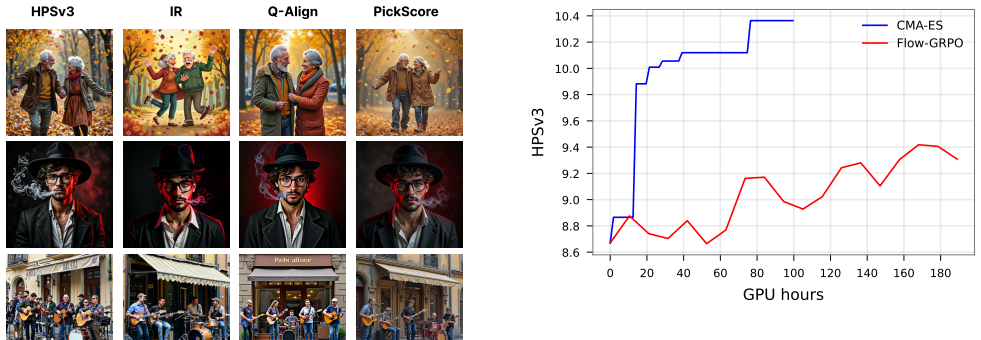
- Because calibration acts at the block output level, it composes with existing alignment methods (e.g., Flow-GRPO): applying Calibri to an already-aligned checkpoint further raises the target reward (and several other rewards).
- The method is effectively training-free in the sense that no gradients flow through the base model; the one-time cost is offline CMA-ES search (tens to hundreds of GPU-hours), after which the scalars are baked into inference.
- Calibri Ensemble suggests that combining differently calibrated versions of the same model behaves like a lightweight ensembling strategy, and for N=2 with block scaling it generalizes skip-layer guidance.
Where Pith is reading between the lines
- A likely risk is reward hacking: because the coefficients are selected by a reward model that the authors themselves note is insensitive to artifacts like extra limbs, the improved scores may partly reflect blind spots. The reported human study on FLUX and Qwen-Image suggests the effect is not purely an artifact, but the mechanism limits how far one can trust metric-only comparisons on prompts whe
- The discovery that some blocks can be disabled with net benefit hints at deeper architectural redundancy in DiTs; one testable extension is pruning or re-weighting blocks at training time, rather than post-hoc, to obtain the gains for free.
- The 10–15 step sweet spot for calibrated ensembles suggests that block scaling can act as a type of guidance term that stabilizes sampling with few steps; combining this with step-distillation or consistency models may yield even larger speedups.
- Because only the scalar multipliers are changed, the fixed points or Jacobian of the diffusion ODE are altered in a structured way; one could analyse how the optimal scalars depend on prompt distribution, potentially leading to prompt-conditional or adaptive calibration.
Editorial analysis
A structured set of objections, weighed in public.
Referee Report
Summary. The paper proposes Calibri, a post-hoc calibration method that reweights the outputs of DiT blocks, layers, or gates via ~100 scalar coefficients optimized with CMA-ES against a reward model (mainly HPSv3). The authors present motivation experiments showing that block ablation or scaling can improve ImageReward on FLUX, then report quality improvements across FLUX, SD-3.5M, and Qwen-Image, a 200-user human study, combination with Flow-GRPO alignment, calibration cost estimates, and supplementary diversity and reward-choice analyses. The central claim is that standard DiT architectures are sub-optimally weighted and that simple scalar calibration can improve generation quality and reduce inference steps.
Significance. If the central claim holds, the result is practically significant: a training-free (post-hoc), parameter-efficient way to improve several state-of-the-art text-to-image models, with an interesting architectural insight about uneven block contributions. The paper's strengths include breadth (three models, multiple reward metrics), the human evaluation, the explicit calibration-cost accounting, and the supplementary diversity analysis. However, the headline comparisons are confounded by simultaneous changes in inference steps, and the primary reported metric is also the optimization objective, so the current evidence does not cleanly separate the calibration effect from step-count reduction or reward overfitting.
major comments (4)
- [§4.2, Table 2, Table 3] The main cross-model comparison is confounded by different inference step counts. Calibri is evaluated at 15 NFE for FLUX and 30 NFE for SD-3.5M and Qwen-Image, while baselines are evaluated at 30, 80, and 100 NFE respectively. Since the calibration coefficients are optimized at 15 steps (Section 4, Implementation Details), the reported HPSv3/IR/Q-Align gains are a joint effect of calibration and step-count reduction. A same-step baseline is shown only for FLUX in Figure 6; no such control is provided for SD-3.5M or Qwen-Image. The human study in Table 3 also appears to compare faster Calibri models against baselines at their default step counts (the text notes Calibri is 2–3.3× faster), so it does not isolate the calibration effect. Please provide same-NFE baselines for all models, or otherwise disentangle the two factors.
- [§4 Implementation Details, Table 1, Supp. A] The paper optimizes exactly HPSv3 during calibration and then reports HPSv3 as the headline metric in Tables 1, 2, and 4. The HPSv3 gains (e.g., 11.41→13.48 in Table 2) are therefore partly fitted values, not independent predictions. The alternative-reward evidence is much weaker and inconsistent: in Table 1, gate scaling achieves the highest HPSv3 (13.48) but lower ImageReward (1.18) and Q-Align (4.88) than layer scaling (1.24 and 4.90). The statement in Supp. C that Calibri is 'not designed as a reward hacking method' is not fully supported by these numbers. The limitation in Supp. A (reward models are insensitive to artifacts such as extra limbs) further underscores the risk. Please add same-step evaluation on held-out reward metrics that were not used as objectives, and ideally report per-prompt significance for the human study.
- [§4.2, Table 2, Table 5] The granularity of calibration used for the main results in Table 2 is not stated. Table 5 lists different scaling types per model (Block/Layer/Gate/Gate/Gate) and different parameter counts, but the main text does not specify which scaling type produced the HPSv3/IR/Q-Align numbers in Table 2 or the human study in Table 3. This makes it difficult to interpret the comparisons and to reproduce the results. Please state explicitly which calibration scheme is used for each model and whether the same scheme was used across all reported metrics.
- [§4.2, Table 2] There is an internal discrepancy in the reported baseline step counts. The text says Calibri uses '15 steps compared to 30 for Flux, 40 for SD-3.5M, and 50 for Qwen-Image,' but Table 2 lists baseline NFE as 30, 80, and 100 respectively. If the text is correct, then the baseline step counts are lower than what is tabulated; if the table is correct, the text is wrong. This discrepancy directly affects the size of the claimed efficiency gain and must be corrected.
minor comments (4)
- [§3.3, Eq. (3)] The notation is inconsistent: Eq. (3) says c ∈ R^(L+1), but in the next paragraph c is defined as ω ∪ {s_i}_{i=1}^{L_s}. Please unify the notation for the number of calibration parameters and define L_s explicitly. Also, in the ensemble formula in §3.4, the sum over i is missing a summation symbol in the typeset equation.
- [§3.2 / Figure 3] The motivation experiment reports ImageReward scores but does not provide error bars or statistical significance despite using 5 seeds. This would strengthen the claim that scaling improves over the baseline for each block.
- [Table 6 (Supp.)] The supplementary diversity table is typeset in a way that is hard to parse; the rows for different Flow-GRPO/Calibri configurations are not visually separated, and 'NFE' values appear inconsistently. Please reformat.
- [Throughout] There are several typos and formatting artifacts: 'Stantdard' in §3.1, 'The The Ministry' in the Acknowledgments, the affiliation placeholder 'AXXX', and the reference numbering in the references list (e.g., [30] appears after [17] in the text but is numbered out of order).
Circularity Check
Partial circularity: the headline HPSv3 gains are the optimized objective; independent rewards and human evaluation keep the central claim from being circular by construction.
specific steps
-
fitted input called prediction
[Section 4 (Implementation Details; Evaluation and Metrics), Table 2]
"We used HPSv3 [25] to track image preference and Q-Align [38] to track image quality during training. ... To measure the final metrics, we used HPSv3 [25], Q-Align [38] and ImageReward [39]."
The calibration coefficients are selected by CMA-ES to maximize HPSv3 on candidate buckets; the same HPSv3 score is then reported as the primary evidence of improvement (Table 2, e.g., FLUX 11.41→13.48). Thus the HPSv3 gain is partly a fitted-value artifact, not an independent prediction. Circularity is partial: HPSv3 is evaluated on held-out HPDv3 prompts, non-target rewards (IR, Q-Align, PickScore) and a human study also improve.
full rationale
The paper's central claim (standard DiT is sub-optimally weighted; scalar calibration improves quality) does not reduce to a single fitted parameter because it is supported by multiple reward models and by a human study (Table 3). However, the most prominent quantitative evidence in Tables 2 and 4 is the HPSv3 score, which is also the optimization objective; that portion of the evidence is circular in the 'fitted input called prediction' sense. The supplementary cross-objective comparison (Table 7) mitigates reward-hacking concerns, although Section A concedes reward models are insensitive to artifacts such as extra limbs, so the reward-as-truth assumption remains load-bearing for backbones not covered by the human study. The NFE comparison (Calibri at 15/30/30 steps vs baselines at 30/80/100) is a confound for attribution, but it is not a formal circularity by construction. The only self-citation ([30] ImageRefl, sharing author Andrey Kuznetsov) is used for a diversity caveat and is not load-bearing. Overall, partial circularity on the headline metric, with independent content elsewhere: score 4.
Axiom & Free-Parameter Ledger
free parameters (4)
- Calibration coefficients c = ω ∪ {s_i} (block/layer/gate scalars) =
not reported in paper
- CMA-ES initial sigma =
0.25
- CMA-ES candidate count =
4+⌊3 ln d⌋ ≈ 20±3
- Bucket size and training inference steps =
16 images; 15 steps
axioms (4)
- domain assumption DiT forward pass is exactly the residual form in Eq. (1)/(2), so multiplying block outputs by scalars preserves semantics.
- domain assumption Reward models HPSv3, Q-Align, ImageReward, PickScore measure human-preferred image quality sufficiently for optimization and evaluation.
- ad hoc to paper The suboptimality of a DiT can be captured by independent scalar multipliers on block/layer/gate outputs.
- domain assumption The prompt sets used for optimization (T2I-Compbench++ train/test) and evaluation (HPDv3) are representative of general text-to-image use.
Cite this review
Pith. "Pith review of Calibri: Enhancing Diffusion Transformers via Parameter-Efficient Calibration." pith.science (2026). https://pith.science/paper/YTC7H27B
@misc{pith2026260324800,
  author       = {Pith},
  title        = {Pith review of: Calibri: Enhancing Diffusion Transformers via Parameter-Efficient Calibration},
  year         = {2026},
  howpublished = {\url{https://pith.science/paper/YTC7H27B}},
  note         = {Machine review of arXiv:2603.24800}
}
read the original abstract
In this paper, we uncover the hidden potential of Diffusion Transformers (DiTs) to significantly enhance generative tasks. Through an in-depth analysis of the denoising process, we demonstrate that introducing a single learned scaling parameter can significantly improve the performance of DiT blocks. Building on this insight, we propose Calibri, a parameter-efficient approach that optimally calibrates DiT components to elevate generative quality. Calibri frames DiT calibration as a black-box reward optimization problem, which is efficiently solved using an evolutionary algorithm and modifies just ~100 parameters. Experimental results reveal that despite its lightweight design, Calibri consistently improves performance across various text-to-image models. Notably, Calibri also reduces the inference steps required for image generation, all while maintaining high-quality outputs.
Figures



Reference graph
Works this paper leans on
-
[1]
Stable flow: Vital layers for training-free image editing
Omri Avrahami, Or Patashnik, Ohad Fried, Egor Nemchi- nov, Kfir Aberman, Dani Lischinski, and Daniel Cohen-Or. Stable flow: Vital layers for training-free image editing. In Proceedings of the Computer Vision and Pattern Recognition Conference, pages 7877–7888, 2025. 1, 2, 3
2025
-
[2]
Training diffusion models with reinforce- ment learning
Kevin Black, Michael Janner, Yilun Du, Ilya Kostrikov, and Sergey Levine. Training diffusion models with reinforce- ment learning. InThe Twelfth International Conference on Learning Representations, 2024. 2
2024
-
[3]
Align your latents: High-resolution video synthesis with la- tent diffusion models
Andreas Blattmann, Robin Rombach, Huan Ling, Tim Dock- horn, Seung Wook Kim, Sanja Fidler, and Karsten Kreis. Align your latents: High-resolution video synthesis with la- tent diffusion models. InProceedings of the IEEE/CVF con- ference on computer vision and pattern recognition, pages 22563–22575, 2023. 2
2023
-
[4]
Pixart-alpha : Fast training of diffusion transformer for photorealistic text-to-image syn- thesis
Junsong Chen, YU Jincheng, GE Chongjian, Lewei Yao, Enze Xie, Zhongdao Wang, James Kwok, Ping Luo, Huchuan Lu, and Zhenguo Li. Pixart-alpha : Fast training of diffusion transformer for photorealistic text-to-image syn- thesis. InThe Twelfth International Conference on Learning Representations. 2
-
[5]
Training-free layout control with cross-attention guidance
Minghao Chen, Iro Laina, and Andrea Vedaldi. Training-free layout control with cross-attention guidance. InProceedings of the IEEE/CVF winter conference on applications of com- puter vision, pages 5343–5353, 2024. 2
2024
-
[6]
Directly fine-tuning diffusion models on differentiable re- wards
Kevin Clark, Paul Vicol, Kevin Swersky, and David J Fleet. Directly fine-tuning diffusion models on differentiable re- wards. InThe Twelfth International Conference on Learning Representations, 2024. 2
2024
-
[7]
Diffusion self-guidance for control- lable image generation.Advances in Neural Information Processing Systems, 36:16222–16239, 2023
Dave Epstein, Allan Jabri, Ben Poole, Alexei Efros, and Aleksander Holynski. Diffusion self-guidance for control- lable image generation.Advances in Neural Information Processing Systems, 36:16222–16239, 2023. 2
2023
-
[8]
Scaling recti- fied flow transformers for high-resolution image synthesis
Patrick Esser, Sumith Kulal, Andreas Blattmann, Rahim Entezari, Jonas M ¨uller, Harry Saini, Yam Levi, Dominik Lorenz, Axel Sauer, Frederic Boesel, et al. Scaling recti- fied flow transformers for high-resolution image synthesis. InForty-first international conference on machine learning,
-
[9]
Geneval: An object-focused framework for evaluating text- to-image alignment.Advances in Neural Information Pro- cessing Systems, 36:52132–52152, 2023
Dhruba Ghosh, Hannaneh Hajishirzi, and Ludwig Schmidt. Geneval: An object-focused framework for evaluating text- to-image alignment.Advances in Neural Information Pro- cessing Systems, 36:52132–52152, 2023. 6
2023
-
[10]
Reducing the time complexity of the derandomized evolution strategy with covariance matrix adaptation (cma- es).Evolutionary computation, 11(1):1–18, 2003
Nikolaus Hansen, Sibylle D M ¨uller, and Petros Koumout- sakos. Reducing the time complexity of the derandomized evolution strategy with covariance matrix adaptation (cma- es).Evolutionary computation, 11(1):1–18, 2003. 2, 4
2003
-
[11]
Nikolaus Hansen, Youhei Akimoto, and Petr Baudis. CMA-ES/pycma on Github. Zenodo, DOI:10.5281/zenodo.2559634, 2019. 2, 4
-
[12]
Deep residual learning for image recognition
Kaiming He, Xiangyu Zhang, Shaoqing Ren, and Jian Sun. Deep residual learning for image recognition. InProceed- ings of the IEEE conference on computer vision and pattern recognition, pages 770–778, 2016. 2
2016
-
[13]
Prompt-to-prompt im- age editing with cross attention control.arXiv preprint arXiv:2208.01626, 2022
Amir Hertz, Ron Mokady, Jay Tenenbaum, Kfir Aberman, Yael Pritch, and Daniel Cohen-Or. Prompt-to-prompt im- age editing with cross attention control.arXiv preprint arXiv:2208.01626, 2022. 2
Pith/arXiv arXiv 2022
-
[14]
Denoising dif- fusion probabilistic models.Advances in neural information processing systems, 33:6840–6851, 2020
Jonathan Ho, Ajay Jain, and Pieter Abbeel. Denoising dif- fusion probabilistic models.Advances in neural information processing systems, 33:6840–6851, 2020. 1
2020
-
[15]
Denoising dif- fusion probabilistic models.Advances in neural information processing systems, 33:6840–6851, 2020
Jonathan Ho, Ajay Jain, and Pieter Abbeel. Denoising dif- fusion probabilistic models.Advances in neural information processing systems, 33:6840–6851, 2020. 2
2020
-
[16]
Video dif- fusion models.Advances in neural information processing systems, 35:8633–8646, 2022
Jonathan Ho, Tim Salimans, Alexey Gritsenko, William Chan, Mohammad Norouzi, and David J Fleet. Video dif- fusion models.Advances in neural information processing systems, 35:8633–8646, 2022. 2
2022
-
[17]
Kaiyi Huang, Chengqi Duan, Kaiyue Sun, Enze Xie, Zhen- guo Li, and Xihui Liu. T2i-compbench++: An enhanced and comprehensive benchmark for compositional text-to-image generation.IEEE Transactions on Pattern Analysis and Ma- chine Intelligence, 47:3563–3579, 2024. 5, 2
2024
-
[18]
Spatiotemporal skip guidance for enhanced video diffusion sampling.IEEE/CVF Conference on Com- puter Vision and Pattern Recognition (CVPR), 2025
Junha Hyung, Kinam Kim, Susung Hong, Min-Jung Kim, and Jaegul Choo. Spatiotemporal skip guidance for enhanced video diffusion sampling.IEEE/CVF Conference on Com- puter Vision and Pattern Recognition (CVPR), 2025. 6
2025
-
[19]
Guiding a diffu- sion model with a bad version of itself.Advances in Neural Information Processing Systems, 2024
Tero Karras, Miika Aittala, Tuomas Kynk ¨a¨anniemi, Jaakko Lehtinen, Timo Aila, and Samuli Laine. Guiding a diffu- sion model with a bad version of itself.Advances in Neural Information Processing Systems, 2024. 6
2024
-
[20]
Pick-a-pic: An open dataset of user preferences for text-to-image generation.Ad- vances in neural information processing systems, 36:36652– 36663, 2023
Yuval Kirstain, Adam Polyak, Uriel Singer, Shahbuland Ma- tiana, Joe Penna, and Omer Levy. Pick-a-pic: An open dataset of user preferences for text-to-image generation.Ad- vances in neural information processing systems, 36:36652– 36663, 2023. 2, 6
2023
-
[21]
Flux.https://github.com/ black-forest-labs/flux, 2024
Black Forest Labs. Flux.https://github.com/ black-forest-labs/flux, 2024. 1, 3, 5, 2
2024
-
[22]
Black Forest Labs, Stephen Batifol, Andreas Blattmann, Frederic Boesel, Saksham Consul, Cyril Diagne, Tim Dock- horn, Jack English, Zion English, Patrick Esser, et al. Flux. 1 kontext: Flow matching for in-context image generation and editing in latent space.arXiv preprint arXiv:2506.15742,
-
[23]
Flow matching for genera- tive modeling
Yaron Lipman, Ricky TQ Chen, Heli Ben-Hamu, Maxim- ilian Nickel, and Matthew Le. Flow matching for genera- tive modeling. InThe Eleventh International Conference on Learning Representations. 1
-
[24]
Flow-grpo: Training flow matching models via on- line rl.arXiv preprint arXiv:2505.05470, 2025
Jie Liu, Gongye Liu, Jiajun Liang, Yangguang Li, Jiaheng Liu, Xintao Wang, Pengfei Wan, Di Zhang, and Wanli Ouyang. Flow-grpo: Training flow matching models via on- line rl.arXiv preprint arXiv:2505.05470, 2025. 2, 5, 6, 8, 1
Pith/arXiv arXiv 2025
-
[25]
Hpsv3: Towards wide-spectrum human preference score
Yuhang Ma, Xiaoshi Wu, Keqiang Sun, and Hongsheng Li. Hpsv3: Towards wide-spectrum human preference score. In Proceedings of the IEEE/CVF International Conference on Computer Vision, pages 15086–15095, 2025. 2, 5, 1
2025
-
[26]
Scalable diffusion models with transformers
William Peebles and Saining Xie. Scalable diffusion models with transformers. InProceedings of the IEEE/CVF inter- national conference on computer vision, pages 4195–4205,
-
[27]
High-resolution image synthesis with latent diffusion models
Robin Rombach, Andreas Blattmann, Dominik Lorenz, Patrick Esser, and Bj ¨orn Ommer. High-resolution image synthesis with latent diffusion models. InProceedings of the IEEE/CVF conference on computer vision and pattern recognition, pages 10684–10695, 2022. 1, 2
2022
-
[28]
U- net: Convolutional networks for biomedical image segmen- tation
Olaf Ronneberger, Philipp Fischer, and Thomas Brox. U- net: Convolutional networks for biomedical image segmen- tation. InInternational Conference on Medical image com- puting and computer-assisted intervention, pages 234–241. Springer, 2015. 1, 2
2015
-
[29]
Freeu: Free lunch in diffusion u-net
Chenyang Si, Ziqi Huang, Yuming Jiang, and Ziwei Liu. Freeu: Free lunch in diffusion u-net. InProceedings of the IEEE/CVF Conference on Computer Vision and Pattern Recognition, pages 4733–4743, 2024. 2
2024
-
[30]
Dmitrii Sorokin, Maksim Nakhodnov, Andrey Kuznetsov, and Aibek Alanov. Imagerefl: Balancing quality and di- versity in human-aligned diffusion models.arXiv preprint arXiv:2505.22569, 2025. 1
Pith/arXiv arXiv 2025
-
[31]
What the daam: Interpreting stable dif- fusion using cross attention
Raphael Tang, Linqing Liu, Akshat Pandey, Zhiying Jiang, Gefei Yang, Karun Kumar, Pontus Stenetorp, Jimmy Lin, and Ferhan T ¨ure. What the daam: Interpreting stable dif- fusion using cross attention. InProceedings of the 61st An- nual Meeting of the Association for Computational Linguis- tics (Volume 1: Long Papers), pages 5644–5659, 2023. 2
2023
-
[32]
Attention is all you need.Advances in neural information processing systems, 30, 2017
Ashish Vaswani, Noam Shazeer, Niki Parmar, Jakob Uszko- reit, Llion Jones, Aidan N Gomez, Łukasz Kaiser, and Illia Polosukhin. Attention is all you need.Advances in neural information processing systems, 30, 2017. 2
2017
-
[33]
Diffusion model align- ment using direct preference optimization
Bram Wallace, Meihua Dang, Rafael Rafailov, Linqi Zhou, Aaron Lou, Senthil Purushwalkam, Stefano Ermon, Caiming Xiong, Shafiq Joty, and Nikhil Naik. Diffusion model align- ment using direct preference optimization. InProceedings of the IEEE/CVF Conference on Computer Vision and Pattern Recognition, pages 8228–8238, 2024. 2
2024
-
[34]
Wan: Open and advanced large-scale video generative models.arXiv preprint arXiv:2503.20314, 2025
Team Wan, Ang Wang, Baole Ai, Bin Wen, Chaojie Mao, Chen-Wei Xie, Di Chen, Feiwu Yu, Haiming Zhao, Jianx- iao Yang, et al. Wan: Open and advanced large-scale video generative models.arXiv preprint arXiv:2503.20314, 2025. 1
Pith/arXiv arXiv 2025
-
[35]
Yibin Wang, Yuhang Zang, Hao Li, Cheng Jin, and Jiaqi Wang. Unified reward model for multimodal understanding and generation.arXiv preprint arXiv:2503.05236, 2025. 2
Pith/arXiv arXiv 2025
-
[36]
Tianyi Wei, Yifan Zhou, Dongdong Chen, and Xingang Pan. Freeflux: Understanding and exploiting layer-specific roles in rope-based mmdit for versatile image editing.arXiv preprint arXiv:2503.16153, 2025. 2, 3
Pith/arXiv arXiv 2025
-
[37]
Qwen-image technical report.arXiv preprint arXiv:2508.02324, 2025
Chenfei Wu, Jiahao Li, Jingren Zhou, Junyang Lin, Kaiyuan Gao, Kun Yan, Sheng-ming Yin, Shuai Bai, Xiao Xu, Yilei Chen, et al. Qwen-image technical report.arXiv preprint arXiv:2508.02324, 2025. 1, 5
Pith/arXiv arXiv 2025
-
[38]
Haoning Wu, Zicheng Zhang, Weixia Zhang, Chaofeng Chen, Liang Liao, Chunyi Li, Yixuan Gao, Annan Wang, Erli Zhang, Wenxiu Sun, Qiong Yan, Xiongkuo Min, Guang- tao Zhai, and Weisi Lin. Q-align: Teaching lmms for vi- sual scoring via discrete text-defined levels.arXiv preprint arXiv:2312.17090, 2023. 5
Pith/arXiv arXiv 2023
-
[39]
Imagere- ward: Learning and evaluating human preferences for text- to-image generation.Advances in Neural Information Pro- cessing Systems, 36:15903–15935, 2023
Jiazheng Xu, Xiao Liu, Yuchen Wu, Yuxuan Tong, Qinkai Li, Ming Ding, Jie Tang, and Yuxiao Dong. Imagere- ward: Learning and evaluating human preferences for text- to-image generation.Advances in Neural Information Pro- cessing Systems, 36:15903–15935, 2023. 2, 3, 5
2023
-
[40]
Qwen3 technical report.arXiv preprint arXiv:2505.09388, 2025
An Yang, Anfeng Li, Baosong Yang, Beichen Zhang, Binyuan Hui, Bo Zheng, Bowen Yu, Chang Gao, Chengen Huang, Chenxu Lv, et al. Qwen3 technical report.arXiv preprint arXiv:2505.09388, 2025. 3 Calibri: Enhancing Diffusion Transformers via Parameter-Efficient Calibration Supplementary Material Supplementary Material Structure This supplementary document is or...
Pith/arXiv arXiv 2025
-
[41]
Section A elaborates on the limitations of the proposed methodology, providing a detailed analysis
-
[42]
Section B analyzes the diversity of images generated by the method, both before and after incorporating the Cal- ibri technique
-
[43]
Section C explains the rationale behind the chosen re- ward model, highlighting its impact on the system’s per- formance
-
[44]
Section D discusses the motivation for using the CMA- ES approach as the parameter search method, justifying its effectiveness. A. Limitations Our calibration coefficients selection method,Calibri, leverages a reward model [25] as its objective function. Re- ward models are trained to approximate user preferences for generated images, which enablesCalibri...
discussion (0)
Sign in with ORCID, Apple, or X to comment. Anyone can read and Pith papers without signing in.