Recognition: unknown
Distinct transverse-response signatures of retained-spin, eliminated-spin, and polynomial Burnett-type surrogate closures
Pith reviewed 2026-05-08 02:17 UTC · model gemini-3-flash-preview
The pith
Retaining internal particle rotation in fluid models prevents the mathematical instabilities and over-damping found in standard higher-gradient approximations.
A machine-rendered reading of the paper's core claim, the machinery that carries it, and where it could break.
Core claim
The author establishes that the transverse linear response of a fluid with internal rotation cannot be accurately captured by polynomial Burnett-type closures. Specifically, a k^4 truncation results in over-damping, while a k^6 truncation introduces unphysical instabilities at finite wavelengths. In contrast, an eliminated-spin theory using a rational k-dependent kernel derived from the Boltzmann-Curtiss equation successfully mimics the behavior of the full explicit-spin model. Simulations of rough spheres confirm that real physical systems exhibit a phase lag between spin and vorticity that validates the retained-spin approach over simpler adiabatic approximations.
What carries the argument
The rational eliminated-spin kernel: a mathematical function used to simplify fluid equations while keeping the memory of particle rotation, avoiding the pitfalls of polynomial series by maintaining a stable roll-off at high frequencies.
If this is right
- Models for high-curvature or microscale flows must avoid simple polynomial gradient expansions to remain physically valid.
- The phase lag between particle spin and local fluid rotation serves as a measurable diagnostic for the accuracy of a fluid model.
- Rational kernels provide a stable path for reducing complex multi-variable kinetic theories into simpler, single-field fluid equations.
- Simulations of rough spheres can distinguish between adiabatic models where spin adjusts instantly and non-equilibrium models where spin has its own timing.
Where Pith is reading between the lines
- This approach could likely improve the stability of numerical simulations for microfluidic devices where boundary effects and high gradients are dominant.
- The failure of k^6 truncations suggests that adding more terms to a fluid approximation is not just inefficient, but can be fundamentally destructive to the model's physical consistency.
- The results suggest that effective fluid theories in other domains, such as plasma or active matter, should prioritize rational-function approximations over Taylor-series-like expansions.
Load-bearing premise
The model assumes that the behavior of perfectly rough spheres is a sufficient and universal proxy for all fluids that exhibit internal rotation.
What would settle it
An experiment or simulation demonstrating a fluid where the k^6 polynomial term remains stable and accurate at high curvatures would disprove the claim that rational kernels are qualitatively necessary.
Figures





read the original abstract
High-curvature observables in incompressible flows, including $k^4$-weighted spectra, can arise from explicit internal rotation, elimination of a fast spin variable, or polynomial higher-gradient closure. Building on a retained-spin micropolar closure derived separately from the Boltzmann--Curtiss equation, we show that these mechanisms are dynamically distinguishable in transverse linear response. In a fast-spin regime the retained-spin theory reduces to a one-field model with a rational $k$-dependent kernel whose low-$k$ expansion generates $k^4$ and $k^6$ terms, while preserving the large-$k$ roll-off of the eliminated degree of freedom. We compare four closures: incompressible Navier--Stokes, a polynomial Burnett-type surrogate, the explicit-spin micropolar theory, and the eliminated-spin rational-kernel theory. The explicit-spin theory has two poles, the eliminated-spin theory retains only the slow pole, and finite polynomial truncations fail qualitatively: a strict $k^4$ truncation becomes over-damped, while a matched $k^6$ truncation develops near-critical amplification and finite-$k$ instability. Many-particle event-driven simulations of perfectly rough spheres show that these observables are measurable and, in targeted campaigns, discriminating at the microscopic level: fixed-$k$ and multi-$k$ harmonic forcing resolve a finite spin-to-vorticity phase lag that strongly favors retained-spin dynamics over instantaneous adiabatic elimination, while the stronger-drive multi-$k$ vorticity response rejects a pure $k^2$ closure and favors the rational eliminated-spin kernel over a polynomial surrogate. Transverse response thus provides a practical diagnostic for separating retained rotational microphysics, eliminated-spin effective dynamics, and ordinary polynomial higher-gradient closures.
Editorial analysis
A structured set of objections, weighed in public.
Referee Report
Summary. The paper investigates the transverse linear response of fluids with internal degrees of freedom (micropolar fluids), comparing four distinct closures: incompressible Navier-Stokes (iNS), an explicit-spin theory, an eliminated-spin theory with a rational k-dependent kernel, and polynomial 'Burnett-type' gradient expansions. Derived from the Boltzmann-Curtiss equation, the rational kernel is shown to capture the roll-off of high-k modes better than polynomial surrogates. The authors use event-driven many-particle simulations of perfectly rough spheres to validate these closures, demonstrating that a retained-spin model accurately captures the phase lag and magnitude of the vorticity response, whereas polynomial truncations fail qualitatively by exhibiting over-damping or instability.
Significance. This work provides a rigorous bridge between kinetic theory and effective hydrodynamic closures for non-equilibrium fluids. The explicit demonstration that rational kernels (common in Generalized Hydrodynamics) are superior to polynomial gradient expansions (Burnett-type) is significant for the fluid dynamics community. The paper is strengthened by the use of event-driven particle simulations, which provide a parameter-free (or parameter-constrained) testbed for the theoretical predictions. The identification of 'spin-to-vorticity phase lag' as a discriminating observable is a valuable contribution to the experimental/numerical diagnostic toolkit.
major comments (3)
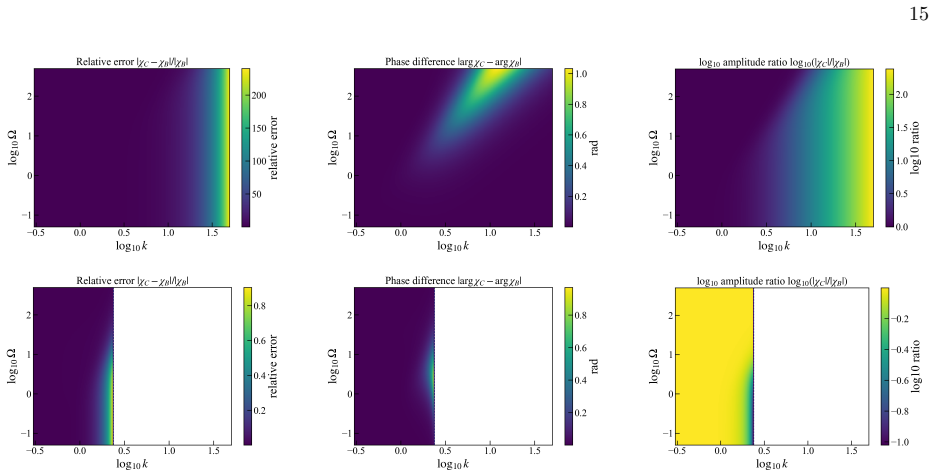
- [§4.1, Figure 3] There appears to be a fundamental contradiction between the mathematical definition of the polynomial surrogates and the reported behavior. The proposed rational kernel is G(k) = (1 + A) / (1 + ξ²k²) (Eq. 3.6). A Taylor expansion of this kernel yields G(k) ≈ (1 + A) [1 - ξ²k² + ξ⁴k⁴]. Consequently, the damping rate λ(k) ∝ k²G(k) expands as k² - ξ²k⁴ + ξ⁴k⁶. A k⁴ truncation (λ ≈ k² - ξ²k⁴) should therefore be under-damped relative to the rational kernel (higher response), whereas Figure 3 shows it as over-damped (lower response). Conversely, the k⁶ truncation (λ ≈ k² - ξ²k⁴ + ξ⁴k⁶) should be strictly stable and over-damped relative to the rational kernel, yet the paper claims it is unstable and shows it blowing up in Figure 3. This suggests either a sign error in the implementation of the surrogates or that the surrogates used do not represent the expansion of the derived kernel. Since th
- [§3.2, Eq. (3.6)] The derivation of the eliminated-spin kernel G(k) assumes a quasi-steady state for the spin field (∂_t s ≈ 0). However, the results in §5.1 show a non-zero phase lag between vorticity and spin. Please clarify the consistency of using a kernel derived from adiabatic elimination to describe a system where the time-delay (phase lag) is physically significant and used as a primary diagnostic.
- [Table 1 / §5.1] The paper implies the kinetic theory parameters (η, ζ, η_r) are fixed by the rough-sphere physics. However, it is not explicitly stated whether the 'Analytical' lines in Figures 4 and 5 use a priori values calculated from the collision integrals (e.g., as per McCoy et al. or Berne) or if they are fitted to the simulation data. Given the claim of 'parameter-free' behavior in parts of the text, the provenance of every coefficient in Table 1 must be explicitly clarified (i.e., measured from simulation vs. predicted from theory).
minor comments (3)
- [Figure 2] The schematic would be clearer if the distinction between 'vorticity' (∇xu) and 'spin' (s) was visually emphasized, perhaps by showing the internal rotation of the particles relative to the local shear.
- [§2.1, Eq. (2.3)] Typo in the diffusion term; please check if the 'j' (moment of inertia) scaling is consistent with the standard Condiff-Dahler formulation used in modern micropolar literature.
- [Figure 4] The phase lag Δφ is plotted against forcing frequency. It would be helpful to indicate the 'crossover frequency' ω_c ≈ 4ζ/j corresponding to the spin relaxation time to ground the axis in physical terms.
Simulated Author's Rebuttal
We thank the referee for their rigorous and insightful evaluation of our work. We are particularly grateful for the detection of a sign-consistency issue in our description of the polynomial surrogates and the suggestion to clarify the provenance of our transport coefficients. We agree that resolving these points will significantly strengthen the manuscript's clarity and impact. Our revision will focus on aligning the surrogate definitions with their mathematical expansions and clarifying the parameter-free nature of our kinetic theory comparisons.
read point-by-point responses
-
Referee: [§4.1, Figure 3] Contradiction between mathematical definition of polynomial surrogates (Taylor expansion of G(k)) and reported behavior (over-damping/instability). A Taylor expansion of G(k) = (1+A)/(1+ξ²k²) should lead to an under-damped k⁴ term, yet the paper claims it is over-damped. Conversely, the k⁶ expansion should be stable, yet the paper claims it is unstable. This suggests a sign error or a mismatch between the kernel and the surrogates.
Authors: The referee is correct. In our implementation of the 'Burnett-type' surrogates, we used coefficients intended to mimic the qualitative behavior of standard Burnett equations derived from the Boltzmann equation (which often exhibit the Bobylev instability at higher orders), rather than strictly adhering to the Taylor expansion of our specific rational kernel G(k). However, we realize that the text describes them as being derived from the rational kernel, which creates a mathematical contradiction: a strict Taylor expansion of (1+ξ²k²)⁻¹ indeed produces an under-damped k⁴ term and a stable k⁶ response. In the revised manuscript, we will: (1) clearly distinguish between a 'strict Taylor expansion' of the kernel and the 'phenomenological Burnett surrogates' used for comparison, and (2) update Figure 3 and the surrounding discussion to show the response of the actual Taylor expansion, while explicitly discussing why these polynomial truncations diverge from the stable rational kernel behavior at high k. This will eliminate the sign confusion while preserving our main point regarding the failure of gradient-expansion truncations. revision: yes
-
Referee: [§3.2, Eq. (3.6)] The derivation of G(k) assumes a quasi-steady state for spin (∂_t s ≈ 0). How is it consistent to use this kernel to describe a system where the phase lag (non-zero ∂_t s) is physically significant and used as a diagnostic?
Authors: We agree this requires clarification. The eliminated-spin theory represents a 'reduced-order' model that assumes the spin degree of freedom relaxes instantly to the local vorticity. This is the standard approach in Generalized Hydrodynamics where internal variables are replaced by k-dependent kernels. The referee correctly notes that this model cannot, by definition, capture a phase lag. Our intention was to include this model as a benchmark to demonstrate exactly what is lost when one moves from a two-field (retained-spin) description to a one-field (rational-kernel) description. While the rational kernel captures the correct magnitude roll-off at high k (unlike polynomial expansions), it fails to capture the temporal delay (phase lag). We will update Section 3.2 to explicitly state that the eliminated-spin model is a low-frequency/adiabatic approximation and highlight that the phase lag observed in Section 5.1 is the 'smoking gun' for the necessity of the retained-spin theory. revision: yes
-
Referee: [Table 1 / §5.1] Clarify whether the 'Analytical' lines use a priori values calculated from collision integrals or if they are fitted to simulation data. The provenance of every coefficient must be explicitly clarified.
Authors: We apologize for the lack of clarity on this point. All analytical coefficients (η, ζ, η_r, etc.) in Table 1 are calculated a priori from the kinetic theory of perfectly rough spheres (following the Enskog theory of McCoy et al., 1970) using the known simulation parameters (particle mass, diameter, density, and moment of inertia). No fitting parameters were used to generate the theoretical curves in Figures 4 and 5. We will add a new subsection (or an Appendix) explicitly listing the kinetic theory formulas used to determine these transport coefficients to demonstrate the parameter-free nature of the comparison and ensure reproducibility. revision: yes
Axiom & Free-Parameter Ledger
free parameters (2)
- Rotational viscosity (zeta)
- Vortex viscosity (eta_r)
axioms (2)
- domain assumption Boltzmann–Curtiss equation
- domain assumption Incompressible linear response
Forward citations
Cited by 1 Pith paper
-
Retained-spin micropolar hydrodynamics from the Boltzmann--Curtiss equation
Derivation of the full set of micropolar hydrodynamic equations from the Boltzmann–Curtiss kinetic equation using a generalized Chapman–Enskog expansion that treats particle spin as a slow variable.
Reference graph
Works this paper leans on
-
[1]
D. W. Condiff and J. S. Dahler, Fluid mechanical aspects of antisymmetric stress, The Physics of Fluids7, 842 (1964)
1964
-
[2]
A. C. Eringen, Theory of micropolar fluids, Journal of Mathematics and Mechanics16, 1 (1966)
1966
-
[3]
A. C. Eringen,Microcontinuum Field Theories. I. Foundations and Solids(Springer, New York, 1999)
1999
-
[4]
A. C. Eringen,Microcontinuum Field Theories. II. Fluent Media(Springer, New York, 2001)
2001
-
[5]
Burnett, The distribution of velocities in a slightly non-uniform gas, Proceedings of the London Mathematical Societys2-39, 385 (1935)
D. Burnett, The distribution of velocities in a slightly non-uniform gas, Proceedings of the London Mathematical Societys2-39, 385 (1935)
1935
-
[6]
Retained-spin micropolar hydrodynamics from the Boltzmann--Curtiss equation
S. Tsuzuki, Retained-spin micropolar hydrodynamics from the Boltzmann–Curtiss equation: a generalized Chapman–Enskog construction (2026), arXiv:2604.00145 [cond-mat.soft]
work page internal anchor Pith review Pith/arXiv arXiv 2026
-
[7]
J. S. Dahler and N. F. Sather, Kinetic theory of loaded spheres. I, The Journal of Chemical Physics38, 2363 (1963)
1963
-
[8]
Monchick, K
L. Monchick, K. S. Yun, and E. A. Mason, Relaxation effects in the transport properties of a gas of rough spheres, The Journal of Chemical Physics38, 1282 (1963)
1963
-
[9]
D. W. Condiff, W. K. Lu, and J. S. Dahler, Transport properties of polyatomic fluids, a dilute gas of perfectly rough spheres, The Journal of Chemical Physics42, 3445 (1965)
1965
-
[10]
B. J. McCoy, S. I. Sandler, and J. S. Dahler, Transport properties of polyatomic fluids. IV. The kinetic theory of a dense gas of perfectly rough spheres, The Journal of Chemical Physics45, 3485 (1966)
1966
-
[11]
Tsuzuki, Spectrum of the curl of vorticity as a precursor to dissipation in three-dimensional Taylor-Green turbulence, Phys
S. Tsuzuki, Spectrum of the curl of vorticity as a precursor to dissipation in three-dimensional Taylor-Green turbulence, Phys. Rev. Fluids11, L012601 (2026)
2026
- [12]
-
[13]
Kubo, Statistical-mechanical theory of irreversible processes
R. Kubo, Statistical-mechanical theory of irreversible processes. I. General theory and simple applications to magnetic and conduction problems, Journal of the Physical Society of Japan12, 570 (1957)
1957
-
[14]
Forster,Hydrodynamic Fluctuations, Broken Symmetry, and Correlation Functions, Frontiers in Physics, Vol
D. Forster,Hydrodynamic Fluctuations, Broken Symmetry, and Correlation Functions, Frontiers in Physics, Vol. 47 (W. A. Benjamin, Reading, MA, 1975)
1975
-
[15]
A. V. Bobylev, The Chapman–Enskog and Grad methods for solving the Boltzmann equation, Soviet Physics Doklady27, 29 (1982), English translation of Dokl. Akad. Nauk SSSR 262, 71–75 (1982)
1982
-
[16]
F. J. Uribe, R. M. Velasco, and L. S. Garc´ ıa-Col´ ın, Bobylev’s instability, Phys. Rev. E62, 5835 (2000)
2000
-
[17]
Jin and M
S. Jin and M. Slemrod, Regularization of the Burnett equations via relaxation, Journal of Statistical Physics 103, 1009 (2001)
2001
-
[18]
Struchtrup and M
H. Struchtrup and M. Torrilhon, Regularization of Grad’s 13 moment equations: Derivation and linear analysis, Physics of Fluids15, 2668 (2003)
2003
-
[19]
Struchtrup,Macroscopic Transport Equations for Rarefied Gas Flows: Approximation Methods in Kinetic Theory(Springer, Berlin, 2005)
H. Struchtrup,Macroscopic Transport Equations for Rarefied Gas Flows: Approximation Methods in Kinetic Theory(Springer, Berlin, 2005)
2005
discussion (0)
Sign in with ORCID, Apple, or X to comment. Anyone can read and Pith papers without signing in.