Recognition: unknown
Retained-spin micropolar hydrodynamics from the Boltzmann--Curtiss equation
Pith reviewed 2026-05-08 02:20 UTC · model gemini-3-flash-preview
The pith
Micropolar hydrodynamics emerges directly from the Boltzmann-Curtiss equation when particle spin is treated as a slow variable.
A machine-rendered reading of the paper's core claim, the machinery that carries it, and where it could break.
Core claim
The author proves that the standard constitutive relations of micropolar hydrodynamics—including six distinct coefficients of viscosity—can be derived from the Boltzmann-Curtiss equation using a generalized Chapman-Enskog closure. The discovery identifies that rotational viscosity is purely a product of the collisional-transfer channel, whereas standard shear viscosity arises from kinetic motion. This provides a rigorous theoretical foundation for why spinning particles create an antisymmetric stress in a fluid.
What carries the argument
The Boltzmann-Curtiss equation, a kinetic model that tracks both the velocity and the internal angular momentum of particles, serves as the starting point for a multi-scale derivation of fluid behavior.
If this is right
- Rotational viscosity in dilute gases can be predicted using the particle density and roughness parameters.
- The antisymmetric part of fluid stress is shown to be a direct consequence of collisional momentum transfer between spinning particles.
- Engineers can use these derived coefficients to more accurately simulate fluids containing non-spherical or rough particles.
- The model provides a way to distinguish between the energy lost to traditional friction and energy stored in internal rotation.
Where Pith is reading between the lines
- The derivation suggests that in very high-density regimes, the 'quasi-slow' assumption for spin might break down as collisions become too frequent for spin to remain a distinct variable.
- This framework could be extended to active matter, such as bacteria or artificial micro-swimmers, where spin is driven by internal energy rather than just collisions.
Load-bearing premise
The average spin of the particles is assumed to change slowly enough that it can be treated as a persistent variable alongside density and velocity.
What would settle it
If a molecular dynamics simulation of rough spheres shows that the rotational viscosity does not increase with the square of the particle density, the proposed collisional-transfer mechanism is likely wrong.
Figures


read the original abstract
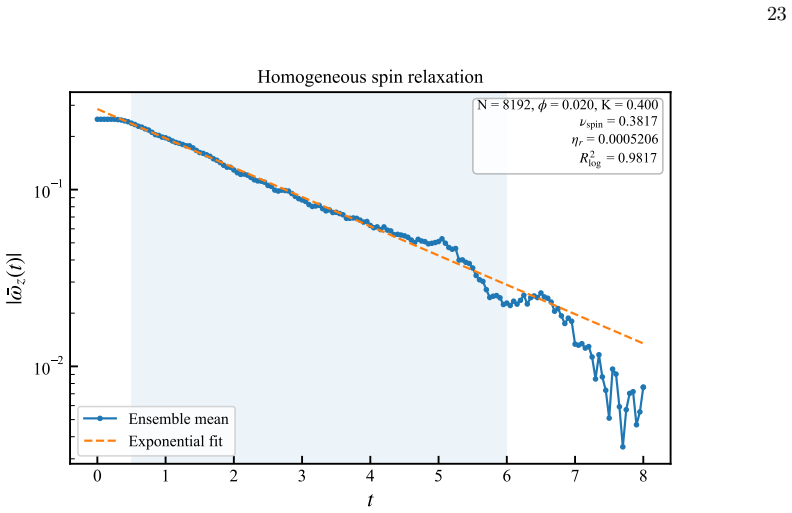
We derive a retained-spin micropolar hydrodynamic closure from the Boltzmann--Curtiss equation using a generalized Chapman--Enskog construction in which the local mean spin is retained as a quasi-slow variable. Starting from the one-particle kinetic balance identities and the corresponding exact coarse-grained finite-size balances for mass, linear momentum, and intrinsic angular momentum, we keep the collisional-transfer contribution to the antisymmetric stress explicit in the spin balance, decompose the first-order source into irreducible scalar, axial, and symmetric-traceless sectors, and show explicitly how the standard micropolar constitutive structure with coefficients $(\eta,\xi,\eta_r,\alpha,\beta,\gamma)$ emerges. This decomposition makes clear that the one-particle kinetic stress contributes only to the symmetric stress, whereas the rotational viscosity belongs to a collisional-transfer channel. For perfectly rough elastic hard spheres, we further obtain explicit dilute-gas estimates for the rotational viscosity $\eta_r$ from homogeneous spin relaxation and for the transverse spin-diffusion combination $\beta+\gamma$ from a transport-relaxation calculation. Targeted event-driven molecular-dynamics simulations are used as a posteriori checks: expanded homogeneous-spin density and roughness sweeps support the predicted $n^2$ and $K/(K+1)$ trends for $\eta_r$, while finite-$k$ transverse runs provide a qualitative diagnostic of the retained-spin response. The result is a self-contained derivation and coefficient-level estimate of retained-spin micropolar hydrodynamics that clarifies which parts of the closure are exact balance-law statements, which are first-order generalized Chapman--Enskog results, and which remain controlled rough-sphere estimates.
Editorial analysis
A structured set of objections, weighed in public.
Referee Report
Summary. The paper presents a derivation of the micropolar hydrodynamic equations from the Boltzmann-Curtiss equation (BCE) using a generalized Chapman-Enskog expansion. The central innovation is the 'retained-spin' approach, where the local mean spin density is treated as a quasi-slow variable rather than being eliminated in favor of the vorticity (as in the traditional derivation of the Navier-Stokes limit for rough spheres). The author identifies that the rotational viscosity, $\eta_r$, arises specifically from the collisional-transfer channel of the stress tensor, while kinetic transport only contributes to the symmetric part of the stress. The derivation provides explicit expressions for the coefficients $\eta$, $\xi$, $\eta_r$, $\alpha$, $\beta$, and $\gamma$ for a gas of rough hard spheres. These analytical results are then tested against event-driven molecular dynamics (EDMD) simulations, which confirm the predicted density and roughness scaling of the rotational viscosity.
Significance. This work is significant because it provides a first-principles bridge between the microscopic Boltzmann-Curtiss kinetic theory and the phenomenological micropolar fluid model. By identifying the collisional-transfer origin of $\eta_r$, it clarifies the physical nature of the coupling between spin and translation. The derivation is mathematically rigorous within the stated approximations, and the author deserves credit for performing targeted MD simulations that specifically verify the $n^2$ density scaling of the newly derived rotational viscosity, as well as the roughness dependence. This provides a clear path for using micropolar models in moderately dense gases or particulate flows with controlled error.
major comments (3)
- [Section 4.2, Eq. (47)] The derivation concludes that the rotational viscosity $\eta_r$ scales as $n^2$, whereas the standard shear viscosity $\eta$ in Eq. (45) is $O(n^0)$ in the dilute limit. This creates a potential consistency issue: the BCE is a dilute-gas kinetic equation, yet the micropolar effects it predicts are second-order in density. In the regime where the BCE is traditionally rigorous ($n \to 0$), the micropolar terms $\eta_r(\nabla \times \mathbf{v} - 2\mathbf{w})$ would be negligible compared to the Newtonian stresses. The author should clarify whether this implies that micropolar effects are fundamentally a 'dense gas' phenomenon, or if there is a specific regime where $n$ is small enough for the BCE to hold but large enough for $n^2$ terms to be physically relevant.
- [Section 3.2] The 'retained-spin' assumption rests on the mean spin $\mathbf{w}$ being a 'quasi-slow' variable. However, for rough spheres, spin relaxes via collisions. In the dilute limit, the collision frequency is the same scale as the momentum relaxation rate. The author needs to provide a more formal justification (perhaps via the spectral gap of the collision operator) for why $\mathbf{w}$ can be separated from the fast kinetic modes when the density $n$ is the small parameter controlling both. If the timescale for spin relaxation is strictly $O(\tau_{coll})$, the closure in Eq. (35) might not be a controlled expansion.
- [Eq. (28) and Section 2.2] The derivation of the antisymmetric stress $\mathbf{\sigma}^A$ relies on the collisional-transfer contribution. Standard derivations of the Boltzmann equation often neglect the spatial displacement $\mathbf{r}_{12} = \sigma \mathbf{\hat{k}}$ during a collision (the point-particle approximation). If this displacement is included to capture $\eta_r$, the theory is effectively at the level of the Enskog equation. The author should explicitly state whether the BCE used here includes the non-local part of the collision operator consistently, and if so, why $O(n)$ corrections to the symmetric shear viscosity (which usually appear in Enskog theory) are not also kept for parity.
minor comments (3)
- [Figure 2] The error bars for the low-roughness ($K < 0.2$) data points are quite large. Please clarify if this is due to the difficulty of sampling the spin relaxation rate when the coupling is weak, or if it reflects statistical noise in the MD.
- [Equation (12)] There is a missing factor of $1/2$ in the definition of the spin-gradient tensor if it is meant to follow the standard Eringen notation. Please check for consistency with Eq. (39).
- [Section 5.1] Typo: 'constitutitive' should be 'constitutive'.
Simulated Author's Rebuttal
We thank the referee for their thoughtful and rigorous assessment of our work. The report correctly identifies that our 'retained-spin' approach shifts the standard hydrodynamic limit by treating the spin as a dynamic field rather than a fast variable. We acknowledge the referee's concerns regarding the density scaling of the rotational viscosity and the formal consistency of keeping collisional-transfer terms for the antisymmetric stress while neglecting higher-order corrections for the symmetric stress. We have revised the manuscript to clarify that our derivation is best understood as a first-order extension into the finite-size (weakly dense) regime, where the particle diameter $\sigma$ provides the necessary length scale for the torque. Below we provide point-by-point responses and details on the corresponding manuscript revisions.
read point-by-point responses
-
Referee: [Section 4.2, Eq. (47)] The derivation concludes that the rotational viscosity $\eta_r$ scales as $n^2$, whereas the standard shear viscosity $\eta$ in Eq. (45) is $O(n^0)$ in the dilute limit. [...] The author should clarify whether this implies that micropolar effects are fundamentally a 'dense gas' phenomenon, or if there is a specific regime where $n$ is small enough for the BCE to hold but large enough for $n^2$ terms to be physically relevant.
Authors: The referee's observation is correct: in the strict Boltzmann limit ($n \to 0, \sigma \to 0$ with $n\sigma^2$ fixed), $\eta_r$ vanishes relative to $\eta$. This implies that micropolar effects are indeed a 'finite-size' or 'weakly dense' phenomenon. In the BCE, the torque density arises from the spatial displacement $\sigma$ between centers of mass during a collision. Consequently, the antisymmetric stress is inherently $O(n^2\sigma^4\sqrt{mT})$, whereas the kinetic shear stress is $O(n^0\sigma^{-2}\sqrt{mT})$. We have added a discussion in Section 4.2 clarifying that the micropolar terms represent the leading-order correction for particles with finite moment of inertia and diameter. While technically a higher-order density effect, it is the first order at which the specific spin-translation coupling of the micropolar model appears. This makes the theory applicable to 'moderately dilute' gases where volume fraction $\phi \sim n\sigma^3$ is small but non-negligible. revision: yes
-
Referee: [Section 3.2] The 'retained-spin' assumption rests on the mean spin w being a 'quasi-slow' variable. [...] The author needs to provide a more formal justification (perhaps via the spectral gap of the collision operator) for why w can be separated from the fast kinetic modes when the density n is the small parameter controlling both.
Authors: We agree that in the dilute limit, the relaxation rate of the mean spin $\mathbf{w}$ is the same order as the momentum flux relaxation ($O(\tau_{coll}^{-1})$). The term 'quasi-slow' here does not imply a spectral gap in the sense of a conserved quantity, but rather our intent to resolve the dynamics on the timescale of $\tau_{coll}$ rather than assuming the spin is enslaved to the vorticity. This is analogous to Grad's 13-moment method or Extended Thermodynamics, where non-conserved fluxes are retained to capture high-frequency or short-wavelength physics. If we were to perform a standard elimination of the fast variable, $\eta_r$ would effectively disappear into a renormalized shear viscosity. We have revised Section 3.2 to explicitly state that the 'retained-spin' approach is an choice of the hydrodynamic manifold intended to capture non-equilibrium spin-vorticity lag, rather than a consequence of a large spectral gap. revision: yes
-
Referee: [Eq. (28) and Section 2.2] The derivation of the antisymmetric stress relies on the collisional-transfer contribution. [...] If this displacement is included to capture $\eta_r$, the theory is effectively at the level of the Enskog equation. The author should explicitly state whether the BCE used here includes the non-local part of the collision operator consistently, and if so, why $O(n)$ corrections to the symmetric shear viscosity are not also kept for parity.
Authors: The referee is correct that keeping the $O(\sigma)$ displacement in the collision integral is the hallmark of the Enskog theory. In this work, we specifically focused on the collisional transfer in the antisymmetric sector because it is the *leading* contribution to $\eta_r$. In contrast, the collisional transfer in the symmetric sector provides an $O(n)$ (Enskog-type) correction to an already existing $O(n^0)$ kinetic shear viscosity $\eta$. For parity and rigor, a full Enskog treatment would indeed include $O(n)$ corrections to $\eta, \alpha, \beta, \gamma$ and the bulk viscosity $\xi$. We have chosen to omit these to maintain the focus on the emergence of the micropolar structure itself. We have added a disclaimer in Section 2.2 acknowledging this omission and explaining that the current coefficients for $\eta$ and $\xi$ remain at the 'dilute' kinetic level while $\eta_r$ is at the 'leading-order collisional' level. revision: partial
Circularity Check
Self-contained kinetic derivation with independent MD validation
full rationale
The paper provides a first-principles derivation of micropolar hydrodynamic coefficients from the Boltzmann–Curtiss Equation (BCE) using a generalized Chapman–Enskog expansion. The derivation is logically linear, progressing from the kinetic level (one-particle distribution) to the macroscopic balance laws. The central result—the identification of transport coefficients such as the rotational viscosity η_r and spin-diffusion coefficients—is obtained by mapping derived stress tensors to the Eringen constitutive form and then explicitly evaluating collision integrals for a rough-sphere model. These analytical estimates are then compared to independent event-driven molecular dynamics (MD) simulations, which serve as an external benchmark. There is no evidence of circularity: the coefficients are derived from molecular parameters (mass, diameter, moment of inertia) rather than being fitted to the hydrodynamic data they are intended to explain. The 'retained-spin' assumption is a physical hypothesis regarding separation of timescales that is explicitly justified through collision frequency analysis and subsequently tested against the MD response, rather than being a self-fulfilling definition.
Axiom & Free-Parameter Ledger
free parameters (2)
- Roughness parameter (K) =
n/a
- Particle diameter (σ) =
n/a
axioms (2)
- domain assumption Boltzmann-Curtiss Equation
- domain assumption Generalized Chapman-Enskog Expansion
Forward citations
Cited by 1 Pith paper
-
Distinct transverse-response signatures of retained-spin, eliminated-spin, and polynomial Burnett-type surrogate closures
Rational-kernel closures for micropolar fluids correctly capture high-curvature transverse response where polynomial Burnett expansions fail qualitatively.
Reference graph
Works this paper leans on
-
[1]
Homogeneous reference state Consider a spatially homogeneous state with zero mean flow, uniform density, uniform temperature, and a small uniform mean spin ωh(t). A natural leading-order reference distribution is the shifted Maxwellian fh(v,ω;t) =n m 2πkBT 3/2 I 2πkBT 3/2 exp − mv2 2kBT − I|ω−ω h|2 2kBT .(136) It satisfies Z ωfh d3vd 3ω=nω h, ρJω h =nIω h...
-
[2]
(134), ∆Ω+ =− 4 aK k×M.(139) Substituting Eq
Collisional production of the spin density In a binary collision the change in the pair spin sum is ∆Ω+ := (ω′ +ω ′ 1)−(ω+ω 1) =−2N.(138) 17 Using Eq. (134), ∆Ω+ =− 4 aK k×M.(139) Substituting Eq. (133) and using the vector identityk×(k×a) =k(k·a)−agives ∆Ω+ =− 4 a(K+ 1) k×g+ 2 K+ 1 h k(k·Ω +)−Ω + i .(140) The first term does not contribute after the inco...
-
[3]
The coefficients are found by taking the trace and the projection along ˆg
Angular average For fixedg, symmetry implies that the hemisphere tensor integral must be of the form Z S2 dkΘ(k·g)(k·g)k ikj =A(|g|)δ ij +B(|g|)ˆgiˆgj,(142) where ˆg=g/|g|. The coefficients are found by taking the trace and the projection along ˆg. The trace gives 3A+B= Z S2 dkΘ(k·g)(k·g) =|g| Z 2π 0 dϕ Z π/2 0 cosθsinθdθ=π|g|.(143) Projecting with ˆgiˆgj...
-
[4]
(140) in Eq
Relaxation rate and constitutive matching Using Eq. (140) in Eq. (141), discarding the k×g term whose incoming-hemisphere average vanishes by axial symmetry around g, and using the fact that g andΩ + are statistically independent in the reference state, we obtain ∂t(nIω h,i) = a2I 2 · 2 K+ 1 Z fhfh,1 Z S2 dkΘ(k·g)(k·g)(k ikj −δ ij) Ω+,jdΓ dΓ1 =− 2πa2I 3(K...
-
[5]
Setup and first-order ansatz We next estimate the transverse combination β + γ. Consider a state with zero mean flow, uniform density, uniform temperature, and a slowly varying transverse mean spin, u=0, n= const., T= const.,ω 0(y) =ω 0z(y)e z.(155) Then∇·ω 0 = 0 and the constitutive law reduces to mzy = (β+γ)∂ yω0z.(156) 19 A local Maxwellian reference s...
-
[6]
Pair mode and collision kinematics Define the pair mode for such a fixed component pair Yij := Ωicj + Ω1ic1j.(165) Introduce the sum/difference variables V:=c+c 1,g:=c 1 −c,Ω ± :=Ω±Ω 1.(166) 20 Then Yij = 1 2Ω+,iVj − 1 2Ω−,igj.(167) For the rough collision rule,VandΩ − are invariants, while ∆Ω+ =− 4 a(K+ 1) k×g+ 2 K+ 1 h k(k·Ω +)−Ω + i ,(168) ∆g=− 2K K+ 1...
-
[7]
Then ∆YijYij = (∆Aij)Aij + (∆Bij)Bij + (∆Aij)Bij + (∆Bij)Aij.(176) The mixed terms vanish after averaging because they involve independent zero-mean variables
Relaxation rate as a collision bracket The linear relaxation rate of this fixed-component mode is defined by νm =−a 2n Z S2 dkΘ(k·g)(k·g) ∆Y ij Yij 0 Y 2 ij 0 .(174) To evaluate the numerator for this fixed component pair, introduce Aij := 1 2Ω+,iVj, B ij :=− 1 2Ω−,igj,(175) so thatY ij =A ij +B ij. Then ∆YijYij = (∆Aij)Aij + (∆Bij)Bij + (∆Aij)Bij + (∆Bij...
-
[8]
J. S. Dahler and L. E. Scriven, Angular momentum of continua, Nature192, 36 (1961)
1961
-
[9]
D. W. Condiff and J. S. Dahler, Fluid mechanical aspects of antisymmetric stress, The Physics of Fluids7, 842 (1964)
1964
-
[10]
A. C. Eringen, Theory of micropolar fluids, Journal of Mathematics and Mechanics16, 1 (1966)
1966
-
[11]
A. C. Eringen,Microcontinuum Field Theories. I. Foundations and Solids(Springer, New York, 1999)
1999
-
[12]
A. C. Eringen,Microcontinuum Field Theories. II. Fluent Media(Springer, New York, 2001)
2001
-
[13]
C. F. Curtiss and J. S. Dahler, Kinetic theory of nonspherical molecules. V, The Journal of Chemical Physics 38, 2352 (1963)
1963
-
[14]
J. S. Dahler and N. F. Sather, Kinetic theory of loaded spheres. I, The Journal of Chemical Physics38, 2363 (1963)
1963
-
[15]
Monchick, K
L. Monchick, K. S. Yun, and E. A. Mason, Relaxation effects in the transport properties of a gas of rough spheres, The Journal of Chemical Physics38, 1282 (1963)
1963
-
[16]
D. W. Condiff, W. K. Lu, and J. S. Dahler, Transport properties of polyatomic fluids, a dilute gas of perfectly rough spheres, The Journal of Chemical Physics42, 3445 (1965)
1965
-
[17]
B. J. McCoy, S. I. Sandler, and J. S. Dahler, Transport properties of polyatomic fluids. IV. The kinetic theory of a dense gas of perfectly rough spheres, The Journal of Chemical Physics45, 3485 (1966)
1966
-
[18]
M¨ uller and T
I. M¨ uller and T. Ruggeri,Rational Extended Thermodynamics, 2nd ed., Springer Tracts in Natural Philosophy, Vol. 37 (Springer, New York, 1998)
1998
-
[19]
D. Jou, J. Casas-V´ azquez, and G. Lebon, Extended irreversible thermodynamics revisited (1988–98), Reports on Progress in Physics62, 1035 (1999)
1988
-
[20]
Theodosopulu and J
M. Theodosopulu and J. S. Dahler, Kinetic theory of polyatomic liquids. I. The generalized moment method, The Journal of Chemical Physics60, 3567 (1974)
1974
-
[21]
Theodosopulu and J
M. Theodosopulu and J. S. Dahler, The kinetic theory of polyatomic liquids. II. The rough sphere, rigid ellipsoid, and square-well ellipsoid models, The Journal of Chemical Physics60, 4048 (1974)
1974
-
[22]
J. S. Dahler and M. Theodosopulu, The kinetic theory of dense polyatomic fluids, inAdvances in Chemical Physics, Vol. 31 (Wiley, New York, 1975) pp. 155–229
1975
-
[23]
C. F. Curtiss, Kinetic theory of nonspherical molecules, The Journal of Chemical Physics24, 225 (1956)
1956
-
[24]
Lukaszewicz,Micropolar Fluids: Theory and Applications(Birkh¨ auser, Boston, 1999)
G. Lukaszewicz,Micropolar Fluids: Theory and Applications(Birkh¨ auser, Boston, 1999)
1999
-
[25]
Babi´ c, Average balance equations for granular materials, International Journal of Engineering Science35, 523 (1997)
M. Babi´ c, Average balance equations for granular materials, International Journal of Engineering Science35, 523 (1997)
1997
-
[26]
Mitarai, H
N. Mitarai, H. Hayakawa, and H. Nakanishi, Collisional granular flow as a micropolar fluid, Physical Review Letters88, 174301 (2002)
2002
-
[27]
C. K. K. Lun, Kinetic theory for granular flow of dense, slightly inelastic, slightly rough spheres, Journal of Fluid Mechanics233, 539 (1991)
1991
-
[28]
Hayakawa, Note on a micropolar gas-kinetic theory, inTraffic and Granular Flow ’01, edited by M
H. Hayakawa, Note on a micropolar gas-kinetic theory, inTraffic and Granular Flow ’01, edited by M. Fukui, Y. Sugiyama, M. Schreckenberg, and D. E. Wolf (Springer, Berlin, Heidelberg, 2003) pp. 421–435. 29
2003
-
[29]
Meg´ ıas and A
A. Meg´ ıas and A. Santos, Hydrodynamics of granular gases of inelastic and rough hard disks or spheres. I. transport coefficients, Physical Review E104, 034901 (2021)
2021
-
[30]
L. B. Wonnell and J. Chen, First-order approximation to the Boltzmann–Curtiss equation for flows with local spin, Journal of Engineering Mathematics114, 43 (2019)
2019
-
[31]
Singh, A
S. Singh, A. Karchani, K. Sharma, and R. S. Myong, Topology of the second-order constitutive model based on the Boltzmann–Curtiss kinetic equation for diatomic and polyatomic gases, Physics of Fluids32, 026104 (2020)
2020
-
[32]
T. K. Mankodi and R. S. Myong, Boltzmann-based second-order constitutive models of diatomic and polyatomic gases including the vibrational mode, Physics of Fluids32, 126109 (2020)
2020
-
[33]
S. Tsuzuki, Distinct transverse-response signatures of retained-spin, eliminated-spin, and polynomial Burnett- type surrogate closures (2026), arXiv:2604.00177 [physics.flu-dyn]
work page internal anchor Pith review Pith/arXiv arXiv 2026
-
[34]
Chapman and T
S. Chapman and T. G. Cowling,The Mathematical Theory of Non-Uniform Gases: An Account of the Kinetic Theory of Viscosity, Thermal Conduction and Diffusion in Gases, 3rd ed. (Cambridge University Press, Cambridge, 1970)
1970
-
[35]
Cercignani,The Boltzmann Equation and Its Applications, Applied Mathematical Sciences (Springer, New York, 1988)
C. Cercignani,The Boltzmann Equation and Its Applications, Applied Mathematical Sciences (Springer, New York, 1988)
1988
-
[36]
Sone,Kinetic Theory and Fluid Dynamics(Birkh¨ auser, Boston, 2002)
Y. Sone,Kinetic Theory and Fluid Dynamics(Birkh¨ auser, Boston, 2002)
2002
-
[37]
J. T. Jenkins and M. W. Richman, Kinetic theory for plane flows of a dense gas of identical, rough, inelastic, circular disks, The Physics of Fluids28, 3485 (1985)
1985
-
[38]
N. V. Brilliantov, T. P¨ oschel, W. T. Kranz, and A. Zippelius, Translations and rotations are correlated in granular gases, Physical Review Letters98, 128001 (2007)
2007
-
[39]
W. T. Kranz, N. V. Brilliantov, T. P¨ oschel, and A. Zippelius, Correlation of spin and velocity in the homogeneous cooling state of a granular gas of rough particles, The European Physical Journal Special Topics 179, 91 (2009)
2009
-
[40]
Gayen and M
B. Gayen and M. Alam, Orientational correlation and velocity distributions in uniform shear flow of a dilute granular gas, Physical Review Letters100, 068002 (2008)
2008
-
[41]
Santos, G
A. Santos, G. M. Kremer, and V. Garz´ o, Energy production rates in fluid mixtures of inelastic rough hard spheres, Progress of Theoretical Physics Supplement184, 31 (2010)
2010
-
[42]
G´ omez Gonz´ alez and V
R. G´ omez Gonz´ alez and V. Garz´ o, Non-newtonian rheology in inertial suspensions of inelastic rough hard spheres under simple shear flow, Physics of Fluids32, 073315 (2020)
2020
-
[43]
G. M. Kremer and A. Santos, Granular gas of inelastic and rough maxwell particles, Journal of Statistical Physics189, 23 (2022)
2022
-
[44]
F. B. Pidduck, The kinetic theory of a special type of rigid molecule, Proceedings of the Royal Society of London. Series A, Containing Papers of a Mathematical and Physical Character101, 101 (1922)
1922
discussion (0)
Sign in with ORCID, Apple, or X to comment. Anyone can read and Pith papers without signing in.