Recognition: no theorem link
Solving L\'{e}vy Sachdev-Ye-Kitaev Model
Pith reviewed 2026-05-13 21:31 UTC · model grok-4.3
The pith
The Lévy SYK model admits an exact large-N solution for any tail exponent mu that tunes chaos continuously from free to maximal.
A machine-rendered reading of the paper's core claim, the machinery that carries it, and where it could break.
Core claim
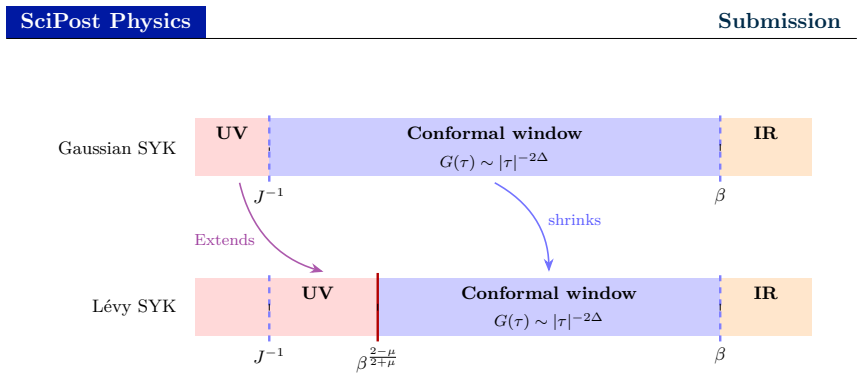
In the large-N limit the LSYK model is solved by Schwinger-Dyson equations obtained from the bosonic oscillator representation of the action. These equations are solved both numerically and analytically in the large-q and infrared regimes, yielding the two-point function from which the Krylov exponent and the Lyapunov exponent are extracted. The tail exponent mu provides a continuous interpolation: the model is free at mu=0 and recovers the maximally chaotic Gaussian SYK model at mu=2, with non-maximal chaos for all intermediate values. Thermodynamic observables are computed explicitly and interpreted in the context of holography and non-Fermi liquid physics.
What carries the argument
The bosonic oscillator representation of the action that converts the Lévy-stable couplings into large-N Schwinger-Dyson equations solvable in the infrared and large-q limits.
If this is right
- The Lyapunov exponent remains strictly below the chaos bound for every mu in (0,2) and saturates only at mu=2.
- Entropy, free energy, and specific heat vary continuously with mu and differ from the corresponding Gaussian SYK quantities at each intermediate value.
- The infrared Green's function admits closed-form expressions in the large-q limit that recover the free-fermion result at mu=0.
- An alternative decomposition of the Lévy distribution establishes an explicit non-trivial mapping onto the Gaussian SYK model.
Where Pith is reading between the lines
- The mu-tuned family could serve as a controlled interpolation between integrable and chaotic regimes for studying the onset of scrambling in other disordered systems.
- Thermodynamic scaling with mu may be tested in cold-atom or trapped-ion realizations that can realize power-law disorder distributions.
- The same bosonic representation technique might be applied to other heavy-tailed interaction distributions to obtain solvable large-N limits.
Load-bearing premise
The bosonic oscillator representation of the action correctly encodes the effects of the Lévy-stable distributed couplings when deriving the large-N Schwinger-Dyson equations.
What would settle it
Finite-N exact diagonalization or Monte Carlo sampling of the Hamiltonian for N around 20-50 that yields a Lyapunov exponent versus mu curve differing from the analytic large-N prediction.
Figures




read the original abstract
We present an exact solution in the large-$N$ limit of the L\'{e}vy Sachdev-Ye-Kitaev (LSYK) model introduced in Ref. [1], wherein the couplings are drawn from a L\'{e}vy Stable distribution parameterized by a tail exponent $\mu \in [0, 2]$. Starting from the Hamiltonian and its associated partition function, we highlight the key differences from the standard Gaussian SYK model and derive the large-$N$ Schwinger-Dyson equations via a bosonic oscillator representation of the action. These equations are solved both numerically and analytically in the large-$q$ and infrared limits. We subsequently analyze the chaotic properties of the model by computing the Krylov exponent from the large-$q$ Green's function and extracting the Lyapunov exponent from the $4$-point function. The parameter $\mu$ continuously interpolates between a free theory at $\mu = 0$ and the conventional, maximally chaotic Gaussian SYK model at $\mu = 2$, with non-maximal chaos persisting throughout the intermediate regime $0 < \mu < 2$. Thermodynamic quantities, including the entropy, free energy, average energy, and specific heat capacity, are computed and compared with their Gaussian SYK counterparts. The interpretations of the thermodynamics are discussed with respect to the holographic dual and non-Fermi liquid theory. Finally, we discuss an alternative representation of the LSYK model based on a distinct decomposition of the L\'{e}vy Stable distribution, which establishes a non-trivial connection to Gaussian SYK, and provide supporting analytical and numerical results in the appendices.
Editorial analysis
A structured set of objections, weighed in public.
Referee Report
Summary. The manuscript claims an exact large-N solution to the Lévy Sachdev-Ye-Kitaev (LSYK) model with couplings drawn from a Lévy stable distribution of tail exponent μ ∈ [0,2]. Starting from the Hamiltonian, it derives the Schwinger-Dyson equations via a bosonic oscillator representation of the action, solves them numerically and analytically in the large-q and infrared limits, extracts the Krylov exponent from the large-q Green's function and the Lyapunov exponent from the four-point function, computes thermodynamic quantities (entropy, free energy, energy, specific heat), and compares them to Gaussian SYK. An alternative decomposition of the Lévy distribution that connects to Gaussian SYK is presented in the appendices.
Significance. If the central derivation is valid, the work supplies a continuous family of models interpolating between a free theory at μ=0 and the maximally chaotic Gaussian SYK at μ=2, with non-maximal chaos for 0<μ<2. The combination of numerical SD solutions, analytic large-q/IR limits, explicit Lyapunov extraction, and thermodynamic comparisons provides concrete, falsifiable predictions relevant to non-Fermi liquids and holographic duality. The alternative representation in the appendices is a useful cross-check.
major comments (1)
- [Derivation of SD equations via bosonic oscillator representation] The derivation of the large-N Schwinger-Dyson equations rests on a bosonic oscillator representation of the action to perform the disorder average over Lévy-stable couplings. For μ<2 the characteristic function is exp(−|k|^μ) rather than Gaussian; it is not obvious that a standard oscillator (quadratic) representation reproduces the correct infinite-variance cumulant-generating functional. This step is load-bearing for all subsequent SD equations, large-q solutions, and chaos exponents. A explicit verification that the representation generates the proper stable-distribution moments (or a demonstration that it reduces to the known Gaussian case only at μ=2) is required.
minor comments (2)
- The abstract cites Ref. [1] for the original LSYK definition; the bibliography entry should be expanded with full bibliographic details.
- In the thermodynamic analysis, the specific-heat curves for intermediate μ would benefit from an explicit statement of the temperature range over which the IR solution is used.
Simulated Author's Rebuttal
We thank the referee for the careful reading, positive assessment of the work's significance, and constructive feedback. We address the single major comment below and will incorporate clarifications in the revised manuscript.
read point-by-point responses
-
Referee: [Derivation of SD equations via bosonic oscillator representation] The derivation of the large-N Schwinger-Dyson equations rests on a bosonic oscillator representation of the action to perform the disorder average over Lévy-stable couplings. For μ<2 the characteristic function is exp(−|k|^μ) rather than Gaussian; it is not obvious that a standard oscillator (quadratic) representation reproduces the correct infinite-variance cumulant-generating functional. This step is load-bearing for all subsequent SD equations, large-q solutions, and chaos exponents. A explicit verification that the representation generates the proper stable-distribution moments (or a demonstration that it reduces to the known Gaussian case only at μ=2) is required.
Authors: We thank the referee for identifying this key point. The bosonic oscillator representation is constructed so that the Gaussian integral over the auxiliary fields exactly yields the characteristic function exp(−|k|^μ) of the Lévy stable distribution for general μ ∈ [0,2]. This is achieved by a μ-dependent rescaling of the oscillator frequencies and couplings that reproduces the correct cumulant-generating functional, including the non-Gaussian higher cumulants and infinite variance for μ < 2. The μ = 2 limit recovers the standard Gaussian SYK averaging procedure. In the revised manuscript we will add an explicit verification subsection (new Appendix C) that computes the first several moments generated by the representation and demonstrates the reduction to the known Gaussian case. This check confirms the validity of the Schwinger-Dyson equations and all downstream results. revision: yes
Circularity Check
No significant circularity in derivation chain
full rationale
The paper starts from the Hamiltonian and its partition function, highlights differences from Gaussian SYK, and derives the large-N Schwinger-Dyson equations via a bosonic oscillator representation of the action. This representation is introduced as a technical step to handle the disorder average, after which the equations are solved numerically and analytically in large-q and IR limits to obtain Green's functions, chaos exponents, and thermodynamics. No quoted step reduces a claimed prediction or result to a fitted input by construction, nor does any load-bearing premise collapse to a self-citation whose content is unverified within the paper. The model is referenced to Ref. [1], but the present derivation chain is self-contained and proceeds from the stated Hamiltonian without redefining its own outputs as inputs. The alternative representation discussed in the appendices is presented as an additional connection rather than a foundational assumption.
Axiom & Free-Parameter Ledger
axioms (1)
- domain assumption Large-N limit permits saddle-point evaluation of the partition function and derivation of closed Schwinger-Dyson equations
Reference graph
Works this paper leans on
-
[1]
B. Bhattacharjee, W. E. Salazar, D. Rosa and A. Andreanov,L´ evy sachdev-ye-kitaev model(2025),2506.04343
-
[2]
O. Bohigas, M. J. Giannoni and C. Schmit,Characterization of chaotic quantum spectra and universality of level fluctuation laws, Phys. Rev. Lett.52, 1 (1984), doi:10.1103/PhysRevLett.52.1
-
[3]
Haake,Quantum signatures of chaos, InQuantum Coherence in Mesoscopic Systems
F. Haake,Quantum signatures of chaos, InQuantum Coherence in Mesoscopic Systems. Springer (1991)
work page 1991
-
[4]
M. L. Mehta,Random Matrices, Pure and applied mathematics: v. 142. Else- vier/Academic Press, Amsterdam, 3rd ed. edn., ISBN 0120884097 (2004)
work page 2004
-
[5]
T. Guhr, A. M¨ uller–Groeling and H. A. Weidenm¨ uller,Random-matrix theo- ries in quantum physics: common concepts, Physics Reports299(4), 189 (1998), doi:https://doi.org/10.1016/S0370-1573(97)00088-4
-
[6]
Srednicki,Chaos and quantum thermalization, Phys
M. Srednicki,Chaos and quantum thermalization, Phys. Rev. E50, 888 (1994), doi:10.1103/PhysRevE.50.888
-
[7]
J. M. Deutsch,Eigenstate thermalization hypothesis, Reports on Progress in Physics 81(8), 082001 (2018), doi:10.1088/1361-6633/aac9f1
-
[8]
M. Fava, J. Kurchan and S. Pappalardi,Designs via free probability, Phys. Rev. X 15, 011031 (2025), doi:10.1103/PhysRevX.15.011031
-
[9]
X. Wang, S. Ghose, B. C. Sanders and B. Hu,Entanglement as a signature of quantum chaos, Phys. Rev. E70, 016217 (2004), doi:10.1103/PhysRevE.70.016217
-
[10]
S. Xu and B. Swingle,Scrambling dynamics and out-of-time-ordered cor- relators in quantum many-body systems, PRX Quantum5, 010201 (2024), doi:10.1103/PRXQuantum.5.010201
-
[11]
D. E. Parker, X. Cao, A. Avdoshkin, T. Scaffidi and E. Altman,A universal operator growth hypothesis, Phys. Rev. X9, 041017 (2019), doi:10.1103/PhysRevX.9.041017
-
[12]
S. Sachdev and J. Ye,Gapless spin-fluid ground state in a random quantum heisenberg magnet, Phys. Rev. Lett.70, 3339 (1993), doi:10.1103/PhysRevLett.70.3339
-
[13]
Kitaev,A simple model of quantum holography
A. Kitaev,A simple model of quantum holography. 36 SciPost Physics Submission
-
[14]
J. Polchinski and V. Rosenhaus,The spectrum in the sachdev-ye-kitaev model, Journal of High Energy Physics2016(4), 1–25 (2016), doi:10.1007/jhep04(2016)001
-
[15]
J. Maldacena and D. Stanford,Remarks on the sachdev-ye-kitaev model, Phys. Rev. D94, 106002 (2016), doi:10.1103/PhysRevD.94.106002
-
[16]
J. S. Cotler, G. Gur-Ari, M. Hanada, J. Polchinski, P. Saad, S. H. Shenker, D. Stan- ford, A. Streicher and M. Tezuka,Black Holes and Random Matrices, JHEP 05, 118 (2017), doi:10.1007/JHEP05(2017)118, [Erratum: JHEP 09, 002 (2018)], 1611.04650
-
[17]
A. M. Garc´ ıa-Garc´ ıa and J. J. M. Verbaarschot,Spectral and thermodynamic properties of the sachdev-ye-kitaev model, Phys. Rev. D94, 126010 (2016), doi:10.1103/PhysRevD.94.126010
-
[18]
Y. Sekino and L. Susskind,Fast scramblers, Journal of High Energy Physics2008(10), 065 (2008), doi:10.1088/1126-6708/2008/10/065
-
[19]
S. H. Shenker and D. Stanford,Black holes and the butterfly effect, Journal of High Energy Physics2014(3), 67 (2014), doi:10.1007/JHEP03(2014)067
-
[20]
T. G. Mertens and G. J. Turiaci,Solvable models of quantum black holes: a re- view on jackiw–teitelboim gravity, Living Reviews in Relativity26(1), 4 (2023), doi:10.1007/s41114-023-00046-1
-
[21]
G. Sarosi,AdS 2 holography and the SYK model, InProceedings of XIII Modave Summer School in Mathematical Physics — PoS(Modave2017), vol. 323, p. 001, doi:10.22323/1.323.0001 (2018)
-
[22]
V. Rosenhaus,An introduction to the syk model, Journal of Physics A: Mathematical and Theoretical52(32), 323001 (2019), doi:10.1088/1751-8121/ab2ce1
-
[23]
D. Chowdhury, A. Georges, O. Parcollet and S. Sachdev,Sachdev-ye-kitaev models and beyond: Window into non-fermi liquids, Rev. Mod. Phys.94, 035004 (2022), doi:10.1103/RevModPhys.94.035004
-
[24]
R. Jha,Introduction to Sachdev-Ye-Kitaev Model: A Strongly Correlated System Perspective(2025),2507.07195
-
[25]
M. Tezuka, O. Oktay, E. Rinaldi, M. Hanada and F. Nori,Binary-coupling sparse sachdev-ye-kitaev model: An improved model of quantum chaos and holography, Phys. Rev. B107, L081103 (2023), doi:10.1103/PhysRevB.107.L081103
-
[26]
A. M. Garc´ ıa-Garc´ ıa, B. Loureiro, A. Romero-Berm´ udez and M. Tezuka,Chaotic- integrable transition in the sachdev-ye-kitaev model, Phys. Rev. Lett.120, 241603 (2018), doi:10.1103/PhysRevLett.120.241603
-
[27]
A. M. Garc´ ıa-Garc´ ıa, Y. Jia, D. Rosa and J. J. M. Verbaarschot,Sparse sachdev-ye- kitaev model, quantum chaos, and gravity duals, Phys. Rev. D103, 106002 (2021), doi:10.1103/PhysRevD.103.106002
-
[28]
A. Andreanov, M. Carrega, J. Murugan, J. Olle, D. Rosa and R. Shir,From dyson models to many-body quantum chaos, Phys. Rev. B111, 035147 (2025), doi:10.1103/PhysRevB.111.035147. 37 SciPost Physics Submission
-
[29]
C. Monthus,Localization transition in random l´ evy matrices: multifractality of eigenvectors in the localized phase and at criticality, Journal of Statistical Me- chanics: Theory and Experiment2016(9), 093304 (2016), doi:10.1088/1742- 5468/2016/09/093304
-
[30]
A. Kutlin and I. M. Khaymovich,Anatomy of the eigenstates distribu- tion: A quest for a genuine multifractality, SciPost Phys.16, 008 (2024), doi:10.21468/SciPostPhys.16.1.008,2309.06468
-
[31]
K. Janzen, A. K. Hartmann and A. Engel,Replica theory for levy spin glasses*, Journal of Statistical Mechanics: Theory and Experiment2008(04), P04006 (2008), doi:10.1088/1742-5468/2008/04/P04006
-
[32]
K. Janzen, A. Engel and M. M´ ezard,The l´ evy spin glass transition, Europhysics Letters89(6), 67002 (2010), doi:10.1209/0295-5075/89/67002
-
[33]
K. Janzen, A. Engel and M. M´ ezard,Thermodynamics of the l´ evy spin glass, Phys. Rev. E82, 021127 (2010), doi:10.1103/PhysRevE.82.021127
-
[34]
J. Maldacena, S. H. Shenker and D. Stanford,A bound on chaos, Journal of High Energy Physics2016(8), 106 (2016), doi:10.1007/JHEP08(2016)106
-
[35]
J. P. Nolan,Univariate Stable Distributions, Springer Cham, doi:https://doi.org/10.1007/978-3-030-52915-4 (2020)
-
[36]
I. Neri, F. L. Metz and D. Boll´ e,The phase diagram of l´ evy spin glasses, Jour- nal of Statistical Mechanics: Theory and Experiment2010(01), P01010 (2010), doi:10.1088/1742-5468/2010/01/P01010
-
[37]
Lee,Recent developments in non-fermi liquid theory, Annu
S.-S. Lee,Recent developments in non-fermi liquid theory, Annu. Rev. Condens. Matter Phys.9(1), 227 (2018)
work page 2018
-
[38]
Z. Luo, Y.-Z. You, J. Li, C.-M. Jian, D. Lu, C. Xu, B. Zeng and R. Laflamme, Quantum simulation of the non-fermi-liquid state of sachdev-ye-kitaev model, npj Quantum Information5(1), 53 (2019), doi:10.1038/s41534-019-0166-7
-
[39]
A. E. Davis,Non-Fermi Liquid Physics and Chaos in Yukawa-SYK Models, Ph.D. thesis, Florida U. (2023)
work page 2023
-
[40]
J. Maldacena, D. Stanford and Z. Yang,Conformal symmetry and its breaking in two-dimensional nearly anti-de sitter space, Progress of Theoretical and Experimental Physics2016(12), 12C104 (2016), doi:10.1093/ptep/ptw124
-
[41]
X. Dong, S. Harrison, S. Kachru, G. Torroba and H. Wang,Aspects of holography for theories with hyperscaling violation, Journal of High Energy Physics2012(6), 41 (2012), doi:10.1007/JHEP06(2012)041
-
[42]
L. Huijse, S. Sachdev and B. Swingle,Hidden fermi surfaces in com- pressible states of gauge-gravity duality, Phys. Rev. B85, 035121 (2012), doi:10.1103/PhysRevB.85.035121
-
[43]
S. Ryu and T. Takayanagi,Holographic derivation of entanglement entropy from the anti–de sitter space/conformal field theory correspondence, Phys. Rev. Lett.96, 181602 (2006), doi:10.1103/PhysRevLett.96.181602. [44]Wave equation in oblate spheroidal coordinates, doi:DLMF-S30.14. 38
discussion (0)
Sign in with ORCID, Apple, or X to comment. Anyone can read and Pith papers without signing in.