Recognition: 3 theorem links
· Lean TheoremGenerative models on phase space
Pith reviewed 2026-05-13 20:49 UTC · model grok-4.3
The pith
Generative models for particle physics data stay exactly on the physical phase space manifold at every sampling step.
A machine-rendered reading of the paper's core claim, the machinery that carries it, and where it could break.
Core claim
Generative models can be constructed so that every step of the sampling trajectory lies on the manifold of massless N-particle Lorentz-invariant phase space in the center-of-momentum frame, thereby satisfying physical priors such as energy and momentum conservation exactly rather than approximately.
What carries the argument
The manifold of massless N-particle Lorentz-invariant phase space in the center-of-momentum frame, which acts as the exact constraint surface that the generative process never leaves.
If this is right
- Diffusion models begin the reverse process from the uniform distribution on the phase space manifold.
- The models reproduce distributions for both small and large numbers of particles that include multiple singularity structures.
- Exact constraint satisfaction improves reliability and interpretability of generated events compared with models that learn constraints only approximately.
- The approach supports future interpretability studies on simulated jet data.
Where Pith is reading between the lines
- The uniform starting distribution on phase space could serve as a reference point for measuring how physical structures emerge in other constrained generative tasks.
- Exact manifold confinement might be adapted to other domains that require strict conservation laws, such as molecular conformation sampling.
- The method could reduce post-generation corrections in Monte Carlo event generators by eliminating unphysical samples at the source.
Load-bearing premise
The exact manifold constraint can be maintained throughout training and sampling without preventing the model from accurately reproducing target distributions that contain various singularity structures.
What would settle it
Generating samples from the trained model and checking whether total four-momentum is exactly conserved while the distribution of pairwise angles or energies deviates from a known target jet distribution with collinear singularities.
Figures


read the original abstract
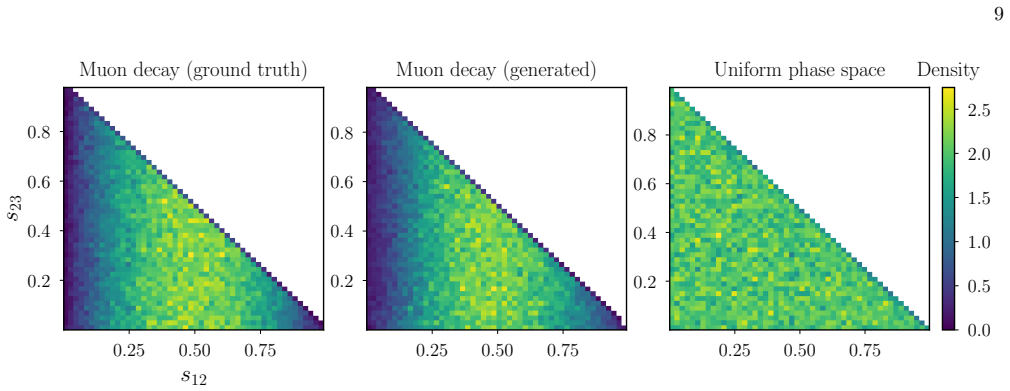
Deep generative models such as diffusion and flow matching are powerful machine learning tools capable of learning and sampling from high-dimensional distributions. They are particularly useful when the training data appears to be concentrated on a submanifold of the data embedding space. For high-energy physics data, consisting of collections of relativistic energy-momentum 4-vectors, this submanifold can enforce extremely strong physically-motivated priors, such as energy and momentum conservation. If these constraints are learned only approximately, rather than exactly, this can inhibit the interpretability and reliability of such generative models. To remedy this deficiency, we introduce generative models which are, by construction, confined at every step of their sampling trajectory to the manifold of massless N-particle Lorentz-invariant phase space in the center-of-momentum frame. In the case of diffusion models, the "pure noise" forward process endpoint corresponds to the uniform distribution on phase space, which provides a clear starting point from which to identify how correlations among the particles emerge during the reverse (de-noising) process. We demonstrate that our models are able to learn both few-particle and many-particle distributions with various singularity structures, paving the way for future interpretability studies using generative models trained on simulated jet data.
Editorial analysis
A structured set of objections, weighed in public.
Referee Report
Summary. The paper introduces diffusion and flow-matching generative models that are confined by construction to the manifold of massless N-particle Lorentz-invariant phase space in the center-of-momentum frame. The forward process terminates at the uniform measure on this manifold, and the models are claimed to learn and sample from target distributions containing soft and collinear singularities for both few- and many-particle cases.
Significance. If the central claim holds, the work provides a meaningful advance in constrained generative modeling for high-energy physics by enforcing exact physical priors (energy-momentum conservation and on-shell conditions) without learned approximations. The parameter-free geometric construction and the explicit uniform-phase-space starting point are clear strengths that could support future interpretability analyses of correlation emergence.
major comments (1)
- [Abstract] Abstract: the claim of successful demonstrations on distributions with various singularity structures is stated without quantitative metrics, error analysis, or comparisons of singular exponents between model and target, leaving the expressivity of the exactly constrained reverse process unverified.
minor comments (1)
- Notation for the phase-space manifold and the precise definition of the forward-process endpoint could be made more explicit to aid reproducibility.
Simulated Author's Rebuttal
We thank the referee for their positive evaluation of the work and for highlighting a useful point about the abstract. We address the comment below and will revise the manuscript to incorporate quantitative elements where appropriate.
read point-by-point responses
-
Referee: [Abstract] Abstract: the claim of successful demonstrations on distributions with various singularity structures is stated without quantitative metrics, error analysis, or comparisons of singular exponents between model and target, leaving the expressivity of the exactly constrained reverse process unverified.
Authors: We agree that the abstract, as a high-level summary, does not include explicit numerical metrics. The main text already presents quantitative evidence for the model's performance, including direct comparisons of generated and target distributions for both few- and many-particle cases, error analyses on energy-momentum conservation residuals, and visual/quantitative assessments of how singular structures (soft and collinear) are reproduced. In the revised version we will update the abstract to reference these results more explicitly, for example by noting the level of agreement achieved on singular exponents and the scale of the error metrics shown in the figures. This change will better convey the expressivity of the exactly constrained reverse process without altering the technical claims. revision: yes
Circularity Check
Direct geometric construction using known physical priors; no circularity
full rationale
The paper's central claim is a direct geometric construction that enforces the massless N-particle Lorentz-invariant phase space manifold (center-of-momentum frame) exactly at every sampling step by construction, drawing on standard physical priors such as energy-momentum conservation and Lorentz invariance. This does not reduce to any fitted parameter, self-referential definition, or load-bearing self-citation chain; the forward process endpoint is the uniform measure on that manifold, and the reverse process is constrained to remain on it without deriving the constraint from the target distribution itself. No steps match the enumerated circularity patterns, and the approach remains self-contained against external benchmarks like known phase-space measures.
Axiom & Free-Parameter Ledger
axioms (1)
- domain assumption The phase space of massless N-particle systems in the center-of-momentum frame is a well-defined manifold on which uniform distributions and sampling trajectories can be defined.
Lean theorems connected to this paper
-
IndisputableMonolith/Foundation/AlexanderDuality.leanalexander_duality_circle_linking echoes?
echoesECHOES: this paper passage has the same mathematical shape or conceptual pattern as the Recognition theorem, but is not a direct formal dependency.
generative models which are, by construction, confined at every step of their sampling trajectory to the manifold of massless N-particle Lorentz-invariant phase space in the center-of-momentum frame
-
IndisputableMonolith/CostJcost_unit0 echoes?
echoesECHOES: this paper passage has the same mathematical shape or conceptual pattern as the Recognition theorem, but is not a direct formal dependency.
the 'pure noise' forward process endpoint corresponds to the uniform distribution on phase space
-
IndisputableMonolith/Foundation/reality_from_one_distinctionreality_from_one_distinction echoes?
echoesECHOES: this paper passage has the same mathematical shape or conceptual pattern as the Recognition theorem, but is not a direct formal dependency.
RAMBO algorithm ... trades the constraints of phase space for a non-uniform distribution in an auxiliary space, q-space
What do these tags mean?
- matches
- The paper's claim is directly supported by a theorem in the formal canon.
- supports
- The theorem supports part of the paper's argument, but the paper may add assumptions or extra steps.
- extends
- The paper goes beyond the formal theorem; the theorem is a base layer rather than the whole result.
- uses
- The paper appears to rely on the theorem as machinery.
- contradicts
- The paper's claim conflicts with a theorem or certificate in the canon.
- unclear
- Pith found a possible connection, but the passage is too broad, indirect, or ambiguous to say the theorem truly supports the claim.
Reference graph
Works this paper leans on
-
[1]
Start from a pointP 0 in phase space, and map it to a pointQ 0(P0,b, x) inq-space as described in Sec. II C. There are many possibilities for choosing this transformation (b, x), which we describe further below
-
[2]
Implement the Langevin dynamics inq-space, Qt+1 =Q t +γ t∇logp ref(Qt) + p 2γtZt, t= 0,1, . . . T,(10) whereZ t ∼ N(0, I 3N×3N ) is isotropic Gaussian noise inR 3N,γ t is a fixed noise schedule, and∇logp ref is given in Eq. (9). At any timestept,RAMBOgives a unique, well-defined mappingQ t →P t whereP t lives onN-particle phase space, and thus we can map ...
-
[3]
3-particle distributions Our diffusion model score network consists of a 4-layer multilayer perceptron (MLP) withSiLUactivations and hidden width 256, using defaultPyTorchinitializations for the inner layers but initializing the last-layer parameters to zero. Diffusion time is encoded through sinusoidal embeddings with dimension 64, appended to the 9-dime...
-
[4]
interpretingp-space vectors directly asq-space vectors)
no augmentation or transformation (i.e. interpretingp-space vectors directly asq-space vectors)
-
[5]
a 2-fold augmentationN mult = 2
-
[6]
16: Training data inq-space for the different data augmentation strategies in Fig
a larger augmentationN mult = 10; 20 0 1 2 3 4 5 6 7 8 q3 10−2 10−1 100 Density Muon decay, q-space distribution Case 1 Case 2 Case 3 Case 4 main text pref(Q) FIG. 16: Training data inq-space for the different data augmentation strategies in Fig. 15. ObservableN mult = 1N mult = 2 E1 0.73×10 −3 2.4×10 −3 E2 0.35×10 −3 1.2×10 −3 E3 1.6×10 −3 5.7×10 −3 ln p...
-
[7]
FID inv” denotes a Fr´ echet distance computed on Lorentz-invariant features, while “FIDAE
a continuous transformation where eachp-space point is boosted and rescaled by adifferentconformal trans- formation (b, x). All models were trained with the same totalq-space training set size of 500,000, with all other hyperparameters the same as described above. The energy distributions are clearly a poor match to the target, with all but the default st...
-
[8]
Higher-dimensional distributions a. Network.For distributions withN≥3 particles, we replace the MLP score network with aPoint Edge Transformer(PET) as described in [25] due to the architecture’s track record for jet tasks and its ability to generalize beyond what it was originally designed for [66, 67]. The PET is a transformer that treats eachq-space eve...
-
[9]
HEP ML Community, A Living Review of Machine Learning for Particle Physics,https://iml-wg.github.io/ HEPML-LivingReview/
-
[10]
C. Fefferman, S. Mitter, and H. Narayanan, Testing the manifold hypothesis, Journal of the American Mathematical Society29, 983 (2013), arXiv:1310.0425
-
[11]
Y. Bengio, A. Courville, and P. Vincent, Representation learning: A review and new perspectives, IEEE transactions on pattern analysis and machine intelligence35, 1798 (2014), arXiv:1206.5538 [cs.LG]
-
[12]
P. P. Brahma, D. O. Wu, and Y. She, Why deep learning works: A manifold disentanglement perspective, IEEE Transac- tions on Neural Networks and Learning Systems27, 1997 (2016)
work page 1997
-
[13]
Deep Unsupervised Learning using Nonequilibrium Thermodynamics
J. Sohl-Dickstein, E. Weiss, N. Maheswaranathan, and S. Ganguli, Deep Unsupervised Learning using Nonequilibrium Thermodynamics, ICML (2015), arXiv:1503.03585 [cs.LG]
work page internal anchor Pith review Pith/arXiv arXiv 2015
-
[14]
Y. Song and S. Ermon, Generative Modeling by Estimating Gradients of the Data Distribution, NeurIPS (2019), arXiv:1907.05600 [cs.LG]
-
[15]
J. Ho, A. Jain, and P. Abbeel, Denoising Diffusion Probabilistic Models, NeurIPS (2020), arXiv:2006.11239 [cs.LG]
work page internal anchor Pith review Pith/arXiv arXiv 2020
-
[16]
Y. Song, J. Sohl-Dickstein, D. P. Kingma, A. Kumar, S. Ermon, and B. Poole, Score-Based Generative Modeling through Stochastic Differential Equations, ICLR (2021), arXiv:2011.13456 [cs.LG]
work page internal anchor Pith review Pith/arXiv arXiv 2021
-
[17]
Flow Matching for Generative Modeling
Y. Lipman, R. T. Q. Chen, H. Ben-Hamu, and M. Nickel, Flow Matching for Generative Modeling, ICLR (2023), arXiv:2210.02747 [cs.LG]
work page internal anchor Pith review Pith/arXiv arXiv 2023
-
[18]
Y. Lipman, M. Havasi, P. Holderrieth, N. Shaul, M. Le, B. Karrer, R. T. Q. Chen, D. Lopez-Paz, H. Ben-Hamu, and I. Gat, Flow matching guide and code, (2024), arXiv:2412.06264 [cs.LG]
work page internal anchor Pith review Pith/arXiv arXiv 2024
-
[19]
A. Tong, K. Fatras, N. Malkin, G. Huguet, Y. Zhang, J. Rector-Brooks, G. Wolf, and Y. Bengio, Improving and generalizing flow-based generative models with minibatch optimal transport, Transactions on Machine Learning Research (2024), arXiv:2302.00482 [cs.LG]
work page internal anchor Pith review Pith/arXiv arXiv 2024
- [20]
- [21]
- [22]
- [23]
- [24]
-
[25]
E. Buhmann, C. Ewen, D. A. Faroughy, T. Golling, G. Kasieczka, M. Leigh, G. Qu´ etant, J. A. Raine, D. Sengupta, and D. Shih, EPiC-ly Fast Particle Cloud Generation with Flow-Matching and Diffusion, (2023), arXiv:2310.00049 [hep-ph]. 27
- [26]
-
[27]
D. Sengupta, M. Leigh, J. A. Raine, S. Klein, and T. Golling, Improving new physics searches with diffusion models for event observables and jet constituents, JHEP04, 109, arXiv:2312.10130 [physics.data-an]
-
[28]
G. Qu´ etant, J. A. Raine, M. Leigh, D. Sengupta, and T. Golling, Generating variable length full events from partons, Phys. Rev. D110, 076023 (2024), arXiv:2406.13074 [hep-ph]
- [29]
-
[30]
V. Mikuni and B. Nachman, Method to simultaneously facilitate all jet physics tasks, Phys. Rev. D111, 054015 (2025), arXiv:2502.14652 [hep-ph]
- [31]
- [32]
- [33]
- [34]
-
[35]
A. Bogatskiy, T. Hoffman, D. W. Miller, and J. T. Offermann, PELICAN: Permutation Equivariant and Lorentz Invariant or Covariant Aggregator Network for Particle Physics, (2022), arXiv:2211.00454 [hep-ph]
- [36]
-
[37]
A. Bogatskiy, T. Hoffman, D. W. Miller, J. T. Offermann, and X. Liu, Explainable equivariant neural networks for particle physics: PELICAN, JHEP03, 113, arXiv:2307.16506 [hep-ph]
-
[38]
J. Spinner, V. Bres´ o, P. de Haan, T. Plehn, J. Thaler, and J. Brehmer, Lorentz-Equivariant Geometric Algebra Trans- formers for High-Energy Physics, in38th conference on Neural Information Processing Systems(2024) arXiv:2405.14806 [physics.data-an]
-
[39]
J. Spinner, L. Favaro, P. Lippmann, S. Pitz, G. Gerhartz, T. Plehn, and F. A. Hamprecht, Lorentz Local Canonicalization: How to Make Any Network Lorentz-Equivariant, (2025), arXiv:2505.20280 [stat.ML]
- [40]
- [41]
- [42]
-
[43]
V. De Bortoli, E. Mathieu, M. Hutchinson, J. Thornton, Y. Whye Teh, and A. Doucet, Riemannian Score-Based Generative Modelling, Advances in neural information processing systems35, 2406 (2022), arXiv:2202.02763 [cs.LG]
-
[44]
Diffusion Processes on Implicit Manifolds
V. Kawasaki-Borruat, C. Grotehans, P. Vandergheynst, and A. Gosztolai, Diffusion processes on implicit manifolds, (2026), arXiv:2604.07213 [cs.LG]
work page internal anchor Pith review Pith/arXiv arXiv 2026
- [45]
-
[46]
B. Nachman and R. Winterhalder, Elsa: enhanced latent spaces for improved collider simulations, Eur. Phys. J. C83, 843 (2023), arXiv:2305.07696 [hep-ph]
- [47]
- [48]
- [49]
-
[50]
A. Hyv¨ arinen and P. Dayan, Estimation of non-normalized statistical models by score matching., Journal of Machine Learning Research6(2005)
work page 2005
- [51]
- [52]
-
[53]
M. Rosenblatt, Remarks on a Multivariate Transformation, Annals of Mathematical Statistics23, 470 (1952)
work page 1952
-
[54]
J. Alwall, R. Frederix, S. Frixione, V. Hirschi, F. Maltoni, O. Mattelaer, H. S. Shao, T. Stelzer, P. Torrielli, and M. Zaro, The automated computation of tree-level and next-to-leading order differential cross sections, and their matching to parton shower simulations, JHEP07, 079, arXiv:1405.0301 [hep-ph]
work page internal anchor Pith review Pith/arXiv arXiv
- [55]
-
[56]
Farhi, A QCD Test for Jets, Phys
E. Farhi, A QCD Test for Jets, Phys. Rev. Lett.39, 1587 (1977). 28
work page 1977
-
[57]
R. K. Ellis, W. J. Stirling, and B. R. Webber,QCD and collider physics, Vol. 8 (Cambridge University Press, 2011)
work page 2011
-
[58]
S. J. Parke and T. R. Taylor, An Amplitude fornGluon Scattering, Phys. Rev. Lett.56, 2459 (1986)
work page 1986
-
[59]
F. A. Berends and W. T. Giele, Recursive Calculations for Processes with n Gluons, Nucl. Phys. B306, 759 (1988)
work page 1988
-
[60]
P. D. Draggiotis, A. van Hameren, and R. Kleiss, SARGE: An Algorithm for generating QCD antennas, Phys. Lett. B 483, 124 (2000), arXiv:hep-ph/0004047
work page internal anchor Pith review Pith/arXiv arXiv 2000
- [61]
-
[62]
R. Roscher, B. Bohn, M. F. Duarte, and J. Garcke, Explainable machine learning for scientific insights and discoveries, IEEE Access8, 42200 (2020), arXiv:1905.08883
-
[63]
M. Krenn, R. Pollice, S. Y. Guo, M. Aldeghi, A. Cervera-Lierta, P. Friederich, G. dos Passos Gomes, F. H¨ ase, A. Jinich, A. Nigam, Z. Yao, and A. Aspuru-Guzik, On scientific understanding with artificial intelligence, Nature Reviews Physics 4, 761 (2022), arXiv:2204.01467
-
[64]
R. Gambhir, M. LeBlanc, and Y. Zhou, The Pareto Frontier of Resilient Jet Tagging, in39th Annual Conference on Neural Information Processing Systems: Includes Machine Learning and the Physical Sciences (ML4PS)(2025) arXiv:2509.19431 [hep-ph]
-
[65]
F. Cagnetta, L. Petrini, U. M. Tomasini, A. Favero, and M. Wyart, How deep neural networks learn compositional data: The random hierarchy model, Physical Review X14, 031001 (2024), arXiv:2307.02129
-
[66]
A. Sclocchi, A. Favero, and M. Wyart, A phase transition in diffusion models reveals the hierarchical nature of data, Proceedings of the National Academy of Sciences122, e2408799121 (2025), arXiv:2402.16991
-
[67]
A. Sclocchi, A. Favero, N. I. Levi, and M. Wyart, Probing the latent hierarchical structure of data via diffusion models, Journal of Statistical Mechanics: Theory and Experiment , 084005 (2025), arXiv:2410.13770
-
[68]
A. Favero, A. Sclocchi, F. Cagnetta, P. Frossard, and M. Wyart, How compositional generalization and creativity improve as diffusion models are trained, inProceedings of the 42nd International Conference on Machine Learning, Proceedings of Machine Learning Research, Vol. 267 (PMLR, 2025) pp. 16286–16306, arXiv:2502.12089
-
[69]
Y. Han, A. Han, W. Huang, C. Lu, and D. Zou, Can diffusion models learn hidden inter-feature rules behind images?, in Proceedings of the 42nd International Conference on Machine Learning, Proceedings of Machine Learning Research, Vol. 267 (PMLR, 2025) pp. 21704–21732, arXiv:2502.04725
- [70]
-
[71]
N. Levi and Y. Oz, The universal statistical structure and scaling laws of chaos and turbulence, (2023), arXiv:2311.01358 [cond-mat.stat-mech]
- [72]
-
[73]
V. Breso-Pla, K. Greif, V. Mikuni, B. Nachman, T. Plehn, T. Wamorkar, and D. Whiteson, Explicit or Implicit? Encoding Physics at the Precision Frontier, (2026), arXiv:2603.08802 [hep-ph]
- [74]
-
[75]
OmniMol: Transferring Particle Physics Knowledge to Molecular Dynamics with Point-Edge Transformers
I. Elsharkawy, V. Mikuni, W. Bhimji, and B. Nachman, OmniMol: Transferring Particle Physics Knowledge to Molecular Dynamics with Point-Edge Transformers, (2026), arXiv:2601.10791 [physics.chem-ph]
work page internal anchor Pith review Pith/arXiv arXiv 2026
-
[76]
P. Vincent, A connection between score matching and denoising autoencoders, Neural computation23, 1661 (2011)
work page 2011
-
[77]
L. N. Smith and N. Topin, Super-convergence: Very fast training of neural networks using large learning rates, inArtifi- cial Intelligence and Machine Learning for Multi-Domain Operations Applications, Vol. 11006 (SPIE, 2019) pp. 369–386, arXiv:1708.07120 [cs.LG]
work page Pith review arXiv 2019
discussion (0)
Sign in with ORCID, Apple, or X to comment. Anyone can read and Pith papers without signing in.