Recognition: no theorem link
Opal: Private Memory for Personal AI
Pith reviewed 2026-05-13 21:05 UTC · model grok-4.3
The pith
Opal confines data-dependent reasoning to a trusted enclave with a lightweight knowledge graph to enable private and efficient personal AI memory retrieval.
A machine-rendered reading of the paper's core claim, the machinery that carries it, and where it could break.
Core claim
Opal claims that decoupling all data-dependent reasoning from bulk personal data and confining it to the trusted enclave allows untrusted disk to see only fixed oblivious memory accesses. The enclave uses a lightweight knowledge graph to capture personal context missed by semantic search alone and manages continuous ingestion by piggybacking reindexing and capacity management on every ORAM access. On a synthetic personal-data pipeline, this yields 13 percentage points higher retrieval accuracy than semantic search and 29 times higher throughput at 15 times lower infrastructure cost than a secure baseline.
What carries the argument
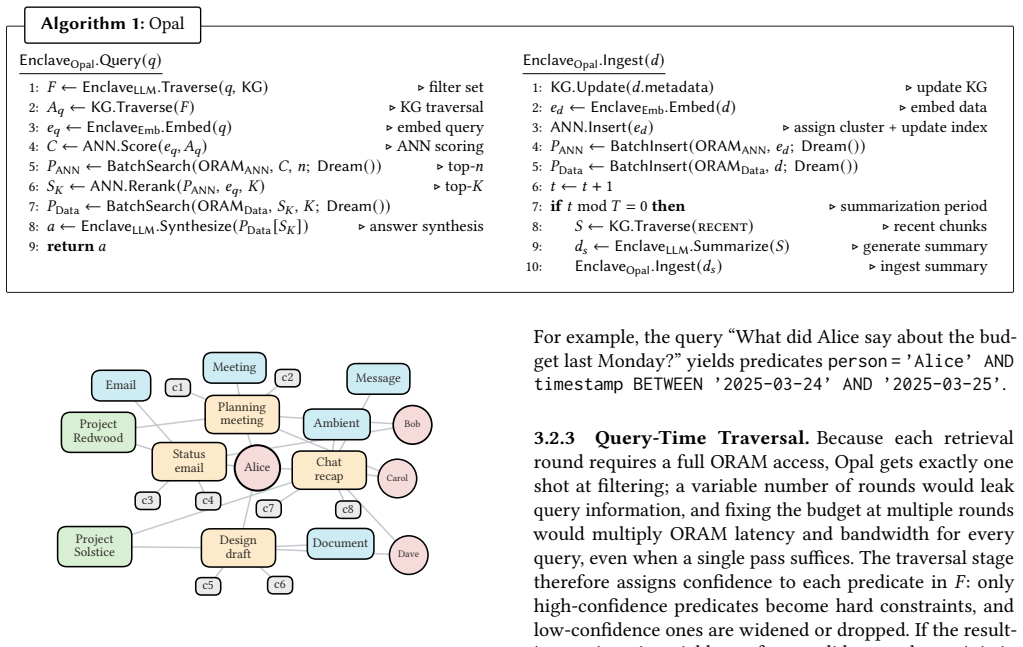
Enclave-resident lightweight knowledge graph that performs query-dependent traversals and context capture while all external accesses remain fixed and oblivious via ORAM.
If this is right
- Retrieval accuracy improves by 13 percentage points compared to semantic search.
- Throughput is 29 times higher with 15 times lower infrastructure cost than secure baselines.
- Continuous ingestion is handled without extra overhead by piggybacking operations on ORAM accesses.
- Personal AI can scale memory to large datastores while preserving privacy from access pattern leaks.
Where Pith is reading between the lines
- Similar decoupling could apply to other privacy-sensitive systems that require dynamic data access.
- Validation on real user data would be needed to confirm the synthetic model results hold.
- The lower cost could make private memory feasible for consumer-grade personal AI applications.
Load-bearing premise
The lightweight knowledge graph in the enclave sufficiently captures the personal context that semantic search misses, and the synthetic stochastic communication model represents real user data and query patterns accurately.
What would settle it
Running the system on actual user personal data and query logs from a deployed AI and observing whether accuracy gains disappear or performance drops below the reported levels would falsify the central performance claims.
Figures




read the original abstract
Personal AI systems increasingly retain long-term memory of user activity, including documents, emails, messages, meetings, and ambient recordings. Trusted hardware can keep this data private, but struggles to scale with a growing datastore. This pushes the data to external storage, which exposes retrieval access patterns that leak private information to the application provider. Oblivious RAM (ORAM) is a cryptographic primitive that can hide these patterns, but it requires a fixed access budget, precluding the query-dependent traversals that agentic memory systems rely on for accuracy. We present Opal, a private memory system for personal AI. Our key insight is to decouple all data-dependent reasoning from the bulk of personal data, confining it to the trusted enclave. Untrusted disk then sees only fixed, oblivious memory accesses. This enclave-resident component uses a lightweight knowledge graph to capture personal context that semantic search alone misses and handles continuous ingestion by piggybacking reindexing and capacity management on every ORAM access. Evaluated on a comprehensive synthetic personal-data pipeline driven by stochastic communication models, Opal improves retrieval accuracy by 13 percentage points over semantic search and achieves 29x higher throughput with 15x lower infrastructure cost than a secure baseline. Opal is under consideration for deployment to millions of users at a major AI provider.
Editorial analysis
A structured set of objections, weighed in public.
Referee Report
Summary. The paper presents Opal, a private memory system for personal AI. It decouples data-dependent reasoning to a trusted enclave containing a lightweight knowledge graph that captures personal context missed by semantic search alone, while using ORAM to ensure only fixed oblivious accesses are visible to untrusted storage. Continuous ingestion is handled by piggybacking reindexing on ORAM operations. On a synthetic personal-data pipeline driven by stochastic communication models, Opal reports a 13 percentage point retrieval accuracy improvement over semantic search, 29x higher throughput, and 15x lower infrastructure cost than a secure baseline.
Significance. If the synthetic evaluation holds under real workloads, the design offers a practical path to scalable, pattern-hiding personal memory for AI agents, addressing a key tension between privacy and the dynamic, context-rich retrieval needed for long-term user modeling. The enclave-resident KG plus piggybacked reindexing is a concrete mechanism that could generalize to other agentic systems constrained by oblivious primitives.
major comments (2)
- [Abstract] Abstract: The 13pp accuracy gain, 29x throughput, and 15x cost claims are derived exclusively from a synthetic pipeline driven by stochastic communication models. No validation of these models against real user traces or query workloads is provided, which directly affects whether the enclave KG actually captures the personal context gaps that semantic search misses in practice.
- [§4] Evaluation (abstract and §4): Concrete accuracy, throughput, and cost numbers are stated without visible error bars, ablation studies on the KG component, or a full description of the experimental methodology and parameter settings. This makes it impossible to assess the robustness or sensitivity of the reported improvements.
minor comments (1)
- [Abstract] Abstract: The phrase 'comprehensive synthetic personal-data pipeline' should be expanded with a brief description of the stochastic model parameters and data-generation process to allow readers to judge its fidelity.
Simulated Author's Rebuttal
We thank the referee for the constructive feedback on the evaluation. We address each major comment below and have revised the manuscript to improve clarity and completeness where feasible.
read point-by-point responses
-
Referee: [Abstract] Abstract: The 13pp accuracy gain, 29x throughput, and 15x cost claims are derived exclusively from a synthetic pipeline driven by stochastic communication models. No validation of these models against real user traces or query workloads is provided, which directly affects whether the enclave KG actually captures the personal context gaps that semantic search misses in practice.
Authors: We acknowledge that the reported gains rely on synthetic workloads generated from stochastic communication models. These models were parameterized using statistical properties drawn from prior studies of personal messaging and document access patterns to capture variability in query-dependent context. We agree that empirical validation against real traces would strengthen the claims. In the revised manuscript we have expanded §4 with additional justification for the model parameters and added an explicit Limitations paragraph discussing the synthetic evaluation and the inherent difficulty of releasing or accessing privacy-sensitive real user traces. revision: partial
-
Referee: [§4] Evaluation (abstract and §4): Concrete accuracy, throughput, and cost numbers are stated without visible error bars, ablation studies on the KG component, or a full description of the experimental methodology and parameter settings. This makes it impossible to assess the robustness or sensitivity of the reported improvements.
Authors: We have revised §4 to include: (i) error bars on all accuracy, throughput, and cost figures computed across ten independent simulation runs with distinct random seeds; (ii) a new ablation that isolates the enclave knowledge-graph component by comparing full Opal against a semantic-search-only variant; and (iii) a dedicated Experimental Setup subsection that enumerates every parameter (stochastic rates, ORAM block size, enclave memory budget, query distribution, etc.). These additions allow direct assessment of robustness. revision: yes
- Validation of the stochastic communication models against real user traces or query workloads
Circularity Check
No circularity: empirical claims rest on independent synthetic evaluation pipeline
full rationale
The paper describes a system architecture using enclave-resident lightweight knowledge graphs and ORAM for oblivious access, with performance and accuracy claims derived from direct measurement on a separately defined synthetic personal-data pipeline driven by stochastic communication models. No equations, derivations, or fitted parameters are shown that reduce the reported 13pp accuracy gain or 29x throughput numbers to the results themselves by construction. The evaluation inputs (synthetic models and workloads) are external to the output metrics, and no self-citation chains or uniqueness theorems are invoked to force the design. The derivation chain is therefore self-contained against external benchmarks.
Axiom & Free-Parameter Ledger
axioms (2)
- standard math ORAM hides access patterns from untrusted storage
- domain assumption Enclave provides trusted execution for reasoning and graph maintenance
invented entities (1)
-
Lightweight knowledge graph resident in enclave
no independent evidence
Forward citations
Cited by 1 Pith paper
-
An AI Agent Execution Environment to Safeguard User Data
GAAP guarantees confidentiality of private user data for AI agents by enforcing user-specified permissions deterministically through persistent information flow tracking, without trusting the agent or requiring attack...
Reference graph
Works this paper leans on
-
[1]
[n. d.]. 1x.https://www.1x.tech/
-
[2]
[n. d.]. ChatGPT.https://chatgpt.com/
-
[3]
[n. d.]. Google Project Astra.https://deepmind.google/models/ project-astra/
-
[4]
[n. d.]. How Do People Re-find Files, Emails and Web Pages?iCon- ference 2014 Proceedings([n. d.]). doi:10.9776/14136
-
[5]
[n. d.]. Mem.ai.https://get.mem.ai/
-
[6]
[n. d.]. NotebookLM.https://notebooklm.google/
-
[7]
[n. d.]. Personal.ai.https://www.personal.ai/
-
[8]
[n. d.]. Pinecone.https://www.pinecone.io/
-
[9]
[n. d.]. Signal.https://signal.org/
-
[10]
[n. d.]. Sunday Robotics.https://www.sunday.ai/
-
[11]
[n. d.]. Weaviate.https://weaviate.io/
-
[12]
[n. d.]. WhatsApp.https://www.whatsapp.com/
-
[13]
[n. d.]. Windows Copilot "Recall".https://learn.microsoft.com/en- us/windows/ai/recall/
-
[14]
End-to-end encryption on Messenger explained
2024. End-to-end encryption on Messenger explained. https://about.fb.com/news/2024/03/end-to-end-encryption- on-messenger-explained/
work page 2024
-
[15]
Gulavani, Alexey Tumanov, and Ramachandran Ramjee
Amey Agrawal, Nitin Kedia, Ashish Panwar, Jayashree Mohan, Nipun Kwatra, Bhargav S. Gulavani, Alexey Tumanov, and Ramachandran Ramjee. 2024. Taming Throughput-Latency Tradeoff in LLM Infer- ence with Sarathi-Serve. InOSDI. USENIX Association, 117–134
work page 2024
-
[16]
Adil Ahmad, Kyungtae Kim, Muhammad Ihsanulhaq Sarfaraz, and Byoungyoung Lee. 2018. OBLIVIATE: A Data Oblivious Filesystem for Intel SGX. InNDSS. The Internet Society
work page 2018
-
[17]
Dumais, Nick Craswell, and Daniel J
Qingyao Ai, Susan T. Dumais, Nick Craswell, and Daniel J. Liebling
-
[18]
Characterizing Email Search using Large-scale Behavioral Logs and Surveys. InWWW. ACM, 1511–1520
-
[19]
Tarfah Alrashed, Ahmed Hassan Awadallah, and Susan T. Dumais
-
[20]
The Lifetime of Email Messages: A Large-Scale Analysis of Email Revisitation. InCHIIR. ACM, 120–129
-
[21]
Amazon Web Services. 2024. The Security Design of the AWS Nitro System.https://docs.aws.amazon.com/whitepapers/latest/security- design-of-aws-nitro-system/security-design-of-aws-nitro- system.html
work page 2024
-
[22]
Amazon Web Services. 2026. Amazon EC2 M6i Instances.https: //aws.amazon.com/ec2/instance-types/m6i/
work page 2026
-
[23]
Amazon Web Services. 2026. Amazon EC2 M7i Instances.https: //aws.amazon.com/ec2/instance-types/m7i/
work page 2026
-
[24]
John R. Anderson and Lael J. Schooler. 1991. Reflections of the En- vironment in Memory.Psychological Science2, 6 (1991), 396–408. doi:10.1111/j.1467-9280.1991.tb00174.x
-
[25]
Sebastian Angel, Aditya Basu, Weidong Cui, Trent Jaeger, Stella Lau, Srinath T. V. Setty, and Sudheesh Singanamalla. 2023. Nimble: Roll- back Protection for Confidential Cloud Services. InOSDI. USENIX Association, 193–208
work page 2023
-
[26]
Sorokin, Dmitry Evseev, Andrey Kravchenko, Mikhail Burtsev, and Evgeny Burnaev
Petr Anokhin, Nikita Semenov, Artyom Y. Sorokin, Dmitry Evseev, Andrey Kravchenko, Mikhail Burtsev, and Evgeny Burnaev. 2025. AriGraph: Learning Knowledge Graph World Models with Episodic Memory for LLM Agents. InIJCAI. ijcai.org, 12–20
work page 2025
-
[27]
Anthropic. 2025. Confidential Inference via Trusted Virtual Ma- chines.https://www.anthropic.com/research/confidential-inference- trusted-vms
work page 2025
-
[28]
Guido Appenzeller. 2024. Welcome to LLMflation: LLM Inference Cost Is Going Down Fast.https://a16z.com/llmflation-llm-inference-cost/
work page 2024
-
[29]
Apple. 2024. Private Cloud Compute.https://security.apple.com/ blog/private-cloud-compute/.Apple Security Blog(2024)
work page 2024
-
[30]
Argilla. 2024. FinePersonas: Synthetic Email Conversations. https://huggingface.co/datasets/argilla/FinePersonas-Synthetic- Email-Conversations
work page 2024
-
[31]
Denis Baylor, Eric Breck, Heng-Tze Cheng, Noah Fiedel, Chuan Yu Foo, Zakaria Haque, Salem Haykal, Mustafa Ispir, Vihan Jain, Levent Koc, Chiu Yuen Koo, Lukasz Lew, Clemens Mewald, Akshay Naresh Modi, Neoklis Polyzotis, Sukriti Ramesh, Sudip Roy, Steven Euijong Whang, Martin Wicke, Jarek Wilkiewicz, Xin Zhang, and Martin Zinkevich. 2017. TFX: A TensorFlow-...
work page 2017
-
[32]
BBC News. 2026. Meta smart glasses: Workers reviewing intimate content.https://www.bbc.com/news/articles/c0q33nvj0qpo
work page 2026
-
[33]
Bernstein, Sergey Bykov, Alan Geller, Gabriel Kliot, and Jorgen Thelin
Philip A. Bernstein, Sergey Bykov, Alan Geller, Gabriel Kliot, and Jorgen Thelin. 2014.Orleans: Distributed Virtual Actors for Programma- bility and Scalability. Technical Report MSR-TR-2014-41. Microsoft Research
work page 2014
- [34]
-
[35]
Haonan Bian, Zhiyuan Yao, Sen Hu, Zishan Xu, Shaolei Zhang, Yifu Guo, Ziliang Yang, Xueran Han, Huacan Wang, and Ronghao Chen
- [36]
-
[37]
Andrea Bittau, Úlfar Erlingsson, Petros Maniatis, Ilya Mironov, Ananth Raghunathan, David Lie, Mitch Rudominer, Ushasree Kode, Julien Tinnés, and Bernhard Seefeld. 2017. Prochlo: Strong Privacy for Analytics in the Crowd. InSOSP. ACM, 441–459. 13
work page 2017
- [38]
-
[39]
Pietro Borrello, Andreas Kogler, Martin Schwarzl, Moritz Lipp, Daniel Gruss, and Michael Schwarz. 2022. ÆPIC Leak: Architecturally Leak- ing Uninitialized Data from the Microarchitecture. InUSENIX Security Symposium. USENIX Association, 3917–3934
work page 2022
-
[40]
Wenisch, Yuval Yarom, and Raoul Strackx
Jo Van Bulck, Marina Minkin, Ofir Weisse, Daniel Genkin, Baris Kasikci, Frank Piessens, Mark Silberstein, Thomas F. Wenisch, Yuval Yarom, and Raoul Strackx. 2018. Foreshadow: Extracting the Keys to the Intel SGX Kingdom with Transient Out-of-Order Execution. In USENIX Security Symposium. USENIX Association, 991–1008
work page 2018
-
[41]
Jo Van Bulck, Nico Weichbrodt, Rüdiger Kapitza, Frank Piessens, and Raoul Strackx. 2017. Telling Your Secrets without Page Faults: Stealthy Page Table-Based Attacks on Enclaved Execution. InUSENIX Security Symposium. USENIX Association, 1041–1056
work page 2017
-
[42]
Yuzheng Cai, Jiayang Shi, Yizhuo Chen, and Weiguo Zheng. 2024. Navigating Labels and Vectors: A Unified Approach to Filtered Ap- proximate Nearest Neighbor Search.Proc. ACM Manag. Data2, 6 (2024), 246:1–246:27
work page 2024
-
[43]
Iqbal, Mary Czerwinski, Priscilla N
Hancheng Cao, Chia-Jung Lee, Shamsi T. Iqbal, Mary Czerwinski, Priscilla N. Y. Wong, Sean Rintel, Brent J. Hecht, Jaime Teevan, and Longqi Yang. 2021. Large Scale Analysis of Multitasking Behavior During Remote Meetings. InCHI. ACM, 448:1–448:13
work page 2021
-
[44]
Pádraig Mac Carron, Kimmo Kaski, and Robin Dunbar. 2016. Calling Dunbar’s numbers.Soc. Networks47 (2016), 151–155
work page 2016
-
[45]
David Cash, Paul Grubbs, Jason Perry, and Thomas Ristenpart. 2016. Leakage-Abuse Attacks Against Searchable Encryption.IACR Cryptol. ePrint Arch.2016 (2016), 718
work page 2016
-
[46]
CERT Coordination Center. 2025. Vulnerability Note VU#404544: Vulnerabilities identified in PCIe Integrity and Data Encryption (IDE) protocol specification.https://kb.cert.org/vuls/id/404544
work page 2025
- [47]
- [48]
-
[49]
Guoqiang Jerry Chen, Janet L. Wiener, Shridhar Iyer, Anshul Jaiswal, Ran Lei, Nikhil Simha, Wei Wang, Kevin Wilfong, Tim Williamson, and Serhat Yilmaz. 2016. Realtime Data Processing at Facebook. In SIGMOD Conference. ACM, 1087–1098
work page 2016
-
[50]
Qi Chen, Bing Zhao, Haidong Wang, Mingqin Li, Chuanjie Liu, Zengzhong Li, Mao Yang, and Jingdong Wang. 2021. SPANN: Highly- efficient Billion-scale Approximate Nearest Neighborhood Search. In NeurIPS. 5199–5212
work page 2021
- [51]
-
[52]
Yihang Cheng, Lan Zhang, Junyang Wang, Mu Yuan, and Yunhao Yao
-
[53]
InACL (Findings) (Findings of ACL)
RemoteRAG: A Privacy-Preserving LLM Cloud RAG Service. InACL (Findings) (Findings of ACL). Association for Computational Linguistics, 3820–3837
-
[54]
Zihao Cheng, Weixin Wang, Yu Zhao, Ziyang Ren, Jiaxuan Chen, Ruiyang Xu, Shuai Huang, Yang Chen, Guowei Li, Mengshi Wang, Yi Xie, Ren Zhu, Zeren Jiang, Keda Lu, Yihong Li, Xiaoliang Wang, Liwei Liu, and Cam-Tu Nguyen. 2026. LifeBench: A Benchmark for Long-Horizon Multi-Source Memory.arXiv preprint arXiv:2603.03781 (2026)
-
[55]
Prateek Chhikara, Dev Khant, Saket Aryan, Taranjeet Singh, and Deshraj Yadav. 2025. Mem0: Building Production-Ready AI Agents with Scalable Long-Term Memory. InECAI (Frontiers in Artificial Intelligence and Applications). IOS Press, 2993–3000
work page 2025
- [56]
-
[57]
Jalen Chuang, Alex Seto, Nicolas Berrios, Stephan van Schaik, Christina Garman, and Daniel Genkin. 2026. TEE.fail: Breaking Trusted Execution Environments via DDR5 Memory Bus Interpo- sition.https://tee.fail/
work page 2026
- [58]
-
[59]
Better to organize personal information by folders or by tags?: The devil is in the details. InASIST (Proc. Assoc. Inf. Sci. Technol., 1). Wiley, 1–13
-
[60]
Confidential Containers. 2024. Trust Model for Confidential Con- tainers.https://confidentialcontainers.org/docs/architecture/trust- model/trust-model/
work page 2024
-
[61]
Graeme Connell, Vivian Fang, Rolfe Schmidt, Emma Dauterman, and Raluca Ada Popa. 2024. Secret Key Recovery in a Global-Scale End- to-End Encryption System. InOSDI. USENIX Association, 703–719
work page 2024
-
[62]
Scott Constable, Jo Van Bulck, Xiang Cheng, Yuan Xiao, Cedric Xing, Ilya Alexandrovich, Taesoo Kim, Frank Piessens, Mona Vij, and Mark Silberstein. 2023. AEX-Notify: Thwarting Precise Single-Stepping At- tacks through Interrupt Awareness for Intel SGX Enclaves. InUSENIX Security Symposium. USENIX Association, 4051–4068
work page 2023
-
[63]
Victor Costan, Ilia A. Lebedev, and Srinivas Devadas. 2016. Sanc- tum: Minimal Hardware Extensions for Strong Software Isolation. In USENIX Security Symposium. USENIX Association, 857–874
work page 2016
-
[64]
Cas Cremers, Alexander Dax, and Aurora Naska. 2023. Formal Analy- sis of SPDM: Security Protocol and Data Model version 1.2. InUSENIX Security Symposium. USENIX Association, 6611–6628
work page 2023
-
[65]
Emmelyn A. J. Croes, Marjolijn L. Antheunis, Chris van der Lee, and Jan M. S. de Wit. 2024. Digital Confessions: The Willingness to Disclose Intimate Information to a Chatbot and its Impact on Emotional Well-Being.Interact. Comput.36, 5 (2024), 279–292
work page 2024
-
[66]
Emma Dauterman, Vivian Fang, Ioannis Demertzis, Natacha Crooks, and Raluca Ada Popa. 2021. Snoopy: Surpassing the Scalability Bot- tleneck of Oblivious Storage. InSOSP. ACM, 655–671
work page 2021
-
[67]
Vicente Bicudo de Castro. 2025. Quantifying the burden of organisa- tional bulk emails in a business school.Higher Education Research & Development44, 8 (2025), 1934–1948. doi:10.1080/07294360.2025. 2510662
-
[68]
David Dearman and Jeffrey S. Pierce. 2008. It’s on my other computer!: computing with multiple devices. InCHI. ACM, 767–776
work page 2008
-
[69]
DMTF. 2025. Security Protocol and Data Model (SPDM) Specification. https://www.dmtf.org/dsp/DSP0274
work page 2025
-
[70]
Yiming Du, Hongru Wang, Zhengyi Zhao, Bin Liang, Baojun Wang, Wanjun Zhong, Zezhong Wang, and Kam-Fai Wong. 2024. PerLTQA: A Personal Long-Term Memory Dataset for Memory Classification, Retrieval, and Fusion in Question Answering. InSIGHAN. Association for Computational Linguistics, 152–164
work page 2024
-
[71]
Dumais, Edward Cutrell, Jonathan J
Susan T. Dumais, Edward Cutrell, Jonathan J. Cadiz, Gavin Jancke, Raman Sarin, and Daniel C. Robbins. 2015. Stuff I’ve Seen: A System for Personal Information Retrieval and Re-Use.SIGIR Forum49, 2 (2015), 28–35. doi:10.1145/2888422.2888425
-
[72]
Darren Edge, Ha Trinh, Newman Cheng, Joshua Bradley, Alex Chao, Apurva Mody, Steven Truitt, Dasha Metropolitansky, Robert Osazuwa Ness, and Jonathan Larson. 2024. From Local to Global: A Graph RAG Approach to Query-Focused Summarization.arXiv preprint arXiv:2404.16130(2024)
work page internal anchor Pith review Pith/arXiv arXiv 2024
-
[73]
Joshua Engels, Benjamin Landrum, Shangdi Yu, Laxman Dhulipala, and Julian Shun. 2024. Approximate Nearest Neighbor Search with Window Filters. InICML (Proceedings of Machine Learning Research). 14 PMLR / OpenReview.net, 12469–12490
work page 2024
-
[74]
Epoch AI. 2026. Trends in AI: The Inference Cost of Frontier Models is Halving Every Two Months.https://epoch.ai/trends
work page 2026
-
[75]
Saba Eskandarian and Matei Zaharia. 2019. ObliDB: Oblivious Query Processing for Secure Databases.Proc. VLDB Endow.13, 2 (2019), 169–183
work page 2019
-
[76]
Federal Trade Commission. 2024.A Look Behind the Screens: Ex- amining the Data Practices of Social Media and Video Streaming Ser- vices. Technical Report.https://www.ftc.gov/system/files/ftc_gov/ pdf/Social-Media-6b-Report-9-11-2024.pdf
work page 2024
-
[77]
Andrew Ferraiuolo, Andrew Baumann, Chris Hawblitzel, and Bryan Parno. 2017. Komodo: Using verification to disentangle secure- enclave hardware from software. InSOSP. ACM, 287–305
work page 2017
-
[78]
Eric W. Fox, Martin B. Short, Frederic P. Schoenberg, Kathryn D. Coronges, and Andrea L. Bertozzi. 2016. Modeling E-mail Networks and Inferring Leadership Using Self-Exciting Point Processes.J. Amer. Statist. Assoc.111, 514 (2016), 564–584. doi:10.1080/01621459.2015. 1135802
-
[79]
Benny Fuhry, Raad Bahmani, Ferdinand Brasser, Florian Hahn, Flo- rian Kerschbaum, and Ahmad-Reza Sadeghi. 2017. HardIDX: Practical and Secure Index with SGX. InDBSec (Lecture Notes in Computer Sci- ence). Springer, 386–408
work page 2017
-
[80]
Stefan Gast, Hannes Weissteiner, Robin Leander Schröder, and Daniel Gruss. 2025. CounterSEVeillance: Performance-Counter Attacks on AMD SEV-SNP. InNDSS. The Internet Society
work page 2025
discussion (0)
Sign in with ORCID, Apple, or X to comment. Anyone can read and Pith papers without signing in.