Recognition: 2 theorem links
· Lean TheoremFermionic mean-field dynamics for spin systems beyond free fermions
Pith reviewed 2026-05-13 19:54 UTC · model grok-4.3
The pith
A fermionic mean-field method reproduces qualitative dynamics in interacting spin systems with polynomial classical cost.
A machine-rendered reading of the paper's core claim, the machinery that carries it, and where it could break.
Core claim
The fermionized time-dependent Hartree-Fock method is formally equivalent to exact dynamics for free fermions and handles non-local string operators from long-range interactions through transition matrix elements between non-orthogonal Slater determinants, enabling polynomial-cost classical implementations that reproduce qualitative dynamics in adiabatic state preparation, many-body localization, and the Schwinger model.
What carries the argument
Transition matrix elements between non-orthogonal Slater determinants, which efficiently evaluate the non-local string operators that arise after the Jordan-Wigner mapping of spin interactions.
If this is right
- The method scales polynomially with system size, allowing simulations of larger spin chains than exact diagonalization.
- Cost linear in the number of time steps supports studies of long-time evolution and slow adiabatic processes.
- The retained mean-field picture supplies a simple interpretation for phenomena such as localization and particle production.
- Long-range interactions are incorporated without additional approximations beyond the mean-field level.
Where Pith is reading between the lines
- The approach could provide efficient classical reference data for testing quantum algorithms that target the same spin models.
- Systematic improvement might be obtained by adding fluctuation corrections while retaining the fermionic Slater-determinant framework.
- Similar mean-field mappings could be explored for other lattice models where Jordan-Wigner strings appear.
Load-bearing premise
The mean-field approximation in the fermionic representation remains accurate enough to reproduce qualitative dynamics for interacting spin systems beyond the free-fermion limit.
What would settle it
A benchmark run in which the time-dependent expectation values of local observables or correlation functions diverge qualitatively from exact results in the disordered spin chain or Schwinger model.
Figures


read the original abstract
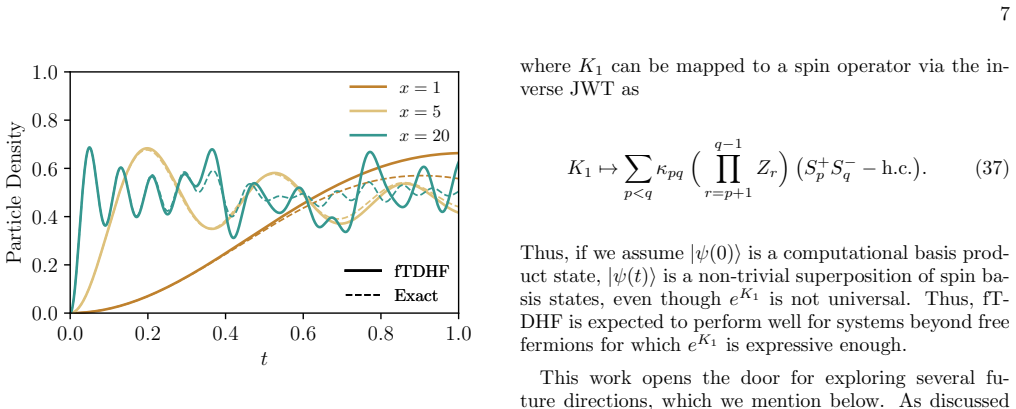
We introduce the fermionized time-dependent Hartree-Fock (fTDHF), a real-time quantum dynamics method for spin-1/2 Hamiltonians following their mapping to fermions via the Jordan-Wigner transformation. fTDHF is formally equivalent to exact dynamics in the case of free fermions and can efficiently handle non-local string operators arising from long-range interactions via transition matrix elements between non-orthogonal Slater determinants. We show that the fTDHF method can be implemented on a classical computer with a cost that scales polynomially with system size, and linearly with the time steps. We benchmark fTDHF against exact dynamics on three separate spin-1/2 models, representing adiabatic preparation of states with long-range correlations, disorder-driven observation of many-body localization, and particle production in the Schwinger model. For each of these systems, fTDHF is shown to reproduce the qualitative dynamics generated by the exact evolutions, while maintaining a simple physical picture due to its mean-field nature.
Editorial analysis
A structured set of objections, weighed in public.
Referee Report
Summary. The manuscript introduces the fermionized time-dependent Hartree-Fock (fTDHF) method for real-time dynamics of spin-1/2 Hamiltonians after Jordan-Wigner mapping to fermions. It claims formal equivalence to exact dynamics for free-fermion (quadratic) cases, efficient classical implementation with polynomial scaling in system size and linear scaling in time steps via transition matrix elements between non-orthogonal Slater determinants, and qualitative reproduction of exact dynamics in three benchmarks: adiabatic preparation of long-range correlated states, disorder-driven many-body localization, and particle production in the Schwinger model.
Significance. If the qualitative agreement holds with controlled errors, fTDHF would supply a computationally tractable mean-field route to spin dynamics that naturally accommodates non-local string operators from long-range interactions while retaining a transparent one-body picture. The formal equivalence for free fermions and the absence of fitted parameters are clear strengths that could make the approach useful for systems where exact diagonalization or tensor-network methods become prohibitive.
major comments (2)
- [Benchmarks and abstract] The central claim that fTDHF reproduces qualitative dynamics for interacting spin systems rests on the three benchmarks, yet no quantitative error metrics (e.g., time-dependent L2 deviation, fidelity, or entanglement entropy difference from exact results) are supplied. Without these, it is impossible to assess how rapidly the neglected correlations beyond the one-body density matrix degrade the approximation as interaction strength or evolution time increases.
- [Implementation and scaling discussion] The polynomial-cost claim for handling non-local string operators via Slater-determinant overlaps is load-bearing for the method's practicality, but the manuscript does not provide an explicit operation-count analysis (e.g., scaling of the overlap matrix construction or the time-step integrator) that would confirm the stated polynomial dependence on system size.
minor comments (1)
- [Figures] Figure captions should explicitly state the system sizes, disorder realizations, and time-step parameters used in each benchmark panel to allow direct comparison with the exact data.
Simulated Author's Rebuttal
We thank the referee for the careful reading and constructive suggestions. We address each major comment below and will revise the manuscript to strengthen the presentation with additional quantitative metrics and an explicit complexity analysis.
read point-by-point responses
-
Referee: [Benchmarks and abstract] The central claim that fTDHF reproduces qualitative dynamics for interacting spin systems rests on the three benchmarks, yet no quantitative error metrics (e.g., time-dependent L2 deviation, fidelity, or entanglement entropy difference from exact results) are supplied. Without these, it is impossible to assess how rapidly the neglected correlations beyond the one-body density matrix degrade the approximation as interaction strength or evolution time increases.
Authors: We agree that quantitative error metrics would allow a more precise evaluation of the approximation's limitations. In the revised manuscript we will add time-dependent L2 deviations, state fidelities, and (where relevant) entanglement entropy differences between fTDHF and exact dynamics for all three benchmarks. These will be presented both as functions of time and as functions of interaction strength or disorder to quantify the growth of errors. revision: yes
-
Referee: [Implementation and scaling discussion] The polynomial-cost claim for handling non-local string operators via Slater-determinant overlaps is load-bearing for the method's practicality, but the manuscript does not provide an explicit operation-count analysis (e.g., scaling of the overlap matrix construction or the time-step integrator) that would confirm the stated polynomial dependence on system size.
Authors: We acknowledge the absence of a detailed operation-count breakdown. The revised manuscript will include a new subsection that explicitly counts the dominant operations: construction of the overlap matrix between non-orthogonal Slater determinants scales as O(N^3) per pair (via determinant evaluation), the one-body density matrix updates remain O(N^2), and the overall per-time-step cost is therefore polynomial in system size N while the number of time steps scales linearly with total evolution time. This analysis will be supported by pseudocode and timing benchmarks on the existing implementations. revision: yes
Circularity Check
fTDHF derivation is self-contained with no circular reductions
full rationale
The paper's central construction applies the standard Jordan-Wigner mapping to convert spin Hamiltonians into fermionic operators, then evolves a single Slater determinant under the resulting quadratic or quartic Hamiltonian using the time-dependent Hartree-Fock equations. The formal equivalence to exact dynamics holds only for free-fermion (quadratic) cases because the state remains Gaussian, a property that follows directly from the algebra of fermionic operators and does not rely on any fitted parameter or self-referential definition introduced in this work. For interacting cases the method is explicitly an approximation that discards higher-order correlations; the paper validates it by direct numerical comparison to exact diagonalization on three benchmark models rather than by any internal fit or self-citation chain. No ansatz is smuggled via prior author work, no uniqueness theorem is invoked, and no known empirical pattern is merely renamed. The implementation cost scaling is derived from standard Slater-determinant algebra and is independent of the target observables.
Axiom & Free-Parameter Ledger
axioms (1)
- standard math The Jordan-Wigner transformation provides an exact mapping from spin-1/2 operators to fermionic operators, including non-local string operators for long-range interactions.
Lean theorems connected to this paper
-
IndisputableMonolith/Foundation/RealityFromDistinction.leanreality_from_one_distinction unclear?
unclearRelation between the paper passage and the cited Recognition theorem.
fTDHF is formally equivalent to exact dynamics in the case of free fermions and can efficiently handle non-local string operators arising from long-range interactions via transition matrix elements between non-orthogonal Slater determinants... scales polynomially with system size, and linearly with the time steps.
-
IndisputableMonolith/Cost/FunctionalEquation.leanwashburn_uniqueness_aczel unclear?
unclearRelation between the paper passage and the cited Recognition theorem.
We assume that the state representing the dynamics of the fermionized system at each time step remains an SD, or in other words, a fermionic mean-field state.
What do these tags mean?
- matches
- The paper's claim is directly supported by a theorem in the formal canon.
- supports
- The theorem supports part of the paper's argument, but the paper may add assumptions or extra steps.
- extends
- The paper goes beyond the formal theorem; the theorem is a base layer rather than the whole result.
- uses
- The paper appears to rely on the theorem as machinery.
- contradicts
- The paper's claim conflicts with a theorem or certificate in the canon.
- unclear
- Pith found a possible connection, but the passage is too broad, indirect, or ambiguous to say the theorem truly supports the claim.
Forward citations
Cited by 1 Pith paper
-
Seniority Eigenstate Configuration Interaction
A new configuration interaction method with fixed local seniority per orbital partition yields high accuracy for strongly correlated electrons, matching or exceeding zero-seniority performance on benchmarks.
Reference graph
Works this paper leans on
-
[1]
Background Let us consider two SDs ofNspinless fermions |AN ⟩=a † 1 · · ·a † N |−⟩,(B1a) |BN ⟩=b † 1 · · ·b † N |−⟩,(B1b) where|−⟩is the physical vacuum, and⟨A N |BN ⟩ ̸= 0. The{a † j}and{b † j}are two sets of arbitrary creation op- erators with indices representing the one-particle states they create, with their corresponding Hermitian conju- gates, the ...
-
[2]
T ransition Matrix Elements The overlap can be written using Eq. (B3) as ⟨AN |BN ⟩=⟨−|a N · · · a1 b† 1 · · ·b † N |−⟩ =− ⟨−|a N · · · a2 b† 1 a1 b† 2 · · ·b † N |−⟩ +S 11 ⟨−|a N · · · a2 b† 2 · · ·b † N |−⟩,(B11) where the recursive relation above continues forNsteps until⟨−|b † 1 = 0. TheN= 1 case is already defined as S11. TheN= 2 case is shown below ⟨...
-
[3]
T ackling Zero Overlaps We have assumed so far that⟨A N |BN ⟩= det(S)̸=
- [4]
-
[5]
We may also encounter cases where det(S)≈0, which can lead to numerical issues in Eq
This happens whenSis rank-deficient, e.g., when AandBshare some common columns, meaning|A N ⟩ and|B N ⟩have some common occupied states. We may also encounter cases where det(S)≈0, which can lead to numerical issues in Eq. (B20). The near-zero scenario can be diagnosed by the SVD of theSmatrix with an additionalO(N 3) cost. Recipes that tackle these zero ...
-
[6]
This is followed by a SVD ofSwith anO(N 3) cost
Summary The first step for computing⟨A N |O|B N ⟩, withObe- ing any number-conserving fermionic operator, is to com- pute the overlap matrixS, which hasO(M N 2) cost. This is followed by a SVD ofSwith anO(N 3) cost. IfSis numerically full-rank, i.e., all singular values are above a numerical threshold, then the next step is to compute⟨A N |BN ⟩= det(S) wi...
- [7]
-
[8]
O. Derzhko, Jordan-Wigner fermionization and the the- ory of low-dimensional quantum spin models: Dynamic properties, inCondensed Matter Physics in the Prime of the 21st Century(World Scientific, 2008) pp. 35–87
work page 2008
-
[9]
C. D. Batista and G. Ortiz, Adv. Phys.53, 1 (2004)
work page 2004
-
[10]
T. M. Henderson, G. P. Chen, and G. E. Scuseria, J. Chem. Phys.157, 194114 (2022)
work page 2022
- [11]
- [12]
-
[13]
E. Lieb, T. Schultz, and D. Mattis, Ann. Phys. (N. Y.) 16, 407 (1961)
work page 1961
- [14]
- [15]
-
[16]
R. J. Baxter,Exactly solved models in statistical me- chanics(Academic Press, London, 1982)
work page 1982
- [17]
-
[18]
B. Sutherland,Beautiful models: 70 years of exactly solved quantum many-body problems(World Scientific Publishing Company, 2004)
work page 2004
-
[19]
L. G. Valiant, inProceedings of the thirty-third annual ACM symposium on Theory of computing(2001) pp. 114–123
work page 2001
-
[20]
Fermionic Linear Optics and Matchgates
E. Knill, (2001), arXiv:quant-ph/0108033
work page internal anchor Pith review Pith/arXiv arXiv 2001
-
[21]
B. M. Terhal and D. P. DiVincenzo, Phys. Rev. A65, 032325 (2002)
work page 2002
-
[22]
N. Yoshioka, T. Okubo, Y. Suzuki, Y. Koizumi, and W. Mizukami, npj Quantum Inf.10, 45 (2024)
work page 2024
-
[23]
C. W. Bauer, Z. Davoudi, A. B. Balantekin, T. Bhat- tacharya, M. Carena, W. A. De Jong, P. Draper, A. El- Khadra, N. Gemelke, M. Hanada,et al., PRX Quantum 4, 027001 (2023)
work page 2023
- [24]
-
[25]
C. W. Bauer, Z. Davoudi, N. Klco, and M. J. Savage, Nat. Rev. Phys.5, 420 (2023)
work page 2023
-
[26]
A. Di Meglio, K. Jansen, I. Tavernelli, C. Alexandrou, S. Arunachalam, C. W. Bauer, K. Borras, S. Carrazza, A. Crippa, V. Croft,et al., PRX Quantum5, 037001 (2024)
work page 2024
-
[27]
S. McArdle, S. Endo, A. Aspuru-Guzik, S. C. Benjamin, and X. Yuan, Rev. Mod. Phys.92, 015003 (2020)
work page 2020
-
[28]
Y. Alexeev, V. S. Batista, N. Bauman, L. Bertels, D. Claudino, R. Dutta, L. Gagliardi, S. Godwin, N. Govind, M. Head-Gordon,et al., J. Chem. Theory Comput.21, 11335 (2025)
work page 2025
-
[29]
A. Browaeys, D. Barredo, and T. Lahaye, J. Phys. B: At. Mol. Opt. Phys.49, 152001 (2016)
work page 2016
- [30]
-
[31]
L. Feng, O. Katz, C. Haack, M. Maghrebi, A. V. Gor- shkov, Z. Gong, M. Cetina, and C. Monroe, Nature623, 713 (2023)
work page 2023
-
[32]
B. Yan, S. A. Moses, B. Gadway, J. P. Covey, K. R. A. Hazzard, A. M. Rey, D. S. Jin, and J. Ye, Nature501, 521 (2013)
work page 2013
-
[33]
A. Asenjo-Garcia, M. Moreno-Cardoner, A. Albrecht, H. J. Kimble, and D. E. Chang, Phys. Rev. X7, 031024 (2017)
work page 2017
- [34]
-
[35]
K. R. A. Hazzard, S. R. Manmana, M. Foss-Feig, and A. M. Rey, Phys. Rev. Lett.110, 075301 (2013)
work page 2013
-
[36]
T. M. Henderson, F. Gao, and G. E. Scuseria, Mol. Phys.122, e2254857 (2024)
work page 2024
-
[37]
T. M. Henderson, B. Harrison, I. Magoulas, J. Necaise, A. M. Projansky, F. A. Evangelista, J. D. Whitfield, and G. E. Scuseria, J. Chem. Phys.161, 234112 (2024)
work page 2024
-
[38]
S. G. Tabrizi, T. M. Henderson, T. D. K¨ uhne, and G. E. Scuseria, J. Chem. Theory Comput.21, 10988 (2025)
work page 2025
-
[39]
T. M. Henderson, G. P. Chen, and G. E. Scuseria, J. Chem. Theory Comput.22, 2324 (2025)
work page 2025
- [40]
-
[41]
D. J. Thouless, Nucl. Phys.21, 225 (1960)
work page 1960
-
[42]
T. Helgaker, P. Jørgensen, and J. Olsen,Molecular Elec- tronic Structure Theory(John Wiley and Sons, 2000)
work page 2000
-
[43]
I. Shavitt and R. J. Bartlett,Many-Body Methods in Chemistry and Physics(Cambridge University Press, 2009)
work page 2009
- [44]
-
[45]
Y.-X. Yao, N. Gomes, F. Zhang, C.-Z. Wang, K.-M. Ho, T. Iadecola, and P. P. Orth, PRX Quantum2, 030307 (2021)
work page 2021
-
[46]
E. K¨ okc¨ u, D. Camps, L. Bassman Oftelie, J. K. Freer- icks, W. A. de Jong, R. Van Beeumen, and A. F. Kem- per, Phys. Rev. A105, 032420 (2022)
work page 2022
-
[47]
B. Peng, S. Gulania, Y. Alexeev, and N. Govind, Phys. Rev. A106, 012412 (2022)
work page 2022
-
[48]
L. Bassman Oftelie, R. Van Beeumen, E. Younis, E. Smith, C. Iancu, and W. A. de Jong, Mater. The- ory6, 13 (2022)
work page 2022
-
[49]
Y. Kim, A. Eddins, S. Anand, K. X. Wei, E. Van Den Berg, S. Rosenblatt, H. Nayfeh, Y. Wu, M. Zaletel, K. Temme, and A. Kandala, Nature618, 500 (2023)
work page 2023
-
[50]
S. Gulania, S. K. Gray, Y. Alexeev, B. Peng, and N. Govind, Electron. Struct.6, 045007 (2024)
work page 2024
-
[51]
M. Pocrnic, M. Hagan, J. Carrasquilla, D. Segal, and N. Wiebe, Phys. Rev. Res.6, 013224 (2024)
work page 2024
-
[52]
S. Gulania, Y. Alexeev, S. K. Gray, B. Peng, and N. Govind, J. Chem. Theory Comput.21, 6280 (2025)
work page 2025
-
[53]
R. W. Chien, M. Chiew, B. Harrison, J. Necaise, W. Wang, M. Mudassar, C. McLauchlan, T. M. Hender- son, G. E. Scuseria, S. Strelchuk, and J. D. Whitfield, Nat. Rev. Phys.8, 131 (2026)
work page 2026
- [54]
-
[55]
G. P. Chen and G. E. Scuseria, J. Chem. Phys.158, 231102 (2023)
work page 2023
-
[56]
T. M. Henderson, S. G. Tabrizi, G. P. Chen, and G. E. Scuseria, J. Chem. Phys.160, 064103 (2024)
work page 2024
-
[57]
G. C. Wick, Phys. Rev.80, 268 (1950)
work page 1950
-
[58]
J.-P. Blaizot and G. Ripka,Quantum Theory of Finite Systems(MIT Press, 1986)
work page 1986
-
[59]
P. Ring and P. Schuck,The Nuclear Many-Body Prob- lem(Springer-Verlag, 1980). 13
work page 1980
- [60]
- [61]
-
[62]
J. Hendekovi´ c, M. Pavlovi´ c, and F. Sokoli´ c, Chem. Phys. Lett.77, 382 (1981)
work page 1981
-
[63]
C. A. Jim´ enez-Hoyos, R. Rodr´ ıguez-Guzm´ an, and G. E. Scuseria, Phys. Rev. A86, 052102 (2012)
work page 2012
- [64]
-
[65]
J. Rodriguez-Laguna, L. M. Robledo, and J. Dukelsky, Phys. Rev. A101, 012105 (2020)
work page 2020
-
[66]
H. G. Burton, J. Chem. Phys.154, 144109 (2021)
work page 2021
-
[67]
J. C. Butcher, Appl. Numer. Math.20, 247 (1996)
work page 1996
-
[68]
P. Virtanen, R. Gommers, T. E. Oliphant, M. Haber- land, T. Reddy, D. Cournapeau, E. Burovski, P. Peter- son, W. Weckesser, J. Bright,et al., Nat. Methods17, 261 (2020)
work page 2020
-
[69]
J. R. McClean, N. C. Rubin, K. J. Sung, I. D. Kivlichan, X. Bonet-Monroig, Y. Cao, C. Dai, E. S. Fried, C. Gid- ney, B. Gimby,et al., Quantum Sci. Technol.5, 034014 (2020)
work page 2020
-
[70]
Fermionic mean-field dynamics for spin sys- tems beyond free fermions
R. Dutta, M. Illa, N. Govind, and K. Kowalski, Source code for “Fermionic mean-field dynamics for spin sys- tems beyond free fermions” (2026)
work page 2026
-
[71]
Z.-X. Gong, M. F. Maghrebi, A. Hu, M. Foss-Feig, P. Richerme, C. Monroe, and A. V. Gorshkov, Phys. Rev. B93, 205115 (2016)
work page 2016
-
[72]
M. F. Maghrebi, Z.-X. Gong, and A. V. Gorshkov, Phys. Rev. Lett.119, 023001 (2017)
work page 2017
-
[73]
P. W. Anderson, Phys. Rev.109, 1492 (1958)
work page 1958
-
[74]
R. Nandkishore and D. A. Huse, Annu. Rev. Condens. Matter Phys.6, 15 (2015)
work page 2015
-
[75]
D. M. Basko, I. L. Aleiner, and B. L. Altshuler, Phys. Rev. B76, 052203 (2007)
work page 2007
- [76]
-
[77]
J. M. Deutsch, Phys. Rev. A43, 2046 (1991)
work page 2046
- [78]
-
[79]
A. L. Burin, Phys. Rev. B92, 104428 (2015)
work page 2015
- [80]
discussion (0)
Sign in with ORCID, Apple, or X to comment. Anyone can read and Pith papers without signing in.