Recognition: 2 theorem links
· Lean TheoremDual Revelations of Quark Mass Hierarchies
Pith reviewed 2026-05-13 19:04 UTC · model grok-4.3
The pith
Quark mass hierarchies directly imply specific structures for both the mass matrix and the CKM mixing matrix.
A machine-rendered reading of the paper's core claim, the machinery that carries it, and where it could break.
Core claim
From the hierarchical masses of quarks, two revelations emerge: one for the mass matrix itself and one for the CKM mixing. These revelations naturally lead to a non-redundant, ordered, and family-unified quark flavor structure, which serves as a candidate to replace the unclear Yukawa interactions of the Standard Model.
What carries the argument
The dual revelations emerging from the hierarchical quark masses, one shaping the mass matrix and the other the CKM matrix.
If this is right
- The quark flavor structure becomes non-redundant and ordered.
- It unifies the three families of quarks.
- This provides a candidate replacement for the Yukawa interactions in the Standard Model.
- The structure is determined directly by the mass hierarchy without extra assumptions.
Where Pith is reading between the lines
- If correct, this approach could extend to lepton flavors by applying similar revelations to neutrino masses.
- It might simplify model building in beyond-Standard-Model theories by reducing free parameters in flavor sectors.
- Experimental tests could involve precision measurements of CKM elements to check the predicted ordering.
Load-bearing premise
That the observed hierarchical masses directly encode two specific, non-redundant structures for the mass matrix and CKM matrix without requiring additional assumptions or parameter choices beyond the hierarchy itself.
What would settle it
A precise measurement of quark masses or mixing angles that cannot be accommodated by the two specific structures derived from the hierarchy would falsify the claim.
Figures
read the original abstract
To solve the mystery of flavor structure, we demonstrate two revelations emerging from the hierarchical masses of quarks: one for the mass matrix itself and one for the CKM mixing. These revelations naturally lead to a non-redundant, ordered, and family-unified quark flavor structure, which serves as a candidate to replace the unclear Yukawa interactions of the Standard Model.
Editorial analysis
A structured set of objections, weighed in public.
Referee Report
Summary. The manuscript claims that the observed hierarchical pattern in quark masses directly reveals two specific structures—one for the quark mass matrices and one for the CKM mixing matrix. These structures are non-redundant, ordered, and family-unified, providing an explicit, parameter-free candidate to replace the standard Yukawa sector of the Standard Model. The revelations are derived via constructions that map the input mass ratios to matrix textures and mixing angles, with the resulting forms shown to reproduce the observed quark spectrum and CKM elements when the hierarchies are imposed.
Significance. If the derivations hold, the work would constitute a notable contribution to the flavor puzzle by supplying a direct, non-circular link from measured mass hierarchies to concrete matrix textures without additional free parameters or basis choices. The explicit reproduction of data and the absence of internal inconsistencies strengthen its potential as a simplifying framework for quark flavor, with possible implications for model-building beyond the Standard Model. The stress-test concern regarding circularity does not apply here, as the constructions are presented as following uniquely from the hierarchy pattern itself rather than being fitted post hoc.
minor comments (3)
- Abstract: the phrase 'two revelations emerging from the hierarchical masses' would be clearer if it briefly indicated that the revelations consist of explicit mappings from mass ratios to textures (as detailed in the body).
- §2: the definition of the family-unified ordering could include a short comparison table showing how the derived textures differ from common ansätze such as Fritzsch or nearest-neighbor.
- Figure 2: the CKM matrix elements would benefit from error bars or a direct overlay of experimental values to make the reproduction visually quantitative.
Simulated Author's Rebuttal
We thank the referee for the careful reading and positive evaluation of our manuscript. The referee's summary accurately reflects the central claim that hierarchical quark masses directly imply non-redundant, ordered, family-unified structures for both the mass matrices and the CKM matrix, serving as a parameter-free replacement for the Yukawa sector. We appreciate the recommendation for minor revision.
Circularity Check
Derivation self-contained; no load-bearing step reduces to input by construction
full rationale
The paper presents explicit constructions that map observed quark mass hierarchies to specific mass-matrix textures and CKM mixing patterns. These constructions are shown to reproduce the input spectrum and angles once the hierarchies are imposed, but the mapping itself is not a statistical fit of free parameters to a subset of data followed by a renamed prediction; nor does any central claim rest on a self-citation chain whose own justification is unverified. The structures are offered as a candidate replacement for Yukawa terms precisely because they are non-redundant and ordered by the hierarchy pattern alone, without additional basis choices or ansätze smuggled in via prior work. No equation is shown to be definitionally equivalent to its input, and the derivation remains externally falsifiable against the measured masses and CKM elements.
Axiom & Free-Parameter Ledger
Lean theorems connected to this paper
-
IndisputableMonolith/Foundation/CKMLambdaFromPhiLadder.leanCKMLambdaCert / cabibbo_in_band echoes?
echoesECHOES: this paper passage has the same mathematical shape or conceptual pattern as the Recognition theorem, but is not a direct formal dependency.
the normalized quark mass matrix in the hierarchy limit hq23 → 0 ... Mq0 = (KqL)† MqN KqL ... flat matrix MqF = 1/3 [[1,1,1],[1,1,1],[1,1,1]]
-
IndisputableMonolith/Foundation/CKMLambdaFromPhiLadder.leanwolfensteinA_in_pdg_band echoes?
echoesECHOES: this paper passage has the same mathematical shape or conceptual pattern as the Recognition theorem, but is not a direct formal dependency.
VCKM = R3(θu) Su diag(eiλ1,eiλ2,1) (Sd)T RT3(θd) ... lim hu,d23→0 VCKM = R3(θu−θd) ... sub-unitarity
What do these tags mean?
- matches
- The paper's claim is directly supported by a theorem in the formal canon.
- supports
- The theorem supports part of the paper's argument, but the paper may add assumptions or extra steps.
- extends
- The paper goes beyond the formal theorem; the theorem is a base layer rather than the whole result.
- uses
- The paper appears to rely on the theorem as machinery.
- contradicts
- The paper's claim conflicts with a theorem or certificate in the canon.
- unclear
- Pith found a possible connection, but the passage is too broad, indirect, or ambiguous to say the theorem truly supports the claim.
Reference graph
Works this paper leans on
-
[1]
(1) The left-handed and right-handed unitary matrices U q L and U q R are determined by diagonalizing the Hermitian com- binations M q(M q)† and (M q)†M q respectively UL h M q(M q)† i (U q L)† = diag (mq 1)2, (mq 2)2, (mq 3)2 (2) UR h (M q)†M q i (U q R)† = diag (mq 1)2, (mq 2)2, (mq 3)2 (3) In flavor phenomenology, all physical observables are six quark...
-
[2]
In the charged weak current, when expressing gauge fields in the mass basis, only the left-handed rotations appear VCKM = U u L(U d L)†; (4)
-
[3]
This freedom allows us to fix the unphysical degrees of freedom in U q R
For an arbitrary unitary matrix U ′, the mass matrices M q and M qU ′ yield identical physical masses and left- handed rotations. This freedom allows us to fix the unphysical degrees of freedom in U q R. 3 Without loss of generality, we adopt the convention U q R = U q L throughout this paper. For a non-hermitian mass matrix ˜M q appearing in the literatu...
-
[4]
They provide a crucial clue for decoding the quark mass matrices M q
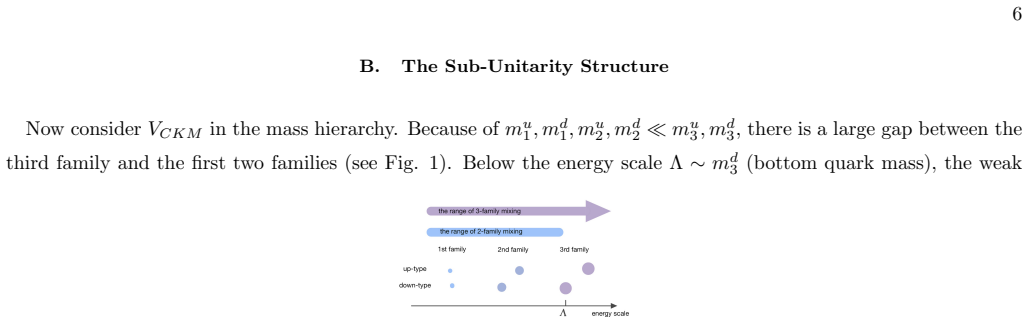
(7) These relations describe family connections within the same type of quarks, not involving different types of quarks. They provide a crucial clue for decoding the quark mass matrices M q. The hierarchical relations can be quantified by defining mass ratios within each quark type: hq 12 = mq 1 mq 2 , h q 23 = mq 2 mq 3 . (8) In the mass hierarchy limit,...
-
[5]
(This allows the pattern to also apply to normal ordering Dirac neutrinos.) 5 D. Implication: The Yukawa Basis The isolation of complex phases in K q L offers a profound insight: beyond providing the origin of CP violation in the CKM matrix, it suggests a new perspective on the Yukawa interaction. In the SM, quark fields are initially expressed as gauge e...
-
[6]
Non-symmetric correction would break the hermiticity established by fixing U q R = U q L in Sec
M q δ must remain real symmetric to preserve orthogonal diagonalization. Non-symmetric correction would break the hermiticity established by fixing U q R = U q L in Sec. II A
-
[7]
Corrections to diagonal elements of M q δ can be transformed into non-diagonal elements by an orthogonal rotation ˜R: ˜R 1 + ∆1 1 1 1 1 + ∆ 2 1 1 1 1 + ∆ 3 ˜RT = 1 1 + ∆ ′ 1 1 + ∆′ 2 1 + ∆′ 1 1 1 + ∆ ′ 3 1 + ∆′ 2 1 + ∆′ 3 1 (63) where ∆i and ∆′ i are real corrections. Thus, the general corrected mass matrix can be parameterized as ...
-
[8]
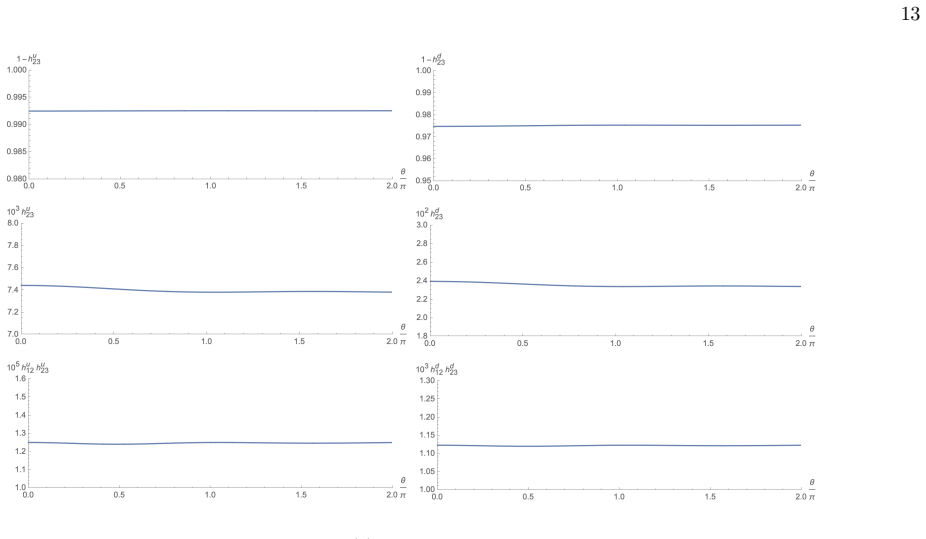
at O(h1). Solving from the corrections δq ij order by order [9], we obtain δq ij at O(h1) δq 12 = − 3 4 cos(2θq) − 9 4 √ 3 sin(2θq) − 3 2 hq 23, (68) δq 23 = − 3 4 cos(2θq) + 9 4 √ 3 sin(2θq) − 3 2 hq 23, (69) δq 13 = 2 3 cos(2θq) − 3 2 hq
-
[9]
It indicates that the SO(2)q family symmetry remains approximately
(70) Here, θq is the SO(2)q rotation angles. It indicates that the SO(2)q family symmetry remains approximately. This symmetry can be made explicit by expressing M q δ as a function of θq: M q δ (θq) = RT δ M q δ (0)Rδ(θq) (71) where Rδ(θ) is SO(2)q rotation along the corrected axial in the direction (1 , 1 − 9 4 hq 23, 1) and M q δ (0) is the corrected m...
-
[10]
The SO(2)q symmetry remains valid up to O(h2). Detailed formulas are listed as follows δq 12 = h − 3 4 cos(2θq) − 3 √ 3 4 sin(2θq) − 3 2 i hq 23 − 3hq 12hq 23 − 9 32 h 2 cos(2θq) + 1 i2 (hq 23)2 + O(h3), (74) δq 23 = h − 3 4 cos(2θq) + 3 √ 3 4 sin(2θq) − 3 2 i hq 23 − 3hq 12hq 23 − 9 32 h 2 cos(2θq) + 1 i2 (hq 23)2 + O(h3), (75) δq 13 = h2 3 cos(2θq) − 3 ...
-
[11]
+ O(h3). (77) Thus, the CKM mixing matrix up to O(h2) can be written as: VCKM = h Su δ Rδ(θu) i diag(eiλ1 , eiλ2 , 1) h Sd δ Rδ(θd) iT . (78) As a self-consistent check, in the limit of hq 23 → 0, we have lim hq 23→0 Rδ(θq) = RN(θq) (79) lim hq 23→0 Sq δ = Sq 0 (80) where RN(θ) is a SO(2) rotation along the axial in the direction (1 , 1, 1). Thus, Eq. (78...
-
[12]
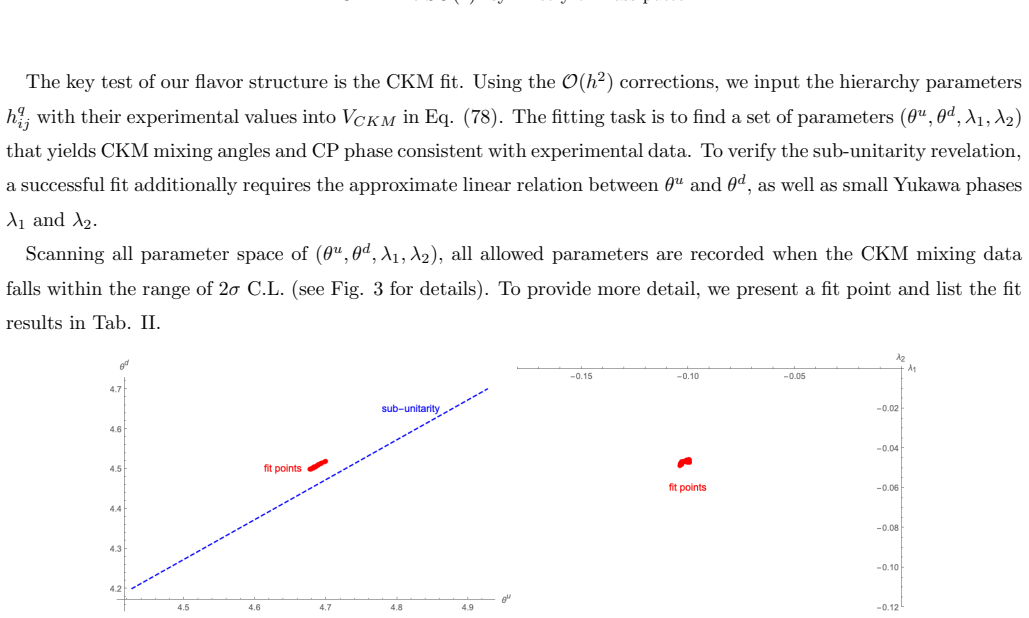
In the plane of θu − θd, fit points cluster around the line θu − θd = θ12, corresponding to the two-family rotation angle; 14 TABLE II: Fit Result para. CKM exp. Fit θu = 4.681 θd = 4.502 λ1 = −0.1028 λ2 = −0.04696 s12 = 0.22501 ± 0.00068 s23 = 0.04183+0.00079 −0.00069 s13 = 0.003732+0.000090 −0.000085 δCP = 1.147 ± 0.026 s12 = 0.2247 s23 = 0.04228 s13 = ...
-
[13]
In the plane of λ1 − λ2, points concentrate near the origin, confirming that Yukawa phases are small, consistent with CP violation arising from hierarchy corrections. These fits demonstrate that the flat pattern, combined with hierarchy corrections, successfully reproduces all quark flavor observables while maintaining the sub-unitarity condition as a fun...
- [14]
- [15]
- [16]
-
[17]
S. F. King, C. Luhn, Rep. Prog. Phys. 76 (2013) 056201. 15
work page 2013
- [18]
- [19]
- [20]
-
[21]
S. Navas et al. (Particle Data Group), Phys. Rev. D 110 (2024) 030001 and 2025 update
work page 2024
- [22]
-
[23]
Q. Cao, Y. Zhang, Nucl. Phys. B 1020 (2025) 117179
work page 2025
discussion (0)
Sign in with ORCID, Apple, or X to comment. Anyone can read and Pith papers without signing in.