Recognition: 2 theorem links
· Lean TheoremProca-Maxwell System in an Infinite Tower of Higher-Derivative Gravity
Pith reviewed 2026-05-13 19:08 UTC · model grok-4.3
The pith
An infinite tower of higher-derivative gravity corrections produces globally regular five-dimensional Proca-Maxwell solutions.
A machine-rendered reading of the paper's core claim, the machinery that carries it, and where it could break.
Core claim
Higher-order corrections in the infinite tower of higher-derivative gravity terms regularize the spacetime, yielding globally regular solutions for the five-dimensional Proca-Maxwell system that satisfy all standard energy conditions across the entire parameter space, with electric charge preventing formation of a frozen critical core.
What carries the argument
The infinite tower of higher-derivative gravity corrections, parameterized by correction order and coupling constant, which removes the central singularity for orders beyond two and enforces regularity while preserving energy conditions.
If this is right
- Globally regular solutions exist for arbitrarily high correction orders in the tower.
- In the supercritical regime the zero-frequency limit produces a regular core that externally mimics an extremal black hole.
- Adding electric charge unfreezes the system and prevents the critical core through electrostatic repulsion.
- The solutions satisfy all standard energy conditions without requiring exotic matter.
Where Pith is reading between the lines
- These regular configurations could function as stable black-hole mimickers in modified gravity theories.
- Perturbation analysis around the numerical backgrounds would test dynamical stability of the regular cores.
- The regularization mechanism might generalize to other matter fields coupled to similar infinite towers.
Load-bearing premise
The numerical solutions constructed for arbitrary high correction orders remain stable and physically realizable without extra constraints on the coupling constant or frequency.
What would settle it
A numerical computation showing a divergent curvature invariant at the origin or a violation of any energy condition for correction orders above two would falsify the regularization claim.
Figures




read the original abstract
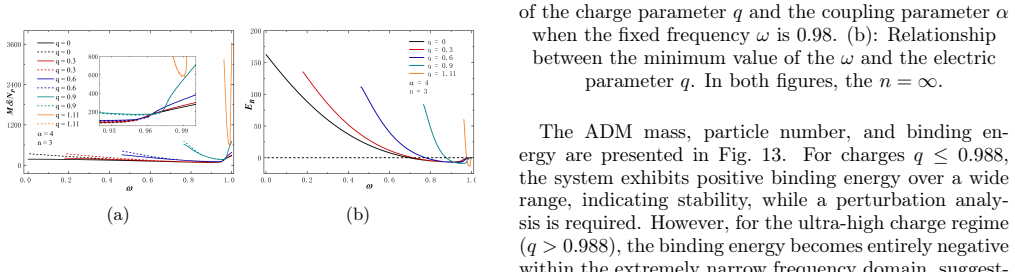
We numerically construct a five-dimensional Proca-Maxwell system coupled to an infinite tower of higher-derivative gravity, parameterized by the correction order and coupling constant. While the first-order correction case recovers standard Einstein gravity results, and the second-order correction (Gauss-Bonnet) case fails to resolve the central singularity in the vanishing frequency limit, we demonstrate that higher-order corrections effectively regularize the spacetime, yielding globally regular solutions. A key finding is the emergence of a ``frozen state'' in the supercritical regime: as the field frequency approaches zero, matter concentrates entirely within a critical radius, creating a regular core that externally mimics an extremal black hole. We further reveal that introducing the electric charge fundamentally alters this behavior; the electrostatic repulsion counteracts the gravitational collapse, effectively ``unfreezing'' the system and preventing the formation of the critical core. Significantly, unlike models relying on exotic matter, our solutions satisfy all standard energy conditions across the entire parameter space, establishing a physically viable pathway for constructing regular black hole mimickers.
Editorial analysis
A structured set of objections, weighed in public.
Referee Report
Summary. The manuscript numerically constructs solutions to a five-dimensional Proca-Maxwell system coupled to an infinite tower of higher-derivative gravity corrections, parameterized by truncation order and coupling strength. It reports that first-order corrections recover Einstein gravity, second-order (Gauss-Bonnet) terms fail to remove the central singularity in the vanishing-frequency limit, but higher-order terms produce globally regular spacetimes. A 'frozen state' is identified in the supercritical regime where matter concentrates inside a critical radius, externally resembling an extremal black hole; electric charge is shown to 'unfreeze' the configuration. All solutions are stated to satisfy the standard energy conditions throughout the parameter space.
Significance. If the numerical constructions are robust, the work supplies a concrete mechanism for generating regular black-hole mimickers in higher-derivative gravity without exotic matter or energy-condition violations. The demonstration that an infinite tower can regularize solutions where lower-order truncations cannot, together with the charge-induced transition away from the frozen state, would be of interest to the modified-gravity and numerical-relativity communities.
major comments (2)
- [Numerical construction and results sections] Numerical construction and results sections: the central claim that higher-order corrections yield globally regular solutions for arbitrary truncation orders rests on numerical integrations whose convergence with respect to the tower order N is not demonstrated. No plots or tables show that regularity at the origin, satisfaction of the Proca-Maxwell equations, and absence of constraint violations persist as N is increased; without such checks the reported regularization could be a finite-N artifact.
- [Abstract and § on the frozen state] Abstract and § on the frozen state: the assertion that solutions satisfy all standard energy conditions 'across the entire parameter space' is presented without accompanying diagnostic plots or tables that would allow independent verification of the null, weak, strong, and dominant conditions for the reported range of frequencies, charges, and coupling values.
minor comments (2)
- [Numerical methods] The manuscript should include a brief description of the numerical scheme (e.g., radial coordinate choice, boundary conditions at the origin and at infinity, and the integrator used) to make the construction reproducible.
- [Notation] Notation for the infinite-tower coupling constants and the truncation index N should be defined once in a dedicated subsection and used consistently thereafter.
Simulated Author's Rebuttal
We thank the referee for their careful reading of our manuscript and for providing constructive feedback. We address each of the major comments below and have made revisions to incorporate the suggested improvements.
read point-by-point responses
-
Referee: Numerical construction and results sections: the central claim that higher-order corrections yield globally regular solutions for arbitrary truncation orders rests on numerical integrations whose convergence with respect to the tower order N is not demonstrated. No plots or tables show that regularity at the origin, satisfaction of the Proca-Maxwell equations, and absence of constraint violations persist as N is increased; without such checks the reported regularization could be a finite-N artifact.
Authors: We appreciate the referee's emphasis on demonstrating numerical convergence. In our original work, solutions were computed for truncation orders up to N=8, with regularity observed consistently. To address this concern, we have performed additional runs for N up to 15 and confirmed that the central curvature remains finite, the Proca-Maxwell equations are satisfied to within numerical tolerance, and constraint violations do not grow with N. We will include a new figure in the revised manuscript showing these convergence diagnostics as a function of N. revision: yes
-
Referee: Abstract and § on the frozen state: the assertion that solutions satisfy all standard energy conditions 'across the entire parameter space' is presented without accompanying diagnostic plots or tables that would allow independent verification of the null, weak, strong, and dominant conditions for the reported range of frequencies, charges, and coupling values.
Authors: We agree that providing explicit verification of the energy conditions would enhance the manuscript's transparency. Our numerical implementation continuously monitors the null, weak, strong, and dominant energy conditions during integration, and no violations were encountered in the explored parameter regime. We have now generated supplementary plots illustrating these conditions for various frequencies, charges, and coupling strengths, which will be added to the results section of the revised paper. revision: yes
Circularity Check
No circularity in numerical construction of Proca-Maxwell solutions
full rationale
The manuscript sets up the field equations for the five-dimensional Proca-Maxwell system coupled to an infinite tower of higher-derivative gravity terms, adopts a static spherically symmetric ansatz, reduces to ODEs, and performs direct numerical integration over the correction order and coupling parameter. Central results on global regularity, the frozen state, and energy-condition compliance are outputs of that integration rather than inputs; no step re-labels a fitted quantity as a prediction, invokes a self-citation as a uniqueness theorem, or defines a quantity in terms of the result it is supposed to derive. The work is therefore self-contained as a numerical exploration.
Axiom & Free-Parameter Ledger
free parameters (2)
- correction order
- coupling constant
axioms (2)
- domain assumption The spacetime is five-dimensional and asymptotically flat or AdS
- domain assumption Standard energy conditions are required for physical viability
Lean theorems connected to this paper
-
IndisputableMonolith/Foundation/RealityFromDistinction.lean; Cost/FunctionalEquation.leanreality_from_one_distinction; washburn_uniqueness_aczel unclear?
unclearRelation between the paper passage and the cited Recognition theorem.
We numerically construct a five-dimensional Proca-Maxwell system coupled to an infinite tower of higher-derivative gravity... higher-order corrections effectively regularize the spacetime, yielding globally regular solutions... satisfy all standard energy conditions
-
IndisputableMonolith/Foundation/AlexanderDuality.leanalexander_duality_circle_linking contradicts?
contradictsCONTRADICTS: the theorem conflicts with this paper passage, or marks a claim that would need revision before publication.
for n=∞... the de Sitter core replaces the singularity at r=0
What do these tags mean?
- matches
- The paper's claim is directly supported by a theorem in the formal canon.
- supports
- The theorem supports part of the paper's argument, but the paper may add assumptions or extra steps.
- extends
- The paper goes beyond the formal theorem; the theorem is a base layer rather than the whole result.
- uses
- The paper appears to rely on the theorem as machinery.
- contradicts
- The paper's claim conflicts with a theorem or certificate in the canon.
- unclear
- Pith found a possible connection, but the passage is too broad, indirect, or ambiguous to say the theorem truly supports the claim.
Reference graph
Works this paper leans on
-
[1]
It states that 𝑇𝜇𝜈𝑡𝜇𝑡𝜈 ≥0for any timelike vector𝑡 𝜇
Weak Energy Condition (WEC). It states that 𝑇𝜇𝜈𝑡𝜇𝑡𝜈 ≥0for any timelike vector𝑡 𝜇. This implies a non-negative energy density and ensures that the projec- tion of the energy-momentum tensor along null directions is non-negative: 𝜌≥0, 𝜌+𝑃 𝑖 ≥0.(36)
-
[2]
It requires𝑇𝜇𝜈𝑘𝜇𝑘𝜈 ≥ 0for any null vector𝑘 𝜇: 𝜌+𝑃 𝑖 ≥0.(37)
Null Energy Condition (NEC). It requires𝑇𝜇𝜈𝑘𝜇𝑘𝜈 ≥ 0for any null vector𝑘 𝜇: 𝜌+𝑃 𝑖 ≥0.(37)
-
[3]
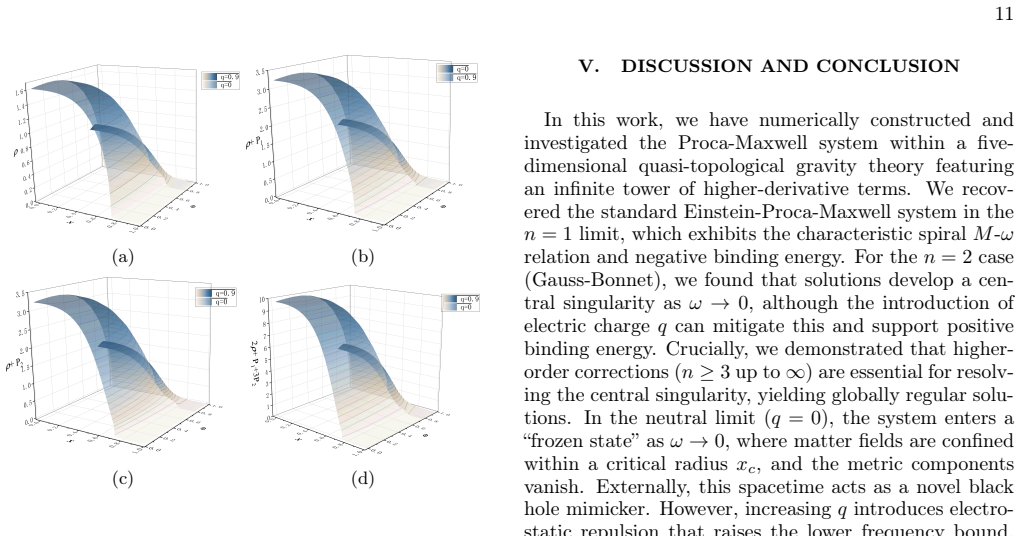
Dominant Energy Condition (DEC). It stipulates that the energy flux measured by any observer must be time- like or null, thereby preserving causality: 11 (a) (b) (c) (d) FIG. 18: The energy density𝜌and its linear combinations with anisotropic pressures𝑃𝑖 (e.g., representing energy conditions). Transparent 3D color surfaces represent the solution for𝑞= 0, ...
-
[4]
frozen” state (𝑞= 0) and the “unfrozen
Strong Energy Condition (SEC). It is defined as 𝑅𝜇𝜈𝑡𝜇𝑡𝜈 ≥0for any timelike vector. In𝐷dimensions, this is equivalent to: 𝜌+𝑃 𝑖 ≥0,2𝜌+𝑃 1 + 3𝑃2 ≥0.(39) The indices𝑖= 1and𝑖= 2correspond to the radial and tangential pressures, respectively. We examine these conditions for the representative cases of the “frozen” state (𝑞= 0) and the “unfrozen” state (𝑞= 0.9)...
-
[5]
Regular solution With the coupling ansatz𝛼𝑛 =𝛼 𝑛−1, the tower func- tion is ℋ(𝜓) =𝜓+ 𝑛max∑︁ 𝑛=2 𝛼 𝑛−1𝜓𝑛.(A4) For𝑛 max =∞we can resum the series explicitly. Writing 𝑘≡𝑛−1so that𝑘= 1,2, . . ., we obtain ℋ(𝜓) =𝜓+ ∞∑︁ 𝑛=2 𝛼 𝑛−1𝜓𝑛 =𝜓 [︃ 1 + ∞∑︁ 𝑘=1 (𝛼𝜓)𝑘 ]︃ .(A5) Using the geometric series∑︀∞ 𝑘=1 𝑥𝑘 =𝑥/(1−𝑥)(for|𝑥|< 1), we arrive at the closed form ℋ(𝜓) = 𝜓 1−...
-
[6]
Horizons and the extremal condition A horizon radius𝑟 ℎ satisfies𝑁(𝑟 ℎ) = 0. From (A14) this is 1− ˜𝑚 𝑟2 ℎ 𝑟4 ℎ + ˜𝑚𝛼= 0⇐ ⇒𝑟 4 ℎ −˜𝑚 𝑟2 ℎ + ˜𝑚𝛼= 0.(A15) 13 Letting𝑧≡𝑟 2 ℎ ≥0gives the quadratic equation 𝑧2 −˜𝑚 𝑧+ ˜𝑚𝛼= 0,(A16) with roots 𝑧± = ˜𝑚± √ ˜𝑚2 −4 ˜𝑚𝛼 2 .(A17) Real horizons exist only when the discriminant is non- negative: ˜𝑚2 −4 ˜𝑚𝛼≥0⇐ ⇒˜𝑚≥4𝛼.(A18...
-
[7]
Horizonless quasi-horizon and useful scaling relations For non-vacuum case, the geometry is horizonless but 𝑁(𝑟)develops a global minimum, which provides an an- alytic proxy for the “quasi-horizon” observed numerically in the frozen regime. Differentiating (A14) gives 𝑁 ′(𝑟) =− 2 ˜𝑚𝑟( ˜𝑚𝛼−𝑟4) (𝑟4 + ˜𝑚𝛼)2 .(A22) Besides the trivial root𝑟= 0, the non-trivia...
-
[8]
Why the charged case does not exhibit the same “universal matching” as the neutral frozen state The neutral frozen state studied in the main text ad- mits an exceptionally sharp geometric interpretation: as 𝜔→0(for𝑞= 0) the matter distribution becomes con- fined inside a critical radius𝑟 𝑐 and the exterior region becomes vacuum. Consequently, the exterior...
-
[9]
S. W. Hawking and R. Penrose, Proc. Roy. Soc. Lond. A314(1970), 529-548 doi:10.1098/rspa.1970.0021
-
[10]
R. Penrose, Phys. Rev. Lett.14(1965), 57-59 doi:10.1103/PhysRevLett.14.57
-
[11]
J. M. M. Senovilla, Gen. Rel. Grav.30(1998), 701 doi:10.1023/A:1018801101244 [arXiv:1801.04912 [gr- qc]]
-
[12]
R. Penrose, Riv. Nuovo Cim.1(1969), 252-276 doi:10.1023/A:1016578408204
- [13]
-
[14]
A. D. Sakharov, Sov. Phys. JETP22(1966), 241
work page 1966
-
[15]
J. Bardeen, Non-singular general relativistic gravita- tional collapse, in Proceedings of GR5, Tiflis, U.S.S.R. (1968)
work page 1968
-
[16]
I. Dymnikova, Gen. Rel. Grav.24(1992), 235-242 doi:10.1007/BF00760226
-
[17]
W. Berej, J. Matyjasek, D. Tryniecki and M. Woronowicz, Gen. Rel. Grav.38(2006), 885-906 doi:10.1007/s10714-006-0270-9 [arXiv:hep-th/0606185 [hep-th]]
-
[18]
J. T. S. S. Junior, F. S. N. Lobo and M. E. Ro- drigues, Class. Quant. Grav.41(2024) no.5, 055012 doi:10.1088/1361-6382/ad210e [arXiv:2310.19508 [gr- qc]]
-
[19]
R. Aros and M. Estrada, Eur. Phys. J. C79 (2019) no.3, 259 doi:10.1140/epjc/s10052-019-6783-7 [arXiv:1901.08724 [gr-qc]]
-
[20]
S. A. Hayward, Phys. Rev. Lett.96(2006), 031103 doi:10.1103/PhysRevLett.96.031103 [arXiv:gr- qc/0506126 [gr-qc]]
-
[21]
E. Ayon-Beato and A. Garcia, Phys. Rev. Lett. 80(1998), 5056-5059 doi:10.1103/PhysRevLett.80.5056 [arXiv:gr-qc/9911046 [gr-qc]]
-
[22]
E. Ayon-Beato and A. Garcia, Phys. Lett. B493(2000), 149-152 doi:10.1016/S0370-2693(00)01125-4 [arXiv:gr- qc/0009077 [gr-qc]]. 16
-
[23]
K. A. Bronnikov, Phys. Rev. D63(2001), 044005 doi:10.1103/PhysRevD.63.044005 [arXiv:gr-qc/0006014 [gr-qc]]
-
[24]
K. A. Bronnikov, Phys. Rev. Lett.85(2000), 4641 doi:10.1103/PhysRevLett.85.4641
-
[25]
I. Dymnikova, Class. Quant. Grav.21(2004), 4417-4429 doi:10.1088/0264-9381/21/18/009 [arXiv:gr- qc/0407072 [gr-qc]]
-
[26]
Z. Y. Fan and X. Wang, Phys. Rev. D94 (2016) no.12, 124027 doi:10.1103/PhysRevD.94.124027 [arXiv:1610.02636 [gr-qc]]
-
[27]
C. Lan, H. Yang, Y. Guo and Y. G. Miao, Int. J. Theor. Phys.62(2023) no.9, 202 doi:10.1007/s10773- 023-05454-1 [arXiv:2303.11696 [gr-qc]]
-
[28]
R. Wang, Q. L. Shi, W. Xiong and P. C. Li, [arXiv:2512.05767 [gr-qc]]
work page internal anchor Pith review Pith/arXiv arXiv
- [29]
-
[30]
U. Uktamov, A. Övgün, R. C. Pantig and B. Ahmedov, [arXiv:2602.15077 [gr-qc]]
-
[31]
K. A. Bronnikov, R. A. Konoplya and A. Zhi- denko, Phys. Rev. D86(2012), 024028 doi:10.1103/PhysRevD.86.024028 [arXiv:1205.2224 [gr-qc]]
-
[32]
J. A. Gonzalez, F. S. Guzman and O. Sarbach, I. Linear stability analysis,” Class. Quant. Grav. 26(2009), 015010 doi:10.1088/0264-9381/26/1/015010 [arXiv:0806.0608 [gr-qc]]
-
[33]
C. H. Hao, L. X. Huang, X. Su and Y. Q. Wang, Eur. Phys. J. C84(2024) no.8, 878 doi:10.1140/epjc/s10052- 024-13105-w [arXiv:2312.03800 [gr-qc]]
-
[34]
P. Bueno, P. A. Cano and R. A. Hennigar, Phys. Lett. B 861(2025), 139260 doi:10.1016/j.physletb.2025.139260 [arXiv:2403.04827 [gr-qc]]
-
[35]
P. Bueno, P. A. Cano, R. A. Hennigar and Á. J. Mur- cia, Phys. Rev. D111(2025) no.10, 104009 doi:10.1103/PhysRevD.111.104009 [arXiv:2412.02740 [gr-qc]]
-
[36]
J. Oliva and S. Ray, Class. Quant. Grav.27 (2010), 225002 doi:10.1088/0264-9381/27/22/225002 [arXiv:1003.4773 [gr-qc]]
-
[37]
R. C. Myers and B. Robinson, JHEP08(2010), 067 doi:10.1007/JHEP08(2010)067 [arXiv:1003.5357 [gr- qc]]
-
[38]
M. H. Dehghani, A. Bazrafshan, R. B. Mann, M. R. Mehdizadeh, M. Ghanaatian and M. H. Vahidinia, Phys. Rev. D85(2012), 104009 doi:10.1103/PhysRevD.85.104009 [arXiv:1109.4708 [hep-th]]
-
[39]
J. Ahmed, R. A. Hennigar, R. B. Mann and M. Mir, JHEP05(2017), 134 doi:10.1007/JHEP05(2017)134 [arXiv:1703.11007 [hep-th]]
-
[40]
A. Cisterna, L. Guajardo, M. Hassaine and J. Oliva, JHEP04(2017), 066 doi:10.1007/JHEP04(2017)066 [arXiv:1702.04676 [hep-th]]
-
[41]
V. P. Frolov, A. Koek, J. P. Soto and A. Zel- nikov, Phys. Rev. D111(2025) no.4, 4 doi:10.1103/PhysRevD.111.044034 [arXiv:2411.16050 [gr-qc]]
-
[42]
V. P. Frolov, Phys. Rev. D113(2026) no.6, 064023 doi:10.1103/mbdj-tqtv [arXiv:2512.14674 [gr-qc]]
-
[43]
P. Bueno, P. A. Cano, J. Moreno and Á. Murcia, JHEP11(2019), 062 doi:10.1007/JHEP11(2019)062 [arXiv:1906.00987 [hep-th]]
- [44]
-
[45]
R. A. Konoplya and A. Zhidenko, Phys. Rev. D109(2024) no.10, 104005 doi:10.1103/PhysRevD.109.104005 [arXiv:2403.07848 [gr-qc]]
-
[46]
F. Di Filippo, I. Kolář and D. Kubiznak, Phys. Rev. D111(2025) no.4, L041505 doi:10.1103/PhysRevD.111.L041505 [arXiv:2404.07058 [gr-qc]]
- [47]
-
[48]
M. Aguayo, L. Gajardo, N. Grandi, J. Moreno, J. Oliva and M. Reyes, JHEP09(2025), 030 doi:10.1007/JHEP09(2025)030 [arXiv:2505.11736 [hep- th]]
- [49]
-
[50]
J. Borissova and R. Carballo-Rubio, [arXiv:2601.17115 [gr-qc]]
work page internal anchor Pith review Pith/arXiv arXiv
-
[51]
Y. Ling and Z. Yu, JCAP03(2026), 004 doi:10.1088/1475-7516/2026/03/004 [arXiv:2509.00137 [gr-qc]]
-
[52]
J. R. Oppenheimer and H. Snyder, Phys. Rev.56 (1939), 455-459 doi:10.1103/PhysRev.56.455
-
[53]
D. J. Kaup, Phys. Rev.172(1968), 1331-1342 doi:10.1103/PhysRev.172.1331
-
[54]
R. Ruffini and S. Bonazzola, Phys. Rev.187(1969), 1767-1783 doi:10.1103/PhysRev.187.1767
-
[55]
R. Brito, V. Cardoso, C. A. R. Herdeiro and E. Radu, Phys. Lett. B752(2016), 291-295 doi:10.1016/j.physletb.2015.11.051 [arXiv:1508.05395 [gr-qc]]
-
[56]
F. Di Giovanni, N. Sanchis-Gual, C. A. R. Herdeiro and J. A. Font, Phys. Rev. D98(2018) no.6, 064044 doi:10.1103/PhysRevD.98.064044 [arXiv:1803.04802 [gr-qc]]
-
[57]
C. Liang, C. A. R. Herdeiro and E. Radu, JHEP03(2025), 119 doi:10.1007/JHEP03(2025)119 [arXiv:2501.05342 [gr-qc]]
-
[58]
M. Colpi, S. L. Shapiro and I. Wasser- man, Phys. Rev. Lett.57(1986), 2485-2488 doi:10.1103/PhysRevLett.57.2485
-
[59]
D. Pugliese, H. Quevedo, J. A. Rueda H. and R. Ruffini, Phys. Rev. D88(2013), 024053 doi:10.1103/PhysRevD.88.024053 [arXiv:1305.4241 [astro-ph.HE]]
-
[60]
J. D. López and M. Alcubierre, Gen. Rel. Grav. 55(2023) no.6, 72 doi:10.1007/s10714-023-03113-8 [arXiv:2303.04066 [gr-qc]]
-
[61]
K. M. Lee, J. A. Stein-Schabes, R. Watkins and L. M. Widrow, Phys. Rev. D39(1989), 1665 doi:10.1103/PhysRevD.39.1665
-
[62]
P. Jetzer and J. J. van der Bij, Phys. Lett. B227(1989), 341-346 doi:10.1016/0370-2693(89)90941-6
-
[63]
I. Salazar Landea and F. García, Phys. Rev. D94 (2016) no.10, 104006 doi:10.1103/PhysRevD.94.104006 [arXiv:1608.00011 [hep-th]]
-
[64]
Y. Mio and M. Alcubierre, Gen. Rel. Grav. 57(2025) no.11, 159 doi:10.1007/s10714-025-03492-0 [arXiv:2508.09081 [gr-qc]]
-
[66]
T. Matos and L. A. Urena-Lopez, Phys. Rev. D 63(2001), 063506 doi:10.1103/PhysRevD.63.063506 17 [arXiv:astro-ph/0006024 [astro-ph]]
-
[67]
W. Hu, R. Barkana and A. Gruzinov, Phys. Rev. Lett. 85(2000), 1158-1161 doi:10.1103/PhysRevLett.85.1158 [arXiv:astro-ph/0003365 [astro-ph]]
-
[68]
L. Hui, J. P. Ostriker, S. Tremaine and E. Wit- ten, Phys. Rev. D95(2017) no.4, 043541 doi:10.1103/PhysRevD.95.043541 [arXiv:1610.08297 [astro-ph.CO]]
-
[69]
V.CardosoandP.Pani, LivingRev.Rel.22(2019)no.1, 4 doi:10.1007/s41114-019-0020-4 [arXiv:1904.05363 [gr- qc]]
work page internal anchor Pith review Pith/arXiv arXiv doi:10.1007/s41114-019-0020-4 2019
-
[70]
K. Glampedakis and G. Pappas, Phys. Rev. D97 (2018) no.4, 041502 doi:10.1103/PhysRevD.97.041502 [arXiv:1710.02136 [gr-qc]]
-
[71]
C. A. R. Herdeiro, A. M. Pombo, E. Radu, P. V. P. Cunha and N. Sanchis-Gual, JCAP 04(2021), 051 doi:10.1088/1475-7516/2021/04/051 [arXiv:2102.01703 [gr-qc]]
-
[72]
Abbottet al.[LIGO Scientific and Virgo], Phys
R. Abbottet al.[LIGO Scientific and Virgo], Phys. Rev. Lett.125(2020) no.10, 101102 doi:10.1103/PhysRevLett.125.101102 [arXiv:2009.01075 [gr-qc]]
-
[73]
J. Calderón Bustillo, N. Sanchis-Gual, A. Torres-Forné, J. A. Font, A. Vajpeyi, R. Smith, C. Herdeiro, E. Radu and S. H. W. Leong, Phys. Rev. Lett.126(2021) no.8, 081101 doi:10.1103/PhysRevLett.126.081101 [arXiv:2009.05376 [gr-qc]]
-
[74]
D. F. Torres, F. E. Schunck and A. R. Liddle, Class. Quant. Grav.15(1998), 3701-3718 doi:10.1088/0264- 9381/15/11/027 [arXiv:gr-qc/9803094 [gr-qc]]
-
[75]
A. W. Whinnett, Phys. Rev. D61(2000), 124014 doi:10.1103/PhysRevD.61.124014 [arXiv:gr-qc/9911052 [gr-qc]]
-
[76]
Y. Brihaye and B. Hartmann, JHEP09(2019), 049 doi:10.1007/JHEP09(2019)049 [arXiv:1903.10471 [gr- qc]]
-
[77]
A. Masó-Ferrando, N. Sanchis-Gual, J. A. Font and G. J. Olmo, Class. Quant. Grav.38(2021) no.19, 194003 doi:10.1088/1361-6382/ac1fd0 [arXiv:2103.15705 [gr-qc]]
-
[78]
A. Masó-Ferrando, N. Sanchis-Gual, J. A. Font and G. J. Olmo, Phys. Rev. D109(2024) no.4, 044042 doi:10.1103/PhysRevD.109.044042 [arXiv:2309.14912 [gr-qc]]
-
[79]
S. Ilijić and M. Sossich, Phys. Rev. D102 (2020) no.8, 084019 doi:10.1103/PhysRevD.102.084019 [arXiv:2007.12451 [gr-qc]]
-
[80]
V. Baibhav and D. Maity, Phys. Rev. D95 (2017) no.2, 024027 doi:10.1103/PhysRevD.95.024027 [arXiv:1609.07225 [gr-qc]]
-
[81]
B. Hartmann, J. Riedel and R. Suciu, Phys. Lett. B 726(2013), 906-912 doi:10.1016/j.physletb.2013.09.050 [arXiv:1308.3391 [gr-qc]]
discussion (0)
Sign in with ORCID, Apple, or X to comment. Anyone can read and Pith papers without signing in.