Recognition: 2 theorem links
· Lean TheoremStructure-Aware Commitment Reduction for Network-Constrained Unit Commitment with Solver-Preserving Guarantees
Pith reviewed 2026-05-13 19:36 UTC · model grok-4.3
The pith
Fixing a sparse set of structurally stable commitment binaries reduces the unit commitment search space while preserving feasibility and solver-certified optimality inside the restricted region.
A machine-rendered reading of the paper's core claim, the machinery that carries it, and where it could break.
Core claim
By identifying a sparse subset of structurally stable commitment binaries and fixing them prior to optimization, the resulting masked problem defines a reduced feasible region of the original unit commitment model. Any solution found in the masked problem is feasible for the full model, and the original solver can still certify optimality with respect to the restricted space without changes to how network, ramping, reserve, or security constraints are handled.
What carries the argument
The masked problem, created by fixing a sparse subset of structurally stable commitment binaries selected by structure or learning methods, which shrinks the branch-and-bound tree while leaving the full constraint set and remaining variables intact for the original solver.
If this is right
- Branch-and-bound node counts and solution times decrease consistently across IEEE 57-bus, RTS 73-bus, IEEE 118-bus, and larger security-constrained instances.
- Order-of-magnitude speedups appear on high-complexity cases while the final objective values remain near-optimal.
- All network, ramping, reserve, and security constraints continue to be enforced exactly by the unchanged MILP solver.
- Feasibility of any returned schedule is guaranteed with respect to the original model.
Where Pith is reading between the lines
- The same masking logic could be applied to other large-scale mixed-integer problems that exhibit stable binary decisions over time or across scenarios.
- Tighter integration with warm-start or cutting-plane routines already present in commercial solvers might compound the observed speedups.
- If the selection rule for which binaries to fix is itself learned from data, the overall method becomes a hybrid of structure-based reduction and data-driven guidance without replacing the solver.
- The approach separates the combinatorial reduction step from the constraint-enforcement step, allowing different selection heuristics to be swapped while retaining the same optimality certificate inside the reduced space.
Load-bearing premise
The chosen subset of commitment binaries must be stable enough that the restricted feasible region still contains solutions whose costs are close to the global optimum of the unrestricted problem.
What would settle it
Solve the same instance both with and without the masking step; if the masked problem ever returns an objective value more than a small tolerance worse than the unrestricted optimum, or if it declares infeasibility when the original instance is feasible, the reduction guarantee would fail.
Figures
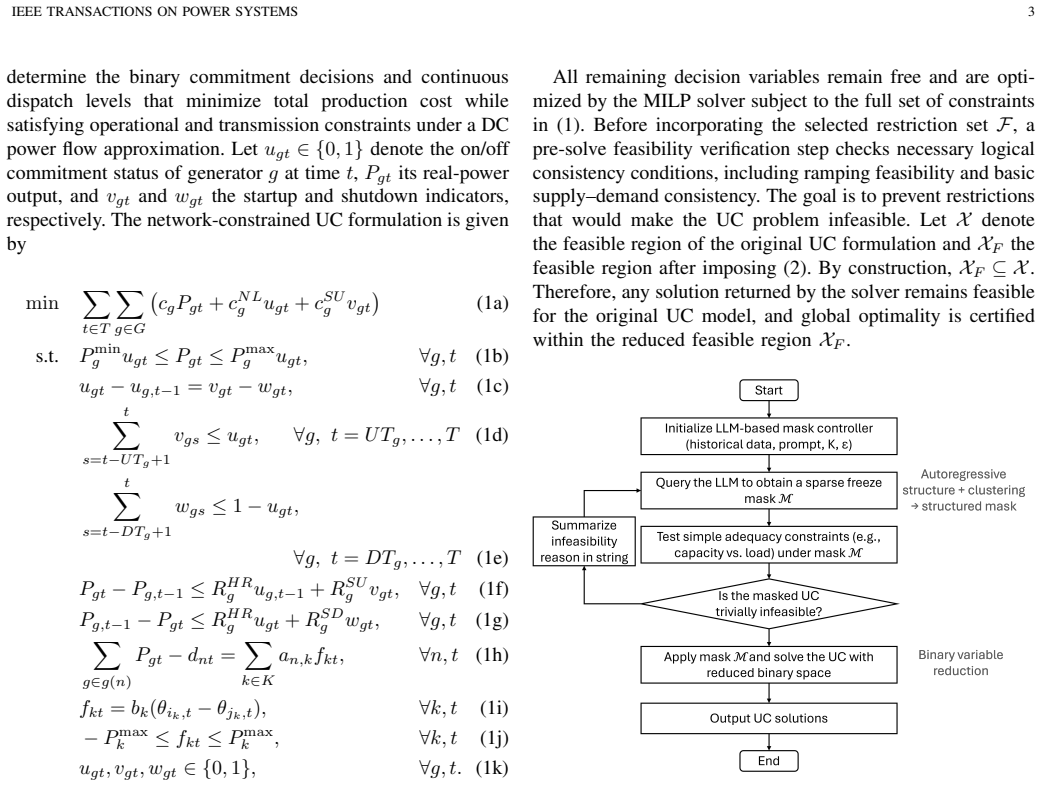


read the original abstract
The growing number of individual generating units, hybrid resources, and security constraints has significantly increased the computational burden of network-constrained unit commitment (UC), where most solution time is spent exploring branch-and-bound trees over unit-hour binary variables. To reduce this combinatorial burden, recent approaches have explored learning-based guidance to assist commitment decisions. However, directly using tools such as large language models (LLMs) to predict full commitment schedules is unreliable, as infeasible or inconsistent binary decisions can violate inter-temporal constraints and degrade economic optimality. This paper proposes a solver-compatible dimensionality reduction framework for UC that exploits structural regularities in commitment decisions. Instead of generating complete schedules, the framework identifies a sparse subset of structurally stable commitment binaries to fix prior to optimization. One implementation uses an LLM to select these variables. The LLM does not replace the optimization process but provides partial variable restriction, while all constraints and remaining decisions are handled by the original MILP solver, which continues to enforce network, ramping, reserve, and security constraints. We formally show that the masked problem defines a reduced feasible region of the original UC model, thereby preserving feasibility and enabling solver-certified optimality within the restricted space. Experiments on IEEE 57-bus, RTS 73-bus, IEEE 118-bus, and augmented large-scale cases, including security-constrained variants, demonstrate consistent reductions in branch-and-bound nodes and solution time, achieving order-of-magnitude speedups on high-complexity instances while maintaining near-optimal objective values.
Editorial analysis
A structured set of objections, weighed in public.
Referee Report
Summary. The paper claims to provide a structure-aware commitment reduction framework for network-constrained unit commitment. It fixes a sparse subset of stable commitment binaries (selected e.g. by LLM) to reduce the MILP search space, formally showing that the masked problem is a feasible restriction of the original UC model, thus preserving feasibility and allowing solver-certified optimality in the restricted space. Experiments on several IEEE and RTS bus systems demonstrate substantial speedups with near-optimal objectives.
Significance. This approach is significant because it combines the strengths of learning methods for variable selection with the reliability of exact MILP solvers, avoiding the infeasibility issues of pure predictive models for UC. If the empirical results hold, it could enable solving larger UC instances faster, which is valuable for power system operations with increasing complexity from renewables and security constraints. The parameter-free nature of the core reduction and the solver-preserving guarantees are key strengths.
major comments (2)
- [Abstract] Abstract: The description of the LLM implementation for selecting variables to fix lacks detail on the threshold or decision criteria used, which directly determines the size of the reduced space and thus the closeness to global optimality (as noted in the weakest assumption).
- [Formal Argument] Formal reduction argument: Although the inclusion of the masked feasible region holds by construction, the paper should explicitly discuss the possibility of the reduced problem becoming infeasible for certain selections and any fallback mechanisms, as this affects practical deployment.
minor comments (1)
- [Experiments] Experiments section: Provide the exact number of units, time periods, and constraint counts for each test case (IEEE 57, RTS 73, IEEE 118) to allow readers to assess scalability claims.
Simulated Author's Rebuttal
We thank the referee for the positive evaluation and constructive comments recommending minor revision. We address each major comment below with planned revisions to improve clarity and practical discussion.
read point-by-point responses
-
Referee: [Abstract] Abstract: The description of the LLM implementation for selecting variables to fix lacks detail on the threshold or decision criteria used, which directly determines the size of the reduced space and thus the closeness to global optimality (as noted in the weakest assumption).
Authors: We agree that additional detail on the LLM selection threshold and criteria is needed for transparency. In the revised manuscript we will expand the abstract and add a short paragraph in the methods section specifying the decision criteria (e.g., variables fixed only if selected consistently across multiple LLM queries above a tunable stability threshold) and how varying this threshold trades off reduction size against proximity to global optimality. revision: yes
-
Referee: [Formal Argument] Formal reduction argument: Although the inclusion of the masked feasible region holds by construction, the paper should explicitly discuss the possibility of the reduced problem becoming infeasible for certain selections and any fallback mechanisms, as this affects practical deployment.
Authors: We thank the referee for noting this deployment consideration. While the masked problem is formally a restriction of the original feasible set, poor variable selections can indeed render it infeasible. We will revise the formal argument section to explicitly acknowledge this case and outline fallback mechanisms such as iteratively unfixed variables or using the LLM output only as a warm-start rather than hard constraints, thereby preserving solver reliability. revision: yes
Circularity Check
No significant circularity identified
full rationale
The paper's core formal claim is that masking (fixing) a subset of binary commitment variables produces a feasible region that is a subset of the original UC feasible set, so any feasible solution to the masked MILP remains feasible for the original model and the solver certifies optimality inside the restricted space. This property follows immediately from the standard definition of variable fixing in MILP and requires no additional derivation, fitted parameters, or self-citation. The choice of which variables to fix is supplied externally (via LLM or structural heuristics) and does not appear inside the equations that establish the inclusion; the optimality guarantee therefore does not reduce to any input defined by the paper itself. No self-definitional loops, fitted-input predictions, or load-bearing self-citations are present in the derivation chain.
Axiom & Free-Parameter Ledger
axioms (1)
- domain assumption Commitment decisions contain structurally stable binaries that can be fixed without destroying feasibility of the original model.
Lean theorems connected to this paper
-
IndisputableMonolith/Foundation/AbsoluteFloorClosure.leanreality_from_one_distinction unclear?
unclearRelation between the paper passage and the cited Recognition theorem.
We formally show that the masked problem defines a reduced feasible region of the original UC model, thereby preserving feasibility and enabling solver-certified optimality within the restricted space.
-
IndisputableMonolith/Cost/FunctionalEquation.leanwashburn_uniqueness_aczel unclear?
unclearRelation between the paper passage and the cited Recognition theorem.
Theorem 1 (Reduced Feasible Region). The restricted feasible region satisfies F_M ⊆ F.
What do these tags mean?
- matches
- The paper's claim is directly supported by a theorem in the formal canon.
- supports
- The theorem supports part of the paper's argument, but the paper may add assumptions or extra steps.
- extends
- The paper goes beyond the formal theorem; the theorem is a base layer rather than the whole result.
- uses
- The paper appears to rely on the theorem as machinery.
- contradicts
- The paper's claim conflicts with a theorem or certificate in the canon.
- unclear
- Pith found a possible connection, but the passage is too broad, indirect, or ambiguous to say the theorem truly supports the claim.
Reference graph
Works this paper leans on
-
[1]
Unit commitment-a bibliographical survey,
N. P. Padhy, “Unit commitment-a bibliographical survey,”IEEE Trans- actions on power systems, vol. 19, no. 2, pp. 1196–1205, 2004
work page 2004
-
[2]
On mixed-integer pro- gramming formulations for the unit commitment problem,
B. Knueven, J. Ostrowski, and J.-P. Watson, “On mixed-integer pro- gramming formulations for the unit commitment problem,”INFORMS Journal on Computing, vol. 32, no. 4, pp. 857–876, 2020
work page 2020
-
[3]
Co-optimization of generation unit commitment and transmission switching with n-1 reliability,
K. W. Hedman, M. C. Ferris, R. P. O’Neill, E. B. Fisher, and S. S. Oren, “Co-optimization of generation unit commitment and transmission switching with n-1 reliability,”IEEE Transactions on Power Systems, vol. 25, no. 2, pp. 1052–1063, 2010
work page 2010
-
[4]
Tight and compact milp formulation for the thermal unit commitment problem,
G. Morales-Espa ˜na, J. M. Latorre, and A. Ramos, “Tight and compact milp formulation for the thermal unit commitment problem,”IEEE Transactions on Power Systems, vol. 28, no. 4, pp. 4897–4908, 2013
work page 2013
-
[5]
Z. Wang, J. Gao, Q. Cui, and Y . Weng, “Constrained branching search for topology identification stream computing with lightweight imple- mentation,”IEEE Transactions on Power Systems, vol. 40, no. 4, pp. 3474–3486, 2025
work page 2025
-
[6]
Comparison of state-of-the- art transmission constrained unit commitment formulations,
H. Pand ˇzi´c, T. Qiu, and D. S. Kirschen, “Comparison of state-of-the- art transmission constrained unit commitment formulations,” inIEEE Power & Energy Society General Meeting, 2013, pp. 1–5
work page 2013
-
[7]
Western interconnection baseline study,
K. Oikonomou, B. Vyakaranam, T. B. Nguyen, K. Harris, E. Schweitzer, N. Samaan, C. Qin, F. Bereta dos Reis, M. M. Abdelmalak, M. Kint- ner Meyer, and J. Dagle, “Western interconnection baseline study,” Pacific Northwest National Laboratory, Tech. Rep. PNNL-36452, Sep. 2024
work page 2024
-
[8]
J. Rand, N. Manderlink, W. Gorman, R. H. Wiser, J. Seel, J. M. Kemp, S. Jeong, and F. Kahrl, “Queued up 2024 edition characteristics of power plants seeking transmission interconnection as of the end of 2023,” Lawrence Berkeley National Laboratory, Tech. Rep., Apr. 2024
work page 2024
-
[9]
Y . Chen, F. Pan, F. Qiu, A. S. Xavier, T. Zheng, M. Marwali, B. Knueven, Y . Guan, P. B. Luh, L. Wu, B. Yan, M. A. Bragin, H. Zhong, A. Giacomoni, R. Baldick, B. Gisin, Q. Gu, R. Philbrick, and F. Li, “Security-constrained unit commitment for electricity market: Modeling, solution methods, and future challenges,”IEEE Transactions on Power Systems, vol. 3...
work page 2023
-
[10]
Is learning for the unit commitment problem a low-hanging fruit?
S. Pineda and J. Morales, “Is learning for the unit commitment problem a low-hanging fruit?”Electric Power Systems Research, vol. 207, p. 107851, 2022
work page 2022
-
[11]
Learning-based branching acceleration for unit commitment with few training samples,
C. Zhang, Z. Qin, and Y . Sun, “Learning-based branching acceleration for unit commitment with few training samples,”Applied Sciences, vol. 15, no. 6, 2025
work page 2025
-
[12]
Combining deep learning and branch-and-cut algorithm for transmission-constrained unit commitment,
G. Zhuozan, “Combining deep learning and branch-and-cut algorithm for transmission-constrained unit commitment,” inAsia Conference on Power and Electrical Engineering, 2024, pp. 1465–1469
work page 2024
-
[13]
LLMs for cold-start cutting plane separator configuration,
C. Lawless, Y . Li, A. Wikum, M. Udell, and E. Vitercik, “LLMs for cold-start cutting plane separator configuration,” 2025. [Online]. Available: https://arxiv.org/abs/2412.12038
-
[14]
SVR-enhanced optimization for voltage control in observability-limited distribution systems,
J. Yuan, J. Wu, Y . Weng, and E. Blasch, “SVR-enhanced optimization for voltage control in observability-limited distribution systems,” inIEEE Power & Energy Society General Meeting, 2025, pp. 1–5
work page 2025
-
[15]
J. Wu, J. Yuan, Y . Weng, and G. Wang, “A unified approach to enforce non-negativity constraint in neural network approximation for optimal voltage regulation,” inProceedings of the Hawaii International Conference on System Sciences, 2025
work page 2025
-
[16]
T. Ahmed and S. Choudhury, “Lm4opt: Unveiling the potential of large language models in formulating mathematical optimization problems,” Information Systems and Operational Research, vol. 62, no. 4, pp. 559– 572, 2024
work page 2024
-
[17]
X. Cai, Z. Meng, Q. Guo, L. Jiang, J. Wu, M. Min, Y . Cheng, X. Gui, and J. Zhao, “Mingyue: A multi-agent system for human-ai collaborative decision-making under safety constraints in complex power grids,” in Power System and Green Energy Conference, 2025, pp. 434–439
work page 2025
-
[18]
Q. Zhang and L. Xie, “Poweragent: A road map toward agentic intel- ligence in power systems: Foundation model, model context protocol, and workflow,”IEEE Power and Energy Magazine, vol. 23, no. 5, pp. 93–101, 2025
work page 2025
-
[19]
Solar photovoltaic assessment with large lan- guage model,
M. Guo and Y . Weng, “Solar photovoltaic assessment with large lan- guage model,”Applied Energy, vol. 402, p. 126835, 2025
work page 2025
-
[20]
R. Yu, L. Mai, Y . Weng, Q. Cui, G. Xu, and P. Ren, “Vision–language models for transmission line fault detection: A new approach for grid reliability and optimization,”Journal of Imaging, vol. 12, no. 3, 2026
work page 2026
-
[21]
The IEEE reliability test system: A proposed 2019 update,
C. Barrows, A. Bloom, A. Ehlen, J. Ik ¨aheimo, J. Jorgenson, D. Krish- namurthy, J. Lau, B. McBennett, M. O’Connell, E. Preston, A. Staid, G. Stephen, and J.-P. Watson, “The IEEE reliability test system: A proposed 2019 update,”IEEE Transactions on Power Systems, vol. 35, no. 1, pp. 119–127, 2020
work page 2019
-
[22]
Power Grid Lib - Unit Commitment (PGLib-UC), Version 19.08,
IEEE PES Task Force on Benchmarks for Validation of Emerging Power System Algorithms, “Power Grid Lib - Unit Commitment (PGLib-UC), Version 19.08,” https://github.com/power-grid-lib/pglib-uc/tree/v19.08, 2019, accessed: 2026-03-20
work page 2019
-
[23]
A. S. Xavier, A. M. Kazachkov, O. Yurdakul, J. He, and F. Qiu, “Unitcommitment.jl: A julia/jump optimization package for security- constrained unit commitment (version 0.3),” 2022. [Online]. Available: https://axavier.org/UnitCommitment.jl/0.3/
work page 2022
-
[24]
R. D. Zimmerman, C. E. Murillo-Sanchez, and R. J. Thomas, “Mat- power: Steady-state operations, planning and analysis tools for power systems research and education,”IEEE Transactions on Power Systems, vol. 26, no. 1, pp. 12–19, 2011
work page 2011
discussion (0)
Sign in with ORCID, Apple, or X to comment. Anyone can read and Pith papers without signing in.