Number fluctuations distinguish different self-propelling dynamics
Pith reviewed 2026-05-13 18:55 UTC · model grok-4.3
The pith
Number fluctuations over time distinguish different self-propelled particle models through reorientation dynamics.
A machine-rendered reading of the paper's core claim, the machinery that carries it, and where it could break.
Core claim
In nonequilibrium suspensions, the time-dependent number fluctuations N(t) inside virtual observation boxes encode enough information to distinguish and parameterize different self-propelled particle models. The distinction arises because reorientation dynamics control the frequency and statistics of particle re-entries into the boxes, producing model-specific signatures in the fluctuation signal.
What carries the argument
The number fluctuation signal N(t) measured inside fixed virtual boxes, which registers re-entrance events controlled by particle reorientation rules.
If this is right
- Models with distinct reorientation dynamics generate distinguishable N(t) statistics.
- Dynamical parameters can be extracted directly from fluctuation measurements without full trajectory reconstruction.
- The approach remains usable in dense suspensions where single-particle tracking fails.
- Dynamic N(t) signals add time-resolved information beyond what static number fluctuations provide.
Where Pith is reading between the lines
- The same fluctuation data could be used to test whether real experimental systems follow one reorientation rule over another.
- Extensions might examine how interaction strength alters the inversion accuracy when density is no longer fixed.
- The method could be combined with existing structure-factor measurements to separate structural from dynamical contributions in active matter.
Load-bearing premise
Differences in reorientation dynamics dominate the observed N(t) statistics and can be inverted to recover model parameters without being masked by density or interaction effects.
What would settle it
Two models with different reorientation rules but otherwise identical parameters would produce identical N(t) statistics.
Figures
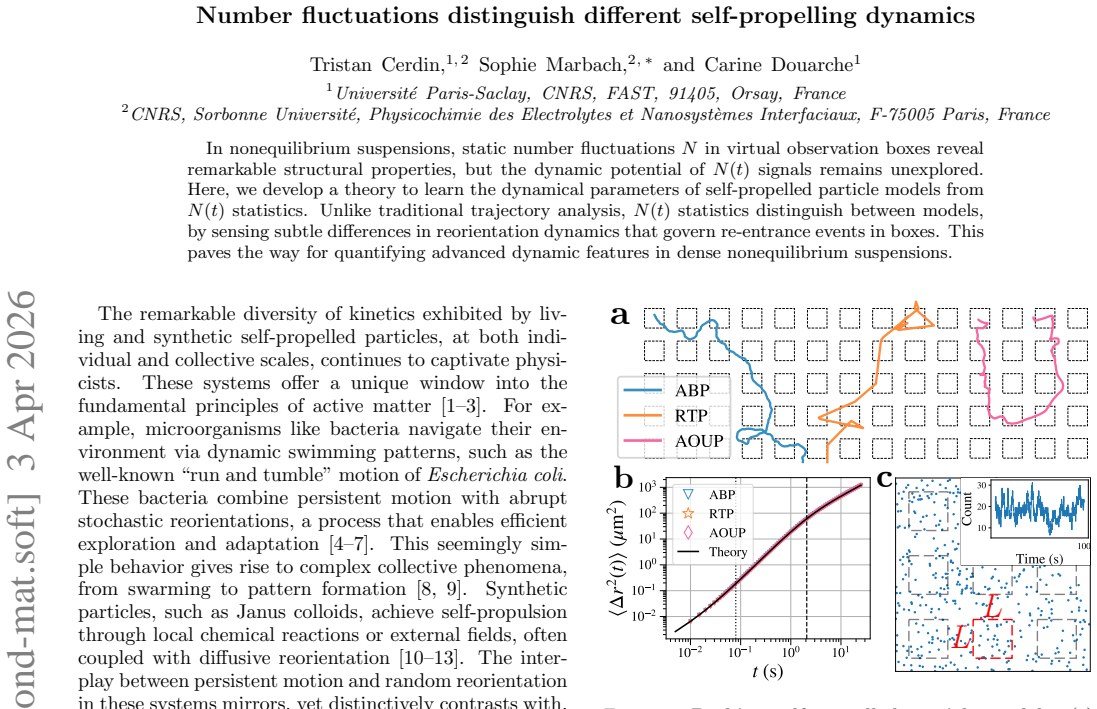


read the original abstract
In nonequilibrium suspensions, static number fluctuations $N$ in virtual observation boxes reveal remarkable structural properties, but the dynamic potential of $N(t)$ signals remains unexplored. Here, we develop a theory to learn the dynamical parameters of self-propelled particle models from $N(t)$ statistics. Unlike traditional trajectory analysis, $N(t)$ statistics distinguish between models, by sensing subtle differences in reorientation dynamics that govern re-entrance events in boxes. This paves the way for quantifying advanced dynamic features in dense nonequilibrium suspensions.
Editorial analysis
A structured set of objections, weighed in public.
Referee Report
Summary. The manuscript develops a theory for extracting dynamical parameters of self-propelled particle models from the statistics of time-dependent number fluctuations N(t) inside virtual observation boxes. It argues that N(t) distinguishes models by sensing differences in reorientation dynamics that control re-entrance events, providing an alternative to trajectory-based analysis for dense nonequilibrium suspensions.
Significance. If the central mapping holds, the work offers a practical route to infer reorientation parameters from fluctuation data in dense active systems where full tracking is impractical. The focus on re-entrance statistics as a probe of intrinsic dynamics is a potentially useful addition to the active-matter toolkit, provided the separation from interaction effects can be established.
major comments (2)
- [Theory section (derivation of N(t) from reorientation rules)] The abstract states that the theory targets dense nonequilibrium suspensions, yet the derivation begins from non-interacting Langevin or telegrapher equations for trajectories inside the virtual box. No decoupling argument or scaling analysis is supplied to show that the mapping from bare reorientation parameters to N(t) moments remains injective once excluded-volume or alignment interactions are restored at finite packing fraction.
- [Results on model distinction] The claim that N(t) statistics uniquely sense reorientation dynamics (rather than effective persistence modified by interactions) is load-bearing for the distinction between models. The manuscript provides no numerical test or analytic bound demonstrating that interaction-induced changes in crossing probabilities do not erase or mimic the signatures of different bare reorientation rules.
minor comments (2)
- [Introduction] Notation for the virtual box size and the precise definition of re-entrance events should be introduced earlier and used consistently.
- [Figures] Figure captions should explicitly state the packing fractions used in the simulations so readers can assess the dense-regime regime.
Simulated Author's Rebuttal
We thank the referee for the careful reading and constructive comments. The points raised concern the extension of the non-interacting derivation to dense interacting systems, which we address by clarifying the assumptions and committing to additional analysis and tests in the revision.
read point-by-point responses
-
Referee: [Theory section (derivation of N(t) from reorientation rules)] The abstract states that the theory targets dense nonequilibrium suspensions, yet the derivation begins from non-interacting Langevin or telegrapher equations for trajectories inside the virtual box. No decoupling argument or scaling analysis is supplied to show that the mapping from bare reorientation parameters to N(t) moments remains injective once excluded-volume or alignment interactions are restored at finite packing fraction.
Authors: We agree that the derivation is performed in the non-interacting limit to isolate the effect of reorientation rules on re-entrance statistics. The abstract's reference to dense suspensions reflects our expectation that the signatures remain observable when interactions are moderate. In the revision we will add a scaling analysis and perturbative argument showing that the mapping from bare parameters to N(t) moments stays approximately injective for packing fractions below a crossover value where single-particle reorientation still dominates crossing events. We will also cite effective-medium approaches from the active-matter literature to support the range of validity. revision: partial
-
Referee: [Results on model distinction] The claim that N(t) statistics uniquely sense reorientation dynamics (rather than effective persistence modified by interactions) is load-bearing for the distinction between models. The manuscript provides no numerical test or analytic bound demonstrating that interaction-induced changes in crossing probabilities do not erase or mimic the signatures of different bare reorientation rules.
Authors: This is a fair criticism; the current manuscript establishes the baseline distinction for non-interacting particles. To substantiate the claim for interacting cases we will include, in the revised manuscript, Brownian-dynamics simulations of the models at moderate packing fractions together with an analytic bound based on short-time independence of crossing events. These additions will demonstrate that the ordering of N(t) moments between models is preserved under weak to moderate interactions. revision: yes
Circularity Check
No significant circularity; theory derives N(t) from reorientation dynamics independently
full rationale
The paper develops a theory to extract dynamical parameters from N(t) statistics by modeling re-entrance events governed by reorientation rules in virtual boxes. The abstract and description present this as a forward derivation from standard Langevin/telegrapher-type equations for particle trajectories, without any quoted steps that fit parameters to a data subset and then rename the output as a prediction, or that reduce the central mapping to a self-citation or self-definition. The distinction between models is claimed to arise from differences in intrinsic reorientation that affect crossing probabilities, and no load-bearing equation is shown to be equivalent to its inputs by construction. This is the expected non-finding for a paper whose core claim remains an independent theoretical mapping.
Axiom & Free-Parameter Ledger
Lean theorems connected to this paper
-
IndisputableMonolith/Cost/FunctionalEquation.leanwashburn_uniqueness_aczel unclear?
unclearRelation between the paper passage and the cited Recognition theorem.
We derive analytical theory... ⟨ΔN²(t)⟩=2⟨N⟩P_out(t) ... P_out(t)≃4vt/πL ... for ABP and RTPs ... 4√π⟨N⟩vt/L for AOUPs
-
IndisputableMonolith/Foundation/RealityFromDistinction.leanreality_from_one_distinction unclear?
unclearRelation between the paper passage and the cited Recognition theorem.
MSD of all 3 models is captured by a single equation ... ⟨Δr²(t)⟩=4(Dt + v²/2Dr)t + ...
What do these tags mean?
- matches
- The paper's claim is directly supported by a theorem in the formal canon.
- supports
- The theorem supports part of the paper's argument, but the paper may add assumptions or extra steps.
- extends
- The paper goes beyond the formal theorem; the theorem is a base layer rather than the whole result.
- uses
- The paper appears to rely on the theorem as machinery.
- contradicts
- The paper's claim conflicts with a theorem or certificate in the canon.
- unclear
- Pith found a possible connection, but the passage is too broad, indirect, or ambiguous to say the theorem truly supports the claim.
Reference graph
Works this paper leans on
-
[1]
M. C. Marchetti, J.-F. Joanny, S. Ramaswamy, T. B. Liverpool, J. Prost, M. Rao, and R. A. Simha, Hydrody- namics of soft active matter, Reviews of modern physics 85, 1143 (2013)
work page 2013
-
[2]
S. Ramaswamy, The mechanics and statistics of active matter, Annual Review of Condensed Matter Physics1, 323 (2010)
work page 2010
-
[3]
C. Bechinger, R. Di Leonardo, H. L¨ owen, C. Reichhardt, G. Volpe, and G. Volpe, Active particles in complex and crowded environments, Rev. Mod. Phys.88, 045006 (2016)
work page 2016
-
[4]
H. C. Berg,Random walks in biology(Princeton Univer- sity Press, Princeton, 1983)
work page 1983
-
[5]
F. W. Dahlquist, P. Lovely, and D. E. Koshland, Quanti- tative analysis of bacterial migration in chemotaxis, Na- ture New Biology236, 120 (1972)
work page 1972
-
[6]
M. J. Schnitzer, Theory of continuum random walks and application to chemotaxis, Phys. Rev. E48, 2553 (1993)
work page 1993
-
[7]
J. Saragosti, V. Calvez, N. Bournaveas, B. Perthame, A. Buguin, and P. Silberzan, Directional per- sistence of chemotactic bacteria in a travel- ing concentration wave, Proceedings of the Na- tional Academy of Sciences108, 16235 (2011), https://www.pnas.org/doi/pdf/10.1073/pnas.1101996108
- [8]
-
[9]
J. Tailleur and M. E. Cates, Statistical mechanics of in- teracting run-and-tumble bacteria, Phys. Rev. Lett.100, 218103 (2008)
work page 2008
-
[10]
J. R. Howse, R. A. L. Jones, A. J. Ryan, T. Gough, R. Vafabakhsh, and R. Golestanian, Self-motile colloidal particles: from directed propulsion to random walk, 6 Physical Review Letters99(2007)
work page 2007
-
[11]
I. Buttinoni, J. Bialk´ e, F. K¨ ummel, H. L¨ owen, C. Bechinger, and T. Speck, Dynamical clustering and phase separation in suspensions of self-propelled colloidal particles, Phys. Rev. Lett.110, 238301 (2013)
work page 2013
-
[12]
J. Palacci, S. Sacanna, A. P. Steinberg, D. J. Pine, and P. M. Chaikin, Living crystals of light- activated colloidal surfers, Science339, 936 (2013), https://www.science.org/doi/pdf/10.1126/science.1230020
-
[13]
S. J. Ebbens and J. R. Howse, Direct observation of the direction of motion for spherical catalytic swimmers, Langmuir, Langmuir27, 12293 (2011)
work page 2011
-
[14]
M. E. Cates and J. Tailleur, Motility-induced phase sep- aration, Annual Review of Condensed Matter Physics6, 219 (2015)
work page 2015
-
[15]
J. Deseigne, O. Dauchot, and H. Chat´ e, Collective motion of vibrated polar disks, Phys. Rev. Lett.105, 098001 (2010)
work page 2010
-
[16]
Y. Fily and M. C. Marchetti, Athermal phase separation of self-propelled particles with no alignment, Physical re- view letters108, 235702 (2012)
work page 2012
-
[17]
C. Manzo and M. F. Garcia-Parajo, A review of progress in single particle tracking: from methods to biophysi- cal insights, Reports on progress in physics78, 124601 (2015)
work page 2015
-
[18]
K. A. Rose, M. Molaei, M. J. Boyle, D. Lee, J. C. Crocker, and R. J. Composto, Particle tracking of nanoparticles in soft matter, Journal of Applied Physics127(2020)
work page 2020
-
[19]
V. A. Martinez, R. Besseling, O. A. Croze, J. Tailleur, M. Reufer, J. Schwarz-Linek, L. G. Wilson, M. A. Bees, and W. C. Poon, Differential dynamic microscopy: a high-throughput method for characterizing the motility of microorganisms, Biophysical journal103, 1637 (2012)
work page 2012
-
[20]
C. Kurzthaler, Y. Zhao, N. Zhou, J. Schwarz-Linek, C. Devailly, J. Arlt, J.-D. Huang, W. C. Poon, T. Fra- nosch, J. Tailleur,et al., Characterization and control of the run-and-tumble dynamics of escherichia coli, Physical Review Letters132, 038302 (2024)
work page 2024
-
[21]
C. Kurzthaler, C. Devailly, J. Arlt, T. Franosch, W. C. Poon, V. A. Martinez, and A. T. Brown, Probing the spatiotemporal dynamics of catalytic janus particles with single-particle tracking and differential dynamic mi- croscopy, Physical review letters121, 078001 (2018)
work page 2018
-
[22]
D. Germain, M. Leocmach, and T. Gibaud, Differen- tial dynamic microscopy to characterize brownian motion and bacteria motility, American Journal of Physics84, 202 (2016)
work page 2016
-
[23]
L. G. Wilson, V. A. Martinez, J. Schwarz-Linek, J. Tailleur, G. Bryant, P. Pusey, and W. C. Poon, Differ- ential dynamic microscopy of bacterial motility, Physical review letters106, 018101 (2011)
work page 2011
-
[24]
C. Kurzthaler, S. Leitmann, and T. Franosch, Intermedi- ate scattering function of an anisotropic active brownian particle, Scientific reports6, 36702 (2016)
work page 2016
-
[25]
Y. Zhao, C. Kurzthaler, N. Zhou, J. Schwarz-Linek, C. Devailly, J. Arlt, J.-D. Huang, W. C. Poon, T. Fra- nosch, V. A. Martinez,et al., Quantitative characteriza- tion of run-and-tumble statistics in bulk bacterial sus- pensions, Physical Review E109, 014612 (2024)
work page 2024
- [26]
-
[27]
E. K. Mackay, S. Marbach, B. Sprinkle, and A. L. Thor- neywork, The countoscope: measuring self and collective dynamics without trajectories, Physical Review X14, 041016 (2024)
work page 2024
-
[28]
M. v. Smoluchowski, Studien ¨ uber kolloidstatistik und den mechanismus der diffusion, Kolloid-Zeitschrift18, 48 (1916)
work page 1916
-
[29]
M. Smoluchowski, Studien ¨ uber molekularstatistik von emulsionen und deren zusammenhang mit der brown’schen bewegung, Akademie der Wissenschaften in Wien123, 2381 (1914)
work page 1914
- [30]
-
[31]
M. R. Bailey, A. R. Sprenger, F. Grillo, H. L¨ owen, and L. Isa, Fitting an active brownian particle’s mean- squared displacement with improved parameter estima- tion, Physical Review E106, L052602 (2022)
work page 2022
-
[32]
H. C. Berg, ed.,E. coli in Motion, Biological and Medical Physics, Biomedical Engineering (Springer, New York, NY, 2004)
work page 2004
-
[33]
E. Clement, A. Lindner, C. Douarche, and H. Auradou, Bacterial suspensions under flow, The European Physical Journal Special Topics225, 2389 (2016)
work page 2016
- [34]
- [35]
-
[36]
A. R. Sprenger, M. A. Fernandez-Rodriguez, L. Alvarez, L. Isa, R. Wittkowski, and H. L¨ owen, Active Brown- ian Motion with Orientation-Dependent Motility: The- ory and Experiments, Langmuir36, 7066 (2020)
work page 2020
-
[37]
R. F. Voss and J. Clarke, Flicker ( 1 f ) noise: Equilibrium temperature and resistance fluctuations, Phys. Rev. B 13, 556 (1976)
work page 1976
- [38]
- [39]
-
[40]
T. Debnath, P. Chaudhury, T. Mukherjee, D. Mondal, and P. K. Ghosh, Escape kinetics of self-propelled par- ticles from a circular cavity, The Journal of Chemical Physics155(2021)
work page 2021
-
[41]
F. Di Trapani, T. Franosch, and M. Caraglio, Active brownian particles in a circular disk with an absorbing boundary, Physical Review E107, 064123 (2023)
work page 2023
-
[42]
F. Mori, P. Le Doussal, S. N. Majumdar, and G. Schehr, Universal survival probability for ad-dimensional run- and-tumble particle, Physical review letters124, 090603 (2020)
work page 2020
-
[43]
J.-F. Rupprecht, N. Waisbord, C. Ybert, C. Cottin- Bizonne, and L. Bocquet, Velocity condensation for mag- netotactic bacteria, Physical review letters116, 168101 (2016)
work page 2016
-
[44]
A. P. Solon, M. E. Cates, and J. Tailleur, Active brown- ian particles and run-and-tumble particles: A compara- tive study, The European Physical Journal Special Topics 7 224, 1231 (2015)
work page 2015
-
[45]
F. Detcheverry, Generalized run-and-turn motions: From bacteria to l´ evy walks, Physical Review E96, 012415 (2017)
work page 2017
-
[46]
A. Gentili, R. Klages, and G. Volpe, Anomalous dynam- ics of superparamagnetic colloidal microrobots with tai- lored statistics, Small , e06538 (2025)
work page 2025
- [47]
-
[48]
F. Peruani, J. Starruß, V. Jakovljevic, L. Søgaard- Andersen, A. Deutsch, and M. B¨ ar, Collective motion and nonequilibrium cluster formation in colonies of glid- ing bacteria, Physical review letters108, 098102 (2012)
work page 2012
-
[49]
Z. Liu, W. Zeng, X. Ma, and X. Cheng, Density fluctua- tions and energy spectra of 3d bacterial suspensions, Soft Matter17, 10806 (2021)
work page 2021
-
[50]
S. Dey, D. Das, and R. Rajesh, Spatial structures and giant number fluctuations in models of active matter, Physical review letters108, 238001 (2012)
work page 2012
-
[51]
F. Alarc´ on, C. Valeriani, and I. Pagonabarraga, Mor- phology of clusters of attractive dry and wet self- propelled spherical particle suspensions, Soft matter13, 814 (2017)
work page 2017
-
[52]
H. Chat´ e, F. Ginelli, G. Gr´ egoire, and F. Raynaud, Col- lective motion of self-propelled particles interacting with- out cohesion, Physical Review E77, 046113 (2008)
work page 2008
-
[53]
O. Chepizhko, D. Saintillan, and F. Peruani, Revisiting the emergence of order in active matter, Soft Matter17, 3113 (2021)
work page 2021
- [54]
-
[55]
V. Narayan, S. Ramaswamy, and N. Menon, Long-lived giant number fluctuations in a swarming granular ne- matic, Science317, 105 (2007)
work page 2007
- [56]
-
[57]
R. M. Navarro and S. M. Fielding, Clustering and phase behaviour of attractive active particles with hydrody- namics, Soft Matter11, 7525 (2015)
work page 2015
discussion (0)
Sign in with ORCID, Apple, or X to comment. Anyone can read and Pith papers without signing in.