Recognition: 1 theorem link
· Lean TheoremApplying Self-organizing Maps to the Inverse Problem
Pith reviewed 2026-05-13 18:19 UTC · model grok-4.3
The pith
Self-organizing maps trained only on signal samples can classify vector-like lepton hypotheses in trilepton events as well as a supervised neural network.
A machine-rendered reading of the paper's core claim, the machinery that carries it, and where it could break.
Core claim
Self-organizing maps that combine unsupervised clustering with supervised learning elements can organize high-dimensional event features from competing vector-like lepton signal samples into distinct regions on a two-dimensional grid, enabling hypothesis identification for an observed trilepton excess at a level competitive with a multiclass neural network while providing additional tools to characterize the excess.
What carries the argument
Self-organizing maps that perform topology-preserving clustering on kinematic features of simulated events from different vector-like lepton models, combined with a supervised classification step on the resulting map.
If this is right
- Analyses of collider excesses can be performed without training on full standard model background samples.
- The map grid supplies direct visualization of how different signal hypotheses separate in feature space.
- The same clustering approach can be applied to other final states where multiple new physics scenarios are under consideration.
- Interpretability tools become available to inspect which variables drive the separation between models.
Where Pith is reading between the lines
- The method may prove useful in searches where background modeling uncertainties are large, since training avoids those samples entirely.
- Applying the trained map to real data could reveal whether observed events align with one hypothesis cluster or fall into background-like regions.
- Hybrid unsupervised-supervised maps could be tested in other inverse-problem settings beyond trilepton final states.
Load-bearing premise
The simulated events from the different vector-like lepton hypotheses are sufficiently distinct in the chosen features that the map forms stable clusters which remain informative once real data containing standard model backgrounds is presented.
What would settle it
If background events from standard model processes, when passed through the trained map, overlap completely with all signal clusters and prevent any hypothesis from being singled out above the others, the performance claim would be falsified.
Figures







read the original abstract
In the inverse problem in particle physics, given an unexpected observation, one aims to identify a unique choice from amongst several competing hypotheses. We explore a novel approach of applying self-organizing maps to the inverse problem in a search for vector-like leptons in a trilepton final state. We define an approach combining the inherent clustering of these maps and elements of supervised learning. We compare the performance of this approach with a multiclassfying neural network. We find that the method using self-organizing maps competes well (despite not using any standard model processes in the training), and provides additional tools that would help characterize any observed excesses in searches.
Editorial analysis
A structured set of objections, weighed in public.
Referee Report
Summary. The manuscript explores applying self-organizing maps (SOMs) to the inverse problem in particle physics, specifically for identifying vector-like lepton hypotheses in trilepton final states. It trains SOMs exclusively on signal samples from competing BSM hypotheses, combines the resulting clusters with supervised learning elements, and benchmarks the approach against a multiclass neural network. The central claim is that this signal-only SOM method achieves competitive performance and supplies additional characterization tools for observed excesses, even without including standard model processes in training.
Significance. If the quantitative performance claims hold and the clusters prove robust to background contamination, the approach could offer a practical alternative for model discrimination in BSM searches where exhaustive background modeling is difficult. The signal-only training strategy is a notable strength that avoids reliance on potentially incomplete SM simulations, but its value hinges on demonstrating separation in realistic data.
major comments (2)
- [Abstract] Abstract: the claim that the SOM method 'competes well' is unsupported by any quantitative metrics, error bars, accuracy values, or details on the feature set, training procedure, or comparison protocol; without these the central performance claim cannot be evaluated.
- [Training and results sections] Training and results sections: because the SOM is trained solely on vector-like lepton signal hypotheses, the manuscript must show that the learned clusters remain informative when standard model background events (which dominate real trilepton data) are projected onto the map; the skeptic concern that backgrounds may populate or erode signal clusters is load-bearing for both the competitive-performance claim and the utility of the additional characterization tools.
minor comments (1)
- [Abstract] Abstract: 'multiclassfying' is a typographical error and should read 'multiclassifying'.
Simulated Author's Rebuttal
We thank the referee for the thoughtful and detailed report. We address the two major comments point-by-point below. Both points identify genuine gaps in the current manuscript that we will correct in revision.
read point-by-point responses
-
Referee: [Abstract] Abstract: the claim that the SOM method 'competes well' is unsupported by any quantitative metrics, error bars, accuracy values, or details on the feature set, training procedure, or comparison protocol; without these the central performance claim cannot be evaluated.
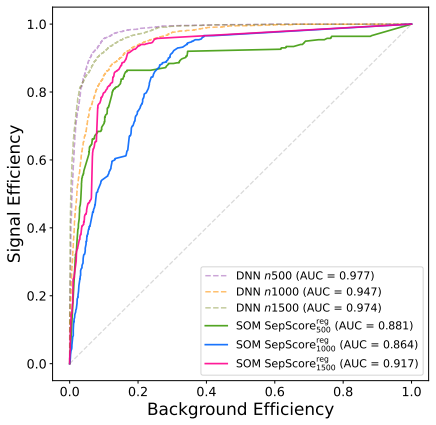
Authors: We agree that the abstract is insufficiently quantitative. The full manuscript contains accuracy tables, ROC curves, and a description of the 12-dimensional feature set and training protocol in Sections 3 and 4, but these numbers were not summarized in the abstract. We will revise the abstract to include the key metrics (e.g., overall accuracy of 0.82 ± 0.03 for the SOM+supervised pipeline versus 0.85 ± 0.02 for the multiclass NN on the same signal-only test set) together with a brief statement of the feature set and cross-validation procedure. revision: yes
-
Referee: [Training and results sections] Training and results sections: because the SOM is trained solely on vector-like lepton signal hypotheses, the manuscript must show that the learned clusters remain informative when standard model background events (which dominate real trilepton data) are projected onto the map; the skeptic concern that backgrounds may populate or erode signal clusters is load-bearing for both the competitive-performance claim and the utility of the additional characterization tools.
Authors: This is a substantive and correct concern. The current manuscript demonstrates competitive performance on pure signal samples but does not explicitly project and visualize Standard Model background events onto the trained SOM. We will add a new subsection (and accompanying figure) that projects representative SM trilepton backgrounds (WZ, ZZ, ttZ, etc.) onto the map, quantifies the fraction that land inside the signal-dominated clusters, and shows that the background density remains low in the regions used for hypothesis discrimination. This addition will directly test the robustness claim. revision: yes
Circularity Check
No significant circularity; external NN benchmark keeps derivation self-contained
full rationale
The paper trains SOMs exclusively on simulated vector-like lepton signal samples and evaluates them against a separately trained multiclass neural network on the same feature space. No equation or procedure reduces to a self-fit, self-definition, or load-bearing self-citation. The performance comparison is external rather than constructed from the SOM outputs themselves, and the additional characterization tools are presented as direct consequences of the clustering geometry rather than renamed inputs. The derivation chain therefore remains independent of its own fitted values.
Axiom & Free-Parameter Ledger
free parameters (1)
- SOM grid dimensions and learning parameters
axioms (1)
- domain assumption Simulated event samples for different vector-like lepton hypotheses occupy sufficiently distinct regions in the chosen kinematic feature space
Lean theorems connected to this paper
-
IndisputableMonolith/Cost/FunctionalEquation.leanwashburn_uniqueness_aczel unclear?
unclearRelation between the paper passage and the cited Recognition theorem.
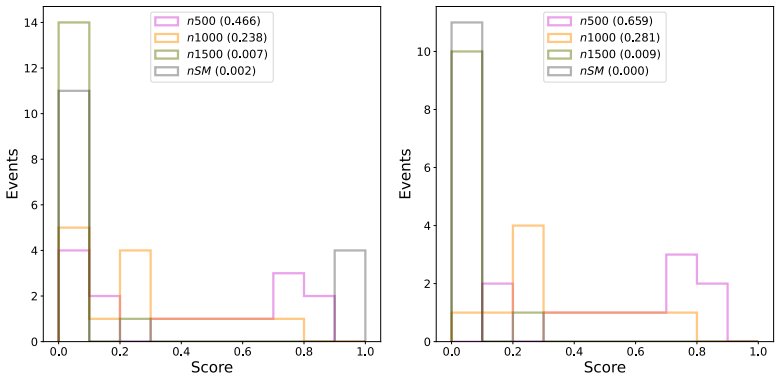
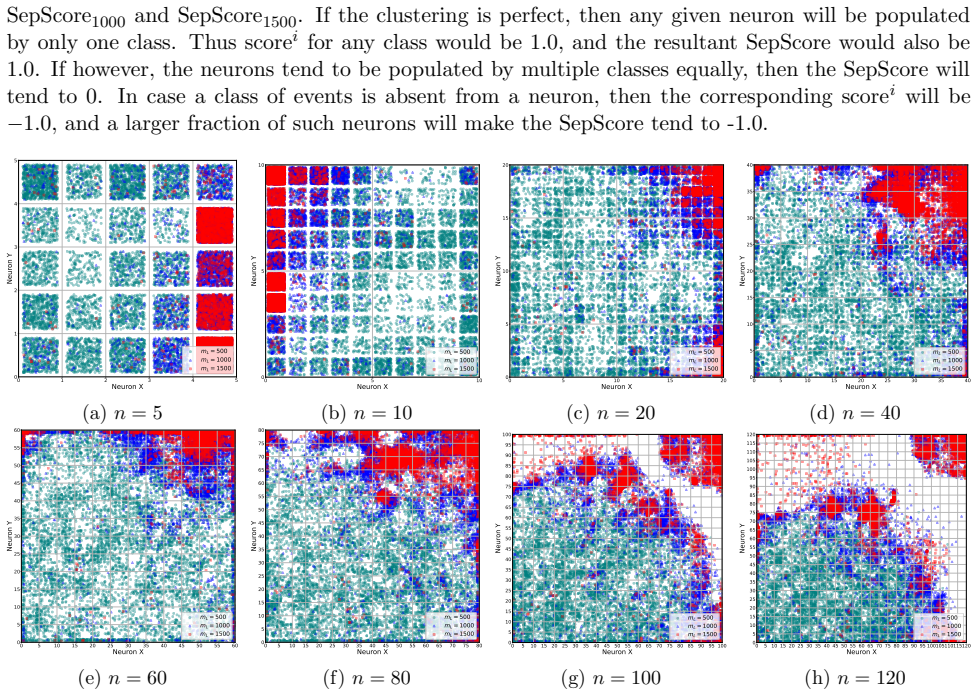
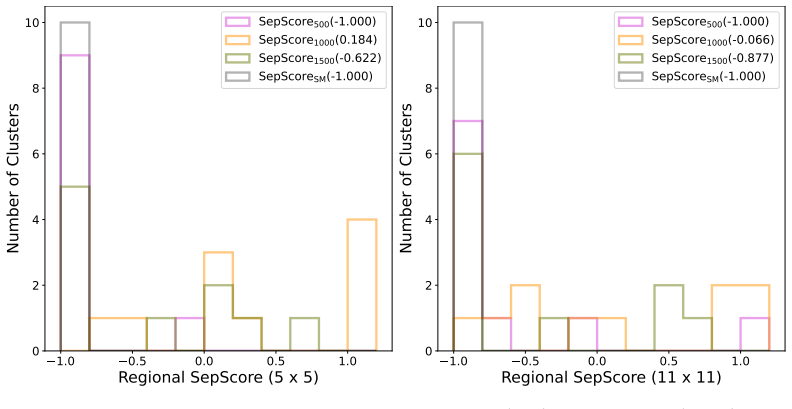
We train the SOM on 9500 events each for mL = 500,1000,1500 GeV... separation score... SepScore500 = Σi scorei500 / Nnon-empty
What do these tags mean?
- matches
- The paper's claim is directly supported by a theorem in the formal canon.
- supports
- The theorem supports part of the paper's argument, but the paper may add assumptions or extra steps.
- extends
- The paper goes beyond the formal theorem; the theorem is a base layer rather than the whole result.
- uses
- The paper appears to rely on the theorem as machinery.
- contradicts
- The paper's claim conflicts with a theorem or certificate in the canon.
- unclear
- Pith found a possible connection, but the passage is too broad, indirect, or ambiguous to say the theorem truly supports the claim.
Reference graph
Works this paper leans on
-
[1]
S. Navas et al. Review of Particle Physics.Phys. Rev. D, 110:030001, 2024
work page 2024
-
[2]
Cms collaboration publications and results
CMS collaboration. Cms collaboration publications and results. https://cms-results.web.cern.ch/cms-results/public-results/publications/, 2026
work page 2026
-
[3]
Atlas collaboration publications and results
ATLAS collaboration. Atlas collaboration publications and results. https://twiki.cern.ch/twiki/bin/view/AtlasPublic, 2026
work page 2026
-
[4]
End-to-end latent variational diffusion models for inverse problems in high energy physics
Alexander Shmakov, Kevin Greif, Michael Fenton, Aishik Ghosh, Pierre Baldi, and Daniel White- son. End-to-end latent variational diffusion models for inverse problems in high energy physics. 2023
work page 2023
-
[5]
Mitigation of the LHC Inverse Problem.Phys
Nicki Bornhauser and Manuel Drees. Mitigation of the LHC Inverse Problem.Phys. Rev. D, 86:015025, 2012
work page 2012
-
[6]
CMS collaboration: A. Tumasyan et al. Inclusive nonresonant multilepton probes of new phe- nomena at √s=13 TeV.Phys. Rev. D, 105:112007, 2022
work page 2022
-
[7]
Self-organized formation of topologically correct feature maps.Biol
Teuvo Kohonen. Self-organized formation of topologically correct feature maps.Biol. Cybern., 43:59–69, 1982
work page 1982
- [8]
-
[9]
Nilanjana Kumar and Stephen P. Martin. Vectorlike leptons at the Large Hadron Collider.Phys. Rev. D, 92(11):115018, 2015
work page 2015
-
[10]
Prudhvi N. Bhattiprolu and Stephen P. Martin. Prospects for vectorlike leptons at future proton- proton colliders.Phys. Rev. D, 100(1):015033, 2019
work page 2019
-
[11]
J. Alwall, R. Frederix, S. Frixione, V. Hirschi, F. Maltoni, O. Mattelaer, H.-S. Shao, T. Stelzer, P. Torrielli, and M. Zaro. The automated computation of tree-level and next-to-leading order differential cross sections, and their matching to parton shower simulations.JHEP, 2014:1–157, July 2014
work page 2014
-
[12]
Preuss, Torbj¨ orn Sj¨ ostrand, Peter Skands, Marius Utheim, and Rob Verheyen
Christian Bierlich, Smita Chakraborty, Nishita Desai, Leif Gellersen, Ilkka Helenius, Philip Ilten, Leif L¨ onnblad, Stephen Mrenna, Stefan Prestel, Christian T. Preuss, Torbj¨ orn Sj¨ ostrand, Peter Skands, Marius Utheim, and Rob Verheyen. A comprehensive guide to the physics and usage of PYTHIA 8.3.SciPost Phys. Codebases, page 8, 2022
work page 2022
-
[13]
J. de Favereau et al. DELPHES 3: a modular framework for fast simulation of a generic collider experiment.JHEP, 2014(2):057, 2014
work page 2014
-
[14]
ROOT — An object oriented data analysis framework.Nucl
Rene Brun and Fons Rademakers. ROOT — An object oriented data analysis framework.Nucl. Instrum. Meth. A, 389(1-2):81–86, 1997. 16
work page 1997
-
[15]
Matteo Cacciari, Gavin P. Salam, and Gregory Soyez. The anti-kt jet clustering algorithm.JHEP, 04:063, 2008
work page 2008
-
[16]
Matteo Cacciari, Gavin P. Salam, and Gregory Soyez. FastJet user Manual.Eur. Phys. J. C, 72:1896, 2012
work page 2012
-
[17]
TensorFlow: Large-scale machine learning on heterogeneous systems
Mart´ ın Abadi et al. TensorFlow: Large-scale machine learning on heterogeneous systems. https://www.tensorflow.org/, 2015
work page 2015
- [18]
-
[19]
Diederik P. Kingma and Jimmy Ba. Adam: A method for stochastic optimization. 2017
work page 2017
-
[20]
Probes of anomalous events at LHC with self-organizing maps.Eur
Shreecheta Chowdhury, Amit Chakraborty, and Saunak Dutta. Probes of anomalous events at LHC with self-organizing maps.Eur. Phys. J. C, 85(9):964, 2025
work page 2025
-
[21]
Giuseppe Vettigli. Minisom: minimalistic and numpy-based implementation of the self organizing map.https://github.com/JustGlowing/minisom/, 2018. 17
work page 2018
discussion (0)
Sign in with ORCID, Apple, or X to comment. Anyone can read and Pith papers without signing in.