A reconfigurable smart camera implementation for jet flames characterization based on an optimized segmentation model
Pith reviewed 2026-05-15 07:51 UTC · model grok-4.3
The pith
Optimized UNet on SoC FPGA delivers 30 FPS jet flame segmentation after 125x parameter reduction.
A machine-rendered reading of the paper's core claim, the machinery that carries it, and where it could break.
Core claim
By mapping an optimized UNet model onto the reconfigurable logic of the Ultra96 SoC FPGA, the system achieves real-time 30 FPS performance for jet flame segmentation. The optimization reduces the model to 59,095 parameters from 7.5 million and improves latency by 7.5x through Vitis-driven pruning, multi-threading, and batch normalization, all while preserving the original Dice Score accuracy on the evaluated jet flame imagery.
What carries the argument
The Vitis-optimized UNet segmentation model deployed on the Ultra96 SoC FPGA's reconfigurable fabric for parallel execution of the fire segmentation pipeline.
If this is right
- Industrial fire safety systems can now perform segmentation and characterization locally at video rates.
- The reduced model size allows deployment on other resource-limited edge devices.
- Replicable setup enables extension to additional fire types and safety scenarios.
- Lower latency supports quicker automated responses in hazardous environments.
Where Pith is reading between the lines
- The same optimization pipeline could speed up other computer vision tasks on FPGAs beyond flame detection.
- Real-time edge processing might reduce the need for cloud connectivity in safety-critical monitoring.
- Future versions could incorporate additional sensors for multi-modal flame analysis.
Load-bearing premise
That the accuracy preservation after optimization generalizes to new jet flame images outside the specific experimental dataset.
What would settle it
Running the deployed model on a diverse collection of jet flame videos from different industrial settings and verifying whether the Dice Score stays at the reported level.
Figures



read the original abstract
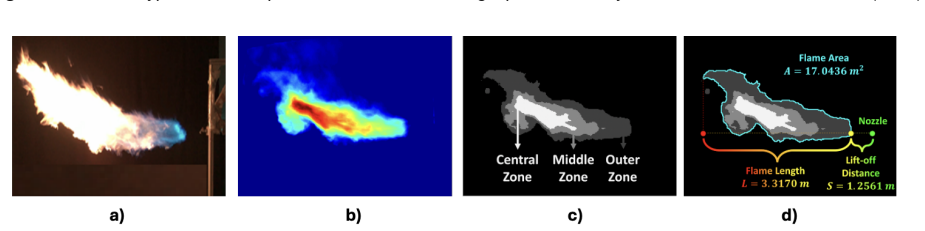
In this work we present a novel framework for fire safety management in industrial settings through the implementation of a smart camera platform for jet flames characterization. The approach seeks to alleviate the lack of real-time solutions for industrial early fire segmentation and characterization. As a case study, we demonstrate how a SoC FPGA, running optimized Artificial Intelligence (AI) models can be leveraged to implement a full edge processing pipeline for jet flames analysis. In this paper we extend previous work on computer-vision jet fire segmentation by creating a novel experimental set-up and system implementation for addressing this issue, which can be replicated to other fire safety applications. The proposed platform is designed to carry out image processing tasks in real-time and on device, reducing video processing overheads, and thus the overall latency. This is achieved by optimizing a UNet segmentation model to make it amenable for an SoC FPGAs implementation; the optimized model can then be efficiently mapped onto the SoC reconfigurable logic for massively parallel execution. For our experiments, we have chosen the Ultra96 platform, as it also provides the means for implementing full-fledged intelligent systems using the SoC peripherals, as well as other Operating System (OS) capabilities (i.e., multi-threading) for systems management. For optimizing the model we made use of the Vitis (Xilinx) framework, which enabled us to optimize the full precision model from 7.5 million parameters to 59,095 parameters (125x less), which translated into a reduction of the processing latency of 2.9x. Further optimization (multi-threading and batch normalization) led to an improvement of 7.5x in terms of latency, yielding a performance of 30 Frames Per Second (FPS) without sacrificing accuracy in terms of the evaluated metrics (Dice Score).
Editorial analysis
A structured set of objections, weighed in public.
Referee Report
Summary. The paper presents a reconfigurable smart camera platform using an optimized UNet model on the Ultra96 SoC FPGA for real-time jet flame segmentation and characterization. It claims that Vitis-based optimization reduces the model from 7.5 million to 59,095 parameters (125x reduction), and with additional multi-threading and batch normalization yields a 7.5x latency improvement to achieve 30 FPS while preserving Dice Score accuracy, extending prior computer-vision work on jet fires with a new experimental setup.
Significance. If the accuracy preservation claim holds, the work provides a concrete demonstration of deploying a heavily pruned segmentation model on reconfigurable edge hardware for industrial fire safety, with measurable gains in parameter count and latency on the target Ultra96 platform. The use of Vitis for full-model optimization and the integration of OS-level multi-threading are practical strengths that could inform similar embedded CV deployments.
major comments (3)
- [Abstract] Abstract: the assertion that the optimized model achieves 30 FPS 'without sacrificing accuracy in terms of the evaluated metrics (Dice Score)' lacks any supporting numerical evidence; no baseline Dice Score for the original 7.5M-parameter UNet, no post-optimization Dice Score, and no ablation on the parameter-reduction steps are reported.
- [Experiments] Experiments section: the manuscript supplies no information on dataset size, composition (e.g., number of images, variation in flame intensity/background/scale), train/test split, or validation protocol, making it impossible to evaluate whether accuracy is preserved on real-world jet flame imagery beyond the specific test set.
- [Results] Results: while latency (2.9x then 7.5x) and parameter counts are directly measured on the Ultra96 board, the absence of error bars, multiple-run statistics, or cross-condition testing leaves the central claim of unchanged segmentation performance weakly supported.
minor comments (2)
- [Abstract] Abstract: the phrase 'we extend previous work on computer-vision jet fire segmentation' requires an explicit citation to the referenced prior publication.
- [Implementation] Implementation: clarify the exact sequence and contribution of batch normalization after Vitis pruning and how it interacts with the multi-threading to produce the final 7.5x latency gain.
Simulated Author's Rebuttal
We thank the referee for their thorough review and constructive comments. We address each major comment below and will make revisions to strengthen the manuscript's claims on accuracy preservation and experimental details.
read point-by-point responses
-
Referee: [Abstract] Abstract: the assertion that the optimized model achieves 30 FPS 'without sacrificing accuracy in terms of the evaluated metrics (Dice Score)' lacks any supporting numerical evidence; no baseline Dice Score for the original 7.5M-parameter UNet, no post-optimization Dice Score, and no ablation on the parameter-reduction steps are reported.
Authors: We thank the referee for this observation. The manuscript's results section demonstrates that the Dice Score is preserved, but we agree that the abstract lacks explicit numerical support and ablation details. We will revise the abstract to include the baseline and post-optimization Dice Scores, and add an ablation study in the Experiments section detailing the parameter reduction steps and their effect on accuracy metrics. revision: yes
-
Referee: [Experiments] Experiments section: the manuscript supplies no information on dataset size, composition (e.g., number of images, variation in flame intensity/background/scale), train/test split, or validation protocol, making it impossible to evaluate whether accuracy is preserved on real-world jet flame imagery beyond the specific test set.
Authors: We agree that these details were insufficiently described. We will expand the Experiments section with full details on the dataset size, composition including variations in flame intensity, background, and scale, as well as the train/test split and validation protocol used. revision: yes
-
Referee: [Results] Results: while latency (2.9x then 7.5x) and parameter counts are directly measured on the Ultra96 board, the absence of error bars, multiple-run statistics, or cross-condition testing leaves the central claim of unchanged segmentation performance weakly supported.
Authors: We acknowledge the need for stronger statistical support. We will add error bars based on multiple runs, report statistics from repeated measurements, and include cross-condition testing results in the revised Results section to bolster the claim of unchanged segmentation performance. revision: yes
Circularity Check
No significant circularity; metrics are direct hardware measurements
full rationale
The paper describes an engineering implementation: a UNet model is optimized via the Vitis framework (parameter count reduced from 7.5M to 59k), then mapped to Ultra96 SoC FPGA with multi-threading and batch normalization, yielding measured 30 FPS and 7.5x latency improvement. These performance figures are obtained by direct timing on the target board after optimization steps, not by any equation that re-derives them from fitted parameters or prior self-citations. No self-definitional loops, fitted-input predictions, or load-bearing self-citations appear in the provided text. The central claim rests on external benchmarks (hardware execution and Dice Score evaluation) rather than internal redefinition. This is the common case of a self-contained empirical report.
Axiom & Free-Parameter Ledger
axioms (1)
- domain assumption UNet architecture remains effective for flame segmentation after extreme parameter reduction via Vitis optimization
Lean theorems connected to this paper
-
IndisputableMonolith/Cost/FunctionalEquation.leanwashburn_uniqueness_aczel unclear?
unclearRelation between the paper passage and the cited Recognition theorem.
optimized the full precision model from 7.5 million parameters to 59,095 parameters (125x less) … multi-threading and batch normalization … 30 FPS without sacrificing accuracy in terms of the evaluated metrics (Dice Score)
-
IndisputableMonolith/Foundation/AlexanderDuality.leanalexander_duality_circle_linking unclear?
unclearRelation between the paper passage and the cited Recognition theorem.
UNet segmentation model … Vitis AI … DPU configuration … single computation engine
What do these tags mean?
- matches
- The paper's claim is directly supported by a theorem in the formal canon.
- supports
- The theorem supports part of the paper's argument, but the paper may add assumptions or extra steps.
- extends
- The paper goes beyond the formal theorem; the theorem is a base layer rather than the whole result.
- uses
- The paper appears to rely on the theorem as machinery.
- contradicts
- The paper's claim conflicts with a theorem or certificate in the canon.
- unclear
- Pith found a possible connection, but the passage is too broad, indirect, or ambiguous to say the theorem truly supports the claim.
Reference graph
Works this paper leans on
-
[1]
Journal of Computing in Civil Engineering 39, 04025068
Visual fire safety inspection framework using computer vision algorithms. Journal of Computing in Civil Engineering 39, 04025068. doi:10.1061/JCCEE5.CPENG-6492. Beheshti, N., Johnsson, L., 2020. Squeeze u-net: A memory and energy efficient image segmentation network, in: Proceedings of the IEEE/CVF conference on computer vision and pattern recognition wor...
-
[2]
Distributed embedded smart cameras for surveillance applica- tions. Computer 39, 68–75. Buslaev, A., Parinov, A., Khvedchenya, E., Iglovikov, V .I., Kalinin, A.A.,
-
[3]
ArXiv e-printsarXiv:1809.06839
Albumentations: fast and flexible image augmentations. ArXiv e-printsarXiv:1809.06839. Colella, F., Ibarreta, A., Hart, R.J., Morrison, T., Watson, H.A., Yen, M., 2020. Jet fire consequence analysis. OTC Offshore Technology Conference doi:10.4043/30802-MS. Cuoci, A., Avedisian, C.T., Brunson, J.D., Guo, S., Dalili, A., Wang, Y ., Mehl, M., Frassoldati, A....
discussion (0)
Sign in with ORCID, Apple, or X to comment. Anyone can read and Pith papers without signing in.