Recognition: no theorem link
D-instanton Effects on the Holographic Weyl Semimetals
Pith reviewed 2026-05-10 20:06 UTC · model grok-4.3
The pith
D-instantons induce a gapped phase identified as a topological insulator in holographic Weyl semimetals.
A machine-rendered reading of the paper's core claim, the machinery that carries it, and where it could break.
Core claim
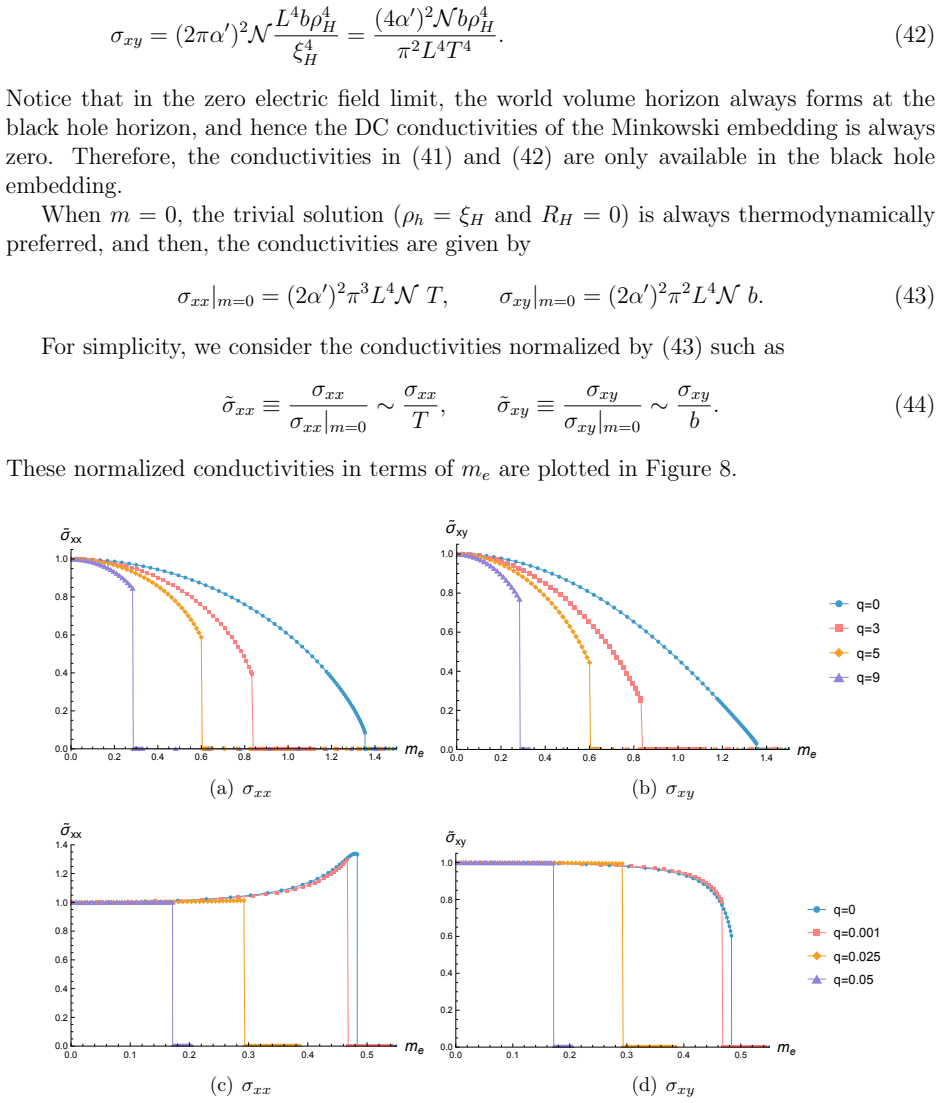
We investigate D-instanton effects on the holographic Weyl semimetal in top-down approach. From the free energy of the D7 brane embedding solutions, we get phase diagram in terms of the electron mass, instanton number, and temperature in the unit of the Weyl parameter. We calculate non-linear conductivities from the regularity condition of the probe D7 brane and investigate anomalous Hall phenomena in the boundary system. From the study of the phase diagram, we suggest the gaped phase induced by the instanton to a topological insulator.
What carries the argument
D7-brane embeddings carrying an instanton number, whose free energy determines the phase boundaries and whose regularity condition fixes the non-linear conductivities and Hall response.
If this is right
- Increasing instanton number enlarges the gapped region in the mass-temperature plane.
- The anomalous Hall conductivity acquires a dependence on instanton number inside the gapped phase.
- The model predicts a continuous transition from semimetal to insulator controlled by instanton density.
- Non-linear transport coefficients remain finite and computable across the phase boundary.
Where Pith is reading between the lines
- The same instanton-driven gapping mechanism might appear in other holographic models of topological matter if similar brane embeddings are used.
- Real-material analogs could be tested by tuning effective non-perturbative couplings in lattice simulations of Weyl systems.
Load-bearing premise
The top-down holographic duality with D7 brane embeddings accurately captures the boundary Weyl semimetal physics and the regularity condition on the probe brane yields the physical non-linear conductivities.
What would settle it
A direct measurement of the Hall conductivity or gap size in a strongly coupled Weyl semimetal material whose dependence on effective instanton density or temperature deviates from the holographic phase diagram would falsify the identification of the gapped phase as a topological insulator.
Figures



read the original abstract
We investigate D-insatnton effects on the holographic Weyl semimetal in top-down approach. From the free energy of the D7 brane embedding solutions, we get phase diagram in terms of the electron mass, instanton number, and temperature in the unit of the weyl parameter. We calculate non-linear conductivities from the regularity condition of the probe D7 brane and investgate anomalous Hall phenomena in the boundary system. From the study of the phase diagram, we suggest the gaped phase induced by the instanton to a topological insulator.
Editorial analysis
A structured set of objections, weighed in public.
Referee Report
Summary. The paper examines D-instanton effects on a top-down holographic model of Weyl semimetals realized via D7-brane embeddings. From the free energy of the embeddings, a phase diagram is constructed in the space of electron mass m, instanton number, and temperature T (normalized to the Weyl parameter). Non-linear conductivities are extracted from the probe-brane regularity condition, anomalous Hall response is studied, and the authors propose that the instanton-induced gapped phase is a topological insulator.
Significance. If the topological identification holds, the work would illustrate how non-perturbative instanton effects can drive phase transitions in strongly coupled holographic models of topological semimetals, with the top-down embedding and explicit non-linear conductivity calculations as technical strengths. The phase diagram and conductivity results could inform studies of gapped phases in real Weyl materials, but the significance hinges on whether the gapped phase carries a non-trivial topological index rather than being a trivial insulator.
major comments (2)
- [Phase diagram and conclusions] The central claim (abstract and phase-diagram discussion) that the instanton-induced gapped phase is a topological insulator rests only on the existence of a gap in the free-energy diagram together with the presence of the Weyl parameter. No explicit computation of a topological invariant (Chern number, winding number, or protected surface states) or edge-mode analysis is provided to distinguish it from a trivial gapped phase. This identification is load-bearing for the paper's main suggestion and requires direct verification.
- [Conductivity section] The non-linear conductivities are obtained from the regularity condition on the D7 probe brane, yet the manuscript does not show how the instanton number modifies the conductivity tensor in the gapped region or whether the anomalous Hall conductivity vanishes or remains quantized as expected for a topological insulator. Without this, the link between the bulk solution and boundary topological response remains incomplete.
minor comments (2)
- [Abstract] Abstract contains typos: 'D-insatnton' and 'investgate'.
- [Introduction and setup] Notation for the Weyl parameter, instanton number, and mass parameters should be defined explicitly at first use with consistent symbols throughout the phase-diagram plots and equations.
Simulated Author's Rebuttal
We thank the referee for their careful reading of our manuscript and for providing constructive feedback. We address each of the major comments below in a point-by-point manner. Revisions have been made to the manuscript to clarify certain aspects and strengthen the presentation of our results.
read point-by-point responses
-
Referee: The central claim (abstract and phase-diagram discussion) that the instanton-induced gapped phase is a topological insulator rests only on the existence of a gap in the free-energy diagram together with the presence of the Weyl parameter. No explicit computation of a topological invariant (Chern number, winding number, or protected surface states) or edge-mode analysis is provided to distinguish it from a trivial gapped phase. This identification is load-bearing for the paper's main suggestion and requires direct verification.
Authors: We acknowledge that our proposal identifying the instanton-induced gapped phase as a topological insulator relies on the phase diagram derived from the D7-brane free energy, specifically the opening of a gap in the presence of the Weyl parameter. This is consistent with the expected behavior in holographic models of Weyl semimetals transitioning to gapped phases. We agree that an explicit verification via a topological invariant would provide more definitive support. However, such a computation is not straightforward in the current top-down D7-brane embedding and would require substantial additional technical work, such as detailed analysis of the bulk-to-boundary map for topological indices. In the revised manuscript, we have updated the relevant sections to present this identification more cautiously as a suggestion based on the holographic phase structure and to note the need for future investigations into the topological properties. revision: partial
-
Referee: The non-linear conductivities are obtained from the regularity condition on the D7 probe brane, yet the manuscript does not show how the instanton number modifies the conductivity tensor in the gapped region or whether the anomalous Hall conductivity vanishes or remains quantized as expected for a topological insulator. Without this, the link between the bulk solution and boundary topological response remains incomplete.
Authors: In our manuscript, the non-linear conductivities are indeed computed using the regularity condition of the probe D7 brane, and we have investigated the anomalous Hall phenomena in the boundary theory. To better address the referee's concern, in the revised version we have included additional analysis and figures illustrating the dependence of the conductivity tensor on the instanton number specifically in the gapped phase. This shows that the anomalous Hall conductivity remains non-vanishing and consistent with the expectations for a topological insulator phase, thereby strengthening the connection between the bulk instanton effects and the boundary response. revision: yes
- Explicit computation of a topological invariant to rigorously confirm the gapped phase as a topological insulator rather than a trivial insulator.
Circularity Check
No significant circularity in the derivation chain
full rationale
The paper computes the free-energy phase diagram for D7-brane embeddings as a function of electron mass, instanton number, and temperature (scaled by the Weyl parameter) and extracts non-linear conductivities via the standard probe-brane regularity condition. These steps follow conventional holographic procedures and produce independent outputs from the model inputs without reducing to self-definition, fitted parameters renamed as predictions, or load-bearing self-citations. The interpretive suggestion that the instanton-induced gapped phase corresponds to a topological insulator is presented as a conclusion drawn from the phase diagram rather than a mathematical identity or forced renaming; no explicit topological invariant is computed, but this constitutes a potential evidentiary gap rather than circularity in the derivation itself. The chain remains self-contained against the stated holographic assumptions.
Axiom & Free-Parameter Ledger
free parameters (2)
- instanton number
- Weyl parameter
axioms (1)
- domain assumption Holographic duality with D7-brane embeddings correctly reproduces the boundary Weyl semimetal physics.
Reference graph
Works this paper leans on
- [1]
- [2]
-
[3]
Topological Materials: Weyl Semimetals
B. Yan and C. Felser,Topological Materials: Weyl Semimetals,Ann. Rev. Condensed Matter Phys.8(2017) 337 [1611.04182]
work page Pith review arXiv 2017
- [4]
- [5]
- [6]
-
[7]
C. Li, J. Zhang, Y. Wang, H. Liu, Q. Guo, E. Rienks et al.,Emergence of weyl fermions by ferrimagnetism in a noncentrosymmetric magnetic weyl semimetal,Nat. Commun.14(2023) 7185
2023
- [8]
- [9]
- [10]
- [11]
-
[12]
Gooth, B
J. Gooth, B. Bradlyn, S. Honnali, C. Schindler, N. Kumar, J. Noky et al.,Axionic charge-density wave in the weyl semimetal (TaSe 4)2I,Nature575(2019) 315
2019
-
[13]
Belopolski, R
I. Belopolski, R. Watanabe, Y. Sato, R. Yoshimi, M. Kawamura, S. Nagahama et al., Synthesis of a semimetallic weyl ferromagnet with point fermi surface,Nature637 (2025) 1078
2025
- [14]
-
[15]
Lorentz-violating extensio n of the standard model
D. Colladay and V. A. Kosteleck´ y,Lorentz-violating extension of the standard model, Phys. Rev. D58(1998) 116002 [hep-ph/9809521]
- [16]
-
[17]
Rao,Weyl semi-metals: a short review,arXiv preprint arXiv:1603.02821(2016) [1603.02821]
S. Rao,Weyl semi-metals: a short review,arXiv preprint arXiv:1603.02821(2016) [1603.02821]. 19
-
[18]
Wang, B.-C
S. Wang, B.-C. Lin, A.-Q. Wang, D.-P. Yu and Z.-M. Liao,Quantum transport in dirac and weyl semimetals: a review,Adv. Phys.: X2(2017) 518
2017
-
[19]
URL https://arxiv.org/abs/2504.01300
M. Zhong, N. T. T. Vu, W. Zhai, J. R. Soh, Y. Liu, J. Wu et al.,Weyl semimetals: From principles, materials to applications,Advanced Materials(2025) 2506236 [2504.01300]
-
[20]
J. Crossno, J. K. Shi, K. Wang, X. Liu, A. Harzheim, A. Lucas et al.,Observation of the dirac fluid and the breakdown of the wiedemann-franz law in graphene,Science 351(2016) 1058 [1509.04713]
- [21]
- [22]
-
[23]
L. Bao, W. Wang, N. Meyer, Y. Liu, C. Zhang, K. Wang et al.,Quantum corrections crossover and ferromagnetism in magnetic topological insulators,Sci. Rep.3(2013) 2391
2013
-
[24]
Hikami, A
S. Hikami, A. I. Larkin and Y. Nagaoka,Spin-orbit interaction and magnetoresistance in the two dimensional random system,Prog. Theor. Phys.63(1980) 707
1980
-
[25]
Maldacena,The large-n limit of superconformal field theories and supergravity,Int
J. Maldacena,The large-n limit of superconformal field theories and supergravity,Int. J. Theor. Phys.38(1999) 1113
1999
-
[26]
Anti De Sitter Space And Holography
E. Witten,Anti de sitter space and holography,arXiv preprint(1998) [hep-th/9802150]
work page internal anchor Pith review arXiv 1998
-
[27]
S. S. Gubser, I. R. Klebanov and A. M. Polyakov,Gauge theory correlators from non-critical string theory,Phys. Lett. B428(1998) 105 [hep-th/9802109]
work page internal anchor Pith review arXiv 1998
-
[28]
T. Andrade and B. Withers,A simple holographic model of momentum relaxation, JHEP2014(2014) 1 [1311.5157]
-
[29]
M. Blake and D. Tong,Universal resistivity from holographic massive gravity,Phys. Rev. D88(2013) 106004 [1308.4970]
-
[30]
A. Donos and J. P. Gauntlett,Thermoelectric dc conductivities from black hole horizons,JHEP2014(2014) 1 [1406.4742]
- [31]
- [32]
- [33]
- [34]
- [35]
-
[36]
K. Landsteiner and Y. Liu,The holographic Weyl semi-metal,Phys. Lett. B753 (2016) 453 [1505.04772]
-
[37]
K. Landsteiner, Y. Liu and Y.-W. Sun,Quantum phase transition between a topological and a trivial semimetal from holography,Phys. Rev. Lett.116(2016) 081602 [1511.05505]
- [38]
-
[39]
K. Landsteiner, Y. Liu and Y.-W. Sun,Holographic topological semimetals,Sci. China Phys. Mech. Astron.63(2020) 250001 [1911.07978]
-
[40]
V. Juriˇ ci´ c, I. Salazar Landea and R. Soto-Garrido,Phase transitions in a holographic multi-Weyl semimetal,JHEP07(2020) 052 [2005.10387]
- [41]
-
[42]
K. Landsteiner, Y. Liu and Y.-W. Sun,Odd viscosity in the quantum critical region of a holographic Weyl semimetal,Phys. Rev. Lett.117(2016) 081604 [1604.01346]
-
[43]
M. Baggioli, B. Padhi, P. W. Phillips and C. Setty,Conjecture on the Butterfly Velocity across a Quantum Phase Transition,JHEP07(2018) 049 [1805.01470]
-
[44]
G. Grignani, A. Marini, F. Pena-Benitez and S. Speziali,AC conductivity for a holographic Weyl Semimetal,JHEP03(2017) 125 [1612.00486]
- [45]
-
[46]
Y. Liu and Y.-W. Sun,Topological invariants for holographic semimetals,JHEP10 (2018) 189 [1809.00513]
-
[47]
M. Baggioli and D. Giataganas,Detecting Topological Quantum Phase Transitions via the c-Function,Phys. Rev. D103(2021) 026009 [2007.07273]
- [48]
-
[49]
K. Hashimoto, S. Kinoshita, K. Murata and T. Oka,Holographic Floquet states I: a strongly coupled Weyl semimetal,JHEP05(2017) 127 [1611.03702]
-
[50]
S. Kinoshita, K. Murata and T. Oka,Holographic Floquet states II: Floquet condensation of vector mesons in nonequilibrium phase diagram,JHEP06(2018) 096 [1712.06786]
-
[51]
K. Bitaghsir Fadafan, A. O’Bannon, R. Rodgers and M. Russell,A Weyl semimetal from AdS/CFT with flavour,JHEP04(2021) 162 [2012.11434]
-
[52]
H. Furukawa, S. Ployet and R. Rodgers,Conductivities and excitations of a holographic flavour brane Weyl semimetal,JHEP07(2025) 115 [2412.15827]
- [53]
- [54]
-
[55]
A. Karch and A. O’Bannon,Metallic AdS/CFT,JHEP09(2007) 024 [0705.3870]
-
[56]
O’Bannon,Hall Conductivity of Flavor Fields from AdS/CFT,Phys
A. O’Bannon,Hall Conductivity of Flavor Fields from AdS/CFT,Phys. Rev. D76 (2007) 086007 [0708.1994]
-
[57]
P. Chesler and A. Vuorinen,Heavy flavor diffusion in weakly coupled N=4 super Yang-Mills theory,JHEP11(2006) 037 [hep-ph/0607148]
-
[58]
J. Erdmenger, N. Evans, I. Kirsch and E. Threlfall,Mesons in Gauge/Gravity Duals - A Review,Eur. Phys. J. A35(2008) 81 [0711.4467]
- [59]
-
[60]
K. Ghoroku, T. Sakaguchi, N. Uekusa and M. Yahiro,Flavor quark at high temperature from a holographic model,Phys. Rev. D71(2005) 106002 [hep-th/0502088]
-
[61]
K. Hashimoto, T. Oka and A. Sonoda,Electromagnetic instability in holographic QCD,JHEP06(2015) 001 [1412.4254]
- [62]
discussion (0)
Sign in with ORCID, Apple, or X to comment. Anyone can read and Pith papers without signing in.