Recognition: 2 theorem links
· Lean TheoremGenerative modeling of granular flow on inclined planes using conditional flow matching
Pith reviewed 2026-05-10 20:11 UTC · model grok-4.3
The pith
A conditional flow matching model reconstructs interior granular velocities and stresses from sparse boundary data by training on particle simulations and enforcing consistency via a differentiable forward operator.
A machine-rendered reading of the paper's core claim, the machinery that carries it, and where it could break.
Core claim
Trained on particle-resolved discrete-element simulations of granular flow on inclined planes, a conditional flow matching model, guided at inference by a differentiable forward operator with sparsity-aware gradient guidance, recovers physically consistent interior velocity fields, mean and deviatoric stresses, and granular temperature from boundary observations that are reduced to 16 percent or even 11 percent of the informative window, while outperforming a deterministic CNN baseline and supplying ensemble-based uncertainty maps.
What carries the argument
Conditional flow matching generative model guided by a differentiable forward operator that enforces measurement consistency without hyperparameter tuning.
If this is right
- Interior velocity fields remain accurate down to 16 percent of the informative observation window.
- The same reconstructions stay reliable at strongly diluted spatial resolutions using only 11 percent of the data.
- A physics decoder converts the velocity output into mean stress, deviatoric stress, and granular temperature without additional training.
- Ensemble sampling from the generative model supplies spatially resolved uncertainty estimates.
- The method outperforms a deterministic CNN baseline in the most under-determined reconstruction settings.
Where Pith is reading between the lines
- The same conditional guidance mechanism could be applied to other particulate or multiphase inverse problems where only boundary data are accessible.
- Real-time deployment would require replacing the current differentiable operator with a faster surrogate that still preserves measurement consistency.
- Uncertainty maps could guide adaptive sensor placement in future experimental setups.
Load-bearing premise
A model trained only on simulated particle data will generalize to real sparse boundary observations without producing unphysical artifacts or requiring extra tuning.
What would settle it
Perform a controlled experiment with transparent side walls and interior particle tracking on the same inclined-plane geometry, then compare the model-reconstructed velocity and stress fields against the directly measured interior data at the same sparse boundary sampling density.
Figures




read the original abstract
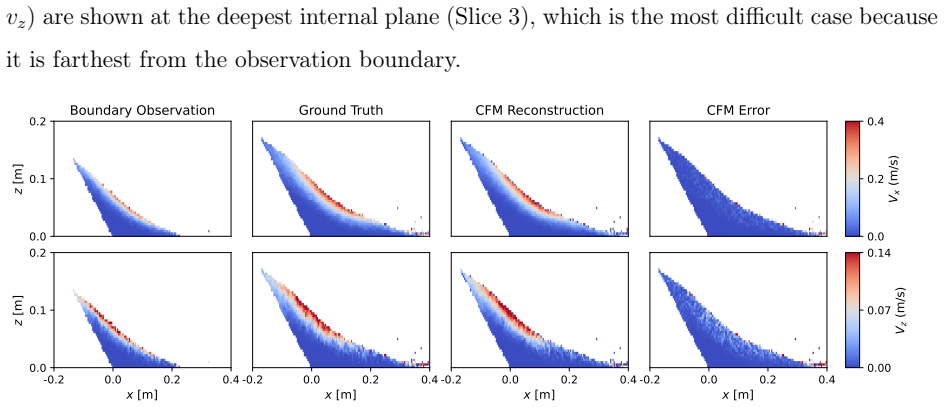
Granular flows govern many natural and industrial processes, yet their interior kinematics and mechanics remain largely unobservable, as experiments access only boundaries or free surfaces. Conventional numerical simulations are computationally expensive for fast inverse reconstruction, and deterministic models tend to collapse to over-smoothed mean predictions in ill-posed settings. This study, to the best of the authors' knowledge, presents the first conditional flow matching (CFM) framework for granular-flow reconstruction from sparse boundary observations. Trained on high-fidelity particle-resolved discrete element simulations, the generative model is guided at inference by a differentiable forward operator with a sparsity-aware gradient guidance mechanism, which enforces measurement consistency without hyperparameter tuning and prevents unphysical velocity predictions in non-material regions. A physics decoder maps the reconstructed velocity fields to stress states and energy fluctuation quantities, including mean stress, deviatoric stress, and granular temperature. The framework accurately recovers interior flow fields from full observation to only 16% of the informative window, and it remains effective under strongly diluted spatial resolution with only 11% of data. It also outperforms a deterministic CNN baseline in the most ill-posed reconstruction regime and provides spatially resolved uncertainty estimates through ensemble generation. These results demonstrate that conditional generative modeling offers a practical route for non-invasive inference of hidden bulk mechanics in granular media, with broader applicability for inverse problems in particulate and multiphase systems.
Editorial analysis
A structured set of objections, weighed in public.
Referee Report
Summary. The manuscript introduces the first conditional flow matching (CFM) generative framework for reconstructing interior velocity fields in granular flows on inclined planes from sparse boundary observations. Trained exclusively on high-fidelity particle-resolved DEM simulations, the model is guided at inference by a differentiable forward operator incorporating sparsity-aware gradient guidance to enforce measurement consistency and avoid unphysical predictions. A physics decoder then maps the reconstructed velocities to mean stress, deviatoric stress, and granular temperature. The work reports accurate recovery down to 16% of the informative window and effectiveness at 11% data dilution, outperformance versus a deterministic CNN baseline in ill-posed regimes, and ensemble-based uncertainty quantification.
Significance. If the performance claims hold, the approach would represent a meaningful advance for inverse problems in granular and particulate systems by providing a generative, uncertainty-aware route to infer hidden bulk mechanics from limited boundary data. Strengths include the integration of CFM with a physics-informed guidance mechanism that requires no hyperparameter tuning and the addition of a decoder for stress and fluctuation quantities. These elements address the ill-posedness of sparse reconstruction more flexibly than deterministic baselines.
major comments (2)
- [Abstract] Abstract: the statements that the framework 'accurately recovers interior flow fields' from full observation to only 16% of the informative window and 'remains effective' at 11% data are presented without any numerical metrics, error bars, validation splits, or ablation results. These quantitative details are load-bearing for the central performance claims and must be supplied explicitly in the results section.
- [Results] Results section: all reported quantitative evaluations (recovery accuracy, CNN comparison, stress/temperature decoding) are generated by sparsifying observations drawn from the identical DEM simulation distribution used for training. This leaves untested the claim of a 'practical route for non-invasive inference' on real-world sparse boundary observations that may include sensor noise, boundary irregularities, and material variability; a concrete test or discussion of distribution shift is required to support the broader applicability assertion.
minor comments (2)
- Figure captions and axis labels for velocity field reconstructions and uncertainty maps should be expanded to indicate the exact sparsity level and ensemble size used in each panel.
- [Methods] The definition and implementation of the 'sparsity-aware gradient guidance' term in the inference procedure should be given a dedicated equation or pseudocode block for reproducibility.
Simulated Author's Rebuttal
We thank the referee for the constructive and detailed feedback. The comments have helped us strengthen the presentation of quantitative results and clarify the scope of applicability. We address each major comment below and indicate the revisions made.
read point-by-point responses
-
Referee: [Abstract] Abstract: the statements that the framework 'accurately recovers interior flow fields' from full observation to only 16% of the informative window and 'remains effective' at 11% data are presented without any numerical metrics, error bars, validation splits, or ablation results. These quantitative details are load-bearing for the central performance claims and must be supplied explicitly in the results section.
Authors: We agree that the abstract claims require explicit quantitative support. In the revised manuscript we have expanded the Results section with detailed numerical metrics, including mean squared error and relative L2 errors (with standard deviations) for velocity reconstruction at the 16% and 11% sparsity levels, obtained from multiple validation splits and ablation studies. The CNN baseline comparison and stress/temperature decoding errors are also reported with the same rigor. The abstract has been lightly edited to reference these concrete results while preserving its length. revision: yes
-
Referee: [Results] Results section: all reported quantitative evaluations (recovery accuracy, CNN comparison, stress/temperature decoding) are generated by sparsifying observations drawn from the identical DEM simulation distribution used for training. This leaves untested the claim of a 'practical route for non-invasive inference' on real-world sparse boundary observations that may include sensor noise, boundary irregularities, and material variability; a concrete test or discussion of distribution shift is required to support the broader applicability assertion.
Authors: The referee is correct that all quantitative results are obtained by sparsifying data from the same DEM distribution. To address this, the revised manuscript adds a new subsection discussing distribution shift. We report additional experiments in which Gaussian noise is superimposed on the boundary observations to emulate sensor noise; the model retains useful reconstruction accuracy under moderate noise levels. We also discuss boundary irregularities and material variability as open challenges and note how the generative, ensemble-based nature of CFM may offer advantages over deterministic models in such settings. A full evaluation on experimental (non-simulated) data is not feasible in the present study because training relies on high-fidelity DEM simulations; we now explicitly list this as a limitation and identify it as a key direction for future work. revision: partial
Circularity Check
No significant circularity; framework applies existing CFM to external DEM data with independent guidance
full rationale
The paper introduces a conditional flow matching model trained exclusively on high-fidelity DEM simulations and guided at inference by a separate differentiable forward operator plus sparsity-aware gradients. No self-definitional steps, fitted inputs renamed as predictions, or load-bearing self-citations appear in the abstract or described chain. Performance claims rest on empirical recovery from sparsified simulation data (standard held-out evaluation) rather than any reduction of outputs to inputs by construction. The derivation is therefore self-contained as a domain application of generative modeling.
Axiom & Free-Parameter Ledger
Lean theorems connected to this paper
-
IndisputableMonolith/Cost/FunctionalEquation.leanwashburn_uniqueness_aczel unclear?
unclearRelation between the paper passage and the cited Recognition theorem.
conditional flow matching (CFM) framework... differentiable forward operator with a sparsity-aware gradient guidance mechanism... physics decoder maps the reconstructed velocity fields to stress states and energy fluctuation quantities
-
IndisputableMonolith/Foundation/RealityFromDistinction.leanreality_from_one_distinction unclear?
unclearRelation between the paper passage and the cited Recognition theorem.
Trained on high-fidelity particle-resolved discrete element simulations... outperforms a deterministic CNN baseline
What do these tags mean?
- matches
- The paper's claim is directly supported by a theorem in the formal canon.
- supports
- The theorem supports part of the paper's argument, but the paper may add assumptions or extra steps.
- extends
- The paper goes beyond the formal theorem; the theorem is a base layer rather than the whole result.
- uses
- The paper appears to rely on the theorem as machinery.
- contradicts
- The paper's claim conflicts with a theorem or certificate in the canon.
- unclear
- Pith found a possible connection, but the passage is too broad, indirect, or ambiguous to say the theorem truly supports the claim.
Reference graph
Works this paper leans on
-
[1]
H. M. Jaeger, S. R. Nagel, R. P. Behringer, Granular solids, liquids, and gases, Reviews of modern physics 68 (4) (1996) 1259
1996
-
[2]
Buscarnera, C
G. Buscarnera, C. Di Prisco, Soil stability and flow slides in unsaturated shallow slopes: Can saturation events trigger liquefaction processes?, Géotechnique 63 (10) (2013) 801– 817
2013
-
[3]
X.Lü, D.Xue, Q.Chen, X.Zhai, M.Huang, Centrifugemodeltestandlimitequilibrium analysis of the stability of municipal solid waste slopes, Bulletin of Engineering Geology and the Environment 78 (4) (2019) 3011–3021
2019
-
[4]
K. Soga, E. Alonso, A. Yerro, K. Kumar, S. Bandara, Trends in large-deformation analysis of landslide mass movements with particular emphasis on the material point method, Géotechnique 66 (3) (2016) 248–273. 35
2016
-
[5]
Y. Fan, K. V. Jacob, B. Freireich, R. M. Lueptow, Segregation of granular materials in bounded heap flow: A review, Powder technology 312 (2017) 67–88
2017
-
[6]
Y. Lu, W. Jin, N. Saha, J. L. Klinger, Y. Xia, S. Dai, Wedge-shaped hopper design for milled woody biomass flow, ACS Sustainable Chemistry & Engineering (2022)
2022
-
[7]
Y. Lu, W. Jin, J. L. Klinger, S. Dai, Effects of the moisture content on the flow behavior of milled woody biomass, ACS Sustainable Chemistry & Engineering 11 (31) (2023) 11482–11489
2023
-
[8]
Y. Wu, T. Pähtz, Z. Guo, L. Jing, Z. Duan, Z. He, Unified flow rule of undeveloped and fully developed dense granular flows down rough inclines, Physical Review Letters 134 (2) (2025) 028201
2025
-
[9]
P. Jop, Y. Forterre, O. Pouliquen, Crucial role of sidewalls in granular surface flows: consequences for the rheology, Journal of fluid mechanics 541 (2005) 167–192
2005
-
[10]
Lueptow, A
R. Lueptow, A. Akonur, T. Shinbrot, Piv for granular flows, Experiments in Fluids 28 (2) (2000) 183–186
2000
-
[11]
T. Zhou, L. Mu, Y. Lu, M. Chen, M. Huang, Y. Li, Rate-dependent uplift behavior and soil failure mechanisms of suction anchors in loose sand: a transparent soil piv study, Ocean Engineering 341 (2025) 122555
2025
-
[12]
D.Gollin, W.Brevis, E.T.Bowman, P.Shepley, Performanceofpivandptvforgranular flow measurements, Granular Matter 19 (3) (2017) 42
2017
-
[13]
T. Man, H. E. Huppert, S. A. Galindo-Torres, Run-out scaling of granular column collapses on inclined planes, Journal of Fluid Mechanics 1002 (2025) A50
2025
-
[14]
Wang, Z.-Y
P. Wang, Z.-Y. Yin, P.-Y. Hicher, Y.-J. Cui, Micro-mechanical analysis of one- dimensional compression of clay with dem, International Journal for Numerical and Analytical Methods in Geomechanics 47 (15) (2023) 2706–2724. 36
2023
-
[15]
Y. Lu, W. Jin, J. Klinger, N. Saha, Y. Xia, S. Dai, Shear rate dependency on flowing granular biomass material, Powder Technology 442 (2024) 119834
2024
- [16]
-
[17]
P. A. Cundall, O. D. Strack, A discrete numerical model for granular assemblies, geotechnique 29 (1) (1979) 47–65
1979
-
[18]
H. P. Zhu, Z. Y. Zhou, R. Yang, A. Yu, Discrete particle simulation of particulate systems: theoretical developments, Chemical engineering science 62 (13) (2007) 3378– 3396
2007
-
[19]
N.Deak, H.Sitaraman, Y.Lu, N.Saha, J.Klinger, Y.Xia, Ahigh-performancediscrete- element framework for simulating flow and jamming of moisture bearing biomass feed- stocks, Powder Technology 452 (2025) 120548
2025
-
[20]
Y. Xia, J. J. Stickel, W. Jin, J. Klinger, A review of computational models for the flow of milled biomass part i: Discrete-particle models, ACS Sustainable Chemistry & Engineering 8 (16) (2020) 6142–6156
2020
-
[21]
W. Jin, Y. Lu, F. Chen, A. Hamed, N. Saha, J. Klinger, S. Dai, Q. Chen, Y. Xia, On the Fidelity of Computational Models for the Flow of Milled Loblolly Pine: A Bench- mark Study on Continuum-Mechanics Models and Discrete-Particle Models, Frontiers in Energy Research 10 (2022)
2022
-
[22]
X.Li, W.Jin, J.Klinger, N.Saha, N.Lajnef, Data-drivenmechanicalbehaviormodeling of granular biomass materials, Computers and Geotechnics 177 (2025) 106907
2025
-
[23]
Zheng, A
Q. Zheng, A. Yu, Finite element investigation of the flow and stress patterns in conical hopper during discharge, Chemical Engineering Science 129 (2015) 49–57. 37
2015
-
[24]
Dunatunga, K
S. Dunatunga, K. Kamrin, Continuum modelling and simulation of granular flows through their many phases, Journal of Fluid Mechanics 779 (2015) 483–513
2015
-
[25]
Y. Lu, W. Jin, J. Klinger, T. L. Westover, S. Dai, Flow characterization of compress- ible biomass particles using multiscale experiments and a hypoplastic model, Powder Technology 383 (2021) 396–409
2021
-
[26]
R. C. Hurley, J. E. Andrade, Continuum modeling of rate-dependent granular flows in sph, Computational Particle Mechanics 4 (1) (2017) 119–130
2017
-
[27]
L. Mu, T. Zhou, Y. Lu, J. Sun, G. Yu, Soil deformation and seepage behavior during suction-assisted installation of compartmented bucket foundations, Marine Structures 107 (2026) 103983
2026
-
[28]
Kumar, K
K. Kumar, K. Soga, J.-Y. Delenne, F. Radjai, Modelling transient dynamics of granular slopes: Mpm and dem, Procedia Engineering 175 (2017) 94–101
2017
-
[29]
D. Xue, X. Lü, K.-W. Lim, G. Buscarnera, Nonlocal implicit gradient enhancements for strain localization informed by controllability criteria for plastic solids, Computer Methods in Applied Mechanics and Engineering 415 (2023) 116275
2023
-
[30]
Y. Lu, W. Jin, J. Klinger, S. Dai, Flow and arching of biomass particles in wedge-shaped hoppers, ACS Sustainable Chemistry & Engineering 9 (45) (2021) 15303–15314
2021
-
[31]
W. J. Baars, N. Hutchins, I. Marusic, Spectral stochastic estimation of high-reynolds- number wall-bounded turbulence for a refined inner-outer interaction model, Physical Review Fluids 1 (5) (2016) 054406
2016
-
[32]
Towne, O
A. Towne, O. T. Schmidt, T. Colonius, Spectral proper orthogonal decomposition and its relationship to dynamic mode decomposition and resolvent analysis, Journal of Fluid Mechanics 847 (2018) 821–867
2018
-
[33]
D. Xu, Y. Shen, An improved machine learning approach for predicting granular flows, Chemical Engineering Journal 450 (2022) 138036. 38
2022
-
[34]
L. Lu, X. Gao, J.-F. Dietiker, M. Shahnam, W. A. Rogers, Machine learning accelerated discrete element modeling of granular flows, Chemical Engineering Science 245 (2021) 116832
2021
-
[35]
Bolandi, X
H. Bolandi, X. Li, T. Salem, V. N. Boddeti, N. Lajnef, Bridging finite element and deep learning: High-resolution stress distribution prediction in structural components, Frontiers of Structural and Civil Engineering 16 (11) (2022) 1365–1377
2022
-
[36]
Raissi, P
M. Raissi, P. Perdikaris, G. E. Karniadakis, Physics-informed neural networks: A deep learning framework for solving forward and inverse problems involving nonlinear partial differential equations, Journal of Computational physics 378 (2019) 686–707
2019
-
[37]
Bolandi, G
H. Bolandi, G. Sreekumar, X. Li, N. Lajnef, V. N. Boddeti, Physics informed neural network for dynamic stress prediction: H. bolandi et al., Applied Intelligence 53 (22) (2023) 26313–26328
2023
-
[38]
L. Lu, P. Jin, G. Pang, Z. Zhang, G. E. Karniadakis, Learning nonlinear operators via deeponet based on the universal approximation theorem of operators, Nature machine intelligence 3 (3) (2021) 218–229
2021
-
[39]
Z. Li, N. Kovachki, K. Azizzadenesheli, B. Liu, K. Bhattacharya, A. Stuart, A. Anand- kumar, Fourier neural operator for parametric partial differential equations, arXiv preprint arXiv:2010.08895 (2020)
work page internal anchor Pith review arXiv 2010
-
[40]
D. P. Kingma, M. Welling, Auto-encoding variational bayes, arXiv preprint arXiv:1312.6114 (2013)
work page internal anchor Pith review Pith/arXiv arXiv 2013
-
[41]
I. J. Goodfellow, J. Pouget-Abadie, M. Mirza, B. Xu, D. Warde-Farley, S. Ozair, A. Courville, Y. Bengio, Generative adversarial nets, Advances in neural information processing systems 27 (2014)
2014
-
[42]
J. Ho, A. Jain, P. Abbeel, Denoising diffusion probabilistic models, Advances in neural information processing systems 33 (2020) 6840–6851. 39
2020
-
[43]
Y. Song, J. Sohl-Dickstein, D. P. Kingma, A. Kumar, S. Ermon, B. Poole, Score- based generative modeling through stochastic differential equations, arXiv preprint arXiv:2011.13456 (2020)
work page internal anchor Pith review Pith/arXiv arXiv 2011
-
[44]
A. Tong, K. Fatras, N. Malkin, G. Huguet, Y. Zhang, J. Rector-Brooks, G. Wolf, Y. Bengio, Improving and generalizing flow-based generative models with minibatch optimal transport, arXiv preprint arXiv:2302.00482 (2023)
work page internal anchor Pith review arXiv 2023
-
[45]
Flow Matching for Generative Modeling
Y. Lipman, R. T. Chen, H. Ben-Hamu, M. Nickel, M. Le, Flow matching for generative modeling, arXiv preprint arXiv:2210.02747 (2022)
work page internal anchor Pith review Pith/arXiv arXiv 2022
-
[46]
M. H. Parikh, X. Fan, J.-X. Wang, Conditional flow matching for generative modeling of near-wall turbulence with quantified uncertainty, Journal of Fluid Mechanics (2026)
2026
-
[47]
A. F. Psaros, X. Meng, Z. Zou, L. Guo, G. E. Karniadakis, Uncertainty quantification in scientific machine learning: Methods, metrics, and comparisons, Journal of Compu- tational Physics 477 (2023) 111902
2023
-
[48]
P. Jop, Y. Forterre, O. Pouliquen, A constitutive law for dense granular flows, Nature 441 (7094) (2006) 727–730
2006
-
[49]
Kamrin, D
K. Kamrin, D. L. Henann, Nonlocal modeling of granular flows down inclines, Soft matter 11 (1) (2015) 179–185
2015
-
[50]
Fan, Shear-induced segregation in dense granular mixtures, University of Minnesota, 2011
Y. Fan, Shear-induced segregation in dense granular mixtures, University of Minnesota, 2011
2011
-
[51]
Nicot, N
F. Nicot, N. Hadda, M. Guessasma, J. Fortin, O. Millet, On the definition of the stress tensor in granular media, International Journal of Solids and Structures 50 (14-15) (2013) 2508–2517. 40 Appendix A. Additional results While the main text details the velocity reconstruction at a representative time step, this appendix provides additional inference re...
2013
discussion (0)
Sign in with ORCID, Apple, or X to comment. Anyone can read and Pith papers without signing in.