Strongly Correlated Superconductivity in Twisted Bilayer Graphene: A Gutzwiller Study
Pith reviewed 2026-05-10 19:20 UTC · model grok-4.3
The pith
Gutzwiller projection on an eight-band model stabilizes nematic superconductivity with a nodal gap at filling 2.5 in magic-angle twisted bilayer graphene.
A machine-rendered reading of the paper's core claim, the machinery that carries it, and where it could break.
Core claim
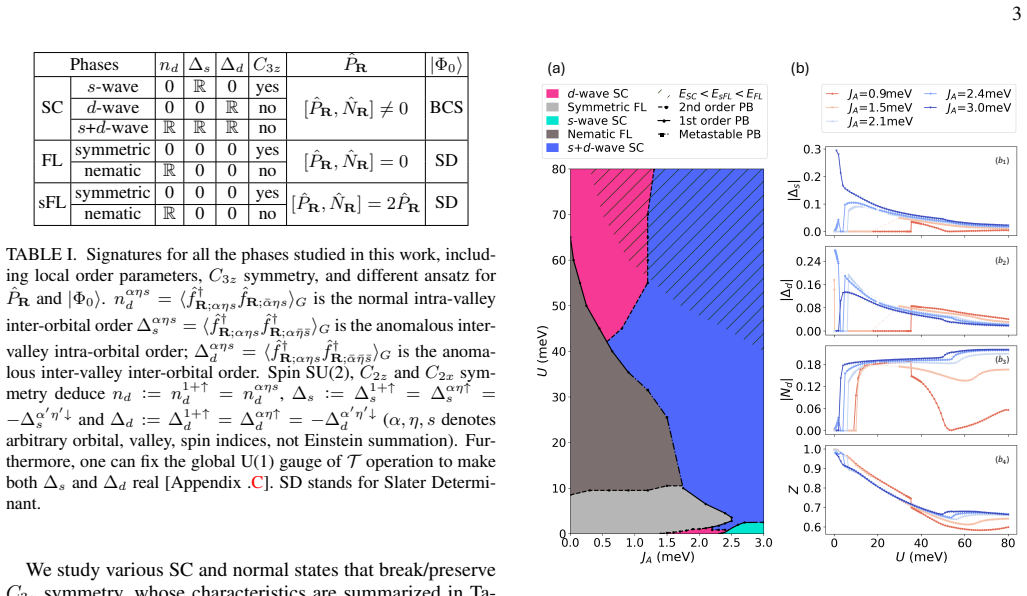
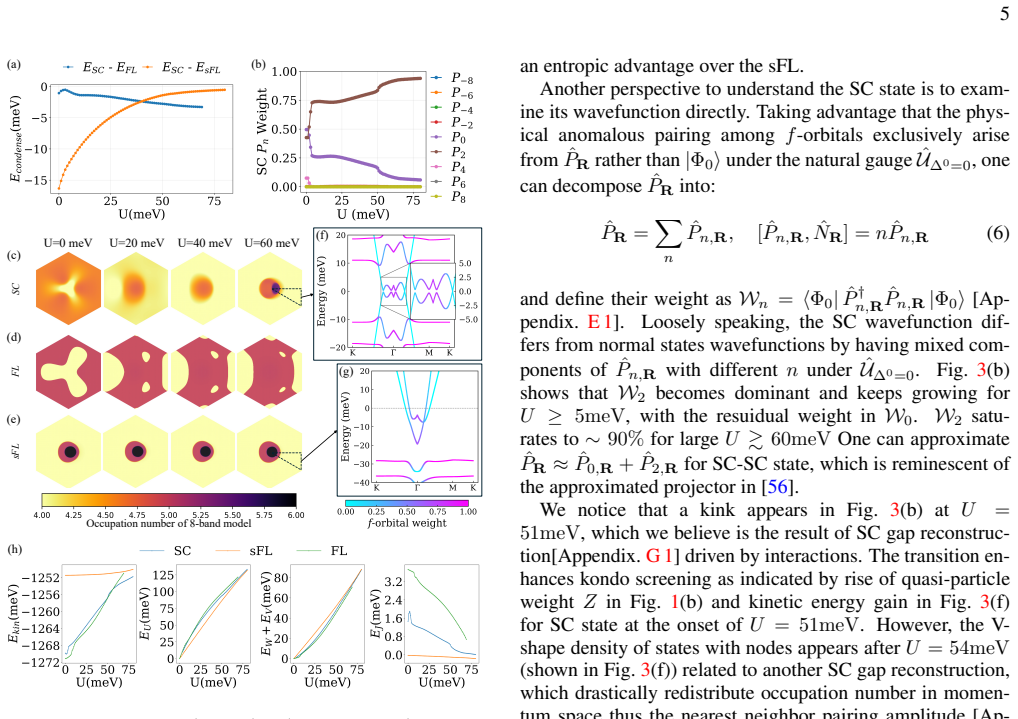
At filling ν=2.5 a nematic SC state is stabilized over a large region of the U-J_A phase diagram including realistic MATBG parameters; at large U it acquires a nodal gap structure with V-shaped DOS via interaction-driven reconstruction, while the off-diagonal Gutzwiller components suppress f-orbital charge fluctuations while keeping finite pairing and Z. The phase diagram shows a dome-shaped FL separating BCS-SC at small U from SC-SC at large U, together with a novel small Fermi liquid (sFL) state of effective Fermi-surface volume ν+2 that becomes the lowest-energy normal state at large U and serves as the parent of the SC-SC phase.
What carries the argument
The variational Gutzwiller projector allowed to break charge U(1) symmetry, applied to an eight-band model containing correlated f-orbitals and uncorrelated c-orbitals with interactions U, J_A and J_H.
If this is right
- The nematic SC state occupies a wide swath of the U-J_A plane that includes experimentally relevant MATBG parameters.
- In the large-U SC-SC regime the quasiparticle weight Z remains finite while f-orbital charge fluctuations are strongly suppressed.
- The small Fermi liquid state with effective Fermi-surface volume ν+2 replaces the conventional Fermi liquid as the lowest-energy normal state once U exceeds roughly 40 meV.
- The conventional Fermi liquid at intermediate U and the small Fermi liquid at large U each act as the parent state of the strongly correlated superconducting phase.
Where Pith is reading between the lines
- The same variational approach could be applied at other integer or fractional fillings to locate additional correlated superconducting domes in twisted bilayer graphene.
- The interaction-driven nodal reconstruction implies that tunneling spectroscopy should detect a linear density of states inside the superconducting gap at large U.
- The persistence of finite Z alongside suppressed charge fluctuations suggests a route by which superconductivity can survive deep inside the correlated regime without crossing into a Mott insulator.
Load-bearing premise
The Gutzwiller approximation on the chosen eight-band model with the selected interactions U, J_A and J_H accurately captures the ground-state energetics and order parameters without large higher-order corrections or missing bands.
What would settle it
A direct measurement showing either a fully gapped spectrum instead of V-shaped density of states at large U, or the absence of nematic superconductivity inside the realistic MATBG parameter window, would falsify the central claims.
Figures



read the original abstract
We study strongly correlated superconductivity in magic-angle twisted bilayer graphene (MATBG) using variational Gutzwiller wavefunction where the Gutzwiller projector $\hat{P}_{R}$ is allowed to break charge U(1) symmetry to accommodate superconducting (SC) order. The ground state energy is evaluated via the Gutzwiller Approximation applied to an 8-band model consisting of correlated f-orbitals and uncorrelated c-orbitals, with interactions including onsite Coulomb repulsion $U$, phonon-mediated anti-Hund's coupling $\hat{H}_{J_A}$, and intra-orbital Hund's coupling $\hat{H}_{J_H}$. At filling $\nu=2.5$, we map out the phase diagram as a function of $U$ and $J_A$, finding a dome-shaped Fermi liquid (FL) phase that separates a weakly correlated BCS-like SC (BCS-SC) at small $U$ from a strongly correlated SC (SC-SC) at large $U$. A nematic SC state, stabilized over a large region of the phase diagram including the realistic parameter regime of MATBG, acquires a nodal gap structure with V-shaped density of states at large $U$ via interaction-driven SC gap reconstruction. In the SC-SC regime, the off-diagonal (charge-U(1)-breaking) components of $\hat{P}_{R}$ strongly suppress $f$-orbital charge fluctuations while maintaining finite pairing order and a sizeable quasiparticle weight $Z$, distinguishing it from a conventional Mott insulator. We further identify a novel small Fermi liquid (sFL) state with effective Fermi surface volume $=\nu+2$. Interestingly, in the intermediate- ($U \lesssim 40$ meV) and large-$U$ ($U \gtrsim 40$ meV) regimes, the conventional FL and the sFL are the lowest-energy normal phases, respectively, potentially serve as the parent states of the SC-SC phase. These results illuminate the interplay between strong correlations and unconventional pairing in MATBG, and establish a versatile Gutzwiller framework applicable to other strongly correlated superconductors.
Editorial analysis
A structured set of objections, weighed in public.
Referee Report
Summary. The manuscript applies a variational Gutzwiller wavefunction with U(1)-breaking projector to an 8-band f-c model of magic-angle twisted bilayer graphene at filling ν=2.5. It maps the U-J_A phase diagram, reports a nematic superconducting dome (including realistic MATBG parameters) that develops a nodal gap and V-shaped DOS at large U via interaction-driven reconstruction, identifies a small Fermi liquid (sFL) state with effective Fermi-surface volume ν+2 as the lowest-energy normal state at large U, and shows that off-diagonal Gutzwiller components suppress f-orbital charge fluctuations while preserving finite pairing and quasiparticle weight Z.
Significance. If the Gutzwiller approximation reliably ranks the energies of the FL, BCS-SC, SC-SC, and sFL phases, the work supplies a concrete variational framework that distinguishes weakly correlated BCS-like superconductivity from a strongly correlated regime in MATBG and highlights how charge-U(1)-breaking projectors can stabilize pairing without driving a conventional Mott insulator. The phase-diagram topology and the sFL parent-state proposal would be useful benchmarks for future DMFT or quantum Monte Carlo studies of twisted bilayer systems.
major comments (2)
- [§3] §3 (Gutzwiller Approximation applied to the 8-band model): the central claims on phase boundaries, the nematic SC dome at realistic MATBG parameters, the nodal-gap reconstruction at large U, and the sFL as parent state all rest on the static GA delivering accurate relative energies between FL, BCS-SC, SC-SC, and sFL phases. No benchmarks against DMFT, cluster exact diagonalization, or variational Monte Carlo with larger projectors are provided to quantify the uncontrolled errors arising from omitted dynamical fluctuations and inter-orbital entanglement beyond the chosen renormalization factors.
- [Results section on the phase diagram] Results section on the phase diagram (U-J_A plane at ν=2.5): the statement that the nematic SC state is stabilized “over a large region including realistic MATBG parameters” is presented without quantitative error bars on the location of the SC-SC/FL and SC-SC/sFL boundaries or convergence checks with respect to the number of variational parameters in the projector P_R.
minor comments (2)
- [sFL state discussion] The definition of the effective Fermi-surface volume for the sFL state (=ν+2) follows directly from the form of the projector but should be accompanied by an explicit expression for the renormalized band structure or Luttinger count used to extract it.
- [SC-SC regime] Notation for the quasiparticle weight Z and the off-diagonal components of P_R is introduced without a compact table summarizing their values across the SC-SC regime; adding such a table would improve readability.
Simulated Author's Rebuttal
We thank the referee for their positive evaluation of the significance of our work and for the constructive major comments. We address each point below and will revise the manuscript accordingly to improve clarity on methodological limitations and convergence.
read point-by-point responses
-
Referee: [§3] §3 (Gutzwiller Approximation applied to the 8-band model): the central claims on phase boundaries, the nematic SC dome at realistic MATBG parameters, the nodal-gap reconstruction at large U, and the sFL as parent state all rest on the static GA delivering accurate relative energies between FL, BCS-SC, SC-SC, and sFL phases. No benchmarks against DMFT, cluster exact diagonalization, or variational Monte Carlo with larger projectors are provided to quantify the uncontrolled errors arising from omitted dynamical fluctuations and inter-orbital entanglement beyond the chosen renormalization factors.
Authors: We agree that the Gutzwiller Approximation (GA) is a static variational method whose accuracy for relative energies depends on the quality of the chosen renormalization factors and does not capture dynamical fluctuations or full inter-orbital entanglement. The phase boundaries and dome structure are obtained from direct variational energy minimization within this controlled ansatz, which has been benchmarked in simpler multi-orbital Hubbard models in the literature. Direct comparisons to DMFT or cluster ED for the full 8-band model at ν=2.5 are computationally prohibitive at present and lie outside the scope of this work. In the revised manuscript we will expand §3 with an explicit discussion of the GA's limitations, cite prior validations of the method for similar systems, and state that the reported phase diagram should be viewed as a variational benchmark for future DMFT or VMC studies. revision: partial
-
Referee: [Results section on the phase diagram] Results section on the phase diagram (U-J_A plane at ν=2.5): the statement that the nematic SC state is stabilized “over a large region including realistic MATBG parameters” is presented without quantitative error bars on the location of the SC-SC/FL and SC-SC/sFL boundaries or convergence checks with respect to the number of variational parameters in the projector P_R.
Authors: The boundaries are located by comparing the variational energies of the competing states at each (U, J_A) point after self-consistent optimization of the Gutzwiller projector. While we did not report explicit numerical error bars, the key features (including the nematic dome encompassing realistic MATBG parameters) remain stable under moderate variations of the projector parameters. In the revision we will add a short paragraph and/or supplementary note that (i) describes the convergence tests performed with respect to the number of variational parameters in P_R and (ii) qualifies the statement on realistic parameters by noting the approximate location of the boundaries within the GA. revision: partial
Circularity Check
No significant circularity; variational energies computed from external parameters
full rationale
The derivation proceeds by applying the Gutzwiller Approximation to an 8-band model whose interactions (U, J_A, J_H) are treated as scanned external parameters rather than fitted quantities. Phase boundaries, the nematic SC dome at ν=2.5, nodal-gap reconstruction, and the sFL identification are obtained by minimizing the approximated energy functional over variational parameters in the U(1)-breaking projector. No step reduces a claimed prediction to a fitted input or self-citation by construction; the sFL volume statement is a direct consequence of the filling constraint and projector definition but is not presented as an independent derived result that tautologically reproduces an input. The central claims therefore remain outputs of the numerical variational procedure on the stated model.
Axiom & Free-Parameter Ledger
free parameters (2)
- U
- J_A
axioms (1)
- domain assumption Gutzwiller Approximation provides a reliable variational estimate of the ground-state energy for the 8-band model with broken U(1) symmetry.
invented entities (1)
-
small Fermi liquid (sFL) state
no independent evidence
Lean theorems connected to this paper
-
IndisputableMonolith/Cost/FunctionalEquation.leanwashburn_uniqueness_aczel unclear?
unclearRelation between the paper passage and the cited Recognition theorem.
variational Gutzwiller wavefunction |Ψ_G⟩ = ∏_R P̂_R |Φ_0⟩ ... Gutzwiller Approximation applied to an 8-band model ... interactions including onsite Coulomb repulsion U, phonon-mediated anti-Hund’s coupling Ĥ_JA, and intra-orbital Hund’s coupling Ĥ_JH
-
IndisputableMonolith/Foundation/AlexanderDuality.leanalexander_duality_circle_linking unclear?
unclearRelation between the paper passage and the cited Recognition theorem.
8-band tight-binding model ... two correlated f-orbitals and six uncorrelated c-orbitals
What do these tags mean?
- matches
- The paper's claim is directly supported by a theorem in the formal canon.
- supports
- The theorem supports part of the paper's argument, but the paper may add assumptions or extra steps.
- extends
- The paper goes beyond the formal theorem; the theorem is a base layer rather than the whole result.
- uses
- The paper appears to rely on the theorem as machinery.
- contradicts
- The paper's claim conflicts with a theorem or certificate in the canon.
- unclear
- Pith found a possible connection, but the passage is too broad, indirect, or ambiguous to say the theorem truly supports the claim.
Reference graph
Works this paper leans on
-
[1]
Energy FunctionalL As discussed in the main text, additional Lagrange multipliers are introduced toLto enableϱ 0 as an extra degrees of varia- tional freedom. The full energy functional (averaged per unit cell) reads: L[µ,ϱ 0,|Φ 0⟩,Λ,λ F(B) ] =⟨ ˆH⟩ G + X l λF l gF l (|Φ0⟩,ϱ 0) + X l λB l gB l (Λ,ϱ 0)−µ X l ⟨ˆnR,l⟩G,(A15) where⟨ ˆH⟩ G =E kin +E atom. We s...
-
[2]
Variational Gutzwiller Equations We’ve worked out the explicit form ofLin the last section, now we can derive the variational equations by fixingϱ 0: ∂L ∂⟨Φ 0| ϱ0 = 0⇒ ˆH F |Φ0⟩=E F |Φ0⟩(A53) ∂L ∂⟨a| ϱ0 = 0⇒H B |a⟩=E BF|a⟩(A54) Both|Φ⟩and|a⟩are the ground state of the respective Hamiltonians. These two are co-dependent linear equations because ˆH F depend...
-
[3]
p V r (A94) 16 Where each blockp V k consists of its multiplicity blocks: pV k = r111 dk . . . r 1nk 1 dk ... ... ... rnk11 dk . . . r nknk 1 dk (A95) nk is the multiplicity fork-irrepandd k denotes its dimension. We can further definep V k;ij equalsp V k withr mn =δ miδnj. Then we can construct our many-body basisΛ k;ij as: Λk;ij = 1√dk
-
[4]
0. . .0 ,(Λ k;ij)II ′ = 1√dk dkX t δIi t δI ′jt (A96) (Λ⊺ k;ij)II ′ = (Λk;ij)I ′I = 1√dk dkX t δI ′it δIj t = (Λk;ji)II ′ (A97) Now we can evaluate elements ofF (k′;i′j′),(k;ij): Tr Λ⊺ k′;i′j′Λk;ij m0 =δ k′kδi′i 1√dk Tr Λk;j ′jm0 =m 0 k;j ′j (A98) m0 k = m0 k;111 dk . . . m 0 k;1nk 1 dk ... ... ... m0 k;nk11 dk . . . m 0 k;nknk 1 dk (A...
-
[5]
m0 k (A101) Which is positive definite sincem 0 is positive definite. Now we can rewrite (A54) into an ordinary eigenvalue equation and define the transformed double-font matrices: ˜H B |˜a⟩=E B g |˜a⟩, ˜H B :=F −1/2H BF −1/2,| ˜a⟩ :=F 1/2 |a⟩(A102) ( ˜R αβ)νν ′ := X ν1ν2 F −1/2 νν1 (R αβ)ν1ν2 F −1/2 ν2ν′ ,( ˜Q αβ)νν ′ := X ν1ν2 F −1/2 νν1 (Q αβ)ν1ν2...
-
[6]
Bose Part Derivatives The PPDs in Bose part needs extra attention as they’re a bit more complicated then thenatural basisversion derived in [58]. For example, the PPDs foreOdefined in (A103): ∂0eO ∂0ϱ0 = ∂0F−1/2 ∂0ϱ0 OF−1/2 +F −1/2 ∂0O ∂0ϱ0 F−1/2 +F −1/2O ∂0F−1/2 ∂0ϱ0 (B21) (B22) Where ∂0F−1/2 ∂0ϱ0 can be obtained by solving the following Sylvester equati...
-
[7]
8-band model and interactions The 8-band tight-binding model of TBG reads: ˆH0 = X sηk f † sηk c† sηk ˆH(0,ff) η (k) ˆH(0,fc) η (k) ˆH(0,fc) η (k)† ˆH(0,cc) η (k) ! fsηk csηk .(C1) wheres, ηare spin, valley indices,kmarks the crystal momentum in the morie Brillouin zone. There 2 orbitals forf sηα;R (α=1, 2: orbital indices forf-orbitals) located at the AA...
-
[8]
single-body basis inirrepblocks Due to valley U(1) symmetry, the reduced Nambu density matrixϱ 0 is valley block-diagonal: ϱ0 = ρ0 η 0 ∆ 0 η 0 0ρ 0 ¯η 0 ∆ 0 ¯η ∆0 η † 0 1− ρ0 ¯η T 0 0 ∆0 ¯η † 0 1− ρ0 η T (C7) C2z andC 2x relates two valleys: ρ0 :=ρ 0 η =ρ 0 ¯η,∆ 0 :=∆ 0 η =∆ 0 ¯η (C8) Tgives (fixing the gauge choice ofT): (ρ0)∗ =ρ 0,(∆ 0)∗ =...
-
[9]
many-body basis inirrepblocks We first need to define the atomic Fock basis convention. For notation simplicity, we also denoteα= (β, η, s), andα= 1,· · ·,8is equivalent toα= (1,+,↑),(1,+,↓),(1,−,↑),· · ·,(2,−,↓). The2 8 Fock states|Γ⟩that span the local Hilbert space are defined as, |Γ⟩= <Y α∈Γ f † α|emp⟩(C12) where within the productQ< α the largestαis ...
-
[10]
Parameterizingρ 0 (ϱ0) (unconstrained) It’s obvious that for any Hermitian matrixX, the following construction: ρ0(X) = 1 eX + 1 (D1) has all of its eigenvalues lies between 0 and 1. Conversely, we can show that any legit density matrixρ 0 can be parametrized in this way by realizing that the exponential functionex is monotone such that we can solvexi = l...
-
[11]
Parametrisingρ 0(ϱ0) (polynomial constraints) Although the exponential map method gives a simple and elegant parameterization, it does not provide an accurate derivative modulation when the minimization is close to the boundary (the eigenvalues ofρ 0 is close to 0 or 1) because dρ0 dx becomes exponentially very small, which leads the minimization to stay ...
-
[12]
Projector weights in SC state To better understand the local correlations of SC-SC state inν= 2 +xTBG and its comparison with normal states (FL and sFL states), one can factorize the projector ˆPinto components having different commutation relations with thef-electron number operator: ˆP= X n ˆPn,[ ˆPn, ˆNf] =n ˆPn, nis even integer (E11) From (A12), we h...
-
[13]
Appendix F: Physical observables under|Ψ G⟩
Gauge transformation ofRandQ The gauge transformation on Nambu basis operators can be conveniently defined as: ˆU † ˆf↑β ˆU= X β′ U↑β,↑β ′ ˆf↑β′ +U ↑β,↓β ′ ˆf † ↓β′ ˆU † ˆf † ↓β ˆU= X β′ U↓β,↑β ′ ˆf↑β′ +U ↓β,↓β ′ ˆf † ↓β′ (E14) Such that under|Φ 0⟩ → ˆU |Φ0⟩,ϱ 0 transforms as: ϱ0 → Uϱ 0U † (E15) Correspondinly, under ˆP→ ˆPU † and|Φ 0⟩ → ˆU |Φ0⟩, the equa...
-
[14]
Now we work on the general case where the quasi-particle operator is given in (A18)
Momentum dependent occupation number:n k For uncorrelatedc-electrons,n c;k equals the uncorrelated occupation numbern 0 c;k as the Gutzwiller projection does not act onc-electrons: nc;kaσ =⟨Ψ G|ˆc† kaσˆckaσ |ΨG⟩=⟨Φ 0|ˆc† kaσˆckaσ |Φ0⟩=n 0 c;kaσ (F1) The momentum dependent occupation number off-electrons is given by: nf;kσα =⟨Ψ G| ˆf † kσα ˆfkσα |ΨG⟩ = 1 N...
-
[15]
Intersite pairing amplitudes Thef-electron pairing amplitude are defined as: ⟨ ˆf↓αRi ˆf↑βRj ⟩G =δij⟨ ˆf↓αRi ˆf↑βRi ⟩G + (1−δ ij)⟨ ˆf↓αRi ˆf↑βRj ⟩G δij⟨ ˆf↓αRi ˆf↑βRi ⟩G =δij X ΓΓ′ ΛΓΛΓ′ Tr m ⊺ ΓD ↓α,↑βm Γ′m0 (1−δ ij)⟨ ˆf↓αRi ˆf↑βRj ⟩G =(1−δ ij) X γδ ⟨ ˆf↓γRi R∗ γα − ˆf † ↑γRi Q∗ γα ˆf↑δRj R∗ δβ + ˆf † ↓δRj Q∗ δβ ⟩0 =(1−δ ij) 1 N X k eik·(Rj −Ri) h R† βδ ...
-
[16]
Fermi surface volume of sFL We first postulate that the quasi-particle dispersionϵ n(k)in sFL is still given by the dispersion of the Fermi Hamiltonian ˆH F =P kn ϵn(k) ˆd† kn ˆdkn [61]. The Fermi surface volume equates to the quasi-particle (uncorrelated) occupation number: VF S = Ωd (2π)d X n Z BZ dkdΘ(µ−ϵ n(k)) = 1 Nk X kn Θ(µ−ϵ n(k)) =⟨Φ 0| X α ˆnα |Φ...
-
[17]
SC gap reconstruction driven byU We plot density of states (DOS) Fig. 5 at differentUvalues with(J A, JH) = (3meV,1.5meV)and find that there’s a reconstruction of the SC gap structure atU= 51meVwhich corresponds to the kink in the quasi-particle weight Fig. 1(b). 40 𝑈=49 𝑚𝑒𝑉 𝑈=50 𝑚𝑒𝑉 𝑈=51 𝑚𝑒𝑉 𝑈=53 𝑚𝑒𝑉 FIG. 5. Density of states (DOS) at differentUvalues wi...
-
[18]
41 SCFLsFL (a)(b) (c) (d) 𝑈=5 𝑚𝑒𝑉𝑈=20 𝑚𝑒𝑉𝑈=40 𝑚𝑒𝑉𝑈=60 𝑚𝑒𝑉𝑱𝑨 =𝟑𝐦𝐞𝐕 𝑱𝑯=𝟏.𝟓𝐦𝐞𝐕 FIG
SC gap structure and normal state Fermi surface Here we present the SC gap contour plots and normal state Fermi surfaces at differentUorJ A values as a complement to the momentum resolved occupation number plot in Fig .3. 41 SCFLsFL (a)(b) (c) (d) 𝑈=5 𝑚𝑒𝑉𝑈=20 𝑚𝑒𝑉𝑈=40 𝑚𝑒𝑉𝑈=60 𝑚𝑒𝑉𝑱𝑨 =𝟑𝐦𝐞𝐕 𝑱𝑯=𝟏.𝟓𝐦𝐞𝐕 FIG. 7. Calculations atν= 2.5,(J A, JH) = (3meV,1.5meV): (a...
-
[19]
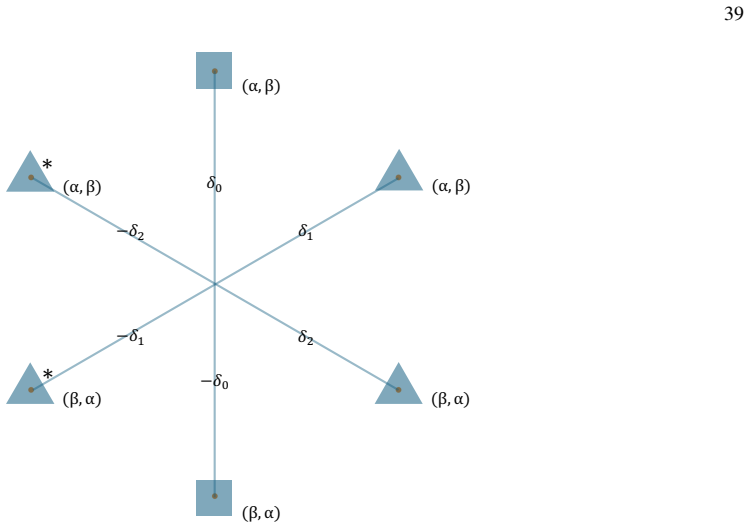
Intersite pairing amplitudes We plot the nearest neighbor pairing amplitudes with respect to the change ofJ A (fixingU= 60meV) andU(fixing JA = 3meV) respectively. Both plots in Fig. 9 show that the pairing amplitudes in all directions decrease when either the coupling strengthJ A or the correlation strengthUis large, indicating that either factor alone i...
-
[20]
Benchmark: Dimer-Lattice model The benchmark of our code using Fabrizio [56]’s Dimer-Lattice model with flat density of states Fig. 10. All physical observables agree well with Fabrizio’s work (orange dashed line) especially inU= 0and largeUlimit where He’s projector ansatz works the best. The normal and anomalous renormalization factorZ(Rin this work) an...
-
[21]
Y . Cao, V . Fatemi, S. Fang, K. Watanabe, T. Taniguchi, E. Kaxiras, and P. Jarillo-Herrero, Unconventional superconductivity in magic- angle graphene superlattices, Nature556, 43 (2018)
work page 2018
-
[22]
M. Oh, K. P. Nuckolls, D. Wong, R. L. Lee, X. Liu, K. Watanabe, T. Taniguchi, and A. Yazdani, Evidence for unconventional supercon- ductivity in twisted bilayer graphene, Nature600, 240 (2021)
work page 2021
-
[23]
Y . Cao, D. Rodan-Legrain, J. M. Park, N. F. Q. Yuan, K. Watanabe, T. Taniguchi, R. M. Fernandes, L. Fu, and P. Jarillo-Herrero, Nematicity and competing orders in superconducting magic-angle graphene, Science372, 264 (2021), https://www.science.org/doi/pdf/10.1126/science.abc2836
-
[24]
J.-X. Lin, Y .-H. Zhang, E. Morissette, Z. Wang, S. Liu, D. Rhodes, K. Watanabe, T. Taniguchi, J. Hone, and J. I. A. Li, Spin-orbit–driven ferromagnetism at half moir ´e filling in magic-angle twisted bilayer graphene, Science375, 437 (2022), https://www.science.org/doi/pdf/10.1126/science.abh2889
-
[25]
X. Liu, Z. Wang, K. Watanabe, T. Taniguchi, O. Vafek, and J. I. A. Li, Tuning electron correlation in magic-angle twisted bilayer graphene using coulomb screening, Science371, 1261 (2021), https://www.science.org/doi/pdf/10.1126/science.abb8754
-
[26]
P. Stepanov, I. Das, X. Lu, A. Fahimniya, K. Watanabe, T. Taniguchi, F. H. L. Koppens, J. Lischner, L. Levitov, and D. K. Efetov, Untying the insulating and superconducting orders in magic-angle graphene, Nature583, 375 (2020)
work page 2020
-
[27]
M. Yankowitz, S. Chen, H. Polshyn, Y . Zhang, K. Watanabe, T. Taniguchi, D. Graf, A. F. Young, and C. R. Dean, Tuning superconductivity in twisted bilayer graphene, Science363, 1059 (2019), https://www.science.org/doi/pdf/10.1126/science.aav1910
-
[28]
Y . Cao, D. Chowdhury, D. Rodan-Legrain, O. Rubies-Bigorda, K. Watanabe, T. Taniguchi, T. Senthil, and P. Jarillo-Herrero, Strange metal in magic-angle graphene with near planckian dissipation, Phys. Rev. Lett.124, 076801 (2020)
work page 2020
-
[29]
A. Kerelsky, L. J. McGilly, D. M. Kennes, L. Xian, M. Yankowitz, S. Chen, K. Watanabe, T. Taniguchi, J. Hone, C. Dean, A. Rubio, and A. N. Pasupathy, Maximized electron interactions at the magic angle in twisted bilayer graphene, Nature572, 95 (2019)
work page 2019
-
[30]
X. Lu, P. Stepanov, W. Yang, M. Xie, M. A. Aamir, I. Das, C. Urgell, K. Watanabe, T. Taniguchi, G. Zhang, A. Bachtold, A. H. MacDonald, and D. K. Efetov, Superconductors, orbital magnets and correlated states in magic-angle bilayer graphene, Nature574, 653 (2019)
work page 2019
-
[31]
H. Polshyn, M. Yankowitz, S. Chen, Y . Zhang, K. Watanabe, T. Taniguchi, C. R. Dean, and A. F. Young, Large linear-in-temperature resistivity in twisted bilayer graphene, Nature Physics , 1 (2019)
work page 2019
- [32]
- [33]
-
[34]
J. M. Park, S. Sun, K. Watanabe, T. Taniguchi, and P. Jarillo-Herrero, Experimental evidence for nodal superconducting gap in moir ´e graphene, Science0, eadv8376 (2025)
work page 2025
-
[35]
H. Kim, G. Rai, L. Crippa, D. C˘alug˘aru, H. Hu, Y . Choi, L. Kong, E. Baum, Y . Zhang, L. Holleis, K. Watanabe, T. Taniguchi, A. F. Young, B. A. Bernevig, R. Valent ´ı, G. Sangiovanni, T. Wehling, and S. Nadj-Perge, Resolving intervalley gaps and many-body resonances in moir´e superconductors, Nature650, 592 (2026)
work page 2026
-
[36]
N. J. Zhang, P. A. Nosov, O. E. Sommer, Y . Wang, K. Watanabe, T. Taniguchi, E. Khalaf, and J. I. A. Li, Angular interplay of nematicity, superconductivity and strange metallicity in magic-angle twisted trilayer graphene, Nature Physics 10.1038/s41567-026-03202-w (2026)
-
[37]
Y .-J. Wang, G.-D. Zhou, S.-Y . Peng, B. Lian, and Z.-D. Song, Molecular pairing in twisted bilayer graphene superconductivity, Phys. Rev. Lett.133, 146001 (2024)
work page 2024
-
[38]
Y .-J. Wang, G.-D. Zhou, H. Jung, S. Youn, S.-S. B. Lee, and Z.-D. Song, Spin-Valley Anderson Impurity for Moir ´e Systems: Fermi Liquid, Pairing, and Pseudogap (2026)
work page 2026
-
[39]
F. Wu, A. H. MacDonald, and I. Martin, Theory of phonon-mediated superconductivity in twisted bilayer graphene, Phys. Rev. Lett.121, 257001 (2018)
work page 2018
-
[40]
B. Lian, Z. Wang, and B. A. Bernevig, Twisted bilayer graphene: A phonon-driven superconductor, Phys. Rev. Lett.122, 257002 (2019)
work page 2019
-
[41]
F. Wu, E. Hwang, and S. Das Sarma, Phonon-induced giant linear-in-tresistivity in magic angle twisted bilayer graphene: Ordinary strangeness and exotic superconductivity, Phys. Rev. B99, 165112 (2019)
work page 2019
- [42]
-
[43]
J.-Y . Zhao and Y .-H. Zhang, Resonating-valence-bond superconductor from small fermi surface in twisted bilayer graphene (2025), arXiv:2510.26801 [cond-mat.str-el]
- [44]
-
[45]
D. V . Chichinadze, L. Classen, and A. V . Chubukov, Nematic superconductivity in twisted bilayer graphene, Phys. Rev. B101, 224513 (2020)
work page 2020
-
[46]
D. M. Kennes, J. Lischner, and C. Karrasch, Strong correlations andd+idsuperconductivity in twisted bilayer graphene, Phys. Rev. B 98, 241407 (2018)
work page 2018
-
[47]
J. Gonz ´alez and T. Stauber, Kohn-luttinger superconductivity in twisted bilayer graphene, Phys. Rev. Lett.122, 026801 (2019)
work page 2019
- [48]
- [49]
-
[50]
E. Khalaf, S. Chatterjee, N. Bultinck, M. P. Zaletel, and A. Vishwanath, Charged skyrmions and topological origin of superconductivity in magic-angle graphene, Science Advances7, eabf5299 (2021), https://www.science.org/doi/pdf/10.1126/sciadv.abf5299
-
[51]
P. J. Ledwith, E. Khalaf, and A. Vishwanath, Strong coupling theory of magic-angle graphene: A pedagogical introduction, Annals of Physics435, 168646 (2021), special issue on Philip W. Anderson
work page 2021
- [52]
-
[53]
Y .-J. Wang, G.-D. Zhou, B. Lian, and Z.-D. Song, Electron-phonon coupling in the topological heavy fermion model of twisted bilayer graphene, Phys. Rev. B111, 035110 (2025)
work page 2025
-
[54]
H. Shi, W. Miao, and X. Dai, Moir ´e optical phonons coupled to heavy electrons in magic-angle twisted bilayer graphene, Phys. Rev. B 111, 155126 (2025)
work page 2025
-
[55]
Z.-D. Song and B. A. Bernevig, Magic-Angle Twisted Bilayer Graphene as a Topological Heavy Fermion Problem, Physical Review Letters129, 047601 (2022)
work page 2022
-
[56]
The Mott-semiconducting state in the magic angle bilayer graphene
M. Haule, E. Y . Andrei, and K. Haule, The Mott-semiconducting state in the magic angle bilayer graphene (2019), arXiv:1901.09852 [cond-mat]
work page Pith review arXiv 2019
-
[57]
M. J. Calder ´on and E. Bascones, Interactions in the 8-orbital model for twisted bilayer graphene, Phys. Rev. B102, 155149 (2020)
work page 2020
-
[58]
Y .-Z. Chou and S. Das Sarma, Kondo Lattice Model in Magic-Angle Twisted Bilayer Graphene, Physical Review Letters131, 026501 (2023)
work page 2023
-
[59]
H. Hu, G. Rai, L. Crippa, J. Herzog-Arbeitman, D. C˘alug˘aru, T. Wehling, G. Sangiovanni, R. Valent´ı, A. M. Tsvelik, and B. A. Bernevig, Symmetric Kondo Lattice States in Doped Strained Twisted Bilayer Graphene, Physical Review Letters131, 166501 (2023)
work page 2023
- [60]
-
[61]
G.-D. Zhou, Y .-J. Wang, N. Tong, and Z.-D. Song, Kondo phase in twisted bilayer graphene, Physical Review B109, 045419 (2024)
work page 2024
-
[62]
G. Rai, L. Crippa, D. C˘alug˘aru, H. Hu, F. Paoletti, L. de’ Medici, A. Georges, B. A. Bernevig, R. Valent´ı, G. Sangiovanni, and T. Wehling, Dynamical Correlations and Order in Magic-Angle Twisted Bilayer Graphene, Physical Review X14, 031045 (2024)
work page 2024
-
[63]
L. L. H. Lau and P. Coleman, Topological mixed valence model for twisted bilayer graphene, Phys. Rev. X15, 021028 (2025)
work page 2025
- [64]
- [65]
-
[66]
R. L. Merino, D. C ˘alug˘aru, H. Hu, J. D ´ıez-M´erida, A. D ´ıez-Carl´on, T. Taniguchi, K. Watanabe, P. Seifert, B. A. Bernevig, and D. K. Efetov, Interplay between light and heavy electron bands in magic-angle twisted bilayer graphene, Nature Physics21, 1078 (2025)
work page 2025
- [67]
-
[68]
Q. Hu, S. Liang, X. Li, H. Shi, X. Dai, and Y . Xu, Link between cascade phenomenon and correlated chern insulators in magic-angle twisted bilayer graphene, Nature Communications16, 9516 (2025)
work page 2025
- [69]
-
[70]
C. Chen, K. P. Nuckolls, S. Ding, W. Miao, D. Wong, M. Oh, R. L. Lee, S. He, C. Peng, D. Pei, Y . Li, C. Hao, H. Yan, H. Xiao, H. Gao, Q. Li, S. Zhang, J. Liu, L. He, K. Watanabe, T. Taniguchi, C. Jozwiak, A. Bostwick, E. Rotenberg, C. Li, X. Han, D. Pan, Z. Liu, X. Dai, C. Liu, B. A. Bernevig, Y . Wang, A. Yazdani, and Y . Chen, Strong electron–phonon co...
work page 2024
-
[71]
C.-X. Liu, Y . Chen, A. Yazdani, and B. A. Bernevig, Electron–k-phonon interaction in twisted bilayer graphene, Phys. Rev. B110, 045133 (2024)
work page 2024
- [72]
-
[73]
H. C. Po, L. Zou, T. Senthil, and A. Vishwanath, Faithful tight-binding models and fragile topology of magic-angle bilayer graphene, Phys. Rev. B99, 195455 (2019)
work page 2019
-
[74]
Z. Song, Z. Wang, W. Shi, G. Li, C. Fang, and B. A. Bernevig, All Magic Angles in Twisted Bilayer Graphene are Topological, Physical Review Letters123, 036401 (2019)
work page 2019
-
[75]
J. Ahn, S. Park, and B.-J. Yang, Failure of Nielsen-Ninomiya Theorem and Fragile Topology in Two-Dimensional Systems with Space- Time Inversion Symmetry: Application to Twisted Bilayer Graphene at Magic Angle, Physical Review X9, 021013 (2019)
work page 2019
-
[76]
Fabrizio, Gutzwiller description of non-magnetic mott insulators: Dimer lattice model, Phys
M. Fabrizio, Gutzwiller description of non-magnetic mott insulators: Dimer lattice model, Phys. Rev. B76, 165110 (2007)
work page 2007
-
[77]
N. Lanat `a, H. U. R. Strand, X. Dai, and B. Hellsing, Efficient implementation of the gutzwiller variational method, Phys. Rev. B85, 035133 (2012)
work page 2012
-
[78]
S. Peng, H. Weng, and X. Dai, Rtgw2020: An efficient implementation of the multi-orbital gutzwiller method with general local interac- tions, Computer Physics Communications276, 108348 (2022)
work page 2022
-
[79]
A. Isidori and M. Capone, Rotationally invariant slave bosons for strongly correlated superconductors, Phys. Rev. B80, 115120 (2009)
work page 2009
-
[80]
X. Deng, L. Wang, X. Dai, and Z. Fang, Local density approximation combined with gutzwiller method for correlated electron systems: Formalism and applications, Phys. Rev. B79, 075114 (2009)
work page 2009
discussion (0)
Sign in with ORCID, Apple, or X to comment. Anyone can read and Pith papers without signing in.