Recognition: no theorem link
Natural SUSY with mixed axion/axino dark matter
Pith reviewed 2026-05-10 19:08 UTC · model grok-4.3
The pith
Natural SUSY permits the axino to act as the lightest supersymmetric particle, producing viable mixed axion-axino dark matter that matches the observed abundance.
A machine-rendered reading of the paper's core claim, the machinery that carries it, and where it could break.
Core claim
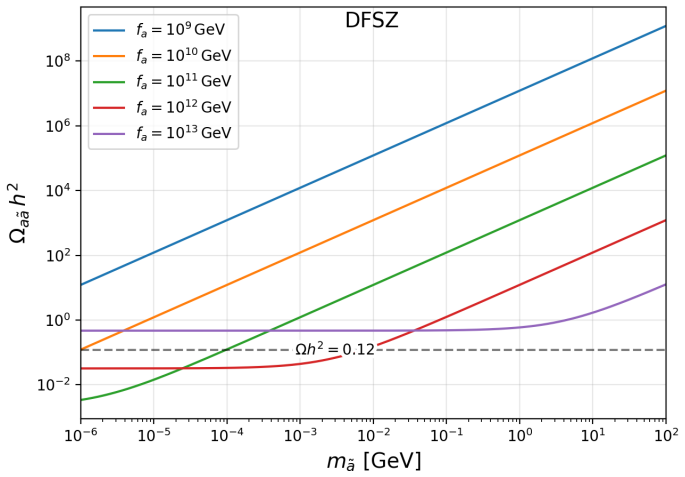
In natural supersymmetry extended by Peccei-Quinn symmetry, the axino can be the lightest supersymmetric particle and therefore produce mixed axion plus axino dark matter. Viable solutions appear in both the SUSY DFSZ and KSVZ models for axino masses near 100 keV. When the Peccei-Quinn scale sits near 10^11 GeV the dark matter is predominantly warm axinos, while at scales around 3 times 10^12 GeV it is predominantly cold axions with only a tiny axino fraction; both cases reproduce the measured dark matter abundance.
What carries the argument
The axino as lightest supersymmetric particle, whose mass and the Peccei-Quinn scale together fix the relative contributions of warm axino and cold axion dark matter components.
If this is right
- For axino masses around 100 keV and Peccei-Quinn scales near 10^11 GeV, the dark matter is mainly warm axinos while still matching the total observed density.
- At higher Peccei-Quinn scales near 3 times 10^12 GeV the same axino mass yields mainly cold axion dark matter with a negligible axino fraction.
- Both outcomes remain consistent with the measured dark matter abundance in the SUSY DFSZ and KSVZ models.
- The construction evades the direct-detection limits that apply to higgsino WIMPs.
Where Pith is reading between the lines
- Warm axino dark matter at the lower Peccei-Quinn scale could leave imprints on small-scale structure formation that differ from pure cold dark matter.
- Axion searches sensitive to the 10^11 to 10^12 GeV range would directly test the allowed windows.
- The scenario preserves the naturalness motivation for supersymmetry while shifting the dark matter candidate away from the WIMP paradigm.
Load-bearing premise
The near-exclusion of higgsino-like WIMPs by multi-ton direct detection experiments is taken as given, and keV-scale axino masses are assumed to evade further cosmological or particle-physics constraints.
What would settle it
A positive detection of higgsino dark matter in a multi-ton noble-liquid detector, or cosmological data that rule out a keV-scale axino component, would eliminate the viable regions identified in the parameter space.
Figures




read the original abstract
While supersymmetric models provide a solution to the big hierarchy problem, natural SUSY is also allowed by the little hierarchy problem. In supersymmetric models which include the Peccei-Quinn (PQ) solution to the strong CP problem, one expects the presence of an axion-axino-saxion supermultiplet with a micro-eV-scale axion and a saxion with mass of order the soft breaking scale. The axino mass is much more model-dependent, and may occur in the range of keV-TeV: over 9 orders of magnitude. This leads to the possibility of the axino as lightest SUSY particle (LSP) and the presence of mixed axion plus axino dark matter. The case of natural SUSY with higgsino-like WIMPs as LSP seems (nearly) excluded by multi-ton noble liquid WIMP detector limits, even in the case where the LSP has a depleted abundance compared to axions. We examine the case where the axino is LSP leading to mixed axion-axino dark matter in a natural SUSY context. We map out regions of PQ scale f_a vs. axino mass m_{\ta} parameter space where such a scenario remains viable in both the SUSY DFSZ and KSVZ axion models. For axino mass ~100 keV, we find solutions in accord with the measured dark matter abundance with mainly warm axino dark matter for f_a~ 10^{11} GeV and also solutions with mainly axion cold DM and a tiny axino contribution for higher f_a~ 3\times 10^{12} GeV.
Editorial analysis
A structured set of objections, weighed in public.
Referee Report
Summary. The manuscript examines natural SUSY models incorporating the Peccei-Quinn solution to the strong CP problem, focusing on scenarios where the axino is the LSP and yields mixed axion-axino dark matter. It maps viable regions of PQ scale f_a versus axino mass m_a~ parameter space in both SUSY DFSZ and KSVZ axion models, identifying choices that reproduce the observed dark matter abundance, including a mainly warm axino DM solution at m_a~ ~100 keV and f_a ~10^11 GeV as well as mainly axion cold DM solutions at higher f_a ~3x10^12 GeV.
Significance. If the relic density calculations hold and all relevant constraints are satisfied, the work offers a concrete way to realize viable dark matter in natural SUSY by sidestepping direct-detection limits on higgsino-like WIMPs. The explicit delineation of f_a-m_a~ space for both axion models is a useful phenomenological contribution that could guide future model-building and searches. The inclusion of warm axino components, however, requires verification against structure-formation data to realize this potential.
major comments (2)
- [Results on f_a ~10^11 GeV solutions] The viability claim for the mainly warm axino DM region at m_a~ ~100 keV and f_a ~10^11 GeV rests only on matching the total Omega_DM; no assessment is provided of the axino free-streaming length or its compatibility with Lyman-alpha forest, Milky Way satellite, or reionization bounds that typically restrict or exclude keV-scale warm DM fractions capable of erasing small-scale power.
- [Parameter space mapping for DFSZ and KSVZ models] The mapping of viable regions lacks explicit formulas, production mechanisms (thermal vs. non-thermal), or dependence on reheating temperature and saxion decays used to compute the axino relic density as a function of f_a and m_a~; without these details the assertion that solutions are 'in accord with the measured dark matter abundance' cannot be verified.
minor comments (2)
- Notation inconsistency: the axino mass is written as m_a~ in the abstract and m_~a in the text; adopt a single consistent symbol such as m_ã throughout.
- [Introduction] The statement that the axino mass 'may occur in the range of keV-TeV: over 9 orders of magnitude' would benefit from a brief reference to the model-dependent origin of this range.
Simulated Author's Rebuttal
We thank the referee for the careful reading of our manuscript and the constructive comments. We address each major point below and will revise the manuscript to incorporate clarifications and additional discussion where needed.
read point-by-point responses
-
Referee: [Results on f_a ~10^11 GeV solutions] The viability claim for the mainly warm axino DM region at m_a~ ~100 keV and f_a ~10^11 GeV rests only on matching the total Omega_DM; no assessment is provided of the axino free-streaming length or its compatibility with Lyman-alpha forest, Milky Way satellite, or reionization bounds that typically restrict or exclude keV-scale warm DM fractions capable of erasing small-scale power.
Authors: We agree that matching the total relic density alone is insufficient to fully establish viability for the warm axino component. The manuscript's primary focus is the computation of the mixed axion-axino relic density in natural SUSY. In the revised version we will add an estimate of the axino free-streaming length at m_a~ ~100 keV together with a brief discussion of its implications for Lyman-alpha forest, satellite, and reionization constraints, qualifying the parameter-space claims accordingly. revision: yes
-
Referee: [Parameter space mapping for DFSZ and KSVZ models] The mapping of viable regions lacks explicit formulas, production mechanisms (thermal vs. non-thermal), or dependence on reheating temperature and saxion decays used to compute the axino relic density as a function of f_a and m_a~; without these details the assertion that solutions are 'in accord with the measured dark matter abundance' cannot be verified.
Authors: The manuscript already outlines the relevant production channels (thermal axino production and non-thermal contributions from saxion decays) and their dependence on the reheating temperature for both DFSZ and KSVZ cases. To improve transparency and verifiability we will insert the explicit analytic expressions for the axino yield as a function of f_a and m_a~ in the revised manuscript, making the origin of the viable regions fully traceable. revision: yes
Circularity Check
No circularity: parameter scan uses external relic density formulas
full rationale
The paper scans f_a vs. m_a~ space in natural SUSY with axino LSP, computing axion and axino relic densities via standard Boltzmann equations and thermal production rates (DFSZ/KSVZ models) to identify regions matching observed Omega_DM. This is a forward calculation from input parameters to output abundance, not a fit or self-definition. No load-bearing self-citations, uniqueness theorems, or ansatze are invoked to force the result; viability regions are determined by external cosmology inputs. The derivation chain is self-contained against benchmarks and does not reduce to its own inputs by construction.
Axiom & Free-Parameter Ledger
free parameters (2)
- PQ scale f_a
- axino mass m_a~
axioms (2)
- domain assumption Natural SUSY solves the little hierarchy problem
- domain assumption Peccei-Quinn symmetry introduces axion-axino-saxion supermultiplet with micro-eV axion
Reference graph
Works this paper leans on
-
[1]
1989, Reviews of Modern Physics, 61, 1, doi: 10.1103/RevModPhys.61.1
S. Weinberg, The Cosmological Constant Problem, Rev. Mod. Phys. 61 (1989) 1–23.doi: 10.1103/RevModPhys.61.1
-
[2]
The Cosmological Constant and the String Landscape
J. Polchinski, The Cosmological Constant and the String Landscape, in: 23rd Solvay Conference in Physics: The Quantum Structure of Space and Time, 2006, pp. 216–236. arXiv:hep-th/0603249
work page Pith review arXiv 2006
-
[3]
H. Baer, X. Tata, Weak scale supersymmetry: From superfields to scattering events, Cam- bridge University Press, 2006
2006
-
[4]
R. D. Peccei, H. R. Quinn, CP Conservation in the Presence of Instantons, Phys. Rev. Lett. 38 (1977) 1440–1443.doi:10.1103/PhysRevLett.38.1440
-
[5]
Weinberg, A New Light Boson?, Phys
S. Weinberg, A New Light Boson?, Phys. Rev. Lett. 40 (1978) 223–226.doi:10.1103/ PhysRevLett.40.223
1978
-
[6]
F. Wilczek, Problem of StrongPandTInvariance in the Presence of Instantons, Phys. Rev. Lett. 40 (1978) 279–282.doi:10.1103/PhysRevLett.40.279
-
[7]
R. Barbieri, G. F. Giudice, Upper Bounds on Supersymmetric Particle Masses, Nucl. Phys. B 306 (1988) 63–76.doi:10.1016/0550-3213(88)90171-X
-
[8]
R. Kitano, Y. Nomura, Supersymmetry, naturalness, and signatures at the LHC, Phys. Rev. D 73 (2006) 095004.arXiv:hep-ph/0602096,doi:10.1103/PhysRevD.73.095004. 12
-
[9]
H. Baer, V. Barger, P. Huang, A. Mustafayev, X. Tata, Radiative natural SUSY with a 125 GeV Higgs boson, Phys. Rev. Lett. 109 (2012) 161802.arXiv:1207.3343,doi: 10.1103/PhysRevLett.109.161802
-
[10]
H. Baer, V. Barger, D. Mickelson, How conventional measures overestimate electroweak fine-tuning in supersymmetric theory, Phys. Rev. D 88 (9) (2013) 095013.arXiv:1309. 2984,doi:10.1103/PhysRevD.88.095013
-
[11]
H. Baer, V. Barger, D. Martinez, S. Salam, Practical naturalness and its implications for weak scale supersymmetry, Phys. Rev. D 108 (3) (2023) 035050.arXiv:2305.16125, doi:10.1103/PhysRevD.108.035050
-
[12]
A. Mustafayev, X. Tata, Supersymmetry, Naturalness, and Light Higgsinos, Indian J. Phys. 88 (2014) 991–1004.arXiv:1404.1386,doi:10.1007/s12648-014-0504-8
- [13]
-
[14]
H. Baer, V. Barger, J. Bolich, J. Dutta, D. Martinez, S. Salam, D. Sengupta, K. Zhang, Prospects for supersymmetry at High-Luminosity LHC, Rev. Mod. Phys. 97 (4) (2025) 045001.arXiv:2502.10879,doi:10.1103/bzw1-gfs1
- [15]
-
[16]
H. Baer, V. Barger, K. Zhang, Decoding the Gaugino Code Naturally at High-Lumi LHC, Particles 7 (4) (2024) 927–938.arXiv:2408.02048,doi:10.3390/particles7040056
-
[17]
H. Baer, V. Barger, X. Tata, K. Zhang, Prospects for Heavy Neutral SUSY HIGGS Scalars in the hMSSM and Natural SUSY at LHC Upgrades, Symmetry 14 (10) (2022) 2061. arXiv:2209.00063,doi:10.3390/sym14102061
-
[18]
H. Baer, V. Barger, X. Tata, K. Zhang, Detecting Heavy Neutral SUSY Higgs Bosons Decaying to Sparticles at the High-Luminosity LHC, Symmetry 15 (2) (2023) 548.arXiv: 2212.09198,doi:10.3390/sym15020548
-
[19]
H. Baer, V. Barger, X. Tata, K. Zhang, Prospects for Charged Higgs Bosons in Natural SUSY Models at the High-Luminosity LHC, Symmetry 15 (8) (2023) 1475.arXiv:2306. 05207,doi:10.3390/sym15081475
-
[20]
H. Baer, V. Barger, J. Dutta, D. Sengupta, K. Zhang, Top squarks from the landscape at high luminosity LHC, Phys. Rev. D 108 (7) (2023) 075027.arXiv:2307.08067,doi: 10.1103/PhysRevD.108.075027
-
[22]
H. Baer, V. Barger, K. Zhang, Stau pairs from natural SUSY at high luminosity LHC, Phys. Rev. D 110 (1) (2024) 015017.arXiv:2403.18991,doi:10.1103/PhysRevD.110.015017
-
[23]
Zhang, Supersymmetry at High Luminosity LHC (1 2026).arXiv:2601.01066
K. Zhang, Supersymmetry at High Luminosity LHC (1 2026).arXiv:2601.01066
-
[24]
J. E. Kim, Weak Interaction Singlet and Strong CP Invariance, Phys. Rev. Lett. 43 (1979) 103.doi:10.1103/PhysRevLett.43.103
-
[25]
M. A. Shifman, A. I. Vainshtein, V. I. Zakharov, Can Confinement Ensure Natural CP Invariance of Strong Interactions?, Nucl. Phys. B 166 (1980) 493–506.doi:10.1016/ 0550-3213(80)90209-6
1980
-
[26]
M. Dine, W. Fischler, M. Srednicki, A Simple Solution to the Strong CP Problem with a Harmless Axion, Phys. Lett. B 104 (1981) 199–202.doi:10.1016/0370-2693(81) 90590-6
-
[27]
A. R. Zhitnitsky, On Possible Suppression of the Axion Hadron Interactions. (In Russian), Sov. J. Nucl. Phys. 31 (1980) 260
1980
-
[28]
Dark matter search results from 4.2 Tonne−Years of exposure of the LUX-ZEPLIN (LZ) experiment
J. Aalbers, et al., Dark Matter Search Results from 4.2 Tonne-Years of Exposure of the LUX-ZEPLIN (LZ) Experiment, Phys. Rev. Lett. 135 (1) (2025) 011802.arXiv:2410. 17036,doi:10.1103/4dyc-z8zf
-
[29]
N. Arkani-Hamed, A. Delgado, G. F. Giudice, The Well-tempered neutralino, Nucl. Phys. B 741 (2006) 108–130.arXiv:hep-ph/0601041,doi:10.1016/j.nuclphysb.2006.02.010
- [30]
- [31]
-
[32]
H. Baer, V. Barger, D. Sengupta, X. Tata, Is natural higgsino-only dark matter ex- cluded?, Eur. Phys. J. C 78 (10) (2018) 838.arXiv:1803.11210,doi:10.1140/epjc/ s10052-018-6306-y
- [33]
-
[34]
K. J. Bae, H. Baer, E. J. Chun, Mainly axion cold dark matter from natural supersymme- try, Phys. Rev. D 89 (3) (2014) 031701.arXiv:1309.0519,doi:10.1103/PhysRevD.89. 031701
-
[35]
K. J. Bae, H. Baer, H. Serce, Prospects for axion detection in natural SUSY with mixed axion-higgsino dark matter: back to invisible?, JCAP 06 (2017) 024.arXiv:1705.01134, doi:10.1088/1475-7516/2017/06/024. 14
-
[36]
C. Goodman, et al., ADMX Axion Dark Matter Bounds around 3.3µeV with Dine- Fischler-Srednicki-Zhitnitsky Discovery Ability, Phys. Rev. Lett. 134 (11) (2025) 111002. arXiv:2408.15227,doi:10.1103/PhysRevLett.134.111002
-
[37]
K. Rajagopal, M. S. Turner, F. Wilczek, Cosmological Implications of Axinos, Nucl. Phys. B 358 (1991) 447–470.doi:10.1016/0550-3213(91)90355-2
-
[38]
L. Covi, J. E. Kim, L. Roszkowski, Axinos as cold dark matter, Phys. Rev. Lett. 82 (1999) 4180–4183.arXiv:hep-ph/9905212,doi:10.1103/PhysRevLett.82.4180
-
[39]
L. Covi, H.-B. Kim, J. E. Kim, L. Roszkowski, Axinos as dark matter, JHEP 05 (2001) 033.arXiv:hep-ph/0101009,doi:10.1088/1126-6708/2001/05/033
-
[40]
K.-Y. Choi, L. Covi, J. E. Kim, L. Roszkowski, Axino Cold Dark Matter Revisited, JHEP 04 (2012) 106.arXiv:1108.2282,doi:10.1007/JHEP04(2012)106
- [41]
- [42]
-
[43]
H. Baer, A. D. Box, H. Summy, Mainly axion cold dark matter in the minimal supergravity model, JHEP 08 (2009) 080.arXiv:0906.2595,doi:10.1088/1126-6708/2009/08/080
-
[44]
L. F. Abbott, P. Sikivie, A Cosmological Bound on the Invisible Axion, Phys. Lett. B 120 (1983) 133–136.doi:10.1016/0370-2693(83)90638-X
-
[45]
J. Preskill, M. B. Wise, F. Wilczek, Cosmology of the Invisible Axion, Phys. Lett. B 120 (1983) 127–132.doi:10.1016/0370-2693(83)90637-8
-
[46]
M. Dine, W. Fischler, The Not So Harmless Axion, Phys. Lett. B 120 (1983) 137–141. doi:10.1016/0370-2693(83)90639-1
-
[47]
A. Brandenburg, F. D. Steffen, Axino dark matter from thermal production, JCAP 08 (2004) 008.arXiv:hep-ph/0405158,doi:10.1088/1475-7516/2004/08/008
-
[48]
A. Strumia, Thermal production of axino Dark Matter, JHEP 06 (2010) 036.arXiv: 1003.5847,doi:10.1007/JHEP06(2010)036
-
[49]
K. J. Bae, E. J. Chun, S. H. Im, Cosmology of the DFSZ axino, JCAP 03 (2012) 013. arXiv:1111.5962,doi:10.1088/1475-7516/2012/03/013
-
[50]
K. J. Bae, H. Baer, A. Lessa, Dark Radiation Constraints on Mixed Axion/Neutralino Dark Matter, JCAP 04 (2013) 041.arXiv:1301.7428,doi:10.1088/1475-7516/2013/04/041. 15
-
[51]
K.-Y. Choi, H. M. Lee, Axino abundances in high-scale supersymmetry, Phys. Dark Univ. 22 (2018) 202–207.arXiv:1810.00293,doi:10.1016/j.dark.2018.11.003
-
[52]
K. J. Bae, K. S. Jeong, PeV gravitino, weak-scale Higgsino, and GeV axino in the Kachru- Kalosh-Linde-Trived setup, Phys. Rev. D 104 (1) (2021) 015013.arXiv:2105.08236, doi:10.1103/PhysRevD.104.015013
-
[53]
H. Baer, V. Barger, K. Zhang, Living dangerously with decoupled first and second gen- eration scalars: SUSY prospects at the LHC, Phys. Rev. D 111 (3) (2025) 035033. arXiv:2411.13541,doi:10.1103/PhysRevD.111.035033
-
[54]
M. R. Douglas, Statistical analysis of the supersymmetry breaking scale (5 2004).arXiv: hep-th/0405279
work page internal anchor Pith review arXiv 2004
-
[55]
L. Susskind, Supersymmetry breaking in the anthropic landscape, in: From Fields to Strings: Circumnavigating Theoretical Physics: A Conference in Tribute to Ian Kogan, 2004, pp. 1745–1749.arXiv:hep-th/0405189,doi:10.1142/9789812775344_0040
-
[56]
Predictive Landscapes and New Physics at a TeV
N. Arkani-Hamed, S. Dimopoulos, S. Kachru, Predictive landscapes and new physics at a TeV (1 2005).arXiv:hep-th/0501082
work page internal anchor Pith review arXiv 2005
-
[57]
V. Agrawal, S. M. Barr, J. F. Donoghue, D. Seckel, Viable range of the mass scale of the standard model, Phys. Rev. D 57 (1998) 5480–5492.arXiv:hep-ph/9707380,doi: 10.1103/PhysRevD.57.5480
-
[58]
H. Baer, V. Barger, H. Serce, K. Sinha, Higgs and superparticle mass predictions from the landscape, JHEP 03 (2018) 002.arXiv:1712.01399,doi:10.1007/JHEP03(2018)002
-
[59]
H. Baer, C.-H. Chen, R. B. Munroe, F. E. Paige, X. Tata, Multichannel search for minimal supergravity atp¯pande +e− colliders, Phys. Rev. D 51 (1995) 1046–1050.arXiv:hep-ph/ 9408265,doi:10.1103/PhysRevD.51.1046
- [60]
- [61]
-
[62]
H. Baer, V. Barger, J. Bolich, D. Sengupta, K. Zhang, Aspects of the WIMP quality problem and R-parity violation in natural supersymmetry with all axion dark matter, JCAP 10 (2025) 072.arXiv:2505.09785,doi:10.1088/1475-7516/2025/10/072
- [63]
-
[64]
J. Sheng, T. T. Yanagida, High quality QCD axion in the Standard Model, Phys. Rev. D 113 (5) (2026) 055010.arXiv:2510.17370,doi:10.1103/h9ws-xgst. 16
-
[65]
T. Goto, M. Yamaguchi, Is axino dark matter possible in supergravity?, Phys. Lett. B 276 (1992) 103–107.doi:10.1016/0370-2693(92)90547-H
-
[66]
E. J. Chun, J. E. Kim, H. P. Nilles, Axino mass, Phys. Lett. B 287 (1992) 123–127. arXiv:hep-ph/9205229,doi:10.1016/0370-2693(92)91886-E
-
[67]
E. J. Chun, A. Lukas, Axino mass in supergravity models, Phys. Lett. B 357 (1995) 43–50. arXiv:hep-ph/9503233,doi:10.1016/0370-2693(95)00881-K
-
[68]
J. E. Kim, M.-S. Seo, Mixing of axino and goldstino, and axino mass, Nucl. Phys. B 864 (2012) 296–316.arXiv:1204.5495,doi:10.1016/j.nuclphysb.2012.06.018
-
[69]
K. J. Bae, H. Baer, E. J. Chun, Mixed axion/neutralino dark matter in the SUSY DFSZ axion model, JCAP 12 (2013) 028.arXiv:1309.5365,doi:10.1088/1475-7516/2013/ 12/028
-
[70]
H. Baer, K.-Y. Choi, J. E. Kim, L. Roszkowski, Dark matter production in the early Universe: beyond the thermal WIMP paradigm, Phys. Rept. 555 (2015) 1–60.arXiv: 1407.0017,doi:10.1016/j.physrep.2014.10.002
-
[71]
K. Jedamzik, Big bang nucleosynthesis constraints on hadronically and electromagnetically decaying relic neutral particles, Phys. Rev. D 74 (2006) 103509.arXiv:hep-ph/0604251, doi:10.1103/PhysRevD.74.103509
-
[72]
D. Curtin, et al., Long-Lived Particles at the Energy Frontier: The MATHUSLA Physics Case, Rept. Prog. Phys. 82 (11) (2019) 116201.arXiv:1806.07396,doi:10.1088/ 1361-6633/ab28d6
-
[73]
J. Alimena, et al., Searching for long-lived particles beyond the Standard Model at the Large Hadron Collider, J. Phys. G 47 (9) (2020) 090501.arXiv:1903.04497,doi:10. 1088/1361-6471/ab4574
-
[74]
G. Barenboim, E. J. Chun, S. Jung, W. I. Park, Implications of an axino LSP for natu- ralness, Phys. Rev. D 90 (3) (2014) 035020.arXiv:1407.1218,doi:10.1103/PhysRevD. 90.035020
- [75]
-
[76]
L. J. Hall, K. Jedamzik, J. March-Russell, S. M. West, Freeze-In Production of FIMP Dark Matter, JHEP 03 (2010) 080.arXiv:0911.1120,doi:10.1007/JHEP03(2010)080
- [77]
-
[78]
E. J. Chun, Dark matter in the Kim-Nilles mechanism, Phys. Rev. D 84 (2011) 043509. arXiv:1104.2219,doi:10.1103/PhysRevD.84.043509. 17
-
[79]
L. Visinelli, P. Gondolo, Dark Matter Axions Revisited, Phys. Rev. D 80 (2009) 035024. arXiv:0903.4377,doi:10.1103/PhysRevD.80.035024
-
[80]
J. Pradler, F. D. Steffen, Thermal gravitino production and collider tests of leptogenesis, Phys. Rev. D 75 (2007) 023509.arXiv:hep-ph/0608344,doi:10.1103/PhysRevD.75. 023509
-
[81]
S. Navas, et al., Review of particle physics, Phys. Rev. D 110 (3) (2024) 030001.doi: 10.1103/PhysRevD.110.030001
discussion (0)
Sign in with ORCID, Apple, or X to comment. Anyone can read and Pith papers without signing in.