Simultaneous Dual-View Mammogram Synthesis Using Denoising Diffusion Probabilistic Models
Pith reviewed 2026-05-10 20:03 UTC · model grok-4.3
The pith
A three-channel DDPM generates consistent dual-view mammograms by encoding their absolute difference.
A machine-rendered reading of the paper's core claim, the machinery that carries it, and where it could break.
Core claim
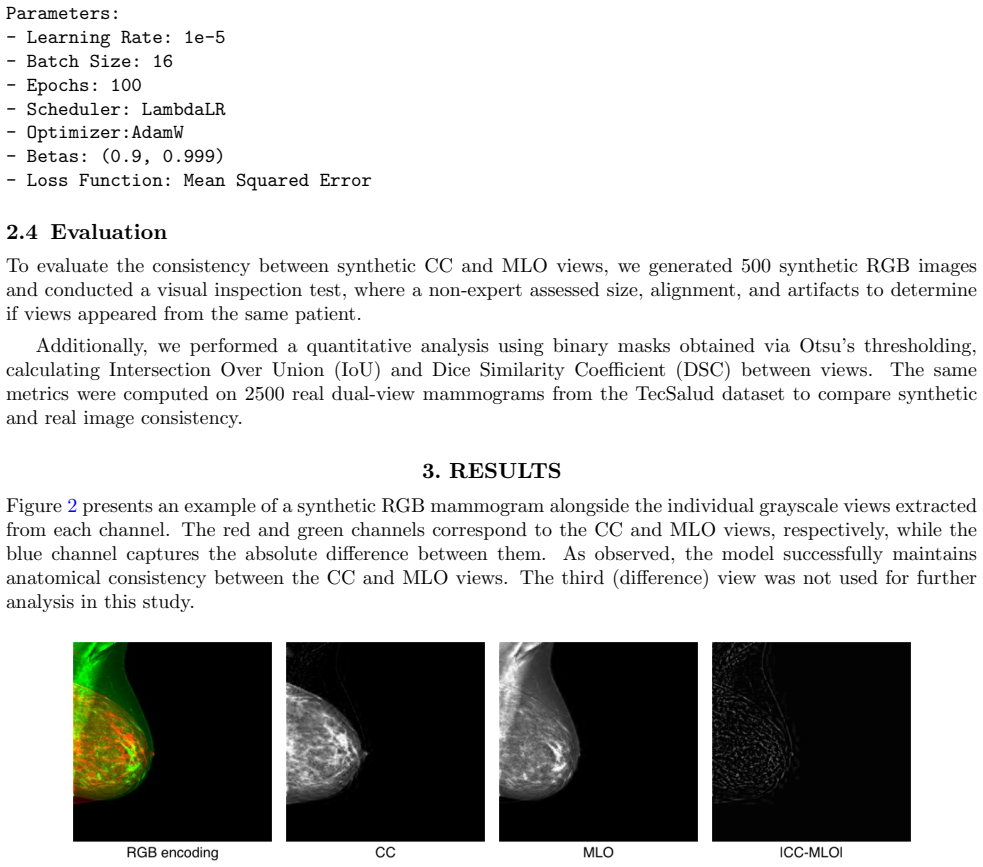
The authors show that a denoising diffusion probabilistic model can be adapted to three channels—CC view, MLO view, and their absolute difference—to simultaneously synthesize paired mammograms that preserve global breast structure and resemble real acquisitions.
What carries the argument
Three-channel difference-guided DDPM for dual-view synthesis, where the difference channel enforces cross-projection anatomical coherence during denoising.
If this is right
- The method allows creation of synthetic paired views to fill gaps in existing mammography datasets.
- Generated images exhibit preserved global breast structure as measured by automated segmentation.
- Synthetic pairs can support training of AI models that require cross-view consistency.
- The approach opens possibilities for dataset augmentation in breast imaging applications.
Where Pith is reading between the lines
- Similar difference-encoding could apply to other paired medical image generation tasks where consistency is critical.
- Success here suggests generative models can reduce the need for extensive real paired data collection.
- Clinical studies could test if these synthetic pairs improve performance of downstream diagnostic tools.
Load-bearing premise
The premise that the difference-based three-channel encoding will lead to anatomically coherent synthetic pairs when the model is fine-tuned on a private dataset.
What would settle it
Automated segmentation of breast masks in the synthetic CC and MLO views would show poor overlap or alignment compared to real pairs, falsifying the preservation of structure.
Figures



read the original abstract
Breast cancer screening relies heavily on mammography, where the craniocaudal (CC) and mediolateral oblique (MLO) views provide complementary information for diagnosis. However, many datasets lack complete paired views, limiting the development of algorithms that depend on cross-view consistency. To address this gap, we propose a three-channel denoising diffusion probabilistic model capable of simultaneously generating CC and MLO views of a single breast. In this configuration, the two mammographic views are stored in separate channels, while a third channel encodes their absolute difference to guide the model toward learning coherent anatomical relationships between projections. A pretrained DDPM from Hugging Face was fine-tuned on a private screening dataset and used to synthesize dual-view pairs. Evaluation included geometric consistency via automated breast mask segmentation and distributional comparison with real images, along with qualitative inspection of cross-view alignment. The results show that the difference-based encoding helps preserve the global breast structure across views, producing synthetic CC-MLO pairs that resemble real acquisitions. This work demonstrates the feasibility of simultaneous dual-view mammogram synthesis using a difference-guided DDPM, highlighting its potential for dataset augmentation and future cross-view-aware AI applications in breast imaging.
Editorial analysis
A structured set of objections, weighed in public.
Referee Report
Summary. The manuscript proposes a three-channel denoising diffusion probabilistic model (DDPM) for simultaneous synthesis of paired craniocaudal (CC) and mediolateral oblique (MLO) mammogram views of the same breast. Two channels hold the individual views while the third encodes their absolute difference to guide learning of cross-view anatomical relationships. A pretrained DDPM is fine-tuned on a private screening mammography dataset; synthetic pairs are assessed via automated breast-mask segmentation for geometric consistency, distributional similarity to real images, and qualitative review of alignment. The authors conclude that the difference encoding preserves global breast structure, yielding pairs that resemble real acquisitions and enabling potential dataset augmentation for cross-view AI tasks.
Significance. If the difference-channel mechanism can be shown to enforce anatomical coherence beyond what a standard DDPM achieves, the work would offer a practical route to augment scarce paired-view mammography data for training diagnostic models that exploit CC-MLO complementarity. The reuse of a publicly available pretrained DDPM and the explicit difference encoding constitute a straightforward yet targeted adaptation of generative diffusion models to this medical-imaging setting.
major comments (3)
- [Evaluation] Evaluation section: the central claim that the three-channel difference encoding produces anatomically coherent CC-MLO pairs rests on automated segmentation for geometric consistency and distributional similarity, yet no ablation that removes the difference channel (or compares against a two-channel baseline) is reported. Without this comparison it remains possible that observed consistency derives from the base DDPM prior or dataset statistics rather than the added encoding.
- [Evaluation] Evaluation section: quantitative metrics (e.g., FID, SSIM, or landmark-based alignment error with error bars) are absent; reliance on qualitative inspection and basic segmentation alone is insufficient to substantiate claims of resemblance to real acquisitions or to isolate the contribution of the difference channel.
- [Dataset and Methods] Dataset and Methods sections: the private nature of the screening dataset, together with the lack of reported dataset size, patient demographics, or access provisions, prevents independent verification and limits assessment of generalizability of the fine-tuned model.
minor comments (2)
- [Abstract] Abstract: the phrase 'basic geometric checks via segmentation' is vague; the main text should explicitly state the segmentation algorithm, overlap metric, and threshold used.
- [Introduction] The manuscript would benefit from a short related-work paragraph contrasting the proposed difference encoding with prior multi-view or conditional diffusion approaches in medical imaging.
Simulated Author's Rebuttal
We thank the referee for the constructive feedback, which highlights important areas for strengthening the evaluation and dataset description. We address each major comment below and outline the revisions planned for the next version of the manuscript.
read point-by-point responses
-
Referee: [Evaluation] Evaluation section: the central claim that the three-channel difference encoding produces anatomically coherent CC-MLO pairs rests on automated segmentation for geometric consistency and distributional similarity, yet no ablation that removes the difference channel (or compares against a two-channel baseline) is reported. Without this comparison it remains possible that observed consistency derives from the base DDPM prior or dataset statistics rather than the added encoding.
Authors: We agree that an ablation is necessary to isolate the contribution of the difference channel. In the revised manuscript we will train a two-channel baseline DDPM (identical architecture and fine-tuning protocol but without the difference channel) on the same data and directly compare geometric consistency via breast-mask overlap metrics as well as qualitative alignment. This comparison will be added to the Evaluation section to demonstrate that the observed coherence exceeds what the base model or dataset statistics alone produce. revision: yes
-
Referee: [Evaluation] Evaluation section: quantitative metrics (e.g., FID, SSIM, or landmark-based alignment error with error bars) are absent; reliance on qualitative inspection and basic segmentation alone is insufficient to substantiate claims of resemblance to real acquisitions or to isolate the contribution of the difference channel.
Authors: We acknowledge the need for quantitative support. We will compute and report FID scores (with standard deviations over multiple sampling runs) between synthetic and real image distributions, plus SSIM between the generated CC-MLO pairs to quantify cross-view consistency. Landmark-based alignment is not feasible because the private dataset lacks annotated landmarks; we will explicitly note this limitation and retain the segmentation-based geometric consistency measure as the primary proxy. These metrics and accompanying error bars will be included in the revised Evaluation section. revision: yes
-
Referee: [Dataset and Methods] Dataset and Methods sections: the private nature of the screening dataset, together with the lack of reported dataset size, patient demographics, or access provisions, prevents independent verification and limits assessment of generalizability of the fine-tuned model.
Authors: The dataset is a private screening mammography collection acquired under IRB approval. In the revised Methods section we will report the exact number of images and patients used for fine-tuning together with aggregate demographic statistics (age range, breast density distribution) that are permitted under the ethics protocol. Full patient-level data and public access cannot be provided due to privacy regulations; we will instead detail the acquisition parameters, scanner types, and ethical approvals to allow readers to assess generalizability within similar screening populations. revision: partial
Circularity Check
No circularity: empirical fine-tuning of DDPM with added difference channel
full rationale
The paper presents an empirical application of a pretrained DDPM fine-tuned on private data using a three-channel input (CC, MLO, absolute difference). No derivation chain, equations, or fitted quantities are claimed to predict or derive results by construction. Evaluation uses segmentation consistency and distributional metrics on generated images, without self-citations that bear the central claim or any reduction of outputs to inputs. The work is self-contained as a generative modeling experiment.
Axiom & Free-Parameter Ledger
axioms (2)
- domain assumption Pretrained DDPMs can be successfully fine-tuned on mammography data to generate realistic images.
- ad hoc to paper Encoding the absolute difference between views guides the model to learn coherent anatomical relationships.
Lean theorems connected to this paper
-
IndisputableMonolith/Cost/FunctionalEquation.leanwashburn_uniqueness_aczel unclear?
unclearRelation between the paper passage and the cited Recognition theorem.
three-channel denoising diffusion probabilistic model ... red channel corresponds to the CC view, the green channel to the MLO view, and the blue channel represents the absolute pixel-wise difference
-
IndisputableMonolith/Foundation/AbsoluteFloorClosure.leanabsolute_floor_iff_bare_distinguishability unclear?
unclearRelation between the paper passage and the cited Recognition theorem.
Evaluation included geometric consistency via automated breast mask segmentation and distributional comparison with real images
What do these tags mean?
- matches
- The paper's claim is directly supported by a theorem in the formal canon.
- supports
- The theorem supports part of the paper's argument, but the paper may add assumptions or extra steps.
- extends
- The paper goes beyond the formal theorem; the theorem is a base layer rather than the whole result.
- uses
- The paper appears to rely on the theorem as machinery.
- contradicts
- The paper's claim conflicts with a theorem or certificate in the canon.
- unclear
- Pith found a possible connection, but the passage is too broad, indirect, or ambiguous to say the theorem truly supports the claim.
Reference graph
Works this paper leans on
-
[1]
World Health Organization, “Breast cancer.” WHO, 26 March 2024https://www.who.int/news-room/ fact-sheets/detail/breast-cancer. (Accessed: 29 July 2025)
work page 2025
-
[2]
Critical assessment of mammography accuracy,
Fitzjohn, J., Zhou, C., and Chase, J. G., “Critical assessment of mammography accuracy,”IFAC- PapersOnLine56, 5620–5625 (1 2023)
work page 2023
-
[3]
Advancements in machine learning and deep learning for breast cancer detection: A systematic review,
Khan, Z., Botlagunta, M., Kumari, G. L. A., Malviya, P., and Botlagunta, M., “Advancements in machine learning and deep learning for breast cancer detection: A systematic review,” in [Federated Learning], Ahmad, S., Alharbi, M., Jha, S., Ali, A., and Damaˇ seviˇ cius, R., eds., ch. 2, IntechOpen, Rijeka (2024)
work page 2024
-
[4]
Busaleh, M., Hussain, M., Aboalsamh, H. A., e Amin, F., and Al Sultan, S. A., “Twoviewdensitynet: Two-view mammographic breast density classification based on deep convolutional neural network,”Math- ematics10(23) (2022)
work page 2022
-
[5]
Dual-view correlation hybrid attention network for robust holistic mammogram classification,
Wang, Z., Xian, J., Liu, K., Li, X., Li, Q., and Yang, X., “Dual-view correlation hybrid attention network for robust holistic mammogram classification,” in [Proceedings of the Thirty-Second International Joint Conference on Artificial Intelligence],IJCAI ’23(2023)
work page 2023
-
[6]
Sutjiadi, R., Sendari, S., Herwanto, H. W., and Kristian, Y., “Generating high-quality synthetic mammo- gram images using denoising diffusion probabilistic models: a novel approach for augmenting deep learning datasets,” in [2024 International Conference on Information Technology Systems and Innovation (ICITSI)], 386–392 (2024)
work page 2024
-
[7]
Maistry, B. and Ezugwu, A. E., “Breast cancer detection and diagnosis: A comparative study of state-of- the-arts deep learning architectures,” (5 2023)
work page 2023
-
[8]
Two-view mammogram synthesis from single-view data using generative adversarial networks,
Yamazaki, A. and Ishida, T., “Two-view mammogram synthesis from single-view data using generative adversarial networks,”Applied Sciences 2022, Vol. 12, Page 1220612, 12206 (11 2022)
work page 2022
-
[9]
Denoising diffusion probabilistic models,
Ho, J., Jain, A., and Abbeel, P., “Denoising diffusion probabilistic models,”Advances in Neural Information Processing Systems2020-December(6 2020)
work page 2020
-
[10]
Ensemble of radiomics and convnext for breast cancer diagnosis,
Garza-Abdala, J. A., Fumagal-Gonz´ alez, G. A., Bosques-Palomo, B. A., Molina, M. A. M., Avedano, D., Cardona-Huerta, S., and Tamez-Pena, J. G., “Ensemble of radiomics and convnext for breast cancer diagnosis,” in [2025 IEEE 38th International Symposium on Computer-Based Medical Systems (CBMS)], 303–306 (2025)
work page 2025
-
[11]
Mam-e: Mammographic synthetic image generation with diffusion models,
Montoya-del Angel, R., Sam-Millan, K., Vilanova, J. C., and Mart´ ı, R., “Mam-e: Mammographic synthetic image generation with diffusion models,”Sensors24(7) (2024)
work page 2024
-
[12]
Prior-guided generative adversarial network for mammogram synthesis,
Joseph, A. J., Dwivedi, P., Joseph, J., Francis, S., P.N., P., P.B., J., Shamsu, A. V., and Sankaran, P., “Prior-guided generative adversarial network for mammogram synthesis,”Biomedical Signal Processing and Control87, 105456 (2024)
work page 2024
-
[13]
Diffusion model based posterior sampling for noisy linear inverse problems,
Meng, X. and Kabashima, Y., “Diffusion model based posterior sampling for noisy linear inverse problems,” (2024)
work page 2024
discussion (0)
Sign in with ORCID, Apple, or X to comment. Anyone can read and Pith papers without signing in.