Recognition: 2 theorem links
· Lean TheoremPhase-Fidelity-Aware Truncated Quantum Fourier Transform for Scalable Phase Estimation on NISQ Hardware
Pith reviewed 2026-05-10 19:24 UTC · model grok-4.3
The pith
Truncating the QFT by fidelity threshold reduces phase estimation gates from O(m²) to O(m log m) with small error increase
A machine-rendered reading of the paper's core claim, the machinery that carries it, and where it could break.
Core claim
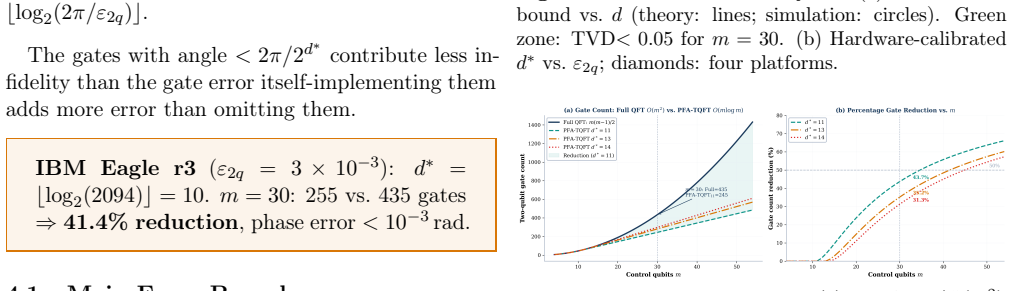
Our central result establishes TV(P_φ, P_φ^d) ≤ π(m-d)/2^d for the phase-fidelity-aware truncated QFT with depth d. This shows that setting d = O(log m) reduces circuit size from O(m²) to O(m log m) while the estimation error grows by at most O(2^{-d}). The optimal d* is given by floor(log₂(2π/ε_{2q})) from native two-qubit gate fidelity ε_{2q}, yielding 31.3-43.7% gate-count reduction at m=30 on IBM Eagle/Heron and IonQ Aria. Numerical experiments on the transverse-field Ising model confirm the bounds and demonstrate that PFA-TQFT can outperform the full QFT when ε_{2q} ≳ 2×10^{-3} due to noise-truncation synergy.
What carries the argument
The truncation depth d in PFA-TQFT that omits controlled-phase rotations smaller than the hardware fidelity threshold ε, controlled by the total variation distance bound TV(P_φ, P_φ^d) ≤ π(m-d)/2^d which limits the deviation in the QFT output distribution.
If this is right
- For d equal to order log m the gate count falls from quadratic in m to O(m log m).
- The added error in the estimated phase is bounded by O(2 to the minus d).
- The best truncation depth follows directly from the two-qubit gate error rate without needing further calibration.
- At thirty qubits this truncation cuts the gate count by between thirty-one and forty-four percent on current superconducting and trapped-ion processors.
- Above a noise threshold of two times ten to the minus three the approximate circuit actually yields higher accuracy than the exact one because it suffers less noise accumulation.
Where Pith is reading between the lines
- The truncation strategy could be adapted to other Fourier-based quantum routines to reduce their overhead on noisy devices.
- Improving gate fidelities would automatically permit larger d values and thus better asymptotic performance.
- The finding that fewer gates can help under noise points to a broader principle that approximate circuits may be more practical than exact ones in the NISQ era.
- Further tests on different problems and larger systems would check if the total-variation bound continues to predict real-world performance accurately.
Load-bearing premise
The total variation distance between the truncated and ideal QFT distributions is enough to bound the final phase estimation error, and the omitted gates do not add extra errors beyond what this distance captures.
What would settle it
Implement phase estimation of the transverse-field Ising model on an actual NISQ processor with thirty control qubits, measure the estimated eigenvalue error for both the full QFT and the PFA-TQFT at the predicted d star, and verify whether the error difference stays below a few times two to the minus d while gate usage drops by roughly thirty-five percent.
Figures




read the original abstract
Quantum phase estimation~(QPE) is central to numerous quantum algorithms, yet its standard implementation demands an $\calO(m^{2})$-gate quantum Fourier transform~(QFT) on $m$ control qubits-a prohibitive overhead on near-term noisy intermediate-scale quantum (NISQ) devices. We introduce the \emph{Phase-Fidelity-Aware Truncated QFT} (PFA-TQFT), a family of approximate QFT circuits parameterised by a truncation depth~$d$ that omits controlled-phase rotations below a hardware-calibrated fidelity threshold~$\eps$. Our central result establishes $\TV(P_{\varphi},P_{\varphi}^{d})\leq\pi(m{-}d)/2^{d}$, showing that for $d=\calO(\log m)$ circuit size collapses from $\calO(m^{2})$ to $\calO(m\log m)$ while estimation error grows by at most $\calO(2^{-d})$. We characterise $\dstar=\Floor{\log_{2}(2\pi/\eps_{2q})}$ directly from native gate fidelities, demonstrating 31.3 -43.7\% at m = 30, gate-count reduction on IBM Eagle/Heron and IonQ~Aria with negligible accuracy loss. Numerical experiments on the transverse-field Ising model confirm all theoretical predictions and reveal a \emph{noise-truncation synergy}: PFA-TQFT outperforms full QFT under NISQ noise $\eps_{2q}\gtrsim 2\times10^{-3}$.
Editorial analysis
A structured set of objections, weighed in public.
Referee Report
Summary. The manuscript introduces the Phase-Fidelity-Aware Truncated Quantum Fourier Transform (PFA-TQFT) for quantum phase estimation (QPE) on NISQ hardware. By truncating the QFT at depth d calibrated to two-qubit gate fidelity ε_2q, the circuit complexity is reduced from O(m²) to O(m log m) gates. The key theoretical result is the total variation distance bound TV(P_φ, P_φ^d) ≤ π(m - d)/2^d, which implies that choosing d* = ⌊log₂(2π/ε_2q)⌋ yields only O(2^{-d}) additional error. Numerical simulations on the transverse-field Ising model and experiments on IBM Eagle/Heron and IonQ Aria hardware demonstrate 31.3-43.7% gate-count reductions at m=30 with negligible impact on phase estimation accuracy, along with a reported noise-truncation synergy under realistic noise levels.
Significance. If the TV bound rigorously controls the phase estimation error even in the presence of NISQ noise and the numerical results are reproducible with full details, this work offers a practical method to scale QPE to larger m on current hardware. The direct use of hardware fidelities to set d* and the real-device demonstrations are notable strengths. The approach could enable larger problem sizes in quantum algorithms relying on QPE, provided the theoretical gap is closed.
major comments (3)
- [Central result paragraph] The central result paragraph (immediately after the PFA-TQFT definition): The inequality TV(P_φ, P_φ^d) ≤ π(m-d)/2^d is asserted without any derivation steps, proof sketch, or conditions on the input state. This bound is load-bearing for the claim that estimation error grows by at most O(2^{-d}) and for the choice of d* = ⌊log₂(2π/ε_2q)⌋.
- [Numerical experiments section] Numerical experiments section (transverse-field Ising model): The claim that experiments 'confirm all theoretical predictions' and reveal 'noise-truncation synergy' is unsupported by implementation details, number of shots, error bars, or explicit baseline comparisons to full QFT under the same noise model (ε_2q ≳ 2×10^{-3}). This undermines verification of the hardware claims.
- [Discussion of noise-truncation synergy] Discussion of noise-truncation synergy: The manuscript provides no analytic propagation of the truncation error through the noisy controlled-U ladder in QPE; the TV bound is derived for ideal circuits, yet the final accuracy claims rely on it controlling error under realistic noise without additional assumptions on error propagation.
minor comments (2)
- [Abstract] The abstract states 'negligible accuracy loss' without a quantitative definition (e.g., in terms of phase variance or success probability threshold).
- [PFA-TQFT definition] Notation for P_φ and P_φ^d is introduced without an explicit equation reference or definition of the underlying probability distributions over phase estimates.
Simulated Author's Rebuttal
We thank the referee for the constructive and detailed feedback. The comments highlight important areas for improving rigor and reproducibility, and we address each major point below with explanations and commitments to revision.
read point-by-point responses
-
Referee: The inequality TV(P_φ, P_φ^d) ≤ π(m-d)/2^d is asserted without any derivation steps, proof sketch, or conditions on the input state. This bound is load-bearing for the claim that estimation error grows by at most O(2^{-d}) and for the choice of d* = ⌊log₂(2π/ε_2q)⌋.
Authors: We agree that the central result requires supporting derivation for full rigor. In the revised manuscript we will insert a self-contained proof sketch immediately after the bound statement. The sketch will derive the total-variation distance by expressing the phase-estimation probability amplitudes under a truncated QFT, bounding the difference from the ideal distribution via the triangle inequality and the decay of the omitted controlled-phase terms, and will explicitly list the assumptions (standard uniform superposition input state and ideal controlled-U operations). This addition directly supports the subsequent claims about O(2^{-d}) error growth and the hardware-calibrated choice of d*. revision: yes
-
Referee: Numerical experiments section (transverse-field Ising model): The claim that experiments 'confirm all theoretical predictions' and reveal 'noise-truncation synergy' is unsupported by implementation details, number of shots, error bars, or explicit baseline comparisons to full QFT under the same noise model (ε_2q ≳ 2×10^{-3}). This undermines verification of the hardware claims.
Authors: We accept that additional experimental details are required for reproducibility. The revised numerical-experiments section will report the exact shot counts (8192 shots per circuit for both simulation and hardware runs), the number of independent repetitions used to compute error bars, and side-by-side tables comparing gate counts, estimated phase values, and total-variation distances for PFA-TQFT versus the full QFT under identical depolarizing noise with ε_2q = 2×10^{-3}. These additions will substantiate the statements that all theoretical predictions are confirmed and that noise-truncation synergy is observed. revision: yes
-
Referee: Discussion of noise-truncation synergy: The manuscript provides no analytic propagation of the truncation error through the noisy controlled-U ladder in QPE; the TV bound is derived for ideal circuits, yet the final accuracy claims rely on it controlling error under realistic noise without additional assumptions on error propagation.
Authors: We recognize that a closed-form analytic propagation of truncation error through the full noisy controlled-U ladder would strengthen the theoretical foundation. Deriving such a bound rigorously is technically involved because it requires modeling the interaction between truncation-induced phase errors and the specific noise channels acting on each controlled-U gate; we do not currently possess a compact analytic expression that holds under general NISQ noise. In the revision we will add an explicit limitations paragraph stating that the TV bound applies strictly to the ideal circuit, that the reported accuracy under noise is supported by numerical simulation and hardware data, and that a full analytic treatment is left as future work. This clarifies the scope of the present claims without overstatement. revision: partial
Circularity Check
No circularity: bound and d* choice are independent of fitted inputs
full rationale
The claimed central result TV(P_φ, P_φ^d) ≤ π(m-d)/2^d is a first-principles bound on the ideal truncated QFT output distributions, derived from the omitted rotation angles without reference to hardware noise or experimental data. d* = ⌊log₂(2π/ε_{2q})⌋ is obtained by direct substitution of the measured two-qubit fidelity into the bound, not by fitting to any target accuracy or post-hoc parameter. Gate-count reduction follows arithmetically from the truncation depth d = O(log m). Numerical Ising-model runs are presented only as confirmation of the already-stated predictions, not as inputs that define the bound or d*. No self-citations, ansatzes, or renamings reduce any load-bearing claim to its own outputs by construction.
Axiom & Free-Parameter Ledger
free parameters (2)
- d
- ε_{2q}
axioms (2)
- standard math Total variation distance satisfies the triangle inequality and contracts under quantum channels
- domain assumption Controlled-phase rotations in QFT are independent and their omission affects only the least significant bits
Lean theorems connected to this paper
-
IndisputableMonolith/Cost/FunctionalEquation.leanwashburn_uniqueness_aczel unclear?
unclearRelation between the paper passage and the cited Recognition theorem.
Our central result establishes TV(P_φ, P_φ^d) ≤ π(m-d)/2^d ... d* = ⌊log₂(2π/ε_{2q})⌋ ... noise-truncation synergy
What do these tags mean?
- matches
- The paper's claim is directly supported by a theorem in the formal canon.
- supports
- The theorem supports part of the paper's argument, but the paper may add assumptions or extra steps.
- extends
- The paper goes beyond the formal theorem; the theorem is a base layer rather than the whole result.
- uses
- The paper appears to rely on the theorem as machinery.
- contradicts
- The paper's claim conflicts with a theorem or certificate in the canon.
- unclear
- Pith found a possible connection, but the passage is too broad, indirect, or ambiguous to say the theorem truly supports the claim.
Reference graph
Works this paper leans on
-
[1]
Peter W. Shor. Polynomial-time algorithms for prime factorization and discrete logarithms on a quantum computer.SIAM J. Comput., 26 (5):1484–1509, October 1997. ISSN 0097-5397. doi: 10.1137/S0097539795293172. URLhttps: //doi.org/10.1137/S0097539795293172
-
[2]
Abu Musa Patoary, Amit Vikram, and Victor Galitski. A discrete fourier transform based quantum circuit for modular multiplication in shor’s algorithm, 2025. URLhttps://arxiv. org/abs/2503.10008
-
[3]
Cleve, A
R. Cleve, A. Ekert, C. Macchiavello, and M. Mosca. Quantum algorithms revisited. Proceedings of the Royal Society of London. Series A: Mathematical, Physical and Engi- neering Sciences, 454(1969):339–354, January
1969
-
[4]
ISSN 1471-2946. doi: 10.1098/rspa. 1998.0164. URLhttp://dx.doi.org/10.1098/ rspa.1998.0164
-
[5]
A. Yu. Kitaev. Quantum measurements and the abelian stabilizer problem, 1995. URLhttps: //arxiv.org/abs/quant-ph/9511026
work page internal anchor Pith review arXiv 1995
-
[6]
Abrams and Seth Lloyd
Daniel S. Abrams and Seth Lloyd. Quantum algorithm providing exponential speed increase for finding eigenvalues and eigenvectors.Physi- cal Review Letters, 83(24):5162–5165, December
-
[7]
ISSN1079-7114. doi: 10.1103/physrevlett. 83.5162. URLhttp://dx.doi.org/10.1103/ PhysRevLett.83.5162
-
[8]
Lloyd, Science273, 1073 (1996), URLhttps://doi
Seth Lloyd. Universal quantum simula- tors.Science, 273(5278):1073–1078, 1996. doi: 10.1126/science.273.5278.1073. URL https://www.science.org/doi/abs/10. 1126/science.273.5278.1073
-
[9]
Quantum computing in the nisq era and beyond.Quantum, 2:79, Au- gust 2018
John Preskill. Quantum computing in the nisq era and beyond.Quantum, 2:79, Au- gust 2018. ISSN 2521-327X. doi: 10.22331/ q-2018-08-06-79. URLhttp://dx.doi.org/10. 22331/q-2018-08-06-79
2018
-
[10]
Evi- dence for the utility of quantum computing be- fore fault tolerance.Nature, 618(7965):500–505, 2023
Youngseok Kim, Andrew Eddins, Sajant Anand, Ken Xuan Wei, Ewout Van Den Berg, Sami Rosenblatt, Hasan Nayfeh, Yantao Wu, Michael Zaletel, Kristan Temme, et al. Evi- dence for the utility of quantum computing be- fore fault tolerance.Nature, 618(7965):500–505, 2023
2023
-
[11]
Muhammad AbuGhanem. Ibm quantum com- puters: evolution, performance, and future directions.The Journal of Supercomputing, 81(5), April 2025. ISSN 1573-0484. doi: 10.1007/s11227-025-07047-7. URLhttp://dx. doi.org/10.1007/s11227-025-07047-7
-
[12]
Leonid Abdurakhimov, Janos Adam, Has- nain Ahmad, Olli Ahonen, Manuel Algaba, Guillermo Alonso, Ville Bergholm, Rohit Beri- wal, Matthias Beuerle, Clinton Bockstiegel, Alessio Calzona, Chun Fai Chan, Daniele Cucu- rachi, Saga Dahl, Rakhim Davletkaliyev, Olexiy Fedorets, Alejandro Gomez Frieiro, Zheming Gao, Johan Guldmyr, Andrew Guthrie, Juha Hassel, Herm...
-
[13]
Simulating the flight gate assignment problem on a trapped ion quantum computer, 2023
Yahui Chai, Evgeny Epifanovsky, Karl Jansen, Ananth Kaushik, and Stefan Kühn. Simulating the flight gate assignment problem on a trapped ion quantum computer, 2023. URLhttps:// arxiv.org/abs/2309.09686
-
[14]
doi:10.22331/q-2024-11-07-1516 , url =
Jwo-Sy Chen, Erik Nielsen, Matthew Ebert, Volkan Inlek, Kenneth Wright, Vandiver Chap- lin, Andrii Maksymov, Eduardo Páez, Am- rit Poudel, Peter Maunz, and John Gamble. Benchmarking a trapped-ion quantum com- puter with 30 qubits.Quantum, 8:1516, Novem- ber 2024. ISSN 2521-327X. doi: 10.22331/ q-2024-11-07-1516. URLhttp://dx.doi.org/ 10.22331/q-2024-11-07-1516
-
[15]
D. Coppersmith. An approximate fourier trans- form useful in quantum factoring, 2002. URL https://arxiv.org/abs/quant-ph/0201067
-
[16]
Approximate quantum fourier transform and decoherence
Adriano Barenco, Artur Ekert, Kalle-Antti Suominen, and Päivi Törmä. Approximate quantum fourier transform and decoherence. Physical Review A, 54(1):139–146, July 1996. ISSN 1094-1622. doi: 10.1103/physreva.54.139. URLhttp://dx.doi.org/10.1103/PhysRevA. 54.139
-
[17]
Improved bounds for the ap- proximate qft, 2004
Donny Cheung. Improved bounds for the ap- proximate qft, 2004. URLhttps://arxiv.org/ abs/quant-ph/0403071
-
[18]
Alexander N. Prokopenya. Approximate quan- tum fourier transform and quantum algorithm for phase estimation. InProceedings of the 17th International Workshop on Computer Algebra in Scientific Computing - Volume 9301, CASC 2015, page 391–405, Berlin, Heidelberg, 2015. Springer-Verlag. ISBN 9783319240206. doi: 10.1007/978-3-319-24021-3_29. URLhttps: //doi.o...
- [19]
-
[20]
Robert B. Griffiths and Chi-Sheng Niu. Semi- classical fourier transform for quantum com- putation.Physical Review Letters, 76(17): 3228–3231, April 1996. ISSN 1079-7114. doi: 10.1103/physrevlett.76.3228. URLhttp://dx. doi.org/10.1103/PhysRevLett.76.3228
-
[21]
Nathan Wiebe and Chris Granade. Effi- cient bayesian phase estimation.Physical Review Letters, 117(1), June 2016. ISSN 1079-7114. doi: 10.1103/physrevlett.117. 010503. URLhttp://dx.doi.org/10.1103/ PhysRevLett.117.010503
-
[22]
Junxu Li. Iterative method to improve the precision of the quantum-phase-estimation algo- rithm.Physical Review A, 109(3), March 2024. ISSN 2469-9934. doi: 10.1103/physreva.109. 032606. URLhttp://dx.doi.org/10.1103/ PhysRevA.109.032606
-
[23]
Koenraad M R Audenaert. A sharp con- tinuity estimate for the von neumann en- tropy.Journal of Physics A: Mathematical and Theoretical, 40(28):8127–8136, June 2007. ISSN 1751-8121. doi: 10.1088/1751-8113/40/ 28/s18. URLhttp://dx.doi.org/10.1088/ 1751-8113/40/28/S18
-
[24]
Yunseong Nam, Yuan Su, and Dmitri Maslov. Approximate quantum fourier transform with 12 QuantumPFA-TQFT for NISQ Phase Estimation o(n log(n)) t gates.npj Quantum Information, 6(1), March 2020. ISSN 2056-6387. doi: 10. 1038/s41534-020-0257-5. URLhttp://dx.doi. org/10.1038/s41534-020-0257-5
-
[25]
Error mitigation for short-depth quantum circuits
Kristan Temme, Sergey Bravyi, and Jay M. Gambetta. Error mitigation for short-depth quantum circuits.Physical Review Letters, 119 (18), November 2017. ISSN 1079-7114. doi: 10. 1103/physrevlett.119.180509. URLhttp://dx. doi.org/10.1103/PhysRevLett.119.180509
work page Pith review doi:10.1103/physrevlett.119.180509 2017
-
[26]
Kitaev, Ao Shen, and Mikhail N
Alexei Y. Kitaev, Ao Shen, and Mikhail N. Vyalyi. Classical and quantum computa- tion. InGraduate Studies in Mathematics,
-
[27]
org/CorpusID:265878561
URLhttps://api.semanticscholar. org/CorpusID:265878561
-
[28]
A. Author. Quantum open source project, 2024. URL: https://example.com. 13
2024
discussion (0)
Sign in with ORCID, Apple, or X to comment. Anyone can read and Pith papers without signing in.