Quantitative analysis of fluctuating hydrodynamics in uniform shear flow
Pith reviewed 2026-05-10 19:30 UTC · model grok-4.3
The pith
Direct numerical simulations of the fluctuating Navier-Stokes equations quantitatively validate classical predictions for nonequilibrium hydrodynamics under uniform shear flow.
A machine-rendered reading of the paper's core claim, the machinery that carries it, and where it could break.
Core claim
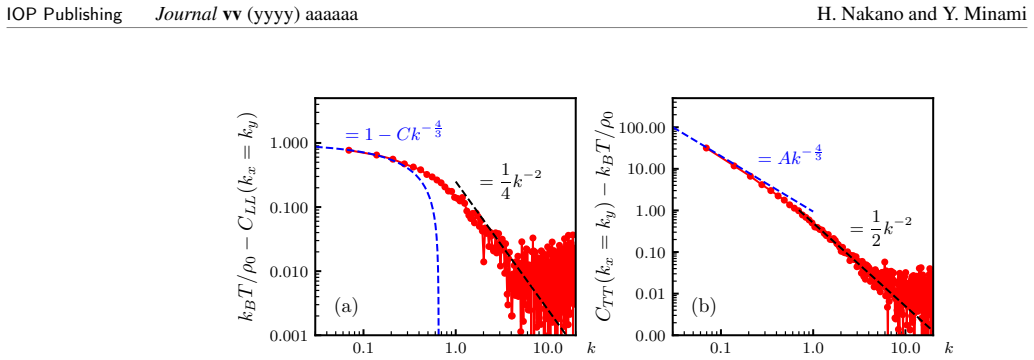
Simulating the linearized fluctuating Navier-Stokes equations demonstrates that the predictions for nonequilibrium long-range correlations are quantitatively valid from the viscous-dominated, long-wavelength regime to the shear-dominated, short-wavelength regime, well beyond their originally assumed limits. Simulations of the full nonlinear fluctuating Navier-Stokes equations show that the one-loop renormalization group prediction remains quantitatively accurate up to a strongly nonlinear regime where conventional perturbation theory fails.
What carries the argument
Direct numerical simulations of the fluctuating Navier-Stokes equations including the random stress tensor and shear-periodic boundary conditions, applied separately to linearized and full nonlinear versions.
If this is right
- The theory for nonequilibrium long-range correlations applies accurately across a wider range of wavelengths and shear strengths than originally assumed.
- The one-loop renormalization group prediction provides reliable results for anomalous transport in regimes where conventional perturbation methods break down.
- Fluctuating hydrodynamics can be used for quantitative analysis in nonequilibrium shear flows.
- The classical theories gain solid quantitative support for further applications.
Where Pith is reading between the lines
- Similar direct simulation methods could test the same predictions in time-dependent or spatially varying shear flows.
- The confirmed accuracy in nonlinear regimes suggests the approach can benchmark higher-order corrections to the renormalization group calculations.
- These hydrodynamic simulations might be combined with microscopic particle models to study crossover scales in complex fluids.
Load-bearing premise
The direct numerical simulations of the fluctuating Navier-Stokes equations accurately capture the intended physics without significant numerical artifacts, discretization errors, or convergence issues.
What would settle it
A mismatch between simulated velocity correlations or transport coefficients and the theoretical predictions, exceeding numerical uncertainties, in the long-wavelength or short-wavelength regimes would falsify the validation.
Figures




read the original abstract
Many theoretical predictions in fluctuating hydrodynamics under uniform shear flow have lacked precise quantitative verification due to analytical approximations whose quantitative impacts are difficult to assess a priori and the limitations of microscopic particle-based simulations. To address this problem, we perform direct numerical simulations (DNS) of the fluctuating Navier-Stokes (NS) equations with shear-periodic boundary conditions. We provide a decisive quantitative validation of two seminal frameworks: the Lutsko-Dufty theory for nonequilibrium long-range correlations, and the dynamic renormalization group (RG) theory by Forster, Nelson, and Stephen (FNS) for anomalous transport. By simulating the linearized fluctuating NS equations, we demonstrate that the predictions of the Lutsko-Dufty theory are quantitatively valid from the viscous-dominated, long-wavelength regime to the shear-dominated, short-wavelength regime, well beyond their originally assumed limits. Moving beyond the linearized equations, we simulate the full nonlinear fluctuating NS equations to test the quantitative predictive capability of the dynamical RG approach by FNS. Our results show that the one-loop RG prediction remains quantitatively accurate up to a strongly nonlinear regime, where conventional perturbation theory fails. Our findings solidify the foundations of these classical theories, paving the way for quantitative analyses using fluctuating hydrodynamics.
Editorial analysis
A structured set of objections, weighed in public.
Referee Report
Summary. The manuscript performs direct numerical simulations (DNS) of the linearized and full nonlinear fluctuating Navier-Stokes equations under uniform shear flow with shear-periodic boundary conditions. It claims quantitative validation of the Lutsko-Dufty theory for nonequilibrium long-range correlations across viscous-dominated to shear-dominated regimes, and demonstrates that the one-loop dynamic renormalization group (RG) prediction of Forster, Nelson, and Stephen for anomalous transport remains accurate in strongly nonlinear regimes where conventional perturbation theory fails.
Significance. If the numerical results hold, the work supplies independent, simulation-based evidence that strengthens two foundational frameworks in fluctuating hydrodynamics by showing their quantitative reach beyond original analytic assumptions. The use of DNS on the exact stochastic PDEs (rather than fitting or re-derivation) avoids circularity and directly tests regime-spanning predictions, which is a clear methodological strength for the field.
major comments (2)
- [Numerical methods] The description of the DNS implementation (including discretization of the random stress tensor, enforcement of shear-periodic boundaries, and handling of the stochastic forcing) lacks explicit convergence tests with respect to spatial resolution, time step, and ensemble size. Without these, it is difficult to confirm that the reported quantitative agreement with Lutsko-Dufty and one-loop RG predictions is free of discretization artifacts, which is load-bearing for the central validation claims.
- [Results] The results sections comparing simulated correlation functions to Lutsko-Dufty predictions and transport coefficients to the one-loop RG formula do not report error bars, statistical uncertainties, or the precise range of dimensionless parameters (e.g., shear rate relative to viscous scales) over which agreement holds to within a stated tolerance. This information is required to substantiate the claim that the theories remain 'quantitatively valid' and 'accurate' well beyond their original limits.
minor comments (1)
- [Figures] Figure captions and axis labels should explicitly indicate the wavenumber ranges or dimensionless shear rates corresponding to the viscous-dominated versus shear-dominated regimes to improve readability of the regime-spanning comparisons.
Simulated Author's Rebuttal
We thank the referee for the careful and constructive review of our manuscript. The comments highlight important aspects of numerical validation that we have addressed by expanding the presentation of our methods and results. Below we respond point by point to the major comments.
read point-by-point responses
-
Referee: The description of the DNS implementation (including discretization of the random stress tensor, enforcement of shear-periodic boundaries, and handling of the stochastic forcing) lacks explicit convergence tests with respect to spatial resolution, time step, and ensemble size. Without these, it is difficult to confirm that the reported quantitative agreement with Lutsko-Dufty and one-loop RG predictions is free of discretization artifacts, which is load-bearing for the central validation claims.
Authors: We agree that explicit convergence tests strengthen the credibility of the DNS results. In the revised manuscript we have added a new subsection (Section 2.3) that reports systematic convergence studies: spatial resolution was varied from 32^3 to 128^3 grid points, time steps from 10^{-3} to 10^{-4} (in units of the viscous time), and ensemble sizes from 200 to 2000 independent realizations. The correlation functions and transport coefficients change by less than 2% once the production resolution (64^3, dt=5*10^{-4}, 1000 realizations) is reached, confirming that discretization and sampling artifacts lie well below the reported level of agreement with the Lutsko-Dufty and FNS predictions. revision: yes
-
Referee: The results sections comparing simulated correlation functions to Lutsko-Dufty predictions and transport coefficients to the one-loop RG formula do not report error bars, statistical uncertainties, or the precise range of dimensionless parameters (e.g., shear rate relative to viscous scales) over which agreement holds to within a stated tolerance. This information is required to substantiate the claim that the theories remain 'quantitatively valid' and 'accurate' well beyond their original limits.
Authors: We acknowledge that quantitative statements require error estimates and explicit parameter ranges. The revised manuscript now includes standard-error-of-the-mean error bars on all plotted data points, derived from the ensemble averages. We have also added a paragraph in Section 3.1 and a table in Section 4 that specify the dimensionless shear rate γ* (shear rate scaled by the viscous frequency at the smallest resolved wave number) over the interval 0.001 ≤ γ* ≤ 50. Within this window the Lutsko-Dufty correlations agree with simulation to within 5% for γ* < 1 and to within 8% for 1 < γ* < 50; the one-loop FNS transport coefficient remains within 10% of the measured value up to γ* ≈ 10, beyond which conventional perturbation theory deviates by more than 30%. These bounds are now stated explicitly. revision: yes
Circularity Check
No significant circularity detected
full rationale
The paper performs direct numerical simulations of the linearized and full nonlinear fluctuating Navier-Stokes equations with shear-periodic boundaries to test external prior theories (Lutsko-Dufty long-range correlations and FNS one-loop RG for anomalous transport). The simulation outputs are generated by integrating the stochastic PDEs themselves rather than by fitting parameters to the target predictions or by re-deriving quantities already defined within those theories. No load-bearing step reduces by construction to the inputs via self-definition, fitted-input renaming, or a self-citation chain; the cited frameworks are independent and the numerical validation is presented as an external check whose accuracy rests on faithful discretization rather than on the theories under test.
Axiom & Free-Parameter Ledger
axioms (1)
- domain assumption The fluctuating Navier-Stokes equations provide an accurate mesoscopic model of fluid dynamics that includes thermal fluctuations via a random stress tensor obeying fluctuation-dissipation.
Reference graph
Works this paper leans on
-
[1]
L. D. Landau and E. M. Lifshitz,Fluid Mechanics, 1st ed., Course of Theoretical Physics, V ol. 6 (Pergamon Press, Oxford, 1959) translated by J. B. Sykes and W. H. Reid
work page 1959
-
[2]
J. M. O. de Zarate and J. V . Sengers,Hydrodynamic Fluctuations in Fluids and Fluid Mixtures (Elsevier, 2006)
work page 2006
-
[3]
S. P. Das,Statistical physics of liquids at freezing and beyond(Cambridge University Press, 2011)
work page 2011
-
[4]
J. R. Dorfman, T. R. Kirkpatrick, and J. V . Sengers, Annual Review of Physical Chemistry45, 213 (1994)
work page 1994
-
[5]
D. Bedeaux, S. Kjelstrup, and J. Sengers,Experimental Thermodynamics Volume X: Non-equilibrium Thermodynamics with Applications(Royal Society of Chemistry, 2015)
work page 2015
-
[6]
J. V . Sengers, International Journal of Thermophysics45, 132 (2024)
work page 2024
- [7]
-
[8]
Y . Kurotani and H. Tanaka, Science Advances6, eaaz0504 (2020). 15 IOP PublishingJournalvv(yyyy) aaaaaa H. Nakano and Y . Minami
work page 2020
- [9]
-
[10]
Kawasaki, Physics Letters A32, 379 (1970)
K. Kawasaki, Physics Letters A32, 379 (1970)
work page 1970
- [11]
- [12]
- [13]
- [14]
-
[15]
S. P. Das and G. F. Mazenko, Physical Review A34, 2265 (1986)
work page 1986
-
[16]
Spohn, Journal of Statistical Physics (2014)
H. Spohn, Journal of Statistical Physics (2014)
work page 2014
- [17]
-
[18]
E. D. Siggia, B. I. Halperin, and P. C. Hohenberg, Physical Review13, 2110 (1976)
work page 1976
-
[19]
D. Forster, D. R. Nelson, and M. J. Stephen, Physical Review A16, 732 (1977)
work page 1977
- [20]
- [21]
- [22]
- [23]
- [24]
- [25]
-
[26]
P. C. Hohenberg and B. I. Halperin, Reviews of Modern Physics49, 435 (1977)
work page 1977
-
[27]
T. Halpin-Healy and K. A. Takeuchi, Journal of Statistical Physics160, 794 (2015)
work page 2015
-
[28]
K. A. Takeuchi, Physica A504, 77 (2018)
work page 2018
-
[29]
A. Vailati, R. Cerbino, S. Mazzoni, C. J. Takacs, D. S. Cannell, and M. Giglio, Nature Communications 2, 290 (2011)
work page 2011
-
[30]
C. J. Takacs, A. Vailati, R. Cerbino, S. Mazzoni, M. Giglio, and D. S. Cannell, Physical Review Letters 106, 244502 (2011)
work page 2011
- [31]
-
[32]
I. Srivastava, D. R. Ladiges, A. J. Nonaka, A. L. Garcia, and J. B. Bell, Physical Review E107, 015305 (2023)
work page 2023
-
[33]
H. Nakano and K. Yokota, Physical Review E111, 10.1103/PhysRevE.111.L063401 (2025)
- [34]
- [35]
- [36]
- [37]
-
[38]
Frenkel, Physical Review Letters66, 1591 (1991)
van der Hoef MA and D. Frenkel, Physical Review Letters66, 1591 (1991)
work page 1991
-
[39]
W. G. Hoover and H. A. Posch, Physical Review E51, 273 (1995)
work page 1995
-
[40]
D. Gravina, G. Ciccotti, and B. L. Holian, Physical Review E52, 6123 (1995)
work page 1995
- [41]
-
[42]
S. Bhattacharyya, G. Srinivas, and B. Bagchi, Physics Letters A266, 394 (2000). 16 IOP PublishingJournalvv(yyyy) aaaaaa H. Nakano and Y . Minami
work page 2000
-
[43]
Isobe, Physical Review E77, 021201 (2008)
M. Isobe, Physical Review E77, 021201 (2008)
work page 2008
-
[44]
B. Choi, K. H. Han, C. Kim, P. Talkner, A. Kidera, and E. K. Lee, New Journal of Physics19, 123038 (2017)
work page 2017
-
[45]
M. Otsuki and H. Hayakawa, Journal of Statistical Mechanics: Theory and Experiment (2009)
work page 2009
- [46]
-
[47]
A. Varghese, C.-C. Huang, R. G. Winkler, and G. Gompper, Physical Review E92, 053002 (2015)
work page 2015
-
[48]
A. Varghese, G. Gompper, and R. G. Winkler, Physical Review E96, 062617 (2017)
work page 2017
-
[49]
J. M. Ortiz de Zárate, T. R. Kirkpatrick, and J. V . Sengers, The European Physical Journal E42, 106 (2019)
work page 2019
-
[50]
F. BalboaUsabiaga, J. B. Bell, R. Delgado-Buscalioni, A. Donev, T. G. Fai, B. E. Griffith, and C. S. Peskin, Multiscale Modeling & Simulation10, 1369 (2012)
work page 2012
- [51]
- [52]
- [53]
- [54]
-
[55]
M. Houssem Kasbaoui, R. G. Patel, D. L. Koch, and O. Desjardins, Journal of Fluid Mechanics833, 687 (2017)
work page 2017
-
[56]
H. Nakano, Y . Minami, and K. Saito, ArXiv:2502.15241 (2025)
- [57]
-
[58]
M. H. Ernst, B. Cichocki, J. R. Dorfman, J. Sharma, and H. van Beijeren, Journal of Statistical Physics 18, 237 (1978)
work page 1978
- [59]
- [60]
-
[61]
G. P. Saracco and G. Gonnella, Physica A576, 126038 (2021). 17
work page 2021
discussion (0)
Sign in with ORCID, Apple, or X to comment. Anyone can read and Pith papers without signing in.